
Judge, 1916-09-23 · page 10 of 32
Judge — September 23, 1916 — page 10: what you’re looking at
What you’re looking at
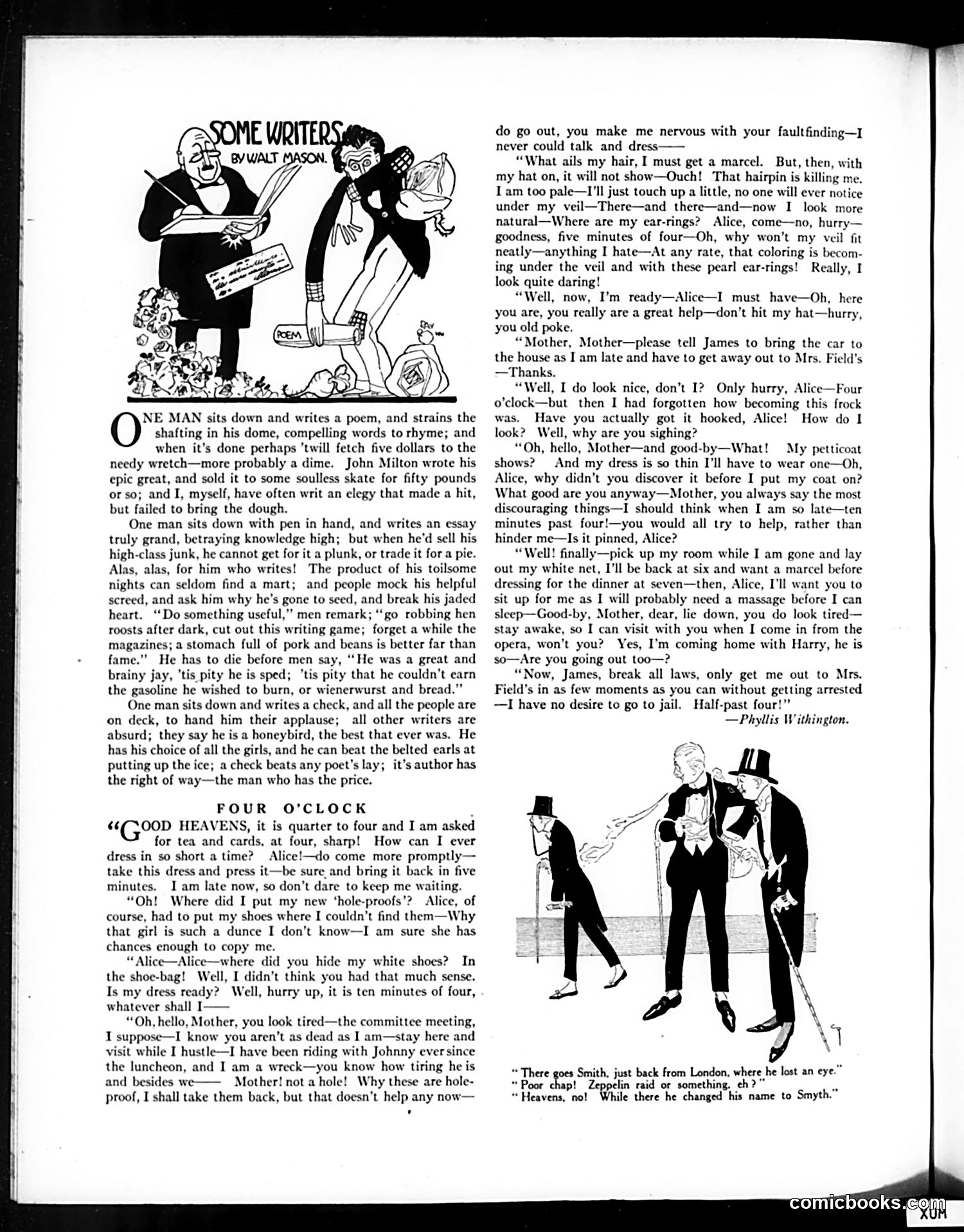
This page contains two satirical pieces about writers and women's vanity. **"Some Writers" (left):** A poem mocking the financial struggles of serious writers. It contrasts the poverty of poets and essayists—even citing John Milton's meager payment—with the undeserved success of men who "write a check." The satire suggests that wealth, not talent, determines social status and respect. Writers are told to abandon their craft for practical work ("robbing hen roosts"), yet only after death do people appreciate them. **"Four O'Clock" (right):** A monologue depicting an upper-class woman frantically preparing for a 4 p.m. social engagement. She constantly badgers her maid Alice about clothing, accessories, and appearance while simultaneously complaining about being rushed. The satire targets wealthy women's superficiality—obsessing over hair, makeup, shoes, and dress while remaining completely self-absorbed and demanding. Her daughter appears equally vain and inconsiderate. The piece mocks the frivolous priorities and poor treatment of servants among society women. Both pieces use exaggeration to critique American class anxieties: artistic merit versus commercial success, and women's materialism.
📄 Transcribed text from this page (OCR, searchable)
Machine-transcribed from the original scan — historical spelling and the odd misread are preserved.
shafting in his dome, compelling words to rhyme; and when it’s done perhaps ‘twill fetch five dollars to the needy wretch—more probably a dime. John Milton wrote his epic great, and sold it to some soulless skate for fifty pounds orso; and I, myself, have often writ an elegy that made a hit, but failed to bring the dough. One man sits down with pen in hand, and writes an essay truly grand, betraying knowledge high; but when he'd sell his high-class junk, he cannot get for it a plunk, or trade it for a pie. Alas, alas, for him who writes! The product of his toilsome nights can seldom find a mart; and people mock his helpful screed, and ask him why he’s gone to seed, and break his jaded heart. ‘Do something useful,” men remark; “go robbing hen roosts after dark, cut out this writing game; forget a while the magazines; a stomach full of pork and beans is better far than fame.” He has to die before men say, ‘“‘He was a great and brainy jay, ’tis pity he is sped; ‘tis pity that he couldn’t earn the gasoline he wished to burn, or wienerwurst and bread.” One man sits down and writes a check, and all the people are on deck, to hand him their applause; all other writers are absurd; they say he is a honeybird, the best that ever was. He has his choice of all the girls, and he can beat the belted earls at putting up the ice; a check beats any poet’s lay; it’s author has the right of way—the man who has the price. O*™ MAN sits down and writes a poem, and strains the FOUR O'CLOCK . 6«Goop HEAVENS, it is quarter to four and I am asked for tea and cards, at four, sharp! How can I ever dress in so short a time? Alice!—do come more promptly— take this dress and press it—be sure and bring it back in five minutes. I am late now, so don’t dare to keep me waiting. “Oh! Where did I put my new ‘hole-proofs’? Alice, of course, had to put my shoes where I couldn’t find them—Why that girl is such a dunce I don’t know—I am sure she has chances enough to copy me. “Alice—Alice—where did you hide my white shoes? In the shoe-bag! Well, I didn’t think you had that much sense. Is my dress ready? Well, hurry up, it is ten minutes of four, whatever shall I—— “Oh, hello, Mother, you look tired—the committee meeting, I suppose—I know you aren’t as dead as I am—stay here and visit while I hustle—I have been riding with Johnny ever since the luncheon, and I am a wreck—you know how tiring he is and besides we—— Mother! not a hole! Why these are hole- proof, I shall take them back, but that doesn’t help any now— ’ do go out, you make me nervous with your faultfinding—I never could talk and dress—— “What ails my hair, I must get a marcel. But, then, with my hat on, it will not show—Ouch! That hairpin is killing me. Lam too pale—I'll just touch up a little, no one will ever notice under my veil—There—and there—and—now I look more natural—Where are my ear-rings? Alice, come—no, hurry— goodness, five minutes of four—Oh, why won’t my veil fit neatly—anything I hate—At any rate, that coloring is becom- ing under the veil and with these pearl ear-rings! Really, I look quite daring! “Well, now, I’m ready—Alice—I must have—Oh, here you are, you really are a great help—don’t hit my hat—hurry, you old poke. “Mother, Mother—please tell James to bring the car to the house as I am late and have to get away out to Mrs. Field’s —Thanks. “Well, I do look nice, don’t I? Only hurry, Ali Four o’clock—but then I had forgotten how becoming this frock was. Have you actually got it hooked, Alice! How do I look? Well, why are you sighing? “Oh, hello, Mother—and good-by—What! My petticoat shows? And my dress is so thin I’ll have to wear one—Oh, Alice, why didn’t you discover it before I put my coat on? What good are you anyway—Mother, you always say the most discouraging things—I should think when I am so late—ten minutes past four!—you would all try to help, rather than hinder me—Is it pinned, Alice? “Well! finally—pick up my room while I am gone and lay out my white net, I'll be back at six and want a marcel before dressing for the dinner at seven—then, Alice, I'll want you to sit up for me as I will probably need a massage before I can sleep—Good-by, Mother, dear, lie down, you do look tired— stay awake, so I can visit with you when I come in from the opera, won’t you? Yes, I'm coming home with Harry, he is so—Are you going out too—? “Now, James, break all laws, only get me out to Mrs. Field’s in as fe joments as you can without getting arrested —I have no desire to go to jail. Half-past four!” —Phyllis Withington. ith, jr Zeppelin raid or something, eh?” a ile there he changed his name to Smyth. * Heavens, no! comicbooks.go