
Judge, 1916-09-23 · page 13 of 32
Judge — September 23, 1916 — page 13: what you’re looking at
What you’re looking at
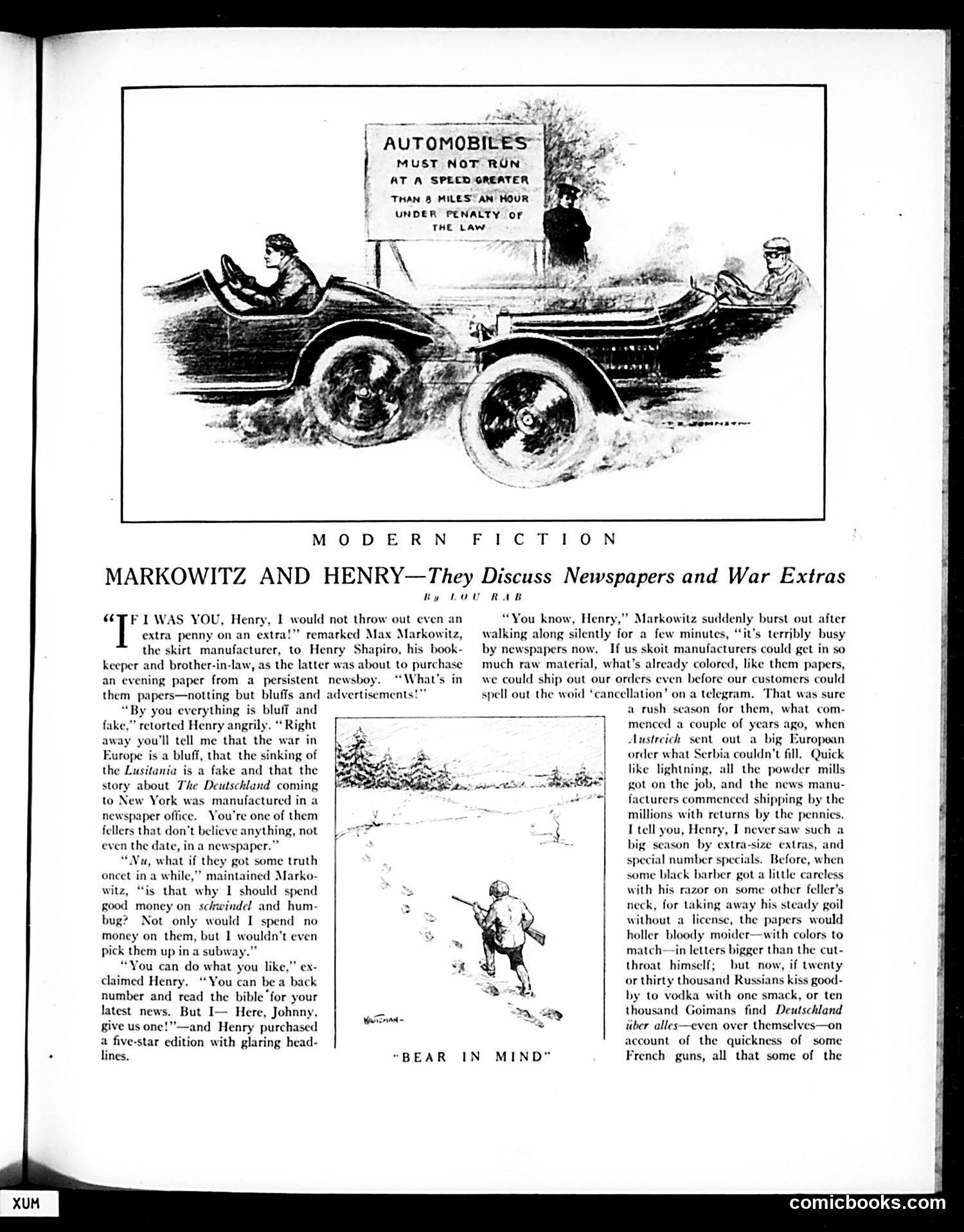
This is a satirical dialogue between two Jewish immigrant characters (identifiable by their accented English and names) debating newspaper credibility during World War I. **The satire targets:** 1. **Yellow journalism**: Henry defends sensational newspaper reporting; Markowitz accuses papers of "bluff and fake." The joke is that wartime "extras" (special editions) sold by exaggerating minor incidents (a barber's razor incident) into massive headlines. 2. **War profiteering**: Markowitz observes that newspapers—like powder mills and munitions manufacturers—experienced boom profits from the war, treating serious events (Russian deaths, German nationalism) as mere commercial opportunities for circulation. 3. **The top cartoon** satirizes early automobile speed laws (8 mph limit), labeling them "modern fiction"—implying such regulations are as unbelievable as the exaggerated newspaper accounts discussed below. The piece mocks both sensationalist media and wartime commercialism, using working-class immigrant characters to voice skepticism about official narratives.
📄 Transcribed text from this page (OCR, searchable)
Machine-transcribed from the original scan — historical spelling and the odd misread are preserved.
AUTOMOBILES MUST NOT RUN AT A SPEED GREATER THAN 8 MILES AN HOUR UNDER PENALTY oF MODERN FICTION MARKOWITZ AND HENRY—They Discuss Newspapers and War Extras By LOU RAB extra penny on an extra!” remarked walking along silently for a few minutes, “‘it’s terribly busy the skirt manufacturer, to Henry S| by newspapers now. If us skoit manufacturers could get in so keeper and brother-in-law, as the latter was about to purch much raw material, what's already colored, like them papers, an evening paper from a persistent newsboy. ‘What's in we could ship out our orders even before our customers could them papers—notting but bluffs and advertisements!” spell out the woid ‘cancellation’ on a telegram. That was sure “By you everything is bluff and a rush season for them, what com- fake,” retorted Henry angrily. “Right menced a couple of years ago, when away you'll tell me that the war in Austreich sent out a big European Europe is a bluff, that the sinking of Ao. order what Serbia couldn’t fill. Quick the Lusitania i fake and that the nee: ae . like lightning, all the powder mills story about The Deutschland coming } cee wi “| got on the job, and the news manu- to New York was manufactured in a . facturers commenced shipping by the newspaper of You're one of them J zs ‘ millions with returns by the pennies. fellers that don’t believe anything, not x5 : I tell you, Henry, I never saw such a even the date, in a newspaper - big season by extra-size extras, and “Nu, what if they got some truth special number specials. Before, when oncet ina while,” maintained Marko- some black barber got a little careless witz, “is that why I should spend * with his razor on some other feller’s good money on schwindel and hum- q neck, for taking away his steady goil bug? Not only would I spend no : without a license, the papers would money on them, but I wouldn’t even % holler bloody moider—with colors to pick them up in a subway.” " match—in letters bigger than the cut- “You can do what you like,” ex- throat himself; but now, if twenty claimed Henry. ‘You can be a back - or thirty thousand Russians kiss good- number and read the bible’for your ‘ by to vodka with one smack, or ten latest news. But I— Here, Johnny, a=, + thousand Goimans find Deutschland give us one!”—and Henry purchased iiber alles—even over themselves—on a five-star edition with glaring head- account of the quickness of some lines, “BEAR IN MIND” French guns, all that some of the ‘T I WAS YOU, Henry, I would not throw out even an “You know, Henry,” Markowitz suddenly burst out after comicbooks.com