
Judge, 1916-09-23 · page 15 of 32
Judge — September 23, 1916 — page 15: what you’re looking at
What you’re looking at
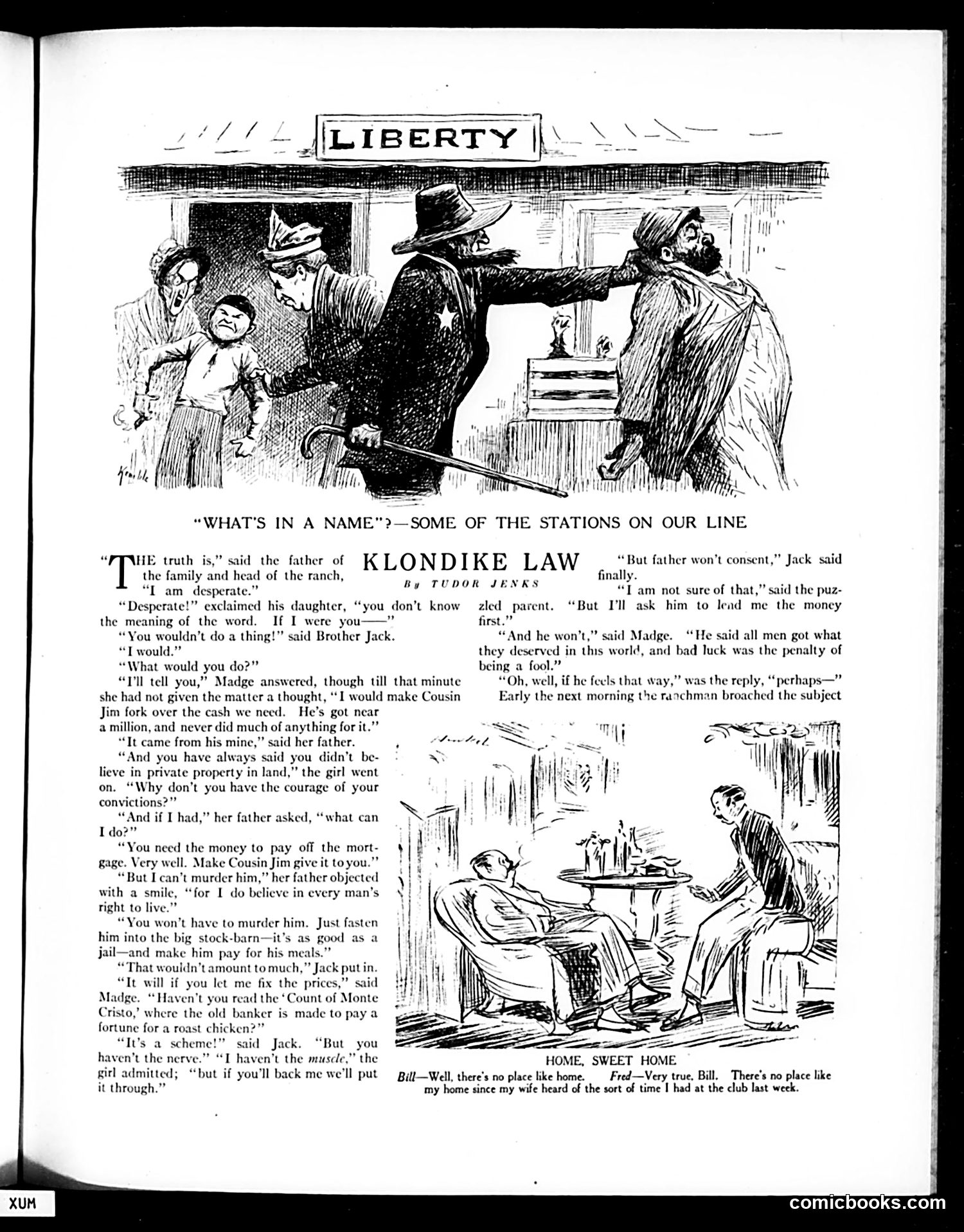
This page contains two distinct pieces from Judge magazine's satirical commentary on American life. **Top cartoon ("What's in a Name?"):** A family discusses financial desperation. The daughter Madge proposes an unethical scheme: lock their wealthy Cousin Jim in a barn and charge him exorbitant prices for food—referencing *The Count of Monte Cristo*—to extort money for the mortgage. The satire targets the hypocrisy of those who claim socialist ideals ("private property in land" is wrong) while proposing ruthless capitalist exploitation. The cartoon mocks both radical rhetoric divorced from principle and the desperation of rural economic hardship. **Bottom cartoon ("Home, Sweet Home"):** Two men (Bill and Fred) exchange a hackneyed saying about home being best. Bill reveals his wife discovered he spent time at a club, implying infidelity or impropriety. The "station on our line" suggests these are observations at different life stages—satirizing domestic discord and the gap between nostalgic sentimentality and actual marital reality. Both pieces use ironic juxtaposition: stated ideals versus actual behavior, and romantic notions versus harsh truth.
📄 Transcribed text from this page (OCR, searchable)
Machine-transcribed from the original scan — historical spelling and the odd misread are preserved.
“WHAT'S IN A NAME"? i HE truth is,” said the father of T the family and head of the ranch, “IT am desperate.” “Desperate!” exclaimed his daughter, the meaning of the word. If I were you—— “You wouldn’t do a thing!” said Brother Jack. “T would.” “What would you do?” “T'll tell you,” Madge answered, though till that minute she had not given the matter a thought, “I would make Cousin Jim fork over the cash we need. He’s got near a million, and never did much of anything for it.’ “Tt came from his mine,” said her father. “And you have alw aid you didn’t be- lieve in private property in land,” the girl went on. “Why don’t you have the courage of your convictions?” “And if I had,” her father asked, I do?” “You need the money to pay off the mort- sage. Very well. Make Cousin Jim give it to you.” “But I can’t murder him,” her father objected with a smile, “for I do believe in every man's right to liv “You won’t have to murder him. Just fasten him i into the big stock-barn—it’s as good asa nd make him pay for his m at wouldn't amount to muc ck putin. “Tt will if you let me fix the prices,” said Madge. “Haven't you read the ‘Count of Monte Cristo,’ where the old banker is made to pay a fortune for a roast chicken? “T's a schem 1 Jack. “But you haven't the nerve.” “I haven't the muscle,” the girl admitted; “but if you'll back me we'll put it through.” By “you don’t know “what can my KLONDIKE LAW TUDOR Bill—Well, there's no place like home. home since my wife heard of the sort of time I had at the club last week. —SOME OF THE STATIONS ON OUR LINE “But father won't consent,” Jack said finally. “Tam not sure of that,” said the puz- “But Vl ask him to lead me the money JENKS zled parent. first.” “And he won't,” they deserved in this world, being a fool.” “Oh, well, if he feels that way,” was the reply, “perhaps—” Early the next morning the ranchman broached the subject said Madge. ‘He said all men got what and bad luck was the penalty of HOME, SWEET HOME Fred—Very true, Bill. There's no place like comicbooks.com