
A complete issue · 71 pages · 1924
Captain Billy's Whiz Bang #57
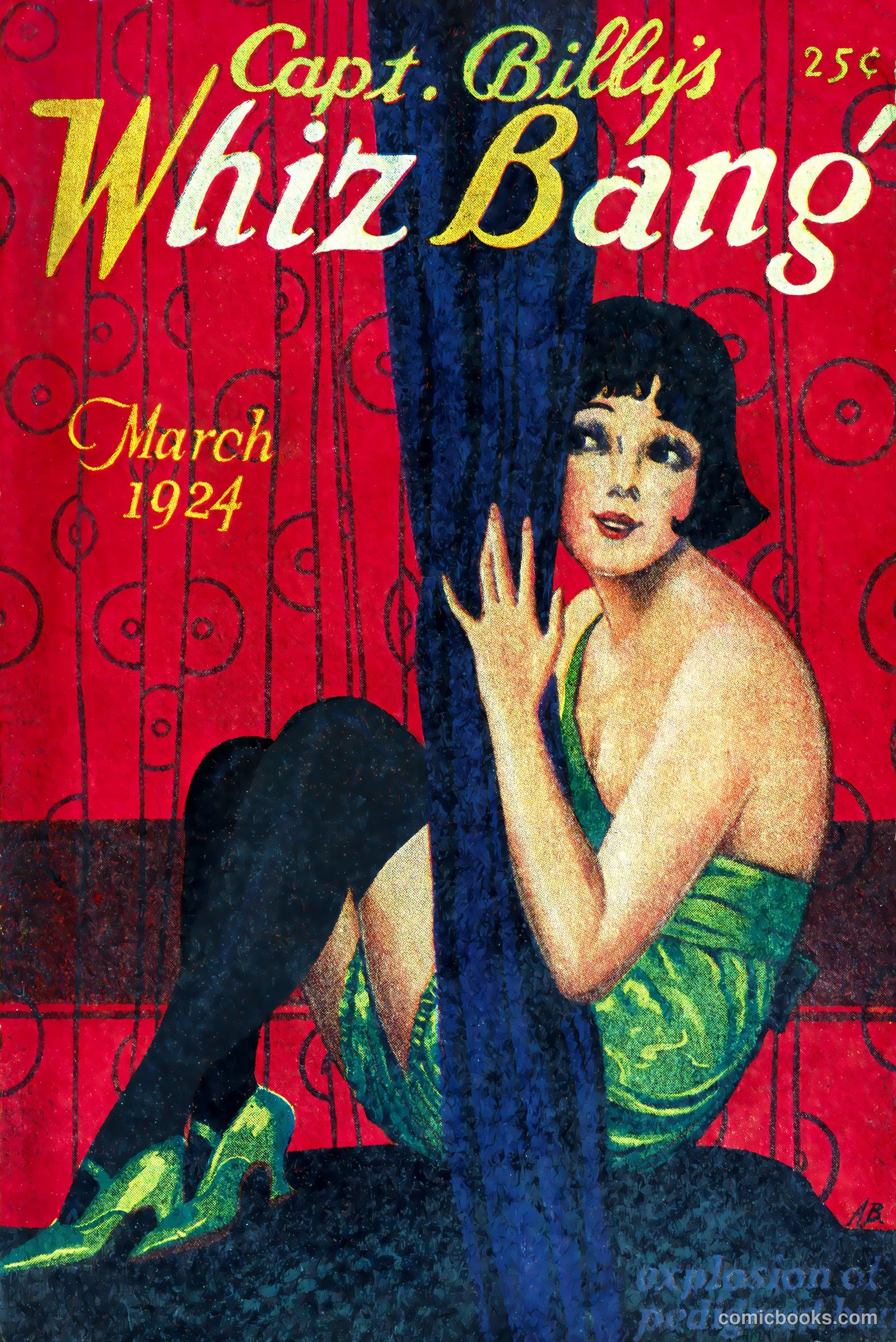
This is the March 1924 cover of "Capt. Billy's Whiz Bang," a 25-cent satirical magazine. The cover features an illustrated woman in 1920s attire—short black bob haircut, green undergarments, black stockings—in a flirtatious pose against a red curtained background with musical note patterns. The image exemplifies 1920s "flapper" culture satire. The woman's bare shoulders, revealing clothing, and suggestive posture reflect contemporary anxieties about changing female sexuality and social roles during the Jazz Age. The title and musical backdrop suggest entertainment or cabaret themes. "Whiz Bang" was known for bawdy humor and risqué content targeting male audiences. This cover uses cheesecake imagery—sexualized illustrations of women—as its primary comedic vehicle, representative of the magazine's irreverent approach to post-WWI American social conventions.
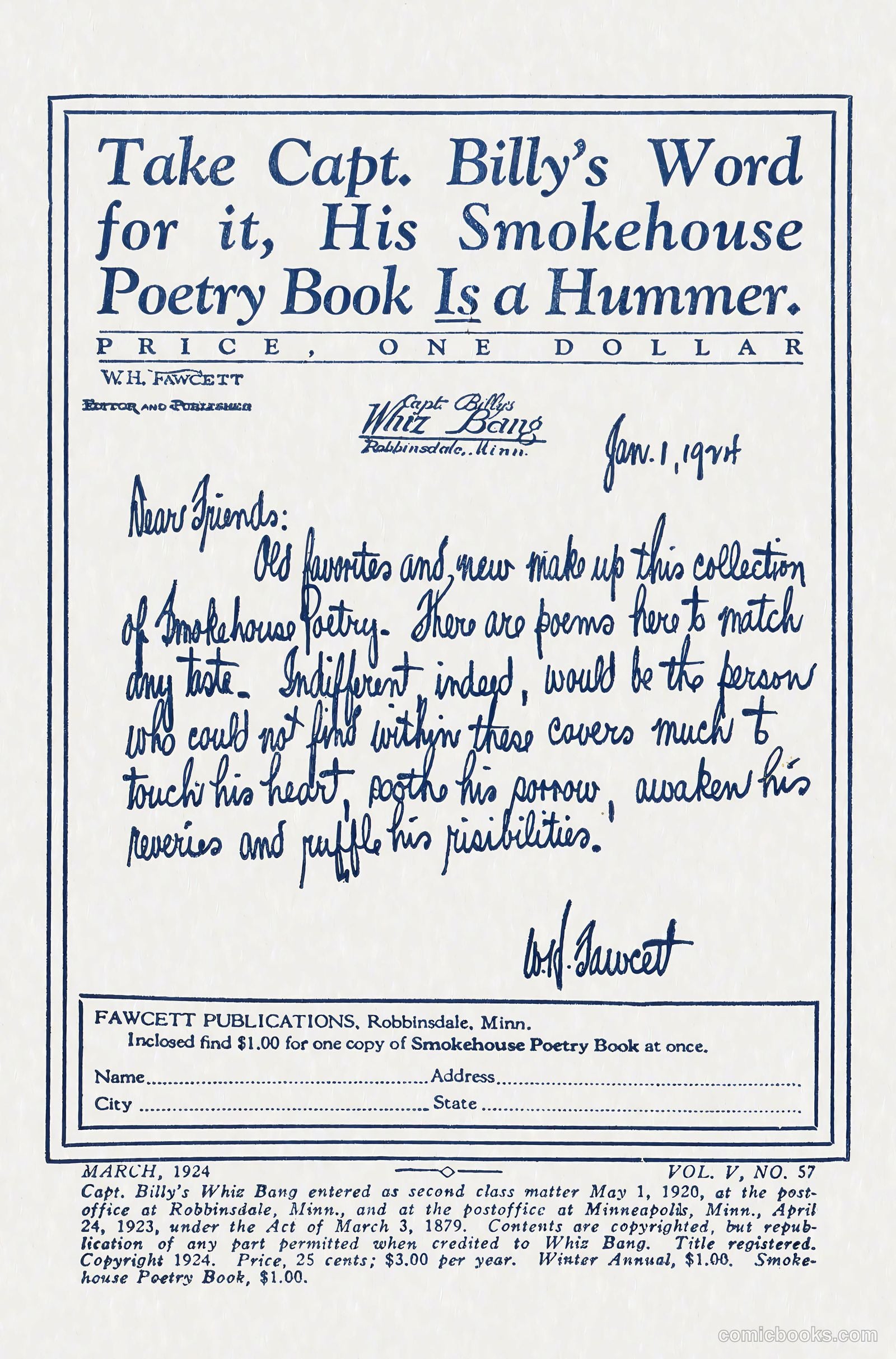
This page is primarily **advertising material**, not a cartoon or satirical content. It's a promotional letter from W.H. Fawcett (editor/publisher) endorsing Captain Billy's "Smokehouse Poetry Book," dated January 1, 1924. The letter humorously recommends the poetry collection to readers, claiming the poems are so emotionally powerful they could move even the hardest person to tears. Fawcett suggests this book would appeal to diverse tastes. The bottom section contains a mail-order form inviting readers to purchase the book for one dollar through Fawcett Publications in Robbinsdale, Minnesota. This appears in **Whiz Bang**, a humor/satire magazine, but this particular page functions as a product advertisement rather than editorial satire or cartooning.
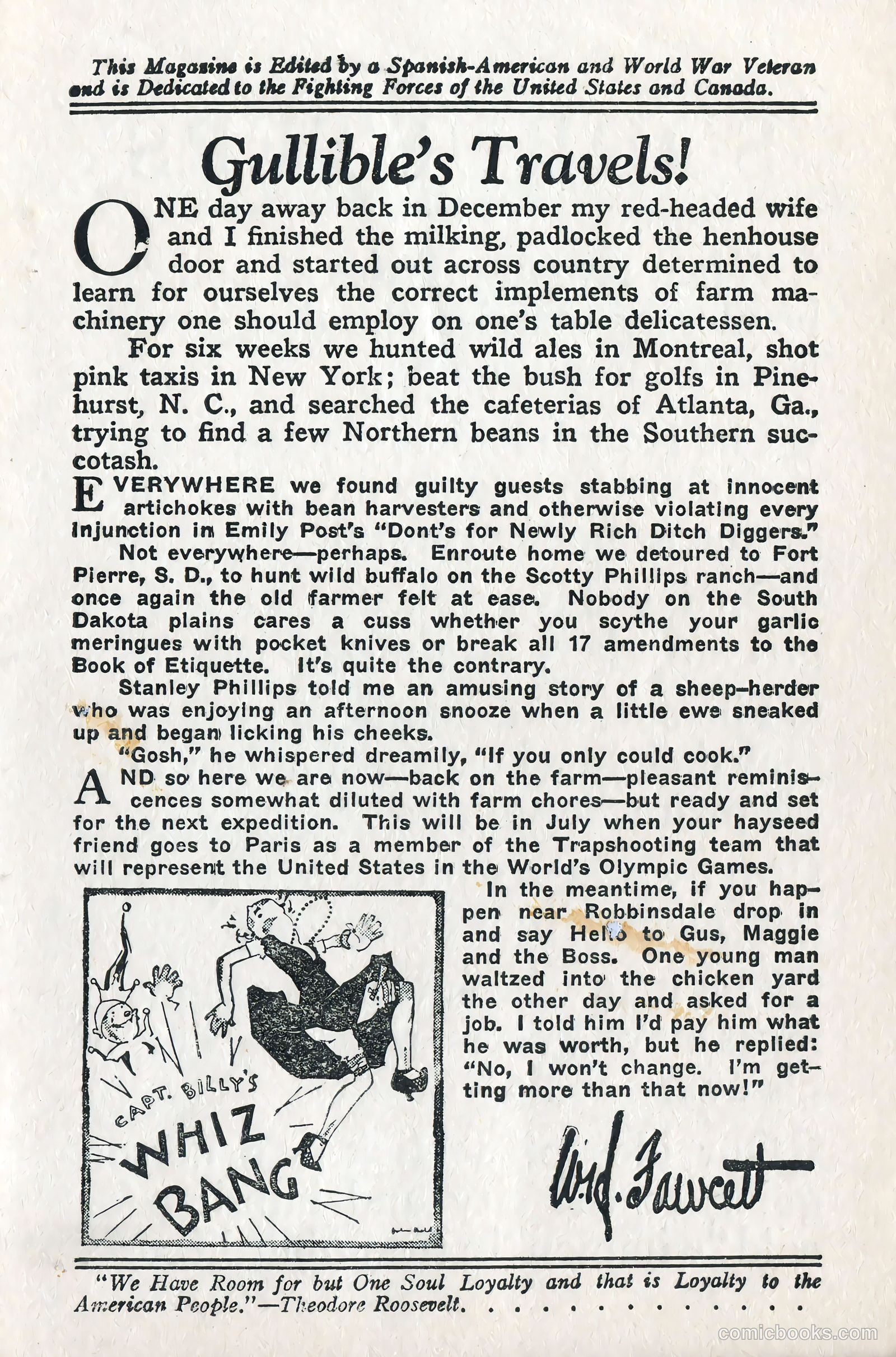
This is a humorous travel narrative satirizing post-WWI American social pretension and etiquette obsession. The unnamed narrator and his "red-headed wife" journey seeking proper table manners, ironically violating Emily Post's etiquette rules everywhere they go—Montreal, New York, North Carolina, Atlanta. The satire targets newly wealthy Americans mimicking refined behavior while remaining clueless about proper conduct. References to "bean harvesters" stabbing artichokes and "garlic meringues" with pocket knives mock their comical misuse of farm tools as dining implements. South Dakota emerges as the story's moral center: honest, unpretentious ranch culture where etiquette rules don't matter. The narrator—signed "Gullible" (the byline puns on the travel narrative genre)—ultimately finds comfort abandoning artificial sophistication for authentic rural simplicity. The cartoon's "WHIZ BANG" explosion reinforces the joke's comedic impact.
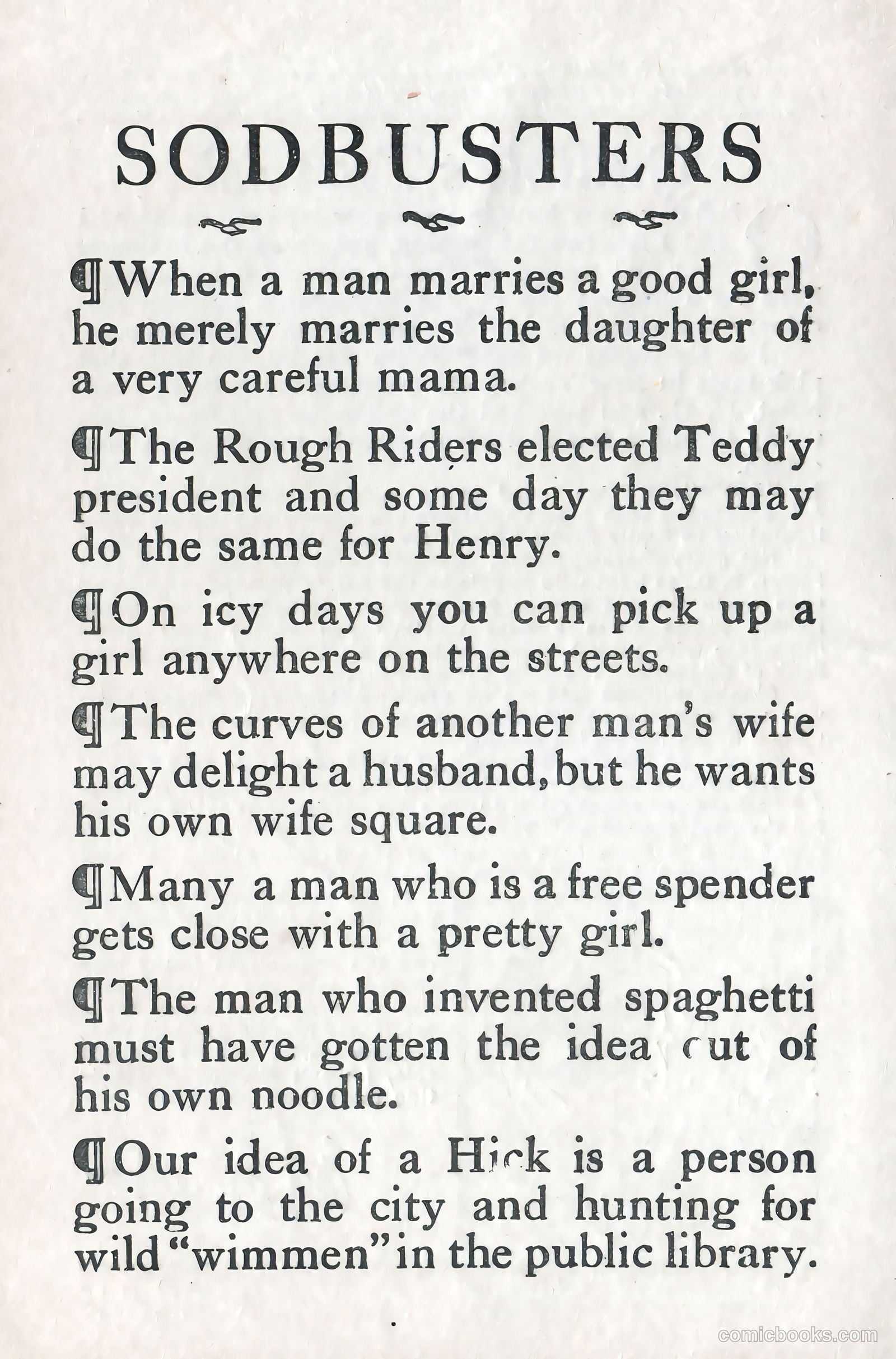
This page contains brief, humorous observations rather than illustrated cartoons. The "Sodbusters" heading likely refers to rural/unsophisticated people, fitting the satirical tone. The jokes mock early 1900s social conventions: mothers controlling daughters' marriages, physical attraction in women, gender stereotypes about spending money, and rural naiveté. References to "Teddy" (Theodore Roosevelt) and "Rough Riders" anchor this to Roosevelt's presidency era. The spaghetti and "wimmen" jokes employ wordplay typical of period humor. The final quip mocks rural "hicks" seeking loose women in libraries—suggesting both rural ignorance and anxieties about city morality. Overall, these are snippets of period comedy poking fun at courtship, class differences, and social pretension common to early 20th-century American magazines.
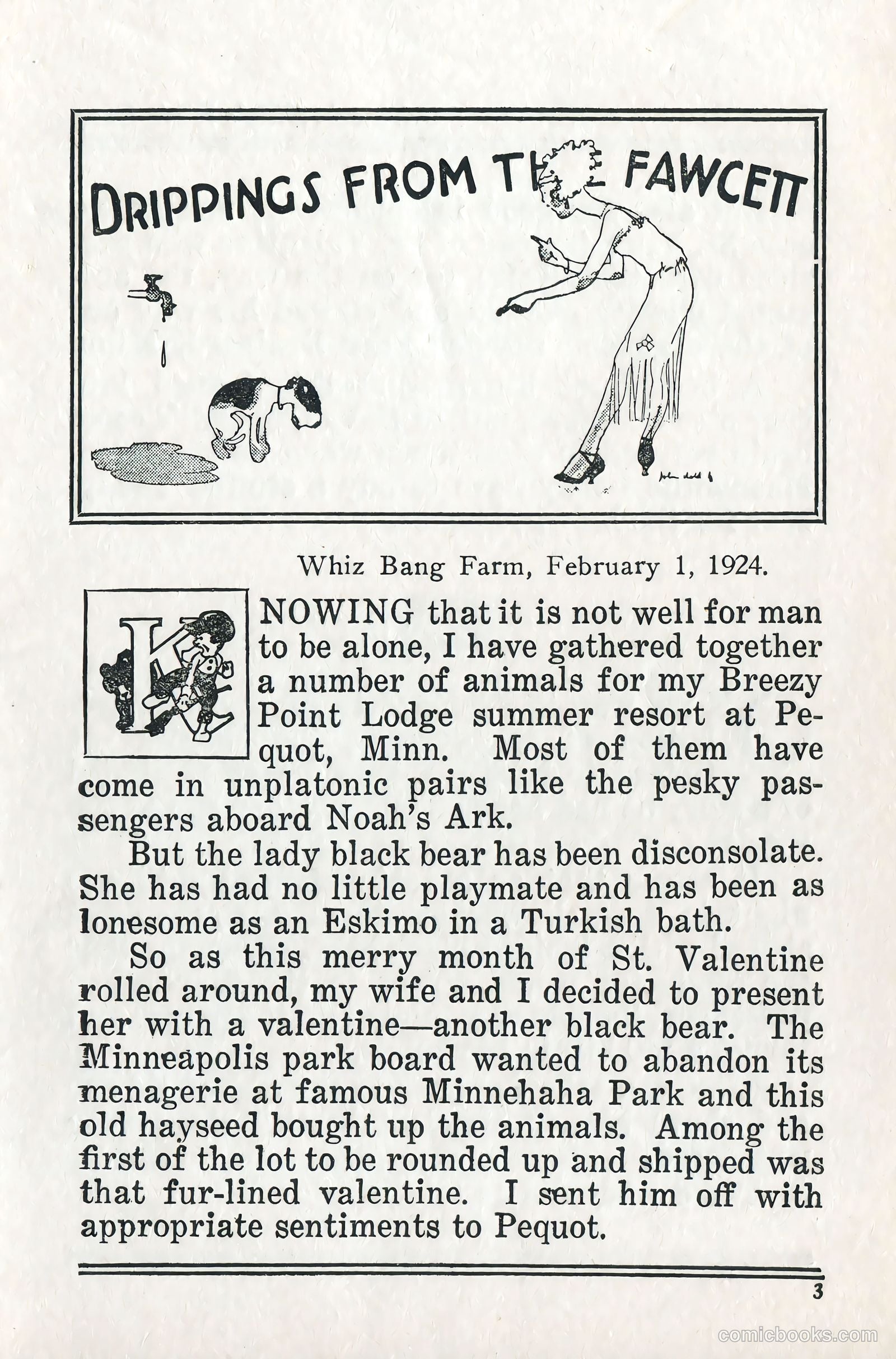
This is a humorous column by John Held Jr. (a famous cartoonist of the 1920s) describing a Valentine's Day gift. The author claims to have purchased animals from Minneapolis's Minnehaha Park menagerie, including a lonely female black bear at his Pequot, Minnesota lodge resort. The joke centers on giving the bear a male bear as a romantic Valentine's "gift"—treating the animal matchmaking as a romantic gesture. The opening cartoon shows water dripping from a faucet and a woman gesturing—apparently illustrating the column's title and tone. The humor relies on the absurdity of applying human romantic sentiments to animal companionship, and the exaggerated rural persona ("old hayseed") narrating mundane farm life with grandiose language. This was typical Whiz Bang style—irreverent, whimsical satire aimed at middle-class American readers.
This page contains two humorous anecdotes about bears, typical of this satirical magazine's lighthearted storytelling style. The first story describes a failed Valentine's Day gift: someone sent a live bear as a romantic gesture, but it escaped near Brainerd, Minnesota, leading to a hunt and the bear becoming steak instead of a cherished pet. The second, more elaborate joke involves a cowboy sneaking a trained black bear onto a train by bribing the porter $20 to hide it in the last berth. The humor relies on the porter's complicity in this deception and the absurdity of smuggling a bear past the conductor. Both stories play on frontier/rural American stereotypes and the comedic collision between civilized spaces (trains, romance) and wild animals. There's no apparent political satire here—just frontier tall tales and vaudeville-style humor typical of 1920s comic magazines.
This page contains two pieces of satirical content from *Whiz Bang* magazine: **The cartoon story** uses racist stereotypes common to early 20th-century American humor. "Rastus" (a stereotypical Black character name) and "the black knight of the whisk-broom" are working on a train. The joke involves confusion about berth placement and a woman in the lower berth—the humor relies on the setup of accidental/suggestive proximity between the male characters and the (apparently white) woman. **The second section** is a word-association game titled "Farmyard Fun and Philosophy." It invites readers to guess nursery rhymes from cryptic phrases. "Monkey-mower" presumably references "Hey Diddle Diddle" (cow jumping over moon). This was presented as entertainment to engage readers' memory and creativity. The page reflects *Whiz Bang's* satirical approach: mixing crude ethnic humor with lighthearted intellectual puzzles. The racial caricatures and dialect would be considered deeply offensive today.
This page from *Captain Billy's Whiz Bang* (a humor magazine popular in the early 20th century) contains two distinct humor pieces: **Top section:** Brief joke fragments, likely setups for longer stories—references to traveling salesman jokes (a common ribald genre), Houdini (the famous magician/escape artist), and suggestive scenarios on trains. **Main story:** A schoolteacher corrects boys' names, insisting on formal versions: "Si" becomes "Silas," "Tom" becomes "Thomas." The joke's payoff: when she asks a third boy his name, he responds "Jackas"—appearing to say an offensive term, but actually his literal name. The humor exploits the double meaning, suggesting the teacher's pedantic corrections about proper names have backfired absurdly. The joke relies on dialect/colloquial speech patterns common in rural Minnesota humor of that era.
This page contains two rural humor stories typical of early 20th-century American satirical magazines. **First story**: Gus, a farmhand, offers to teach his city cousin how to milk a cow. The cousin, inexperienced and lacking confidence (as mentioned in the header), asks if he should "learn on the calf" instead—a naive, illogical suggestion that plays on the contrast between city slicker ignorance and rural common sense. **Second story**: A visiting Minneapolis man spends five nights at a Robbinsdale hotel causing escalating chaos—fighting, cheating staff, telling inappropriate stories, and voyeuristic behavior. When presented with his bill, he protests it as "outrageous" and asks for clergy discounts, apparently expecting the hotel to reduce charges based on religious affiliation. The satire mocks his audacity: he causes extensive trouble then demands special treatment. Both stories employ rural vs. urban stereotypes common to the era, portraying city visitors as either foolishly ignorant or morally corrupt.
This page contains two short humorous stories rather than political cartoons. **First story**: A diner points to a menu item he cannot read (written in French or Italian by a non-English-speaking chef). The waiter refuses, saying "the band is playing it"—a joke implying the item listed is actually a musical composition, not food. The satire mocks both pretentious foreign cuisine and the absurdity of fancy restaurant menus. **Second story**: A woman tells a friend she'll marry "Bob" next month if he gets a week off work. When asked if he'll manage it, she reasons employers will grant time off for marriage (necessary) but not for vacation (leisure). The joke satirizes employer attitudes toward workers' personal time—suggesting marriage is considered a legitimate life event while simple relaxation is frivolous. Both stories reflect working-class perspectives on urban life and employment in early 20th-century America.
This is a humorous anecdote from *Whiz Bang*, a satirical magazine popular in the 1920s-30s. The joke is a simple escalating absurdity: the narrator encounters a youth carrying a cat in a birdcage, claiming he's "taking mother's canary for an airing." When asked where the bird is, the boy replies it's "inside the cat"—meaning the cat ate it. Later, the boy returns with a bulldog, saying he's taking the cat home. When asked where the cat is, he answers: "Inside the dog." The humor relies on deadpan delivery and the boy's apparent literal-mindedness. It's a chain of increasingly ridiculous pet-transportation mishaps, playing on the idea of naive efficiency gone wrong—fitting the column's title "Farmyard Fun and Filosophy." The joke mocks both the boy's obliviousness and the adult's patient questioning, characteristic of early 20th-century American comic storytelling.
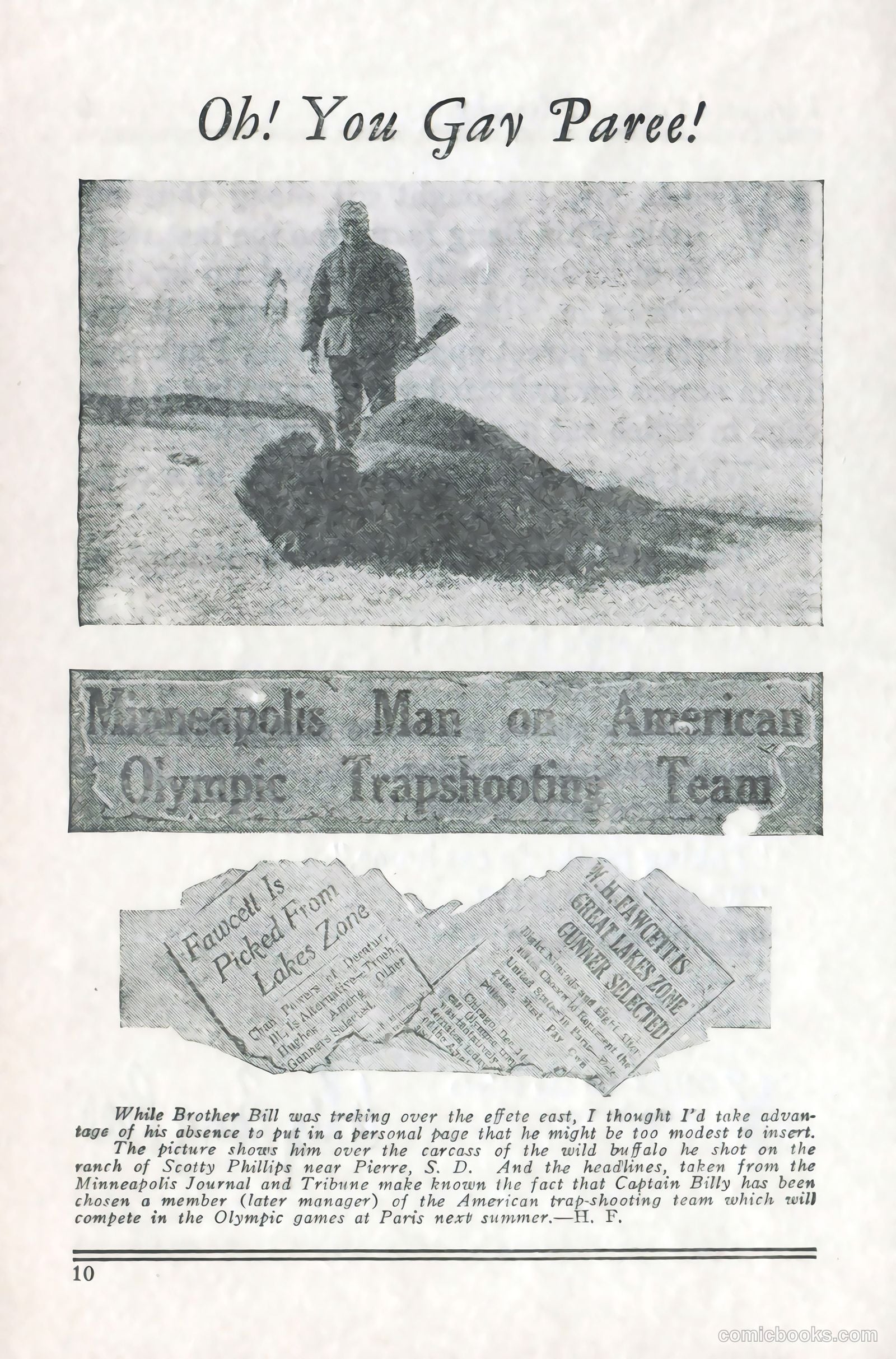
This page celebrates Captain Billy (the magazine's editor) being selected for the American Olympic trap-shooting team competing in Paris. The humor is self-deprecating: the author acknowledges that Billy was absent, so he's using the opportunity to promote his brother's accomplishment—something Billy might modestly decline to do himself. The photograph shows Billy posing over a buffalo he killed on a South Dakota ranch, establishing him as a skilled marksman. The clipping headlines from Minneapolis newspapers announce his selection to the U.S. team. The satire is light: the title "Oh! You Gay Paree!" plays on Paris's reputation for sophistication, contrasting it with Billy's rugged American frontier hunting credentials. The joke suggests this Minneapolis trap-shooter represents authentic American marksmanship competing on the world stage. The article frames this as newsworthy boasting by a colleague rather than self-promotion.
This page collects brief, humorous "fence post" observations—casual farmyard philosophizing on contemporary topics. The satire targets: 1. **Literary pretension**: A Chicago Tribune story's overwrought description of a woman bathing is mocked as absurdly purple prose. "Gus says the water was a little fresh"—implying the real problem is mundane, not the pseudo-intellectual language. 2. **Marriage and gender**: A cynical exchange questions whether women should confess secrets; the response dismisses it as tired, hackneyed morality drama. Another anecdote depicts marital numbness—a wife's presence causes her husband's leg to fall asleep faster than before, suggesting dulled sensation from routine familiarity. 3. **Extreme drought humor**: An Arizona correspondent exaggerates dryness so extreme that bullfrogs can't swim and cats can't spit—absurdist humor about environmental hardship. The overall tone is wry, deflating pretense (literary and social), and observing life's mundane realities beneath inflated rhetoric.
This page from the satirical magazine contains five brief, unrelated humorous anecdotes typical of early 20th-century American humor magazines. The jokes target small-town life and character types: a tourist amused by rural infrastructure; a local theater critic implying a promoter's interest in a woman is non-professional; "Olaf" (a Scandinavian immigrant character type) who ignores railroad crossing warnings and encounters fatal accidents—dark humor reflecting real dangers of early automobiles; "Gus," another immigrant name, bragging about impossible circus feats; and a final quip about automotive ownership. The humor relies on ethnic stereotyping (Scandinavian names for foolish characters), casual treatment of death, and cynical observations about small-town social dynamics. There are no political cartoons visible—only text-based jokes typical of this magazine's "short gags" format.
This page features a humor contest titled "Our Monthly Song Hits"—a reader-submitted competition for comedic song titles. The winning entries are bawdy, irreverent one-liners typical of 1920s lowbrow humor. The first-prize winner's title mocks chatty druggists: a monologue where the pharmacist says only "no." The subsequent entries employ crude sexual humor: one jokes about a man's unattractive face during phone sex; another crudely references an elderly man's sexual dysfunction; the third makes a joke about garage mechanics entering heaven—likely implying they're going to hell. This represents *Whiz Bang*'s signature style: irreverent, working-class satire aimed at men, mixing sexual innuendo with mockery of various professions. The humor is deliberately lowbrow and anti-establishment, characteristic of the magazine's appeal to soldiers and blue-collar readers in the post-WWI era.
This page from *Captain Billy's Whiz Bang* (a 1920s satirical magazine) contains reader-submitted one-liners and jokes, not cartoons. The humor targets contemporary social anxieties: **Key themes:** - **Crime/dishonesty**: The bank joke satirizes embezzlement by cashiers - **Urban vice**: References to unauthorized apartment access and neighbor nuisances (pigs in cellars) - **Modern dating**: The "express train on time" joke mocks how technology (reliable trains) prevents romantic encounters—a complaint about modern efficiency - **Fashion morality**: The short skirts reference reflects 1920s anxieties about changing women's fashion and morality - **Physical mishaps**: Shoe laces, green necks from jewelry—absurdist humor These are typical of *Whiz Bang's* format: crude, topical jokes submitted by readers from across America. The humor is intentionally lowbrow and punchy, reflecting working-class comedy sensibilities of the Jazz Age.
This page contains satirical humor pieces typical of 1920s American magazines. The jokes target: **Social pretension**: A nouveau-riche New Yorker assumes a housemaid comes with a rental property; she witily refuses to be "included." **Modern speed culture**: "Speed babies" (young people obsessed with fast cars) would find slow turtles boring—satirizing the era's car obsession. **Old-fashioned prudishness**: Mrs. Murphy hiding money in her bustle dates the joke; "leave behind" is a pun on her posterior. **Women's fashion**: The verse mocks women's clothing as preventing them from striking matches (performing basic tasks), likely referencing flapper styles or suffragette-era dress debates. **Rural superstition vs. modern danger**: Sven Torkelson's horseshoe luck fails against a "flivver" (Model T Ford), contrasting old folk beliefs with new technology. **Marriage mismatch**: Conflicting values between conservative and modern spouses create constant friction. Overall, the page satirizes generational and cultural clashes of the Jazz Age through brief, punchy gags.
This page contains several short satirical pieces mocking early 1920s American culture and social trends: **"Farmer, Farmer"** jokes about rural/urban cultural divide: an unsophisticated farmer visiting the Chicago Art Museum finds modern abstract art incomprehensible, yet expects it cost only a quarter—satirizing both rural philistinism and the perceived pretension of modern art. **The "Culture" poem** mocks interpretative dance as incomprehensible nonsense that viewers must guess at rather than understand. **The doll joke** appears to reference women's changing roles post-WWI, sarcastically suggesting inventors should create dolls mimicking modern girls' exclamations. **"Lord Jeff's Tribute"** uses slang ("ears," "knockout," "hardware") to describe a flapper at a modern dance—a "modern girl" who dances energetically ("stags wore shinguards" means male partners needed protection), knows fashion ("hardware" = jewelry/accessories), and is assertively social. **Final line**: References Prohibition (1920-1933), sarcastically claiming tight skirts (associated with flappers and modernity) disappeared when Prohibition began, implying modern women's fashion reflected pre-Prohibition excess. Overall: satire of 1920s cultural modernization and generational conflict.
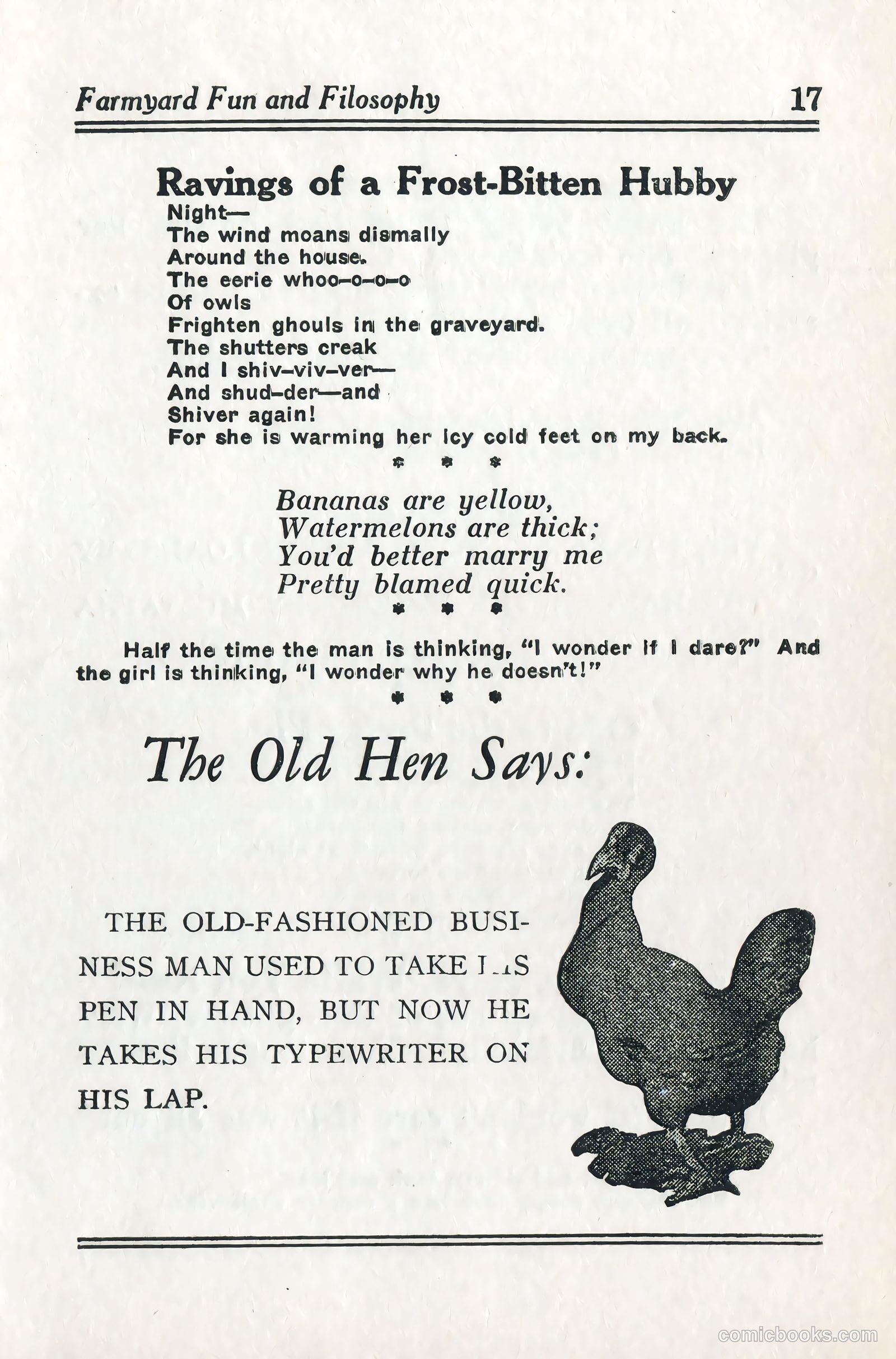
This page from *Whiz-Bang* contains three separate humorous pieces: 1. **"Frost-Bitten Hubby"**: A comedic poem about a husband shivering in bed while his wife warms her cold feet on his back—relatable domestic humor about marital discomfort. 2. **"Bananas are yellow..."**: An awkward marriage proposal presented as a non-sequitur poem, mocking clumsy romantic declarations. 3. **Gender difference joke**: Observes that men hesitate to propose ("I wonder if I dare?") while women wonder why men don't act ("I wonder why he doesn't!")—reflecting early 20th-century dating dynamics where men were expected to initiate. 4. **"The Old Hen Says"**: A brief satirical comment about modernization: businessmen once used pens formally at desks, but now use typewriters informally on their laps—mocking the casualness that newer technology enables, or perhaps suggesting declining formality in business. The illustration shows a hen, the traditional "wise advisor" figure in farmyard satire.
This page from the satirical magazine *Captain Billy's Whiz Bang* contains several brief jokes and humorous pieces typical of 1920s American humor: **"Those Meticulous Oculists"** mocks overly thorough doctors through a pun—a woman fears her broken glasses require full body examination. **The Abie-Ikey dialogue** uses stereotypical Jewish immigrant characters (common in period humor) to joke about marriage and respectability. **"Late Books"** presents fake book titles with puns: "Yes, I Have No More Wagon Loads" (referencing a popular song), "The Halt in the Desert" (Mustapha Smoke/mustache smoke), and "Leaky Overshoes" (Iva Cold/I've a cold). **"Ode to the Pretty Fly"** humorously assigns purposeful roles to animals while the fly merely "speculates and sings"—a gentle commentary on uselessness. **"Stand Steady, Boys"** presents a drunk and officer interaction, a stock comedic scenario. The magazine blended lowbrow humor, puns, and ethnic stereotypes typical of 1920s popular entertainment.
This 1924 gossip column satirizes Hollywood celebrity anxieties about appearance and infidelity. The main target is **Rudolph Valentino**, the famous silent-film "Sheik," whose wife allegedly defends against baldness rumors by claiming his scalp merely shows through his naturally thin hair when combed tightly—an absurd excuse the magazine mocks. The piece references **Samson and Delilah** (Mrs. Sampson cutting her husband's locks), treating male hair loss as a widespread vanity crisis among celebrities. A secondary item reports a divorce involving **Sam Yim** (a government interpreter) allegedly seduced by actress **Chow Moey**, with Yim's wife poetically blaming "a flower punged by the west wind"—satirizing both the scandal and flowery language used to describe romantic betrayal. The satire ridicules celebrity pretension, superficiality, and the magazine's own role in amplifying Hollywood gossip.
This gossip column discusses **Mabel Normand**, a silent film comedienne (nicknamed "Mickey"), and a real scandal involving her. The text references a shooting incident involving her chauffeur **Horace A. Greer** (alias Joe Kelly) and actress **Edna Purviance**, with a Denver oil operator also implicated—presented here as a love triangle among Normand's male admirers. The satire mocks Normand's contradictory denials about knowing Greer, while simultaneously admitting she regularly asked her various chauffeurs for opinions. The author sarcastically highlights her evasiveness ("the ones—get that plural?") and suggests she attracted male attention across class lines (chauffeurs to "oil princes"). The column's tone is gently ribbing rather than condemning, treating the scandal as Hollywood melodrama while implying Normand's modest silence about her romantic conquests was actually wise PR strategy.
This page satirizes Hollywood's response to real scandals involving prominent silent-film stars. It references **Wallace Reid's** drug addiction and death, and **Mabel Normand's** chauffeur shooting someone on New Year's Day—both genuine 1922 incidents that shocked the public. The satire targets **Will Hays**, the film industry's chief censor, suggesting he'd manufacture convenient alibis for stars to tell police. The piece mocks how quickly the word "hop" (slang for opium/drugs) became the scapegoat explanation for all Hollywood crime, rather than addressing actual negligence or character flaws. The opening jabs at Mabel Normand specifically—suggesting she needed "female chauffeurs" instead of male ones to avoid scandal. The final section ridicules how the phrase spread through gossip, creating incentive for drug-use narratives that distracted from the real issues. It's cynical commentary on celebrity protection, industry spin, and moral panic over drugs in 1920s America.
This page from the satirical magazine contains three gossip-style items mocking entertainment figures and social issues: 1. **The opening anecdote** sarcastically describes a wealthy man shooting the "wrong guest" after picking up a stray pistol, blaming drug use ("dope"). The satire criticizes how wealthy, privileged individuals commit violence yet society excuses it through convenient explanations like drug addiction—treating such crimes as inevitable rather than criminal. 2. **Bayard Veiller** (real playwright, author of "Within the Law") is ridiculed for not paying his tailor, receiving a lawsuit ("suit—not of cloth") instead. The mockery uses flowery language about his appearance and cologne. 3. **Ruth Roland** (silent film actress known for serials) is presented as unusually frugal, saving her vaudeville earnings—the item implies this contradicts the stereotype of lavish-spending performers. The satire targets wealth, excess, and the entertainment industry's reputation for extravagance and poor character.
This is a gossip column satirizing Hollywood figures and film industry practices circa the silent era. **Key references:** - **Ruth** (likely actress Ruth Roland): Gossip about her real estate dealings with a divorced partner and rumored marriage to an Eastern millionaire—satirizing Hollywood's mercenary social climbing. - **Bill Hart Junior**: A child who allegedly runs an apartment building by demanding silence from 7 PM to 9 AM, mocking the spoiled behavior of celebrities' children. - **Charlie Chaplin**: The satire mocks his upcoming frozen-custard themed film. The joke suggests using naturally-frozen tears instead of glycerine tears—absurdist humor about film tricks and production challenges in cold weather filming. - **Charles Ray**: His casting in *The Courtship of Miles Standish* is criticized; audiences supposedly won't take him seriously because of his previous "Battling Kid" five-reel shorts. The column traffics in mild celebrity scandal, production gossip, and industry in-jokes typical of fan magazines of the period.
This gossip column contains three entertainment-focused items satirizing early 1920s Hollywood: 1. **Mahlon Hamilton**: A local produce merchant has disappeared, supposedly gone to Egypt "with the movies," likely referencing the widespread King Tutankhamun craze following the tomb's 1922 discovery. The joke: he'll raid the tomb to improve his Welsh rarebit recipes. 2. **The crane bird**: An obscure reference to an unnamed actor (likely a silent film star) frequenting actor Earle Williams's home. The "crane" metaphor is unclear but appears to mock the person's appearance or behavior. 3. **Marilyn Miller and Flo Ziegfeld Jr.**: The major item concerns Broadway star Marilyn Miller leaving theatrical impresario Ziegfeld's management after marrying actor Jack Pickford. The satire suggests Ziegfeld was overly controlling of his performers' personal lives, including his interest in Mary Eaton's marriage, whom he's featuring in the revue *Kid Boots*. Miller's departure with her husband represents independence from Ziegfeld's authority.
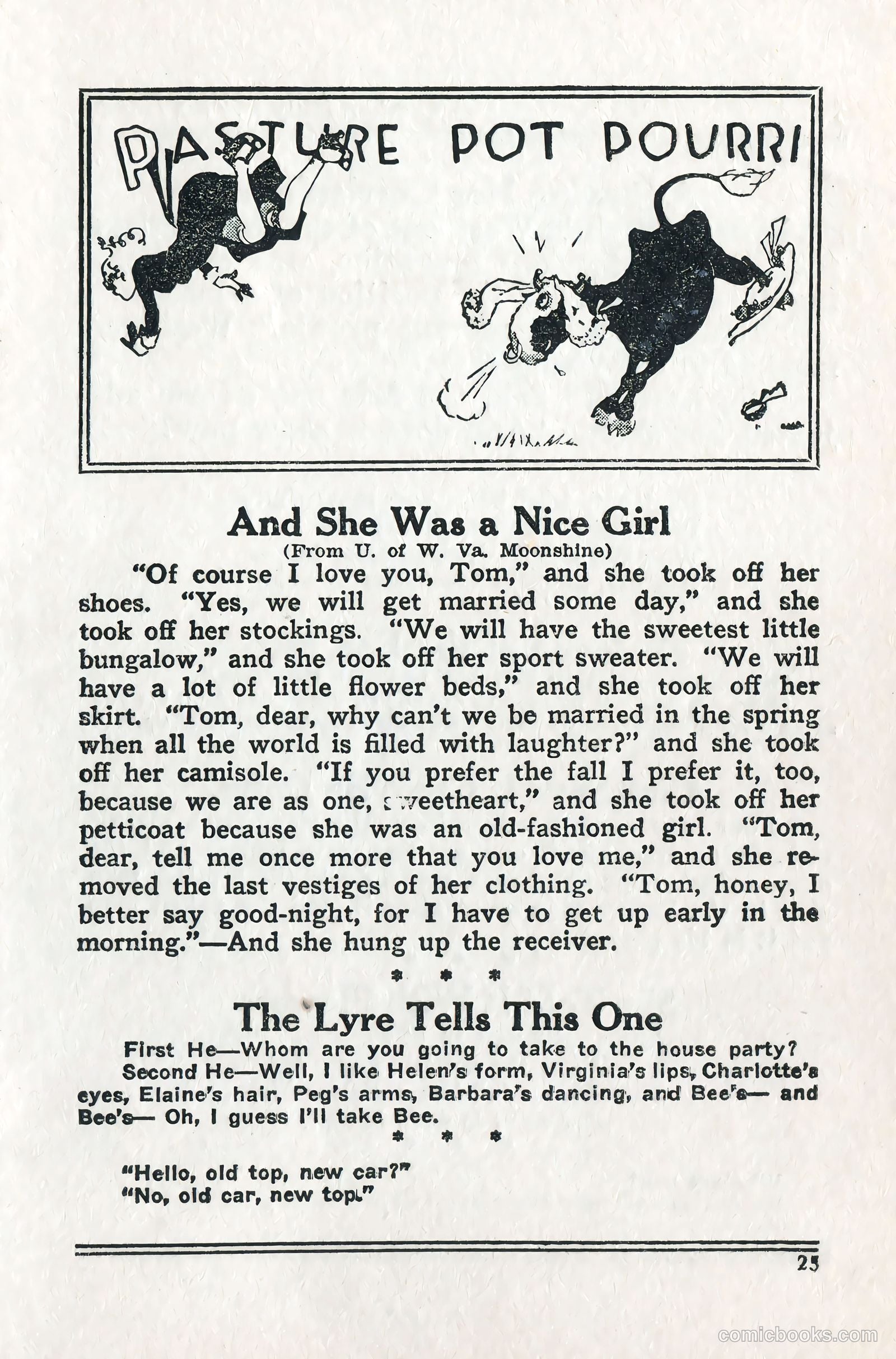
This page contains three brief satirical pieces from what appears to be a 1920s college humor magazine. **"And She Was a Nice Girl"** mocks courtship and sexual propriety of the era. The joke plays on the phrase "nice girl"—a woman who maintains respectability—by having her progressively undress while making romantic promises to "Tom" over a phone, then abruptly ending the call claiming she must wake early. The humor derives from the contradiction: she acts immodestly while claiming old-fashioned virtue, and the physical intimacy occurs via telephone (implying distance, absurdity). **"The Lyre Tells This One"** satirizes shallow male dating logic. A man selecting a date compiles attractive features from multiple women, then chooses "Bee" simply because he can't articulate what he likes about her—suggesting men either lack discernment or their reasons are reductive. **The car joke** is a simple pun: "new car" versus "new top" (convertible roof). All three pieces reflect Jazz Age themes: changing sexual mores, youth rebellion against Victorian standards, and satirical treatment of modern dating behavior.
This page from *Captain Billy's Whiz Bang* (a humor magazine, circa 1920s) contains several short jokes and anecdotes typical of the era's satirical content: **"Adjusting Her Curriculum"**: A mild joke about a model candidate whose profile may only be visible from certain angles—suggesting vanity or physical insecurity. **"Henry Lee" poem**: A dark humor piece about someone drowning while pursuing a fish, where his companions couldn't swim either. **"Dialogue of the End Men"**: Uses period-dialect humor (offensive by modern standards) depicting a boastful altercation with exaggerated speech patterns. **"Olaf Says It Can't Be Done"**: An absurdist riddle-joke playing on logical impossibilities (how can disabled people perform these actions?). **"She Told It With Flowers"**: Wordplay humor about someone literally wearing an Easter lily as a hat instead of buying one. **"Who are you?"**: A crude joke about introducing crabs (the parasitic infestation) into crab-apples. The humor relies on wordplay, absurdism, and physical comedy rather than sophisticated satire of specific political figures or events.
This page contains four separate humorous pieces from *Whiz-Bang*, a satirical magazine: 1. **"The Elsie Smith Blues"**: A joke about a man forced to use a typewriter himself while his attractive stenographer is on vacation—poking fun at male incompetence with office equipment. 2. **"The Mink Link"**: A brief romantic poem, likely satirizing overly sentimental love poetry of the era. 3. **"Three Weeks" Movie Reference**: A jab at the film adaptation of Elinor Glyn's scandalous novel, suggesting censorship will strip away its sensational content (the "nails and bolts"—its provocative elements). 4. **"Gus Spurts Out Some Free Verse"**: A mockery of modernist free verse poetry, using a silly barn-dance anecdote where "big Tilda Swanson" confuses "We Have No Bananas" (a 1923 novelty song) with "The Star-Spangled Banner" and stands respectfully. The final note satirizes Prohibition-era morality legislation, suggesting surface-level legal reforms don't actually change behavior or character.
This page contains several short jokes typical of 1920s American humor magazines. The humor relies on social transgression and double entendre: **"Gus Knows Her"** mocks emerging female independence—a woman smokes in a men's train car and defies the porter by rejecting the "lady" label, implying she's of loose morals. **"The Stuttering Blooz"** is straightforward wordplay about a stutter. **"Household Hints"** contains two jokes: one about a husband using false teeth as a cigar cutter (absurd), and a bawdy innuendo joke where a salesman's comment about where garments "wear out" is misinterpreted by an embarrassed young woman as a sexual reference. The final aphorism disparages women's work ethic compared to men's financial motivation. Overall, the page reflects 1920s attitudes: anxiety about changing gender roles, ribald humor, and casual misogyny—typical of the era's satirical publications.
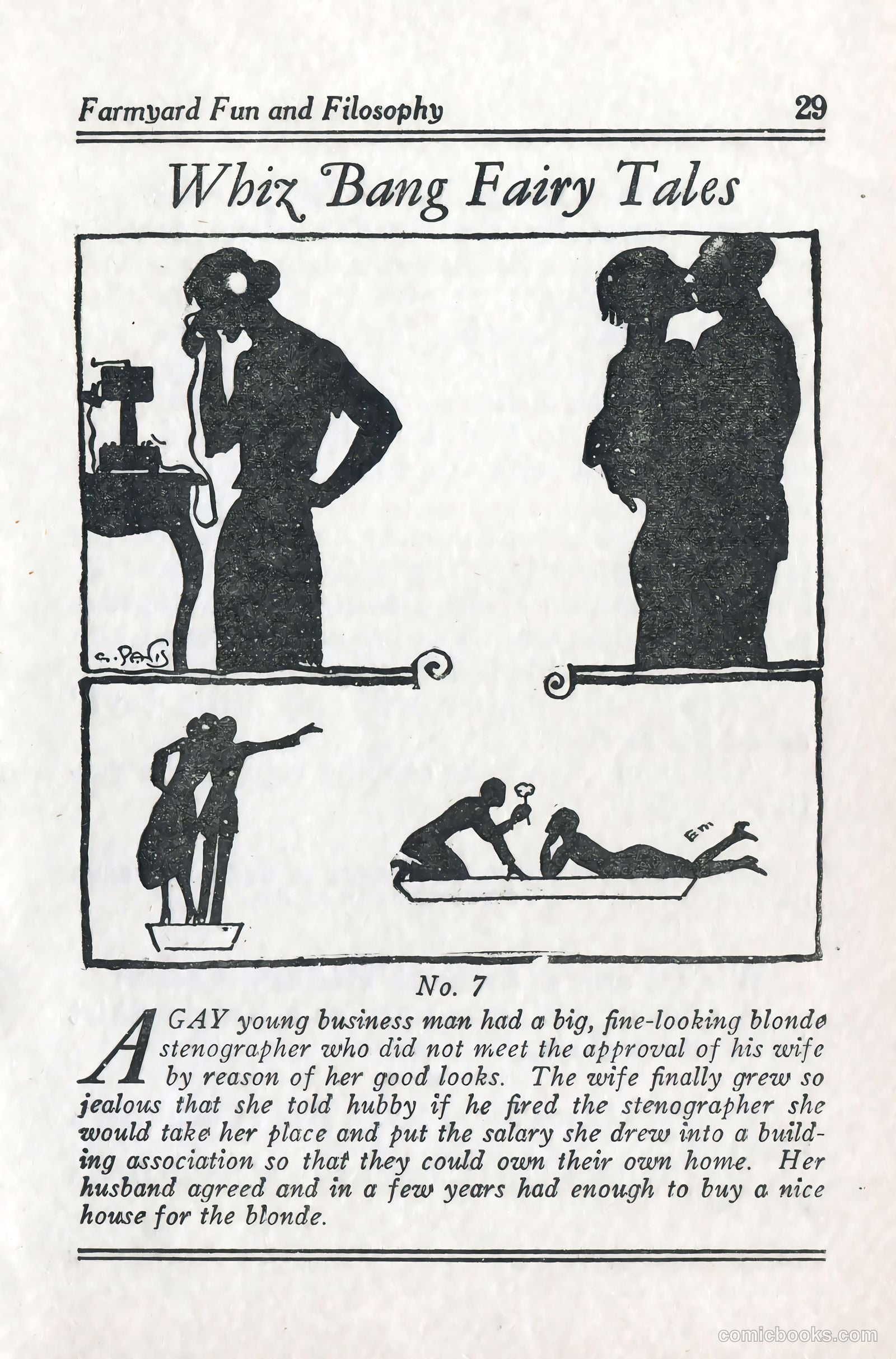
This is a satirical "fairy tale" about marital jealousy and ironic outcomes. The setup involves a classic 1920s workplace scenario: a businessman employs an attractive blonde stenographer, provoking his wife's jealousy. The wife makes an ultimatum—fire the stenographer or the wife will replace her, dedicating her wages to a building fund for homeownership. The satirical twist (the "moral"): the husband agrees, but the punchline suggests the final house ends up belonging to the blonde stenographer anyway—implying the wife's scheme backfired or was thwarted by circumstance. The cartoon mocks period anxieties about women in offices, marital jealousy, and wives' economic powerlessness. It reflects Whiz Bang's irreverent humor about modern relationships and gender dynamics of the Jazz Age era.
This page contains three separate jokes from an early 20th-century satirical magazine: **"Billy-aches"**: A child's misunderstanding of the Adam and Eve creation story leads to physical comedy—Billy interprets his side pain as the beginning of wife-creation, echoing the Sunday school lesson about Adam's rib. **King Tut reference**: A topical joke. The 1922 discovery of Tutankhamun's tomb created massive public fascination ("King Tut craze"). Gus humorously wishes they'd instead excavate "September Morn"—likely referring to Paul Chabas's 1912 nude painting, which caused scandal and censorship battles in America, suggesting he'd prefer that controversy over the Egyptian obsession. **Prohibition-era joke**: The "hootch from a blind pig" is slang for illegal alcohol from an unlicensed speakeasy during Prohibition (1920-1933). The joke plays on offering legitimate milk versus the speaker's preference for contraband liquor—commentary on widespread defiance of alcohol laws.
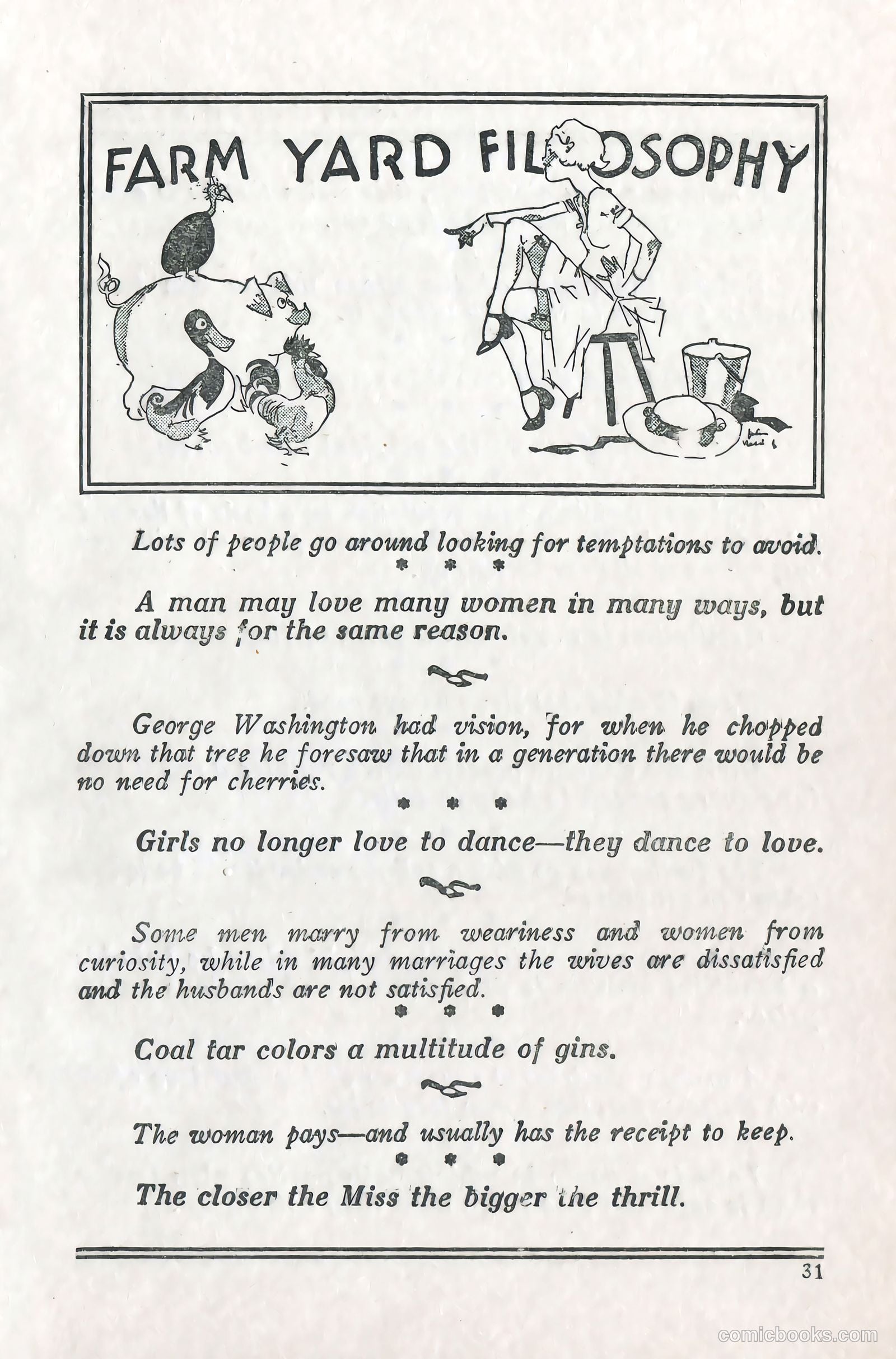
This page presents satirical aphorisms rather than political cartoons. The illustrations show farm animals (left) and a flapper-era woman (right), offering visual humor for what appears to be 1920s-era social commentary. The "philosophy" consists of cynical observations about human behavior and gender relations. Key targets include: - **Romantic hypocrisy**: men's inconsistent motivations, women dancing "to love" rather than for enjoyment - **Marriage dissatisfaction**: mutual unhappiness despite different reasons for marrying - **Economic dynamics**: women bearing financial burdens while keeping receipts (evidence of expenditure) - **Sexual morality**: the final quip about proximity and "thrill" suggests commentary on courtship boundaries The cherry reference appears to be a cheeky reference to virginity loss. Overall, this represents typical interwar satirical magazine humor—cynical about relationships, gender differences, and social pretense, presented through pithy one-liners rather than narrative cartoons.
This page contains no cartoons—only aphorisms (witty sayings) from "Captain Billy's Whiz Bang," a popular 1920s satirical magazine. The humor is cynical and tongue-in-cheek commentary on romance and relationships. The jokes mock both sexes: men who abandon women or flee from them; women as expensive to maintain ("small fortune every season"); the contradiction between how women and men remember past loves; and love itself as an unsafe gamble where both parties lose more than they gain. References like "grass widow" (divorced/separated woman), "flappery" (flirtation in the Jazz Age style), and "osculation" (kissing) date this to the 1920s. The tone is sardonic, treating romantic entanglement as inherently foolish—characteristic of post-WWI American humor that rejected sentimentality. The aphorisms function as bawdy, cynical wisdom for a male audience.
This page from *Whiz-Bang*, a 1920s satirical magazine, contains three separate humor pieces: **"A Fellow Feeling of Brotherly Love"** satirizes young courtship. A man tries bribing his girlfriend's little brother to leave so they can be alone—offering increasingly larger sums (dime, quarter, half-dollar). The joke's punchline: the boy refuses all money because he wants to *watch* them—implying voyeuristic curiosity and the awkwardness of chaperones/lack of privacy in that era. **The philosophical aside** makes a democratic joke about human equality. **"The Passing of Maud"** parodies sentimental Victorian poetry (particularly "Casabianca," the famous "boy stood on the burning deck" poem) by applying it absurdly to a mule dying in a fire. The repetitive "he-haw!" braying mimics the original's dramatic refrain, creating dark comedy through bathos—treating a mule's death with mock-heroic language meant for human tragedy. All three pieces exemplify *Whiz-Bang's* irreverent, often crude humor style targeting middle-class conventions.
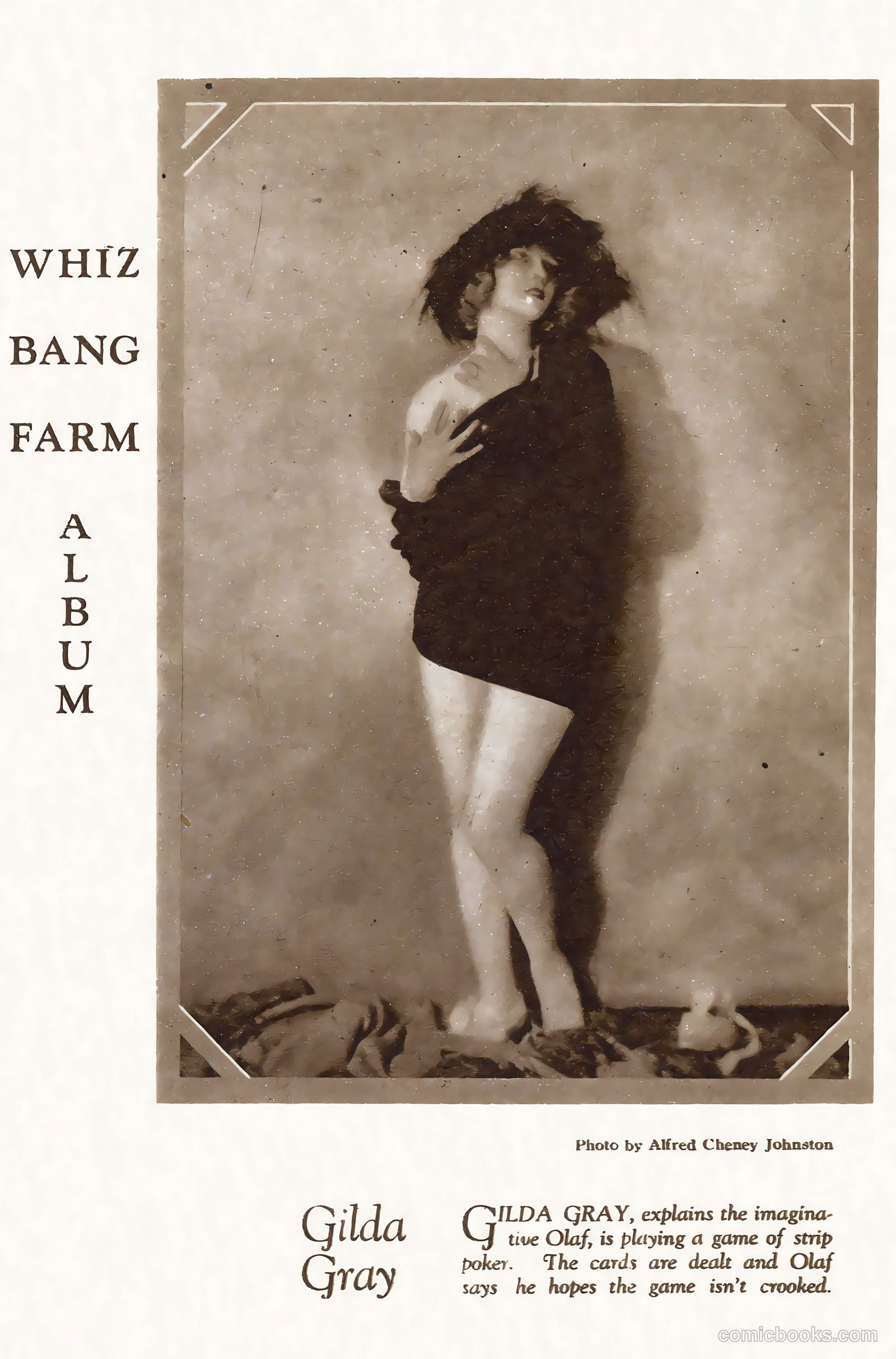
This page features a photograph of actress/dancer Gilda Gray in a suggestive pose, partially draped in dark fabric. The accompanying caption presents a mild joke: a character named Olaf observes Gray playing strip poker and expresses hope the game "isn't crooked"—a double meaning playing on "crooked" as both dishonest and physically bent/contorted. The humor relies on Gilda Gray's fame as a performer known for provocative entertainment (she popularized the "shimmy" dance), making the strip poker reference topical. The joke is relatively tame by modern standards but would have seemed risqué for the 1920s-era *Whiz Bang*, a magazine known for cheeky humor and pin-up style content. The "Farm Album" framing suggests this was part of a recurring photo feature.
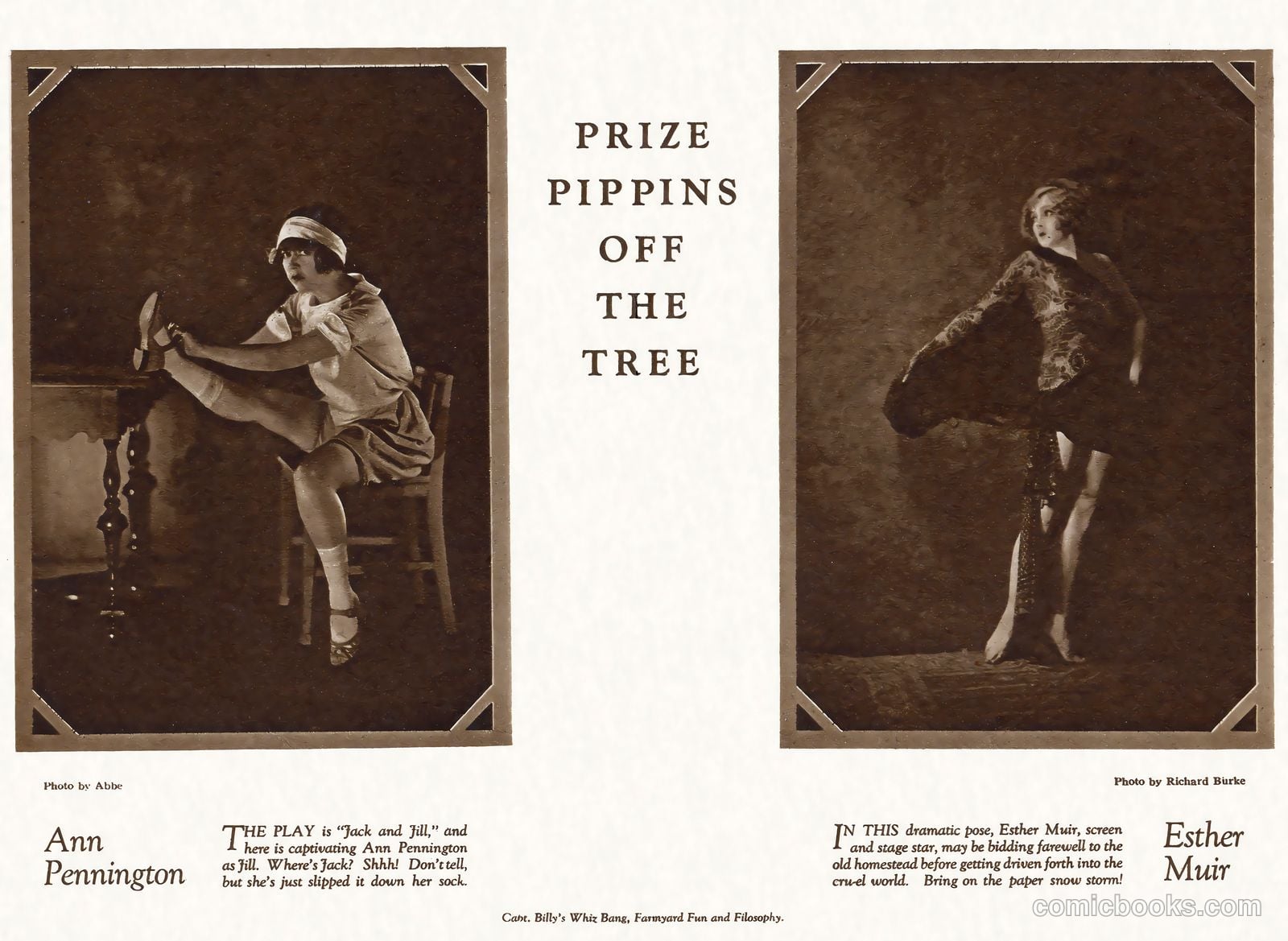
This page features theatrical publicity photos labeled as "Prize Pippins"—a period slang term for attractive young women. The two photographs showcase actresses Ann Pennington and Esther Muir in staged theatrical poses. The captions use innuendo typical of 1920s humor magazines. Pennington's caption makes a suggestive joke about "Jack and Jill," implying she's hidden something in her sock. Muir's caption depicts her in a melodramatic "farewell to homestead" pose, joking about abandonment and hardship. The content reflects early 20th-century entertainment journalism—mixing legitimate theatrical promotion with cheeky, flirtatious commentary aimed at male readers. The "prize" framing and objectifying language were standard for the era's popular magazines, treating actresses primarily as objects of visual interest rather than serious artists.
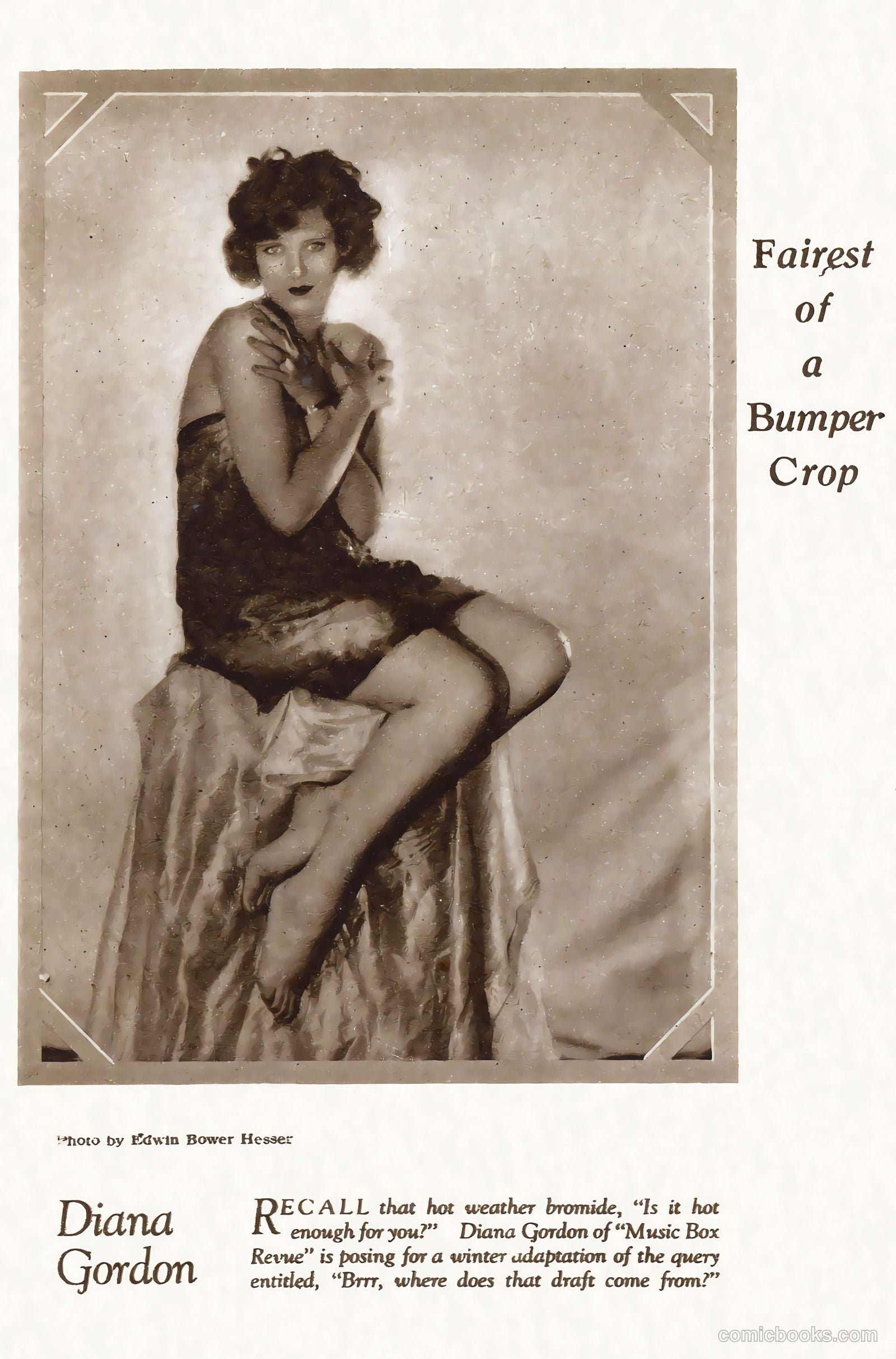
This page features a glamour photograph of actress Diana Gordon from the Broadway show "Music Box Revue," credited to photographer Edwin Bower Hesser. The accompanying text makes a mild joke: it references the common summer small-talk question "Is it hot enough for you?" and presents Gordon's posed photograph as a "winter adaptation" with the inverted query "Brrr, where does that draft come from?"—a playful innuendo about her revealing costume and exposed legs. The "Fairest of a Bumper Crop" heading suggests this is part of a series of actress photographs. This appears to be entertainment/celebrity content rather than political satire, typical of 1920s magazine filler celebrating stage performers.
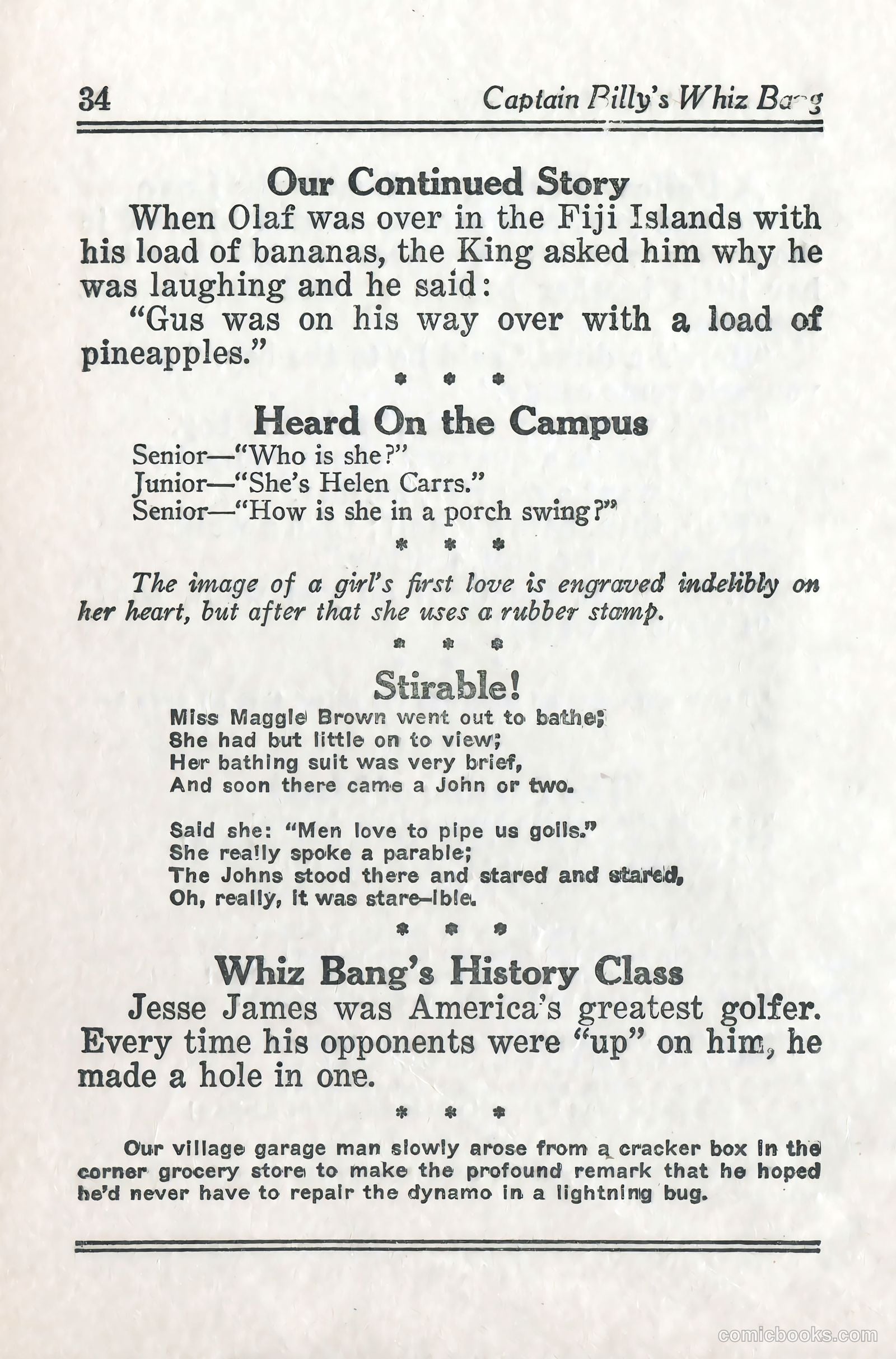
This page contains lighthearted jokes and satirical humor typical of 1920s American magazines. The content includes: **"Our Continued Story"**: A nonsensical joke about Olaf laughing over Gus delivering pineapples to Fiji—the humor relies on absurdist randomness. **"Heard On the Campus"**: College-themed jokes playing on names (Helen Carrs/Helen cars) and romantic behavior, reflecting 1920s dating culture. **"Stirable!"**: A pun-heavy poem about Miss Maggie Brown's brief bathing suit attracting men's stares, with "stare-ible" as a forced rhyme. This reflects era anxieties about women's increasing public presence and revealing swimwear. **"Whiz Bang's History Class"**: A joke conflating Jesse James (the outlaw) with golf terminology—"making a hole in one" becomes darkly humorous given his violent reputation. **Final Quip**: A nonsensical garage-man observation about lightning bugs, exemplifying the magazine's absurdist style. Overall, the humor is pun-based, innocuous, and targets college students and small-town life with mild social commentary.
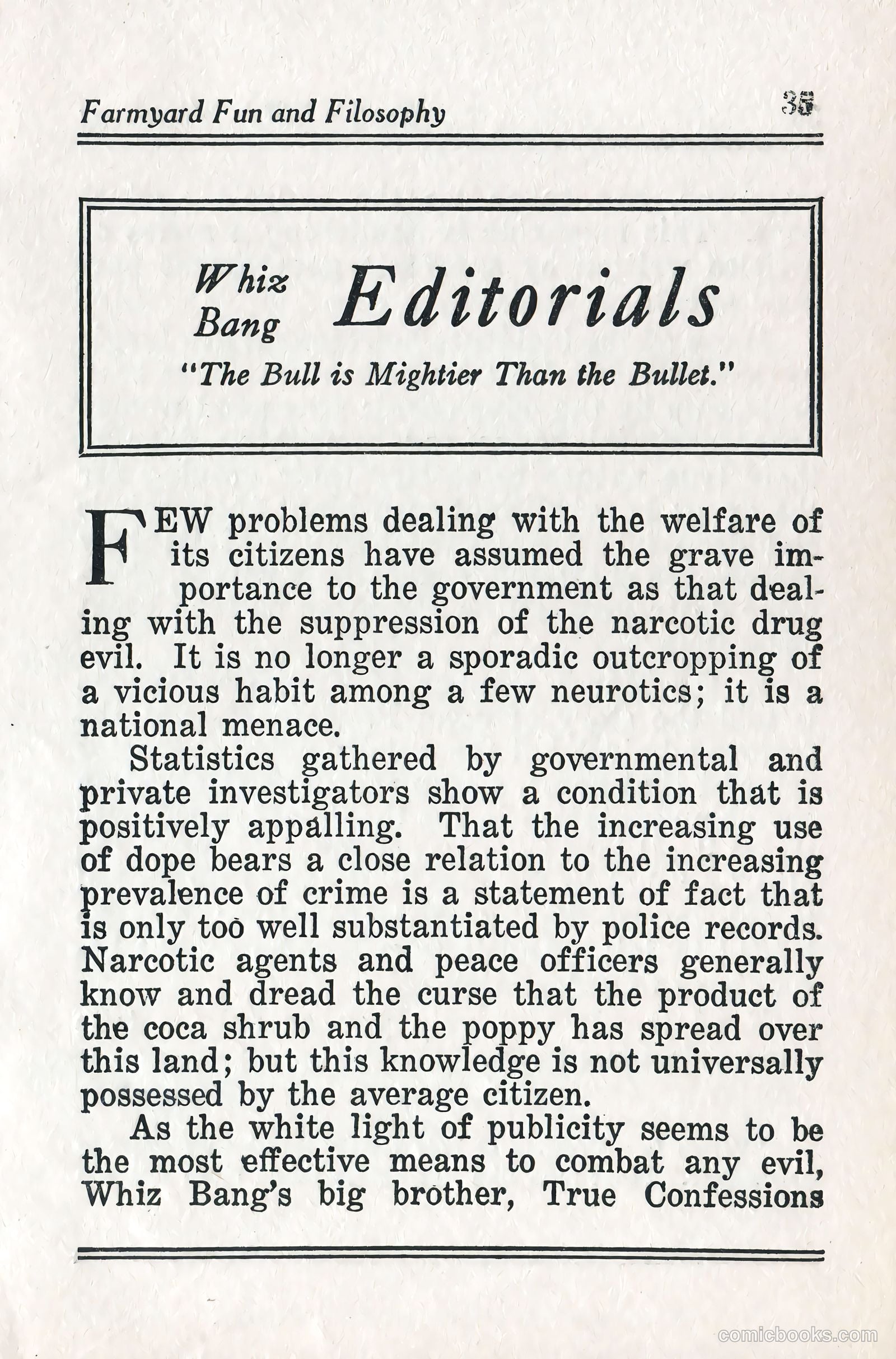
This is an editorial page (not a cartoon) from **Whiz Bang**, a satirical American magazine. The section titled "Whiz Bang Editorials" with the motto "The Bull is Mightier Than the Bullet" addresses the drug crisis as a serious national problem. The editorial argues that narcotic addiction—specifically cocaine and opium use—has become widespread and is directly linked to rising crime rates. While law enforcement understands this threat, the author claims ordinary citizens lack this awareness. The piece advocates for **public education through publicity** as the solution, referencing Whiz Bang's "big brother" publication, *True Confessions*, as a vehicle for exposing this evil through investigative journalism. The tone is reformist and urgent, reflecting early-20th-century Progressive Era attitudes toward drug prohibition and public health education campaigns. The "bull" metaphor suggests that bold, direct confrontation with the problem is more effective than violence.
This page from **Captain Billy's Whiz Bang** (a satirical magazine) contains anti-drug advocacy text rather than cartoons. The main content promotes articles about drug addiction's dangers, particularly from *True Confessions* magazine, which featured a story about actor John Paul Jones (a theatrical performer, not the historical admiral). The text describes drug addiction's devastating consequences: broken homes, moral degradation, and ruined careers—calling drugs "the great god—Junk." It emphasizes Jones's fall into "the lowest depths of degradation" and jail, but notes his redemption, framing the story as an emotionally gripping "human document." The final item is a brief satirical joke: responding to "When Is a Woman at Her Best?" with the cynical observation that men prefer women who aren't "too good"—a commentary on male hypocrisy regarding female virtue. The page reflects 1920s-era anti-drug messaging combined with the magazine's characteristic irreverent humor.
This satirical piece mocks what the author calls a "new American credo"—a moralistic impulse to criminalize personal preferences. The author argues that Americans increasingly declare their own tastes virtuous and others' tastes sinful, then seek to impose these views as law. The repeated examples (prize-fights, modern novels, alcohol, smoking, Sunday fishing) illustrate how arbitrary this moralism becomes. The author suggests that if such logic prevailed, even harmless activities like "twiddling thumbs" would face legal punishment. The closing quip about "skid chains" on one's wife suggests the suffocating constraint of living under such rigid moral policing—even with family. The piece critiques American puritanism and intolerance, likely responding to Prohibition-era moralizing. The title "Farmyard Fun and Philosophy" suggests this is satirical commentary disguised as rustic wisdom, mocking those who impose their values on others as absurd and tyrannical.
This page contains three satirical philosophical pieces typical of the magazine's style—no visible cartoon illustrations. The first presents a creation myth contrasting "Knockers" (negative, suspicious people) with "Boosters" (optimistic civic-minded individuals), suggesting humanity must choose between cynicism and positivity. The second briefly mocks ambition itself, comparing it to a toad chasing a star's reflection—absurd yet dignified by aspiration. The third addresses a real post-WWI political debate: whether to reduce taxes (favored by Treasury Secretary Andrew Mellon) or pay bonuses to returning soldiers. The satire criticizes politicians torn between fiscal conservatism and honoring veterans' service, implying their indecision reflects conflicting values rather than principled choice. This references genuine 1920s policy disputes over veterans' compensation.
This page discusses Prohibition-era politics. The main article references the **Volstead Act** (Prohibition law) and proposes modifying it to legalize light wines and beer, generating tax revenue to fund both a **soldiers' bonus** (post-WWI veterans' compensation) and tax cuts—specifically below Secretary of Treasury **Mellon's** $323 million proposal. The *Chicago Tribune* argues this compromise could satisfy both veteran advocates and those wanting lower taxes, while eliminating bootleggers and illegal "blind pig" bars. The piece mocks "fanatical drys" (Prohibition extremists) for prioritizing alcohol bans over veterans' justice. The final two short items are unrelated quips about changing social mores regarding marital fidelity and women's fashion—likely referencing the looser styles and morality of the "Roaring Twenties." The satire targets Prohibition's unpopularity and the false choice politicians presented between conflicting fiscal goals.
This page from the satirical magazine contains four distinct humorous pieces: 1. **The Drowning Joke**: Dark humor mocking pseudo-scientific advice—absurdly suggesting amputating one's legs to survive drowning, based on a misunderstanding of buoyancy. 2. **Caesar's Wife**: A witty restatement of the biblical maxim, implying Caesar's wife should avoid even the *appearance* of impropriety, not just actual wrongdoing. Likely a commentary on marital scandal or political wives' behavior. 3. **Treating the Elderly**: A lengthy, earnest passage advocating kindness to aging people, emphasizing life's brevity and moral duty—contrasting with the magazine's typical irreverent tone. 4. **Cemetery Traffic**: Sharp social satire comparing past generations who slowly visited cemeteries on Sundays with modern drivers who speed recklessly "at sixty miles per hour"—implying contemporary dangerous driving habits are literally filling cemeteries faster. This reflects 1920s concerns about automobile safety and mortality rates.
This page collects brief rural humor pieces typical of 1920s American satirical magazines. The content relies on period stereotypes: **"The Corn Was In the Colonel"**: A joke playing on a Kentucky Colonel's heavy drinking—the punchline suggests both the Colonel and mosquitoes are so drunk neither notices the other. **Crooked Fence anecdote**: Simple farmyard absurdist humor about a geometrically impossible fence. **"Crap Shootin' Blues"**: References gambling (craps), poverty, and family hardship in dialect, reflecting African American vernacular humor of the era. **"Warm Weather Stuff"**: A brief commentary on modern courtship—a "sheik" (1920s slang for a seductive man) stops his car under moonlight, but romance lacks excitement ("kick"). **Final joke**: A pun about ferries and fairy tales—pure wordplay. The page reflects early 20th-century rural Americana humor, using dialect humor and gentle satire about farming life, drinking culture, gambling, and modern dating customs.
This page from *Captain Billy's Whiz Bang* contains several brief humorous pieces typical of 1920s American satirical magazines: **"One Bottle of Milk, Please"** jokes on marital disappointment—a woman mistakes a stranger's kiss for romance, then coldly greets her actual husband, implying she'd prefer the stranger's attention. **The janitor/cook verse** is ethnic humor featuring an Irish character ("Shure me love") using stereotypical dialect and blarney to flirt. **"Santa Claus"** uses a common Depression-era trope: Santa bribing a poor boy with circus play to work (sawing wood), satirizing how children's labor was exploited under economic hardship. **"Protecting the Boys on Broadway"** mocks 1920s morality enforcement—a woman attempting independence is arrested by police and magistrate, suggesting authorities controlled female sexuality under the guise of "protection." **"The Dangerous Age"** cynically tracks female maturation: naïveté at sixteen, attraction to confidence at eighteen, skepticism by twenty—implying women naturally become wary of male intentions.
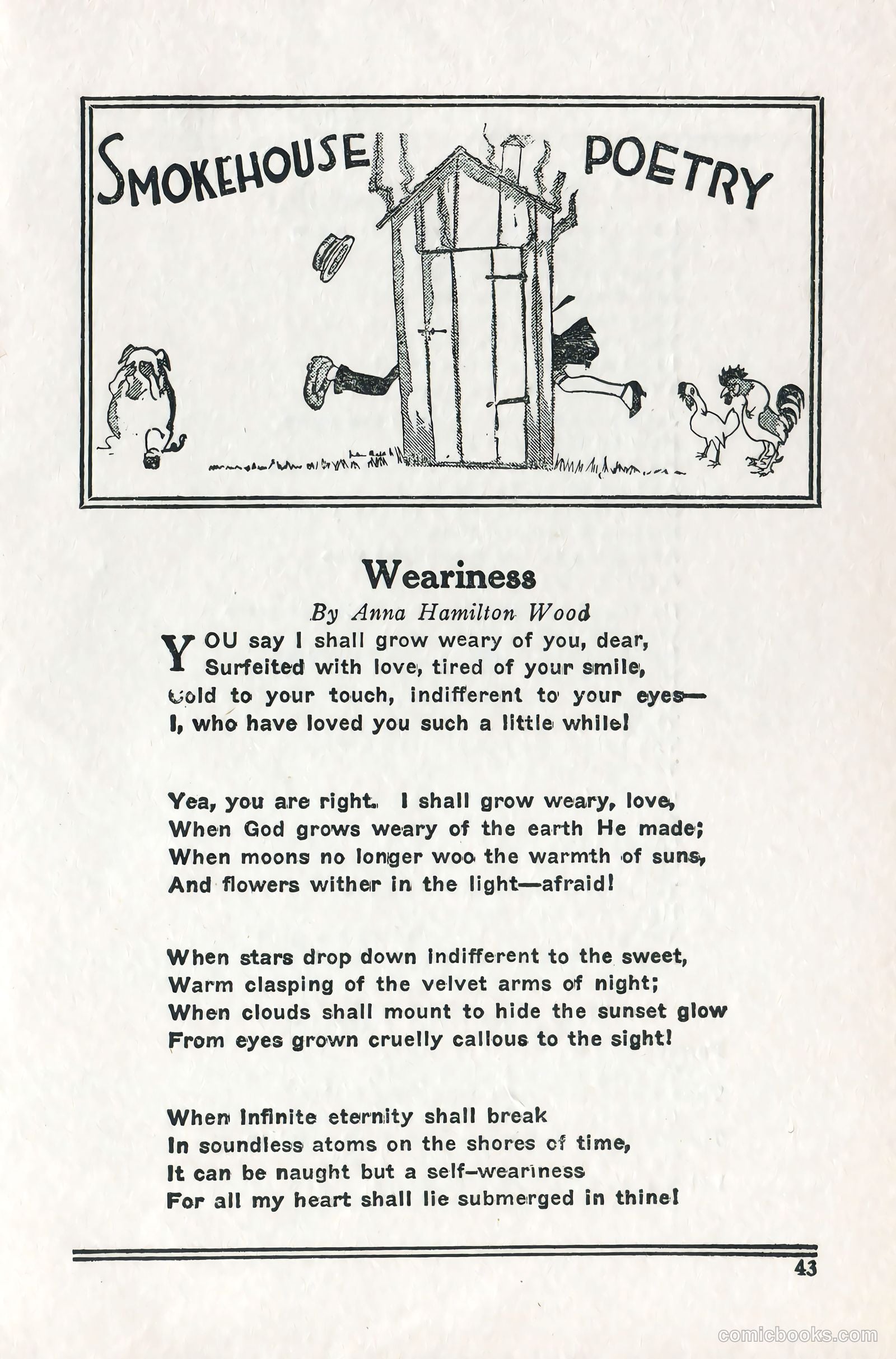
This page features a romantic poem by Anna Hamilton Wood published in *Whiz-Bang*, a satirical magazine. The header illustration shows a rustic smokehouse with figures around it—possibly depicting rural or working-class life, fitting the magazine's irreverent humor. The poem itself is a love declaration responding to accusations of inevitable romantic fatigue. The speaker argues she'll only grow weary of her beloved when cosmic forces fail—when God tires of creation, when celestial bodies lose their warmth, when eternity itself collapses. It's hyperbolic romantic sentiment, asserting eternal devotion through increasingly absurd cosmic scenarios. The "Smokehouse Poetry" header appears to be *Whiz-Bang's* humorous framing device, suggesting this earnest romantic verse represents unsophisticated or rural sentiment—the magazine's typical target for gentle mockery. The juxtaposition between the lowbrow aesthetic and the poem's grandiose metaphysical claims creates the satirical effect.
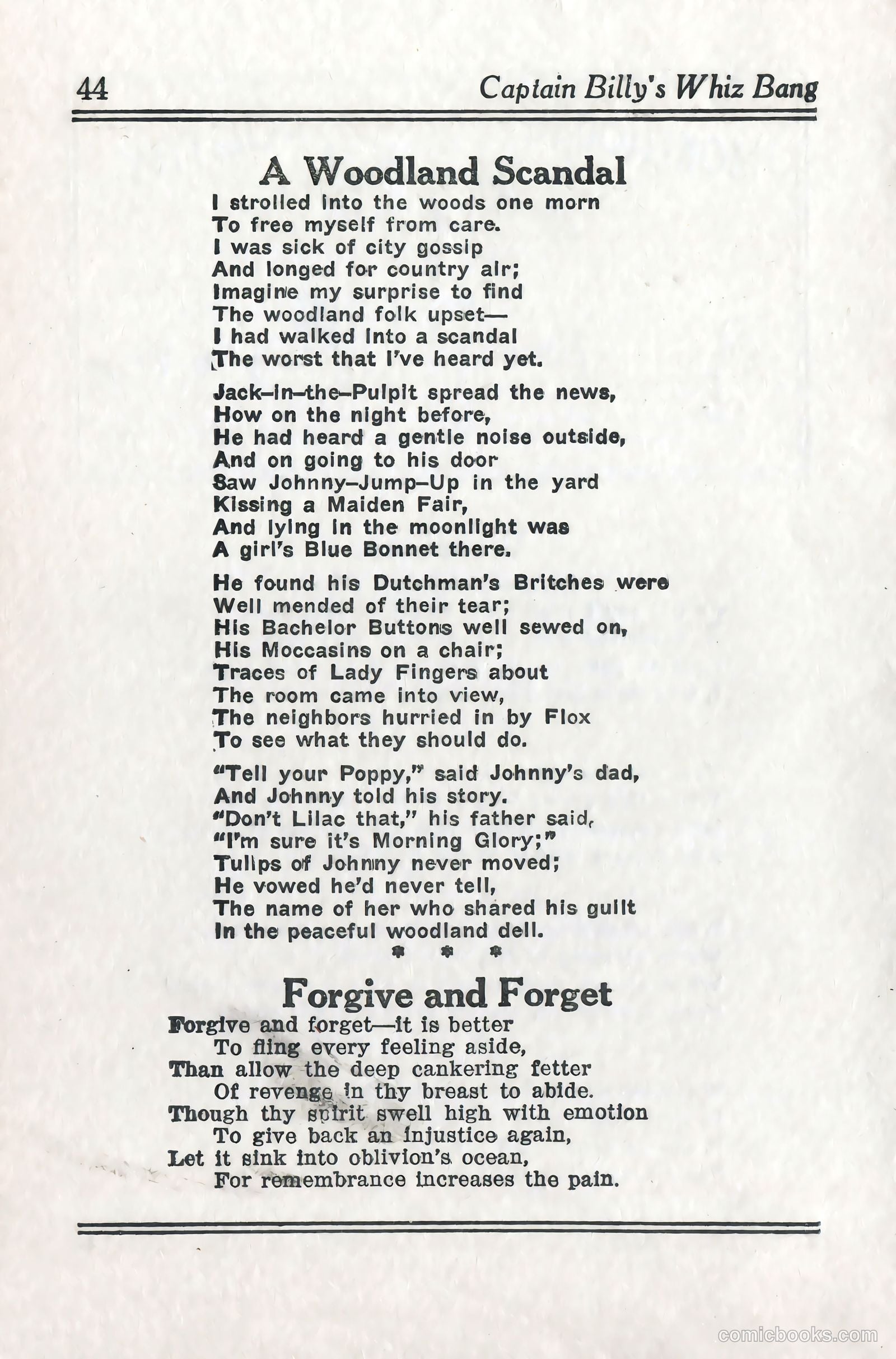
This is a clever pun-based poem disguised as gossip. Rather than depicting actual people or political figures, it's a whimsical story where **all the "characters" are flowers and plants with common names**—Jack-in-the-Pulpit, Johnny-Jump-Up, Maiden Fair, Blue Bonnet, Dutchman's Britches, Bachelor Buttons, Lady Fingers, and Morning Glory. The "scandal" is Johnny-Jump-Up kissing Maiden Fair in the woods. The humor lies in the double meanings: the flower names create an absurd melodrama of neighborhood gossip, while the adults' dialogue (Johnny's father suggesting it's "Morning Glory" instead, warning not to "Lilac that") employs botanical puns as euphemisms for indiscretion. The accompanying poem "Forgive and Forget" suggests the moral: overlook transgressions rather than harbor resentment. This appears to be lighthearted satire of small-town busybodies and gossip culture, using nature wordplay for family-friendly humor typical of *Whiz Bang* magazine's comedic style.
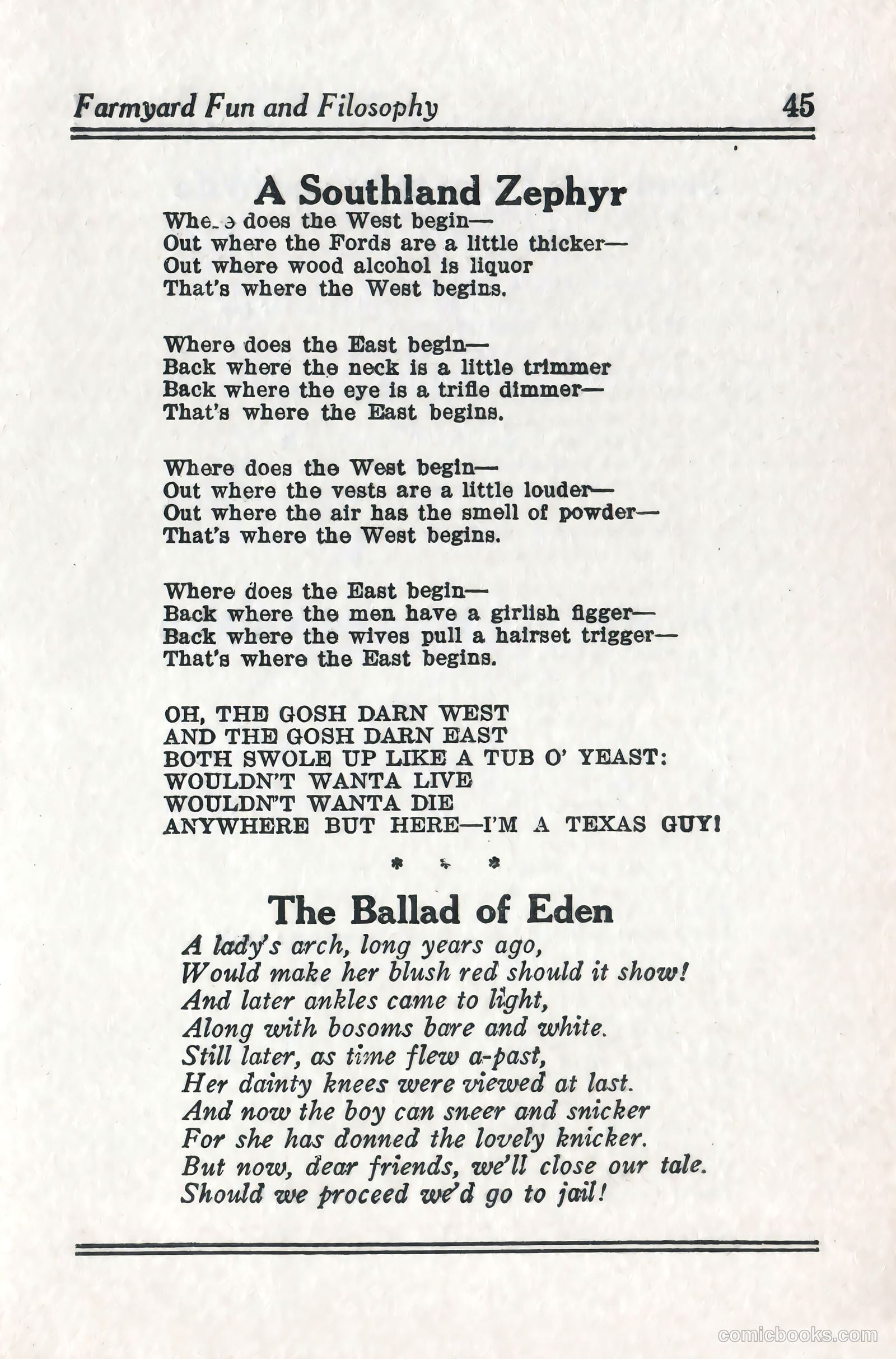
**"A Southland Zephyr"** is a satirical poem mocking regional American stereotypes. It contrasts the "West" (rural, rough, bootlegging during Prohibition with "wood alcohol") with the "East" (effete, fashion-conscious). The joke hinges on exaggerated physical differences: Western men are tough; Eastern men are feminized ("girlish figger"). The finale celebrates Texas identity above both regions—capturing 1920s regionalism and the cultural divide between rural and urban America. **"The Ballad of Eden"** is sexual/social satire about women's changing fashion and modesty standards. It traces how women's clothing gradually became more revealing (ankles, bosoms, knees, now "knickers"). The final couplet jokes that describing further changes would constitute obscenity prosecutable under law. This reflects 1920s anxieties about "flapper" fashion and changing morality post-WWI. Both pieces use humor to comment on social change and regional/gender divisions of the era.
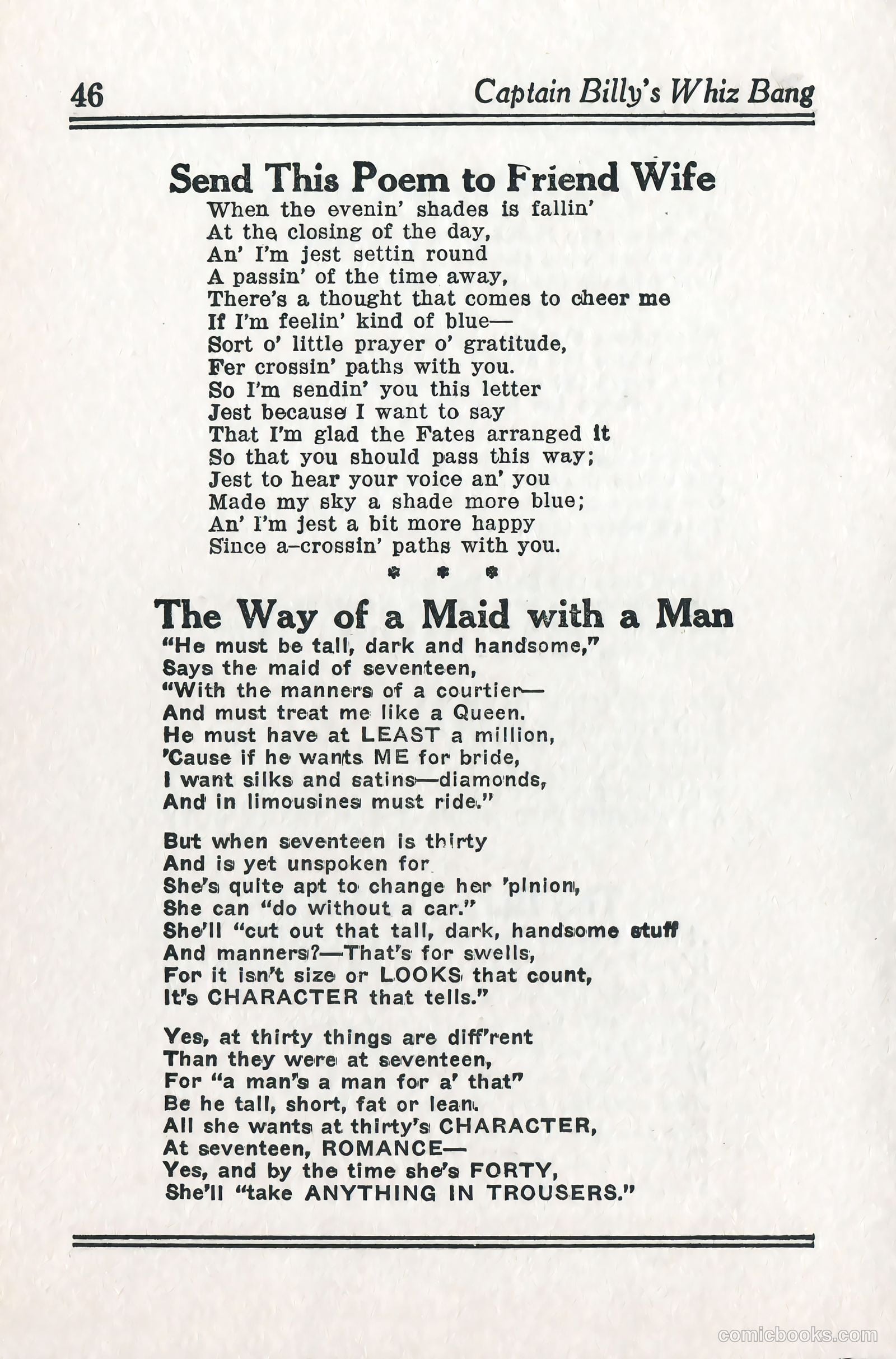
This page contains two humorous poems typical of this satirical magazine's content. The first poem, "Send This Poem to Friend Wife," is sentimental verse about gratitude for companionship—seemingly genuine but positioned as something a husband should send to his wife. It's likely presented as earnest material that readers could actually use. The second poem, "The Way of a Maid with a Man," is satirical commentary on women's changing expectations across life stages. It mocks female materialism and romantic idealism at seventeen (demanding wealth, handsomeness, luxury), then contrasts this with supposedly more pragmatic thirty-year-old values emphasizing "character." The punchline—that by forty she'll "take ANYTHING IN TROUSERS"—delivers crude satire suggesting aging, unmarried women lower standards drastically, reducing romantic expectations to mere male presence. The humor targets both youthful female vanity and the desperation of aging single women, reflecting era attitudes about marriage and aging.
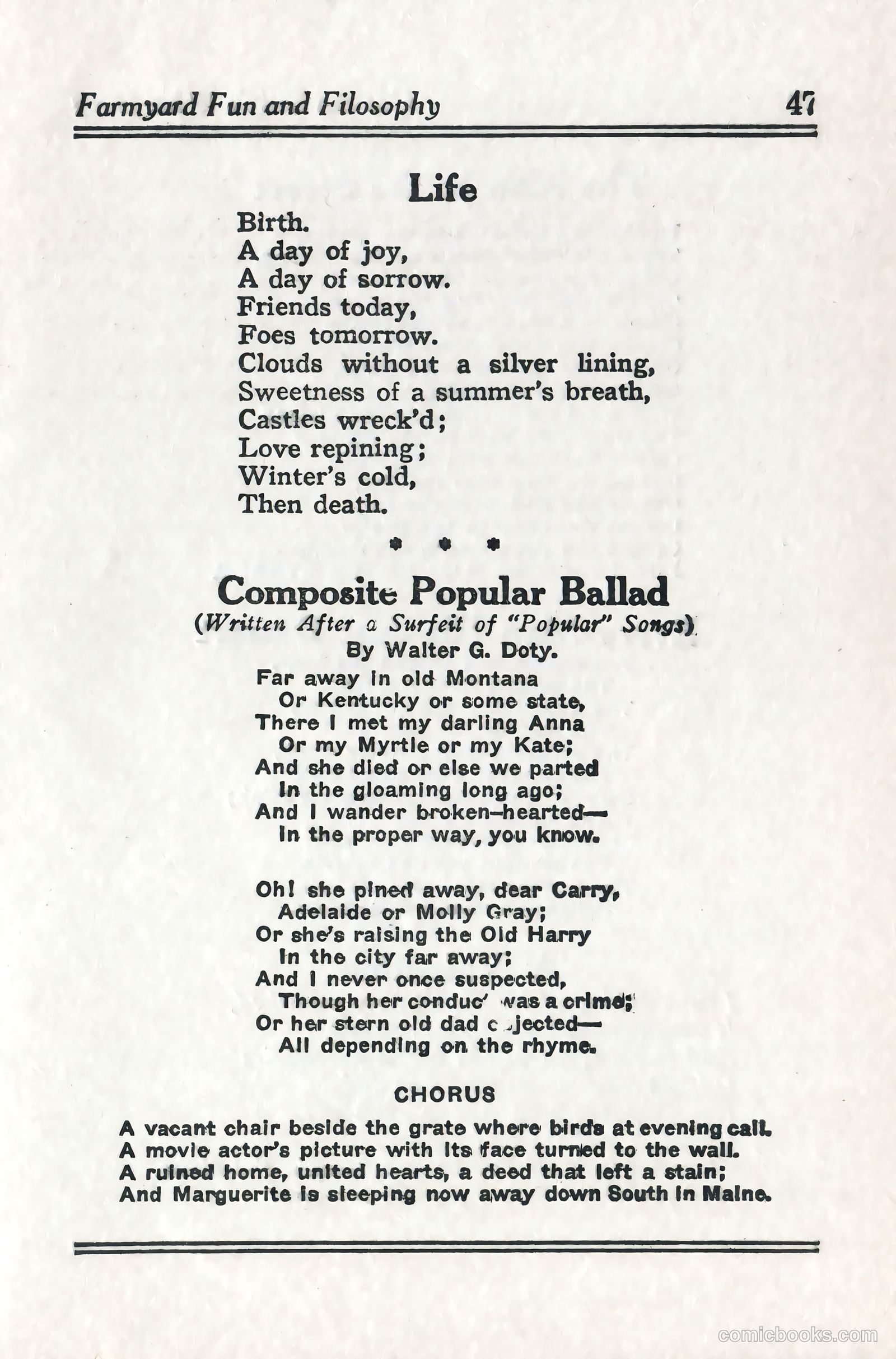
This page satirizes the clichéd conventions of early 20th-century popular songs. Walter G. Doty mocks how these sentimental ballads recycled identical emotional tropes: lost love in vague rural settings, interchangeable female names (Anna, Myrtle, Kate, Carry, Molly Gray), tragic separations, and melodramatic heartbreak. The humor lies in exposing how artists simply plugged different names and details into the same template, caring more about rhyme scheme than narrative coherence—"All depending on the rhyme." The chorus parodies the absurd imagery these songs stacked together: vacant chairs, turned-around photographs, ruined homes, and contradictory geography (Marguerite sleeping "down South in Maine"). For modern readers: this is essentially mocking the formulaic sentimentality of 1920s pop music the way we might mock contemporary bubblegum pop or melodramatic country songs—pointing out how interchangeable and emotionally manipulative they were.
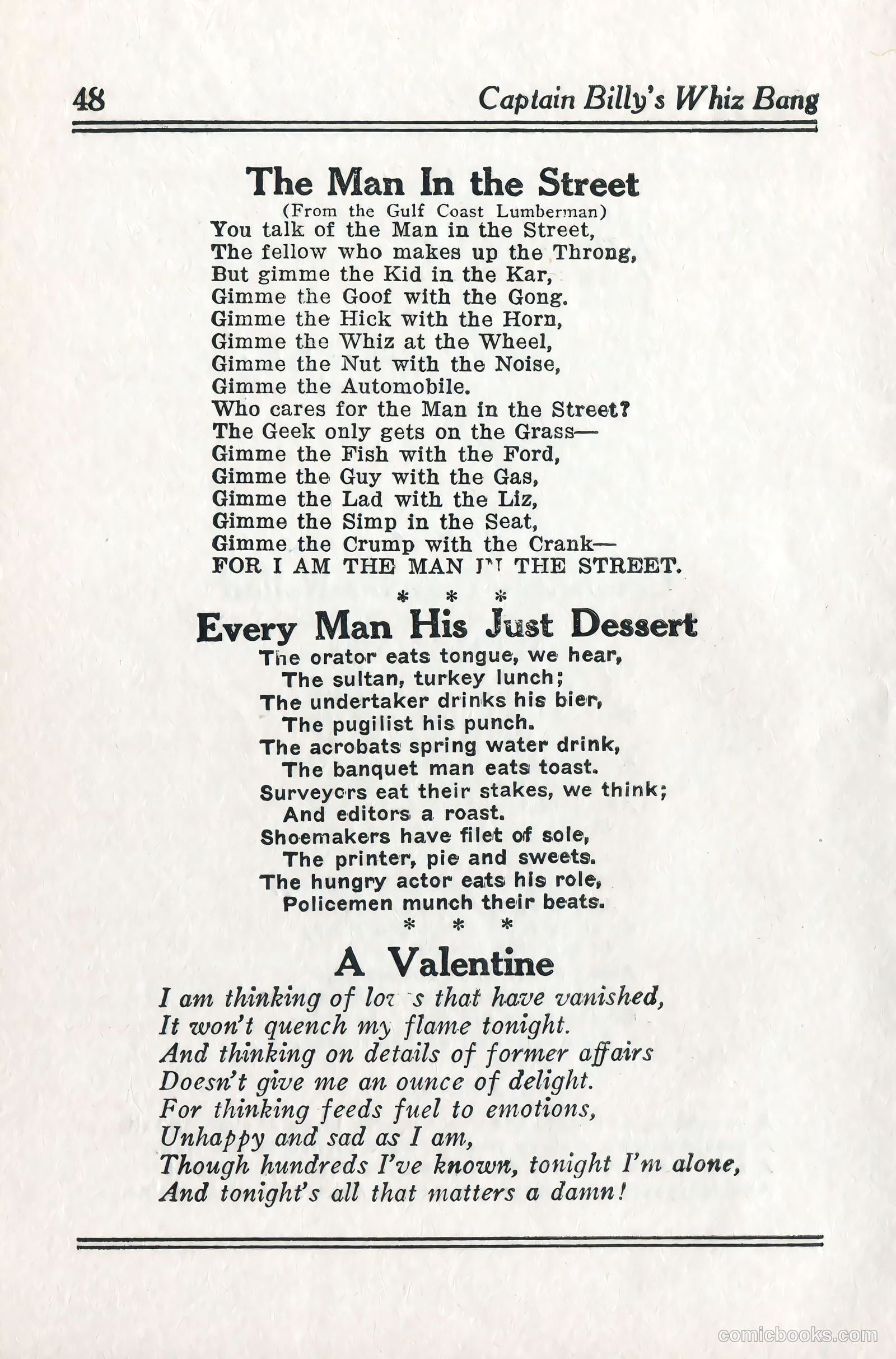
This page contains three humorous poems reflecting 1920s American society: **"The Man in the Street"** satirizes the new automobile culture. The speaker ironically claims to champion "the Man in the Street" (the common person) while actually celebrating reckless drivers—the "Kid in the Kar," the "Whiz at the Wheel," and various "Nuts" making noise. The joke is that this "man in the street" is actually a menace, honking horns and speeding, yet he boasts "FOR I AM THE MAN IN THE STREET." It mocks both automobile enthusiasm and working-class bravado. **"Every Man His Just Dessert"** uses puns based on professions: orators eat "tongue" (they talk), surveyors eat "stakes," editors get "roasted," printers eat "pie," and policemen "munch their beats." It's wordplay humor typical of period comedy. **"A Valentine"** is a cynical love poem—the speaker dismisses past romances as meaningless and declares that only the present moment matters. It's sentimental yet bleakly modern in tone. These poems reflect post-WWI American culture: automobile anxiety, workplace satire, and romantic disillusionment.
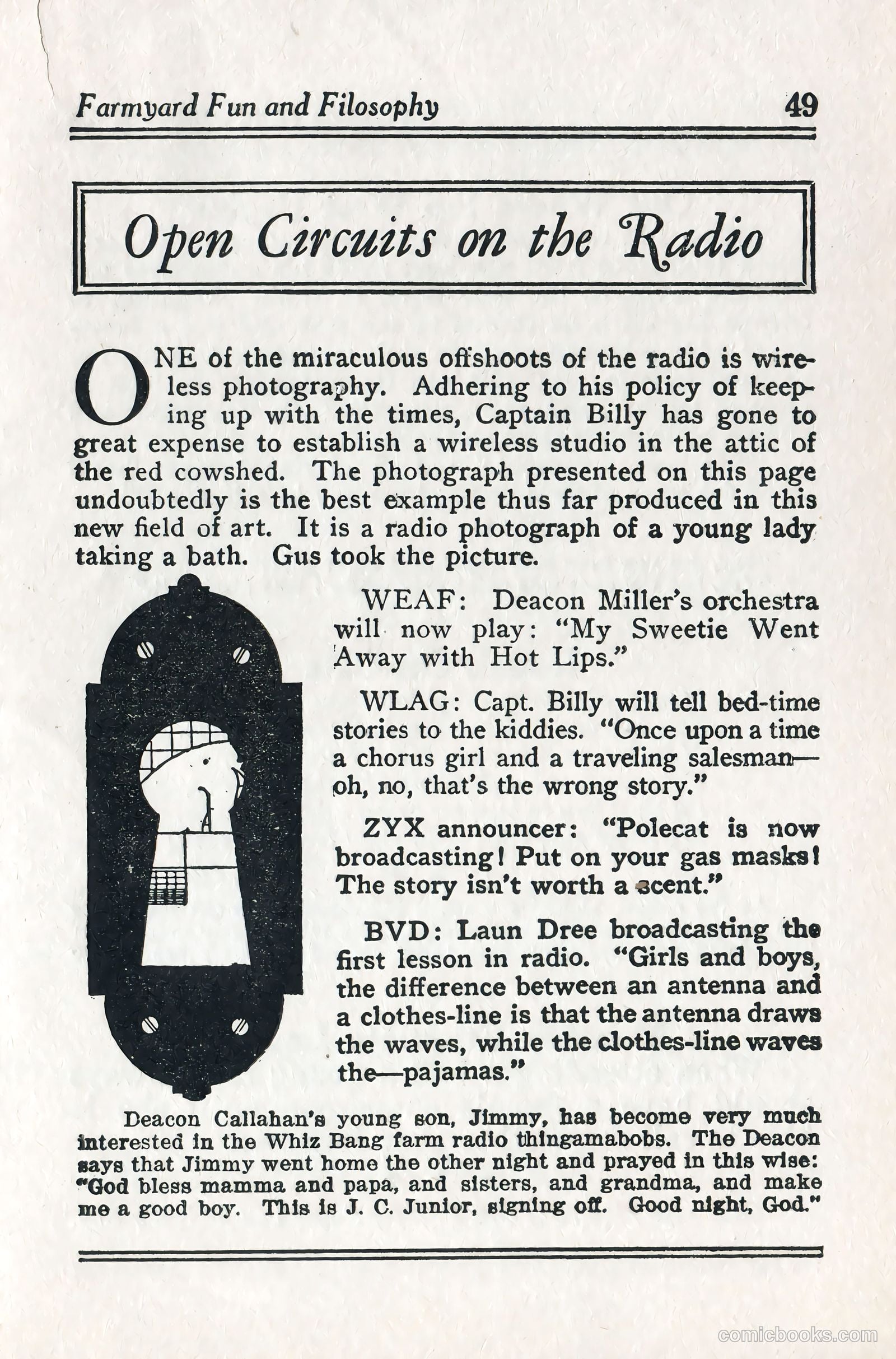
This page satirizes early 1920s radio broadcasting's novelty and absurdity. "Captain Billy" (the magazine's owner) claims to have created "wireless photography"—a fake technology—supposedly showing a woman bathing, mocking both radio's miraculous reputation and crude humor. The fake radio station callouts parody actual early broadcasters with increasingly risqué jokes: Deacon Miller plays a suggestive song title; Captain Billy nearly tells a "traveling salesman and chorus girl" joke (a known risqué format); a "Polecat" broadcast is worthless; and "Laun Dree" (laundry, a pun) makes innuendo about pajamas and clotheslines. The final joke depicts young Jimmy mimicking radio sign-offs during prayer—satirizing how radio's broadcasting conventions were becoming embedded in everyday speech and behavior, even among children. The humor relies on radio being still-novel enough that its conventions seemed both impressive and ridiculous.
This page contains several brief humorous sketches typical of early 20th-century American satirical magazines: **"Out Where the West Begins"** references Bill Nye, a real Western humorist and editor of *The Boomerang* in Laramie, Wyoming. The anecdote satirizes the rough frontier code: an Eastern "tenderfoot" (inexperienced newcomer) attempts privacy while changing clothes, but Western barroom patrons violently reject this "civilized" behavior, shooting through his makeshift newspaper screen. The joke mocks both Eastern propriety and crude frontier masculinity. **"Rough On Cats"** is a bawdy poem parodying overly romantic "love" songs—the speaker wants rough treatment as proof of authentic passion, ending with a drunk man's confused murmur comparing his girlfriend to striped stockings. **"Monthly Etiquette Lesson"** offers mock-serious advice about chaperones, using coded language ("call some other chap her own") for courtship conventions. The final line uses contemporary slang ("Maple Sugar"/"Sap") for romantic relationships. These pieces reflect Whiz Bang's irreverent, working-class humor targeting Victorian social norms.
This is a satirical gossip column from *Whiz-Bang* magazine (February 1, 1924) about Hollywood scandal. An unnamed Eastern filmmaker, visiting the Western film industry, was caught at a female film star's home. When a gunshot was fired in her drawing room—likely by an angry party—he fled at extraordinary speed to the railroad station without saying goodbye. The joke mocks both his cowardice and the scandalous affair: he ran so fast he set unofficial sprint records, suggesting either jealous violence or a setup to humiliate him publicly. The second item jokes that golfer Gene Sarazen's engagement to actress Pauline Garon is positive because he's a "real champion"—implying that if he neglects her for golf (the "nineteenth hole" being bar-room drinking), at least he's accomplished elsewhere, unlike mediocre golfers. Both items exemplify 1920s Hollywood gossip culture and sexual scandal.
This page contains three gossip-column items satirizing 1920s celebrity and social scandals: 1. **The McLaughlin fight**: Major Frederick McLaughlin (husband of famous dancer Irene Castle) beat up a traveling salesman aboard a ship for making inappropriate remarks about Castle. The joke plays on Prohibition-era boxing matches held illegally beyond the three-mile limit. 2. **Elinor Glyn controversy**: Actress/novelist Elinor Glyn sent promotional stills of her film "Three Weeks" to Spain's queen but allegedly snubbed England's queen. The satire humorously suggests this diplomatic slight might damage Anglo-Spanish relations as severely as the historical Spanish Armada. 3. **Will Rogers**: The comedian made irreverent remarks about religion versus entertainment at a luncheon, which a clergy member found amusing rather than offensive. The column's tone mocks celebrity drama and social pretension through exaggeration and sarcasm.
This page contains three separate gossip items and satirical commentary typical of early 20th-century scandal sheets. The first item attributes to "Rogers" (likely Will Rogers, the famous humorist) a cynical joke about missionary work: Western churches and film studios send missionaries and movies to "heathens" who, the joke implies, are sophisticated enough to dismiss both—eating missionaries if appetizing, laughing off the films. The satire mocks Western cultural imperialism and self-congratulatory missionary efforts. The second item celebrates elderly actor Bert Woodruff's marriage to his childhood sweetheart, presenting romantic sentiment as triumphing over age. The third, longest item ridicules Mrs. Daniel Sully, wife of a wealthy cotton broker, over her son Billy's $200,000 lawsuit by actress "extra girl" Yvonne Darcy. The satire targets the scandal's impact on financial markets and Mrs. Sully's apparent denial of her son's misconduct—mocking both high society's pretensions and maternal blindness to scandal.
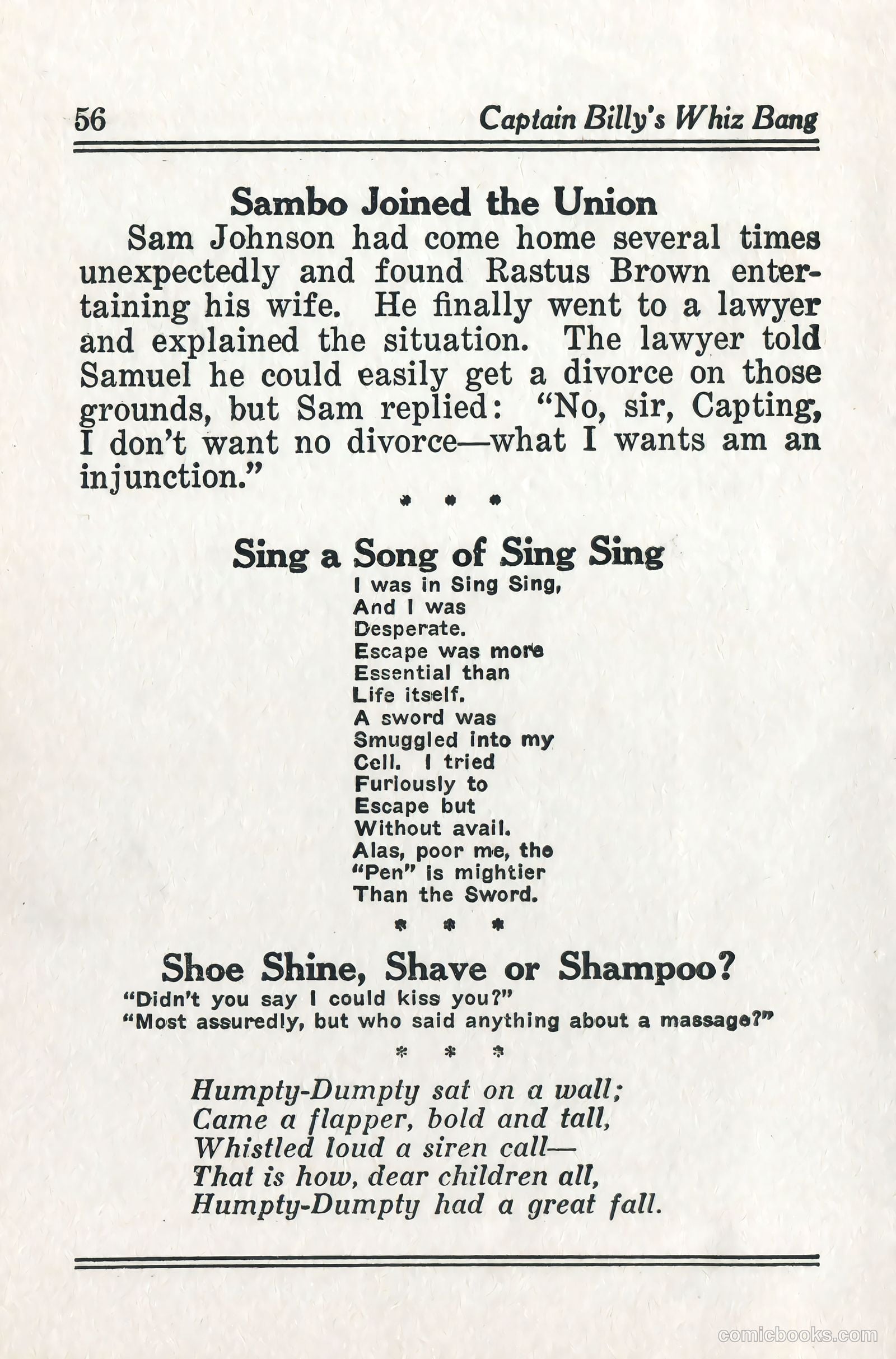
This page from *Captain Billy's Whiz Bang* (a humor magazine) contains several short jokes and anecdotes, all referencing **Prohibition-era America** (1920s-1930s). **"Going Back to Her Youth"** depicts Mandy, a Black hotel maid, searching guest rooms for leftover alcohol—illegal under Prohibition. She discovers a bottle labeled "Plato" (likely a patent medicine containing alcohol, which technically circumvented Prohibition laws). The porter warns her against drinking it; the humor derives from her defiant response. **The Volstead reference** alludes to the Volstead Act, which enforced Prohibition. **"The Robbinsdale Gallery of Art"** is a rural grocer's joke: he won't sell "bathin' beauty postcards" because he enjoys looking at them himself—mild sexual humor. **Final exchanges** include a beer advertisement (promoting near-beer, a legal alcohol-free substitute) and jokes about patent medicines like Peruna and Taniac—products marketed as medicinal but often alcohol-heavy, exploiting Prohibition loopholes. The overall tone mocks Prohibition enforcement and the hypocrisy of "medicinal" alcohol sales.
This page contains three separate humorous pieces typical of early-20th-century American satirical magazines: **"Kitty, Kitty, Kitty"** is a simple pun: the barber's reply "we do not" sounds like "we do not" but plays on the name "Katz" (cat). **The Rosebud anecdote** is farmyard humor about a cow straining itself jumping, with the joke being the absurd medical diagnosis that jumping strained her milk production. **"Scrambled Eggs"** is a nonsensical verse poem satirizing Christopher Columbus by depicting him as a Bolshevik (likely a topical jab at revolutionary politics), then descending into absurdist humor with impossible scenarios—fish with legs, the "cow that jumped the moon" (referencing the nursery rhyme). The incoherent geography and logic appear intentionally ridiculous. Overall, this represents low-brow, pun-based humor typical of this publication's "Farmyard Fun" section, mixing wordplay with deliberately absurd situations for comedic effect.
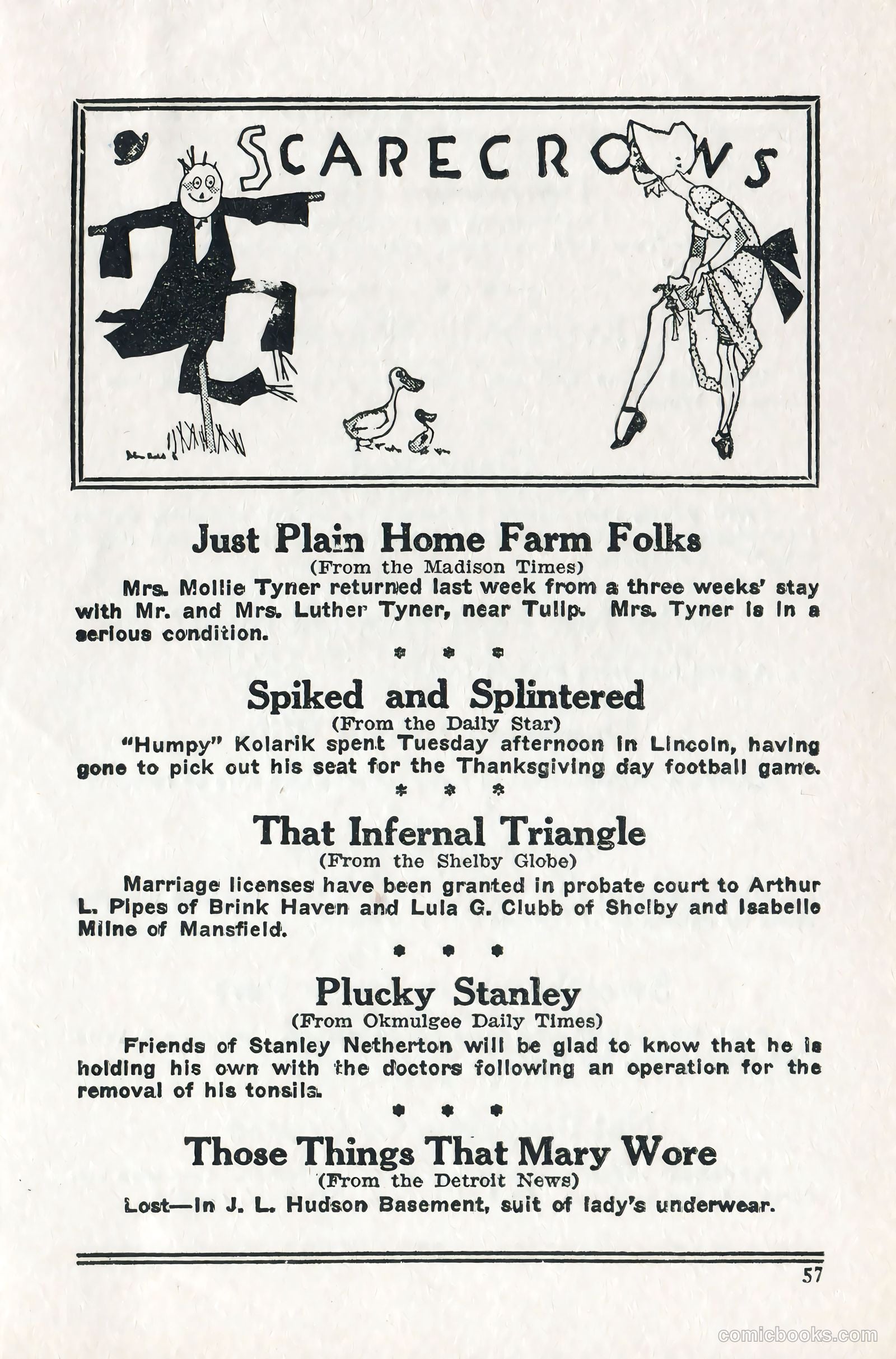
This page collects humorous small-town newspaper items under the heading "Scarecrows"—likely satirizing rural gossip and absurdity. The cartoons at top depict exaggerated scarecrows and a woman, visual metaphors for the foolish content below. The jokes mock mundane local news: a woman's illness, a man attending a football game, a "love triangle" where two women marry different men simultaneously (creating scandal), a man's tonsil surgery, and a lost pair of underwear. Each item is sourced from different regional newspapers, suggesting this was a widespread phenomenon of trivial reporting. The humor targets small-town culture's preoccupation with petty scandals and non-events treated as major news. The "scarecrow" framing implies these stories are hollow—just straw-stuffed gossip meant to scare or amuse rather than inform. It's gentle satire of rural American journalism's breathless coverage of nothing consequential.
This page contains no cartoons—it's a humor section reprinting absurd classified ads and headlines from real newspapers. The satire works through **incongruity and double meanings**. The jokes exploit awkward phrasing in genuine advertisements: - "Downtown Girls" and "Everybody Welcome" set up expectations for entertainment venues, but advertise mundane services (roomers, women's clothing) - "Classy-fied" plays on a woman mistaking a stranger for her husband at a masquerade - "Why Not Feed Him Oil Meal?" repurposes an agricultural headline as innuendo - "Strayed or Stolen" absurdly describes a chicken as lost "from machine" - "Not Bragging, Of Course" uses euphemistic language ("understands her business") to imply the widow seeks a gentleman caller for undisclosed purposes The humor targets small-town America's naive, unintentionally suggestive classified ads. By reprinting real notices from actual regional papers (Ohio Tribune, Miami Herald, etc.), *Whiz Bang* mocks both the advertisers' accidental impropriety and period attitudes toward propriety itself.
This page from *Whiz-Bang* contains three separate humor pieces: 1. **"Oh, You Married Women!"** — A brief joke playing on infidelity: a bachelor claims he wants to marry a woman specifically so he can experience being "loved by a married woman" (implying affairs). 2. **"Watson! The Insecticide!"** — A humorous poem imagining life as various insects, each chosen for opportunities to bite or annoy people (horseflies, mosquitoes, kissing bugs, hornets, and finally soap in a "fairy's bath"). The humor relies on crude double-entendres and puns about biting/bothering humans, typical of 1920s-era satirical magazines. 3. **Final joke** — A pun on "crop" and "thrashed," with "Gus" making a crude joke about chickens that's deliberately obscure. The overall tone is lowbrow, irreverent satire mocking romantic/sexual conventions and featuring animal-based innuendo—standard fare for *Whiz-Bang*, known for bawdy humor.
This page from *Whiz Bang*, a humor magazine popular in the 1920s-30s, contains several satirical pieces targeting social hypocrisy and masculine pretension. **"Oh! Those Shotgun Blues"** mocks marriage troubles through regional editorial banter—Eastern, Western, and Southern editors trade quips about infidelity and broken promises, suggesting marital discord was widespread regardless of region or commitment level. **"Cynical Mutterings"** presents bleak observations about fair-weather friendship and social status, claiming people abandon you when you're broke ("haven't got the jack") and suggesting dependence on friends is foolish. The **ex-soldier/ex-pressman exchange** sarcastically deflates masculine boasting—both men claim importance from past employment, with the pressman's deadpan one-upmanship suggesting such claims are equally hollow. The **autograph album rhyme** is a cheeky double-entendre about not "shaking trees" (sexual proposition), typical of the magazine's risqué humor for a male audience. Overall, the page satirizes infidelity, false friendship, and masculine vanity.
This is a humor advice column mimicking rural readers' letters to a magazine. The jokes work through absurdist non-sequiturs and puns targeting early 20th-century American culture: **The satire targets:** - Medical/hygiene fads (rubber gloves for courting a nurse) - Sentimental popular culture ("Sweet Adeline" as a drunkard's prayer) - Emerging Hollywood celebrity culture (asking if May Fitzgerald is a movie queen) - Rural simplicity (naming a child "Roe Sawbuck"—a play on money) - Patriotic kitsch (military-themed gift suggestions) The column's humor relies on readers recognizing how absurd these "solutions" are while playing with period slang, puns, and stereotypes about rural Americans. The fake names of letter-writers (Jack N. Turn, Musta'ra Hugg) suggest wordplay itself ("jackin' turn," "mustache hug"). It's essentially lowbrow comedy exploiting rural/urban divides popular in the era's satirical magazines.
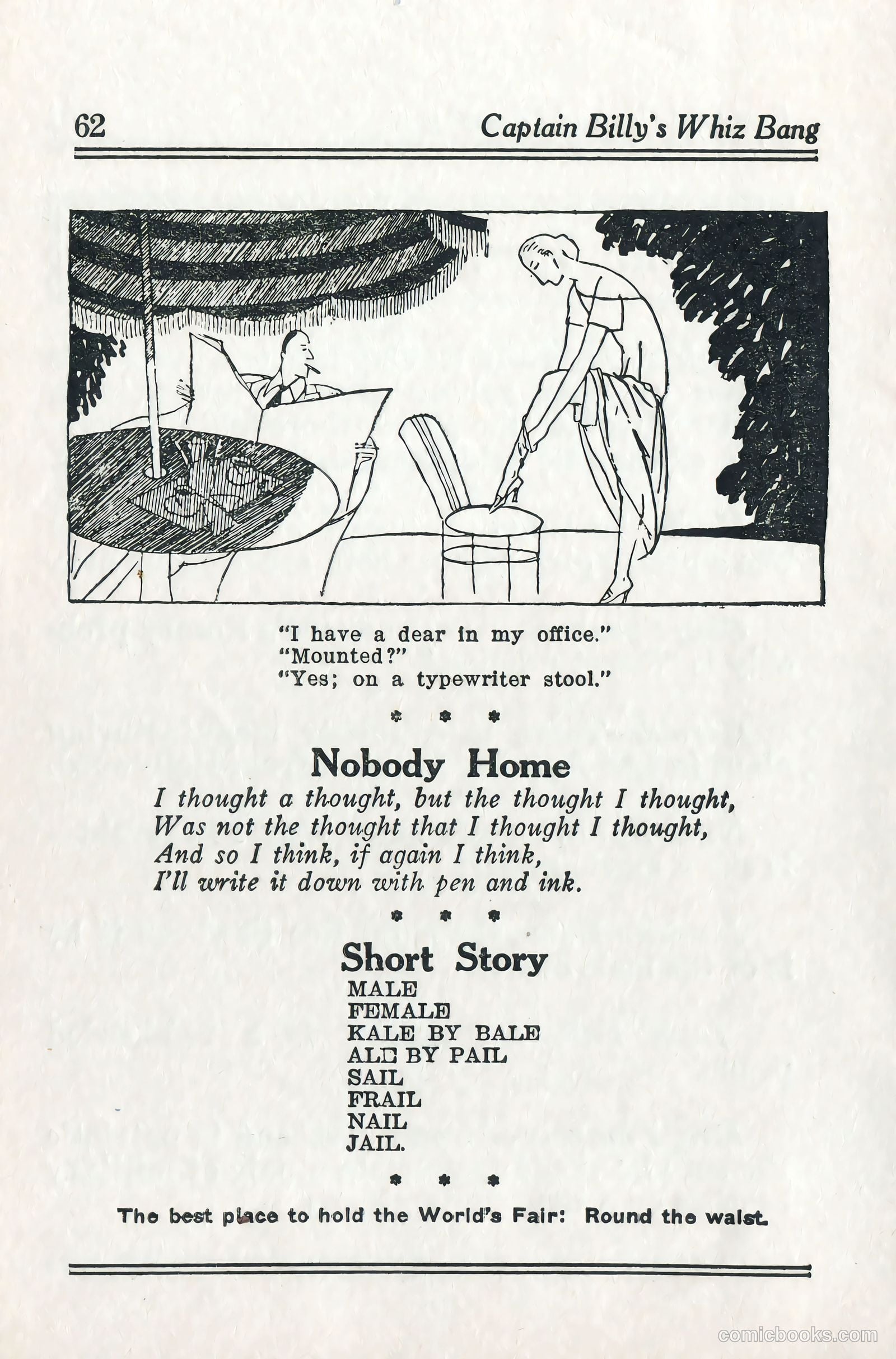
This page from *Captain Billy's Whiz Bang* (a 1920s humor magazine) contains several unrelated jokes: **Top cartoon**: A visual pun about a mounted "deer" (likely meaning an attractive woman) in an office—the joke being she's mounted on a typewriter stool rather than being an actual taxidermied animal. It plays on double meaning and office flirtation humor common to the era. **"Nobody Home"**: A tongue-twister poem poking fun at muddled thinking—"if I think again, I'll write it down"—mocking absent-mindedness or forgetfulness. **"Short Story"**: A word-association joke listing rhyming pairs (male/female, kale/bale, ale/pail, etc.) that form a nonsensical narrative—humor based on absurdist wordplay. **Final joke**: A mildly suggestive one-liner about women's body size and fashion, referencing the 1920s "World's Fair" craze. The humor relies on physical comedy stereotypes typical of period magazines.
This page contains brief humor pieces typical of *Whiz-Bang*, an American satirical magazine. The jokes include: **"A Fast Train in Arkansaw"**: A traveler misses his stop because the train engineer deliberately refuses to stop there out of spite toward the station agent—absurdist humor about petty railroad dysfunction. **"Don't Crowd, Boys"**: A limerick (attributed to "Lord Jeff, Amherst") about a beautiful woman from Exeter whose husband protectively guards her from admirers' attention. **"Those Infant Industries Again"**: A satirical jab at France instituting a decoration for large families (ten+ children), with the joke being that France already had the "Médaille d'Industrie"—making the new award redundant or ironic. **"Blue Jay's Tickler File"**: Adam-and-Eve jokes: one about New Year's resolutions on Saturday (implying procrastination), another pun where a surgeon says "here's where I cut in" (double meaning: inserting himself and making surgical incisions). The page showcases typical early-20th-century American humor: ribald, punny, and satirizing social conventions.
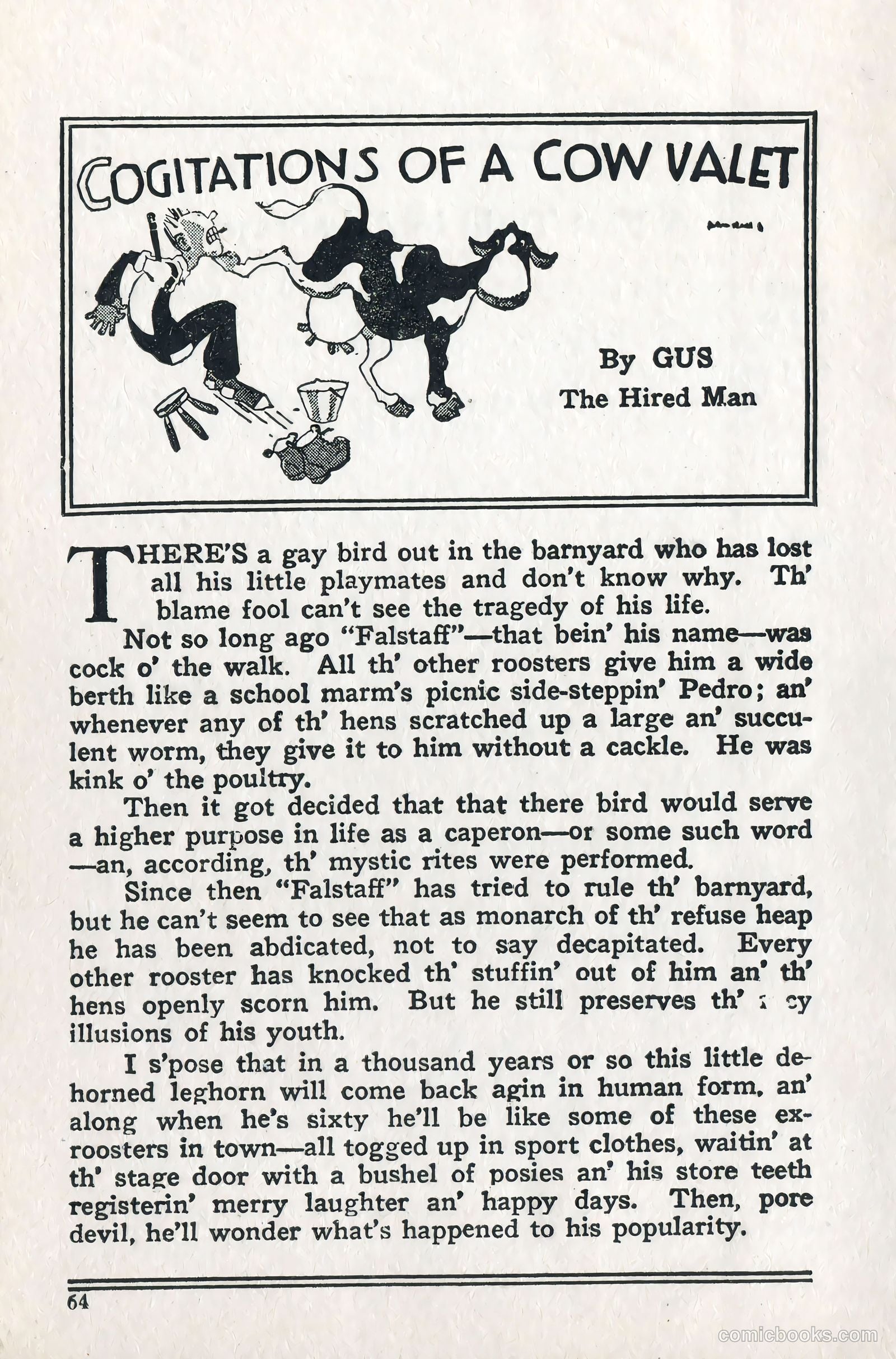
This is a humorous barnyard fable by "Gus the Hired Man." A rooster named "Falstaff" was once the dominant bird in the farmyard—respected and pampered by the hens. After being castrated (euphemistically called becoming a "caperon"), he lost his status and masculinity. Other roosters now fight him, and hens scorn him, yet he clings to delusions of his former glory. The satire compares this castrated rooster to aging ex-playboys in town—once popular, now pathetically dressed up and waiting at stage doors with flowers and false teeth, desperately seeking attention they once commanded. The joke ironically suggests that such men, like Falstaff, will eventually wonder what happened to their lost youth and popularity. It's a commentary on masculine vanity and the inevitable decline of status.
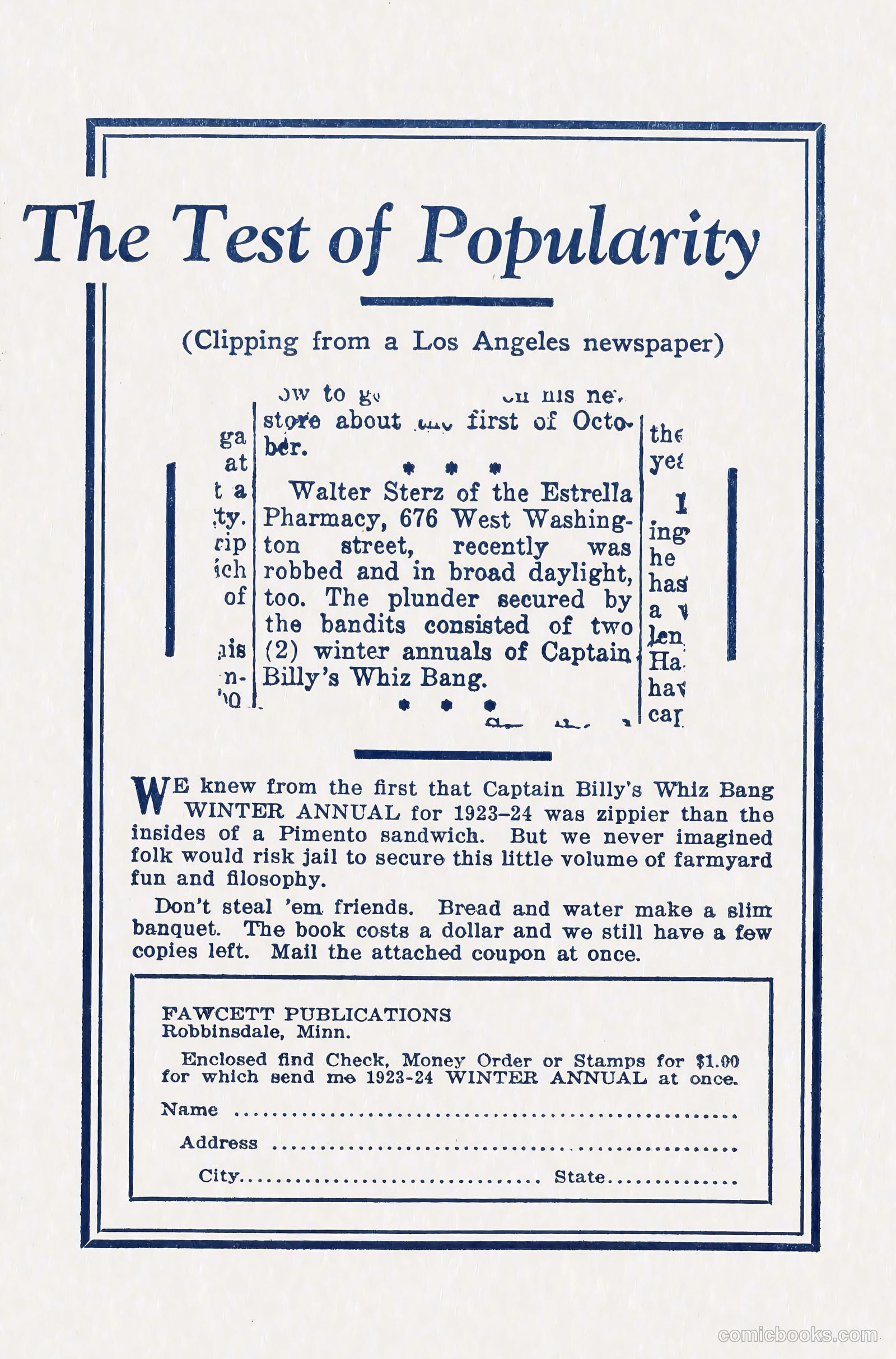
This page is primarily **advertising, not satire or political commentary**. It's a mail-order ad for "Captain Billy's Whiz Bang Winter Annual for 1923-24," a humor magazine. The headline "The Test of Popularity" frames a humorous anecdote: a pharmacy in Los Angeles was robbed in broad daylight—but the thieves only stole two copies of the Whiz Bang annual, suggesting the magazine's exceptional popularity and desirability. The joke is self-promotional: even criminals apparently want this publication. The ad emphasizes the book's value ("a dollar") and appeals to readers to purchase it legitimately ("Don't steal 'em friends") rather than risk jail. The torn newspaper clipping format and mock-serious tone create the humor, but this is fundamentally a **direct-response advertisement** with an embedded joke, not political satire.
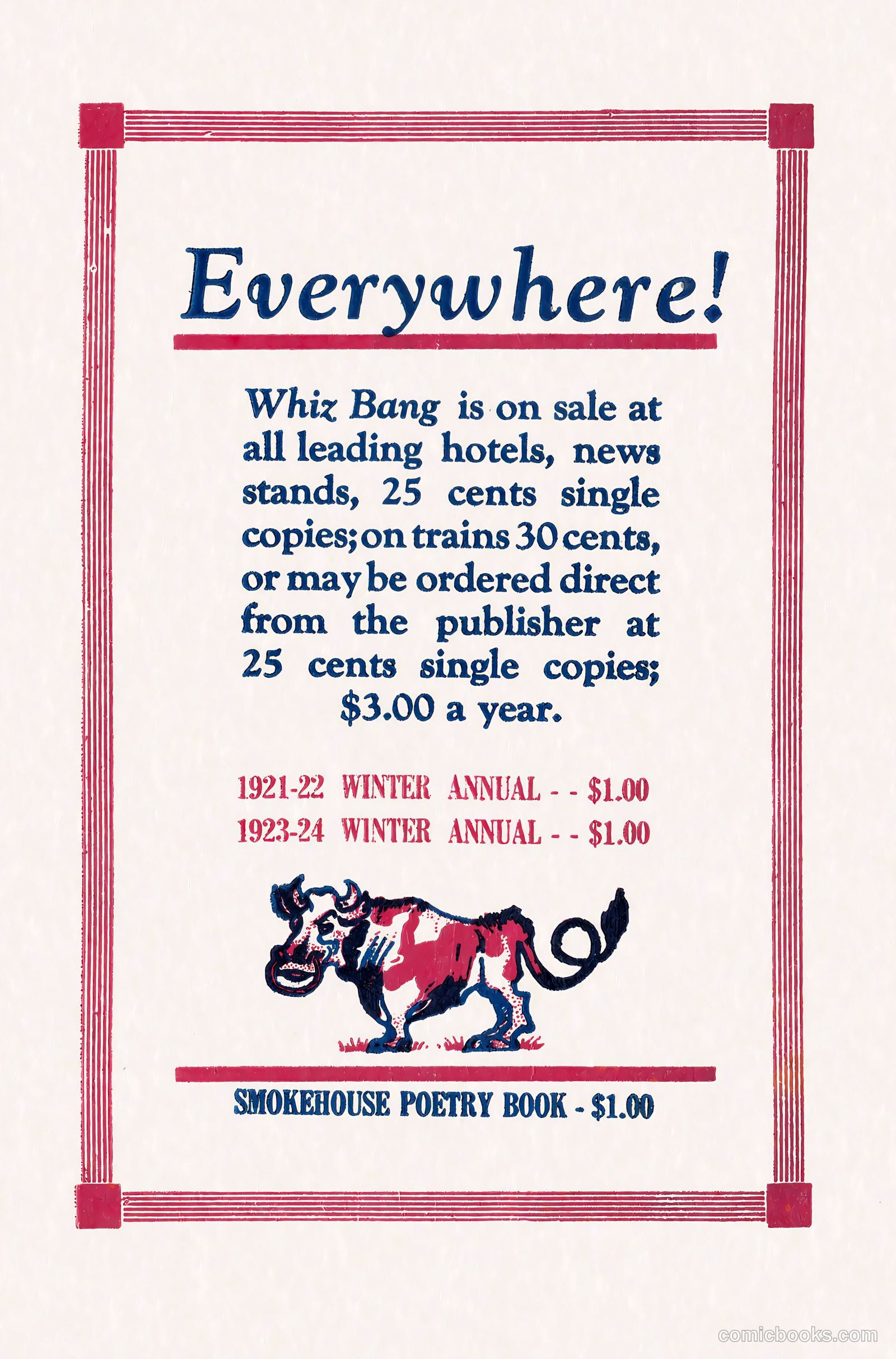
This is primarily an **advertisement page**, not editorial content. It promotes *Whiz Bang*, a satirical magazine, emphasizing its wide availability ("Everywhere!") at hotels, newsstands, and via mail subscription for 25 cents per copy or $3 annually. The page advertises specific products: past winter annuals (1921-22 and 1923-24) and a *Smokehouse Poetry Book*, all priced at $1. The cartoon bull mascot (rendered in red, white, and blue) appears to be the magazine's logo or trademark, likely chosen for humorous effect in a satirical publication. This is essentially a sales pitch highlighting the magazine's distribution reach and available back issues during the early 1920s.