
Captain Billy's Whiz Bang, March 1924 · page 30 of 71
Captain Billy's Whiz Bang #57 — page 30: what you’re looking at
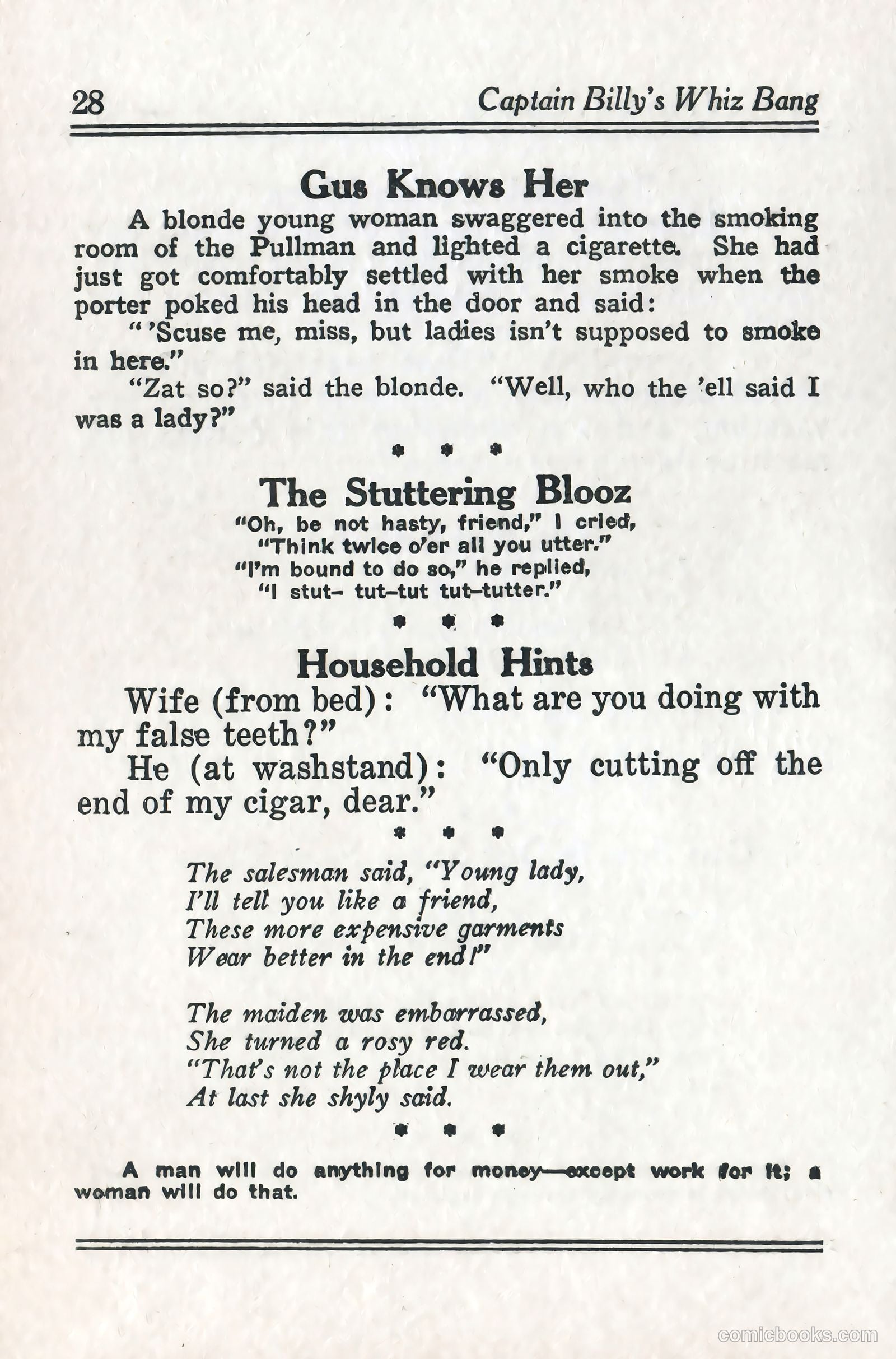
What you’re looking at
This page contains several short jokes typical of 1920s American humor magazines. The humor relies on social transgression and double entendre: **"Gus Knows Her"** mocks emerging female independence—a woman smokes in a men's train car and defies the porter by rejecting the "lady" label, implying she's of loose morals. **"The Stuttering Blooz"** is straightforward wordplay about a stutter. **"Household Hints"** contains two jokes: one about a husband using false teeth as a cigar cutter (absurd), and a bawdy innuendo joke where a salesman's comment about where garments "wear out" is misinterpreted by an embarrassed young woman as a sexual reference. The final aphorism disparages women's work ethic compared to men's financial motivation. Overall, the page reflects 1920s attitudes: anxiety about changing gender roles, ribald humor, and casual misogyny—typical of the era's satirical publications.
📄 Transcribed text from this page (OCR, searchable)
Machine-transcribed from the original scan — historical spelling and the odd misread are preserved.
28 Captain Billy's Whiz Bang Gus Knows Her A blonde young woman swaggered into the smoking room of the Pullman and lighted a cigarette. She had just got comfortably settled with her smoke when the porter poked his head in the door and said: “’Scuse me, miss, but ladies isn’t supposed to smoke in here.” “Zat so?” said the blonde. “Well, who the ’ell said I was a lady?” The Stuttering Blooz “Oh, be not hasty, friend,” I cried, “Think twice o’er all you utter.” “I’m bound to do so,” he replied, “I stut- tut-tut tut-tutter.” Household Hints Wife (from bed): “What are you doing with my false teeth?” He (at washstand): “Only cutting off the end of my cigar, dear.” The salesman said, “Young lady, I’ll tell you like a friend, These more expensive garments Wear better in the end!” The maiden was embarrassed, She turned a rosy red. “That’s not the place I wear them out,” At last she shyly said. A man will do anything for money—except work for it; a woman will do that.