
Captain Billy's Whiz Bang, March 1924 · page 22 of 71
Captain Billy's Whiz Bang #57 — page 22: what you’re looking at
What you’re looking at
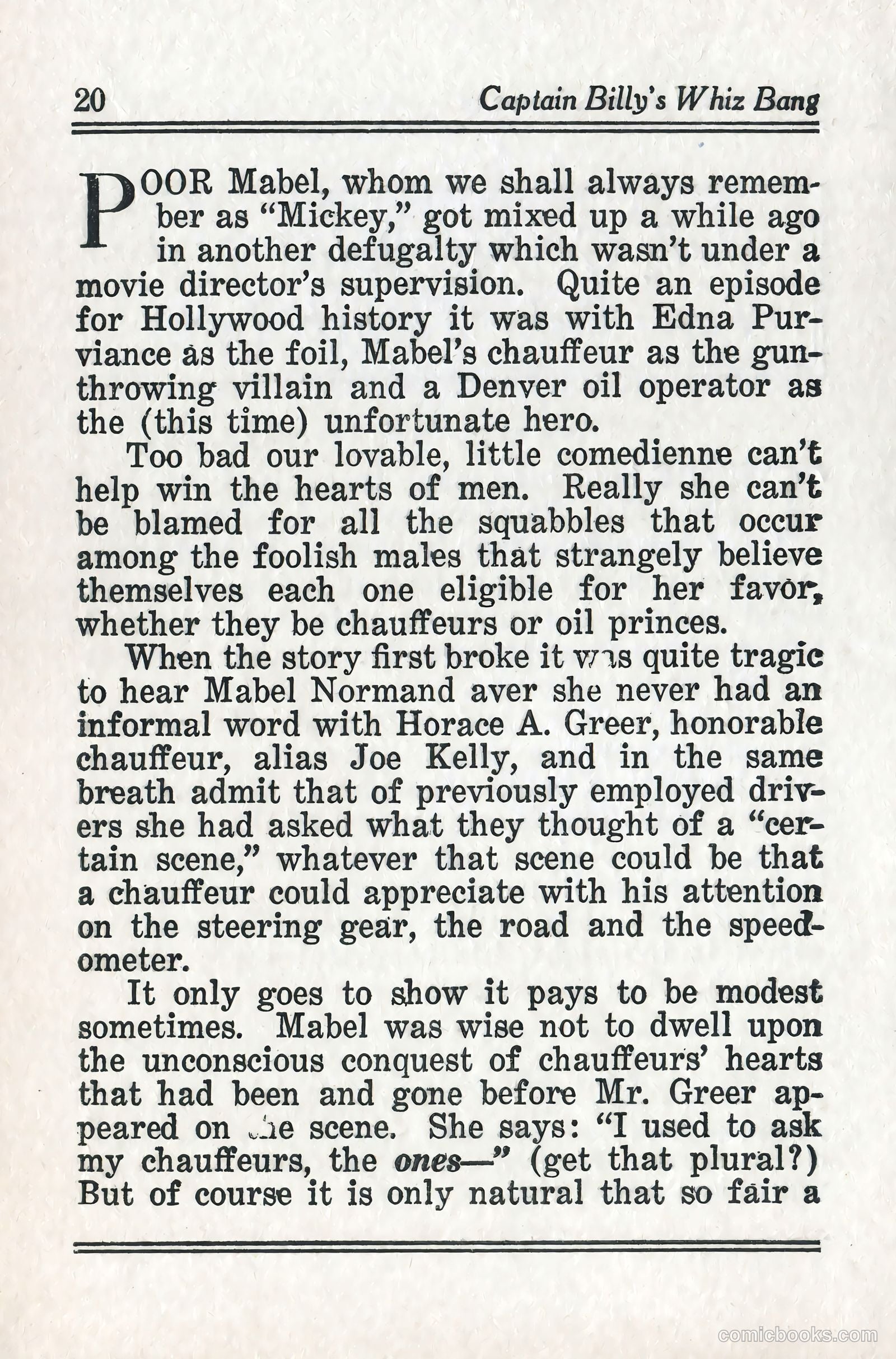
This gossip column discusses **Mabel Normand**, a silent film comedienne (nicknamed "Mickey"), and a real scandal involving her. The text references a shooting incident involving her chauffeur **Horace A. Greer** (alias Joe Kelly) and actress **Edna Purviance**, with a Denver oil operator also implicated—presented here as a love triangle among Normand's male admirers. The satire mocks Normand's contradictory denials about knowing Greer, while simultaneously admitting she regularly asked her various chauffeurs for opinions. The author sarcastically highlights her evasiveness ("the ones—get that plural?") and suggests she attracted male attention across class lines (chauffeurs to "oil princes"). The column's tone is gently ribbing rather than condemning, treating the scandal as Hollywood melodrama while implying Normand's modest silence about her romantic conquests was actually wise PR strategy.
📄 Transcribed text from this page (OCR, searchable)
Machine-transcribed from the original scan — historical spelling and the odd misread are preserved.
20 Captain Billy's Whiz Bang POOR Mabel, whom we shall always remem- ber as “Mickey,” got mixed up a while ago in another defugalty which wasn’t under a movie director’s supervision. Quite an episode for Hollywood history it was with Edna Pur- viance as the foil, Mabel’s chauffeur as the gun- throwing villain and a Denver oil operator as the (this time) unfortunate hero. Too bad our lovable, little comedienne can’t help win the hearts of men. Really she can’t be blamed for all the squabbles that occur among the foolish males that strangely believe themselves each one eligible for her favor, whether they be chauffeurs or oil princes. When the story first broke it was quite tragic to hear Mabel Normand aver she never had an informal word with Horace A. Greer, honorable chauffeur, alias Joe Kelly, and in the same breath admit that of previously employed driv- ers she had asked what they thought of a “cer- tain scene,” whatever that scene could be that a chauffeur could appreciate with his attention on the steering gear, the road and the speed- ometer. It only goes to show it pays to be modest sometimes. Mabel was wise not to dwell upon the unconscious conquest of chauffeurs’ hearts that had been and gone before Mr. Greer ap- peared on the scene. She says: “I used to ask my chauffeurs, the ones—” (get that plural?) But of course it is only natural that so fair a