
Captain Billy's Whiz Bang, March 1924 · page 69 of 71
Captain Billy's Whiz Bang #57 — page 69: what you’re looking at
What you’re looking at
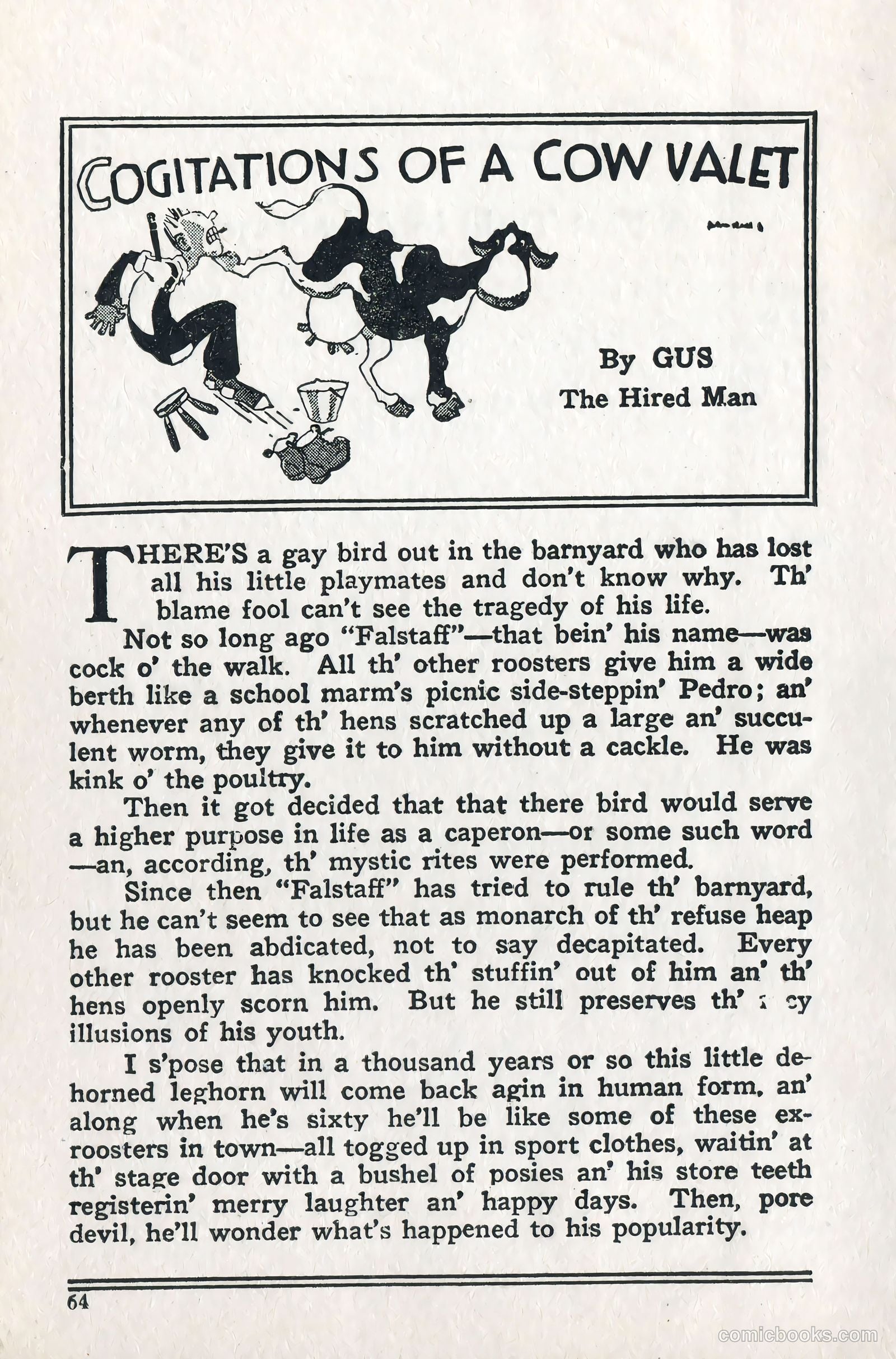
This is a humorous barnyard fable by "Gus the Hired Man." A rooster named "Falstaff" was once the dominant bird in the farmyard—respected and pampered by the hens. After being castrated (euphemistically called becoming a "caperon"), he lost his status and masculinity. Other roosters now fight him, and hens scorn him, yet he clings to delusions of his former glory. The satire compares this castrated rooster to aging ex-playboys in town—once popular, now pathetically dressed up and waiting at stage doors with flowers and false teeth, desperately seeking attention they once commanded. The joke ironically suggests that such men, like Falstaff, will eventually wonder what happened to their lost youth and popularity. It's a commentary on masculine vanity and the inevitable decline of status.
📄 Transcribed text from this page (OCR, searchable)
Machine-transcribed from the original scan — historical spelling and the odd misread are preserved.
COGITATIONS OF A COW VALET By GUS The Hired Man HERE'S a gay bird out in the barnyard who has lost all his little playmates and don't know why. Th' blame fool can't see the tragedy of his life. Not so long ago “Falstaff”—that bein' his name—was cock o' the walk. All th' other roosters give him a wide berth like a school marm's picnic side-steppin' Pedro; an' whenever any of th' hens scratched up a large an' succu-lent worm, they give it to him without a cackle. He was kink o' the poultry. Then it got decided that that there bird would serve a higher purpose in life as a caperon—or some such word—an, according, th' mystic rites were performed. Since then “Falstaff” has tried to rule th' barnyard, but he can't seem to see that as monarch of th' refuse heap he has been abdicated, not to say decapitated. Every other rooster has knocked th' stuffin' out of him an' th' hens openly scorn him. But he still preserves th' i cy illusions of his youth. I s'pose that in a thousand years or so this little de-horned leghorn will come back agin in human form, an' along when he's sixty he'll be like some of these ex-roosters in town—all togged up in sport clothes, waitin' at th' stage door with a bushel of posies an' his store teeth registerin' merry laughter an' happy days. Then, pore devil, he'