
Captain Billy's Whiz Bang, March 1924 · page 45 of 71
Captain Billy's Whiz Bang #57 — page 45: what you’re looking at
What you’re looking at
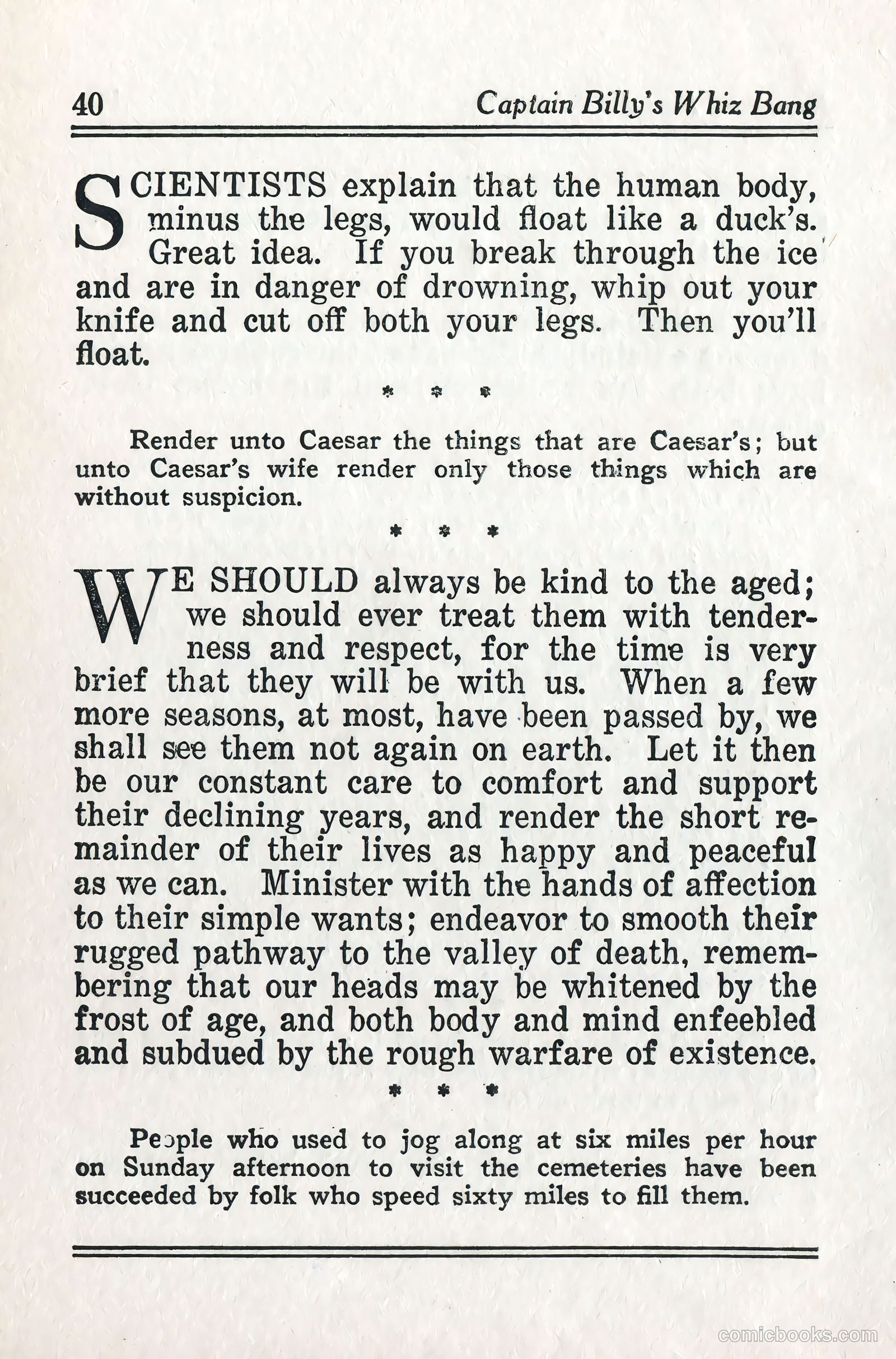
This page from the satirical magazine contains four distinct humorous pieces: 1. **The Drowning Joke**: Dark humor mocking pseudo-scientific advice—absurdly suggesting amputating one's legs to survive drowning, based on a misunderstanding of buoyancy. 2. **Caesar's Wife**: A witty restatement of the biblical maxim, implying Caesar's wife should avoid even the *appearance* of impropriety, not just actual wrongdoing. Likely a commentary on marital scandal or political wives' behavior. 3. **Treating the Elderly**: A lengthy, earnest passage advocating kindness to aging people, emphasizing life's brevity and moral duty—contrasting with the magazine's typical irreverent tone. 4. **Cemetery Traffic**: Sharp social satire comparing past generations who slowly visited cemeteries on Sundays with modern drivers who speed recklessly "at sixty miles per hour"—implying contemporary dangerous driving habits are literally filling cemeteries faster. This reflects 1920s concerns about automobile safety and mortality rates.
📄 Transcribed text from this page (OCR, searchable)
Machine-transcribed from the original scan — historical spelling and the odd misread are preserved.
40 Captain Billy's Whiz Bang SCIENTISTS explain that the human body, minus the legs, would float like a duck's. Great idea. If you break through the ice and are in danger of drowning, whip out your knife and cut off both your legs. Then you'll float. * * * Render unto Caesar the things that are Caesar's; but unto Caesar's wife render only those things which are without suspicion. * * * WE SHOULD always be kind to the aged; we should ever treat them with tender- ness and respect, for the time is very brief that they will be with us. When a few more seasons, at most, have been passed by, we shall see them not again on earth. Let it then be our constant care to comfort and support their declining years, and render the short re- mainder of their lives as happy and peaceful as we can. Minister with the hands of affection to their simple wants; endeavor to smooth their rugged pathway to the valley of death, remem- bering that our heads may be whitened by the frost of age, and both body and mind enfeebled and subdued by the rough warfare of existence. * * * People who used to jog along at six miles per hour on Sunday afternoon to visit the cemeteries have been succeeded by folk who speed sixty miles to fill them.