
A complete issue · 52 pages · 1928
Life — November 30, 1928
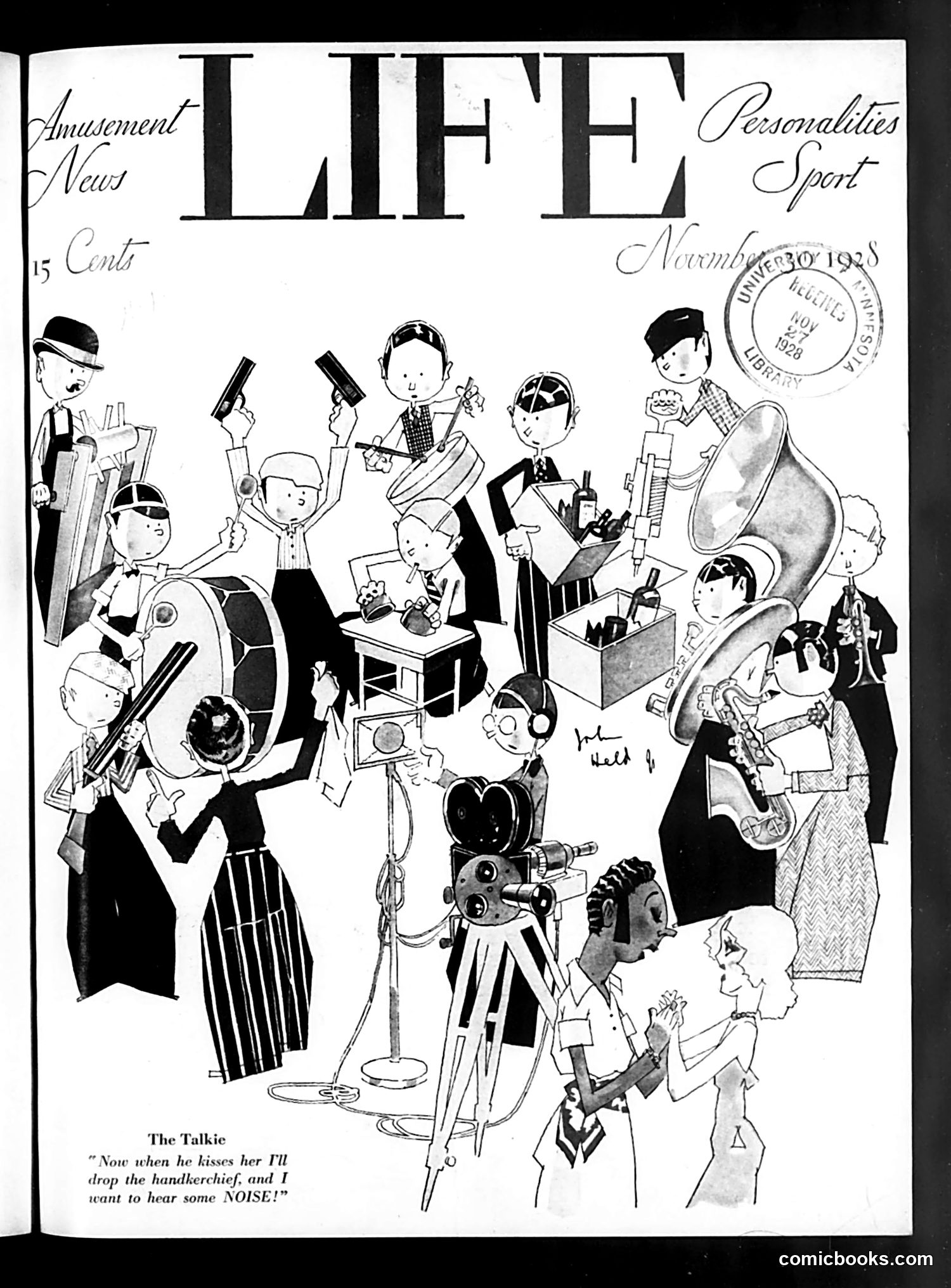
This cover satirizes the advent of "talking pictures" (sound films), a revolutionary technology that disrupted entertainment in the late 1920s. The central figure appears to be a film director managing a chaotic movie set where silent-film conventions clash with sound recording requirements. The cartoon jokes about the absurdity of synchronized sound: musicians, actors with megaphones, and various performers surround sound equipment (microphones, recording devices), all attempting to coordinate for the new "talkie" format. The caption references a kiss scene requiring sound effects ("drop the handkerchief...I want to hear some NOISE"), mocking how sound technology forced filmmakers to reconsider what audiences should hear. The illustration satirizes the entertainment industry's scramble to adapt to this technological disruption.
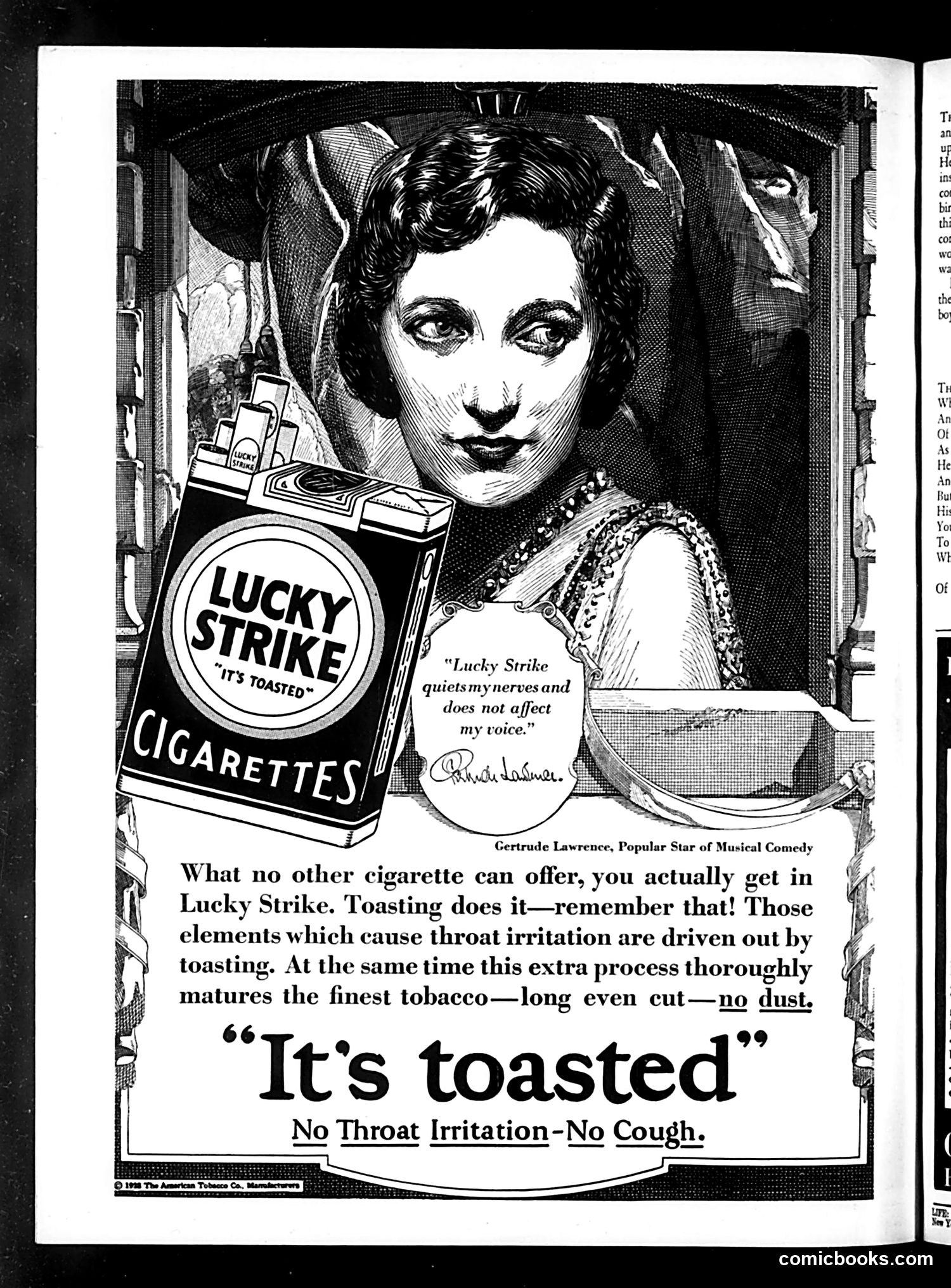
This is a **cigarette advertisement, not satire**—a Lucky Strike endorsement featuring actress Gertrude Lawrence, a popular musical comedy star of the era. The ad claims Lucky Strike cigarettes are "toasted," which allegedly removes throat-irritating elements while maturing the tobacco. Lawrence endorses the product with a quote: "Lucky Strike quiets my nerves and does not affect my voice." The tagline promises "No Throat Irritation—No Cough." **Context for modern readers:** This represents early tobacco marketing before health dangers were widely acknowledged or regulated. Celebrities were routinely paid to endorse cigarettes with dubious health claims. Such advertisements would be illegal today under modern advertising standards and tobacco regulations.
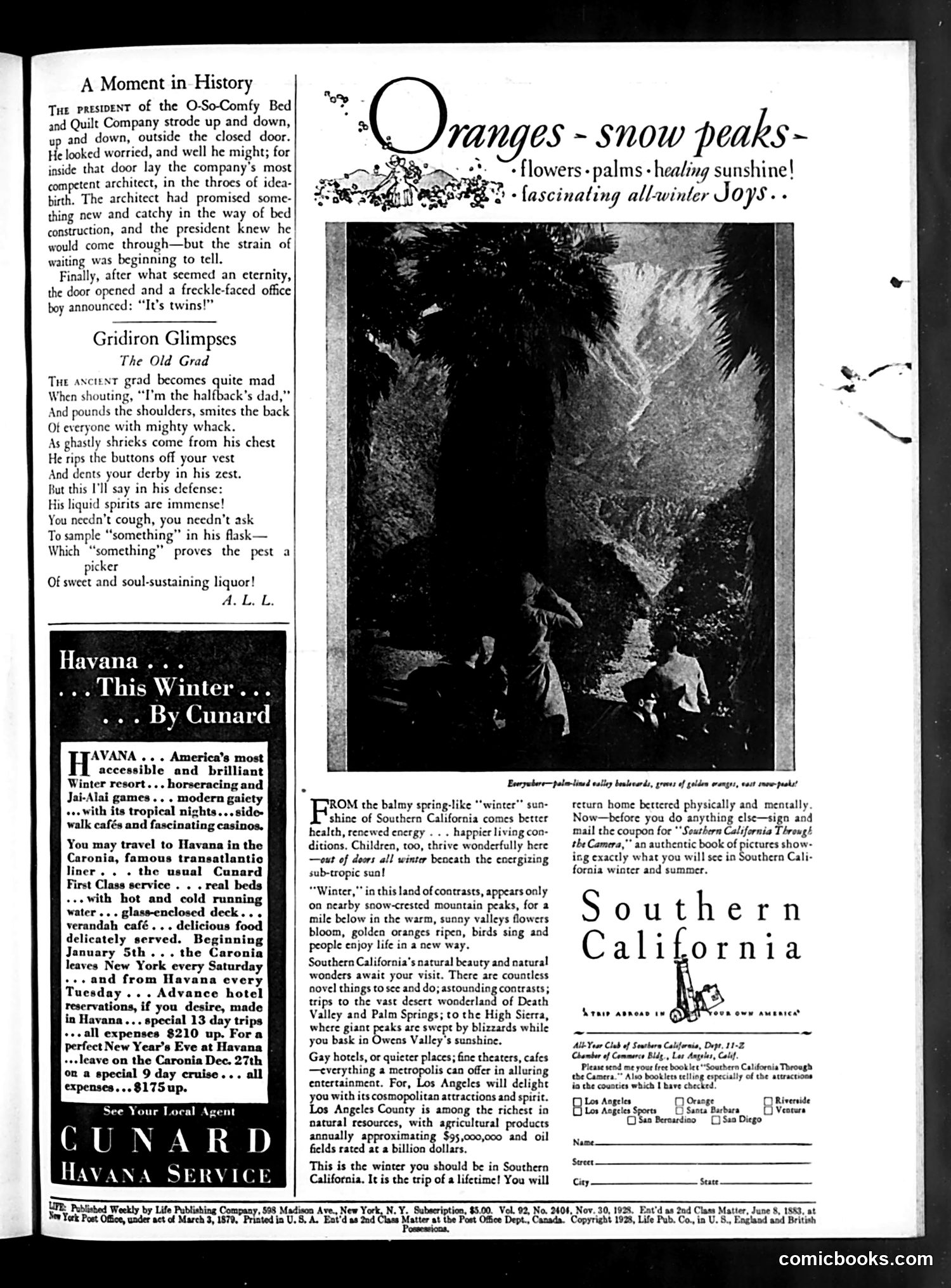
This page consists primarily of **advertisements and travel content** rather than political satire or editorial cartoons. The left side contains two distinct pieces: "A Moment in History" (a humorous anecdote about bed company executives), and "Gridiron Glimpses: The Old Grad" (a poem about an intoxicated football alumnus at a game). The latter mocks college football culture and excessive drinking—a light satirical jab at sports culture rather than political commentary. The right side is dominated by **advertising**: a Cunard cruise line promotion for Havana travel, and a Southern California tourism advertisement featuring a photograph of what appears to be a scenic valley with palm trees. The page reflects 1920s leisure culture and commercial interests rather than serious political satire.
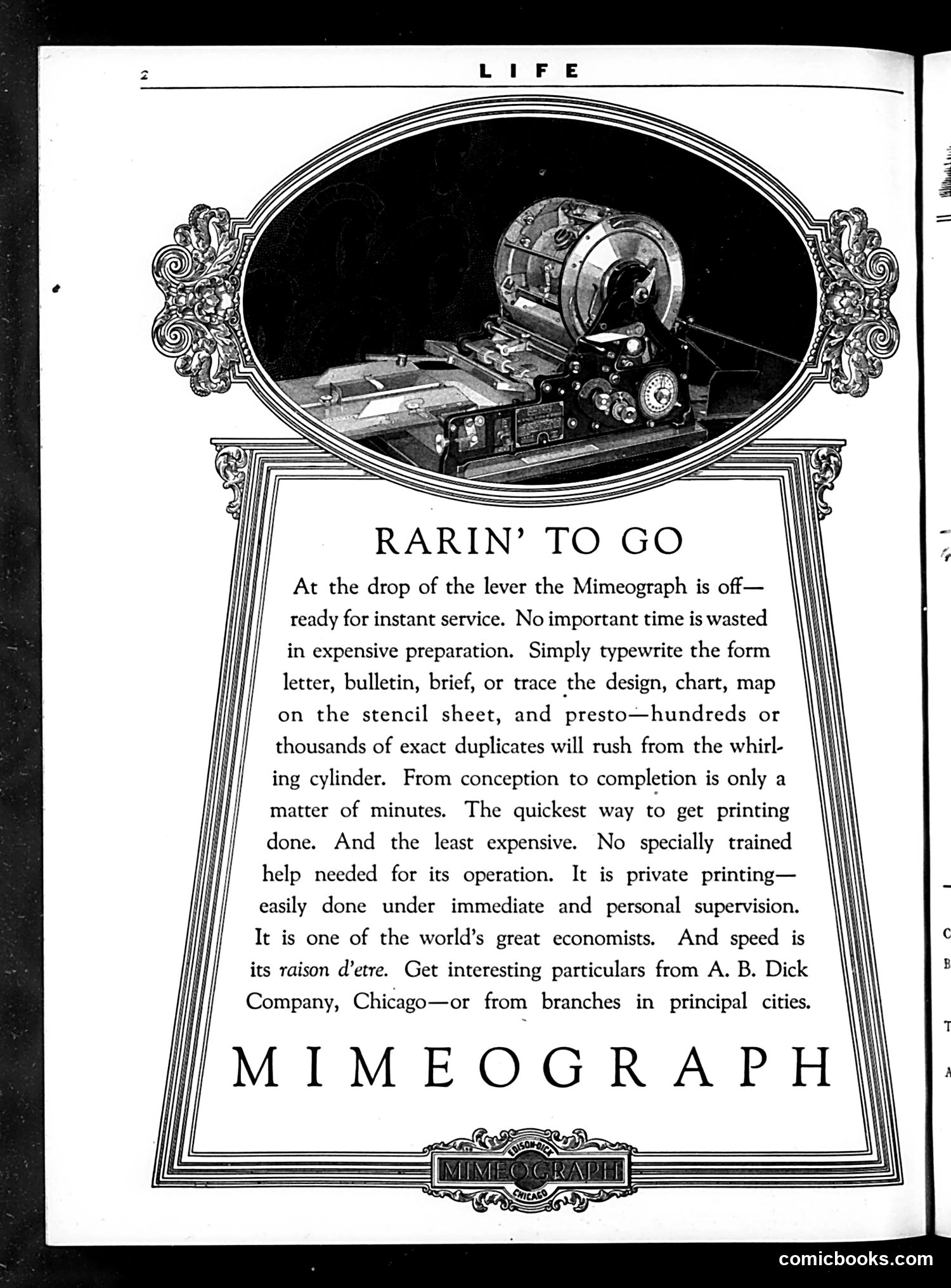
This is primarily **advertising copy**, not satire or political commentary. The page promotes the Mimeograph machine, manufactured by A.B. Dick Company of Chicago. The advertisement emphasizes the machine's speed and economy for small-scale printing operations. The ornate framing and the photograph of the device itself suggest this ran in Life magazine (likely early 20th century based on styling). The ad targets business users needing quick document duplication—letters, bulletins, charts—without expensive professional printing. The headline "Rarin' to Go" uses colloquial language to suggest immediacy and efficiency. The appeal is economic: fast turnaround at low cost, requiring no specialized training. This reflects the machine's genuine appeal to offices and small businesses of the era.
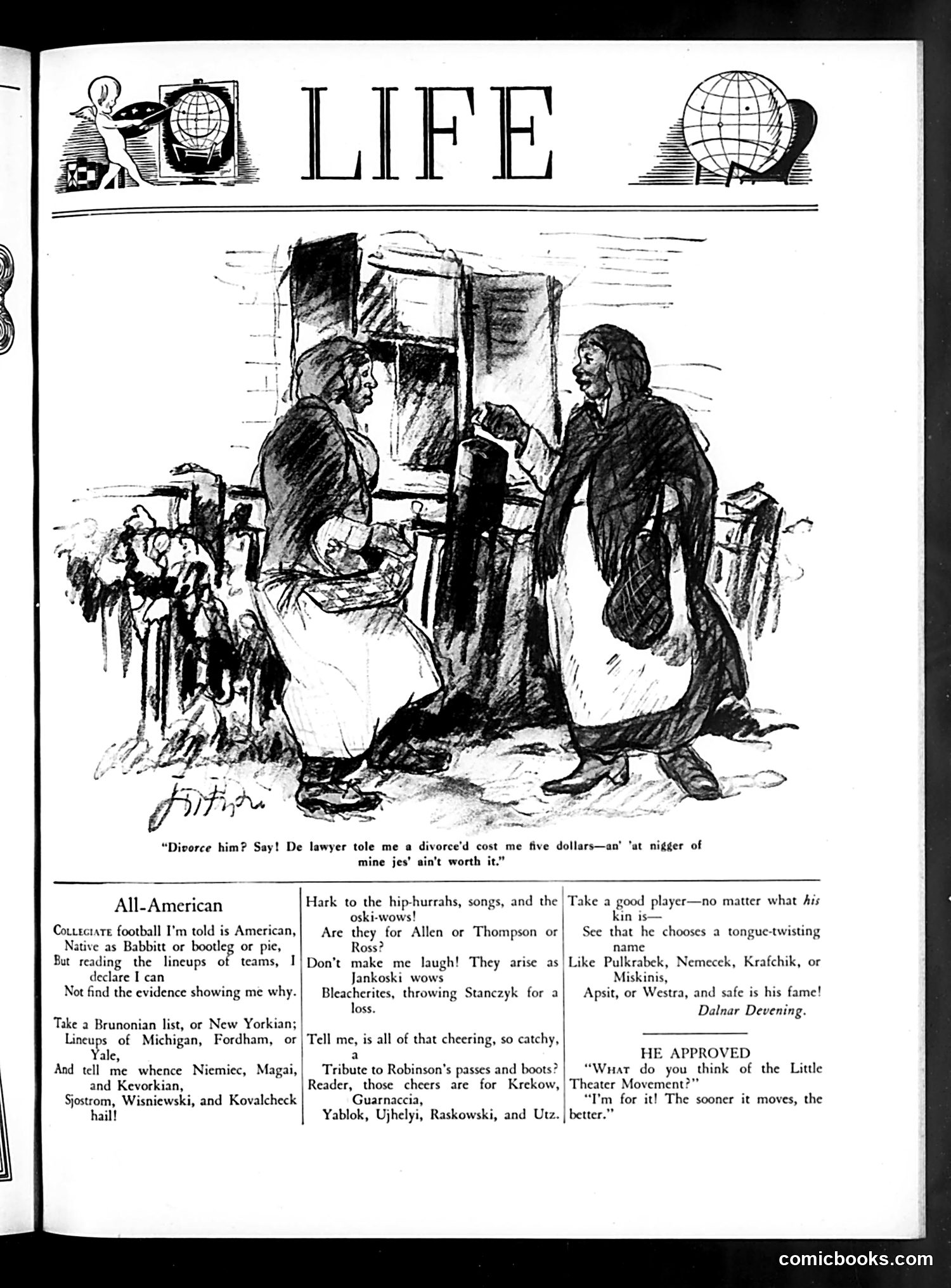
The main cartoon depicts two women in conversation near a window, with the caption presenting a dialogue about divorce costs. One woman tells the other that a lawyer quoted her five dollars for a divorce, which she rejected as an insult—the cost being less than the value of her jewelry. This satirizes attitudes toward divorce and marriage in the early 20th century, mocking both the commodification of relationships and women's materialism. The joke relies on period assumptions about marriage as a financial transaction and women's concern with possessions. The surrounding text contains three separate pieces: "All-American" discusses collegiate football team lineups and ethnic names; "Hark to the hip-hurrahs" comments on cheering traditions; and "He Approved" briefly quotes someone's opinion on a theater movement. These appear to be typical magazine filler content and brief commentary rather than connected satirical pieces.
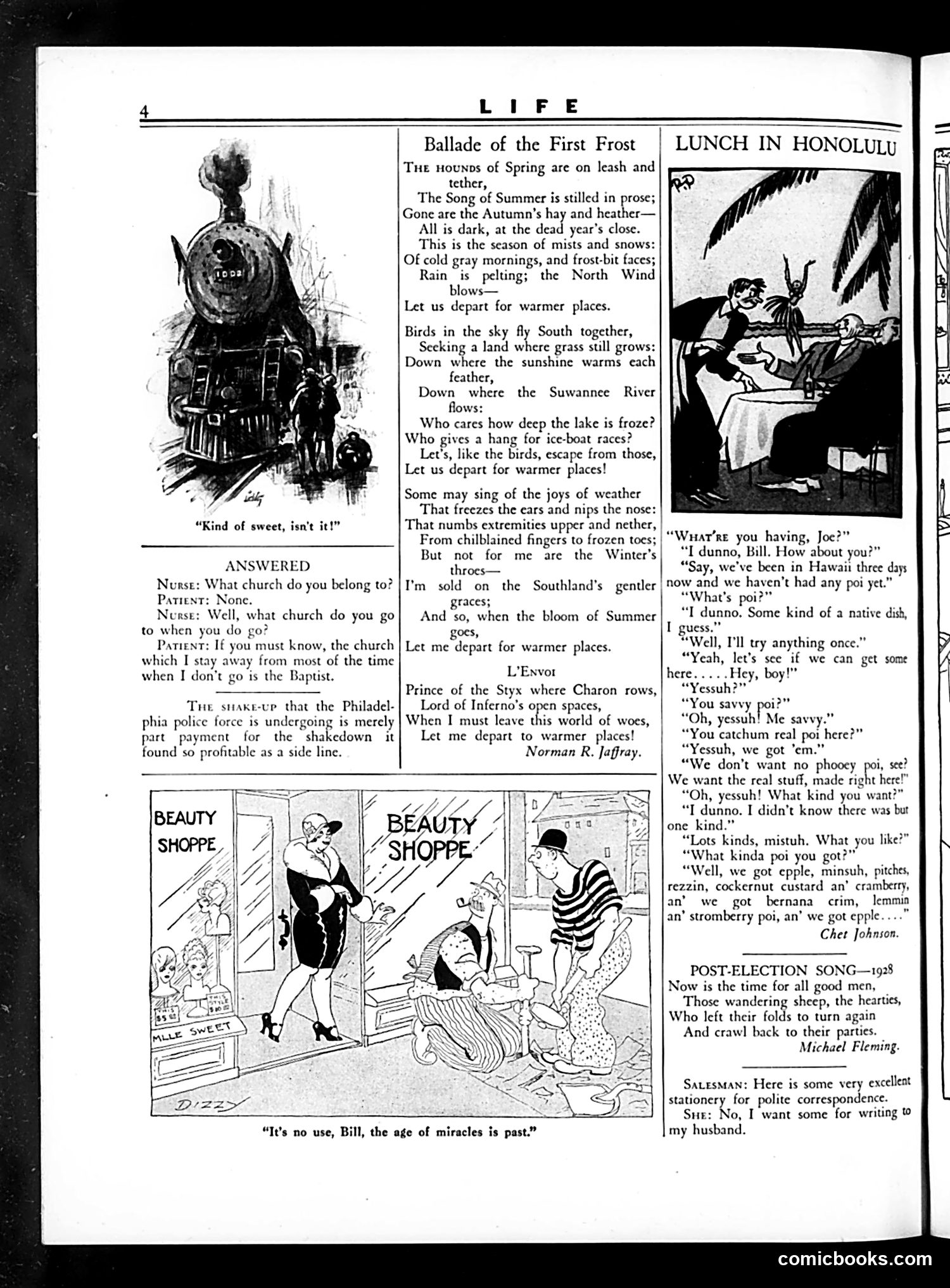
The page contains three main sections: **"Ballad of the First Frost"** (top) is a nostalgic poem by Norman R. Jaffray about escaping winter for warmer southern climates, reflecting early 20th-century travel aspirations. **"Beauty Shoppe" cartoon** (bottom) shows women in a salon. The caption "It's no use, Bill, the age of miracles is past" suggests satire about beauty treatments' limited effectiveness—a common theme mocking the beauty industry's exaggerated promises. **"Lunch in Honolulu"** (right) depicts diners in Hawaii discussing tropical foods—likely poking fun at tourists' unfamiliarity with local cuisine and their pretentious attempts to seem sophisticated about exotic dishes. The overall page reflects 1920s American middle-class preoccupations: leisure travel, consumer products, and aspirational lifestyle content typical of Life magazine's satirical humor.
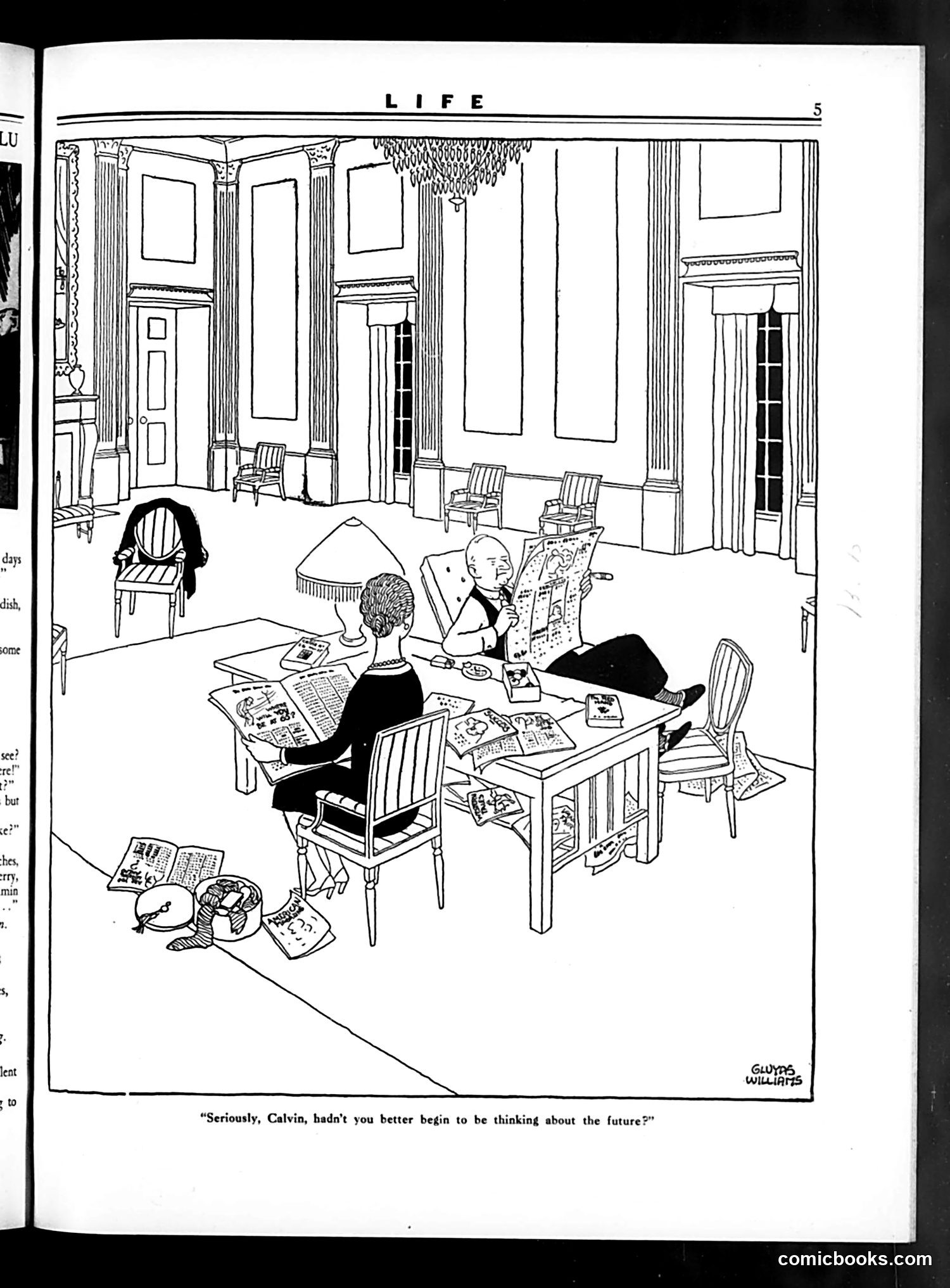
This single-panel cartoon by Gluydas Williams depicts a mother addressing her son Calvin in an elegant, formal drawing room. The caption reads: "Seriously, Calvin, hadn't you better begin to be thinking about the future?" The humor derives from the stark contrast between the refined, adult setting and Calvin's apparent youth and carefree attitude. Scattered around him are comic books and what appear to be toys or entertainment materials—suggesting he's absorbed in childish pursuits rather than serious planning. The satire targets parental anxiety about youth's readiness for adult responsibilities, a timeless concern but particularly resonant during the early-to-mid 20th century when this magazine circulated. The mother's formal tone emphasizes generational expectations that young people should prioritize self-improvement and career preparation over leisure.
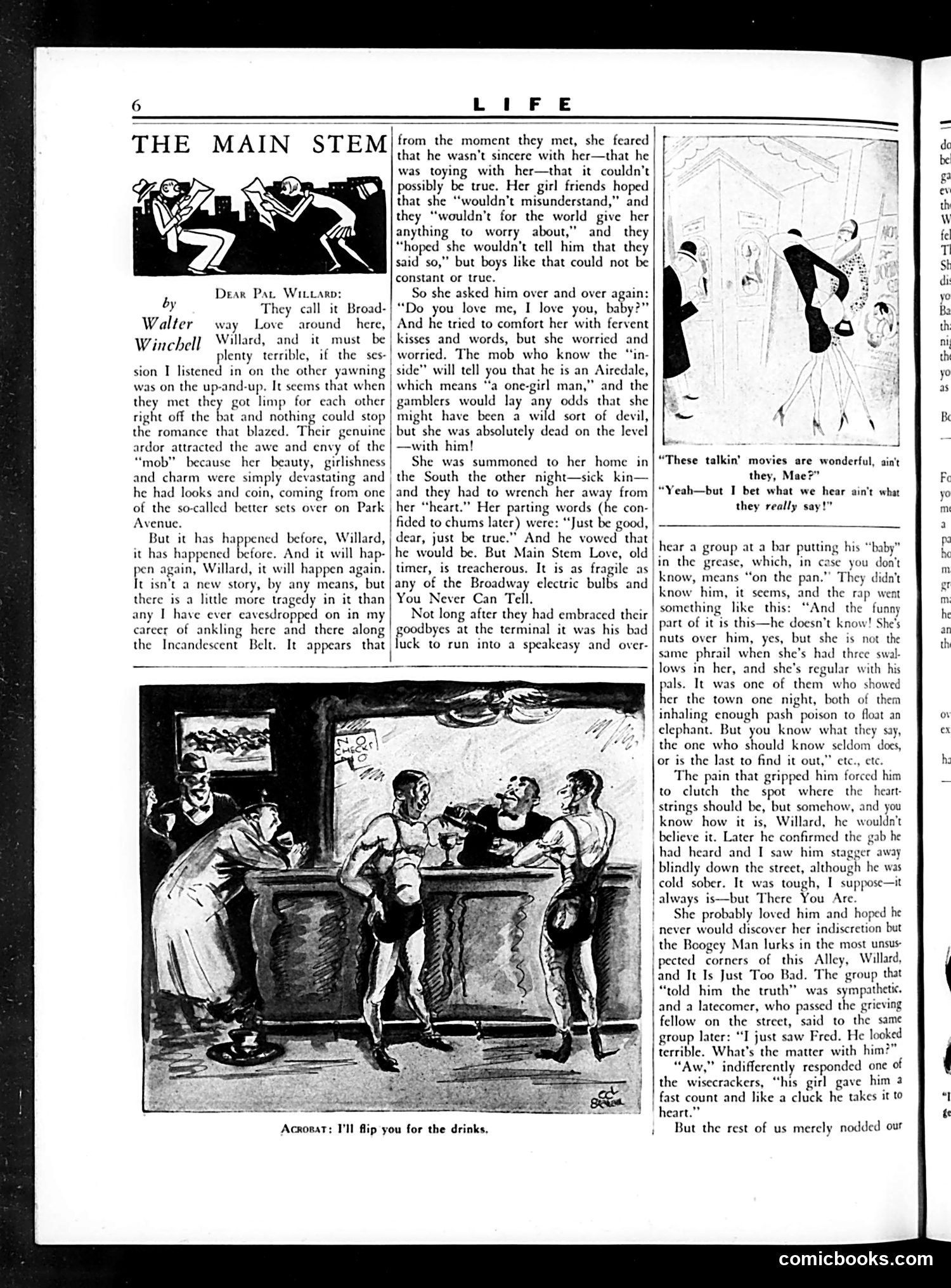
This is a gossip column by Walter Winchell, the famous Broadway columnist, not a political cartoon. The piece discusses romantic entanglements among unnamed socialites, using Winchell's characteristic cryptic style ("Broad-way Love," "Airedale," "Boozey Man"). The two illustrations depict scenes of urban nightlife—a speakeasy (illegal bar, given Prohibition-era context) and well-dressed patrons at what appears to be a social venue. The acrobat illustration's caption ("I'll flip you for the drinks") references gambling and casual excess. The tone is cynical about romance and modern youth behavior, typical of 1920s-30s Winchell columns mocking high society's moral failings through anonymous anecdotes.
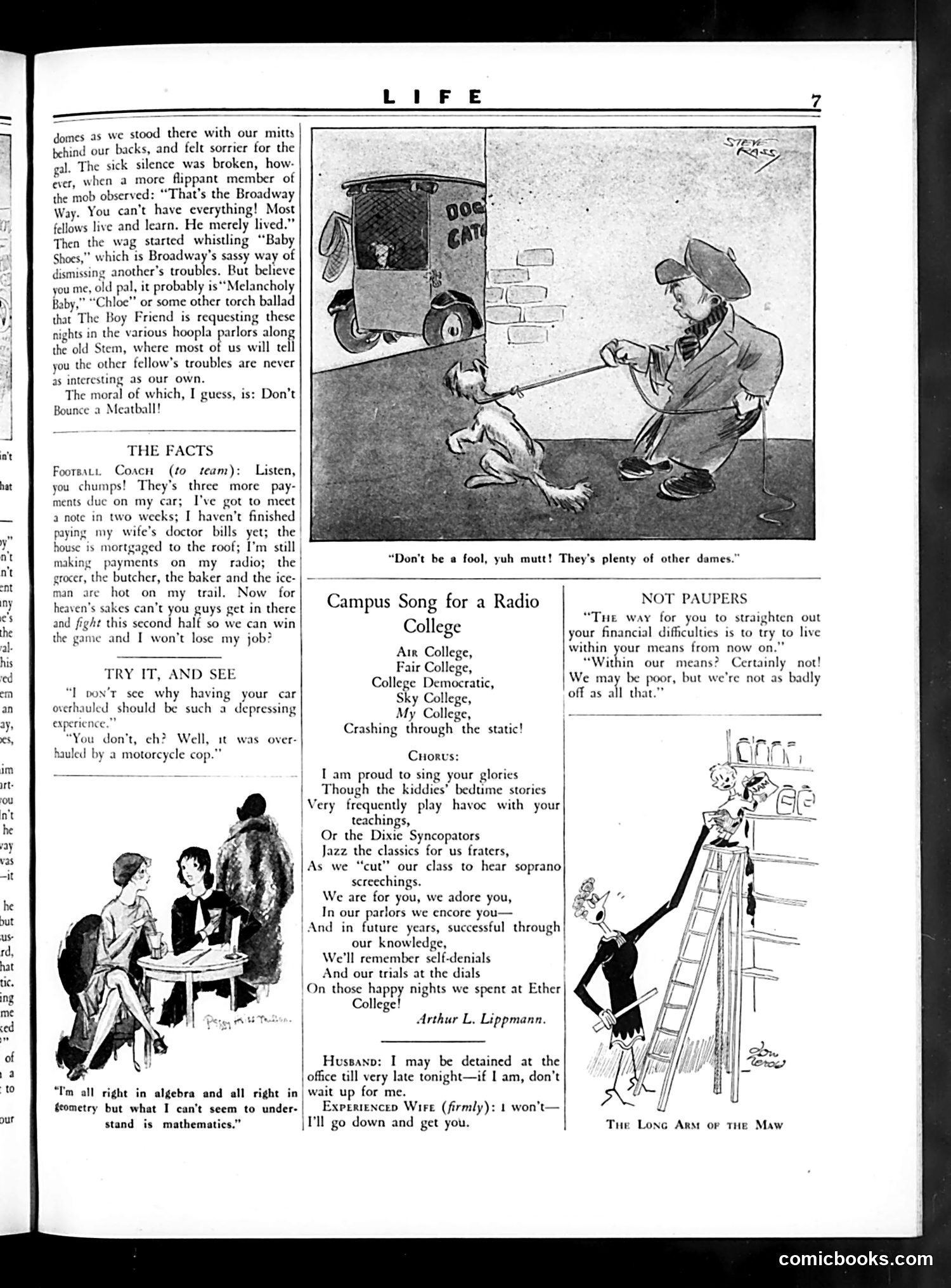
This page contains humor pieces targeting working-class anxieties of the early 20th century. **Top cartoon**: A man confronts another over a damaged dog, with a "Dog Catcher" wagon visible. The caption "Don't be a fool, yuh mutt! They's plenty of other dames" suggests the joke involves mistaken identity—the speaker believes the man is wrongly blaming him for the dog's injury. **"The Facts" section**: A coach lists overwhelming financial burdens (car payments, medical bills, mortgage, radio payments) while demanding his team win to keep his job. The satire mocks how common people struggled with debt while employers showed no sympathy. **Other pieces** include a college song, a section titled "Not Paupers" about managing poverty with dignity, and "The Long Arm of the Maw"—likely a domestic humor cartoon about wives managing household finances. The page reflects Depression-era concerns about financial precarity and class struggle.
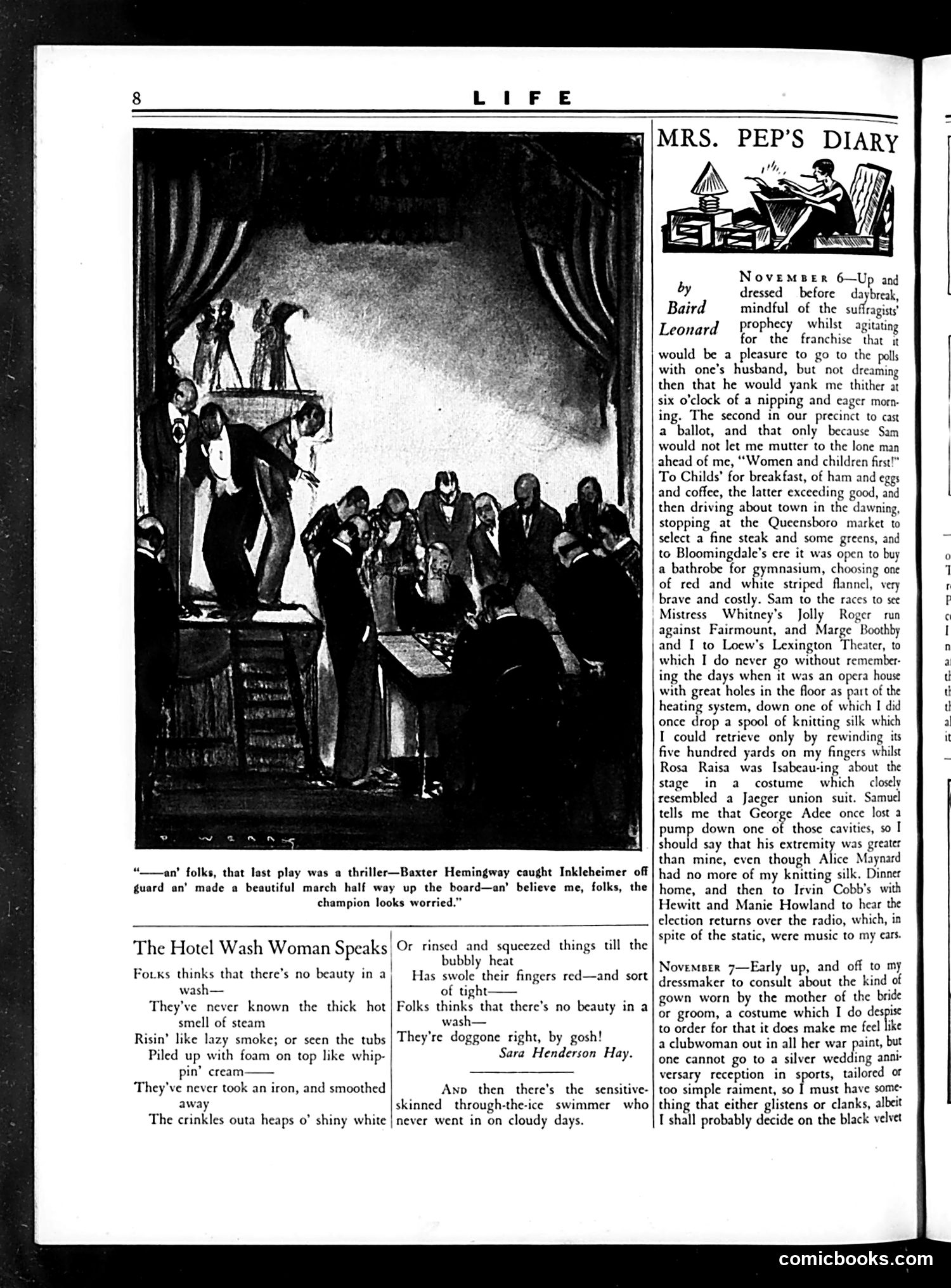
This page contains a satirical poem titled "The Hotel Wash Woman Speaks," presented as social commentary on domestic labor. The poem, attributed to Sara Henderson Hay, gives voice to a laundry worker describing the physical toll and unglamorous reality of her job—wringing, squeezing, and ironing clothes that guests never appreciate. The accompanying illustration (credited to Baird Leonard) shows what appears to be a theatrical or dramatic scene, though the connection between image and poem is unclear. The poem's satire lies in its ironic celebration of invisible labor: the wash woman insists there's "no beauty in a wash" while poetically detailing the skilled, exhausting work involved. It's social commentary highlighting how working-class domestic workers go unrecognized and unvalued by those who benefit from their labor.
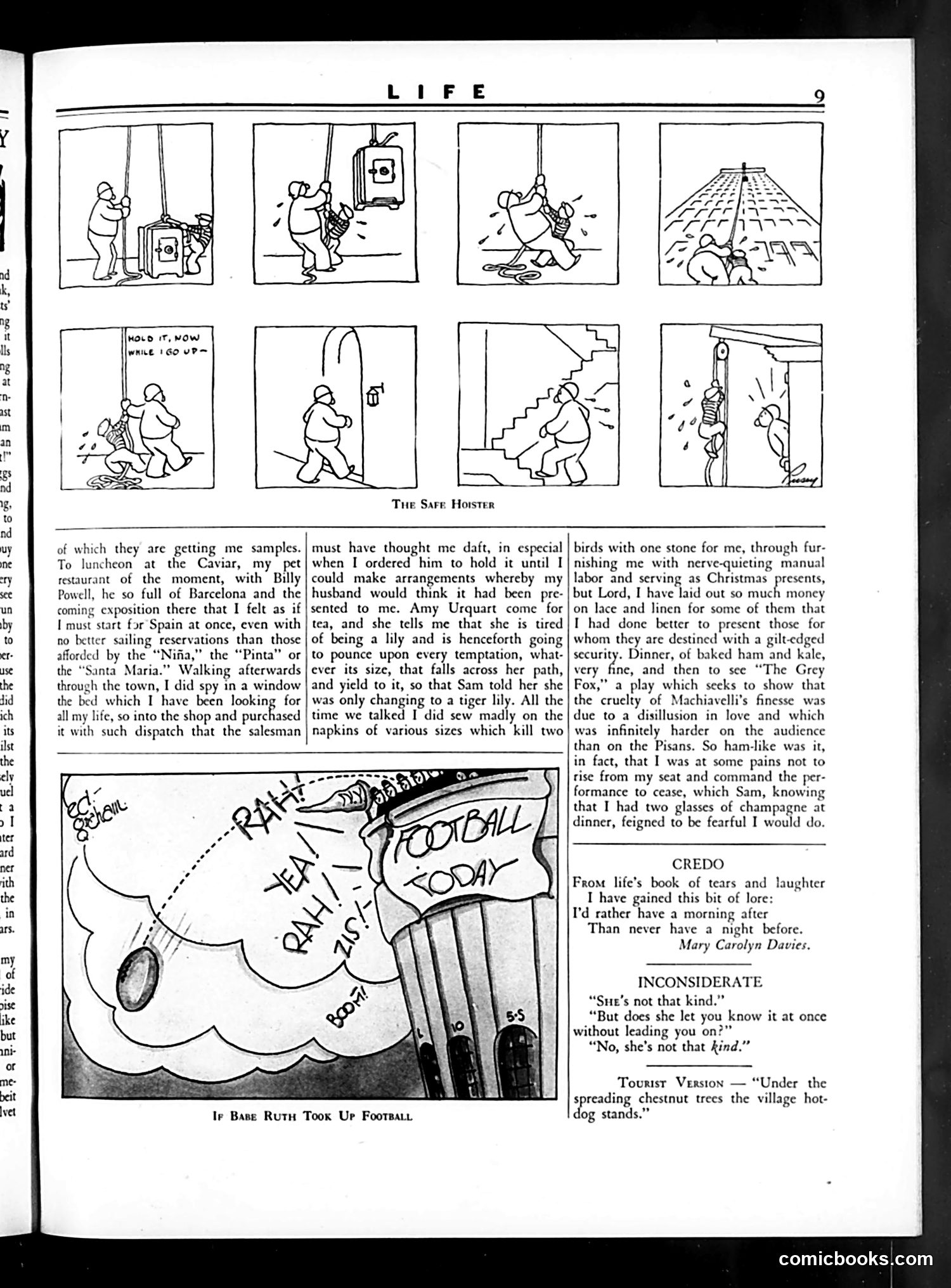
**"The Safe Hoister" Comic Strip (top):** An eight-panel sequence depicting someone attempting to steal a safe using a pulley system. The progression shows escalating complications—the safe swings wildly, crashes through floors and ceilings, and ultimately falls on the would-be thief. The humor is slapstick: incompetent burglary with physical comedy consequences. **"If Babe Ruth Took Up Football" Cartoon (center):** A surreal illustration imagining famous baseball player Babe Ruth playing football instead. The image shows a football covered in labels ("BALL," "FOOTBALL TODAY," "RATH," "SOCK," etc.) being launched dramatically. The satire pokes fun at Ruth's celebrity status and the absurdity of inserting a baseball legend into an entirely different sport—likely contemporary commentary on cross-sport publicity stunts.
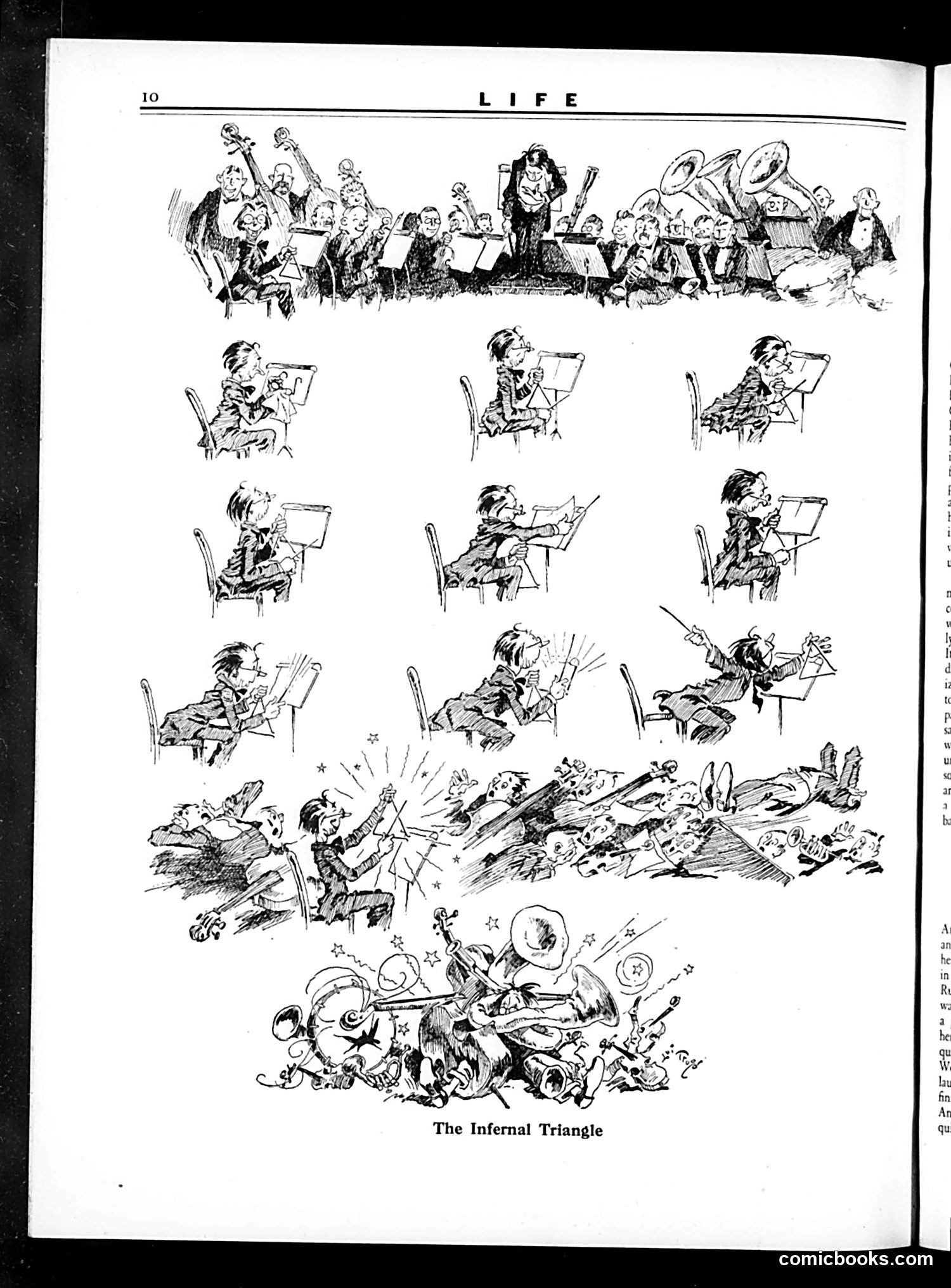
This satirical cartoon depicts a conductor leading an orchestra through chaos. The top panel shows a proper orchestra arrangement; the subsequent panels illustrate the conductor's increasingly frantic attempts to maintain control as musicians become disorderly. The final panel, titled "The Infernal Triangle," shows the complete breakdown—instruments scattered, musicians in disarray, with magical stars suggesting explosive chaos. The satire likely criticizes poor leadership or management, showing how incompetent direction causes organizational collapse. The "infernal triangle" probably references three problematic elements (though the specific reference remains unclear without additional context). This appears to be social commentary on institutional dysfunction, using the orchestra as a metaphor for any organization requiring coordination and discipline.
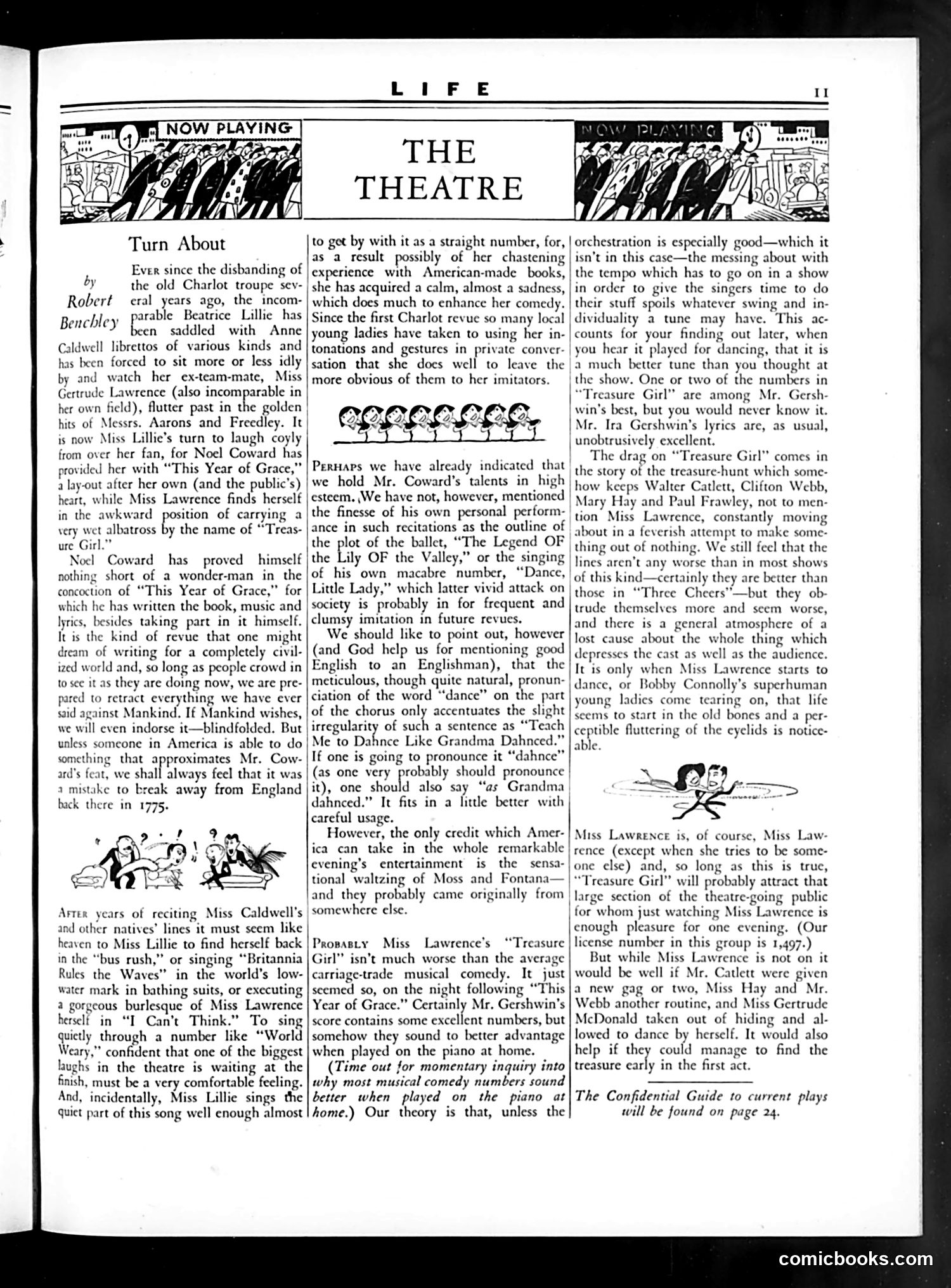
This is a theatre review column discussing current Broadway productions. The main review covers "Treasure Girl," a musical comedy featuring Miss Lawrence. The critic praises the entertainment value while noting the show lacks sophisticated plot or orchestration. The review mentions performers including Noel Coward (who wrote "This Year of Grace"), Beatrice Lillie, and Gertrude Lawrence. Small cartoon illustrations accompany the text showing theatrical scenes and performers in comedic poses. The column's tone is witty and gossipy, typical of Life's satirical approach to entertainment criticism. Rather than pure satire, this represents the magazine's cultural commentary function—evaluating popular entertainment for an educated audience while maintaining humorous, slightly irreverent commentary on performers and productions.
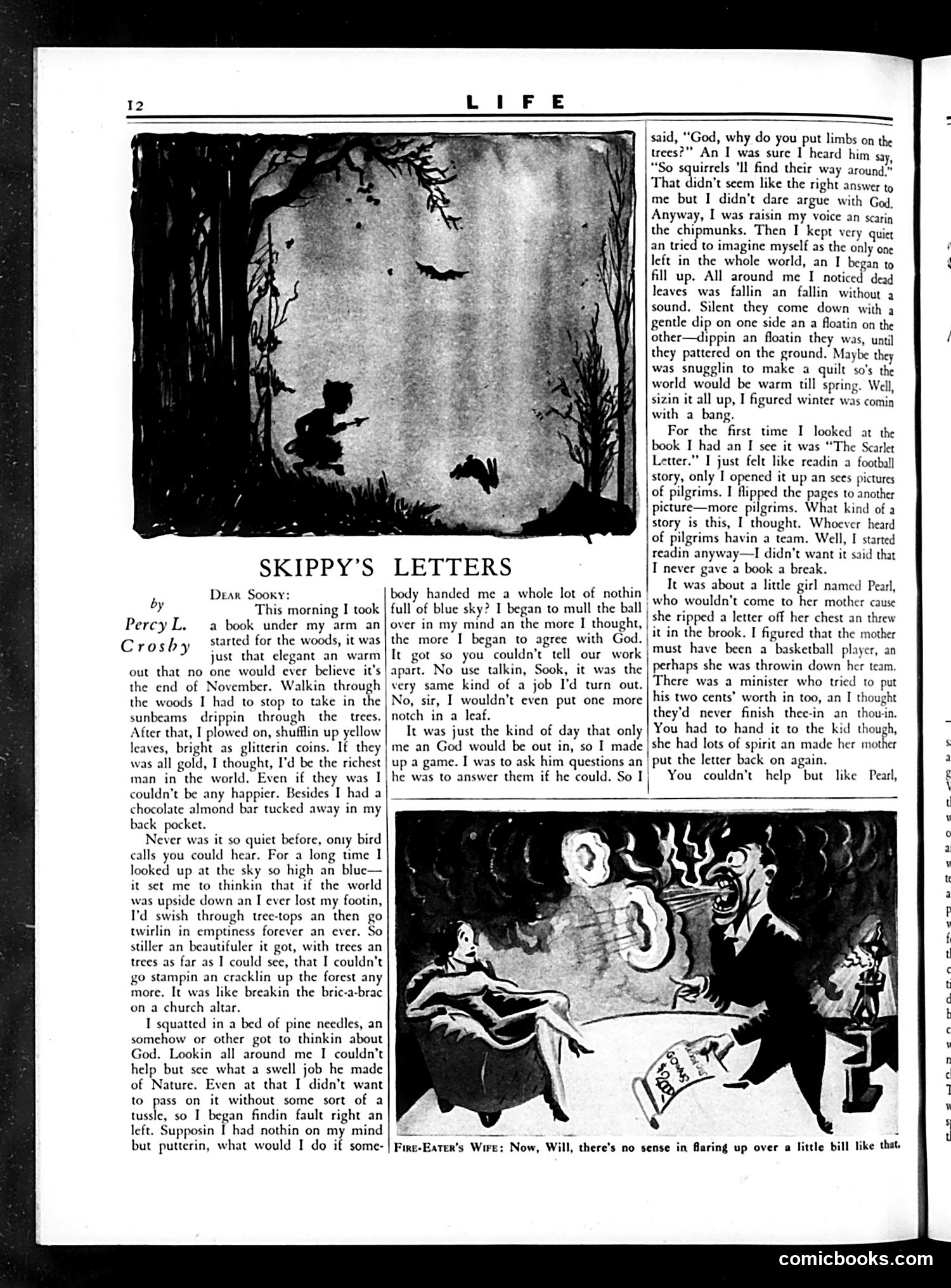
This page contains **"Skippy's Letters,"** a humorous column by Percy L. Crosby featuring a child's perspective on everyday observations. The top illustration shows a child in woods encountering falling leaves—introducing the naive philosophical musings that follow. The main text consists of a letter from "Skippy" to "Sooky" reflecting on childhood experiences: discovering books (specifically *The Scarlet Letter*), observing nature (silent falling leaves), and encountering social absurdities (a minister trying to contribute money to a basketball player). The **bottom cartoon** depicts "Fire-Eater's Wife," showing a domestic dispute over a bill, with the caption mocking the husband's recklessness about finances. Both elements use gentle satire to expose human folly through innocent or exasperated viewpoints—a characteristic Life magazine approach to social commentary.
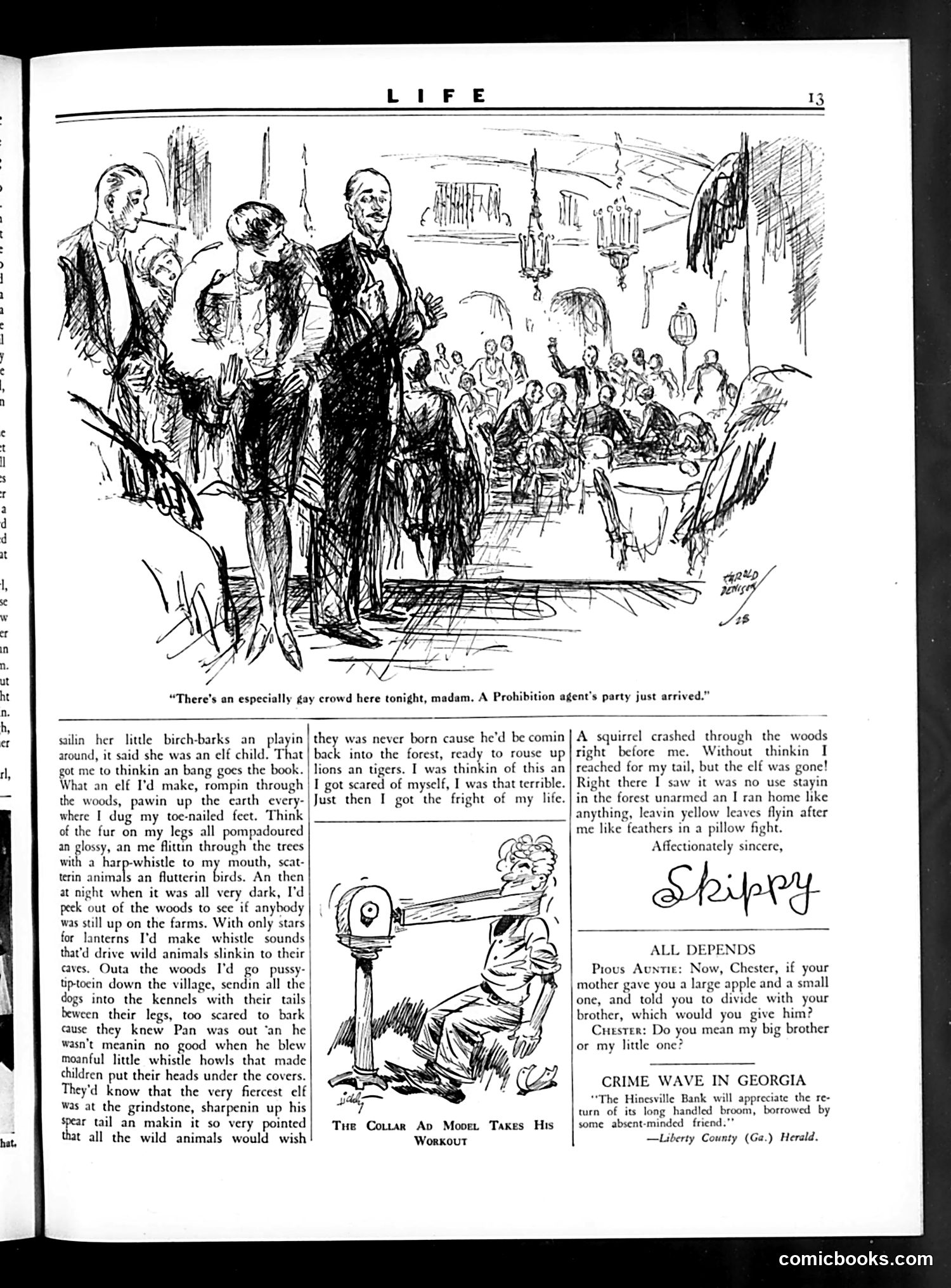
The main cartoon shows a well-dressed couple entering what appears to be a speakeasy or nightclub during Prohibition, with the caption: "There's an especially gay crowd here tonight, madam. A Prohibition agent's party just arrived." The joke relies on Prohibition-era context (1920s-1930s): speakeasies were illegal bars, and Prohibition agents were federal law enforcement who raided them. The humor is ironic—the host is sarcastically suggesting that a raid by federal agents will make the party "gay" (meaning lively/fun), when in reality their arrival would shut down the illegal operation and likely arrest patrons. The secondary cartoon titled "The Collar Ad Model Takes His Workout" shows a man exercising with a device, illustrating vintage advertising humor unrelated to the main content.
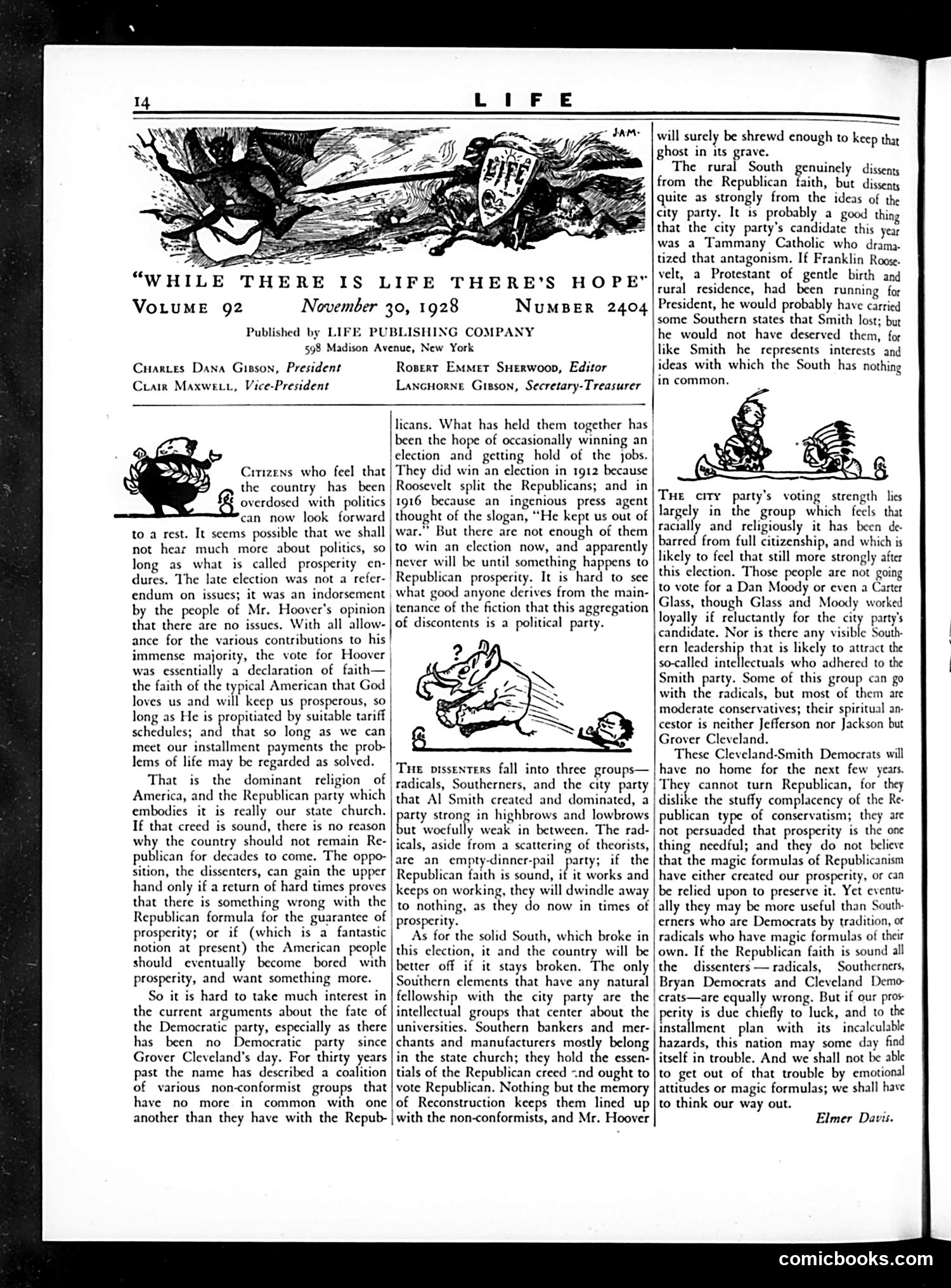
This page contains political commentary on the 1928 U.S. election aftermath. The article discusses divisions within the Democratic Party into three factions: radicals, Southerners, and city-party members. The accompanying cartoons depict these internal conflicts. One illustration shows what appears to be a donkey (the Democratic symbol) in distress or turmoil, symbolizing party disunity. The text references Republican prosperity under Hoover and suggests Democrats lack coherent philosophy beyond electoral ambition. The author (Elmer Davis) argues that Southern Democrats and urban Democrats have fundamentally incompatible values, with the party held together only by desire for electoral victory. The piece suggests this fragmentation threatens Democratic viability compared to Republican organizational strength.
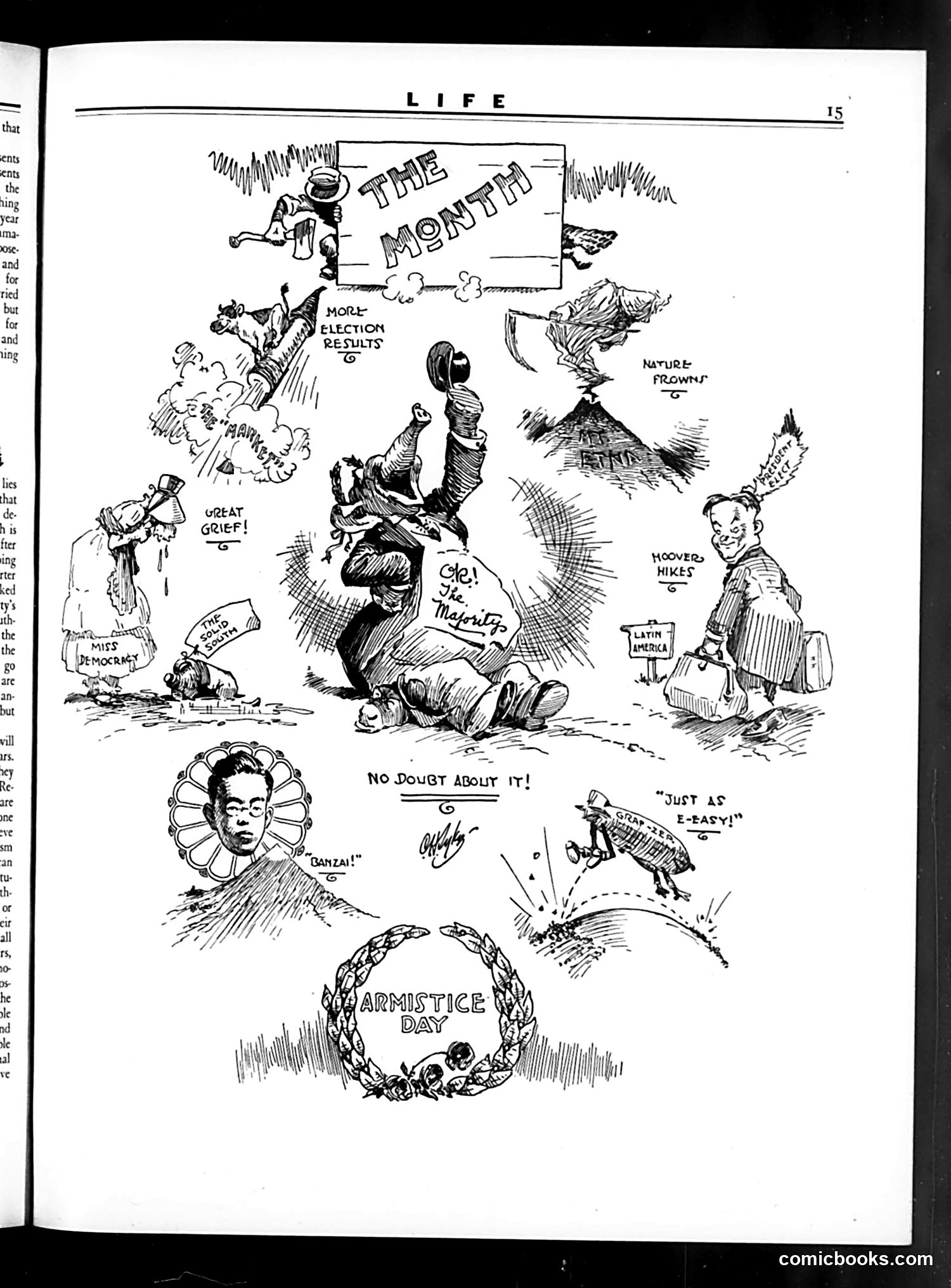
This satirical cartoon comments on November 1918 events, likely surrounding the armistice ending World War I (November 11). The central figure, knocked down and struggling, appears to represent Germany or the Central Powers, battered by various "blows" labeled throughout: - "More Election Results" (likely U.S. midterm elections) - "Great Grief!" (Miss Democracy weeping) - "Nature Frowns" and "Latin America" (international pressure) - "Hoover Hikes" (possibly food/economic policy) The bottom panel shows "Armistice Day" with a wreath, suggesting the month's culmination in the armistice agreement. The cartoon satirizes how multiple crises—political, economic, and military—converged in this pivotal month, leaving various parties defeated or struggling under accumulated pressures.
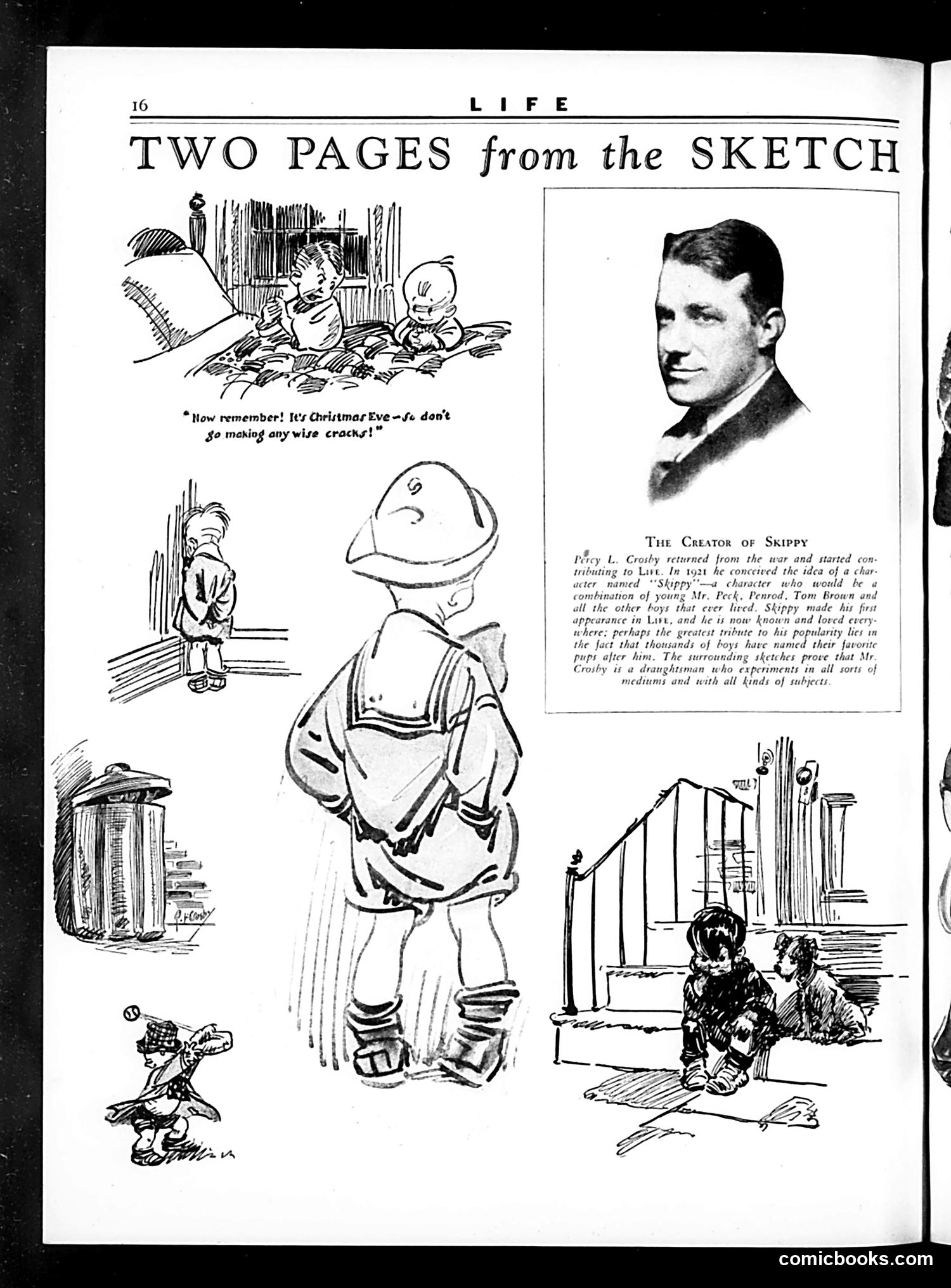
This page from *Life* magazine features sketches by Percy L. Crosby, creator of the comic strip "Skippy." The right side includes a portrait of Crosby with biographical text explaining how he developed the character Skippy—described as a combination of various mischievous boys Crosby knew, including young versions of figures like Tom Brown. The left side shows multiple cartoon sketches depicting childhood scenes: children playing, a child standing alone (possibly punished or sad), trash cans, and a small figure at bottom. These appear to be preliminary sketches or studies illustrating the everyday adventures and mischief that characterize Skippy's comic world—capturing authentic boyhood behavior and emotions that made the strip popular with readers.
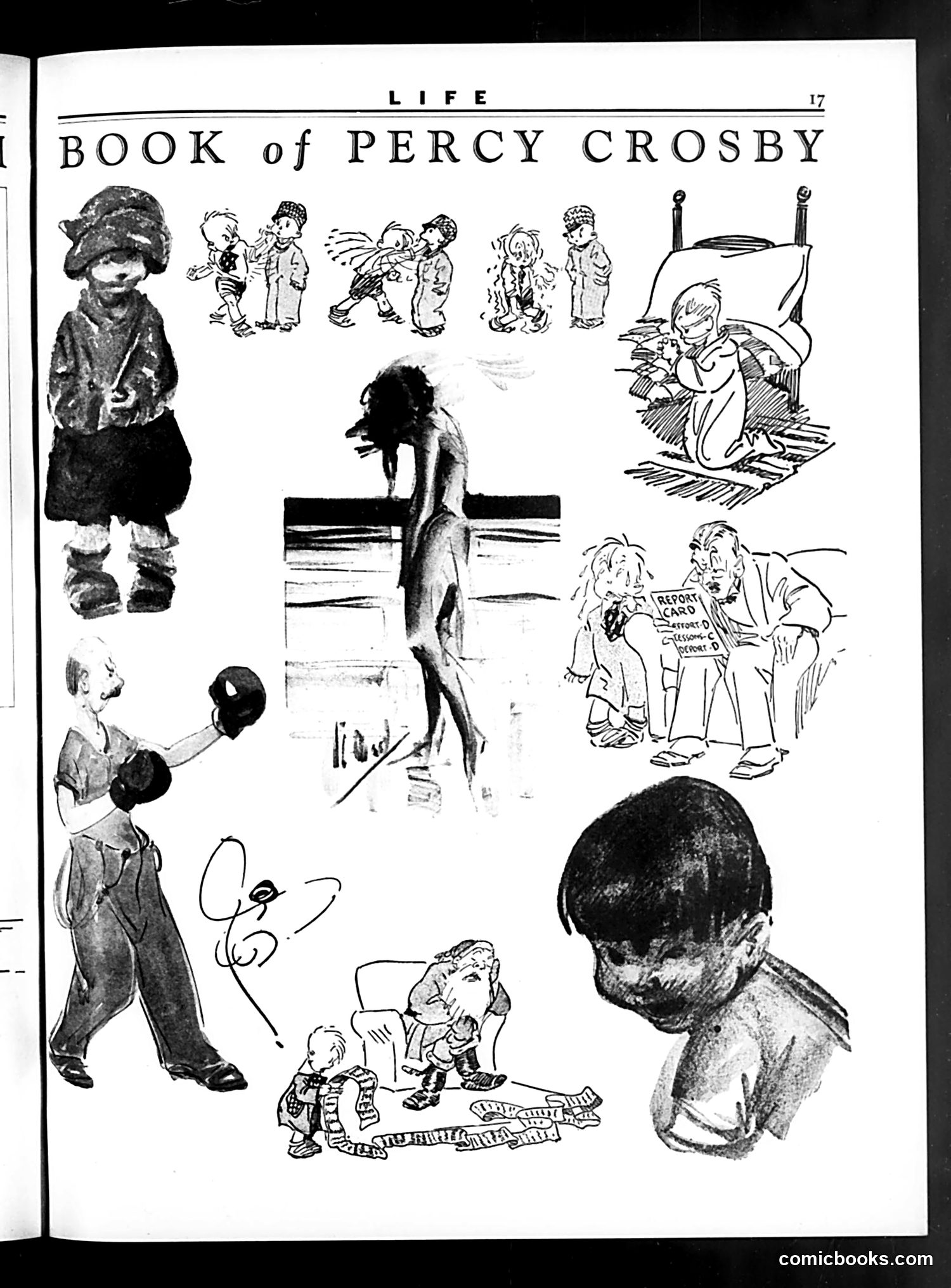
This page showcases illustrations from Percy Crosby's work, a prominent cartoonist of the early 20th century. The collection depicts various scenes of childhood and family life: children playing games, fighting, studying school reports, lying in bed, exercising with dumbbells, and swimming. The illustrations appear designed to capture authentic moments of childhood behavior—mischief, physical activity, education, and play. Crosby was known for his detailed, naturalistic drawings of children that reflected contemporary American youth culture. The large portrait heads at page corners emphasize character expressions. Without accompanying text explaining these specific cartoons' satirical targets, the precise social commentary remains unclear, though Crosby's work generally used children's activities to comment on broader American social and cultural themes of his era.
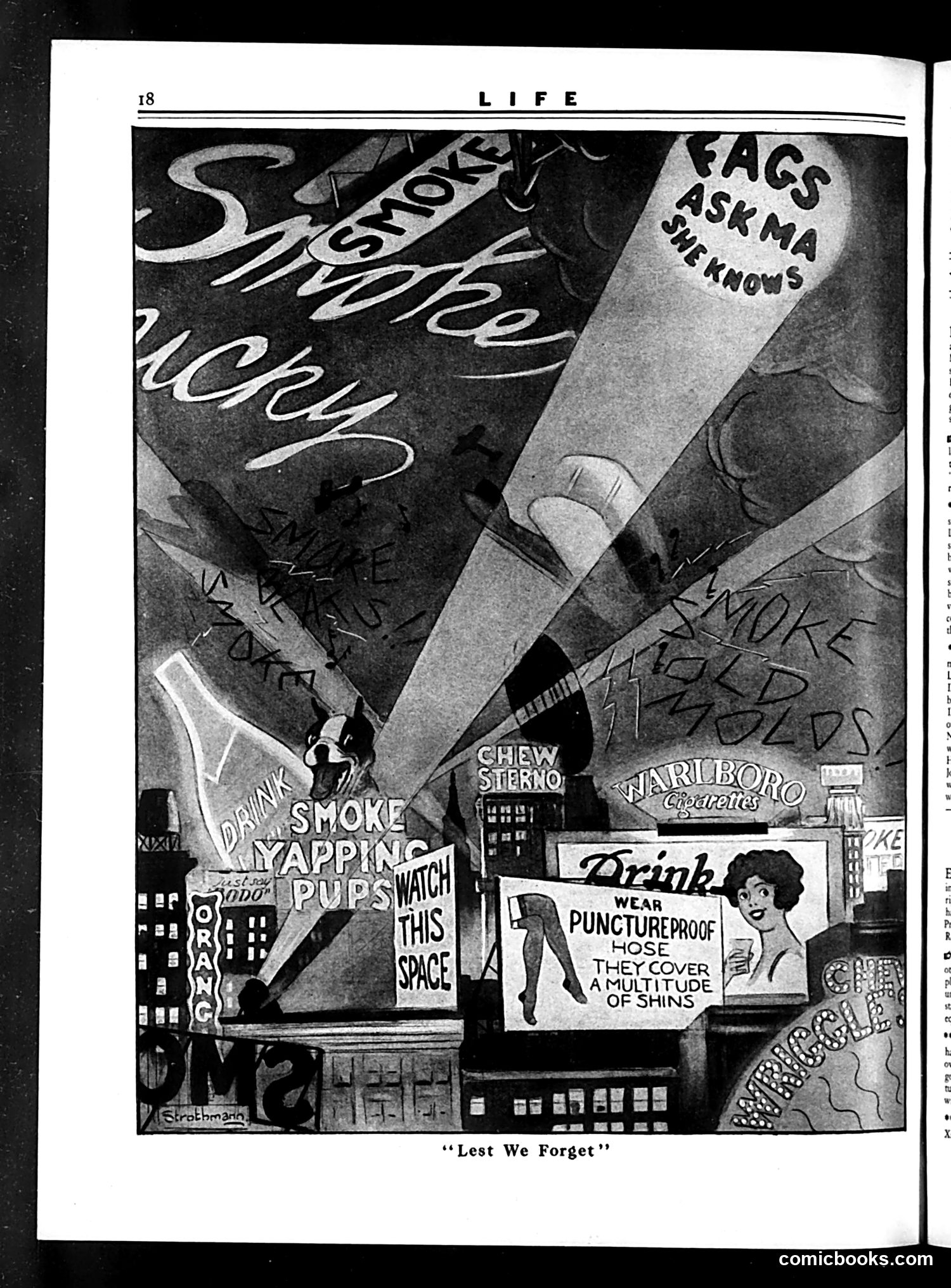
This cartoon satirizes 1920s city life and commercialism. A massive searchlight illuminates a crowded urban skyline filled with advertisements for tobacco, alcohol, and other products ("Smoke," "Drink," "Chew Sternos," "Marlboro Cigarettes"). The title "Lest We Forget" appears ironic—suggesting we should remember moral values, yet the image shows how commercial vice dominates the cityscape. A woman's legs advertise "punctureproof" hosiery that "cover a multitude of shins," making a crude pun on the biblical phrase "cover a multitude of sins." The overall message critiques how advertising and consumer culture have overtaken urban morality, with vice literally towering over the city. The searchlight may reference wartime imagery, creating tension between patriotic memory and present commercial excess.
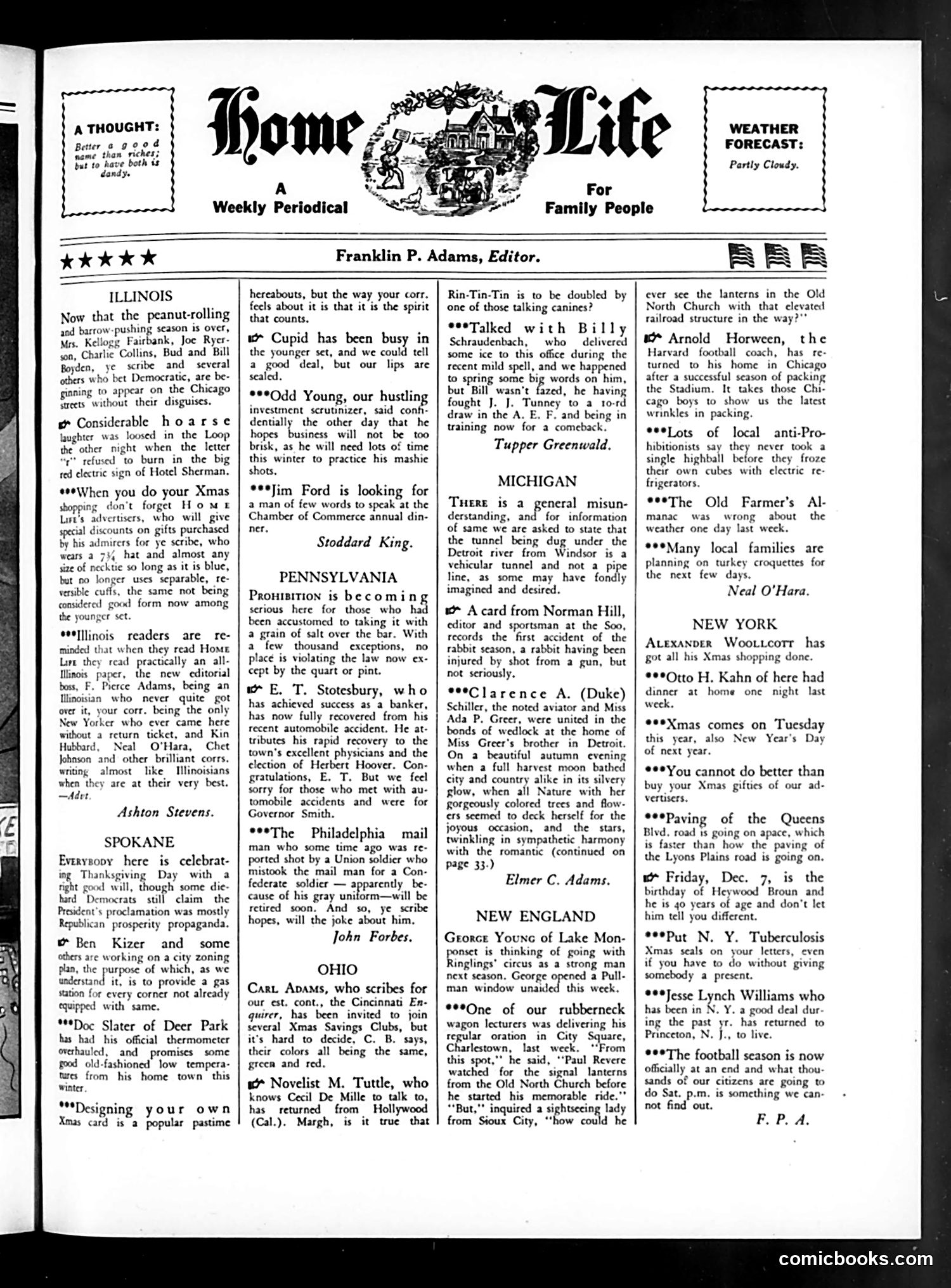
This page from *Home Life* (a weekly periodical edited by Franklin P. Adams) contains no political cartoons—instead it's a humor column featuring regional correspondents sharing anecdotes and witticisms from across America (Illinois, Spokane, Pennsylvania, Ohio, Michigan, New England, New York). The humor is gentle domestic satire typical of the era: references to Prohibition enforcement ("no place is violating the law now except by the quart or pint"), Republican prosperity claims, automobile accidents as comedy fodder, and romantic entanglements among the younger set. Notable: the Illinois correspondent mentions that an electric hotel sign refused to burn—likely a joke about electrical failure rather than political commentary. The overall tone is affectionate small-town gossip and light social observation—not satire of major political figures or movements. This appears to be lifestyle/entertainment content for "family people" rather than hard-hitting commentary.
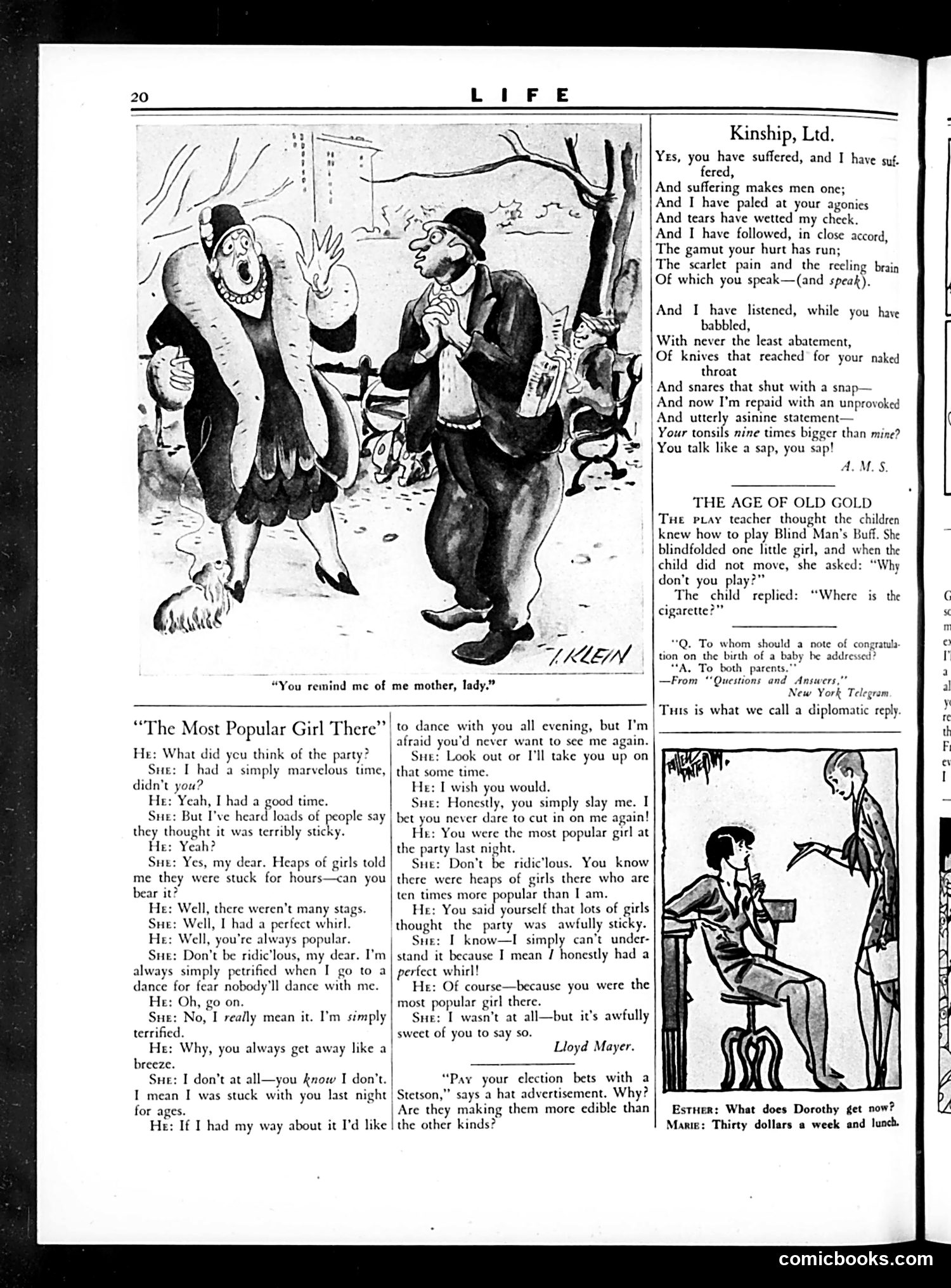
**The Main Cartoon (top):** A caricatured couple—the woman appears to be of exaggerated proportions with an elaborate hat and necklace. The man says "You remind me of me mother, lady," suggesting an insulting comparison. The satire mocks flirtation rituals and backhanded compliments at social gatherings. **"The Most Popular Girl There" (center):** This dialogue piece satirizes feminine social performance and false modesty. The woman constantly denies being popular while providing evidence she clearly is ("perfect whirl," men dancing with her). The man plays along, creating a comedy of transparent self-contradiction and performative insecurity. It mocks 1920s social conventions where women were expected to downplay their appeal and popularity. **Other Items:** Minor humor pieces including a joke about hat advertisements and election betting, and a brief anecdote about a child asking where cigarettes are during a game—mocking early 20th-century ubiquitous smoking. The page captures Jazz Age social dynamics and gender performance conventions of the period.
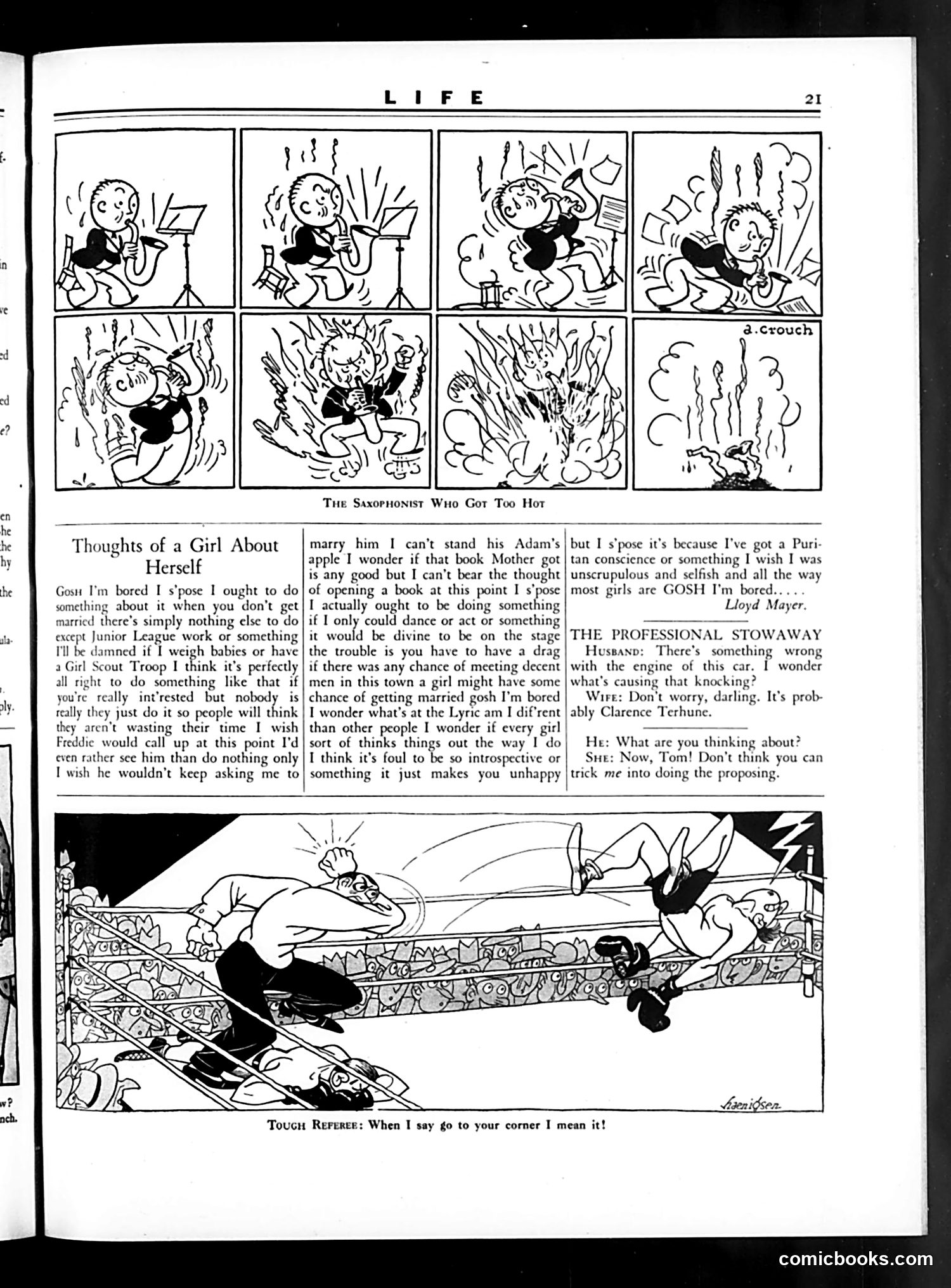
This page contains three satirical pieces typical of 1920s-30s American humor: **"The Saxophonist Who Got Too Hot"** (comic strip): A musician playing saxophone becomes so energetically absorbed in his music that he literally ignites, with flames consuming him and his surroundings. The joke satirizes passionate jazz performance and the era's association of jazz with wild, uncontrolled behavior. **"Thoughts of a Girl About Herself"**: A monologue mocking the self-absorbed, aimless social world of upper-class unmarried women. The protagonist complains of boredom, obsesses over marriage prospects and her appearance, and engages in shallow introspection—satirizing both female dependency on marriage and the pretentiousness of self-analysis. **"The Professional Stowaway"** and **"Tough Referee"**: Brief joke captions depicting domestic squabbles and sports scenes, using exaggeration for humor. The satire targets 1920s social conventions: jazz-age excess, women's limited life options despite social freedom, and marital dynamics among the leisure class.
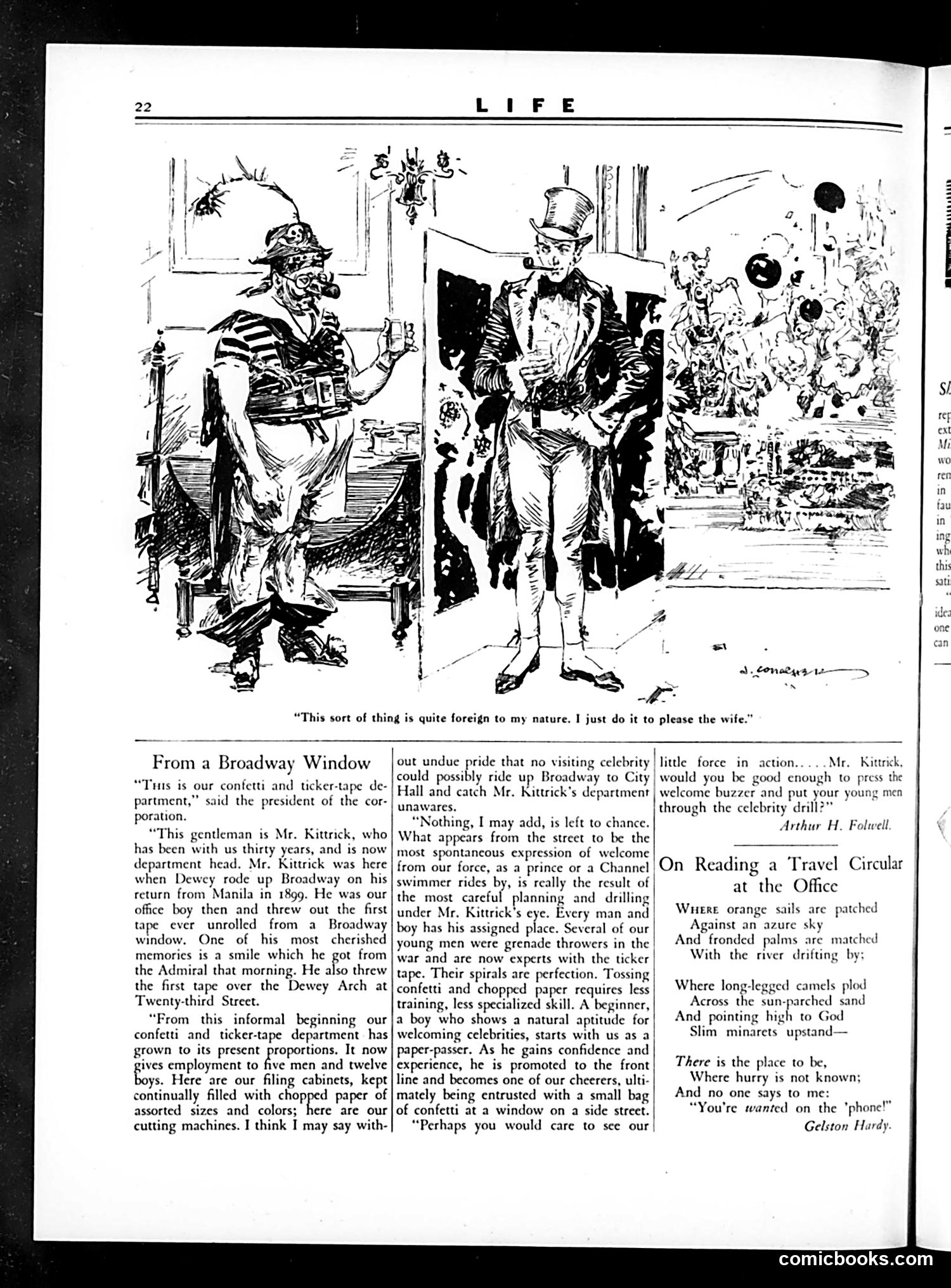
This cartoon satirizes the mechanization and elaborate planning behind what appears to be spontaneous civic celebration. The cartoon shows a corporate department head explaining to a visitor that the confetti and ticker-tape parades welcoming celebrity visitors to New York are entirely orchestrated—with filing systems, trained staff, assigned positions, and specialized techniques. The satire targets the performative nature of American civic life: what crowds perceive as genuine, joyful spontaneity is actually carefully drilled corporate theater. The reference to Admiral Dewey's 1899 return from Manila grounds this in a real historical parade tradition, suggesting this "industry" has grown over decades into an absurdly elaborate operation with departments, hierarchies, and ex-soldier experts throwing confetti "spirals." The opening caption—a man telling his wife "I just do it to please the wife"—establishes the underlying joke: people perform enthusiasm and conformity for others' expectations, not genuine feeling.
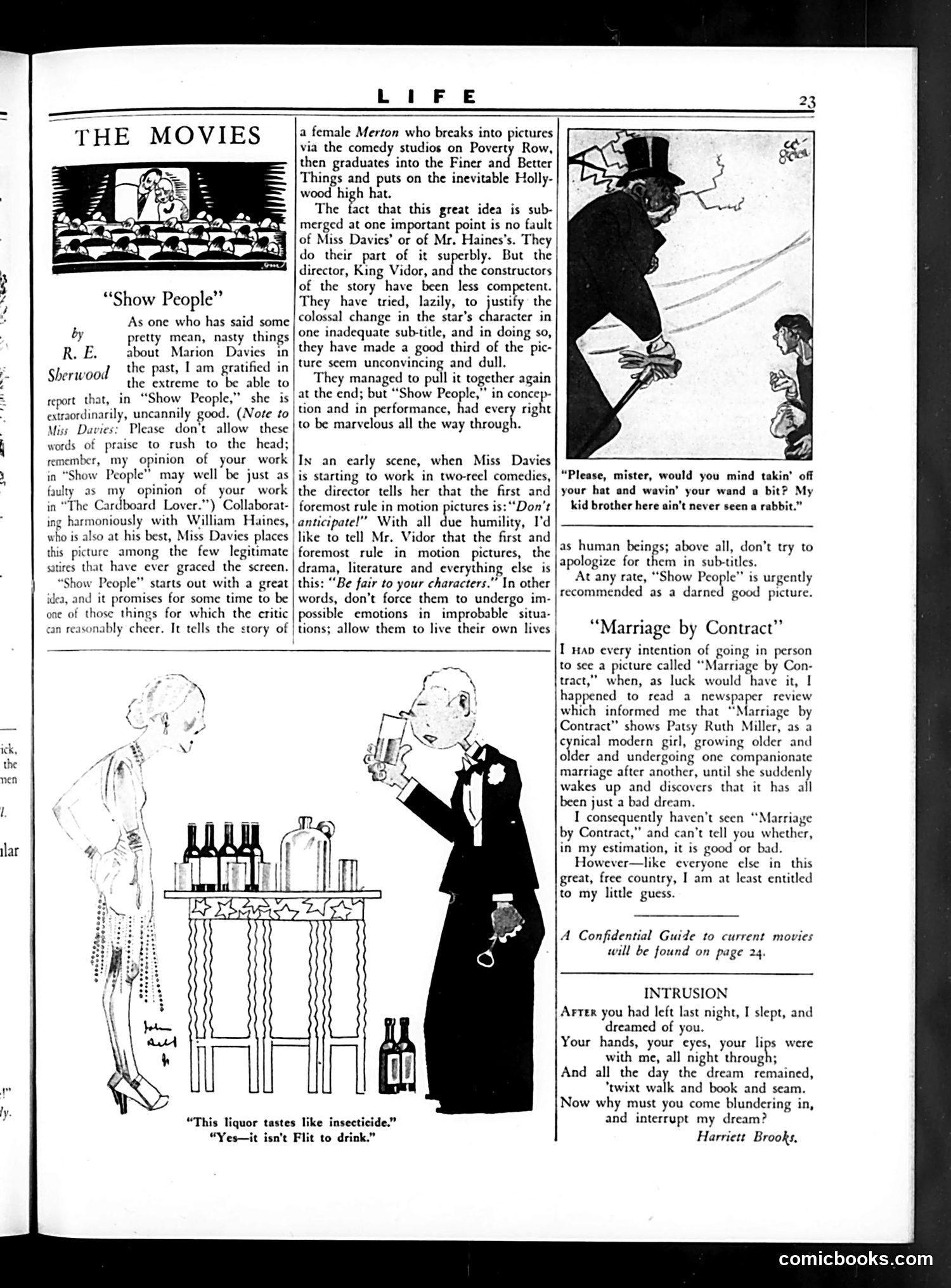
This page from *Life* magazine contains film reviews by critic R.E. Sherwood. The main cartoon depicts a well-dressed man examining bottles of liquor at a bar, with the caption "This liquor tastes like insecticide. Yes—it isn't Flit to drink." This is a Prohibition-era joke: "Flit" was a commercial insecticide brand, and the humor plays on both the terrible quality of bootleg liquor during the 1920s alcohol ban and the brand name similarity. The reviews discuss Marion Davies' film "Show People" (praised despite the critic's previous criticism of her work) and "Marriage by Contract" (which the critic hasn't seen but dismisses based on its plot summary). The smaller cartoon shows a rabbit performer, likely referencing vaudeville or early cinema tricks. The page exemplifies 1920s satirical magazine content: topical humor about contemporary entertainment, Prohibition-era drinking culture, and Hollywood gossip.
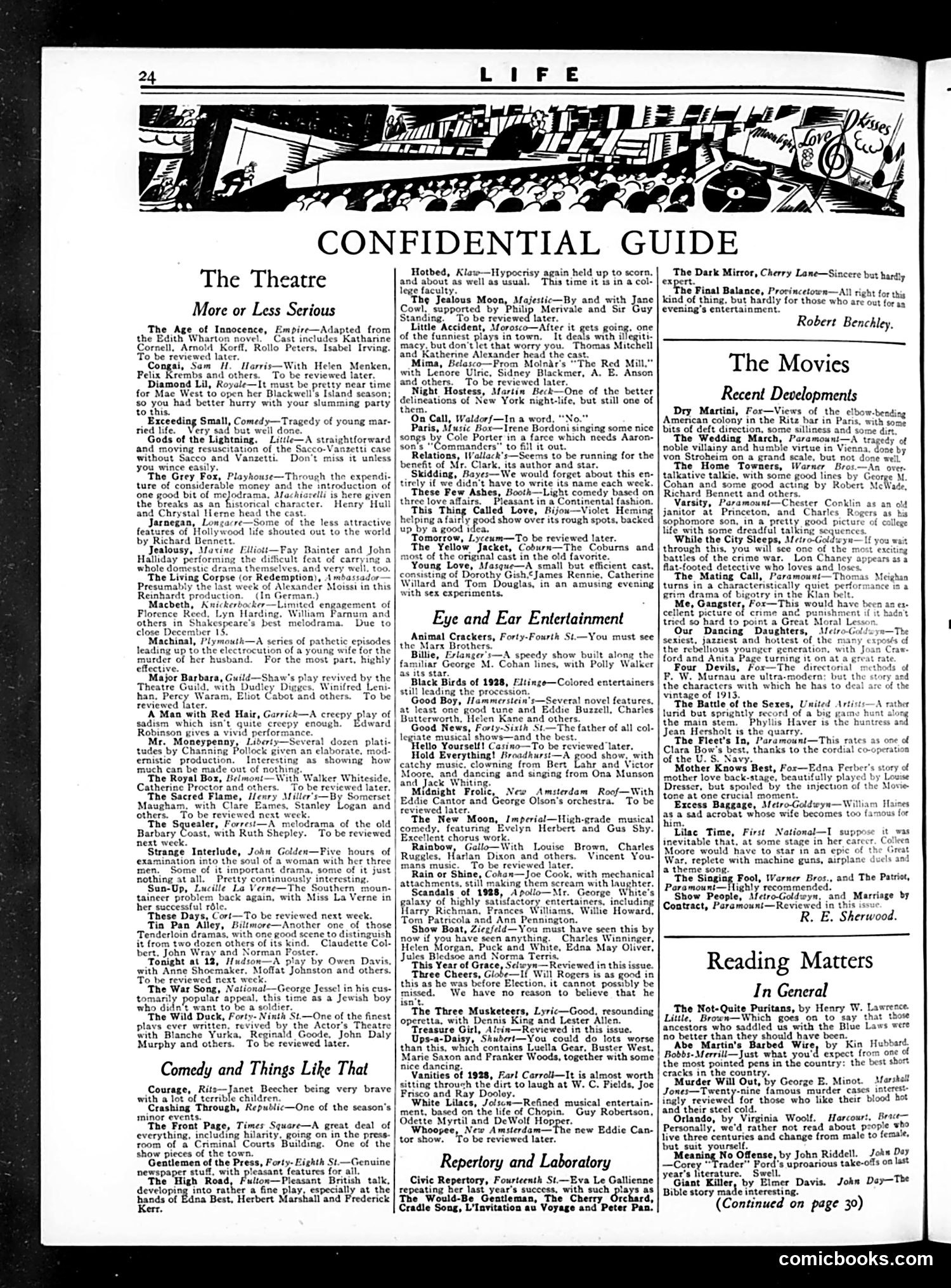
This page is a **theater and entertainment guide**, not a political cartoon. It's a "Confidential Guide" reviewing Broadway plays, movies, and performances currently running. The page lists dozens of theatrical productions with brief critical assessments. Notable references include: - **Mae West's "Diamond Lil"** — the review sarcastically suggests she'll soon need "Blackwell's Island season" (a prison reference, playing on West's risqué reputation) - **"Gods of the Lightning"** — explicitly noted as about the **Sacco-Vanzetti case**, the infamous 1920s murder trial of two Italian anarchists - **Eugene O'Neill's "Strange Interlude"** — described as a five-hour play at the John Golden Theatre The guide reflects 1920s theatrical culture, mixing serious drama (Shakespeare's *Macbeth*), contemporary social commentary (Sacco-Vanzetti), and popular entertainment. The tone is witty and irreverent throughout, typical of Life magazine's satirical approach to cultural criticism.
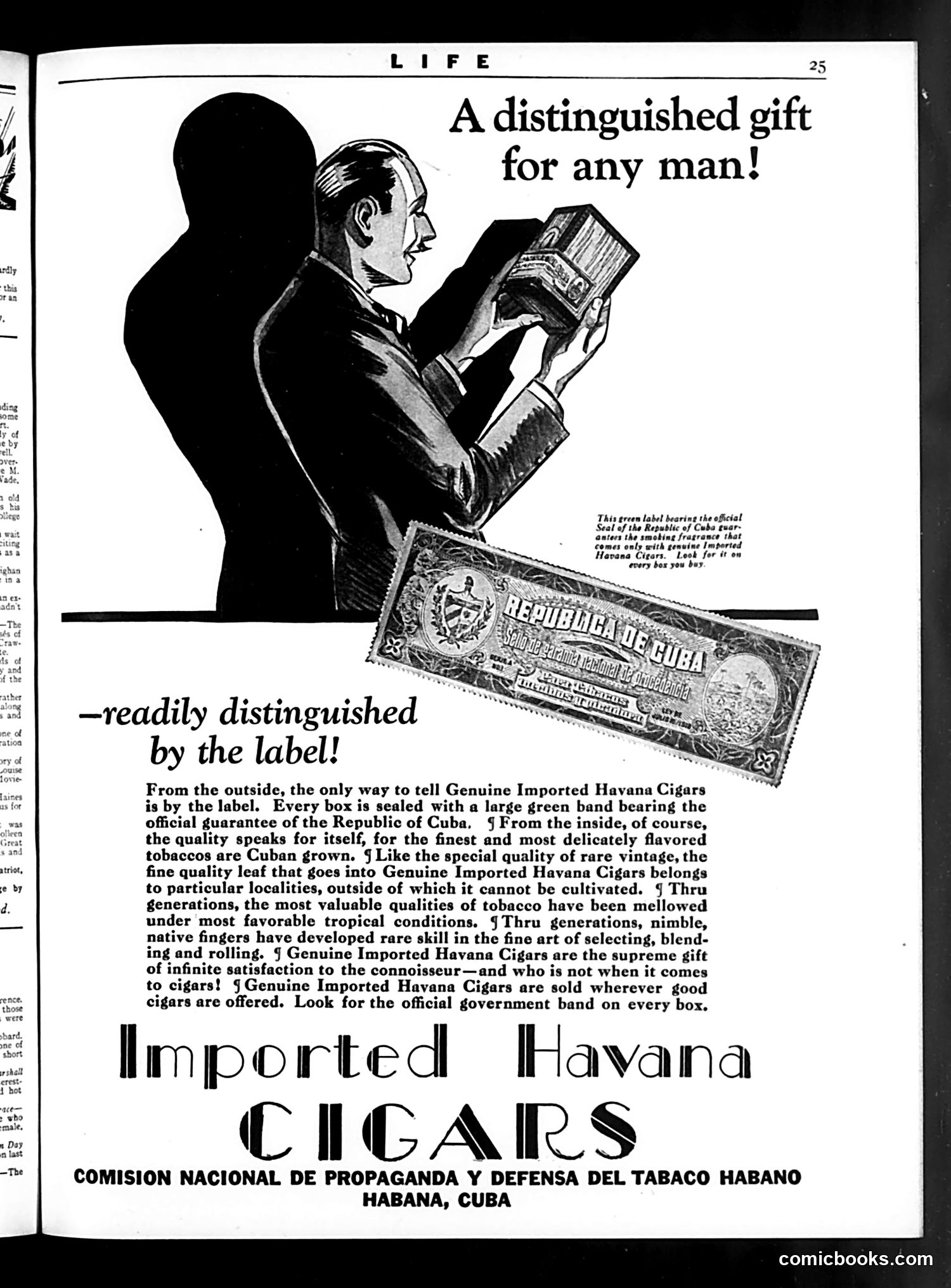
This is a **Cuban government advertisement** for Havana cigars, not satire. It appears in Life magazine promoting genuine Cuban cigars to American male consumers. The image shows a distinguished gentleman examining a cigar box, emphasizing luxury and refinement. The text stresses that authentic Havana cigars are identifiable by an official green government seal from Cuba's tobacco commission, guaranteeing quality. The advertisement appeals to American connoisseurship and masculine sophistication—cigars as a "distinguished gift" signaling taste and status. It emphasizes the product's exclusivity: tobacco from specific Cuban regions, multi-generational craftsmanship, and tropical cultivation conditions that cannot be replicated elsewhere. This represents pre-1959 Cuban-American trade relations, when Havana cigars were prestigious luxury goods freely imported and advertised in major American publications. The Cuban government actively promoted this export to maintain commercial ties and prestige.
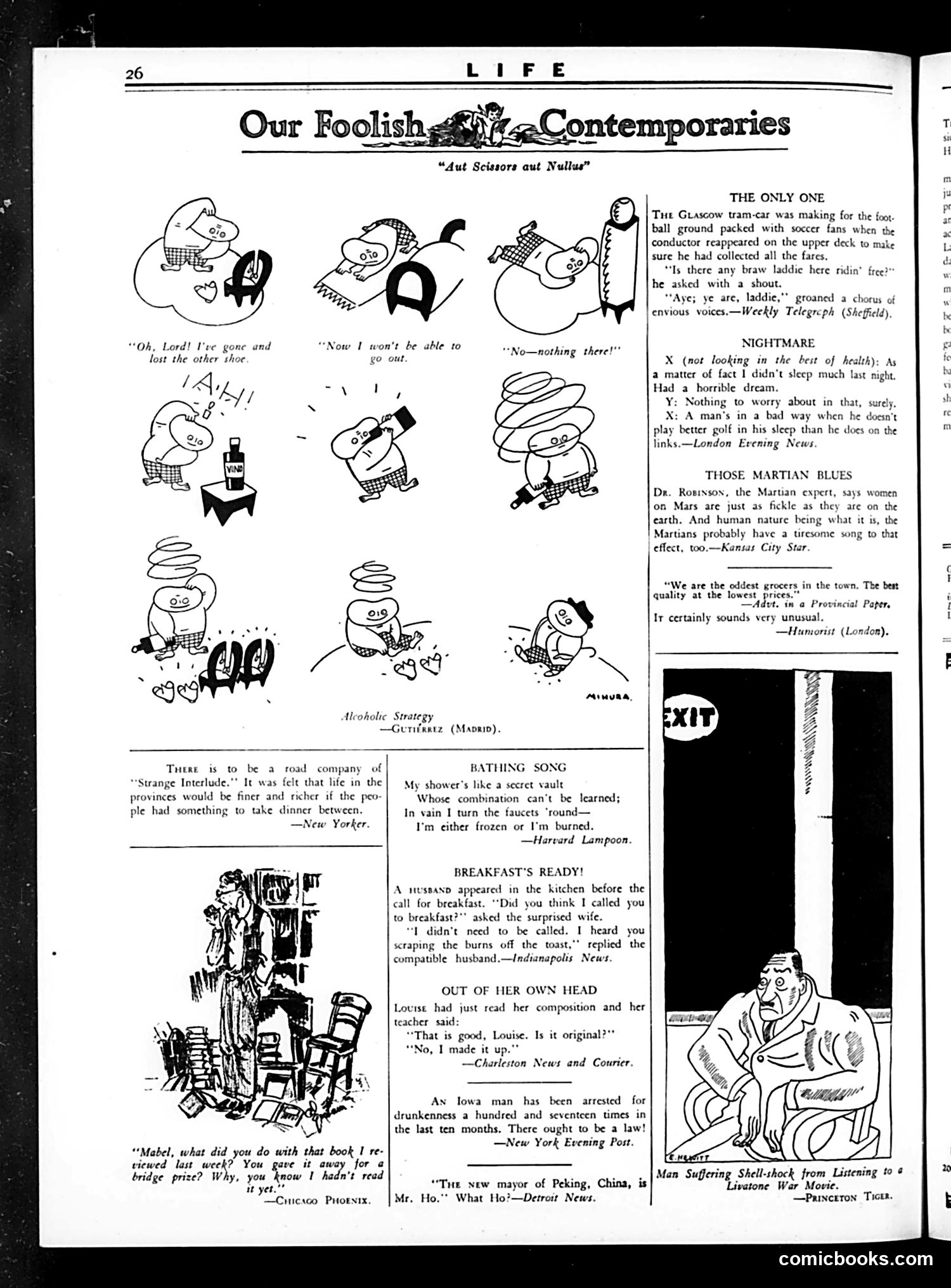
This page collects brief satirical anecdotes and jokes mocking contemporary absurdities. The cartoon strip (top left) depicts a man repeatedly losing shoes while drunk—visual humor about alcoholism's consequences. The text items target everyday foolishness: a wife's illogical excuse for losing a borrowed book; a husband smugly hearing burnt toast scraping instead of being called to breakfast; a student claiming her composition is original while admitting she "made it up"; and a Glasgow conductor sarcastically calling out the one passenger riding free (the conductor himself). Other bits mock 1920s popular culture and pseudo-science: Broadway's experimental theater spreading to provinces; implausible plumbing ("frozen or burned"); Dr. Robinson's claim that Martian women are fickle; and shell-shock from watching war movies. The humor is mild social observation—poking fun at human contradictions, marital dynamics, and modern pretensions rather than serious satire.
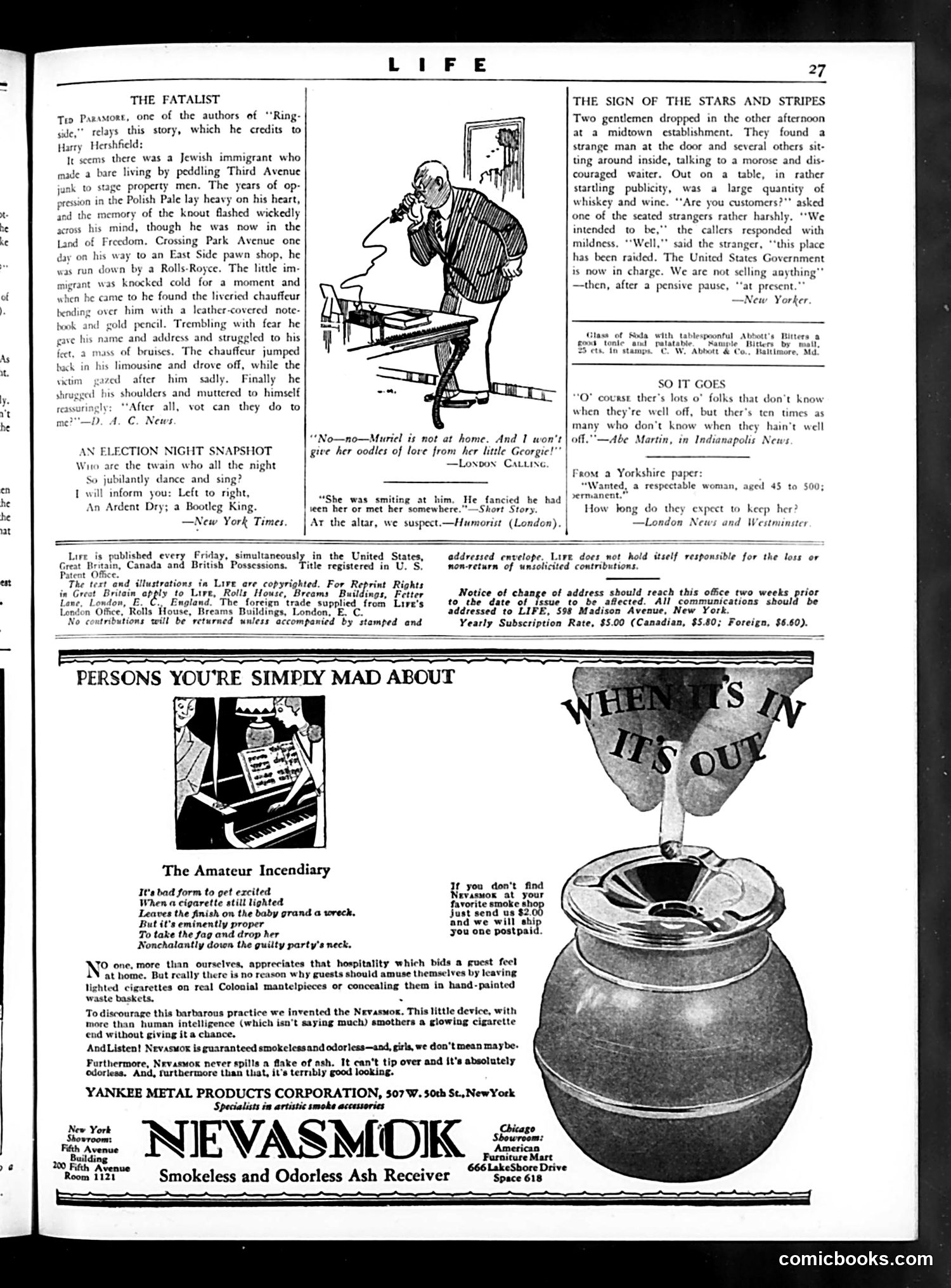
This page contains three humorous short pieces typical of *Life* magazine's satirical style: **"The Fatalist"** mocks fatalistic attitudes through a Jewish immigrant's story. A Rolls-Royce hits him; when the wealthy chauffeur approaches with notepad, the immigrant assumes he'll be sued. Instead, the driver leaves without consequence. The immigrant's resigned shrug—"What can they do to me?"—satirizes how the powerless accept injustice as inevitable, contrasting his Old World oppression with New World inequality. **"The Sign of the Stars and Stripes"** lampoons Prohibition enforcement. Federal agents raid a bar and claim the government is "now in charge," then pause before admitting they're "not selling anything—at present," implying corruption or that enforcement is performative theater. **"The Amateur Incendiary"** advertises the Nevasmok ashtray by mocking careless smokers who leave lit cigarettes on furniture—a gentle jab at hosts who damage property while claiming hospitality. The page reflects 1920s concerns: wealth inequality, Prohibition's contradictions, and social etiquette.
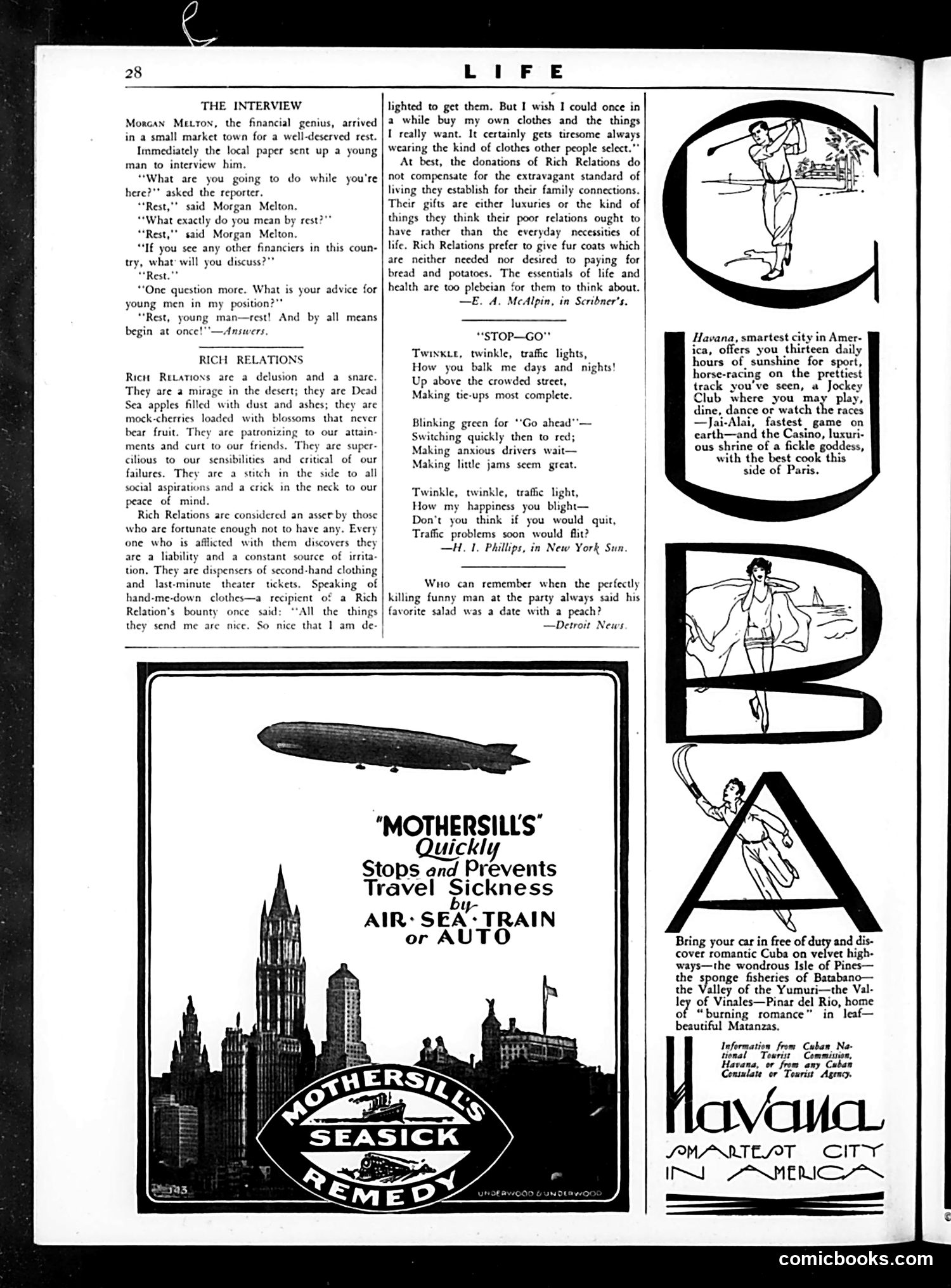
This page combines three satirical pieces with period advertisements: **"The Interview"** mocks wealthy financier Morgan Melton through repetitive questioning—the joke being his sole answer to every question is "Rest," satirizing the wealthy elite's leisure culture and disconnect from productive work. **"Rich Relations"** is biting social commentary on the burden of wealthy relatives. It argues that having rich family members is actually a liability disguised as an asset—they give unwanted hand-me-downs and impose social expectations rather than provide genuine help. The satire targets class anxiety and the performative nature of wealth display in early 20th-century America. **"Stop-Go"** humorously complains about traffic lights (then relatively new technology), personifying them as frustrating obstacles—reflecting contemporary anxiety about modern urban infrastructure. The advertisements for Mothersills seasickness remedy and Havana tourism reflect period leisure marketing. The page overall satirizes wealth, social climbing, and modern inconveniences of the Jazz Age era.
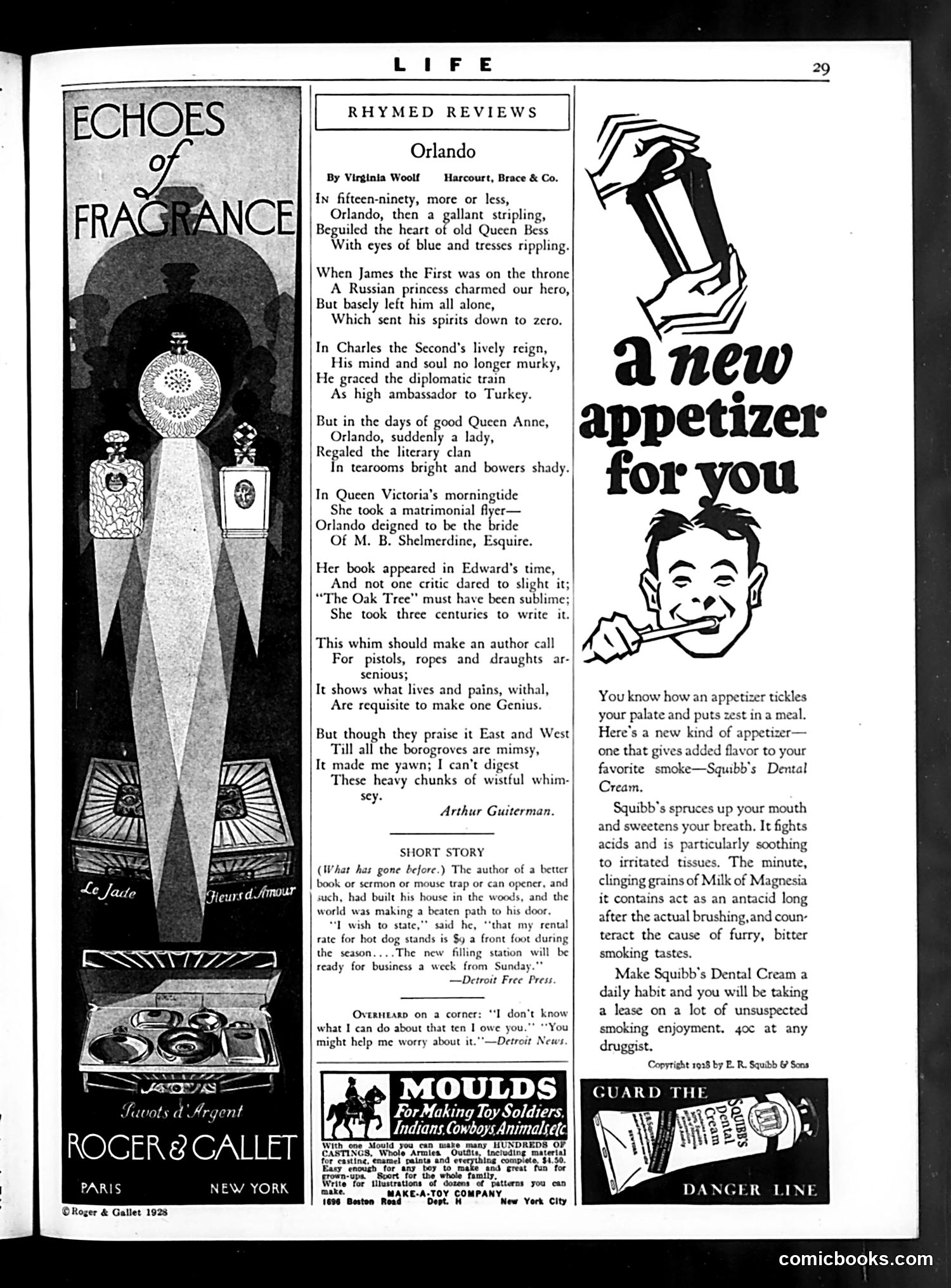
This page features Arthur Guiterman's rhymed review of Virginia Woolf's novel *Orlando* (published 1928). The review mockingly summarizes the book's fantastical premise: a character who lives across centuries, changing sex from man to woman, and encounters various historical figures (Queen Elizabeth I, James I, Charles II, Queen Anne, Queen Victoria, Edward VII). Guiterman's satire targets the novel's experimental modernism and what he views as its self-indulgent whimsy. While acknowledging the book receives critical praise ("East and West"), he dismisses it as tedious—"heavy chunks of wistful whimseys" that made him "yawn." His complaint about the three-century writing timeline for "The Oak Tree" mocks what he sees as pretentious literary excess. The satire works for modern readers as period literary criticism: Guiterman represents traditionalist taste finding Woolf's boundary-breaking narrative bewildering and self-important, a common contemporary reaction to modernist fiction's formal experimentation.
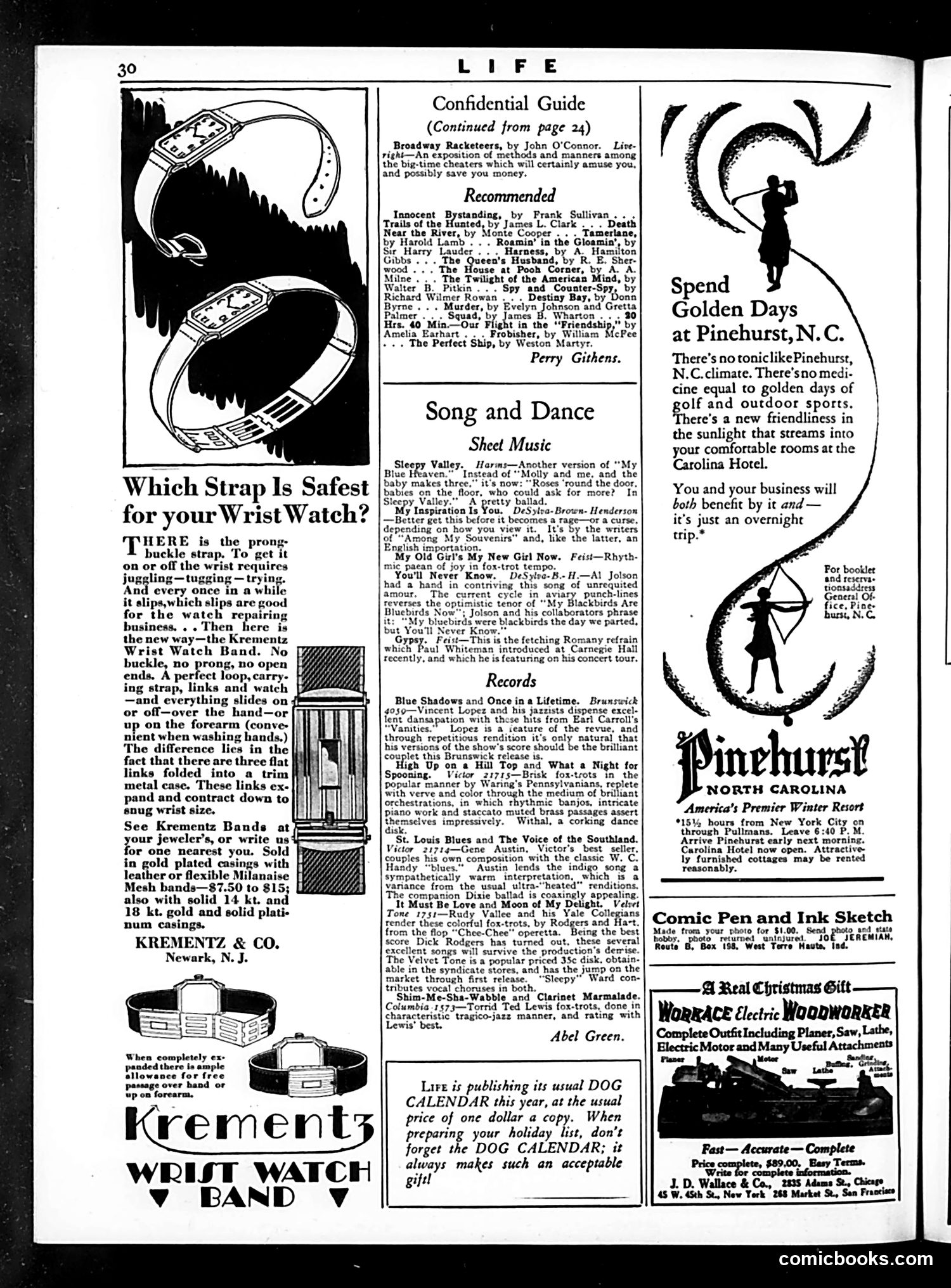
This page is primarily **advertising and entertainment listings**, not satire. The main content includes: **Left side:** A Krementz & Co. advertisement for wrist watch bands, comparing traditional prong-buckle straps (depicted as complicated in the illustration) with their new seamless loop design. The ad positions their product as safer and more convenient for daily wear. **Center:** A "Confidential Guide" recommending books, sheet music, and phonograph records—typical entertainment coverage for Life magazine of this era (appears to be late 1920s based on references to Amelia Earhart's "Friendship" flight and Paul Whiteman). **Right side:** A tourism advertisement for Pinchurst, North Carolina, marketing it as a golf and outdoor sports destination. The page contains no political cartoons or satire. It's a standard magazine layout mixing product advertisements with entertainment recommendations.
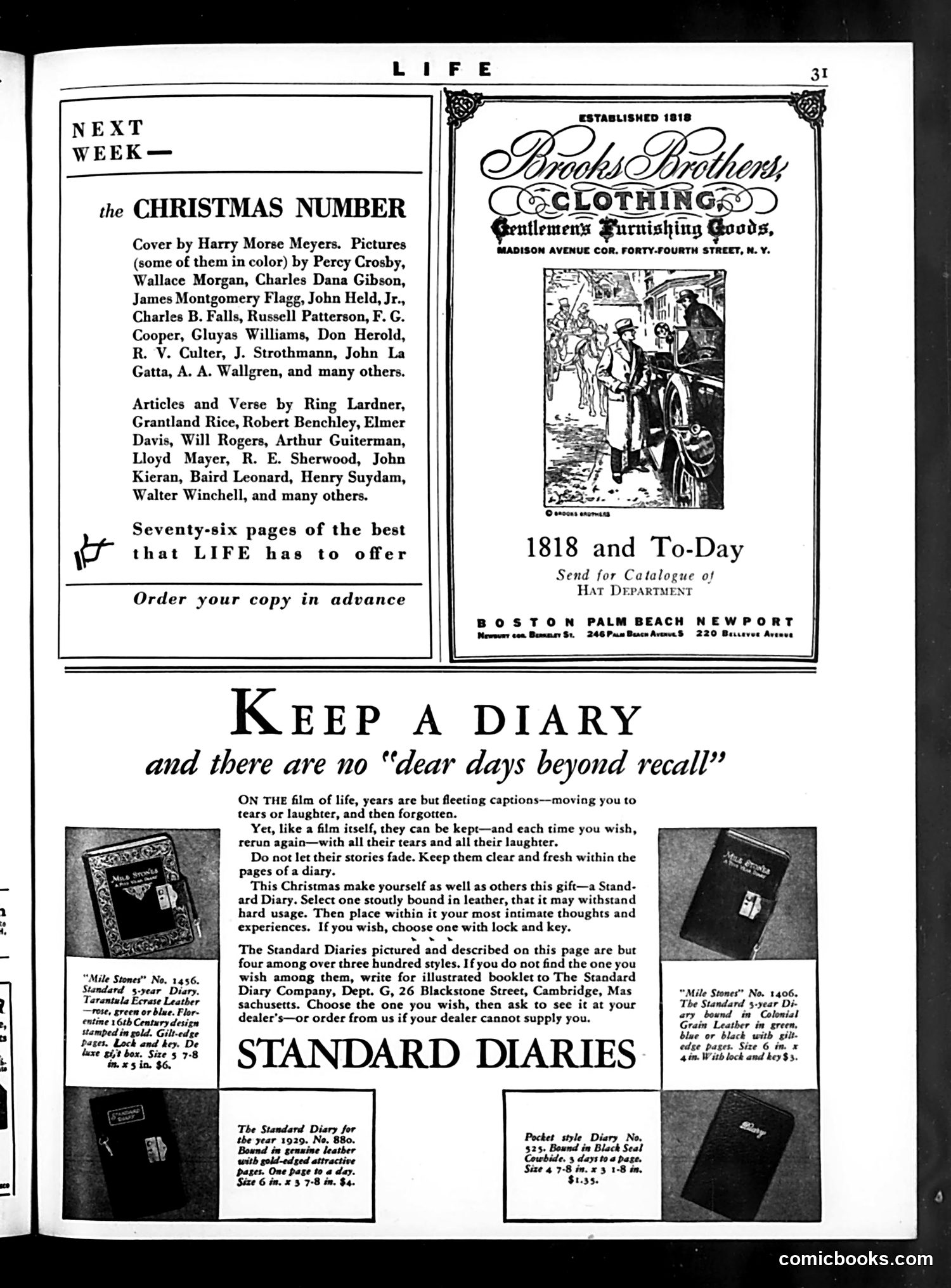
This page is primarily **advertising and promotional content**, not political satire. It contains: 1. **"Next Week" teaser** for Life's upcoming Christmas issue, listing prominent illustrators (Flagg, Held, Gibson) and writers (Ring Lardner, Will Rogers). 2. **Brooks Brothers clothing advertisement** featuring a vintage illustration of men in formal wear. 3. **"Keep a Diary" campaign** promoting Standard Diaries as Christmas gifts, with poetic copy about preserving memories ("years are but fleeting captions"). Multiple diary styles are pictured with prices ($1.35–$6). The diary section uses sentimental language typical of 1920s advertising—emphasizing nostalgia and personal reflection rather than satirizing anything. There is **no political content or cartoon satire** visible on this page. It's a straightforward magazine layout mixing holiday promotion with luxury goods advertising.
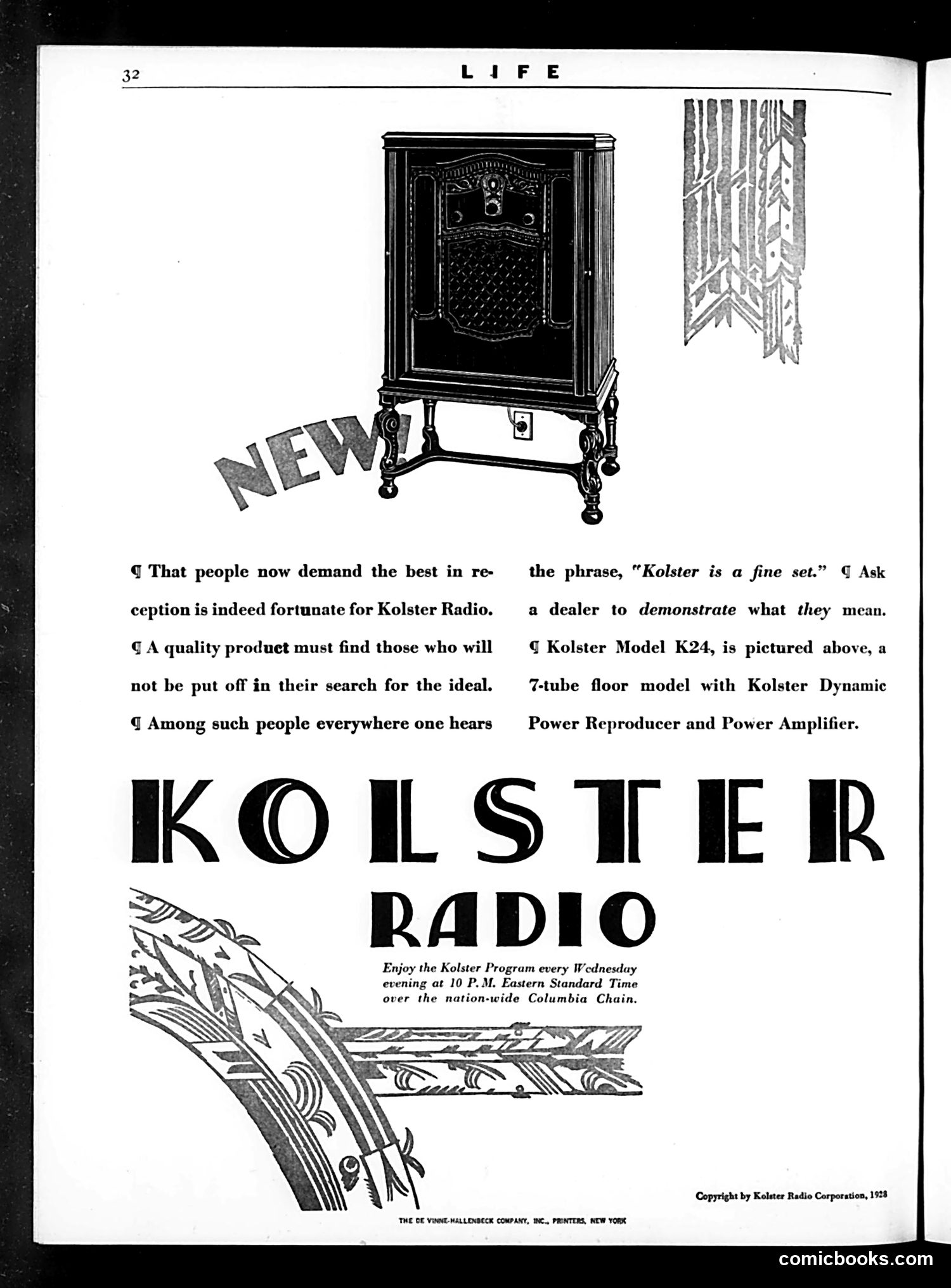
This is a **full-page advertisement**, not political satire. It promotes the Kolster Model K24 radio receiver, a floor-standing console with seven tubes—advanced technology for 1928. The ad emphasizes quality and aspirational messaging: consumers "demanding the best" will recognize "Kolster is a fine set." The Model K24 featured Kolster's "Dynamic Power Reproducer and Power Amplifier," highlighting technical superiority as a selling point. The decorative geometric elements in the upper right and lower left are Art Deco design flourishes typical of 1920s advertising aesthetics. The page also promotes a weekly radio program broadcast Wednesdays at 10 PM on the Columbia radio network—part of the product's marketing strategy. The copyright date (1928) places this during radio's rapid commercial expansion, when owning a quality receiver was a status symbol for middle-class households.
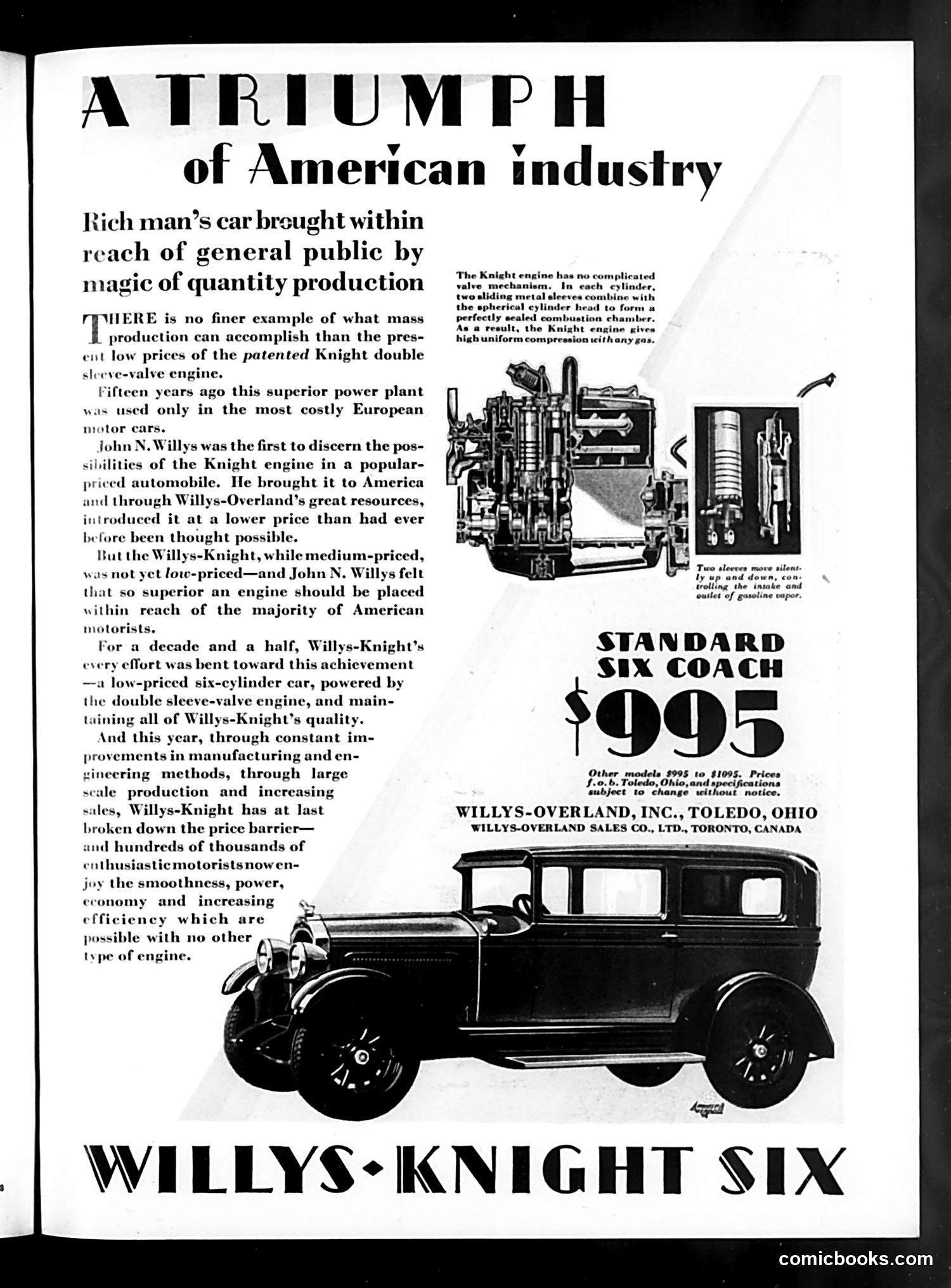
This is **not a cartoon or satire**—it's a straightforward automobile advertisement disguised as editorial content, a common early 20th-century marketing practice. The page promotes the Willys-Knight Six automobile, emphasizing how mass production has made an expensive European engine technology affordable for ordinary Americans. The headline "A Triumph of American Industry" frames mass manufacturing as democratic achievement. The narrative credits John N. Willys for recognizing the Knight engine's commercial potential and spending 15+ years perfecting manufacturing to lower the price from luxury to mass-market ($995). The technical diagrams explain the engine's double sleeve-valve mechanism—a genuine engineering feature that was genuinely advanced at the time. The "satire" label appears misapplied; this is period advertising rhetoric celebrating capitalism and industrial efficiency as making luxury accessible to the middle class—a sincere ideological claim of the era, not mockery.

This is a **Camel cigarette advertisement** from 1928, not satire or political commentary. The page features a black-and-white photograph showing a group of people in what appears to be a social gathering or party setting, positioned above the Camel cigarette pack logo. The ad uses lifestyle marketing, associating cigarettes with positive social qualities: "mellow, mild, friendly, refreshing" and "companionship." The phrase "pleasure's trail" frames smoking as an enjoyable social activity. This represents early-to-mid twentieth-century cigarette advertising that openly promoted smoking for social bonding and leisure—messaging that would be unthinkable in modern advertising due to health warnings and regulatory restrictions on tobacco promotion.
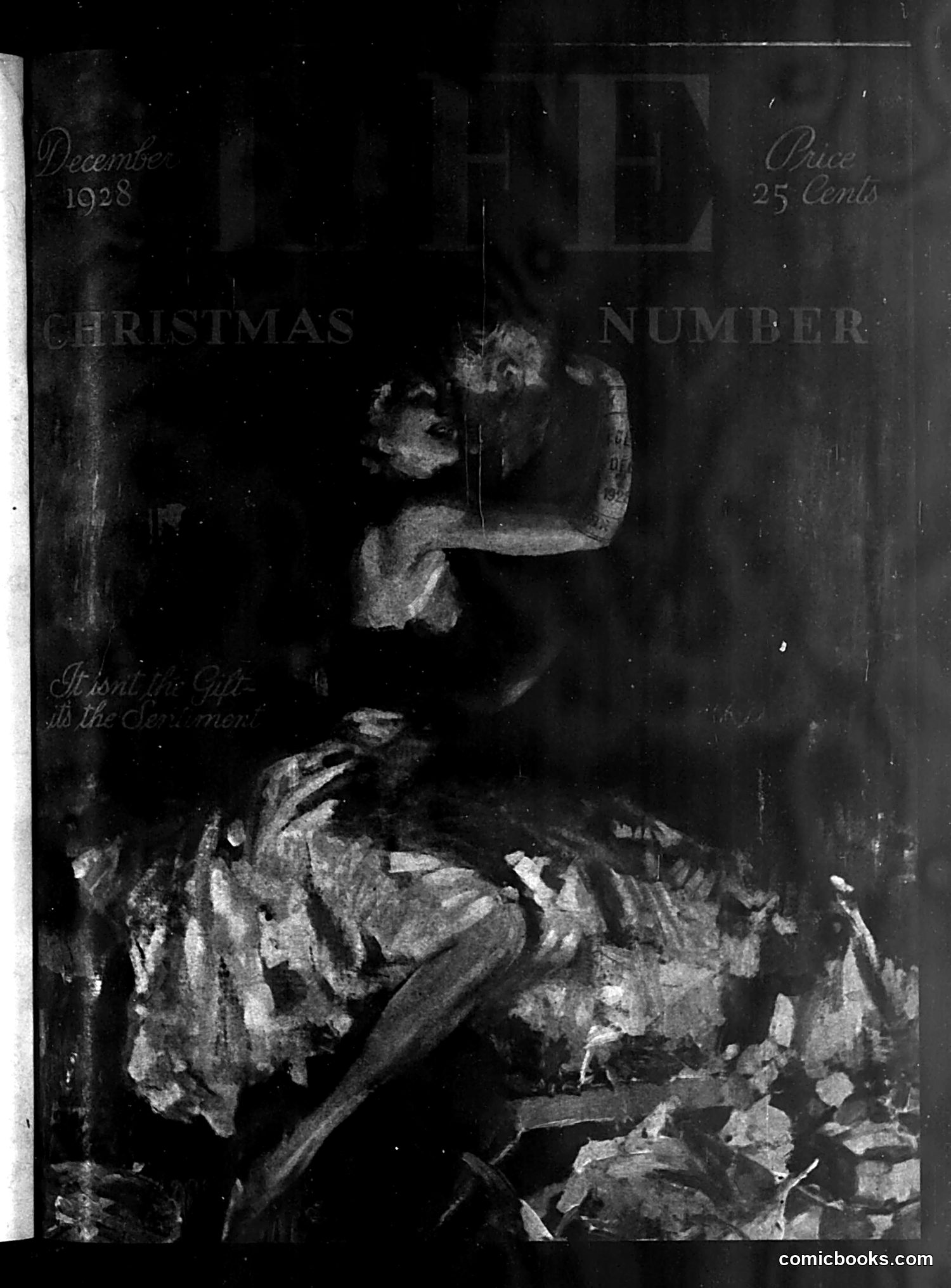
This is the **cover of Life magazine's Christmas Number from December 1928**, priced at 25 cents. The central image depicts a cherub or cupid-like figure holding what appears to be a wrapped gift or package. The child-angel wears flowing, classical drapery and gazes upward in a contemplative pose. The visible text fragment reads "A tout for Gilt—'tis the Season" (likely "A tout for Gilt"), suggesting commentary on commercialism during the Christmas season—a common satirical theme in Life magazine. The overall composition appears to be seasonal artwork celebrating Christmas gift-giving, though the specific satirical point regarding "gilt" (gold/wealth) and commercialization would have resonated with 1920s readers during the prosperous pre-Depression era.
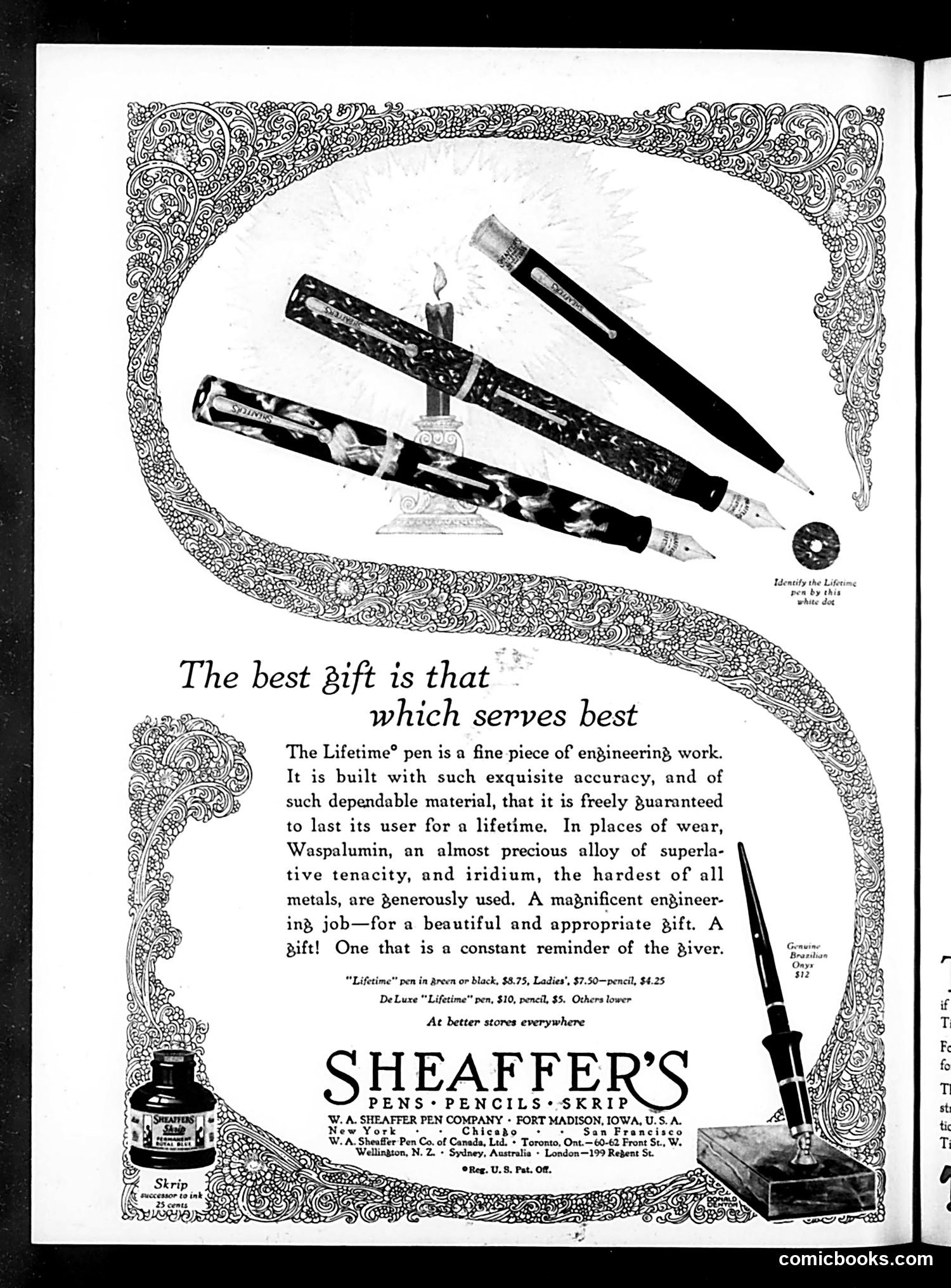
This is **not a political cartoon or satire**—it's a **full-page advertisement** for Sheaffer fountain pens and pencils, likely from the 1920s-1930s based on styling and pricing. The "meaning" is straightforward commercial messaging: Sheaffer markets the "Lifetime" pen as an ideal gift because it's engineered to last a lifetime, using premium materials like Waspalumin alloy and iridium. The ornate decorative border frames the product display, and the tagline "The best gift is that which serves best" appeals to purchasers seeking quality and permanence. There is no satire, political reference, or hidden joke—this is genuine product promotion positioning luxury fountain pens as thoughtful, durable gifts. The decorative Art Deco/Arts and Crafts styling was typical of upscale advertising from this era, lending elegance to the merchandise.
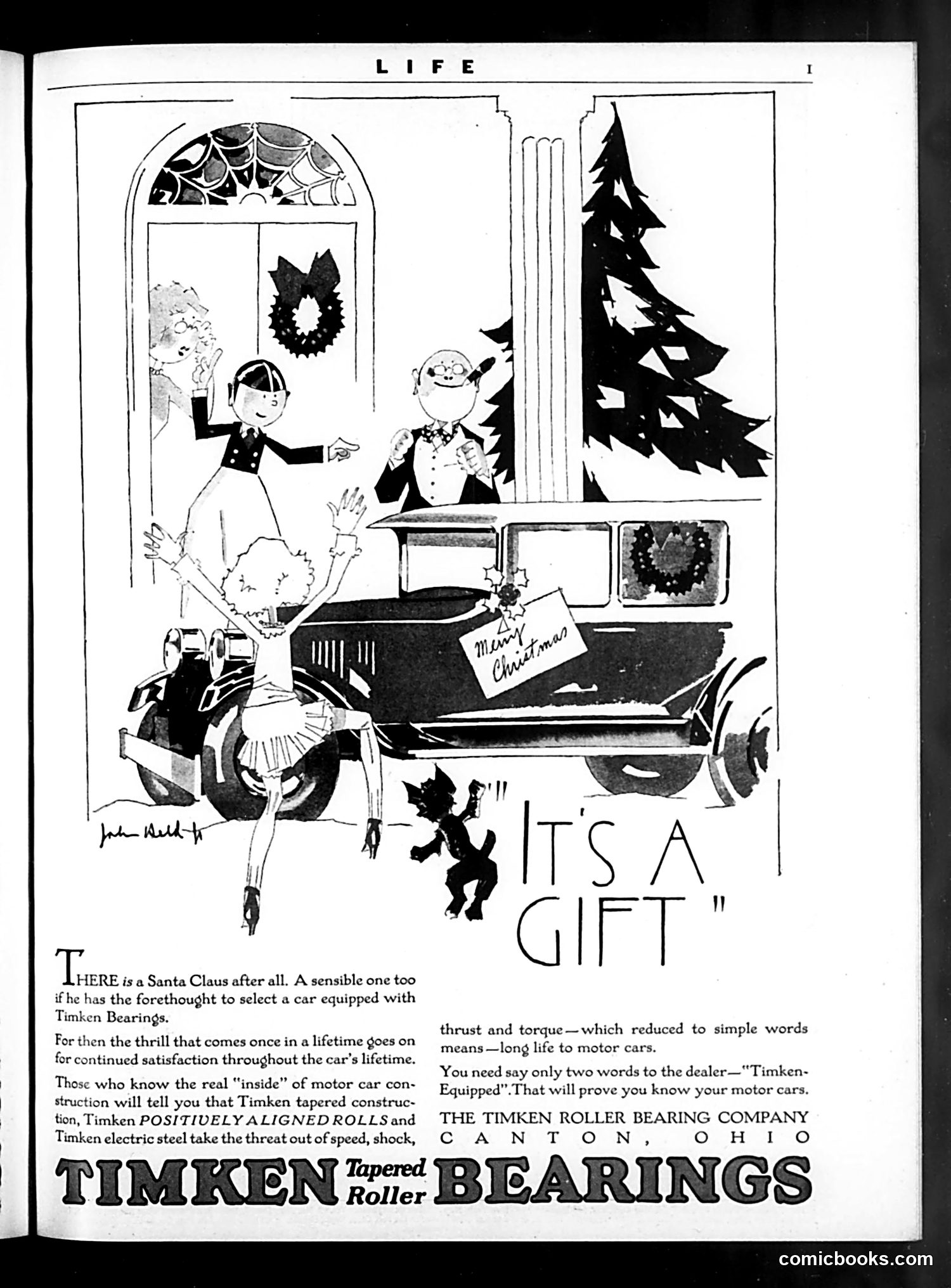
This is primarily a **Timken Roller Bearings advertisement** dressed as editorial content in Life magazine, a common practice of the era. The illustration depicts a cheerful Christmas scene: Santa Claus arriving at a house in a motorcar (notable for the 1920s-30s styling), with a child and gift-laden vehicle. The visual pun is explicit: "IT'S A GIFT"—suggesting that equipping a car with Timken bearings is as desirable as receiving a Christmas present. The satirical angle is subtle: the ad uses the authority of "those who know the real 'inside' of motor car construction" to position Timken bearings as the mark of automotive sophistication. For modern readers, the key humor lies in the earnest, almost absurd conflation of Santa Claus with mechanical engineering specifications—treating bearing construction as a gift-worthy luxury rather than a functional component. The ad's rhetoric ("sensible," "know your motor cars") appeals to aspiring middle-class buyers seeking to demonstrate consumer expertise.
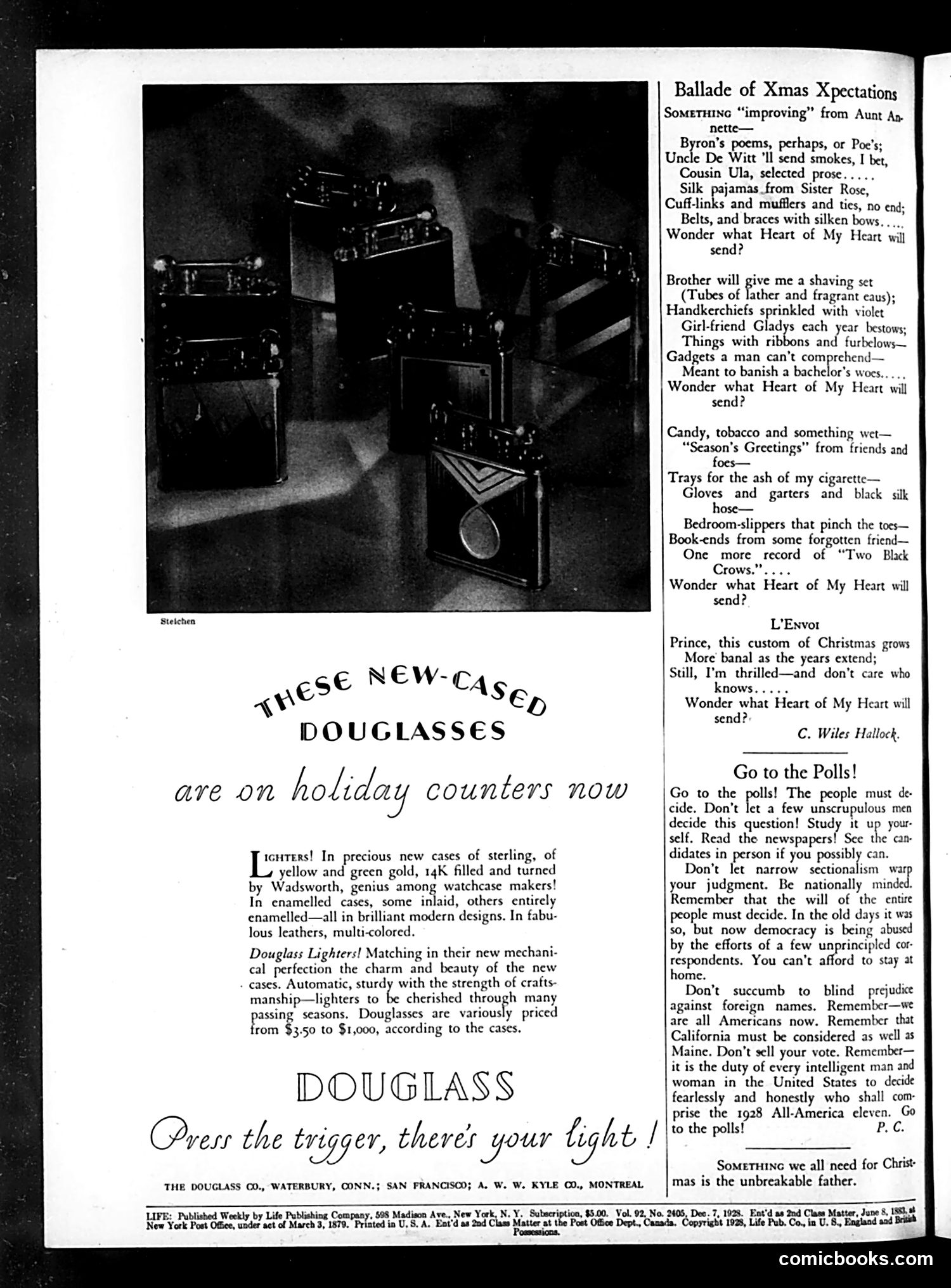
This page contains **advertising and poetry**, not political cartoons. **Left side:** A Douglass lighter and watchcase advertisement targeting holiday gift-givers, emphasizing luxury materials (sterling silver, gold, enameled designs) and mechanical quality. **Right side:** A humorous poem titled "Ballad of Xmas Expectations" by C. Wiles Hallock satirizes the banality of Christmas gift-giving—listing predictable presents (pajamas, handkerchiefs, slippers, cigars) while the narrator wonders what his romantic interest ("Heart of My Heart") will send. The poem mocks how the custom has become formulaic and impersonal. **Below:** An editorial titled "Go to the Polls!" urges 1928 voters to research candidates independently, avoid regional prejudice, and exercise voting rights—framed as a civic duty comparable to selecting "the 1928 All-America eleven" (a sports reference). The tone suggests concerns about voter apathy and misinformation. The page reflects 1920s consumer culture, romantic sentiment, and democratic participation rhetoric.
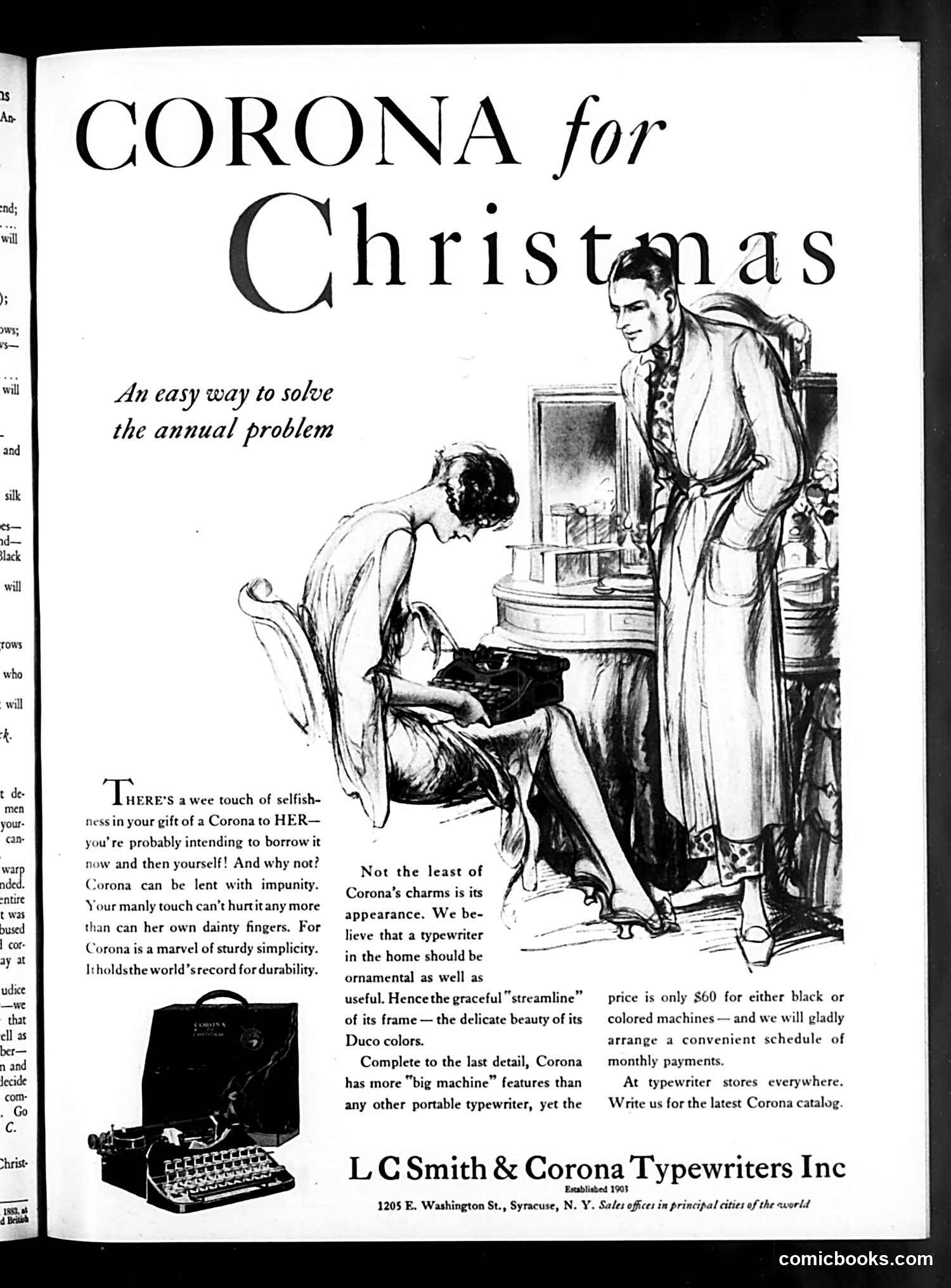
This is primarily a **typewriter advertisement**, not a political cartoon. The "satire" is subtle and reveals 1920s-30s gender assumptions. The ad depicts a man and woman in a domestic scene, positioning a Corona typewriter as a Christmas gift "for HER"—yet the copy's actual pitch is to the male gift-giver: he can "borrow it now and then yourself." The humor trades on the notion that a man gives his wife/girlfriend a "practical" gift he intends to use, framing shared ownership as mutually beneficial rather than selfish. The illustration shows the woman seated at the machine while the man stands proprietarily nearby, reinforcing the era's gender dynamics: the typewriter is nominally "hers" but really his to share. The advertisement emphasizes the machine's durability ("your manly touch can't hurt it"), beauty ("ornamental"), and affordability ($60, with payment plans), marketing it as the perfect gift that solves "the annual problem"—presumably the difficulty of choosing Christmas presents.
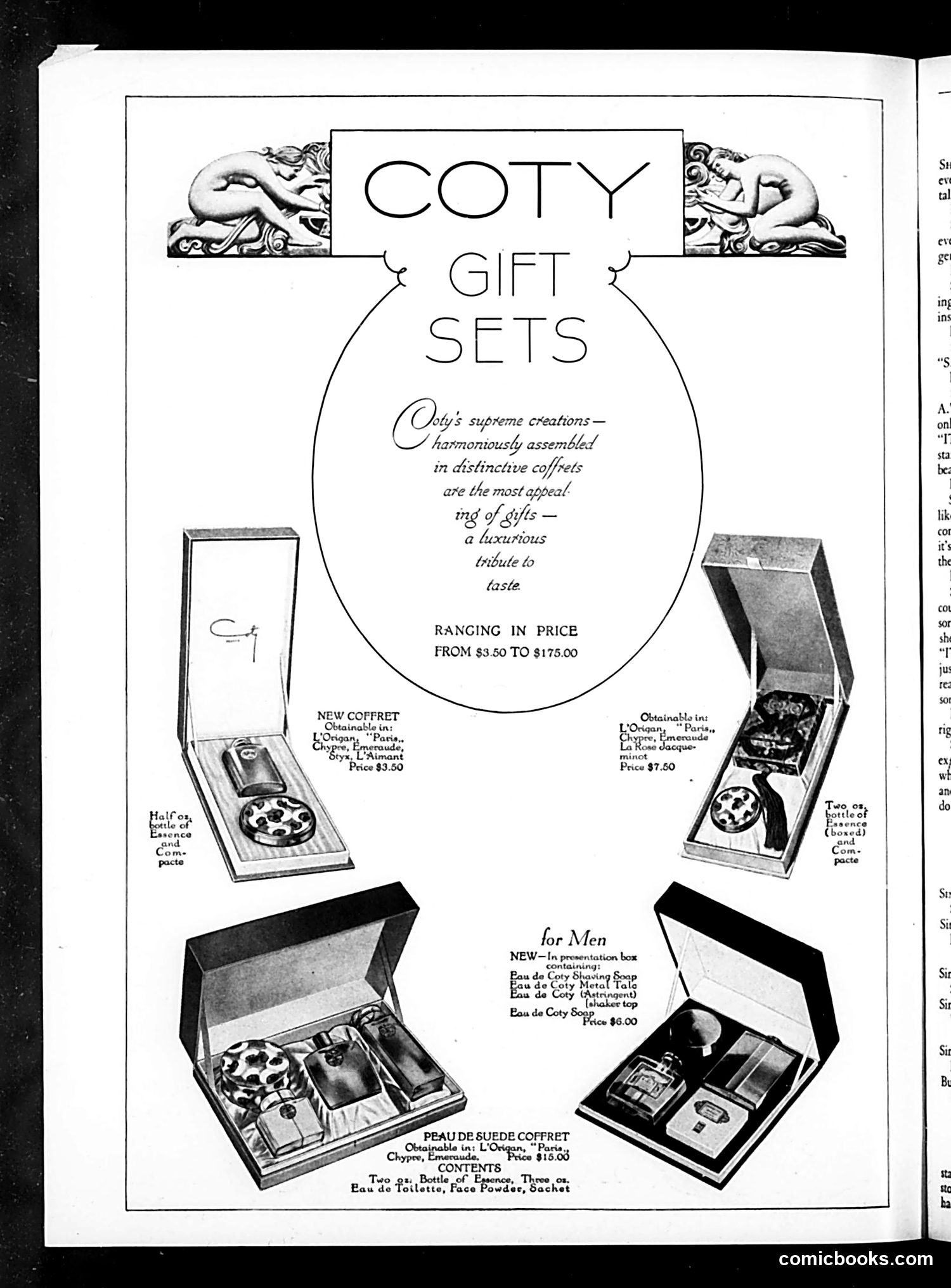
This is a **fragrance advertisement**, not political satire. It promotes Coty cosmetics and perfume gift sets for the American market. The page showcases luxury "coffrets" (decorative gift boxes) containing perfume, cologne, soap, and toiletries, priced from $3.50 to $175.00. Products include variants like "Emeraude" and "L'Origan," with collections aimed at both women and men. The decorative cherubs at the top and the refined typography reflect the **1920s-30s aesthetic** typical of *Life* magazine advertising. The presentation emphasizes exclusivity and taste—positioning these items as prestigious gifts. The "for Men" section represents early marketing of grooming products to male consumers, a relatively novel commercial category at the time. This is straightforward luxury product marketing with no satirical content.
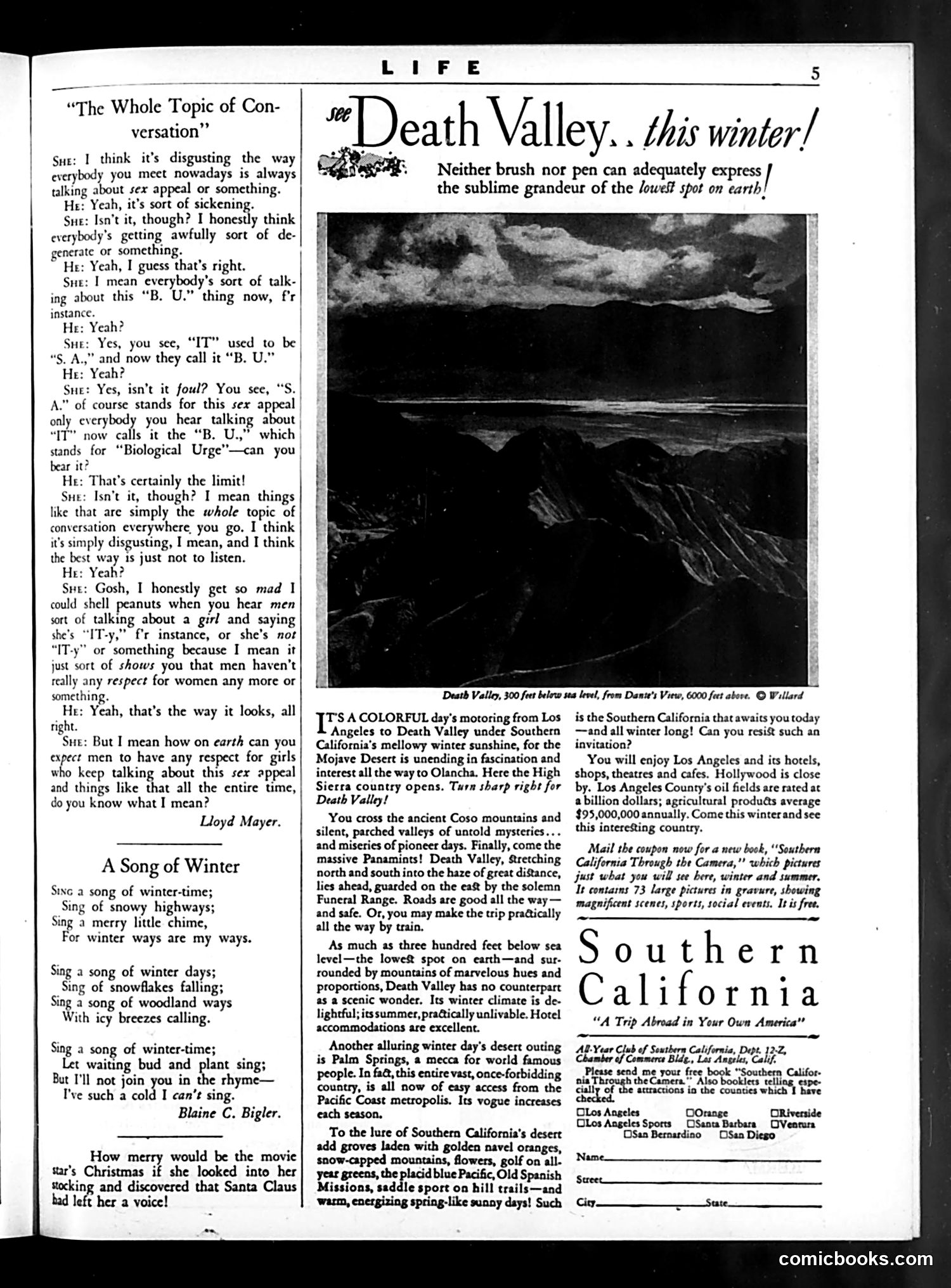
This page contains two distinct sections: **Left side — Political/Social Satire ("The Whole Topic of Conversation"):** A dialogue by Lloyd Mayer mocking contemporary prudishness. A couple expresses disgust at widespread talk of "sex appeal" and the modern slang term "B.U." ("Biological Urge"), which has replaced the older "S.A." The satire targets the hypocrisy: they condemn such talk as "degenerate" while simultaneously obsessing over it. Sue particularly objects to men judging women's "IT-ness" (sexual appeal), yet she and her companion spend their entire conversation discussing exactly that topic. Mayer ridicules how people performatively condemn the very subject matter they cannot stop discussing. **Right side — Travel Advertisement:** A tourism promotion for Death Valley and Southern California's desert regions, emphasizing winter accessibility and scenic grandeur. **Bottom — Minor poem:** A humorous piece by Blaine C. Bigler about being too ill to sing winter songs. The page juxtaposes satirical social commentary with commercial promotion.
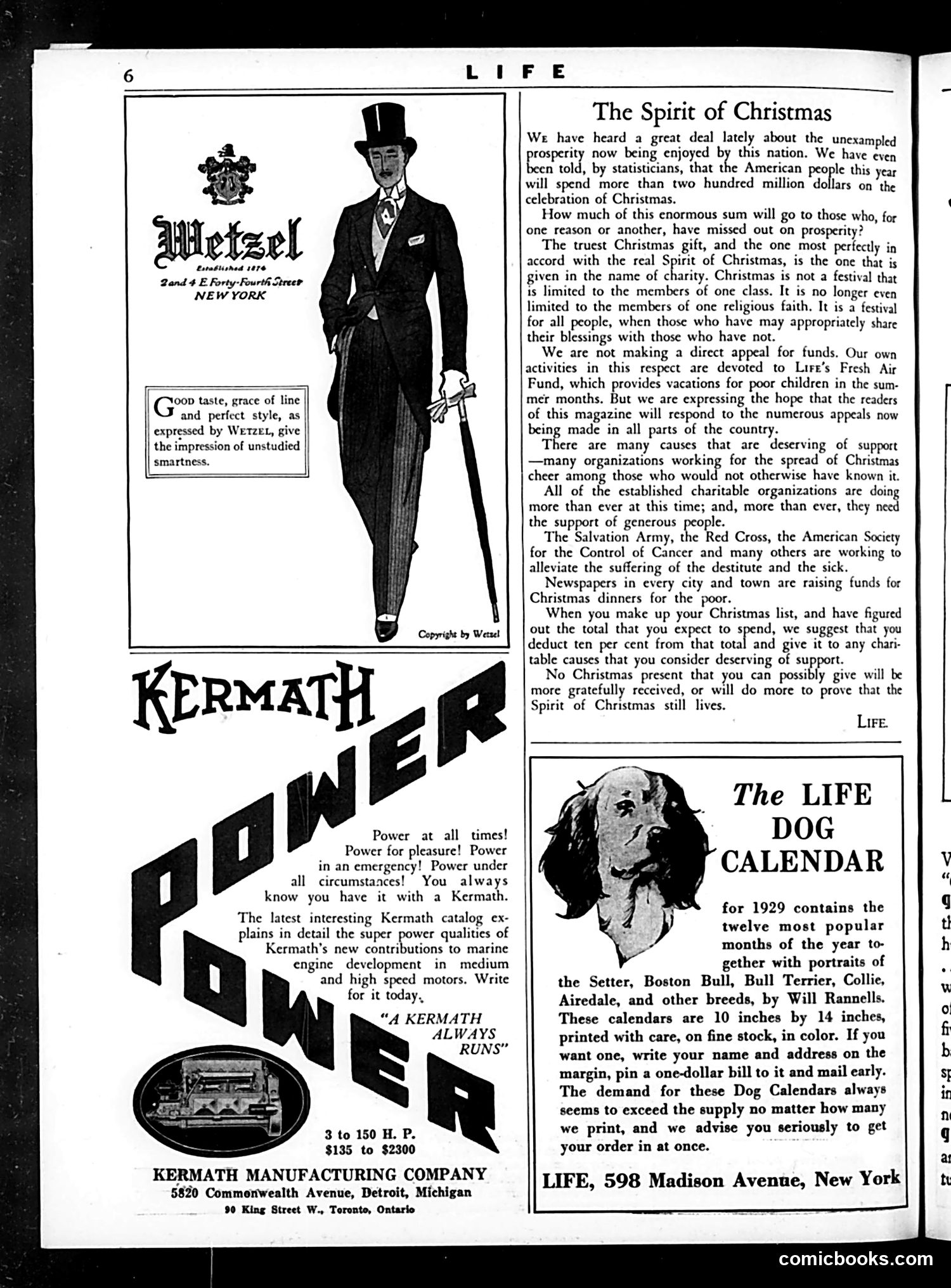
This page contains **editorial content and advertisements** rather than political cartoons. **"The Spirit of Christmas" editorial:** Life magazine's leadership addresses the era's prosperity (likely the late 1920s boom before the 1929 crash) by arguing Christmas charity should be universal, not class-limited. They advocate donating 10% of holiday spending to established charities—the Salvation Army, Red Cross, and cancer organizations—and promote Life's own Fresh Air Fund for poor children's summer vacations. The message reflects Progressive-era social responsibility rhetoric. **Advertisements:** - **Wetzel fashion** (top left): A stylized illustration of an elegantly dressed man advertising sophisticated menswear - **Kermath Power** (bottom left): Marine engine manufacturer promoting reliability - **Life Dog Calendar** (right): Promoting an illustrated 1929 calendar featuring dog breeds, priced at one dollar The page reflects 1920s consumer culture alongside charitable appeals—a tension between commercial prosperity and social conscience.
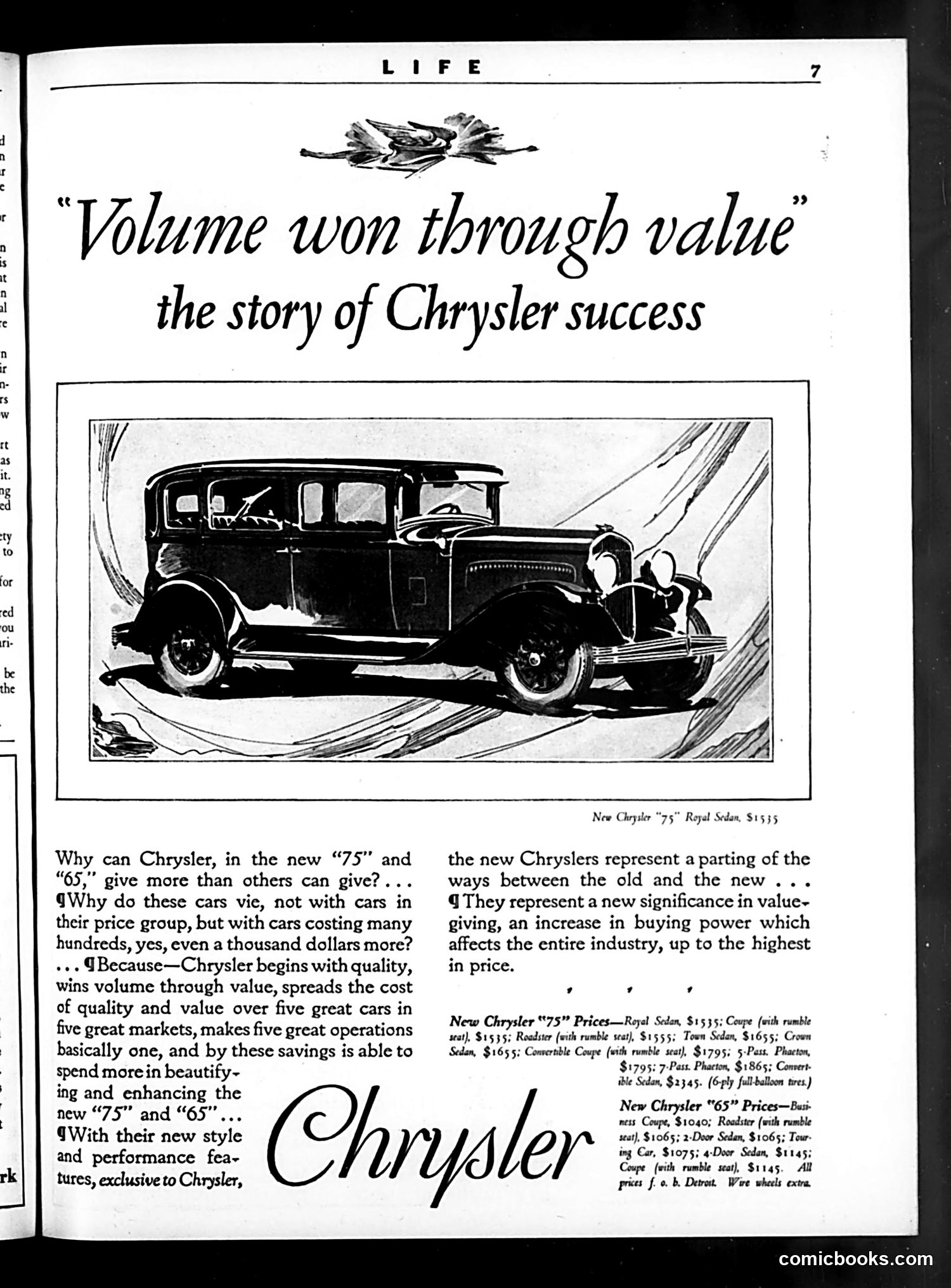
This is **not a cartoon or satire**—it's a straightforward advertisement for Chrysler automobiles, likely from the late 1920s based on the car designs and pricing. The page promotes Chrysler's business strategy: the company manufactures five car models ("75" and "65" series) across different price points ($1,040–$1,865), allowing them to achieve economies of scale. By spreading manufacturing costs across volume, Chrysler claims to offer more features and quality than competitors at similar prices—essentially undercutting luxury cars while competing with mid-range vehicles. The tagline "Volume won through value" encapsulates this approach. The illustration shows a sleek sedan positioned against stylized background elements, emphasizing modern design. This reflects 1920s automotive competition and manufacturing innovation, where mass production enabled affordability without sacrificing perceived quality—a strategy that made Chrysler a major American automaker.
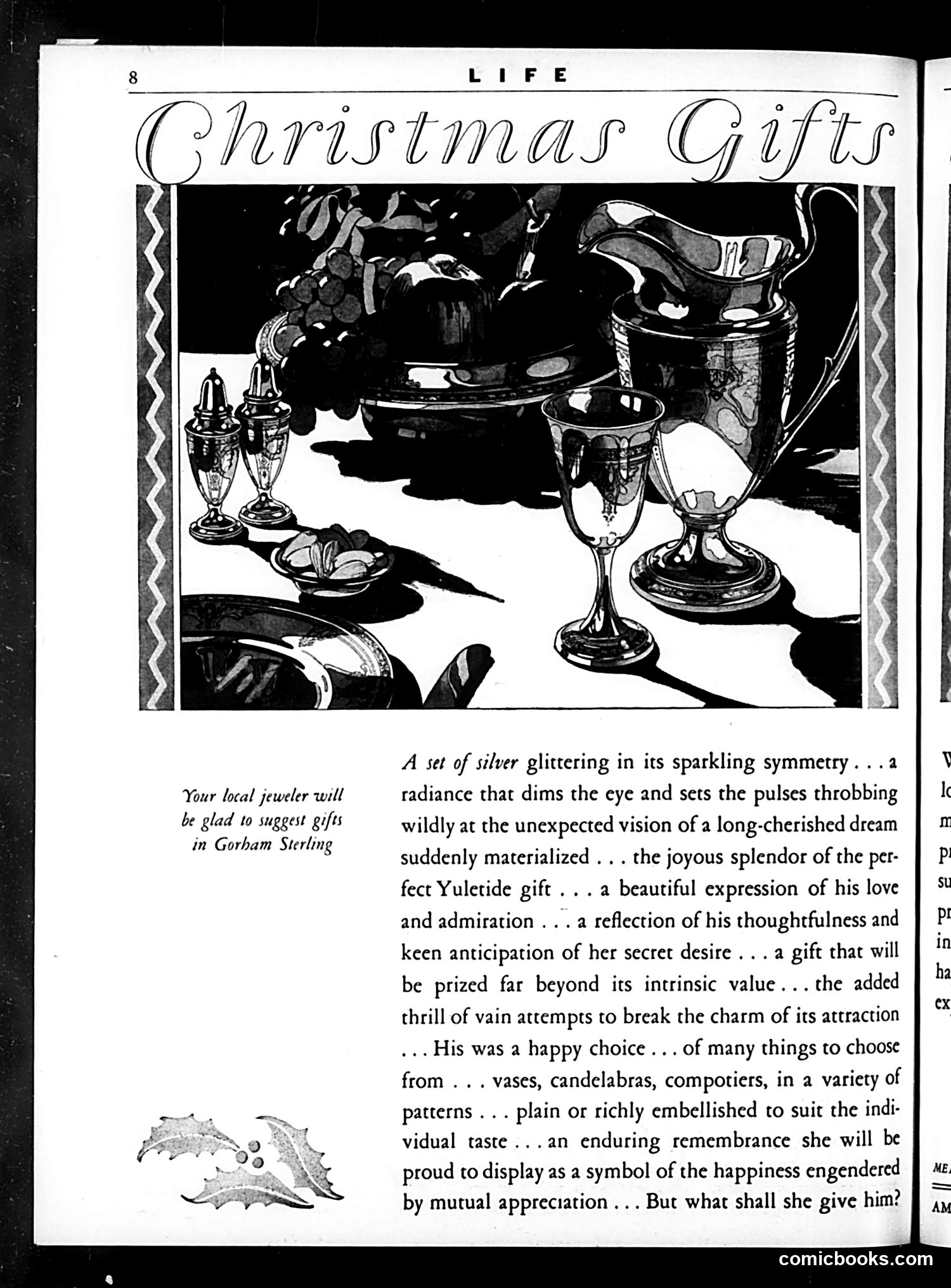
This is primarily a **luxury goods advertisement**, not political satire. It promotes Gorham Sterling silver as an ideal Christmas gift, specifically positioned for men giving to women. The page reflects **early-to-mid 20th century gender dynamics and consumerism**. The elaborate prose romanticizes silver as embodying male affection and thoughtfulness—describing it as expressing "his love and admiration" and "keen anticipation of her secret desire." The visual shows elegant silver pieces: candlesticks, serving vessels, and stemware arranged formally. Notably, the text ends with a telling rhetorical question: "But what shall she give him?"—suggesting the advertisement assumes men are gift-givers and women are recipients, reflecting period attitudes about gender roles and purchasing power. The ornate language and emotional appeals are characteristic of Depression-era luxury marketing, attempting to justify expensive purchases as vehicles for romance and status rather than mere functionality.
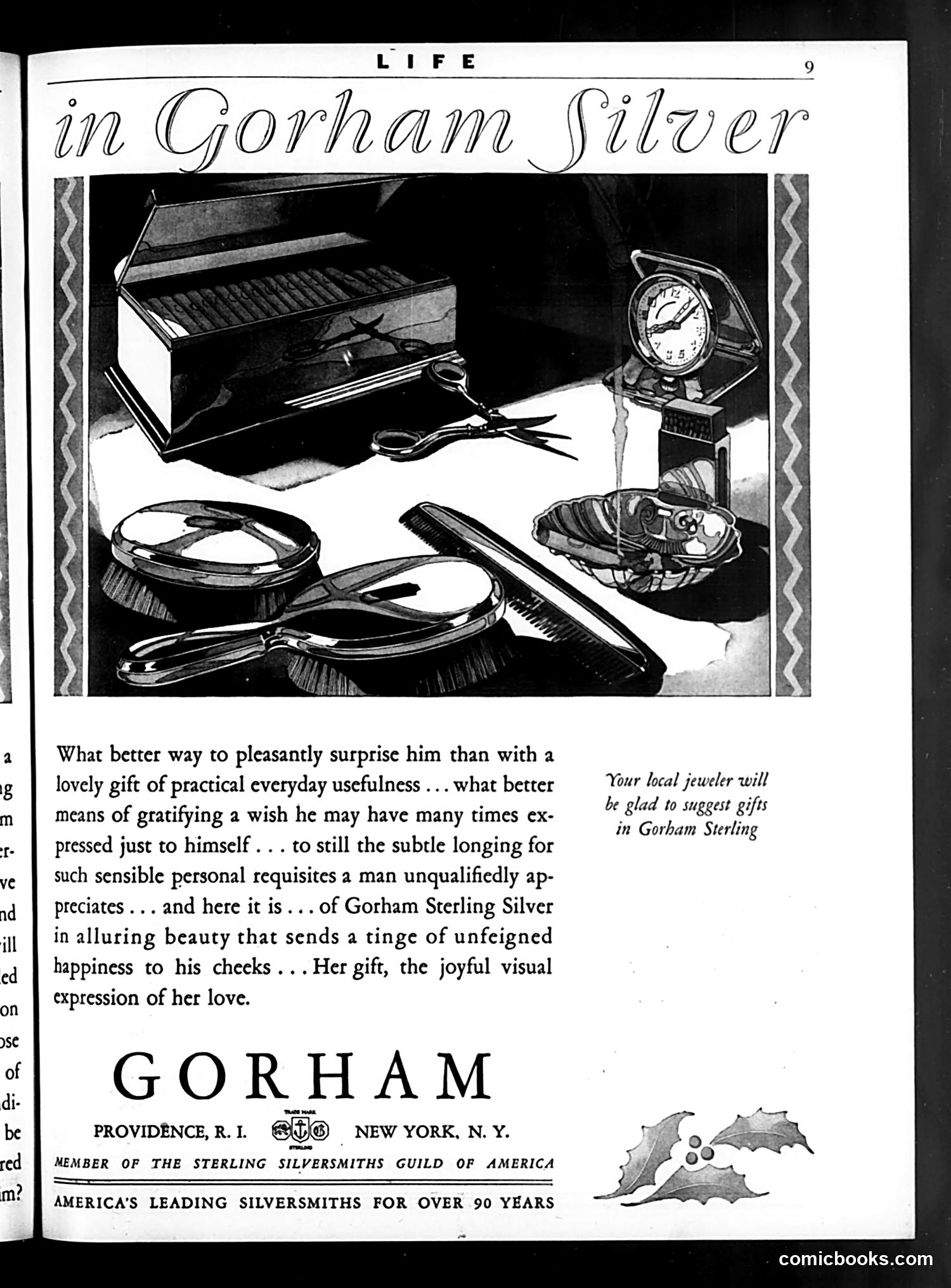
This is not a political cartoon or satirical content—it is a **commercial advertisement** for Gorham Sterling Silver, a luxury silverware manufacturer. The page features product photography displaying elegant silver grooming and household items: brushes, scissors, a clock, and a dish. The text employs flowery, romantic language typical of early-to-mid 20th-century advertising, positioning sterling silver gifts as expressions of romantic love and appreciation for masculine "practical" needs. The ad appeals to female gift-givers by framing silver items as simultaneously useful and emotionally meaningful—gifts that communicate subtle, refined affection. The mention of "America's Leading Silversmiths for Over 90 Years" emphasizes brand heritage and prestige. There is no satire, political reference, or joke here—simply sophisticated product marketing designed for *Life* magazine's affluent readership.
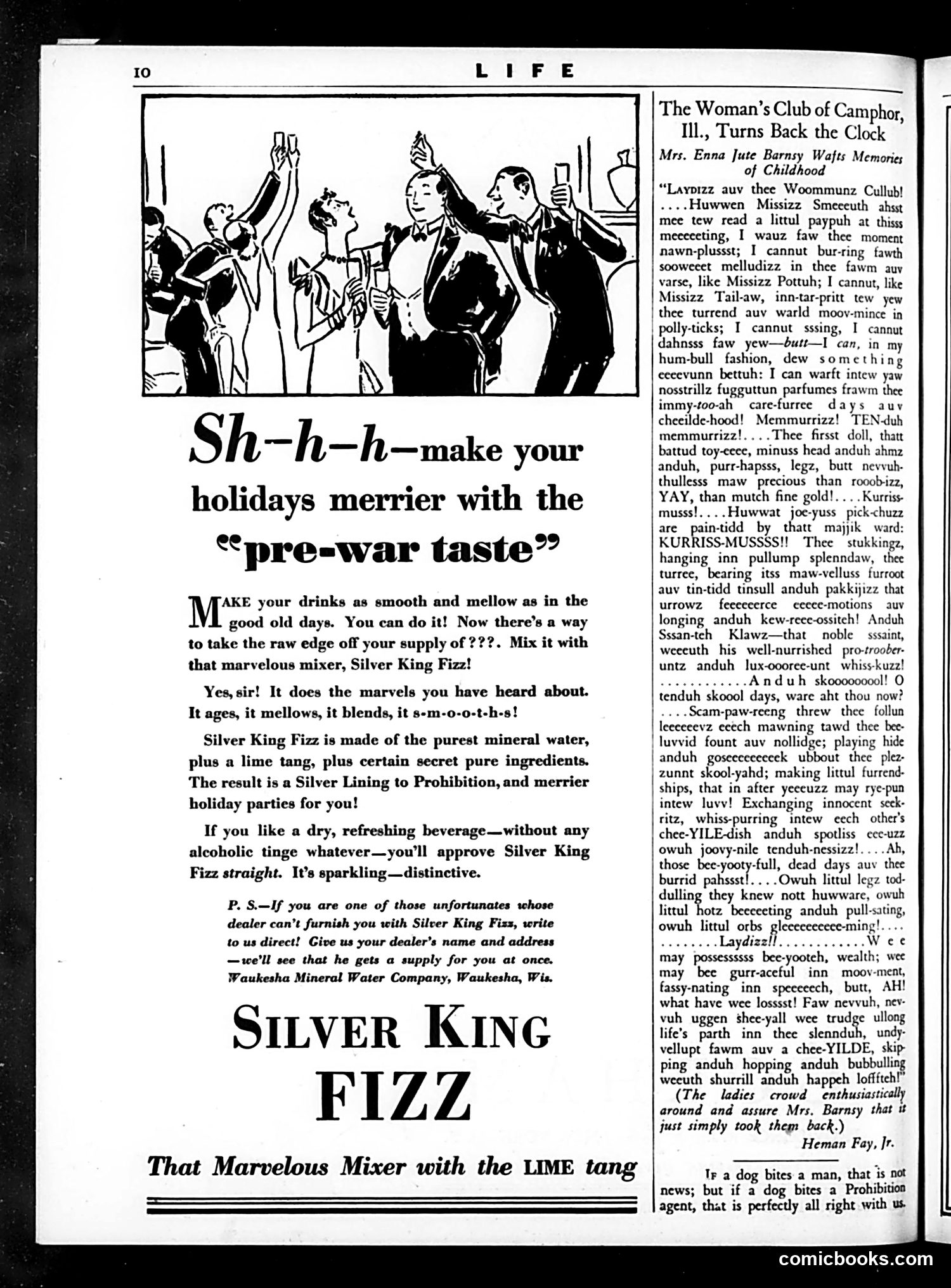
This page contains two distinct pieces of satire about Prohibition-era America (likely 1920s): **Left: Silver King Fizz Advertisement (Parody)** The ad mockingly presents a "mineral water mixer" as a solution for making homemade liquor palatable during Prohibition. The winking language—"pre-war taste," mixing with "???" (implied illegal alcohol), creating a "Silver Lining to Prohibition"—satirizes how Americans circumvented the alcohol ban through creative home brewing and mixing. The P.S. about "unfortunates whose dealer can't furnish" further lampoons the widespread bootlegging culture. **Right: "Woman's Club Turns Back the Clock"** This satirizes sentimental nostalgia, featuring a woman (Mrs. Barnsy) delivering an absurdly overwrought, phonetically-written speech about childhood memories to her club. The exaggerated dialect and purple prose mock middle-class women's clubs that indulged in romanticizing "the good old days"—a common cultural target of *Life* magazine's humor. Together, the page captures 1920s anxieties: defiance of Prohibition laws and escapist nostalgia for simpler times.
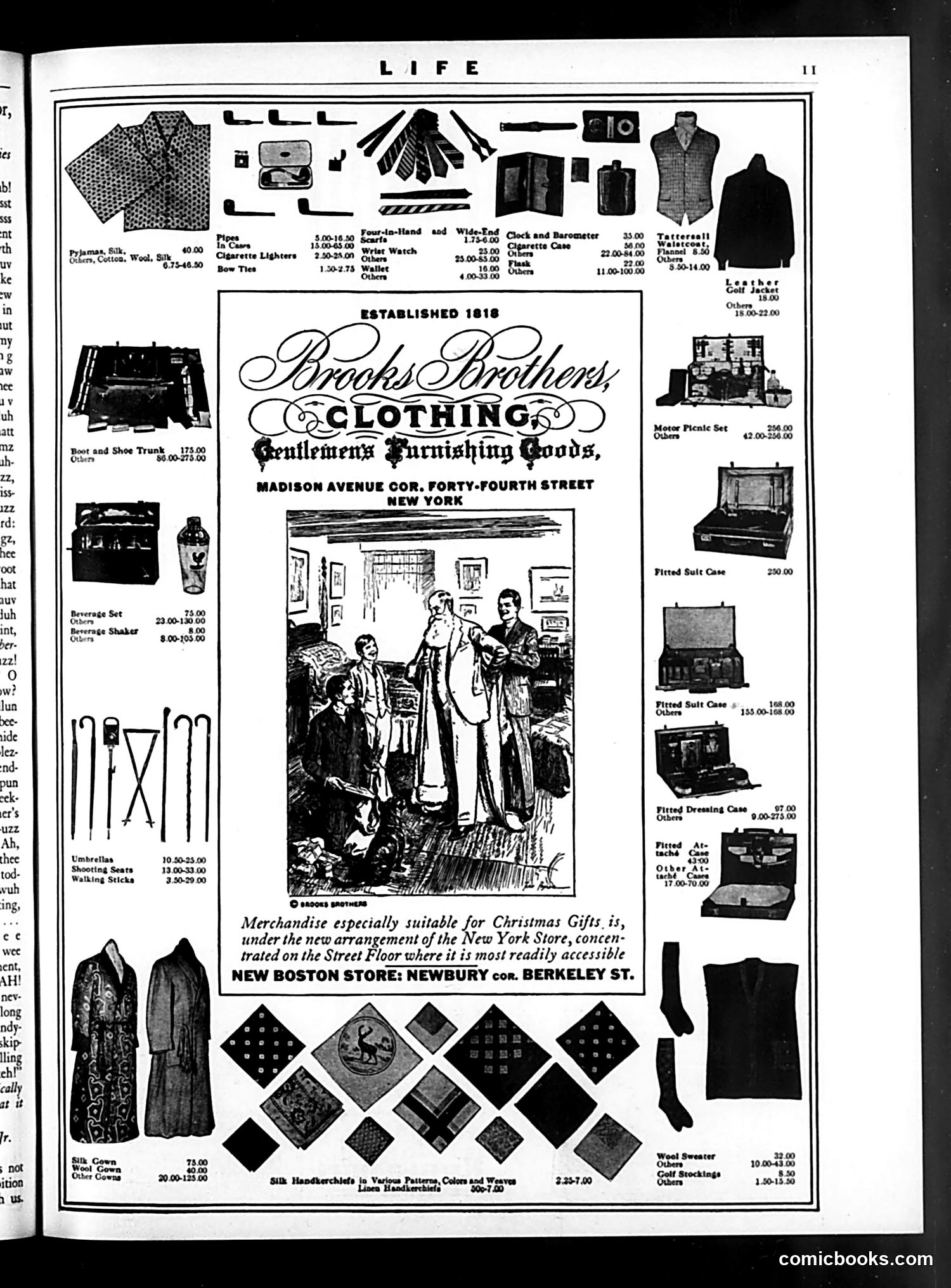
This page is primarily a **Christmas gift advertisement** for Brooks Brothers, the established menswear company (founded 1818). The central illustration shows a salesman or clerk assisting customers in what appears to be a store interior—a scene depicting the shopping experience. The page showcases gentlemen's furnishings typical of the era: ties, scarves, wallets, cigarette lighters, umbrellas, dress cases, trunks, and clothing. Price ranges suggest luxury goods aimed at affluent male consumers. The advertisement emphasizes that merchandise is "concentrated on the Street Floor where it is most readily accessible"—highlighting convenient shopping for Christmas gift-giving. A secondary notice mentions a **new Boston store location**. This is **not satirical content** but rather a straightforward commercial appeal to wealthy readers during the holiday season, typical of *Life* magazine's advertising pages. The illustration conveys aspirational shopping and service-oriented retail culture of the period.
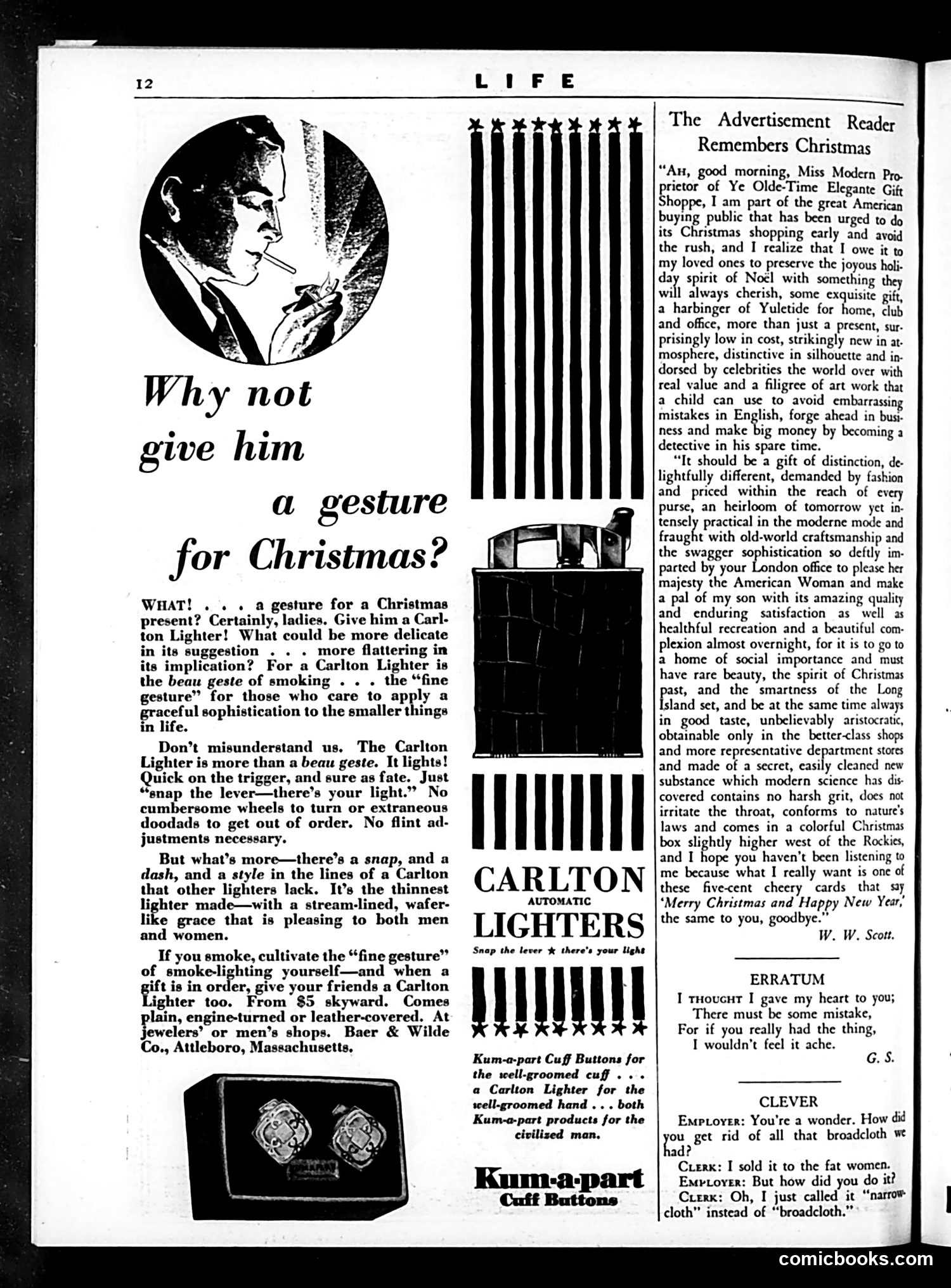
This page contains **advertisements and satirical commentary about advertising itself**. The main ad promotes **Carlton Automatic Lighters** as a sophisticated Christmas gift—marketed with language about "fine gesture," elegance, and style to appeal to affluent, fashion-conscious buyers. The satire appears on the right side: **"The Advertisement Reader Remembers Christmas"** by W. W. Scott mocks the excessive, flowery advertising copy of the era. The character mimics absurdly overwrought gift-marketing language—piling on contradictory claims (simultaneously "practical" yet "heirloom," "low cost" yet "better-class shops," beneficial for business *and* beauty). The joke targets how 1920s-30s advertisements used pretentious vocabulary and social snobbery ("Long Island set," "civilized man") to sell ordinary products. The satirist exposes that beneath all the elaborate rhetoric, the customer simply wants a cheap five-cent Christmas card. It's essentially mockery of advertising's manipulation through aspirational language and class appeals.
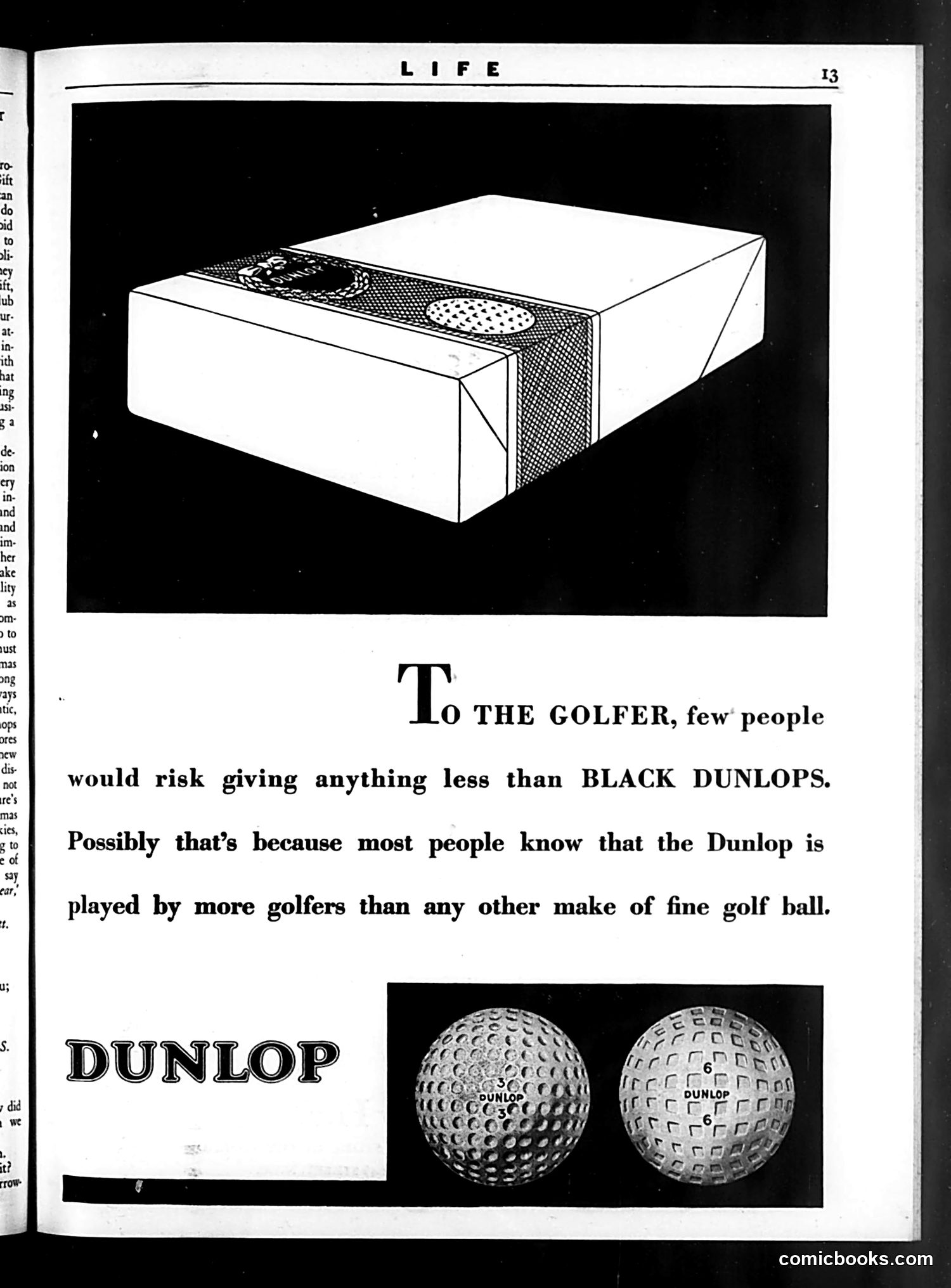
This is a **golf ball advertisement**, not a political cartoon. It promotes Dunlop brand golf balls, specifically their "Black Dunlops" model. The ad uses a marketing appeal to golfers by claiming that Dunlop is "played by more golfers than any other make of fine golf ball," suggesting it's the popular choice among serious players. The accompanying images show two golf balls with dimple patterns and the Dunlop branding. The headline's phrasing—that few would "risk giving anything less"—frames the product as a safe, trusted choice. This appears to be a straightforward commercial advertisement from Life magazine's advertising pages rather than satirical editorial content.
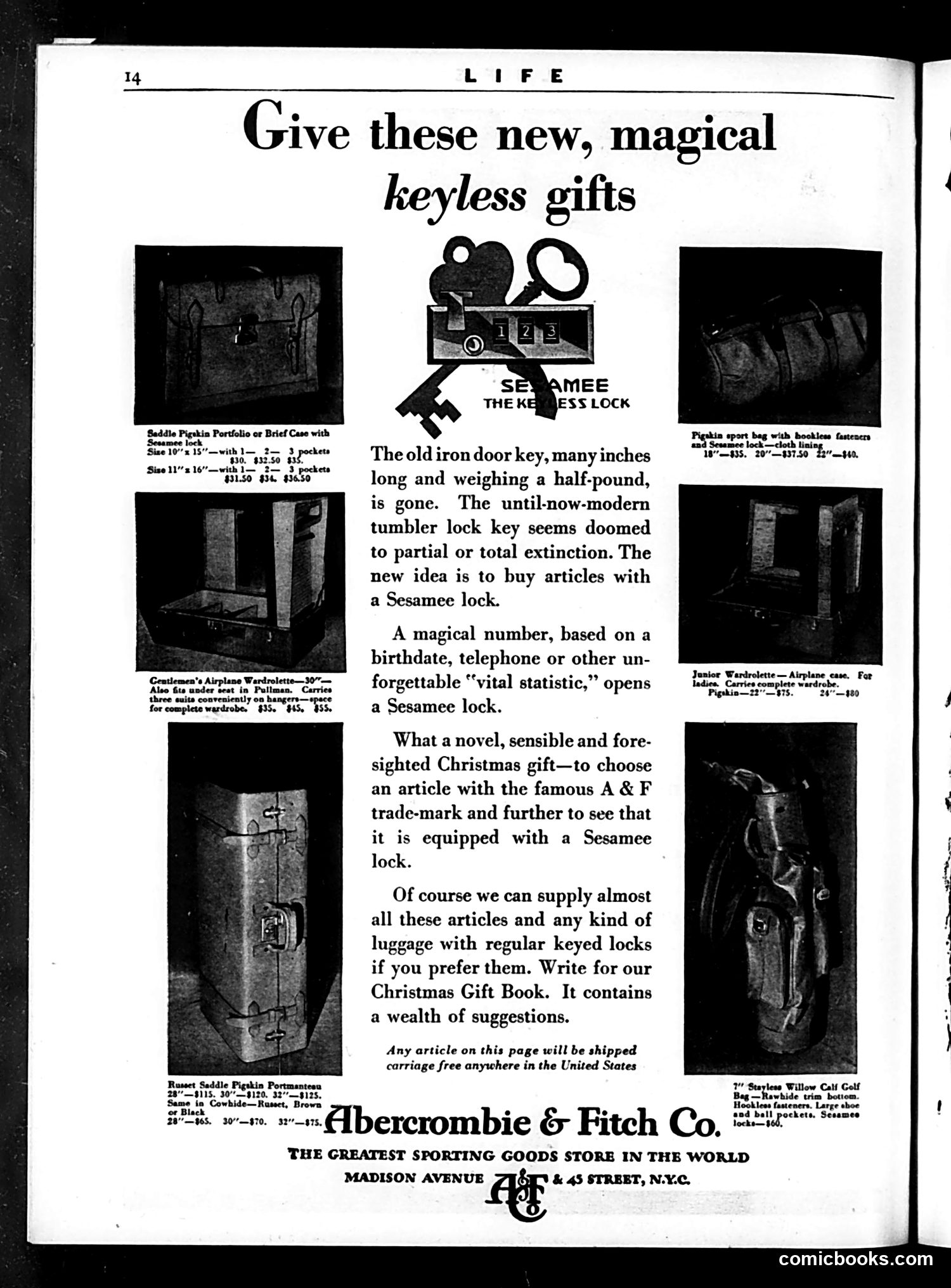
This is **not a political cartoon or satire**—it's a straightforward advertisement for Abercrombie & Fitch, a luxury sporting goods retailer. The page promotes "Sesamee," a new **keyless lock system** that uses a combination based on personal numbers (birthdate, telephone number, etc.) rather than traditional metal keys. The ad markets this as a modern innovation for luggage, portmanteaus, and other leather goods. The copy humorously suggests that old-fashioned tumbler locks are becoming obsolete, positioning the Sesamee lock as a sophisticated Christmas gift for wealthy consumers. Multiple leather goods are pictured—golf bags, airplane cases, saddle bags—all equipped with this new locking mechanism. The appeal is to readers' sense of modernity and convenience: forget carrying bulky keys; instead, remember a personal number. It's essentially an early version of the combination lock concept, marketed as cutting-edge technology to an affluent audience in the 1920s-30s era.