
Life, 1928-11-30 · page 24 of 52
Life — November 30, 1928 — page 24: what you’re looking at
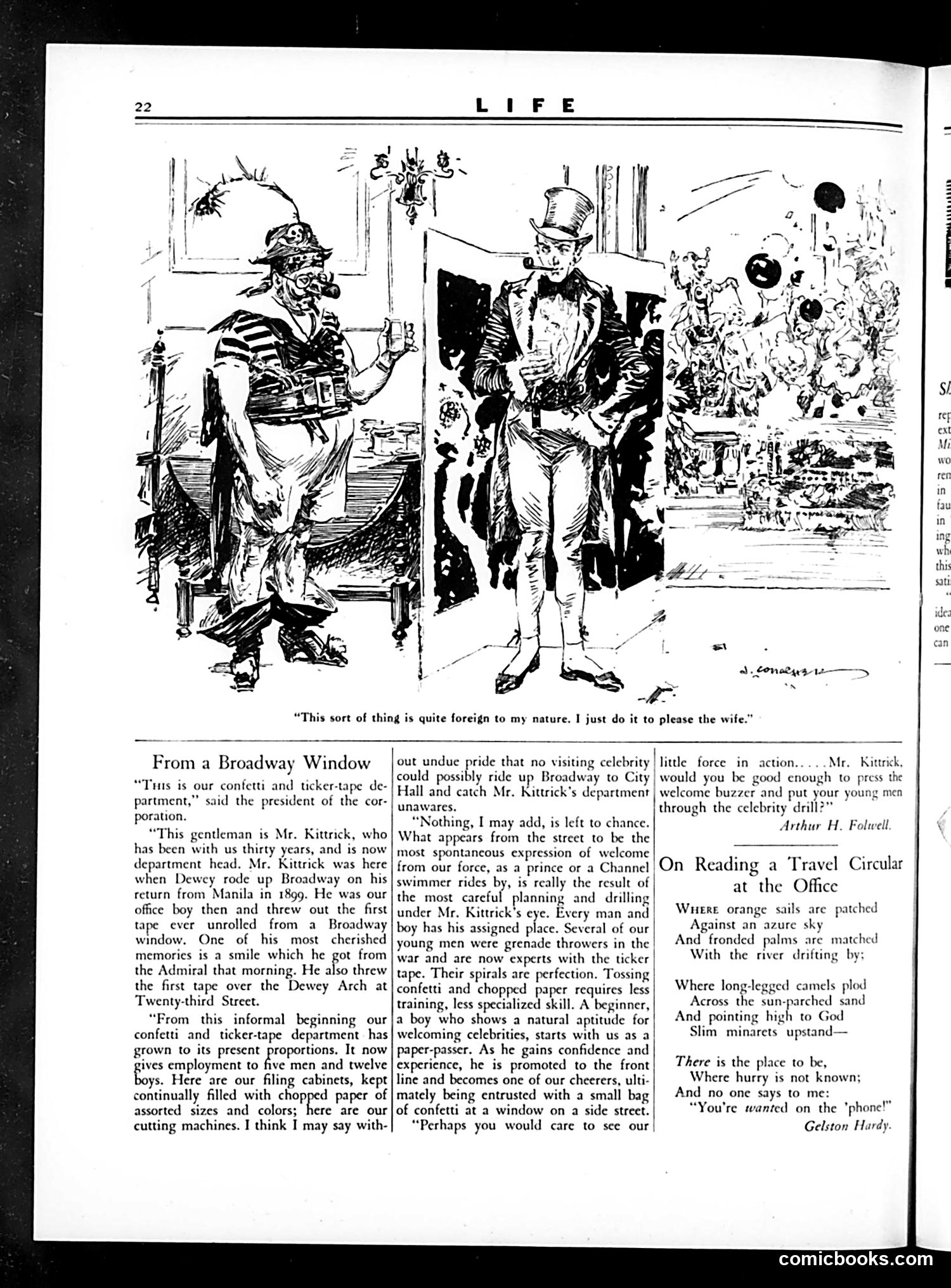
What you’re looking at
This cartoon satirizes the mechanization and elaborate planning behind what appears to be spontaneous civic celebration. The cartoon shows a corporate department head explaining to a visitor that the confetti and ticker-tape parades welcoming celebrity visitors to New York are entirely orchestrated—with filing systems, trained staff, assigned positions, and specialized techniques. The satire targets the performative nature of American civic life: what crowds perceive as genuine, joyful spontaneity is actually carefully drilled corporate theater. The reference to Admiral Dewey's 1899 return from Manila grounds this in a real historical parade tradition, suggesting this "industry" has grown over decades into an absurdly elaborate operation with departments, hierarchies, and ex-soldier experts throwing confetti "spirals." The opening caption—a man telling his wife "I just do it to please the wife"—establishes the underlying joke: people perform enthusiasm and conformity for others' expectations, not genuine feeling.
📄 Transcribed text from this page (OCR, searchable)
Machine-transcribed from the original scan — historical spelling and the odd misread are preserved.
a fonetyg 1e— N “This sort of thing is quite foreign to my nature. I just do it to please the wife.” From a Broadway Window “Tuts is our confetti and ticker-tape de- partment,” said the president of the cor- poration, “This gentleman is Mr. Kittrick, who has been with us thirty years, and is now department head. Mr. Kittrick was here when Dewey rode up Broadway on his return from Manila in 1899. He was our office boy then and threw out the first tape ever unrolled from a Broadway window. One of his most cherished memories is a smile which he got from the Admiral that morning. He aie threw the first tape over the Dewey Arch at Twenty-third Street. “From this informal beginning our confetti and ticker-tape department has grown to its present proportions. It now ives employment to five men and twelve Bove Here are our filing cabinets, kept continually filled with chopped paper of assorted sizes and colors; Bava are our cutting machines. I think I may say with- out undue pride that no visiting celebrity could possibly ride up Broadway to City | Hall and catch Mr. Kittrick’s department unawares, “Nothing, I may add, is left to chance. What appears from the street to be the most spontancous expression of welcome from our force, as a prince or a Channel swimmer rides by, is really the result of the most careful planning and drilling under Mr. Kittrick’s eye. Every man and boy has his assigned place. Several of our young men were grenade throwers in the war and are now experts with the ticker tape. Their spirals are perfection. Tossing confetti and chopped paper requires less training, less specialized skill. A beginner, a boy who shows a natural aptitude for welcoming celebrities, starts with us as a paper-passer. As he gains confidence and experience, he is promoted to the front line and becomes one of our cheerers, ulti- mately being entrusted with a small bag of confetti at a window on a side street. | “Perhaps you would care to see our little force in action.....Mr. Kittrick, would you be good enough to press the welcome buzzer and put your young men through the celebrity drill?” Arthur H, Folwell a ‘| Circular On Reading 2 at the Office Wuere orange sails are patched Against an azure sky And fronded palms are matched With the river drifting by: Where long-legged camels plod Across the sun-parched sand And pointing high to God Slim minarets upstand— There is the place to be, Where hurry is not known; And no one says to me: “You're wanted on the ‘phone!” Gelston Hardy comicbooks.com