
Life, 1928-11-30 · page 13 of 52
Life — November 30, 1928 — page 13: what you’re looking at
What you’re looking at
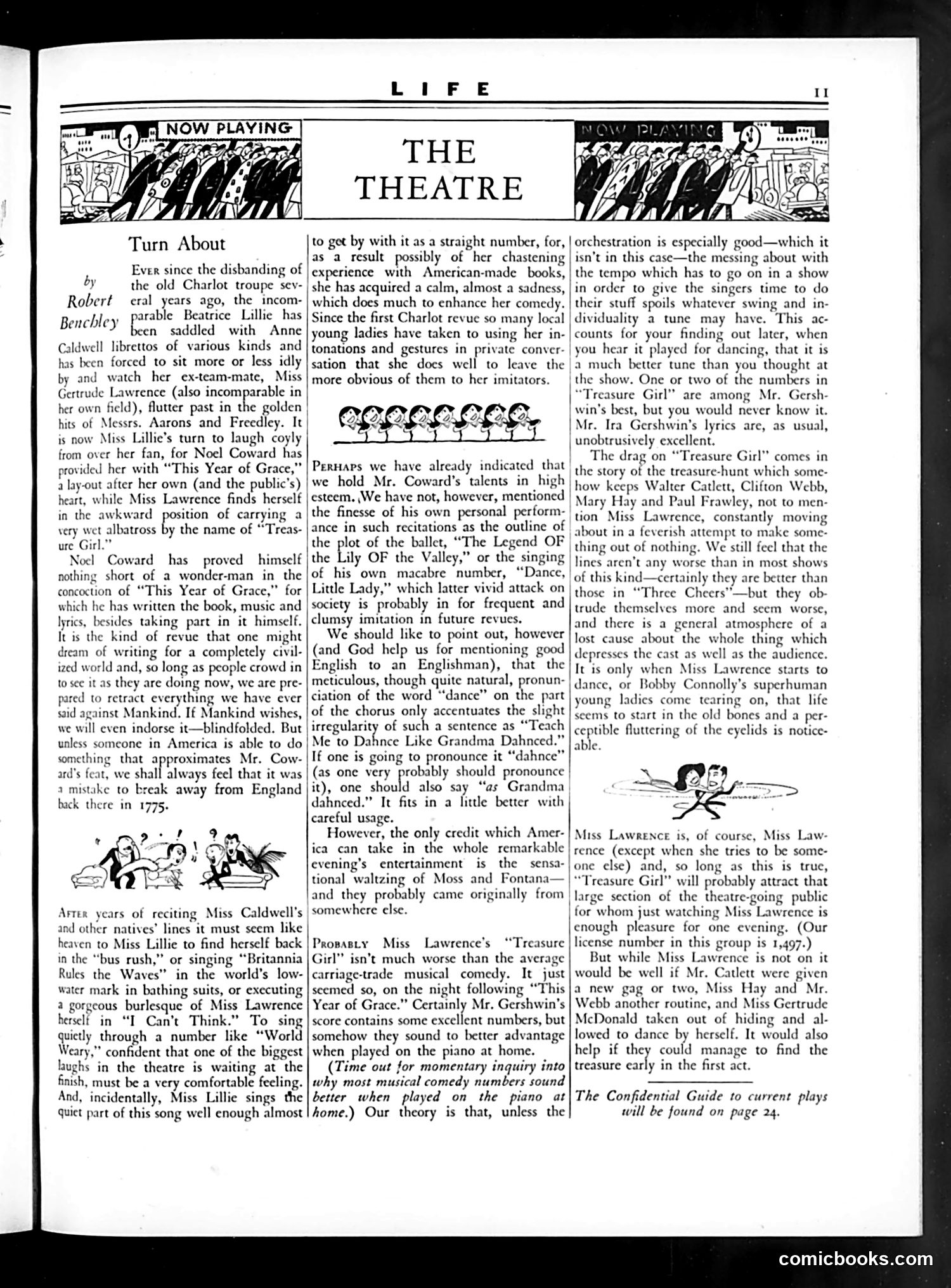
This is a theatre review column discussing current Broadway productions. The main review covers "Treasure Girl," a musical comedy featuring Miss Lawrence. The critic praises the entertainment value while noting the show lacks sophisticated plot or orchestration. The review mentions performers including Noel Coward (who wrote "This Year of Grace"), Beatrice Lillie, and Gertrude Lawrence. Small cartoon illustrations accompany the text showing theatrical scenes and performers in comedic poses. The column's tone is witty and gossipy, typical of Life's satirical approach to entertainment criticism. Rather than pure satire, this represents the magazine's cultural commentary function—evaluating popular entertainment for an educated audience while maintaining humorous, slightly irreverent commentary on performers and productions.
📄 Transcribed text from this page (OCR, searchable)
Machine-transcribed from the original scan — historical spelling and the odd misread are preserved.
Lire Turn About Ever since the disbanding of by the old Charlot troupe sev- Robert cral_ years ago, age sfjpy parable Beatrice Lillie has Benchley been saddled with Anne Caldwell librettos of various kinds and has been forced to sit more or less idly by and watch her ex-team-mate, Miss Gertrude Lawrence (also dhcom parable in her own field), flutter past in tl hits of Messrs. Aarons and Freedley. It is now Miss Lillie’s turn to laugh coyly from over her fan, for Noel Coward has provided her with “This Year of Grace,” a lay-out after her own (and the public’s) heart, while Miss Lawrence finds herself in the awkward position of carrying a very wet albatross by the name of “Treas- ure Girl.” Nocl Coward has proved himself nothing short of a wonder-man in the concoction of “This Year of Grace,” for which he has written the book, music and lyrics, besides taking part in it himself. It is the kind of revue that one might dream of writing for a completely civil- ized world and, so long as people crowd in to see it as they are doing now, we are pre- pared to retract everything we have ever said against Mankind. If Mankind wishes, we will even indorse it—blindfolded. But | unless someone in America is able to do something that approximates Mr. Cow- ard’s feat, we shall always feel that it was a mistake to break away from England back there in 1775. Arter years of reciting Miss Caldwell's and other natives’ lines it must seem like heaven to Miss Lillie to find herself back in the “bus rush,” or singing “Britannia Rules the Waves” in the world’s low- water mark in bathing suits, or executing a gorgeous burlesque of Miss Lawrence herself in “I Can't Think.” To sing quietly through a number like “World Weary,” confident that one of the biggest laughs in the theatre is waiting at the finish, must be a very comfortable feeling. And, incidentally, Miss Lillie sings the quiet part of this song well enough almost jexperience with American-made books, | THE THEATRE to get by with it as a straight number, for, | orchestration is especially good—which it as a result possibly of her chastening | isn’t in this case—the messing about with the tempo which has to go on in a show she has acquired a calm, almost a sadness, | in order to give the singers time to do which does much to enhance her comedy. | their stuff spoils whatever swing and in- Since the first Charlot revue so many local | dividuality a tune may have. This ac- young ladies have taken to using her in-|counts for your finding out later, when tonations and gestures in private conver-| you hear it played for dancing, that it is sation that she docs well to leave thea much better tune than you thought at ¢ golden | more obvious of them to her imitators. Pernaps we have already indicated that we hold Mr. Coward’s talents in high esteem. We have not, however, mentioned the finesse of his own personal perform- ance in such recitations as the outline of the plot of the ballet, “The Legend OF the Lily OF the Valley,” or the singing of his own macabre number, “Dance, Little Lady,” which latter vivid attack on society is probably in for frequent and clumsy imitation in future revues. We should like to point out, however (and God help us for mentioning good English to an Englishman), that the meticulous, though quite natural, pronun- ciation of the word “dance” on the part of the chorus only accentuates the slight irregularity of such a sentence as “Teach Me to Dah Like Grandma Dahnced.” If one is going to pronounce it “dahnce” (as one very probably should pronounce it), one should also say “as Grandma dahnced.” It fits in a little better with careful usage. However, the only credit which Amer- ica can take in the whole remarkable | evening's entertainment is the sensa- tional waltzing of Moss and Fontana— and they probably came originally from somewhere else. Prosascy Miss Lawrence's ‘Treasure Girl” isn’t much worse than the average carriage-trade musical comedy. It just seemed so, on the night following “This Year of Grace.” Certainly Mr. Gershwin’s score contains some excellent numbers, but somehow they sound to better advantage when played on the piano at home. (Time out for momentary inquiry into why most musical comedy numbers sound better when played on the piano at home.) Our theory is that, unless the the show. One or two of the numbers in “Treasure Girl” are among Mr. Gersh- | win's best, but you would never know it. | Mr. Ira Gershwin’s lyrics are, as usual, | unobtrusively excellent. The drag on “Treasure Girl” comes in the story of the treasure-hunt which some- |how keeps Walter Catlett, Clifton Webb, | Mary Hay and Paul Frawley, not to men- tion Miss Lawrence, constantly moving about in a feverish attempt to make some- thing out of nothing. We still feel that the lines aren't any worse than in most shows of this kind—certainly they are better than those in “Three Cheers"—but they ob- trude themselves more and seem worse, and there is a general atmosphere of a lost cause about the whole thing which depresses the cast as well as the audience. It is only when Miss Lawrence starts to jdance, or Bobby Connolly's superhuman young ladies come tearing on, that life seems to start in the old bones and a per- ceptible fluttering of the eyelids is notice- able. SO Miss Lawrence is, of course, Miss Law- rence (except when she tries to be some- one else) and, so long as this is true, “Treasure Girl” will probably attract that large section of the theatre-going public for whom just watching Miss Lawrence is enough pleasure for one evening. (Our license number in this group is 1,497-) But while Miss Lawrence is not on it would be well if Mr. Catlett were given a new gag or two, Miss Hay and Mr. Webb another routine, and Miss Gertrude McDonald taken out of hiding and al- lowed to dance by herself. It would also help if they could manage to find the treasure catty in the first act. The Confidential Guide to current plays will be found on page 24. comicbooks.com