
Life, 1928-11-30 · page 8 of 52
Life — November 30, 1928 — page 8: what you’re looking at
What you’re looking at
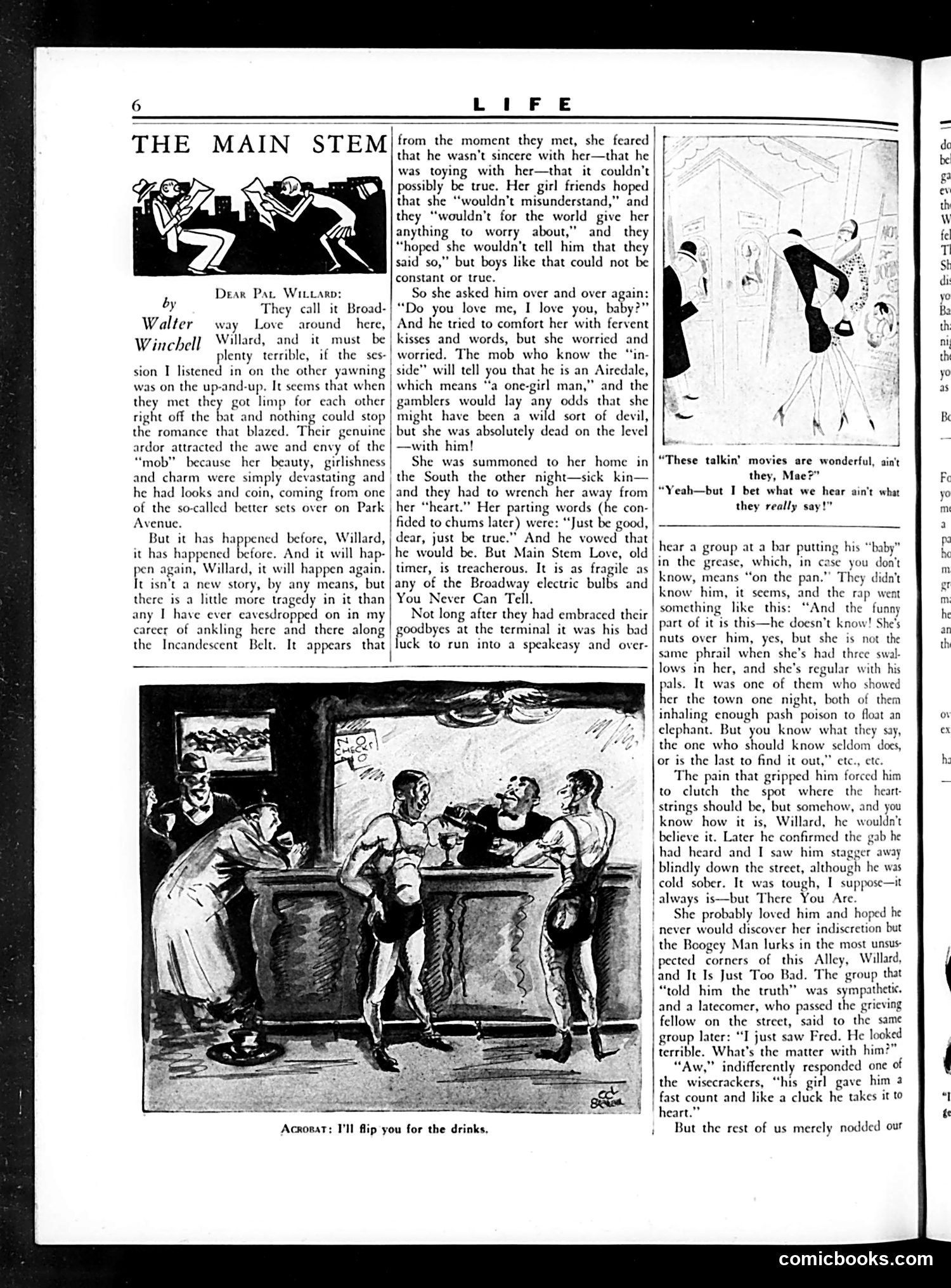
This is a gossip column by Walter Winchell, the famous Broadway columnist, not a political cartoon. The piece discusses romantic entanglements among unnamed socialites, using Winchell's characteristic cryptic style ("Broad-way Love," "Airedale," "Boozey Man"). The two illustrations depict scenes of urban nightlife—a speakeasy (illegal bar, given Prohibition-era context) and well-dressed patrons at what appears to be a social venue. The acrobat illustration's caption ("I'll flip you for the drinks") references gambling and casual excess. The tone is cynical about romance and modern youth behavior, typical of 1920s-30s Winchell columns mocking high society's moral failings through anonymous anecdotes.
📄 Transcribed text from this page (OCR, searchable)
Machine-transcribed from the original scan — historical spelling and the odd misread are preserved.
FE THE MAIN STEM Dear Pat Wittarp: by They call it Broad- Walter way Love around here, Winchell Willard, and it_ must be plenty terrible, if the ses- sion I listened in on the other yawning was on the up-and-up. It seems that when they met they got limp for each other right off the bat and nothing could stop the romance that blazed. Their genuine ardor attracted the awe and envy of the “mob” because her beauty, girlishness and charm were simply devastating and he had looks and coin, coming from one of the so-called better sets over on Park Avenue. But it has happened before, Willard, it has happened before. And it will hap- pen again, Willard, it will happen again. It isn'ta new story, by any means, but there is a lithe more tragedy in it than any I have ever cavesdropped on in my career of ankling here and there along the Incandescent Belt. It appears that from the moment they met, she feared that he wasn’t sincere with her—that he was toying with her—that it couldn't possibly be true. Her girl friends hoped that she “wouldn't misunderstand,” and they “wouldn't for the world give her anything to worry about,” and they “hoped she wouldn't tell him that they said so,” but boys like that could not be constant or true. So she asked him over and over again: “Do you love me, I love you, baby?” And he tried to comfort her with fervent kisses and words, but she worried and worried. The mob who know the “in- side” will tell you that he is an Airedale, which means “a one-girl man,” and the gamblers would lay any odds that she might have been a wild sort of devil, but she was absolutely dead on the level —with him! She was summoned to her home in the South the other night—sick kin— and they had to wrench her away from her “heart.” Her parting words (he con- fided to chums later) were: “Just be good, dear, just be true.” And he vowed that he would be. But Main Stem Love, old timer, is treacherous. It is as fragile as any of the Broadway electric bulbs and You Never Can Tell. Not long after they had embraced their goodbyes at the terminal it was his bad luck to run into a speakeasy and over- Acrorat: I'll flip you for the drinks, \ = a “These talkin’ movies are wonderful, ain't they, Mae?” |*Yeah—but I bet what we hear ain't what | they really say!” | hear a group at a bar putting his “ba in the grease, which, in case you d know, means “on the pan.” They didn’t know him, it seems, and the rap went something like this: “And the funny part of it is this—he doesn’t know! She's nuts over him, yes, but she is not the same phrail when she’s had three swal- lows in her, and she's regular with his pals. It was one of them who showed her the town one night, both of them | inhaling enough pash poison to float an elephant. But you know what they say, | the one who should know seldom does, or is the last to find it out,” etc., ete. The pain that gripped him forced him to clutch the spot where the heart- strings should be, but somehow, and you know how it is, Willard, he wouldn't believe it. Later he confirmed the gab he had heard and I saw him stagger away blindly down the street, although he was jcold sober. It was tough, I suppose—it |always is—but There You Are. | She probably loved him and hoped he never would discover her indiscretion but the Boogey Man lurks in the most unsus | pected corners of this Alley, Willard, {and It Is Just Too Bad. The group that | “told him the truth” was sympathetic. | and a latecomer, who passed the grieving fellow on the street, said to the same | group later: “I just saw Fred. He looked terrible. What's the matter with him?” “Aw,” indifferently responded one of the wisecrackers, “his girl gave him a fast count and like a cluck he takes it to heart.” But the rest of us merely nodded our comicbooks.com ov ex ha