
Life, 1928-11-30 · page 25 of 52
Life — November 30, 1928 — page 25: what you’re looking at
What you’re looking at
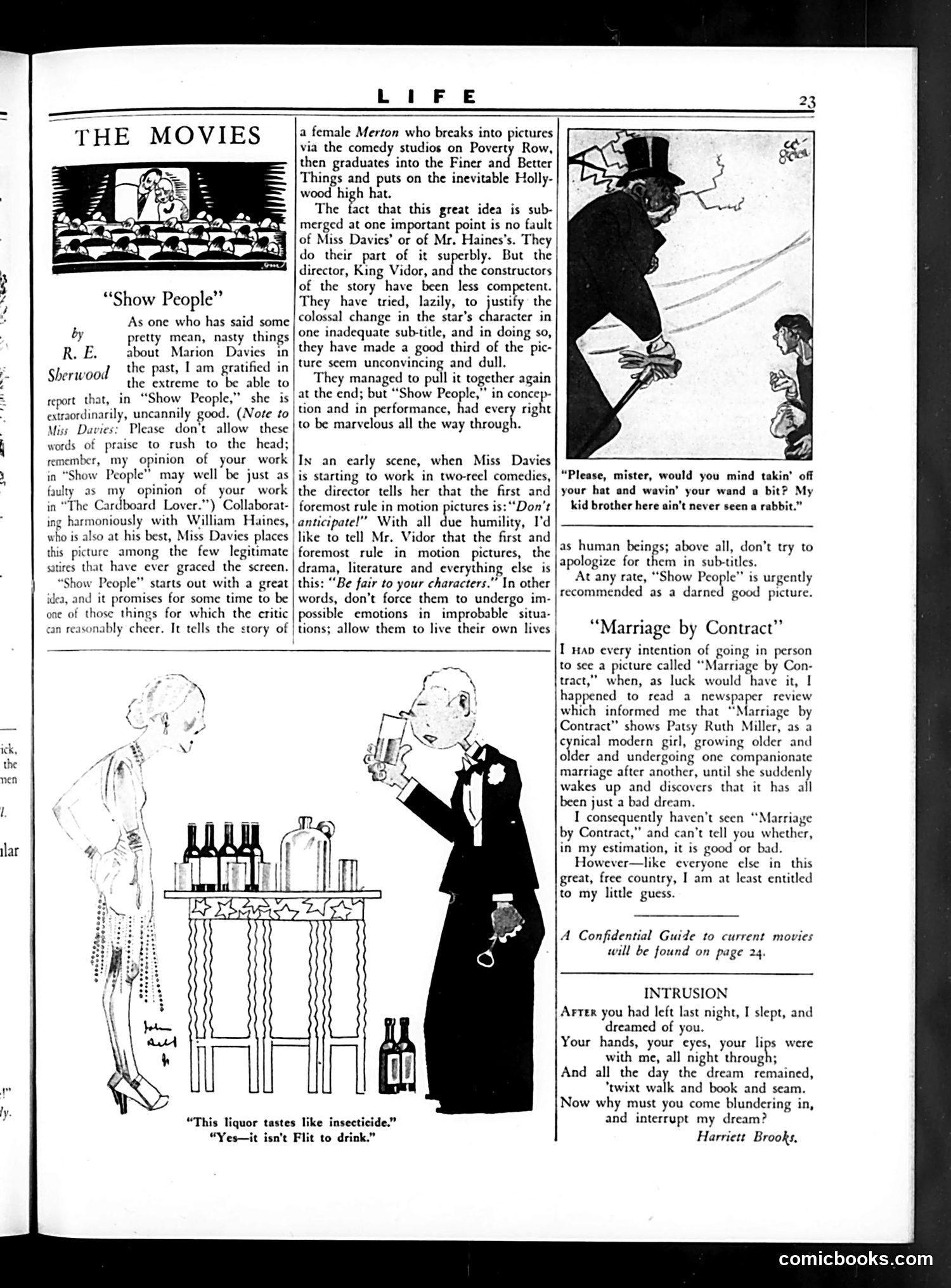
This page from *Life* magazine contains film reviews by critic R.E. Sherwood. The main cartoon depicts a well-dressed man examining bottles of liquor at a bar, with the caption "This liquor tastes like insecticide. Yes—it isn't Flit to drink." This is a Prohibition-era joke: "Flit" was a commercial insecticide brand, and the humor plays on both the terrible quality of bootleg liquor during the 1920s alcohol ban and the brand name similarity. The reviews discuss Marion Davies' film "Show People" (praised despite the critic's previous criticism of her work) and "Marriage by Contract" (which the critic hasn't seen but dismisses based on its plot summary). The smaller cartoon shows a rabbit performer, likely referencing vaudeville or early cinema tricks. The page exemplifies 1920s satirical magazine content: topical humor about contemporary entertainment, Prohibition-era drinking culture, and Hollywood gossip.
📄 Transcribed text from this page (OCR, searchable)
Machine-transcribed from the original scan — historical spelling and the odd misread are preserved.
LIFE THE MOVIES “Show People” As one who has said some pretty mean, nasty things about Marion Davies in the past, I am gratified in the extreme to be able to report that, in “Show People,” she is extraordinarily, uncannily good. (Note to Miss Davies: Please don’t allow these words of praise to rush to the head; remember, my opinion of your work in “Show People” may well be just as by R. E. Sherwood fault in “The Cardboard Lover.) Collaborat- ing harmoniously with William Haines, so at his best, Miss Davies places ure among the few legitimate | satires that have ever graced the screen. Show People” starts out with a great and it promises for some time to be one of those things for which the critic can reasonably cheer. It tells the story of as my opinion of your work | a female Merton who breaks into pictures via the comedy studios on Poverty Row, then graduates into the Finer and Better Things and puts on the inevitable Holly- wood high hat. The Ect that this great idea is sub- merged at one important point is no fault of Miss Davies’ or of Mr. Haines's. They | do their part of it superbly. But the} director, King Vidor, and the constructors of the story have been less competent. They have tried, lazily, to justify the colossal change in the star’s character in one inadequate sub-title, and in doing so, they have made a good third of the pic- ture seem unconvincing and dull. They managed to pull it together again at the end; but “Show People,” in concep- tion and in performance, had every right to be marvelous all the way through. Ix an early scene, when Miss Davies is starting to work in two-reel comedies, the director tells her that the first and foremost rule in motion pictures is:““Don’t anticipate!” With all due humility, I'd like to tell Mr. Vidor that the first and foremost rule in motion pictures, the drama, literature and everything else is this: “Be fair to your characters.” In other words, don’t force them to undergo im- possible emotions in improbable situa- tions; allow them to live their own lives “This liquor tastes like insecticide.” “Yes—it isn't Flit to drink.” “Please, mister, would you mind takin’ off your hat and wavin’ your wand a bit? My kid brother here ain't never seen a rabbit.” as human beings; above all, don’t try to apologize for them in sub-titles. At any rate, “Show People” is urgently recommended as a darned good picture. “Marriage by Contract” I Hap every intention of going in person to see a picture called “Marriage by Con- tract,” when, as luck would have it, I happened to read a newspaper review which informed me that “Marriage by Contract” shows Patsy Ruth Miller, as a cpoical modern girl, growing older and older and undergoing one companionate marriage after another, until she suddenly wakes up and discovers that it has all been just a bad dream. I consequently haven't seen “Marriage by Contract,” and can’t tell you whether, in my estimation, it is good or bad. However—like everyone else in this great, free country, I am at least entitled to my little guess. A Confidential Guide to current movies will be found on page 24. INTRUSION Arter you had left last night, I slept, and dreamed of you. Your hands, your eyes, your lips were with me, all night through And all the day the dream remained, *twixt walk and book and seam. Now why must you come blundering in, and interrupt my dream? Harriett Brooks, comicbooks.com