
Life, 1928-11-30 · page 16 of 52
Life — November 30, 1928 — page 16: what you’re looking at
What you’re looking at
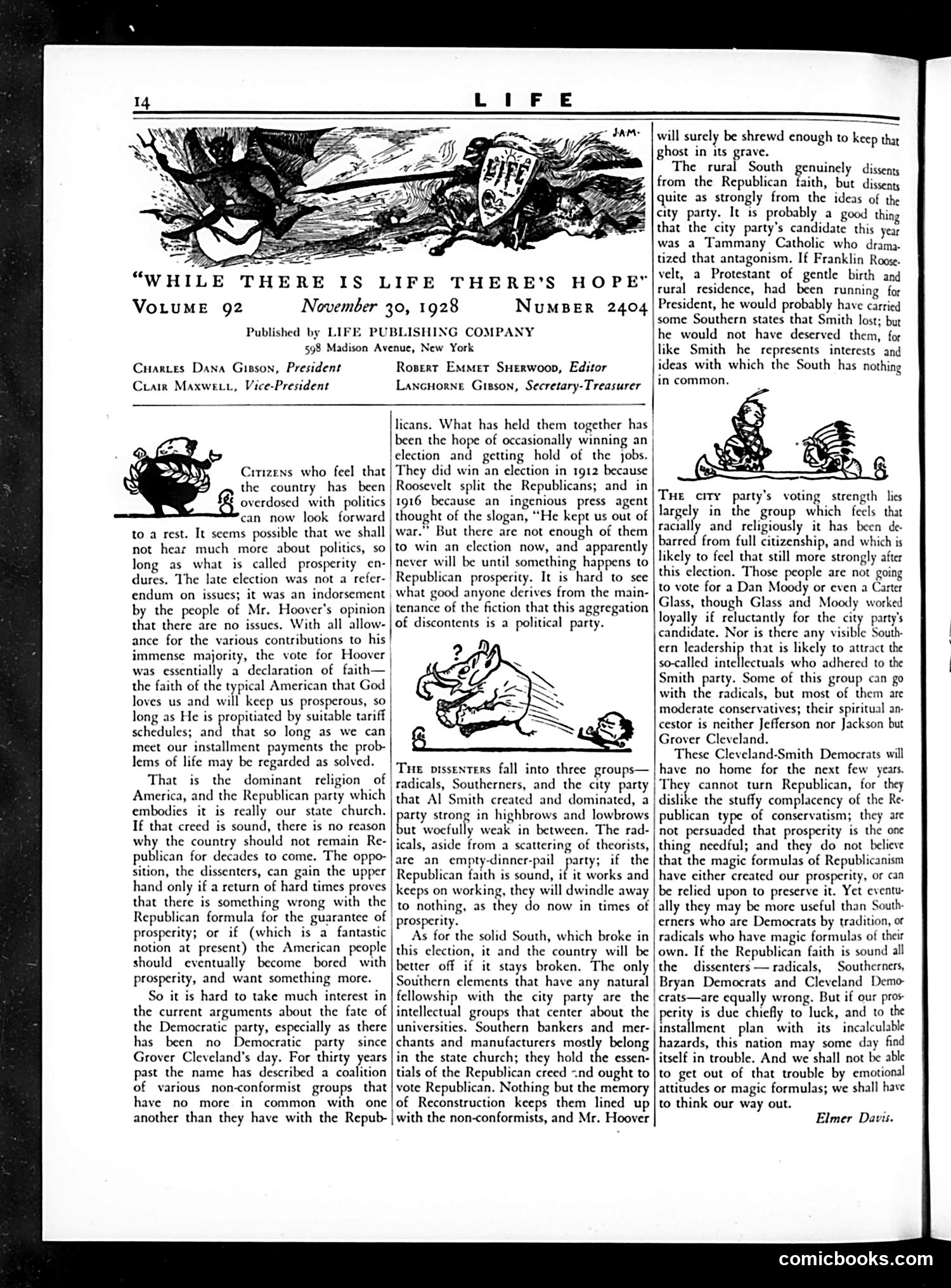
This page contains political commentary on the 1928 U.S. election aftermath. The article discusses divisions within the Democratic Party into three factions: radicals, Southerners, and city-party members. The accompanying cartoons depict these internal conflicts. One illustration shows what appears to be a donkey (the Democratic symbol) in distress or turmoil, symbolizing party disunity. The text references Republican prosperity under Hoover and suggests Democrats lack coherent philosophy beyond electoral ambition. The author (Elmer Davis) argues that Southern Democrats and urban Democrats have fundamentally incompatible values, with the party held together only by desire for electoral victory. The piece suggests this fragmentation threatens Democratic viability compared to Republican organizational strength.
📄 Transcribed text from this page (OCR, searchable)
Machine-transcribed from the original scan — historical spelling and the odd misread are preserved.
VoLUME 92 Cuarces Dana Gipson, President Crain Maxwett, Vice-President November 30, 1928 Published by LIFE. PUBLISHING COMPANY 598 Madison Avenue, New York NuMBER 2404 Rosert Emmet Suerwoop, Editor Lancuorne Gisson, Secretary-Treasurer Cimzens who feel that the country has been & overdosed with politics can now look forward toa rest. It seems possible that we shall not hear much more about politics, so long as what is called prosperity en- dures. The late election was not a refer- endum on issues; it was an indorsement by the people of Mr. Hoover's opinion that there are no issues. With all allow- ance for the various contributions to his immense majority, the vote for Hoover was essentially a declaration of faith— the faith of the typical American that God loves us and will keep us prosperous, so long as He is propitiated by suitable tariff schedules; and that so long as we can meet our installment payments the prob- lems of life may be regarded as solved. That is the dominant religion of America, and the Republican party which embodies it is really our state church. Tf that creed is sound, there is no reason why the country should not remain Re- publican for decades to come. The oppo- sition, the dissenters, can gain the upper hand only if a return of hard times proves that there is something wrong with the Republican formula for the guarantee of prosperity; or if (which is a fantastic notion at present) the American people should eventually become bored with prosperity, and want something more. So it is hard to take much interest in the current arguments about the fate of the Democratic party, especially as there has been no Democratic party since Grover Cleveland’s day. For thirty years past the name has described a coalition of various non-conformist groups that have no more in common with one another than they have with the Repub- | with the non-conformists, and Mr. Hoover | Te pissenters fall into three groups— licans. What has held them together has | been the hope of occasionally winning an | election and getting hold of the jobs. They did win an election in 1912 because Roosevelt split the Republicans; and in 1916 because an ingenious press agent thought of the slogan, “He kept us out of war.” But there are not enough of them to win an election now, and apparendy never will be until something happens to Republican prosperity. It is hard to see what good anyone derives from the main- tenance of the fiction that this aggregation of discontents is a political party. radicals, Southerners, and the city party | that Al Smith created and dominated, a} party strong in highbrows and lowbrows ut woefully weak in between. The rad- icals, aside from a scattering of theorists, are an empty-dinner-pail party; if the Republican faith is sound, ific works and keeps on working, they will dwindle away to nothing, as they do now in times of prosperity. As for the solid South, which broke in this election, it and the country will be better off if it stays broken. The only Southern elements that have any natural fellowship with the city party are the intellectual groups that center about the universities. Southern bankers and mer- chants and manufacturers mostly belong in the state church; they hold the essen- tials of the Republican creed <nd ought to vote Republican. Nothing but the memory of Reconstruction keeps them lined u will surely be shrewd enough to keep that ghost in its grave. The rural South genuinely dissents from the Republican faith, but dissents quite as strongly from the ideas of the city party. It is probably a good thing that the city party's candidate this year was a Tammany Catholic who drama. tized that antagonism. If Franklin Roos. velt, a Protestant of gentle birth and rural residence, had been running for President, he would probably have carried some Southern states that Smith lost; but he would not have deserved them, for like Smith he represents interests and ideas with which the South has nothing in common. Tue city party's voting strength lies largely in the group which feels that racially and religiously it has been de- barred from full citizenship, and which is likely to feel that still more strongly after this election. Those people are not going to vote for a Dan Moody or even a Carter Glass, though Glass and Moody worked loyally if reluctantly for the city party's candidate. Nor is there any visible South- ern leadership that is likely to attract the so-called intellectuals who adhered to the Smith party. Some of this group can go with the radicals, but most of them are moderate conservatives; their spiritual an- cestor is neither Jefferson nor Jackson but Grover Cleveland. These Cleveland-Smith Democrats will have no home for the next few years. They cannot turn Republican, for they dislike the stuffy complacency of the Re- publican type of conservatism; they are not persuaded that prosperity is the one thing needful; and they do not believe that the magic formulas of Republicanism have either created our prosperity, or can be relied upon to preserve it. Yet eventu- ally they may be more useful than South- erners who are Democrats by tradition, of radicals who have magic formulas of their own. If the Republican faith is sound all the dissenters — radicals, Southerners, Bryan Democrats and Cleveland Demo- | crats—are equally wrong. But if our pros- perity is due chiefly to luck, and to the installment plan with its incalculable hazards, this nation may some day find itself in trouble. And we shall not be able to get out of that trouble by emotional attitudes or magic formulas; we shall have to think our way out. Elmer Davis. comicbooks.com