
Life, 1928-11-30 · page 26 of 52
Life — November 30, 1928 — page 26: what you’re looking at
What you’re looking at
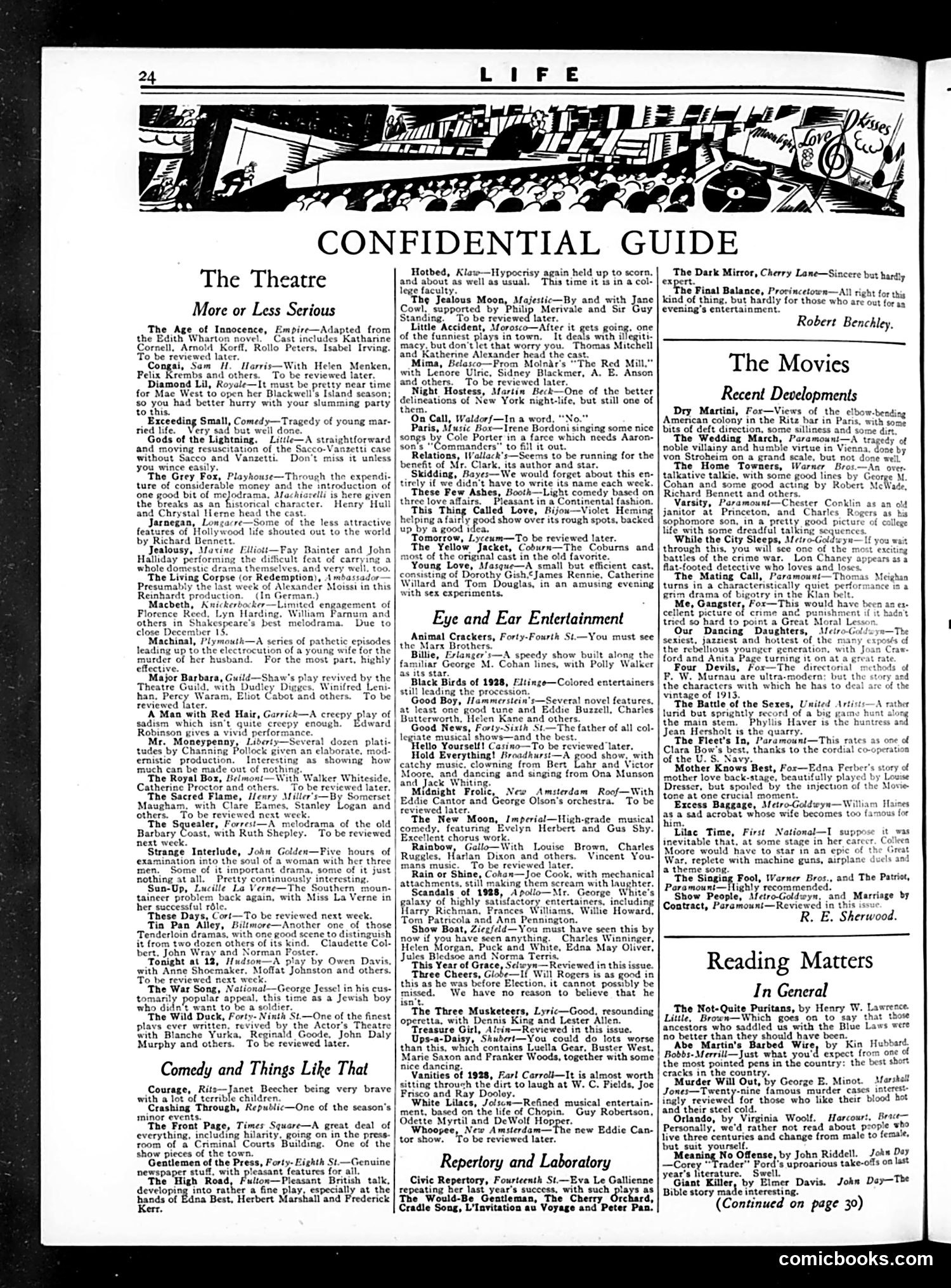
This page is a **theater and entertainment guide**, not a political cartoon. It's a "Confidential Guide" reviewing Broadway plays, movies, and performances currently running. The page lists dozens of theatrical productions with brief critical assessments. Notable references include: - **Mae West's "Diamond Lil"** — the review sarcastically suggests she'll soon need "Blackwell's Island season" (a prison reference, playing on West's risqué reputation) - **"Gods of the Lightning"** — explicitly noted as about the **Sacco-Vanzetti case**, the infamous 1920s murder trial of two Italian anarchists - **Eugene O'Neill's "Strange Interlude"** — described as a five-hour play at the John Golden Theatre The guide reflects 1920s theatrical culture, mixing serious drama (Shakespeare's *Macbeth*), contemporary social commentary (Sacco-Vanzetti), and popular entertainment. The tone is witty and irreverent throughout, typical of Life magazine's satirical approach to cultural criticism.
📄 Transcribed text from this page (OCR, searchable)
Machine-transcribed from the original scan — historical spelling and the odd misread are preserved.
CONFIDENTIAL GUIDE The Theatre More or Less Serious The Age of Innocence, Empire—Adapted from the Edith Wharto 1.” Cast includes Kathanne Cornell, Arnold Korff, Rollo Peters, Isabel Irving. To be reviewed later. Sam H. Harris—With Helen Menken, hers. To be reviewed later. Diamond Lil, Royale—It must be pretty near time for Mae West to open her Blackwell's Island season; so you had better hurry with your slumming party to this. Exceeding Small, Comedy—Tragedy of young mar- ried life. Very sad but weil done. Gods of the Lightning. Littie—A straightforward and moving resuscitation of the Sacco-Vanzetti case without Sacco and Vanzetti. Don't miss it unless you wince easily. The Grey Fox, Playhouse—Thr ture of considerable money and one good bit of meJodrama, Ma: the breaks as an historical chara and Chrystal Herne head the cast. Jarnegan, Longacre—Some of the less attractive features of Hollywood life shouted out to the world by Richard Bennett. Maxine Elliott—Pay Bainter and Joh forming th feat of car ic drama themselves. and very we Corpse (or Redemption), A mbassade Presumably the last week of Alexander Moissi in this Reinhardt production. (In Ger Macbeth, Anickerbock Florence Reed, Lyn Harding others in Shakespeare's best melodrama. close December 15. Machinal, Plymo: leading up to the ele murder of her husband. effective. Major Barbar: Theatre Guild, han, Percy W reviewed later. A Man with Red Hair, Garrick—A creepy sadism which isn’t quite creepy enough. Robinson gives a vivid performance. Mr. Moneypenny, Liderty—Several tudes by Channing Pollock given an elaborate, mod- emnistic production. —Intere: ‘as showing how much ean be made out of no The Royal Box, Belmont—With Walker Whitesid: Catherine Proctor and others. To be reviewed later. The Sacred Flame, //enry Miller's—By Somerset Maugham, with Clare Eames, Stanley Logan and others. To be reviewed nest week. The Squealer, Barbary Coast, next week. Strange Interlude, John Golden—Pive hours of h her three hh the expendi- oduction of he i Halliday whole dom The L Due to —A series of pathetic episodes ncution of a young wife for For the most part, hig! lay of Baward th Ruth Shepley. To be reviewed men. Some of nothing at all. y interesting Sun-Up, Lucille La Verne—The Southern moun- tainecr problem back again, with Miss La Verne in her successful rdle. These Days, Cor!—To be reviewed next week, Tin Pan Alley, Biltmore—Another one of those Tenderloin dramas, with one good scene to d it from two dozen others of its kind. Claude! bert, John Wray and Norman Foster. Tonight at 12, Hudson—A play by Owen D: with Anne Shoemaker, Moffat Johaston and o' To be reviewed next week ‘The War Song, Nationai—George Jesset in his cus- tomarily popular appeal, this time as a Jewish boy who didn’t want to be a soldier. The Wild Duck, Forty- Ninth St—One of the finest plavs ever written, revived by the Actor's Theatre with Blanche Yurka, Reginald Goode, John Daly Murphy and others. To be reviewed later. Comedy and Things Like That Courage, Rits—Janet Beecher being very brave with a lot of terrible children. Crashing Through, Republic—One of the season's minor events. The Front Page, Times Square—A great deal of everything, including hilarity, going on in the press- room of a’ Criminal Courts Building. One of the show pieces of the town. Gentlemen of the Pre Eighth St—Genuine newspaper stuil, with pledsant features for al The High Road, Fulton—Pleasant British talk, developing into rather a fine play, especially at the hands of Edna Best, Herbert Marshall and Frederick err. melodrama of the old | ec of it just | Hotbed, Klaw—Hypocrisy again held up to scorn, and about as well as usual, This time it is in a col- lege faculty. The Jealous Moon, Majesti—By and with Jane Cowl, supported by Philip Merivale and Sir Guy Stand To be reviewed later. Little Accident, Morosco—Alter it gets going. one of the funniest plays in town, It deals with illegiti- macy, but don't let that worry you. Thomas Mitchell and Katherine Alexander head the cast. Mima, Belasco—Prom Molnar's “The Red Mill.” Lenore Ulric, Sidney Blackmer, A. E. Anson nd others. To be reviewed later. Night Hostess, Martin Beck—One of the better delineations of New York night-life, but still one of them. On Call, Waldorf—In a word, “No.” . Paris, Music Bor—lIrene Bordoni singing some nice songs by Cole Porter in a farce which needs Aaron- son's “Commanders” to fill it out. : Relations, Wallack’s—Scems to be running for the benefit of Mr. Clark, its author and star. Skidding, Bayes—We would forget about this en- tirely if we didn’t have to write its name each week. These Few Ashes, Booth—Light comedy based on three love affairs. Pleasant in a Continental fashion. This Thing Called Love, Bifon—Violet Heming | helping a fairly good show over its rough spots, backed | up_by a good idea. Tomorrow, Lyceum—To be reviewed later. The Yellow Jacket, Coburn—The Coburns and t of the original cast in the old favorite. Young Love, Masque—A small but efficient cast, consisting of Dorothy Gish,<James Rennie, Catherine Willard and Tom Douglas, in an amusing evening with sex experiments, Eye and Ear Entertainment Animal Crackers, Forty-Fourth St.—You must see the Marx Brothers. Billie, Erlanger’s—A speedy show built along the familiar George M. Cohan lines, with Polly Walker as its star. Black Birds of 1928, Fitinge—Colored entertainers still leading the processio Good Boy, Hammerstein's—Several novel features, at least one good tune and Butterworth, Helen Kane and others. Good News, Forty-Sixth St—The father of all col- legiate musical shows—and the best Hello Yourself! Casino—To be reviewed later, Hold Everything! Broadhurst—A good show, with catchy music, clowning from Bert Lahr and Victor Moore, and dancing and singing from Ona Munson and Jack Whiting. Midnight Frolic, New Amsterdam Roof—With | Eddie Cantor and George Olson's orchestra. To be reviewed later. The New Moon, Imperial—High-grade, musical comedy, featuring Evelyn Herbert and Gus Shy. Excellent chorus work. Rainbow, Gallo—With Louise Brown, Charles Ruggles, Harlan Dixon and others. Vincent You- mans music. To be reviewed later. Rain or Shine, Cohan—Joe Cook, with mechanical attachments, still making them scream with laughte: Scandals of 1988, Apollo—Mr. George White's galaxy of highly satisfactory entertainers, includin Harry Richman, Frances Williams, Willie Howard, Tom Patricola and Ann Pennington. Show Boat, Ziesfeld—You must have seen this by pow if you have seen anything. | Charles Winninger, Heten Morgan, Puck and White, Edna May Oliver, Jules Bledsoe and Norma Terris. This Year of Grace, Selwyn—Reviewed in this issue. Three Cheers, Giobe—If Will Rogers is as good in this as he was before Election, it cannot possibly be issed. We have no reason to believe that he The Three Musketeers, Lyric—Good, resounding operetta, with Dennis King and Lester Allen. re Girl, Alrin—Reviewed in this issue. IP sy, ‘Shubert—You could do lots worse than this, which contains Luella Gear, Buster West, Marie Saxon and Pranker Woods, together with some nice dancing. Vanities of 1928, Farl Carroli—It is almost worth sitting throuch the dirt to laugh at W. C. Pields, Joe Frisco and Ray Doole; ‘ White Lilacs, Jolsom—Refined musical entertain- ment, based on’the life of Chopin. Guy Robertson, Odette Myrtil and DeWolf Hopper. Whoopee, New Amsterdam—The new Eddie Can- tor show. ‘To be reviewed later. Repertory and Laboratory Civic Repertory, Fourteenth St—Eva Le Gal repeating her last’ year's success, with such plays as The Would-Be Gentleman, The Cherry Orchard, Cradle Song, L'Invitation au Voyage and Peter Pan. ane The Dark Mirror, Cherry Lane—Sincere but hardly expert. he Final Balance, Prorincetown—Al kind of thing, but hardly evening's entertainment. ‘ght fo for those who are out ioe Robert Benchley, The Movies Recent Developments Dry Martini, For—Views of the elbow-ben American colony in the Ritz bar in Paris, with som bits of deft direction, some silliness and some ditt, The Wedding March, Paramount—A tragedy of noble villainy and humble virtue in Vienna, done by von Stroheim on a grand scale, but not done well, The Home Towners, Warner Bros.—An over talkative talkie. with some good lines by George M. Cohan and some good acting by Robert McWade, Richard Bennett and others. Varsity, Poramount—Chester Conklin as an old janitor at Princeton, and Charles R. sophomore son, in a pretty good pict life with some dreadful talking sequences. While the City Sleeps, Metro-Goldwyn— if you wait through this, you will see one of the ti battles of the crime war. ei turns in a charact grim drama of bigotry in the Klan belt. Me, Gangster, x—This would have been an ex- cellent picture of eri 2 ps tried so hard to point a Great M Our Dancing Daughters, sexiest, jazziest and hot the rebellious younger ford and Anita Page turni Four Devils, Fox—Th PF. W. Murnau are ult: the characters with which he has to vintage of 1913. The Battle of the Sexes, United A lurid but sprightly record ‘of a big the main stem. Phyllis Haver is Jean Hersholt ts the quarry. The Fleet's In, /aramount—This rates as one of Clara Bow's best, thanks to the cordial co~ a of the U. Navy. Mother Knows Best, Fox—Edna Fer mother love back-stage, beautifully playe Dresser, but spoiled by the injection of tone at one crucial moment. . Excess Baggage, Metro-Goldwyn—William as a sad acrobat whose wife becomes too { him. Lilac Time, First National—I suppose it was inevitable that, at some stage in her career. Colle joore would have to star in an epic of ‘ar, replete with machine guns, airplane duels a theme song. The Singing Fool, tarner Bros., and The Patrist, Paramount—flighly recommended. . Show People, Metro-Goldwyn, and Marriage by Contract, Paramouni—Reviewed in this issue. R. E. Sherwood. ly quiet tory ard of the Reading Matters In General The Not-Quite Puritans, by Henry Little, Brown—Which goes on to say ancestors who saddled us with the Blue L no better than they should have been. Abe Martin's bed Wire, by Kin Hubbard. Bobbs-Merrili—Just what you'd expect {rom one of the most pointed pens in the country: the best short cracks in the country. ve Murder Will Out, by George E. Minot. Marshell Jones—Twenty-nine famous murder cases interest: ingly reviewed for those who like their blood hot and their steel cold. Orlando, by, Virginia Woolf. Brace— Personally, we'd rather not read about pzople who live three centuries and change from male to female but suit yourself. ‘Meaning No Offense, by John Riddell. Joh Dey Corey “Trader” Ford's uproarious ‘take-olfs of las ear’s literature. well. **Giant Killer, by Elmer Davis. John Day—Tbe Bible story made interesting. (Continued on page 30) . Lawrence hat rs were Harcow comicbooks.com