
A complete issue · 40 pages · 1923
Life — April 5, 1923
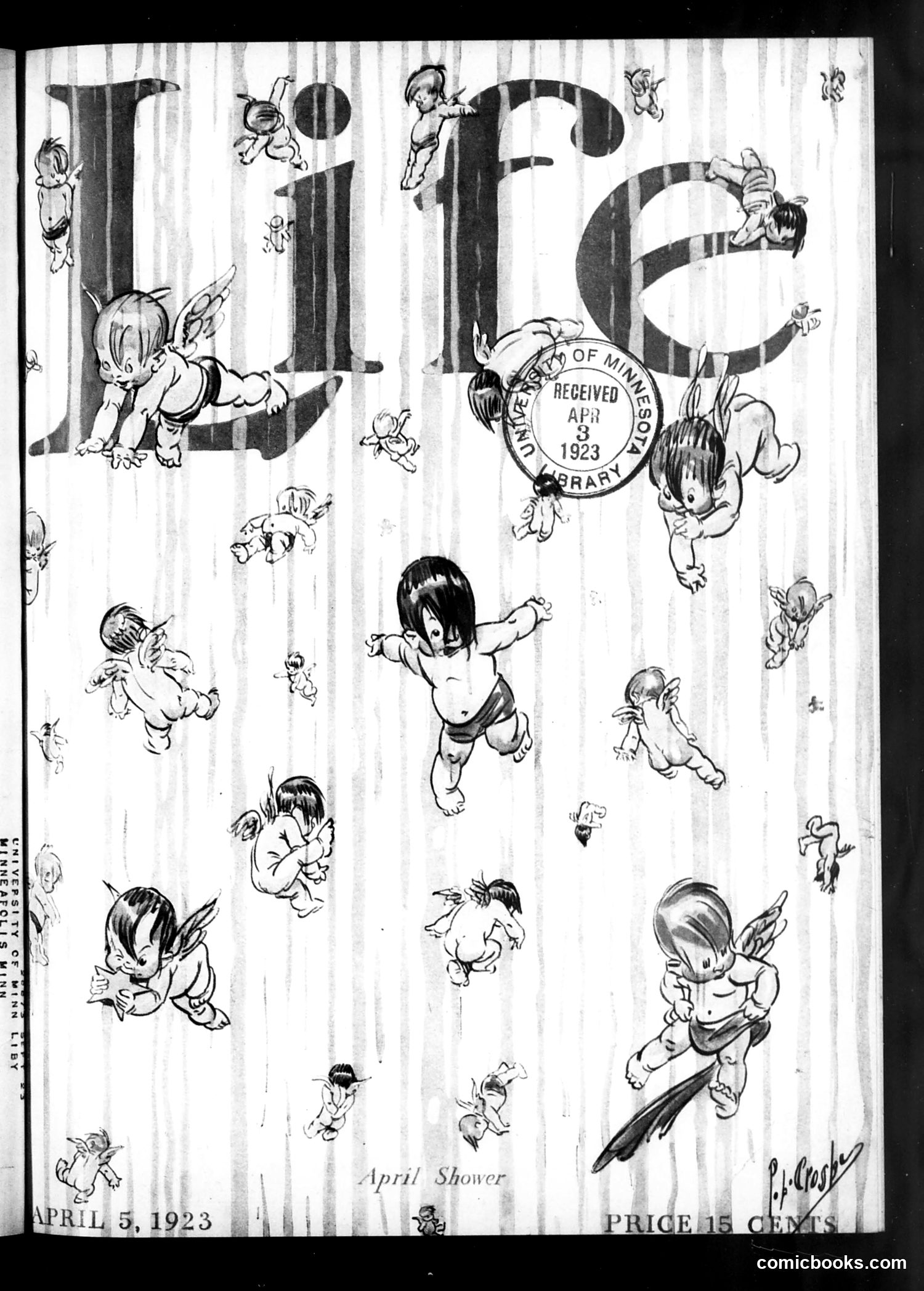
This cover illustration, titled "April Shower," depicts cherubic babies and cupids raining down from the large numbers "1923." The satire plays on the common expression "April showers bring May flowers," reimagined here with infants as the "shower." Given the 1923 date and "April Shower" theme, this likely satirizes a post-World War I baby boom—Americans were having more children following the war's conclusion. The cartoon makes a humorous visual pun: instead of rain, babies literally pour down like precipitation, suggesting the abundance of newborns arriving that spring. The whimsical cherubs and playful composition transform demographic change into cheerful, if slightly chaotic, imagery typical of Life's lighthearted social commentary.
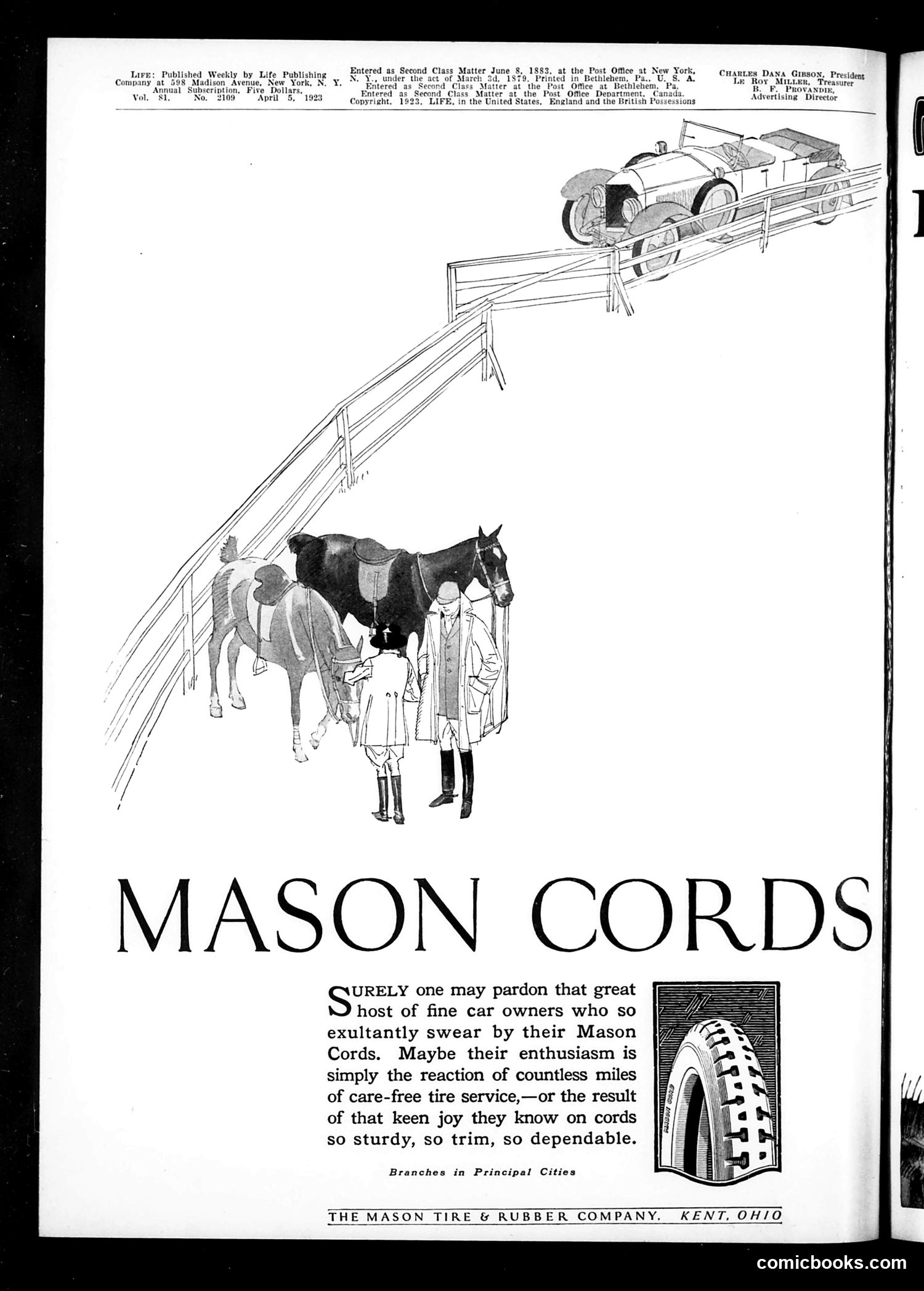
This is a **1923 advertisement** for Mason Cords tires, not satire. The image contrasts two transportation methods: a wealthy couple with a saddled horse below, while a fancy automobile speeds past on an elevated ramp above. The ad's message uses this contrast to suggest that Mason Cord tire owners experience "care-free tire service" and "countless miles" of dependable performance—implying their modern car travel is superior to old-fashioned horse transportation. The text claims car owners' enthusiasm for Mason Cords results from years of reliable service. This reflects 1920s advertising strategy: positioning automobiles as modern progress while dismissing horse-based transportation as obsolete.
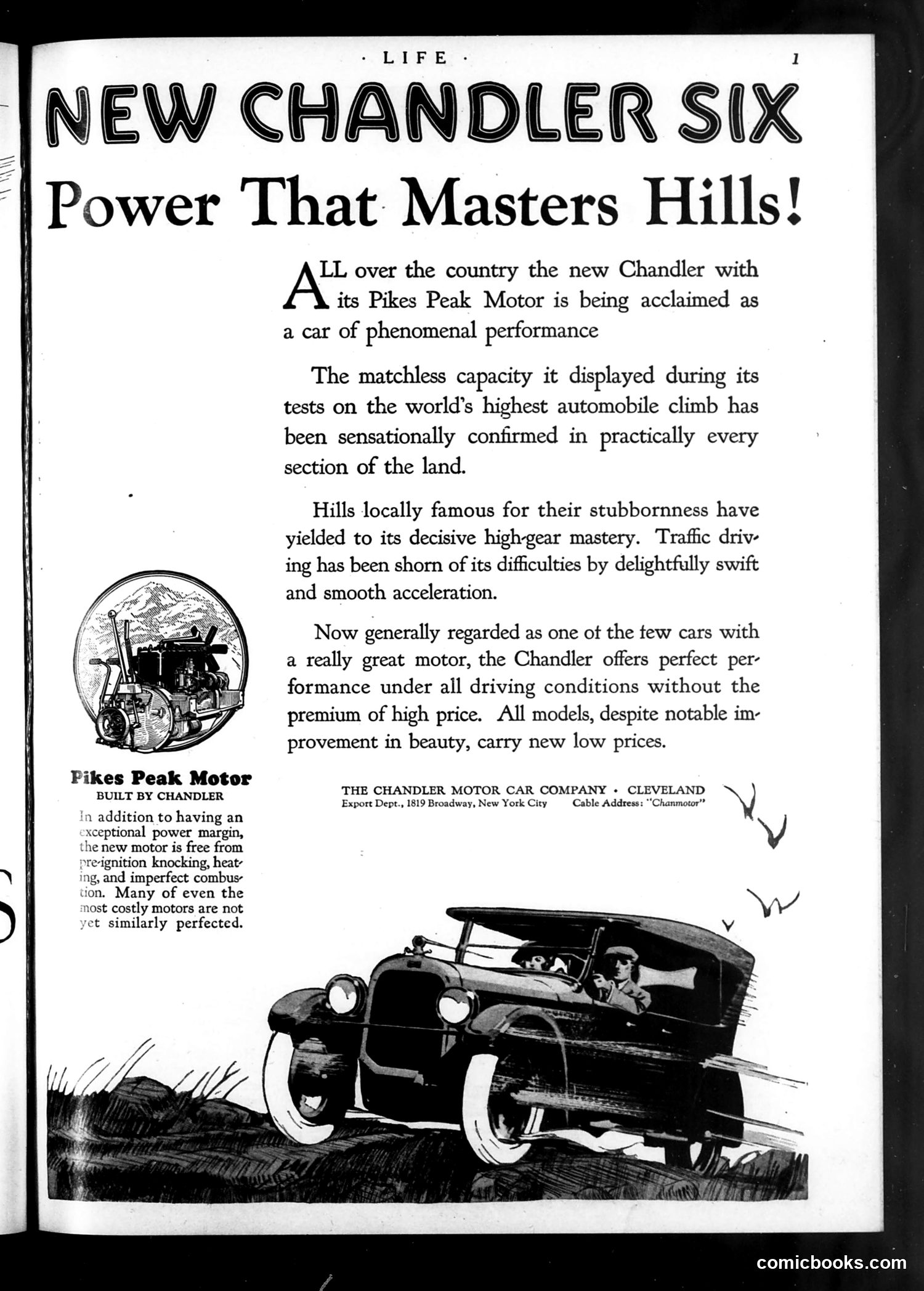
This is **not a satirical cartoon page** — it's a **straight automobile advertisement** for the Chandler Motor Car Company of Cleveland, appearing in *Life* magazine. The page promotes the "New Chandler Six" automobile, emphasizing its "Pikes Peak Motor" and ability to climb hills effectively. The advertisement claims the car performed well during tests on Pikes Peak (the world's highest automobile climb) and promises "perfect performance under all driving conditions without the premium of high price." The illustration shows a vintage 1920s car ascending a steep hillside. This is product marketing, not satire — *Life* magazine regularly published advertisements alongside its satirical content. The dramatic imagery and copy aim to convince readers of the car's superior engineering and value.
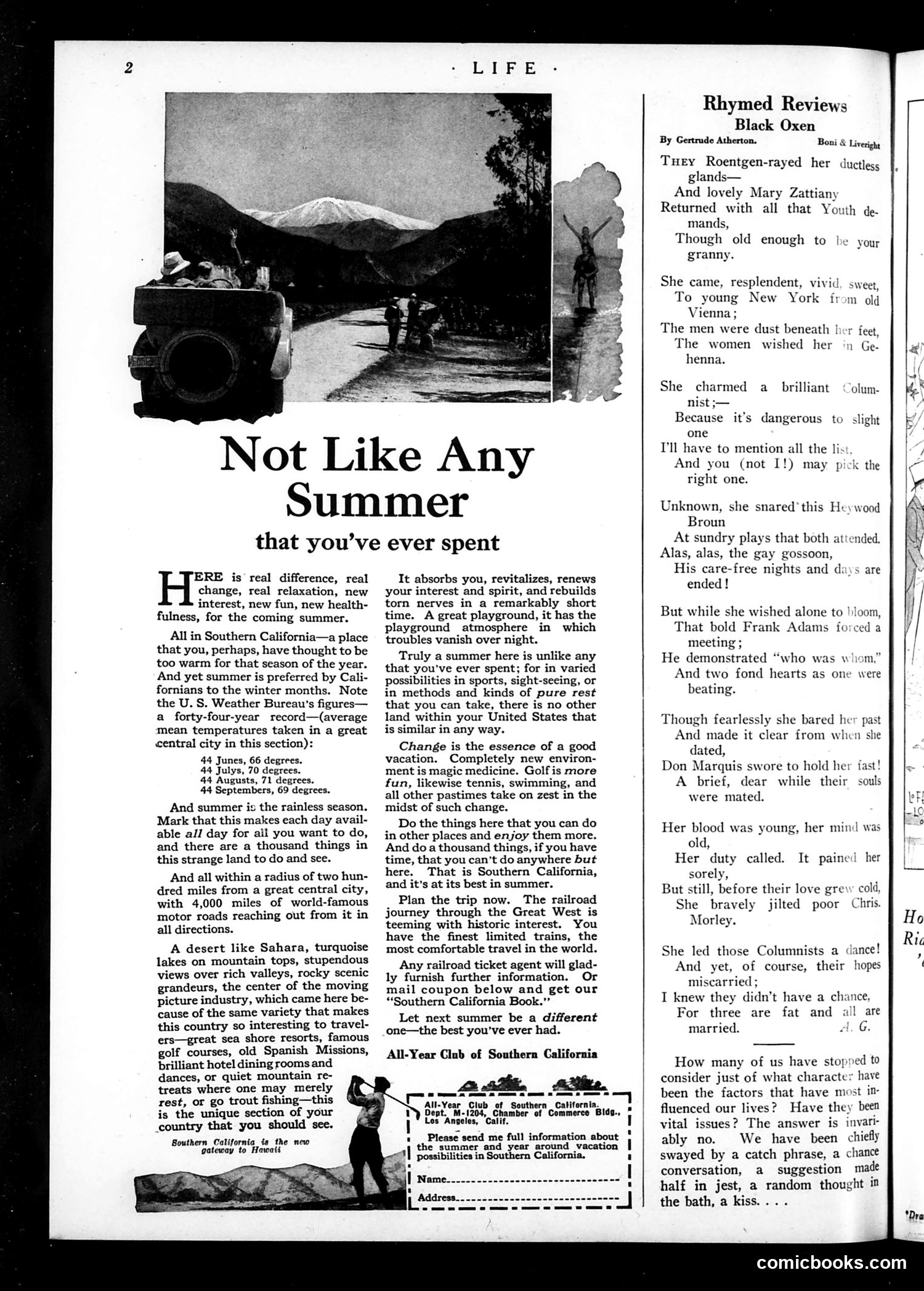
This page contains primarily **advertising and travel promotion** rather than political satire. The main content is a Southern California tourism advertisement titled "Not Like Any Summer that you've ever spent," promoting the region's climate, recreational opportunities, and railroad access. The piece emphasizes Southern California's unique advantages: consistent warm temperatures (44-69 degrees), varied activities (golf, swimming, motor roads), and accessible destinations via the "All-Year Club of Southern California." On the right side is "Rhymed Reviews: Black Oxen" by Gertrude Atherton—a literary review in verse form about a woman named Mary Zattiany who returns to New York after years away, charming society figures including Frank Adams and Don Marquis. This page reflects **1920s leisure culture and celebrity gossip** rather than political commentary.
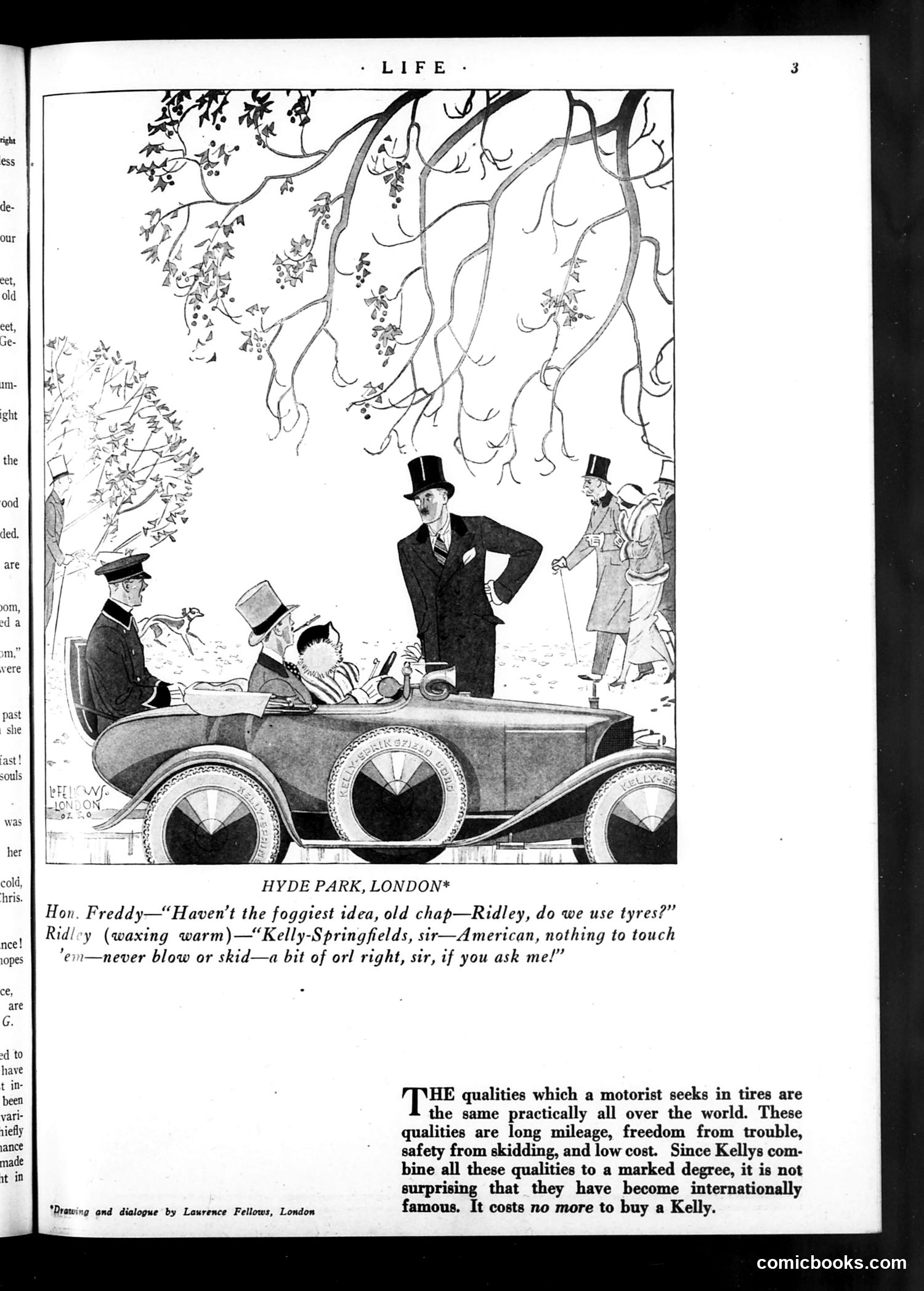
This page contains a cartoon advertisement for Kelly tires set in Hyde Park, London. The illustration shows well-dressed gentlemen in top hats in an early automobile, with others standing nearby under weeping willow trees. The humor relies on a conversation about tire quality. "Hon. Freddy" asks about "tyres" (British spelling), and Ridley responds enthusiastically about "Kelly-Springfields, sir—American, nothing to touch 'em—never blow or skid." The satire targets American commercial boosterism: here, British aristocrats in their own park are being won over by American tire superiority. The advertisement leverages nationalist pride and emerging automobile culture to sell a product. The formal setting and dignified characters lend credibility to the product endorsement, a common advertising strategy of the early 20th century.
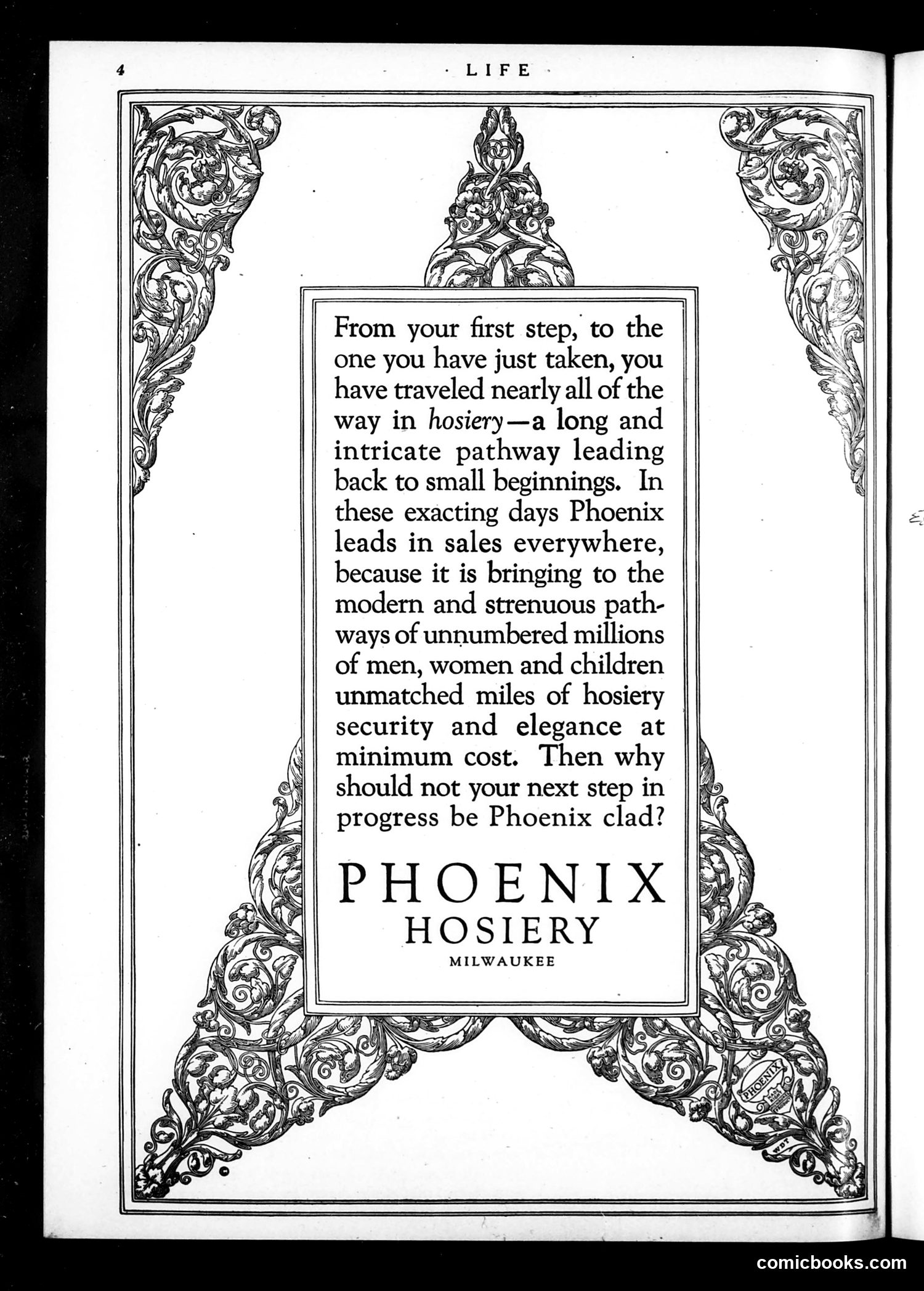
This page is primarily a **commercial advertisement**, not satire or political commentary. It's an ornately-bordered ad for Phoenix Hosiery from Milwaukee, placed in *Life* magazine. The ad uses a metaphorical "journey" conceit: it describes hosiery-wearing as a path from "first step" to present, positioning Phoenix brand as the logical "next step in progress." The copy emphasizes Phoenix's market dominance ("leads in sales everywhere") and promises value—"unmatched miles of hosiery security and elegance at minimum cost" for "men, women and children." The elaborate decorative border and formal typography reflect early 20th-century advertising aesthetics. There is no identifiable satirical content or political reference—this is straightforward commercial promotion using aspirational, progress-oriented marketing language typical of the era.
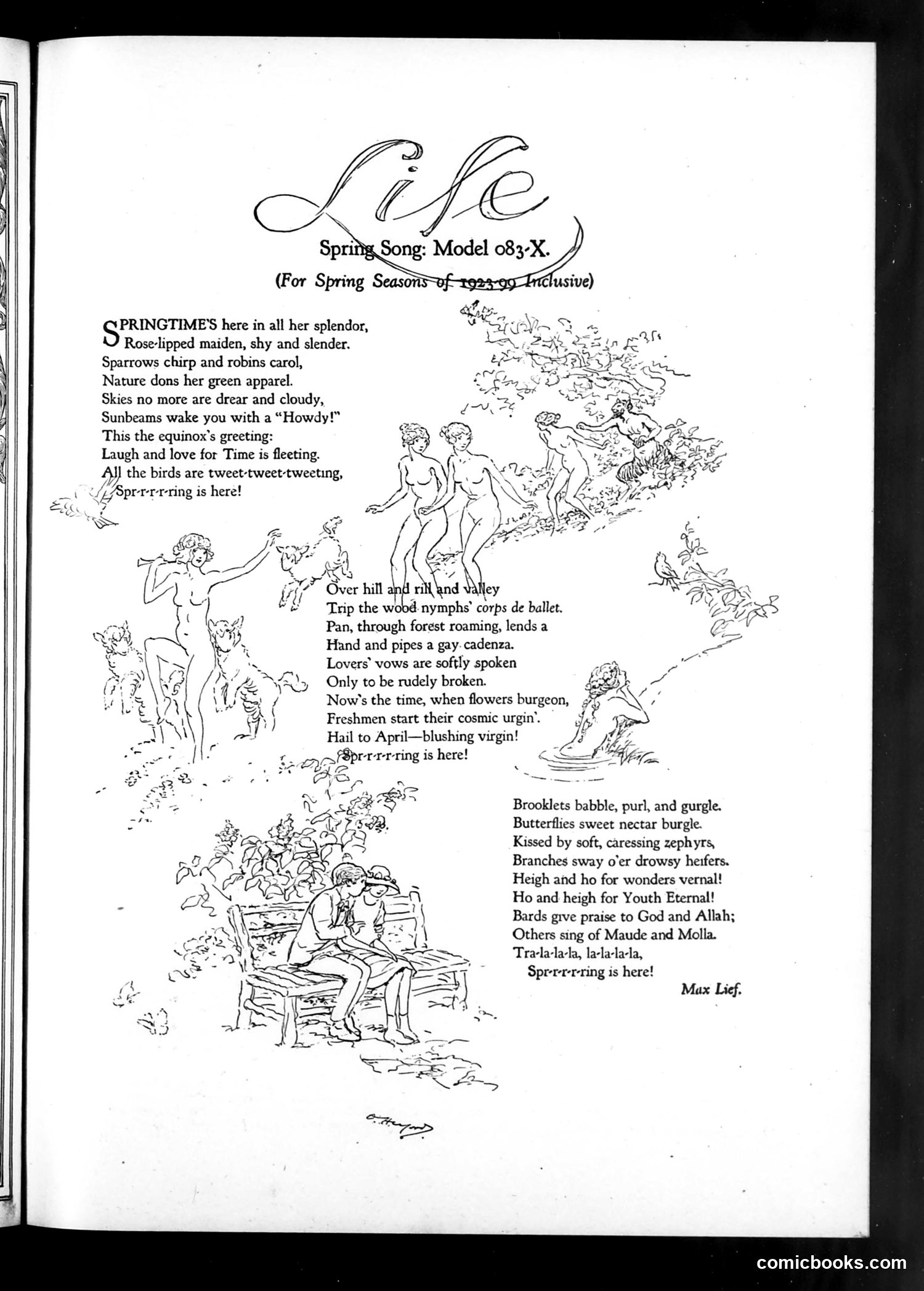
This page is a whimsical spring poem by Max Lief, illustrated with line drawings of nudes and nature scenes rather than political satire. The title humorously treats spring as a commercial "model," suggesting it's an annual product release. The poem celebrates spring's arrival through romanticized imagery: nymphs dancing through forests, Pan piping, flowers blooming, and lovers' vows. The illustrations show classical nude figures frolicking in pastoral settings—consistent with *Life* magazine's sophisticated art and literary culture of the 1920s era. This appears to be light satirical commentary on how spring is commercially packaged and anticipated annually, wrapped in classical artistic language and imagery. It's essentially celebrating youthful romance and renewal rather than critiquing specific politics or figures.
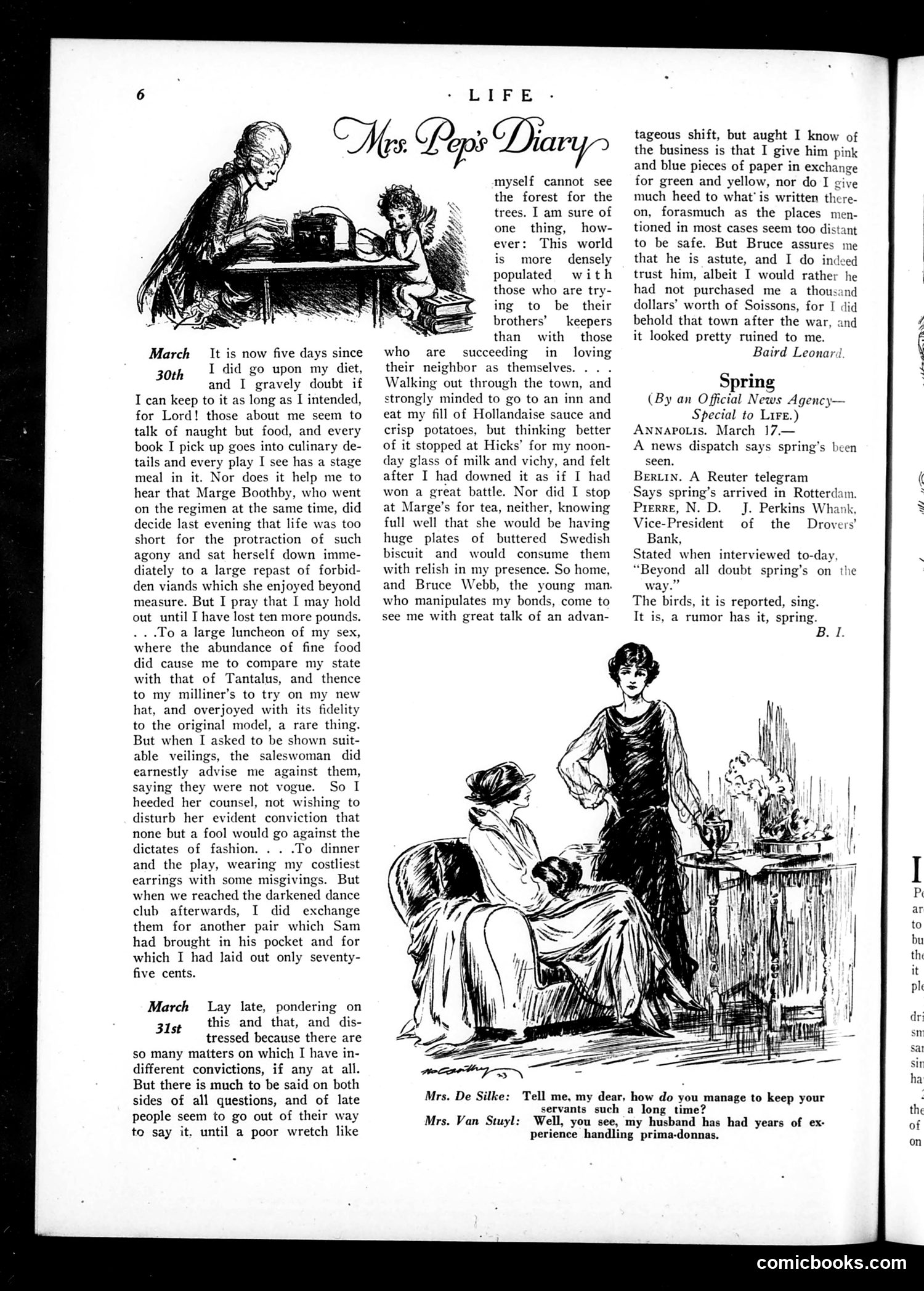
This page presents **"Mrs. Peps Diary,"** a serialized humor column featuring a woman's domestic observations. The March 30th entry satirizes her recent dietary experiment and shopping experiences, mocking her attempts at fashionable restraint while ultimately indulging in luxuries like new hats and dance club outings. The lower illustration depicts a conversation between **Mrs. De Silke** and **Mrs. Van Stuyl** about managing servants—specifically "prima-donnas" (implying difficult household staff). The "Spring" news section offers brief satirical dispatches about spring's arrival from various locations. Overall, the page targets upper-middle-class women's social pretensions, vanity, domestic management challenges, and their obsession with fashion—typical early 20th-century satirical fare about women's leisure activities and consumer habits.
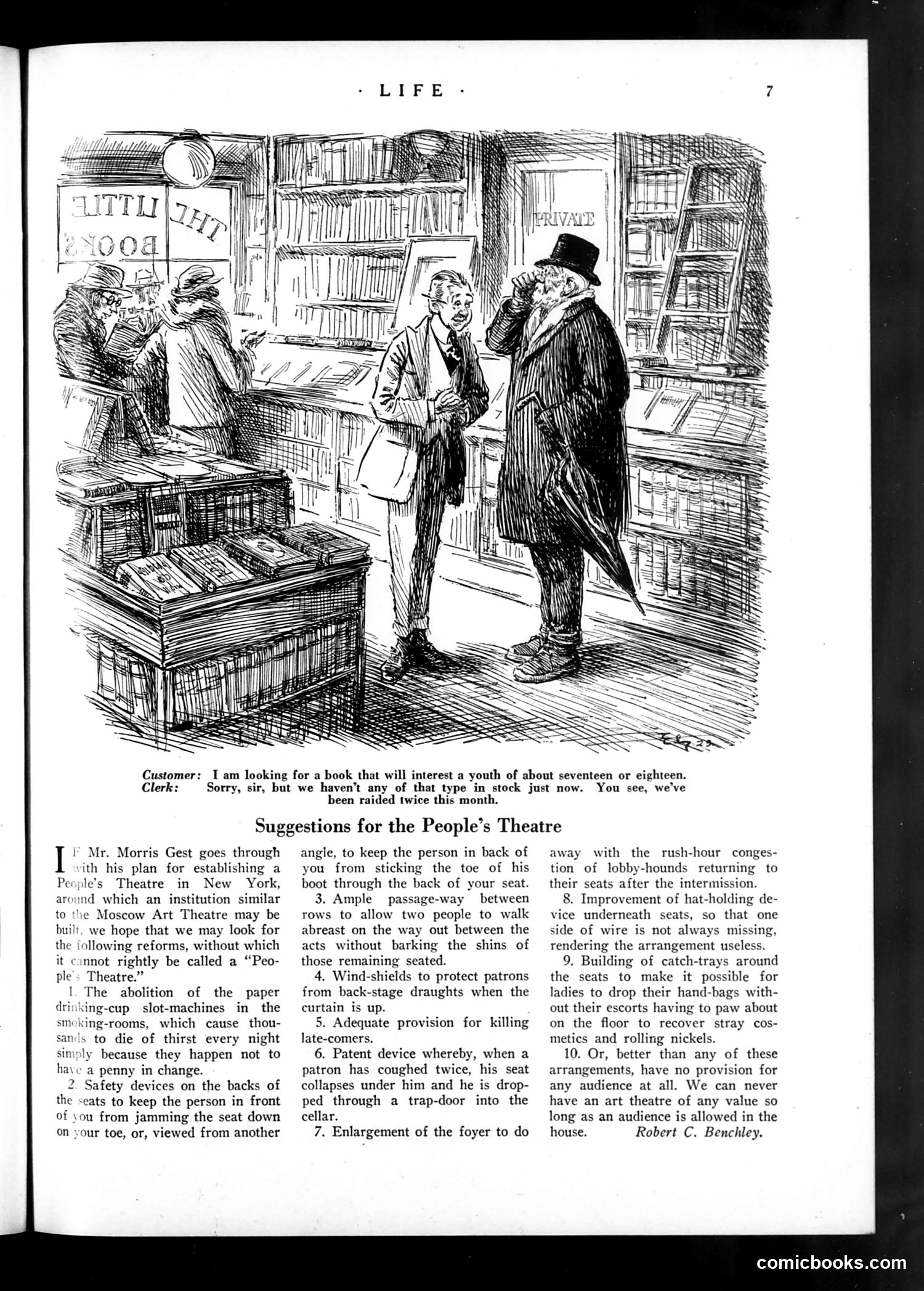
This page contains a single-panel cartoon and an article about theater design. **The Cartoon:** A bookstore clerk tells a customer he cannot stock books for seventeen- or eighteen-year-olds because the store has been "raided twice this month." The joke satirizes censorship efforts targeting youth literature—likely referencing early 20th-century book-banning campaigns. The clerk's matter-of-fact response suggests such raids were common enough to disrupt inventory. **The Article:** "Suggestions for the People's Theatre" by Robert C. Benchley proposes theatrical reforms for a hypothetical "People's Theatre" in New York. It addresses practical audience concerns: seat design, circulation, noise reduction, and preventing late-arrivals from disrupting performances. Benchley humorously advocates for basic theater amenities most patrons would expect. Together, the page reflects Progressive Era concerns about public institutions and social access.
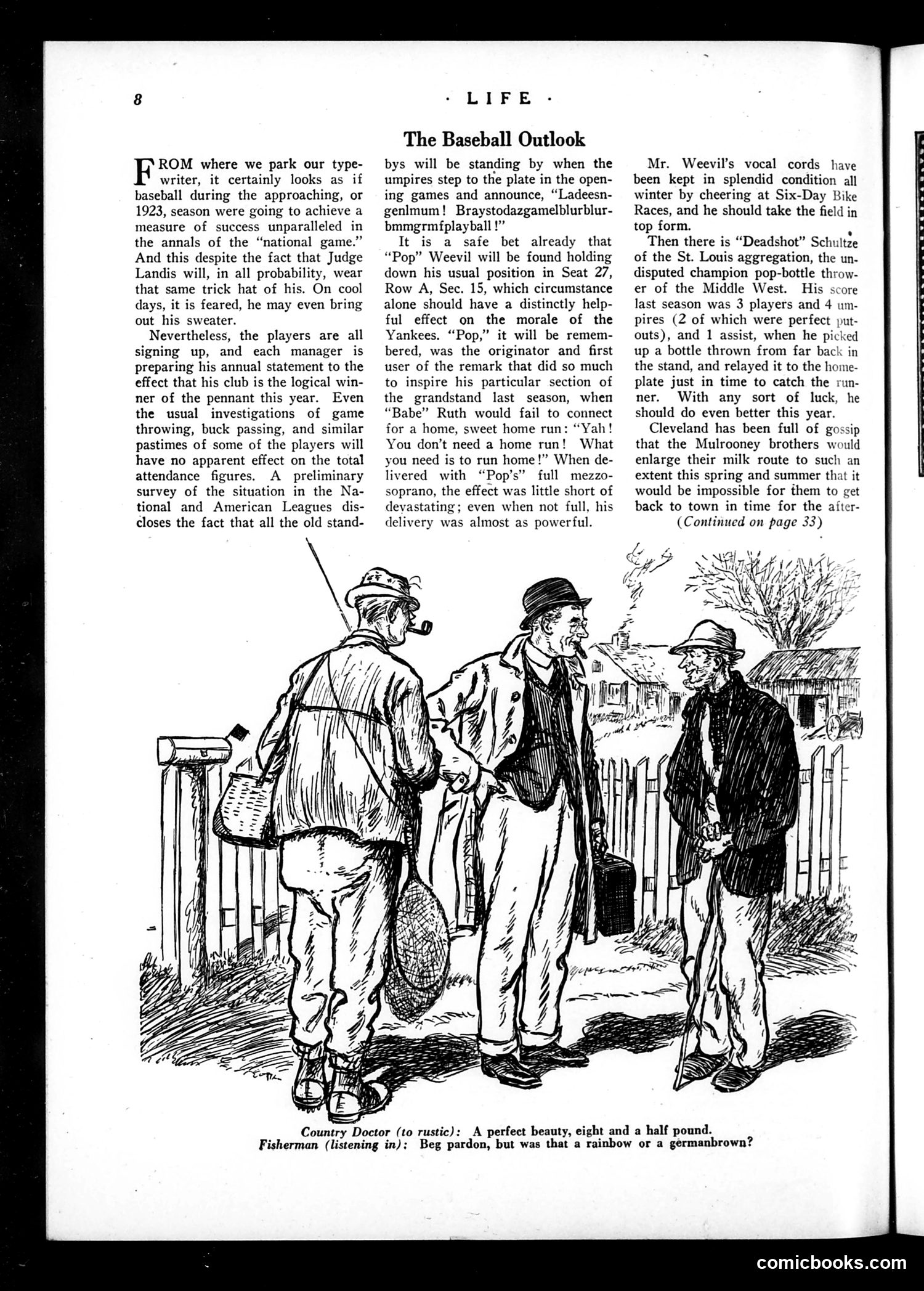
This page contains an article about the 1923 baseball season's prospects, discussing players like "Pop" Weevil and "Deadshot" Schultz, with optimism about the coming season despite Judge Landis's recent strict enforcement actions. The cartoon below depicts three rural men—a country doctor (center), a fisherman (left), and a rustic figure (right)—in conversation. The doctor mentions catching "a perfect beauty, eight and a half pound" fish, and the fisherman corrects him, asking whether it was actually "a rainbow or a germanbrown?" This is a **humorous rural/fishing joke**: the fisherman is pedantically fact-checking the doctor's fish story, suggesting the doctor misidentified the species—a gentle satire of both tall-tale telling and know-it-all corrections common in small-town interactions.
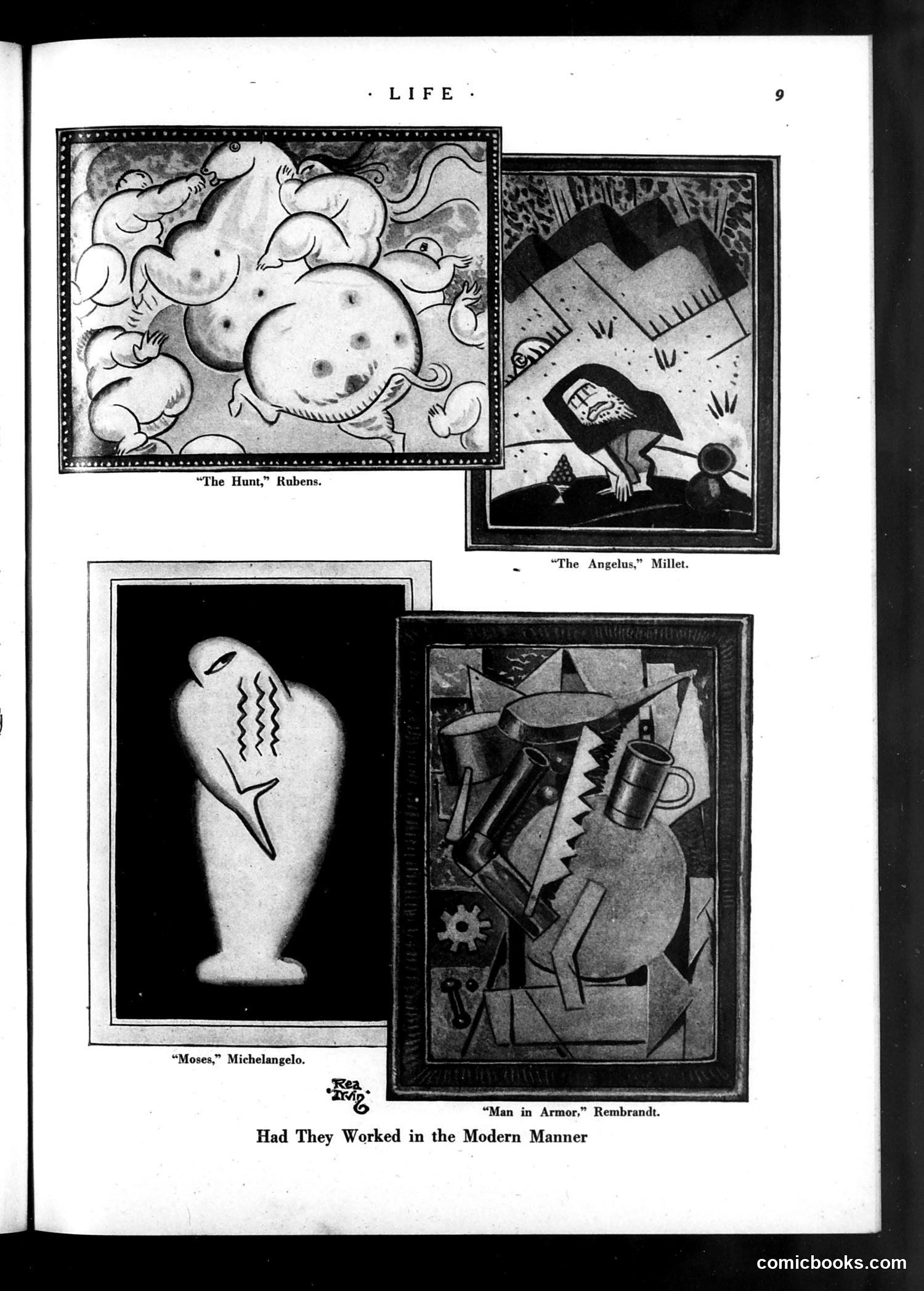
This page presents four famous artworks reimagined in a modernist style—a satirical commentary on early 20th-century avant-garde art movements. **The artworks shown:** - "The Hunt" by Rubens (top left): his voluptuous figures rendered as abstract rounded forms - "The Angels" by Miller (top right): simplified into geometric shapes - "Moses" by Michelangelo (bottom left): transformed into an abstract sculptural form with minimal detail - "Man in Armor" by Rembrandt (bottom right): deconstructed into cubist/mechanical components The satire mocks how modernist artists stripped classical masterworks of their representational detail, reducing recognizable figures to abstract or geometric interpretations. The title suggests that applying these contemporary experimental techniques to Old Masters would result in barely recognizable, overly simplified compositions—criticizing modernism's departure from traditional artistic values.
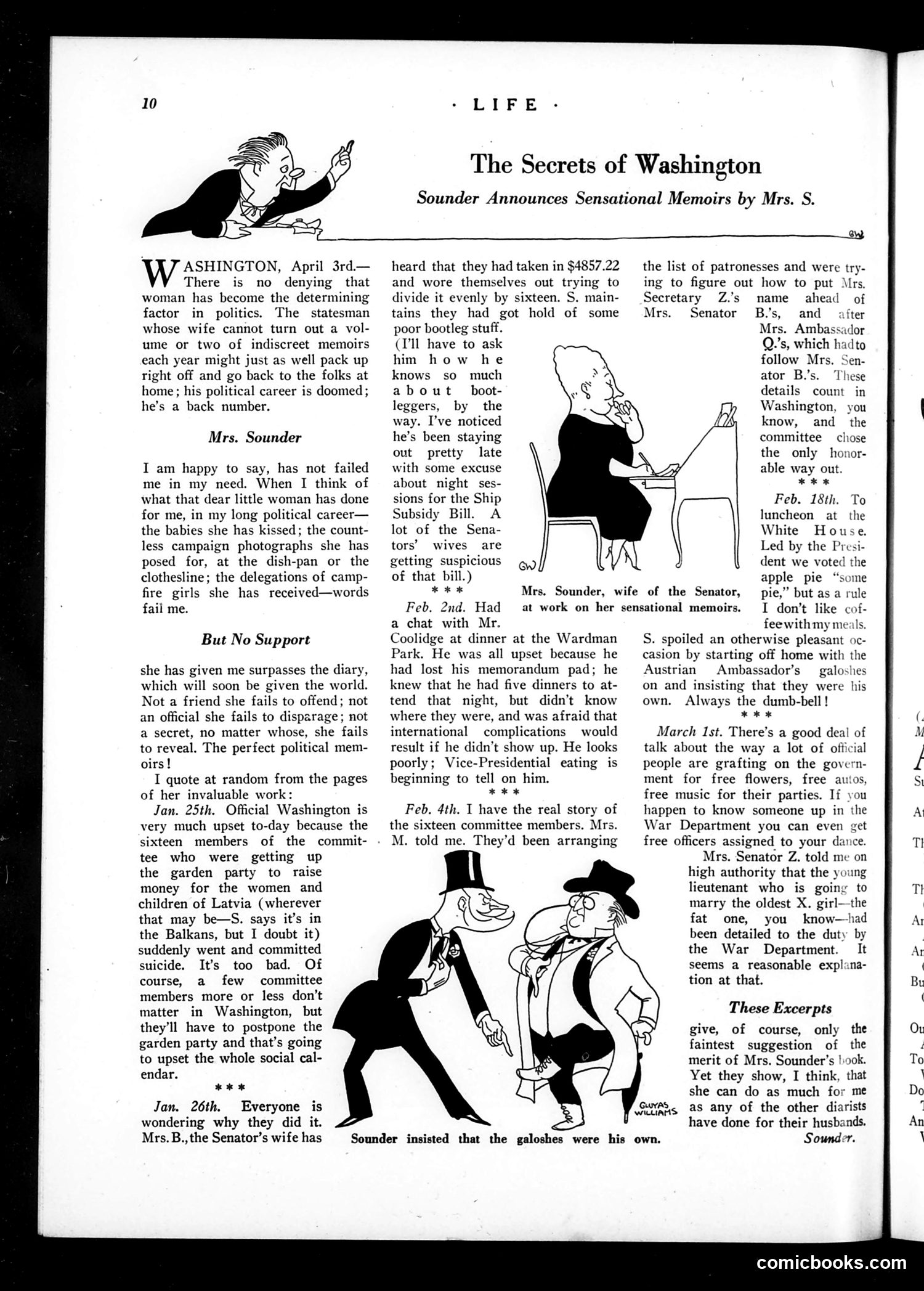
This page satirizes Washington society and political wives' influence. The main article presents Mrs. Sounder (wife of a Senator) announcing her memoirs, which will expose embarrassing details about senators, their wives, and social scandals. The satire mocks how politicians' careers can be damaged by indiscreet spouses publishing compromising information. The cartoon illustrations depict Mrs. Sounder writing her memoir and show two gentlemen in top hats (appearing to be senators or diplomats) discussing "galosbes" — likely a veiled reference to a minor scandal being elevated to memoir-worthy status. The joke targets both women's growing political influence through gossip and memoir-writing, and the fragility of male political reputations dependent on wives' discretion.
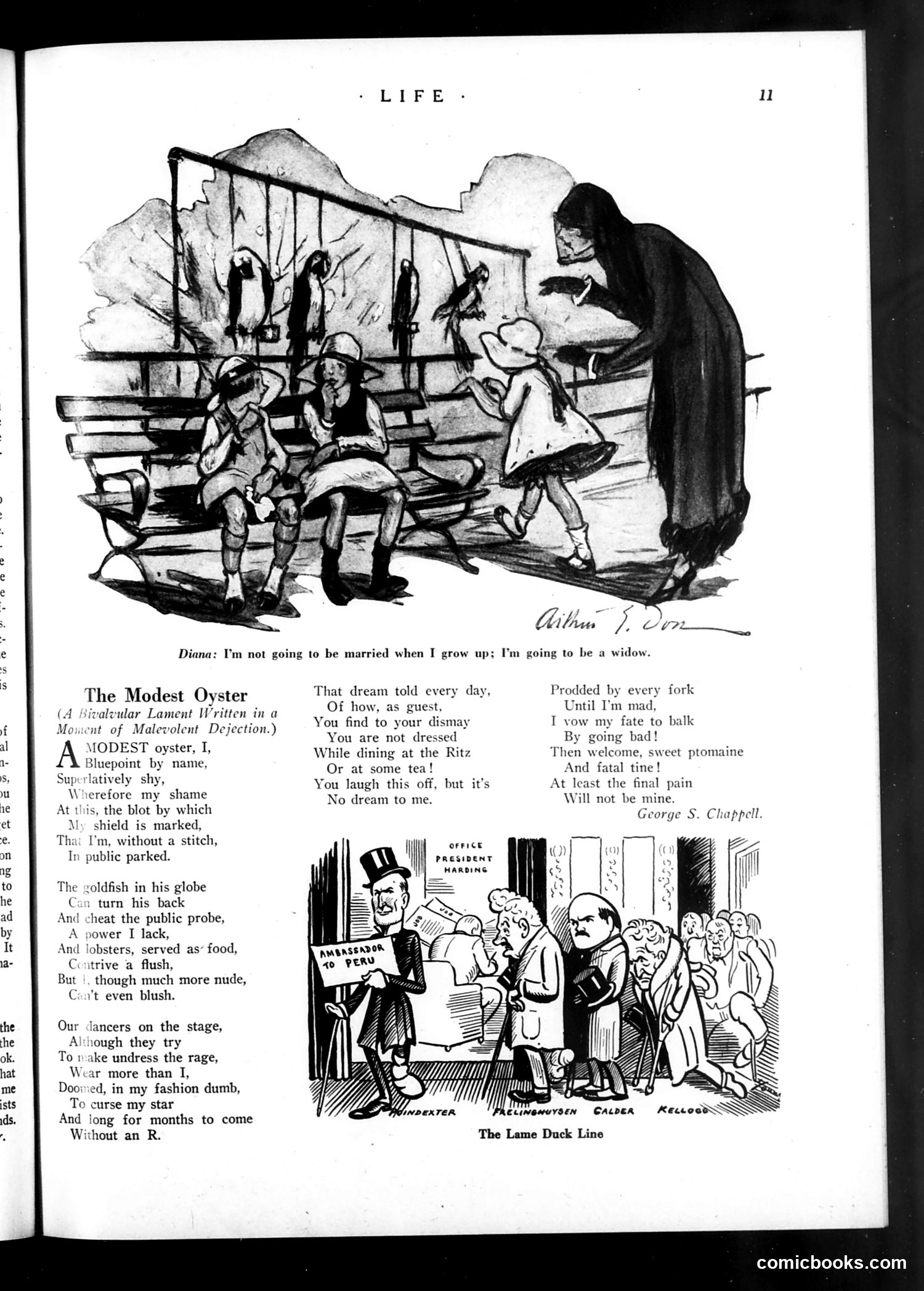
**Top Illustration**: Arthur I. Keller's cartoon shows children at play, with a girl (Diana) declaring she won't marry when grown—she'll be a widow instead. This appears to satirize precocious or unusual childhood declarations. **"The Modest Oyster"**: A poem by George S. Chappell mocking an oyster's self-deprecation and complaints about being eaten. **"The Lame Duck Line"**: The lower cartoon depicts what appears to be political figures (names visible but unclear) at an "Office of President Harding" with "Ambassador to Peru" signage. This likely satirizes the Harding administration's appointments or political maneuvering, using "lame duck" to reference ineffectual political figures or a departing official's diminished power. The page combines social satire with political commentary typical of Life's satirical approach.
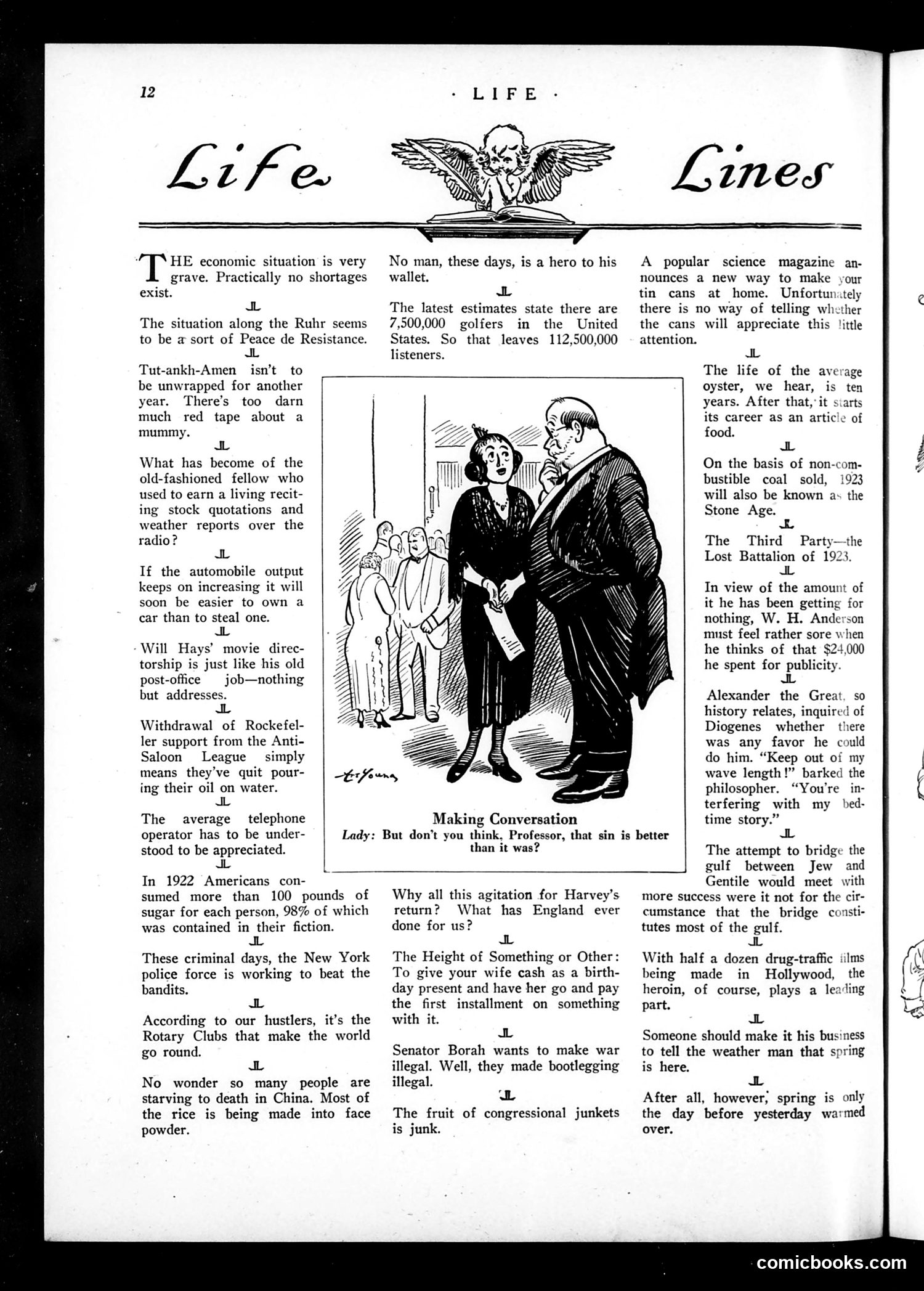
This cartoon depicts a well-dressed man and woman in what appears to be a social gathering. The caption reads: "Lady: But don't you think, Professor, that sin is better than it was?" The satire targets pretentious social conversation—specifically the absurdity of polite small talk at gatherings. The "Professor" character represents intellectuals or academics who might engage in pompous philosophical discussion. The woman's deliberately nonsensical statement ("sin is better than it was") mocks how people discuss serious topics superficially at parties, and the man's apparent readiness to engage suggests he'll respond seriously to an inherently meaningless question. The joke critiques both affected intellectualism and the banality of upper-class social discourse during this period.
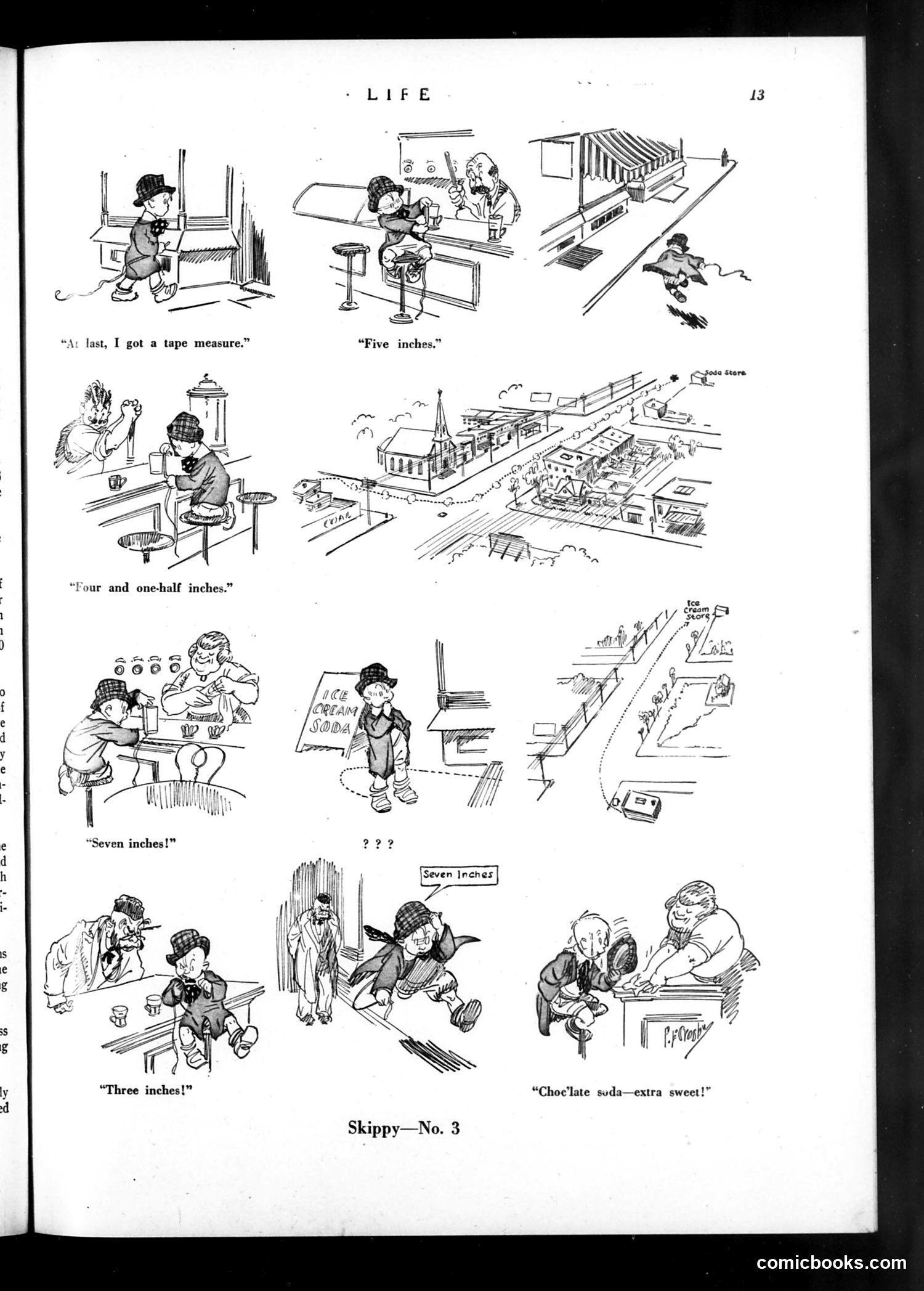
This is a comedic strip titled "Skippy—No. 3" showing a child's misadventure with measurements. The humor follows a child attempting to measure something (likely a building project or structure), progressing through increasingly absurd measurements: 5 inches, 4.5 inches, 7 inches, 3 inches, and finally "seven inches"—none matching. The joke satirizes childhood logic and incompetence: the child confidently announces different measurements despite obvious inconsistency. The final panels show the child's measurement proving hilariously wrong when applied to reality, with the payoff being the child's solution to get "chocolate soda—extra sweet!" as compensation. This reflects early 20th-century Life magazine's focus on gentle, family-friendly humor about children's innocent mistakes and their manipulative charm.
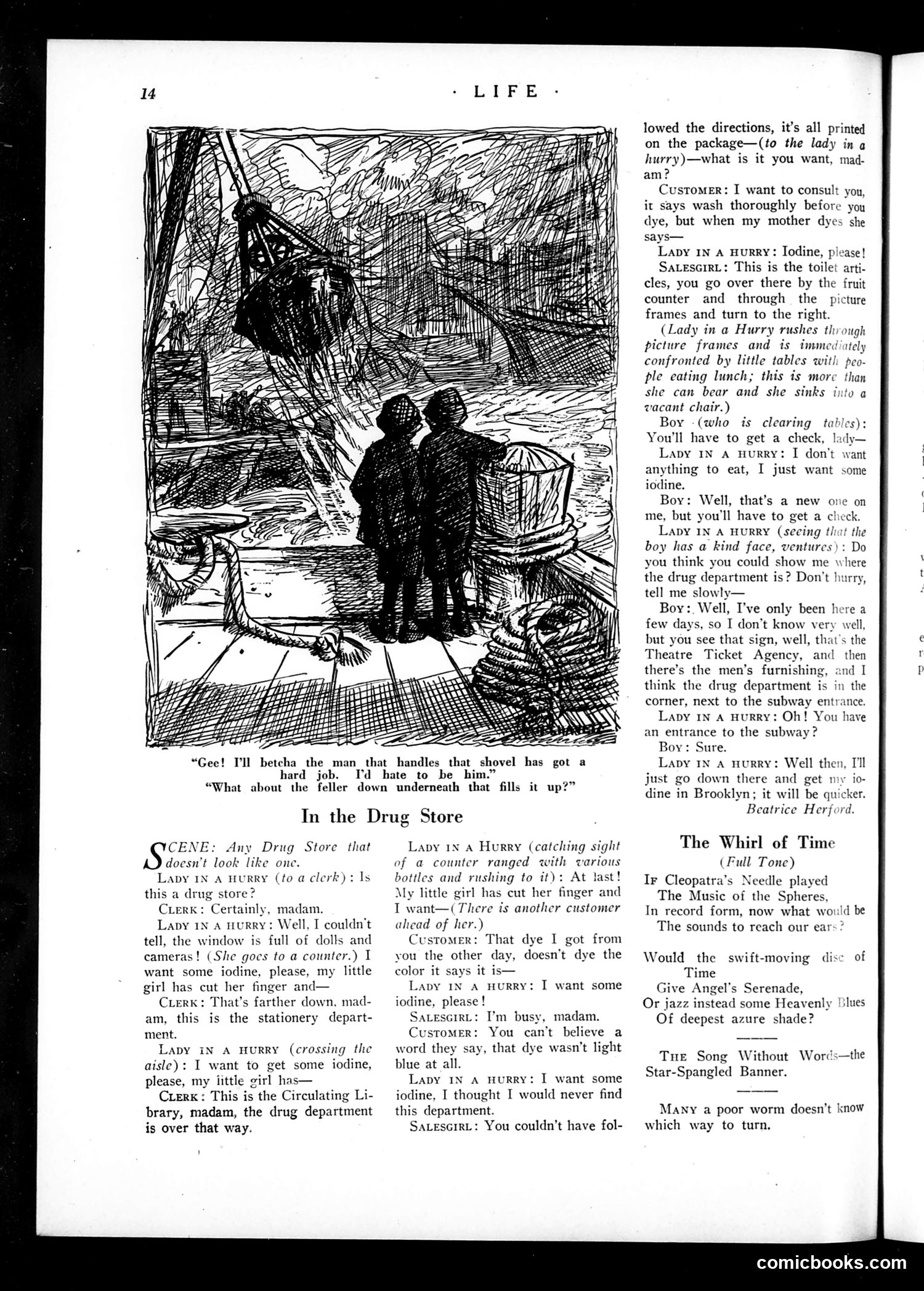
This humorous sketch depicts a common urban scenario: a hurried woman asking a drugstore clerk for iodine while another customer seeks directions to the drug department. The satire targets the absurdity of modern city life—specifically drugstore confusion and inefficiency. The "Lady in a Hurry" represents the impatient urban customer, while the Boy represents a lost newcomer. The joke's structure plays on miscommunication: customers navigate confusing store layouts, salesgirls are busy, and simple transactions become convoluted ordeals. The accompanying woodcut illustration shows silhouettes of figures in what appears to be a cramped, chaotic drugstore interior, emphasizing the crowded, bewildering nature of urban shopping. This reflects early 20th-century satire of modern consumer culture's inefficiencies and absurdities.
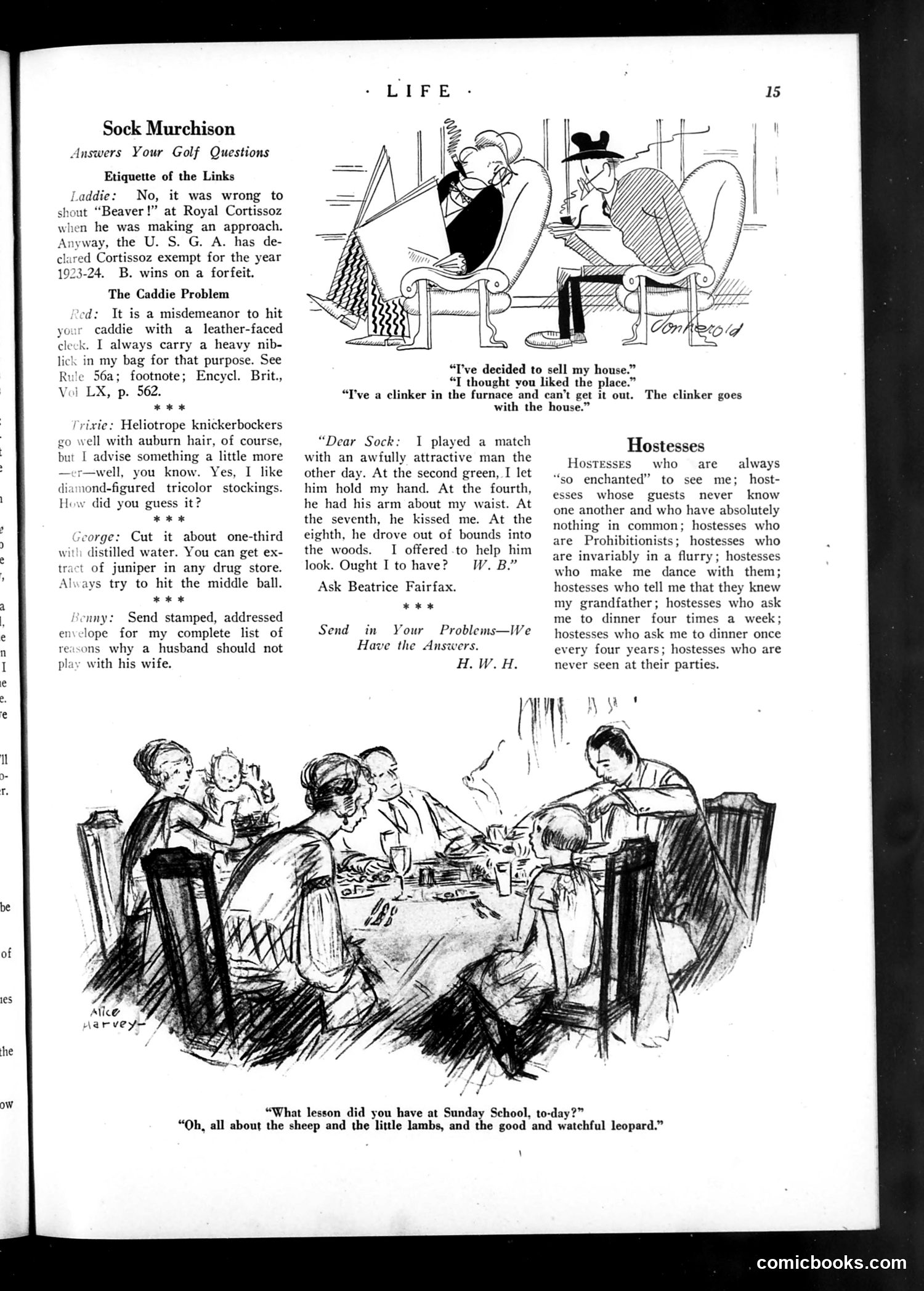
This page contains **humorous advice columns and cartoons** satirizing American social conventions circa the 1920s. **Sock Murchison's Golf Column** offers absurdist "etiquette" answers—joking that one can hit a caddie with a club, or that juniper (alcohol) helps golf. This mocks both golf's fussy rules and Prohibition-era drinking culture. **The top cartoon** shows a couple discussing selling their house solely because of a furnace clinker—trivial domestic complaints driving major life decisions. **"Hostesses"** satirizes social-climbing affectation: the column catalogs types of tedious, pretentious, or inconsistent hostesses—those who brag about knowing grandfather, invite guests who don't know each other, or vanish from their own parties. It mocks upper-class dinner-party culture. **The bottom cartoon** shows a child reporting Sunday School involved "sheep and little lambs, and the good and watchful leopard"—likely a child's confused retelling of Biblical lessons, mocking both religious instruction and parental disconnection from what children actually learn. The page's humor targets **manners, Prohibition hypocrisy, social pretension, and family life**.
This page contains two satirical political essays rather than traditional cartoons. The first piece, by R. Daugherty, analyzes President Warren G. Harding's suitability for reelection. Daugherty argues Harding is "suitable" precisely because he makes leadership seem unimportant—a backhanded compliment suggesting the post-WWI period requires minimal executive direction. The essay sarcastically praises Harding's temperament: he's friendly, unbored, and handles golf outings well. Daugherty implies Harding's actual weakness (ineffective leadership) could become a liability if circumstances change and strong leadership becomes necessary again. The second piece praises recently deceased Syracuse University Chancellor James R. Day, celebrating his unapologetic capitalist convictions and business-building approach. The tone is affectionate but gently mocking—Day is praised for being "pleasant" despite holding ideas "easy subjects for derision." Both essays employ Life's characteristic satirical approach: praising subjects with qualifications that subtly undermine them, using irony to critique both weak political leadership and unexamined faith in business authority.
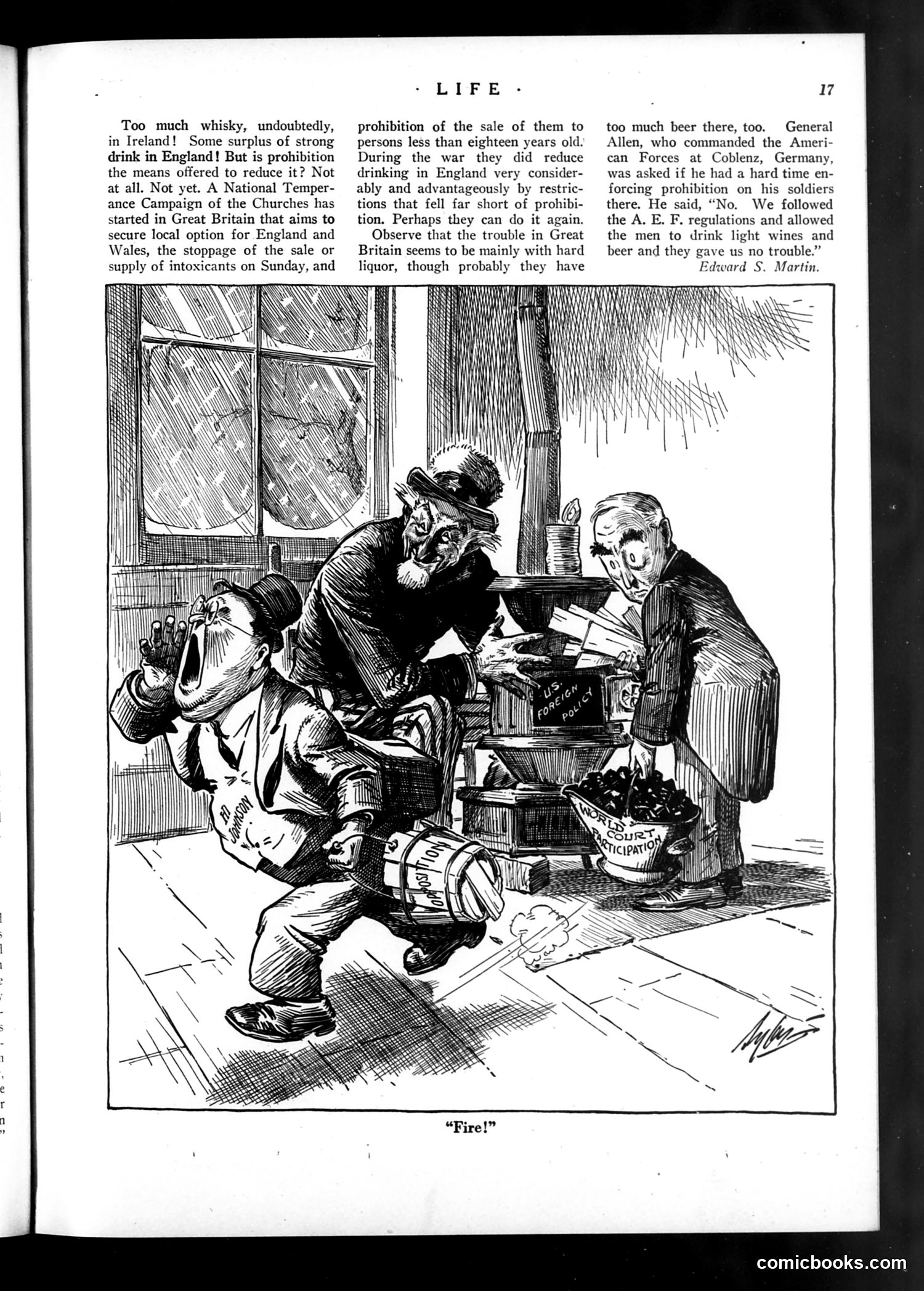
This satirical cartoon illustrates the debate over alcohol prohibition in post-WWI Britain and America. The image shows three figures—appearing to represent British temperance reformers or politicians—discovering barrels labeled with prohibition-related terms, with one figure exclaiming "Fire!" in alarm. The accompanying text by Edward S. Martin discusses a Church-led temperance campaign in Great Britain advocating for local option laws and Sunday sales bans. Martin notes that wartime restrictions (without full prohibition) successfully reduced drinking in England, and cites American General Allen's experience allowing soldiers light wines and beer without discipline problems. The cartoon's satire suggests that zealous prohibitionists are "raising an alarm" over alcohol—treating it as an urgent crisis requiring drastic measures—when the text implies more moderate, practical restrictions proved effective. The cartoon mocks the intensity and rigidity of the prohibition movement.
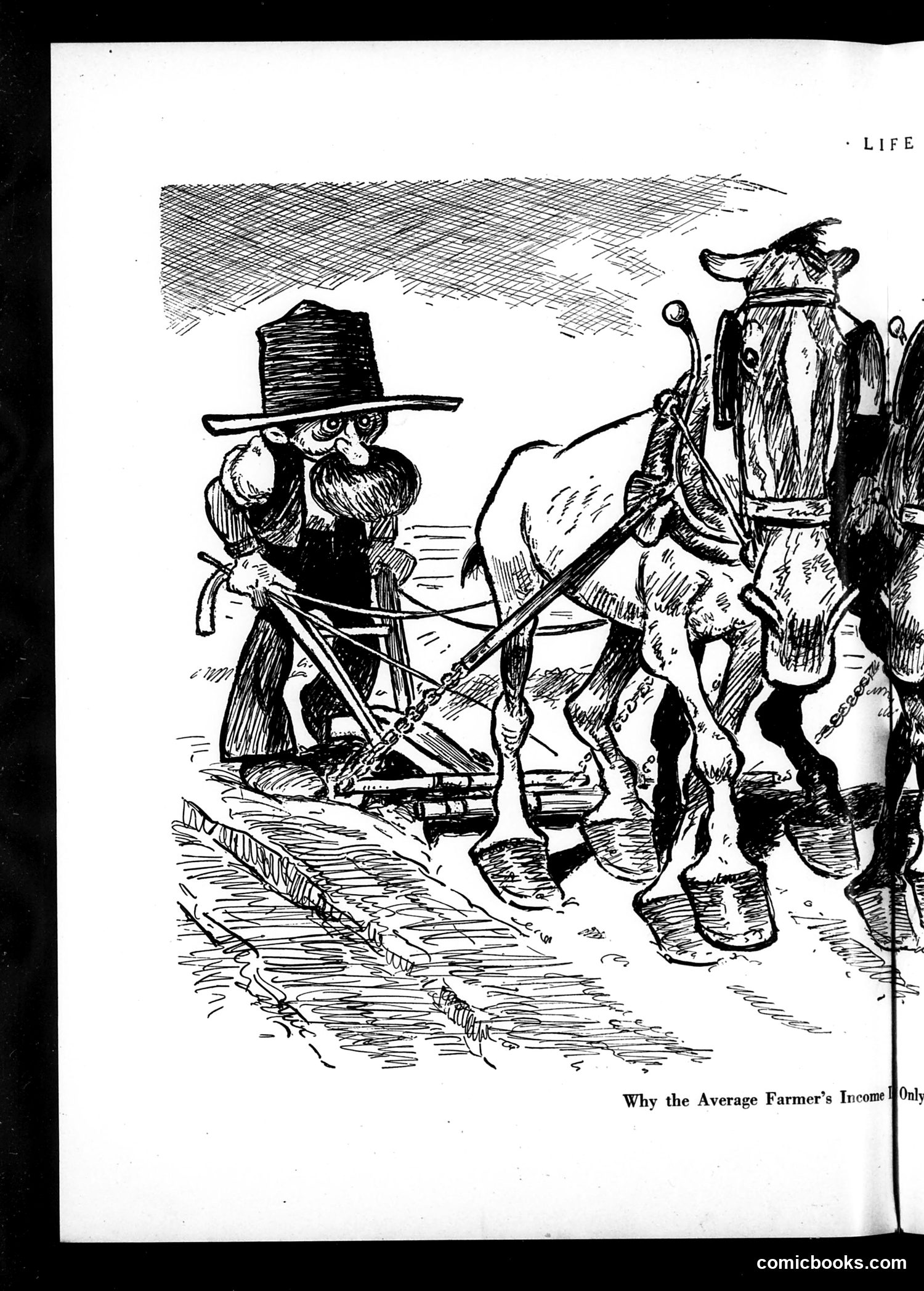
This cartoon illustrates economic hardship facing American farmers through a visual pun. A farmer, depicted with exaggerated features and wearing a wide-brimmed hat, struggles to plow frozen or snow-covered ground with horses. The harsh weather conditions and difficult terrain represent obstacles to agricultural productivity and income. The incomplete caption "Why the Average Farmer's Income Only" suggests the cartoon answers the question of why farmers' earnings were limited—the implication being environmental challenges, poor conditions, or labor-intensive work with minimal returns. This reflects early-20th-century concerns about agricultural economics and rural poverty in America. The satirical tone mocks the farmers' predicament while commenting on systemic economic inequalities.
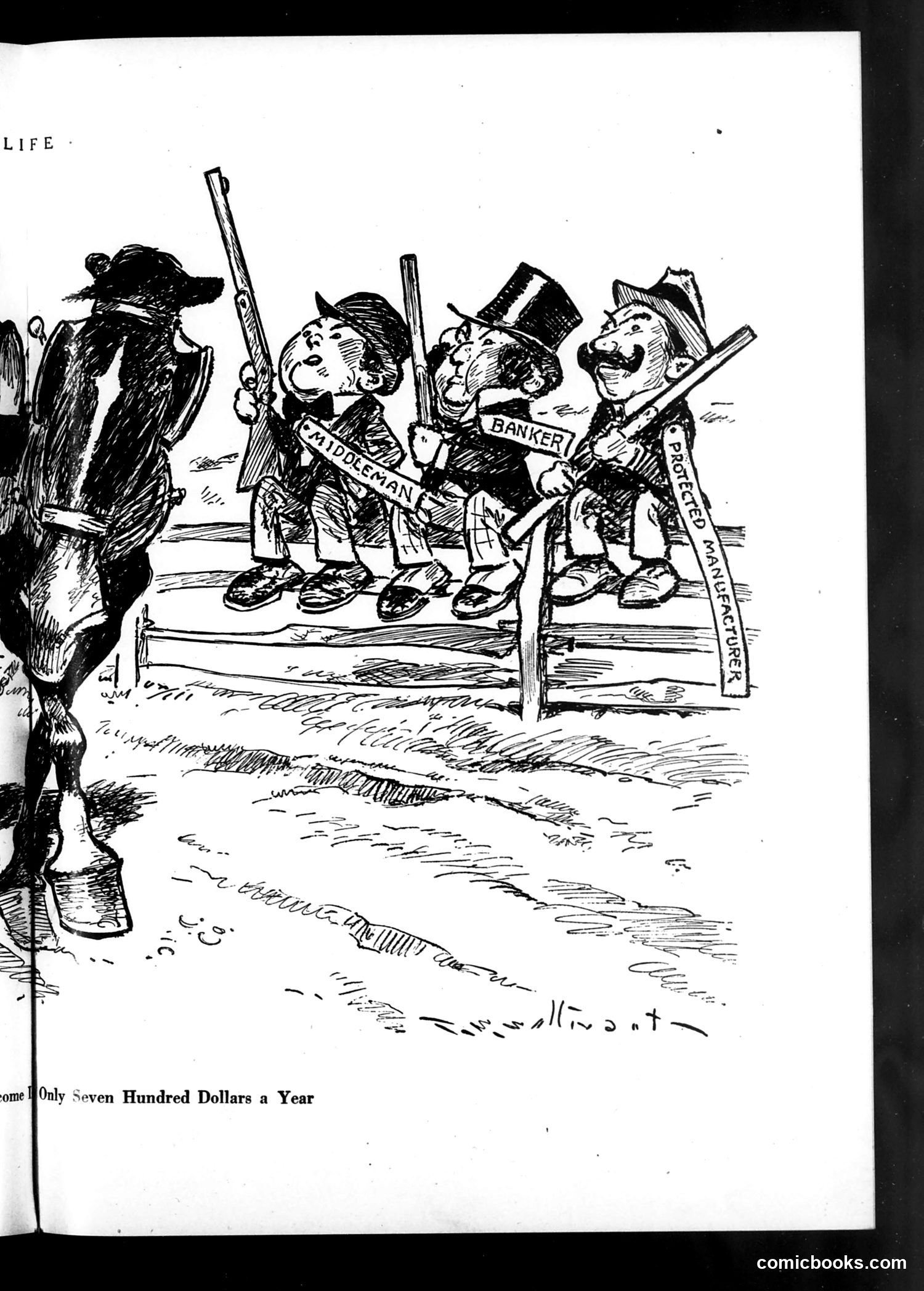
This political cartoon depicts three figures labeled "MIDDLEMAN," "BANKER," and "PORCUPINE MANUFACTURER" firing rifles at a vulture on the left. The caption reads "Only Seven Hundred Dollars a Year." The satire appears to critique how various middlemen and financial interests profit from workers earning meager wages—only $700 annually. The vulture likely represents either poverty, exploitation, or death itself, which these profiteers are supposedly fighting. However, the irony suggests they're actually complicit in the system that keeps workers impoverished while they enrich themselves through financial manipulation and manufacturing. This reflects early-20th-century American labor and economic reform debates about income inequality and profiteering.
This page contains theater reviews, not political cartoons. The ornamental "DRAMA" header is decorative. The main content critiques actor **Lionel Atwill's** deteriorating performance style in the play "The Comedian" by Sacha Guitry. The reviewer argues Atwill has become an excessive, affected "ham" actor—overacting emotionally and mugging to the audience. A specific scene is mocked: Atwill's exaggerated facial expressions (pain, anger, bitterness, sneeze-like expression) when his character's wife leaves. The review also criticizes director **David Belasco** for instituting what the critic calls "Russian technique"—having actors make grand entrances, shout at audiences, and perform pantomime unnecessarily. This exaggerated style is presented as ridiculous rather than sophisticated. A second review briefly praises another Guitry play, "Pasteur," starring Henry Miller, as superior to "The Comedian" despite its episodic structure. The satire targets theatrical excess and affected acting styles of the 1920s era.
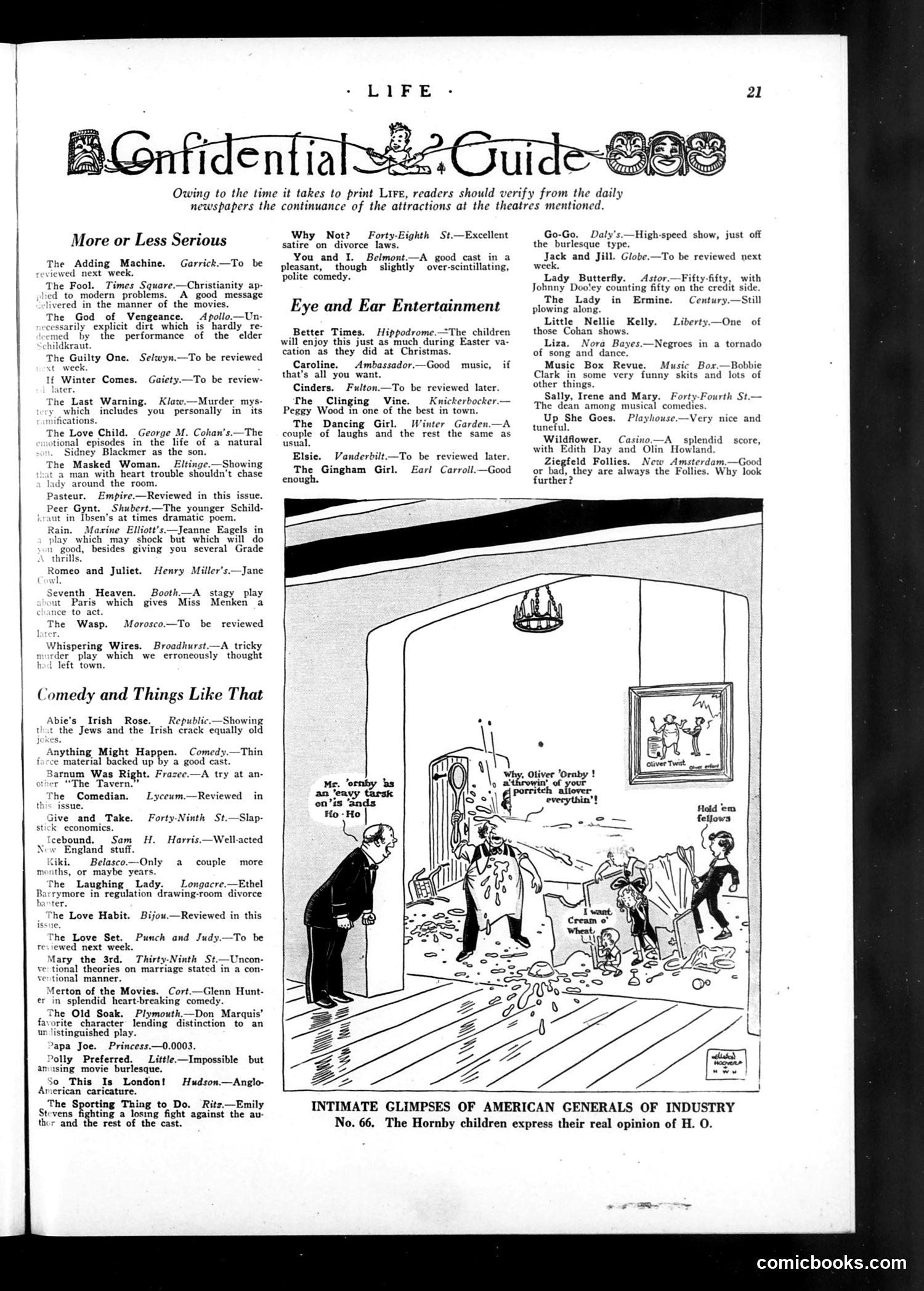
This single-panel cartoon satirizes wealthy industrialists' parenting styles and domestic life. The caption labels it "No. 66," suggesting it's part of a recurring series mocking powerful businessmen. The scene depicts an older gentleman (representing a wealthy "general of industry") observing chaos in a nursery—children destroying furniture, throwing toys, and creating mayhem. The caption quotes him expressing concern about one child's behavior toward "H.O." (likely a household servant or employee). The satire's point: wealthy industrialists who ruthlessly control their business empires are comically helpless against their own children's misbehavior. It suggests hypocrisy—these men demand order and obedience in their companies but cannot manage their own households. The cartoon mocks both the industrialists' loss of control and, implicitly, American wealth and privilege during this period.
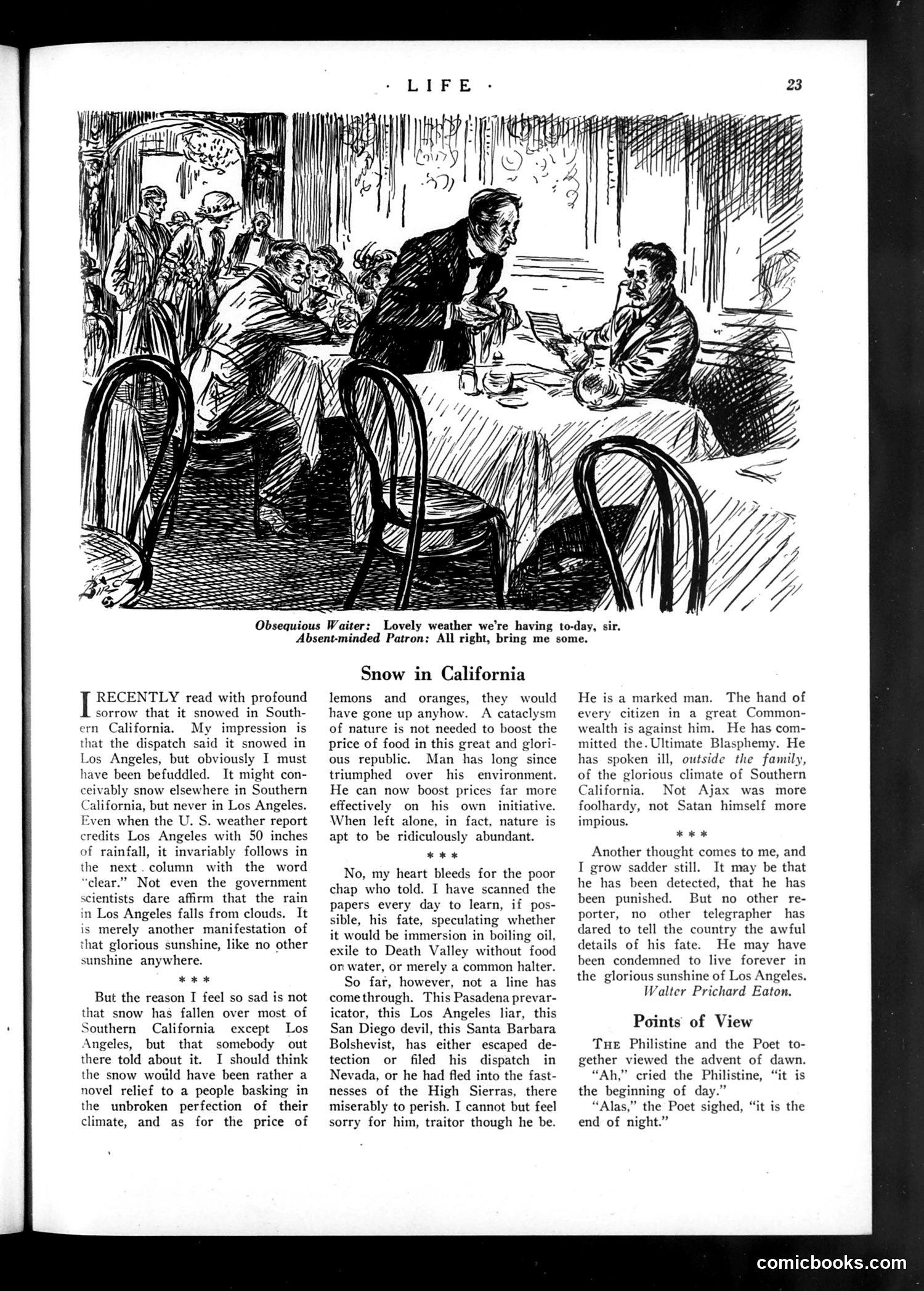
**The Cartoon:** A waiter offers a distracted customer food; the customer, mishearing "weather," asks the waiter to bring him "some" weather. It's a simple pun-based visual joke about inattention. **The Main Article:** Satirist Walter Prichard Eaton mocks Southern California's obsessive pride in its perfect climate. He ironically suggests that reporting snow in the region is a grave betrayal—worse than treason. The piece uses exaggerated outrage to critique the region's boastfulness and its citizens' defensive reaction to any criticism of their weather. **Historical Context:** This reflects early 20th-century California boosterism, when the state aggressively promoted its climate as paradise to attract settlers and investment. Any negative reports were treated as threats to this marketing narrative. **"Points of View":** A brief philosophical joke contrasting a practical person's optimism ("beginning of day") with a poet's melancholy ("end of night")—two perspectives on identical reality.
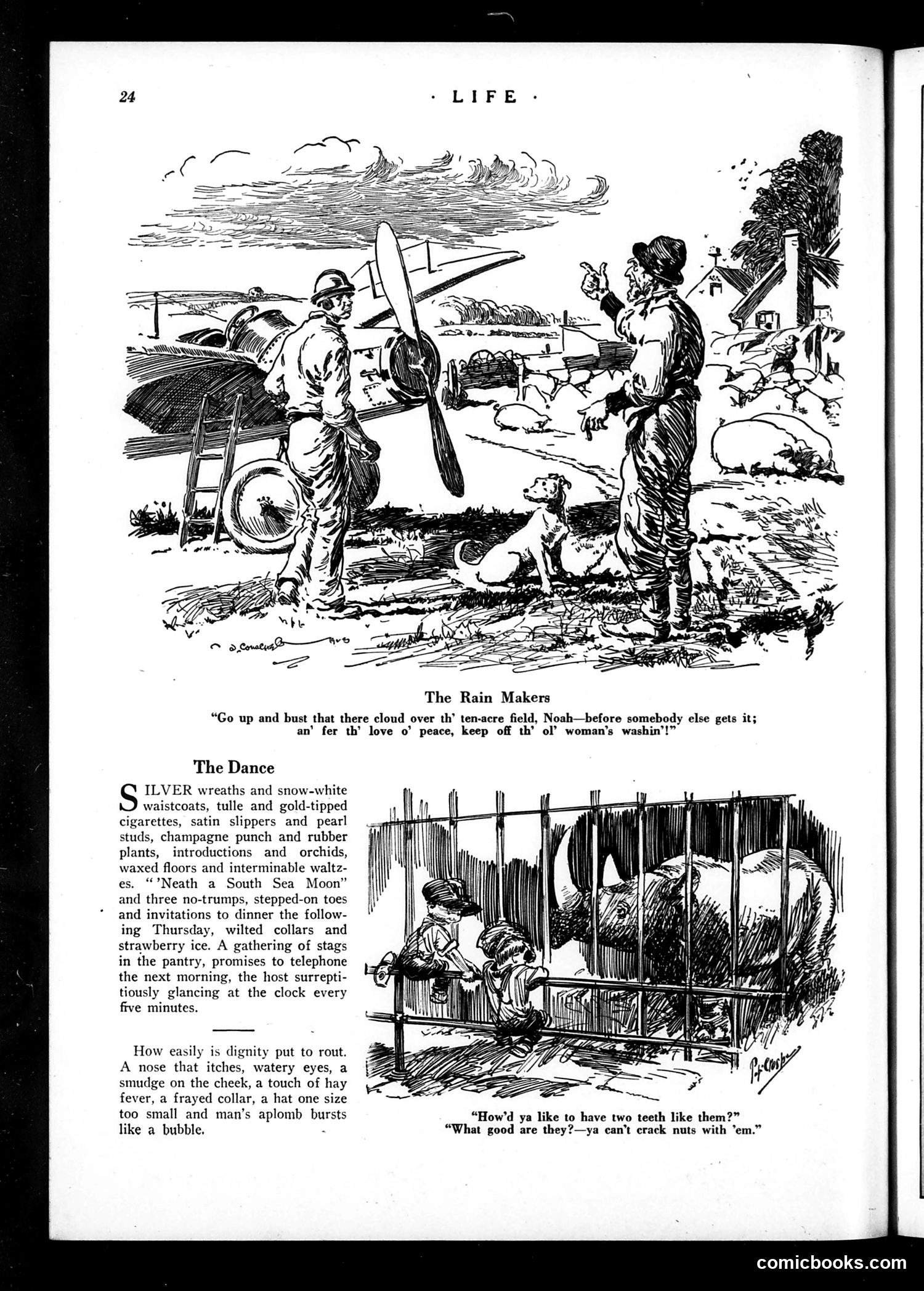
**"The Rain Makers"** depicts rural farmers discussing cloud-seeding—a real agricultural practice of the era. The humor lies in the colloquial dialect ("th' ten-acre field," "th' ol' woman's washin'") and the competitive scramble among farmers to claim weather-making technology before neighbors do. The joke satirizes both rural speech patterns and the desperation of agricultural communities dependent on unpredictable rainfall. **"The Dance"** contrasts elegant high-society formality with human indignity. The text catalogs luxurious details (silver wreaths, champagne, waltzes) before revealing how easily dignity collapses—itchy noses, watery eyes, ill-fitting hats. The accompanying cartoon shows two working-class men examining teeth, with one unable to crack nuts with them. The satire mocks pretentious sophistication while suggesting that all social classes ultimately succumb to physical discomfort and awkwardness.

This is primarily a **product advertisement**, not satire or political commentary. It promotes Republic Tires' "Grande Cords" brand to car owners. The page features an isometric illustration showing various automobiles and a loading platform, demonstrating Republic's manufacturing and distribution process. The text emphasizes quality control: engineers design the tires, skilled workmen build them using "highest grade materials," and only certified dealers meeting strict service requirements can sell them (identifiable by an "Eagle Sign"). The advertisement claims Republic Grande Cords are "the world's finest tires," backed by "comparative tests." It highlights the "Silent Non-Skid Staggard Studs" as superior traction technology. This reflects 1920s-era advertising strategy: establishing brand prestige through claims of engineering excellence, quality materials, expert craftsmanship, and authorized dealer networks—reassuring consumers about a product they couldn't easily evaluate themselves.
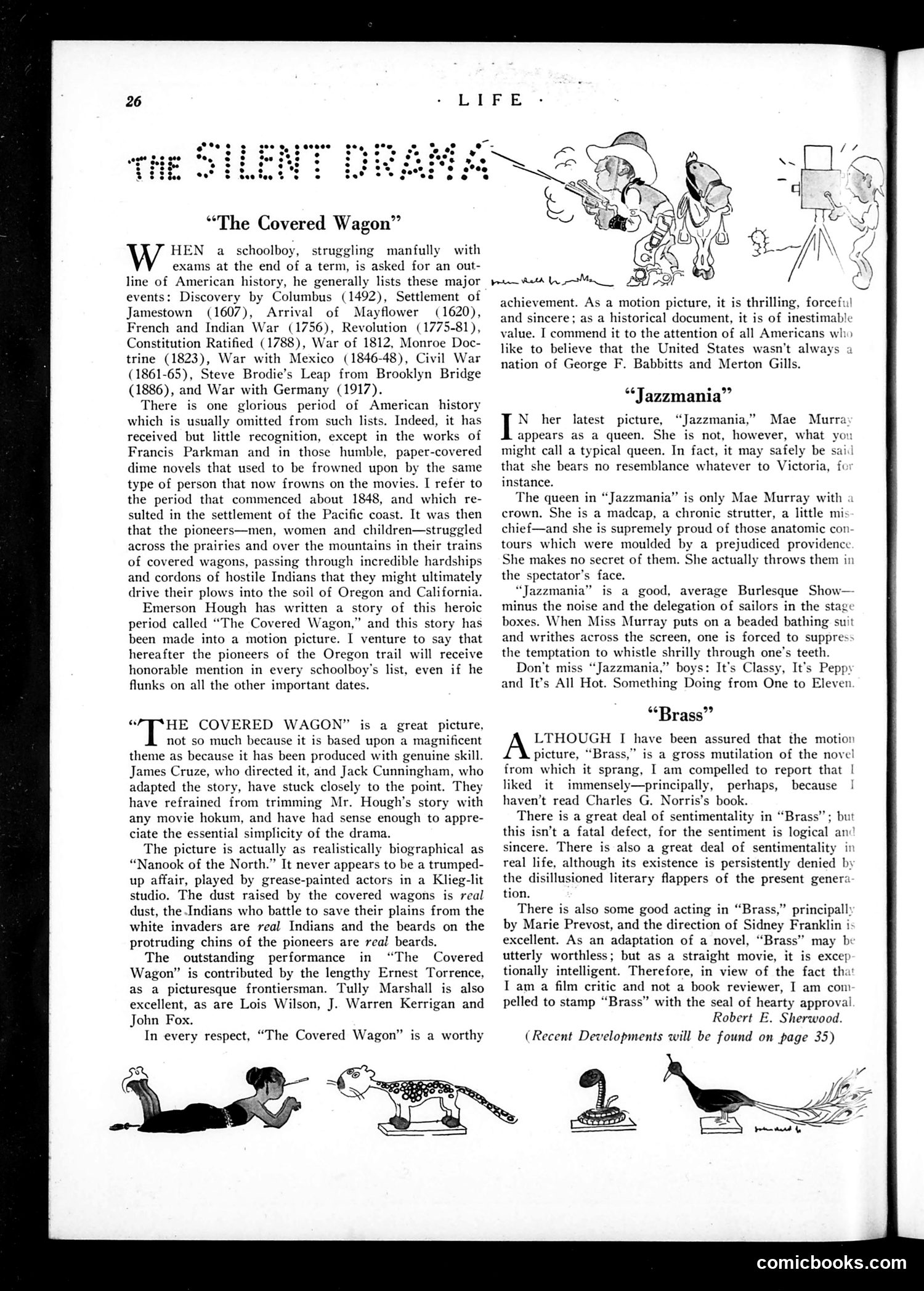
This page reviews three 1920s silent films. **"The Covered Wagon"** receives high praise as a historically significant picture about westward expansion on the Oregon Trail—notably absent from typical schoolboy history lessons. The reviewer commends director James Cruze for authentic filmmaking: real dust, real Native Americans, genuine beards. He argues it will elevate pioneer history to importance alongside Columbus and the Civil War. **"Jazzmania"** features Mae Murray as a scandalous "queen" who is essentially a vain, strutting showgirl proud of her body. The review dismisses the film as average burlesque with crude humor. **"Brass"** receives mixed assessment—sentimental and somewhat worthless as literature, yet competently made with good acting by Marie Prevost. The reference to "George F. Babbits and Merton Gills" (Sinclair Lewis's satirical businessman character) suggests contemporary anxieties about American materialism and shallow values.
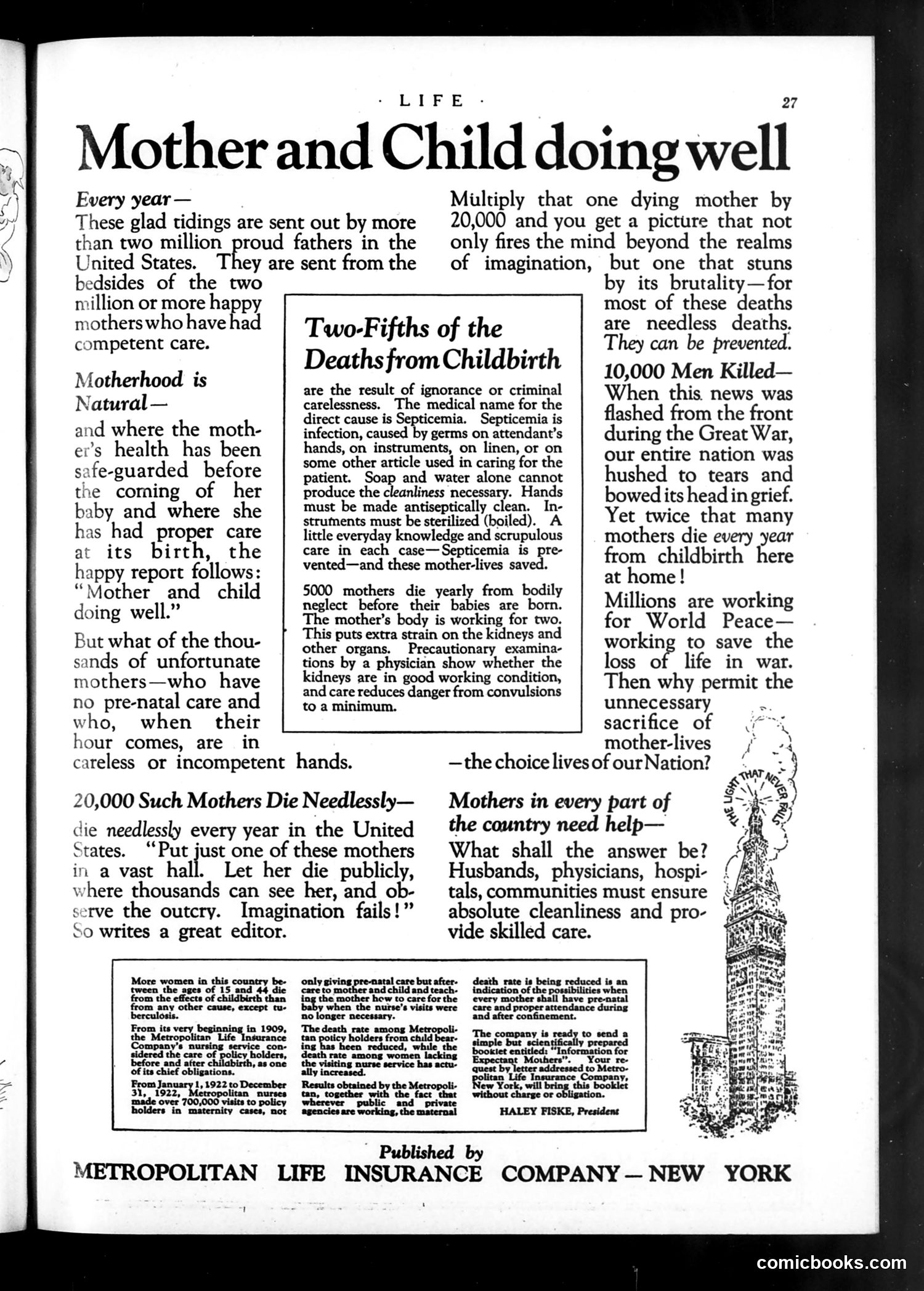
This is **not a cartoon or satire**, but a serious public health advertisement from Metropolitan Life Insurance Company. The page uses stark statistics and emotional rhetoric to advocate for improved maternal healthcare. The core argument: While 2 million American births annually are celebrated with "Mother and child doing well," approximately **20,000 mothers die needlessly** from childbirth complications, primarily septicemia (infection from poor hygiene during delivery). The text compares this staggering loss to wartime casualties—noting twice as many mothers die yearly at home as American soldiers died in the entire Great War—to shame readers into action. The piece targets husbands, physicians, and communities, demanding they ensure antiseptic conditions, prenatal care, and skilled attendance. The boxed section explains that two-fifths of childbirth deaths result from "ignorance or criminal carelessness"—preventable through basic cleanliness and medical oversight. This reflects early-20th-century public health advocacy, when maternal mortality remained a leading cause of women's death. The insurance company positions itself as a concerned institution offering free educational materials ("Information for Mothers").
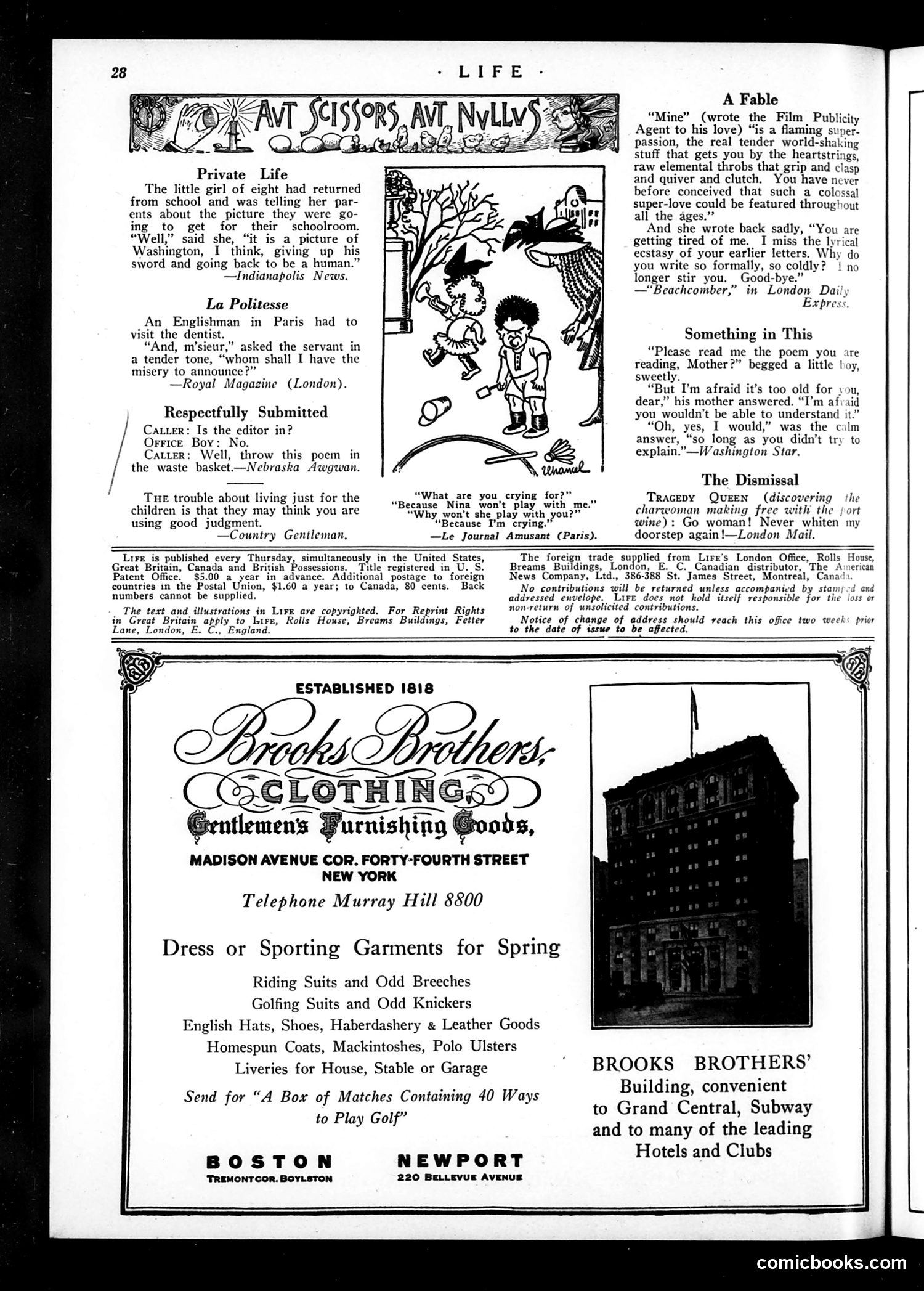
This page from Life contains six brief satirical anecdotes targeting social pretension and human folly, plus advertising. **Key pieces:** - **"Private Life"**: A child innocently describes Washington "giving up his sword and going back to be a human"—satirizing the gap between historical myth and ordinary personhood. - **"La Politesse"**: A French servant's formal question about whom to announce to the dentist mocks overwrought politeness. - **"A Fable"**: A film publicist's inflated romantic language ("flaming super-passion") contrasts with his lover's complaint that he's grown cold and formal—satire on Hollywood's shallow theatricality and how grandiose language masks indifference. - **"Something in This"**: A boy's request that his mother *not* explain a poem jokes that explanation ruins understanding. - **"The Dismissal"**: A lady discovers her charwoman drinking her port wine—social comedy about class boundaries. These are typical Life magazine humor pieces: short, cynical observations about pretension, hypocrisy, and human nature. The Brooks Brothers advertisement occupies the lower half.
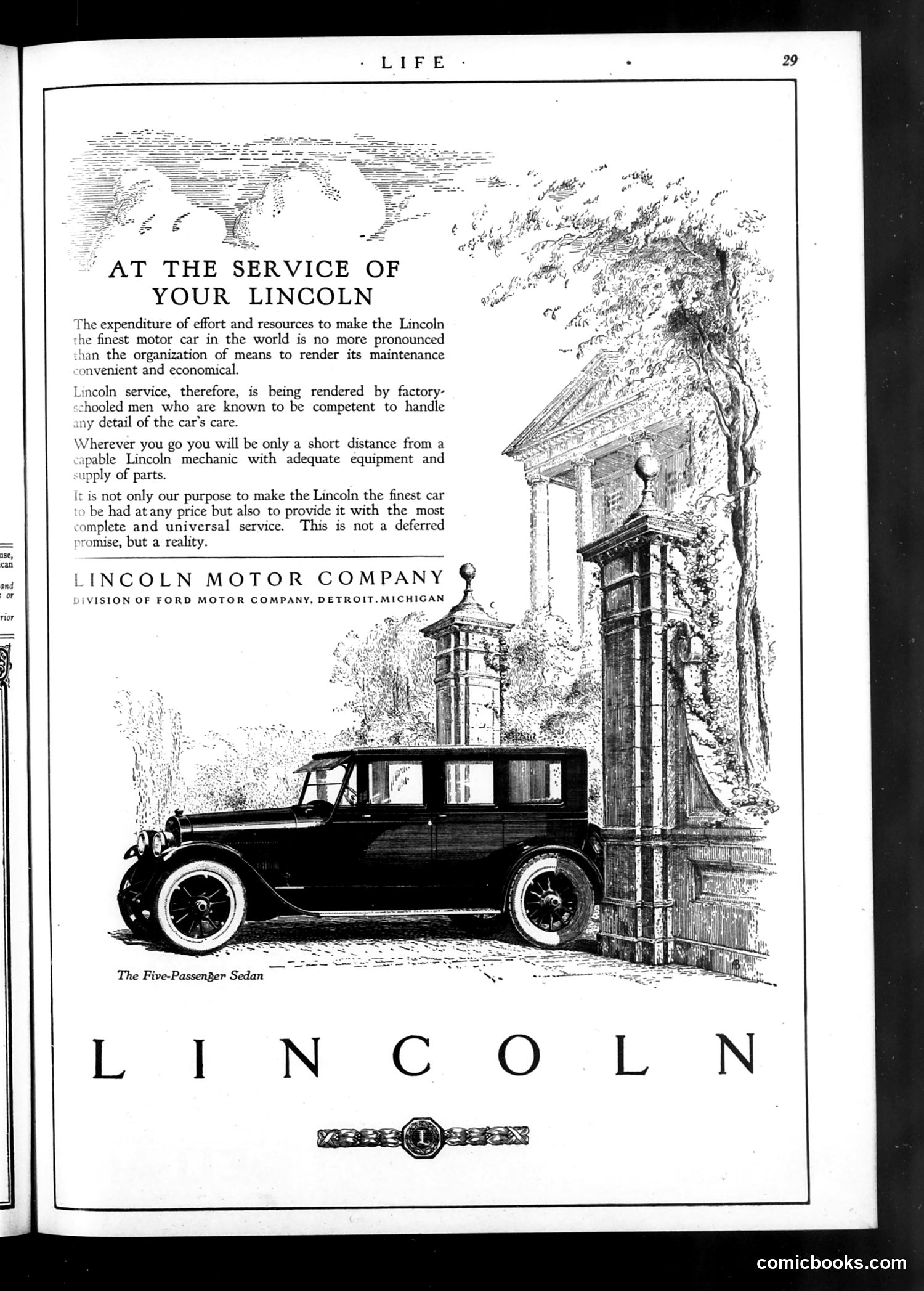
This is a **full-page advertisement**, not a political cartoon or satire. It promotes the Lincoln automobile (a luxury brand owned by Ford Motor Company) to readers of *Life* magazine. The ad emphasizes Lincoln's service network—a key selling point for early automobiles when reliable mechanics were scarce. The text promises that owners can find trained Lincoln mechanics "wherever you go," with proper equipment and parts available. The illustration shows a Five-Passenger Sedan parked beside a classical colonial building, evoking wealth, stability, and American prestige. This appeals to *Life's* affluent readership. There is **no satire or political commentary** here—this is straightforward luxury car marketing from the 1920s era, emphasizing both the product's quality and the manufacturer's commitment to customer support and maintenance, which were genuine competitive advantages at the time.
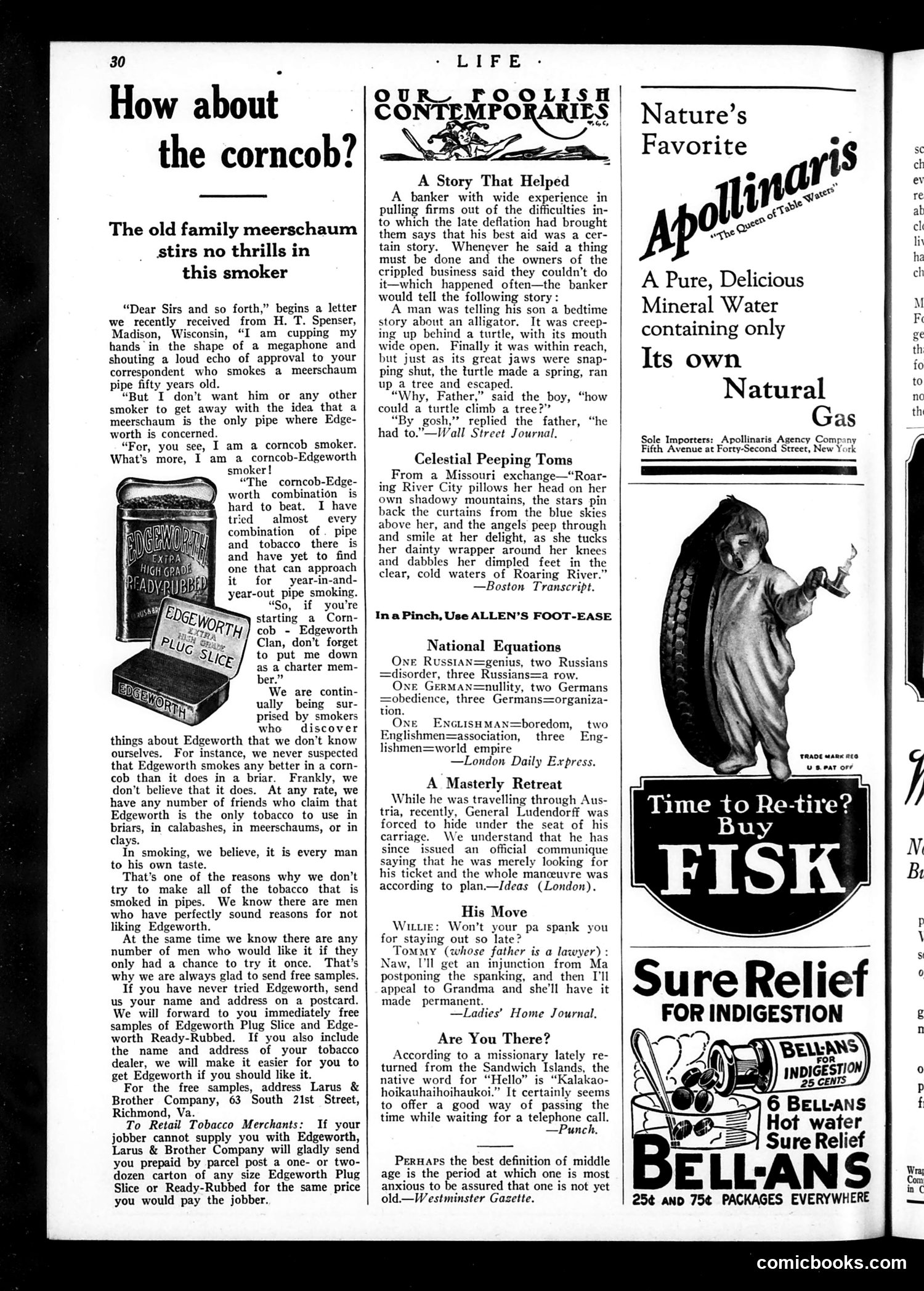
This page is primarily **advertising and reader correspondence** for Edgeworth pipe tobacco, with some satirical filler content. **Main Content:** A letter from a reader praising Edgeworth tobacco in corncob pipes. The publisher responds philosophically that tobacco quality is subjective—they don't claim superiority and offer free samples to curious smokers. **Satirical Sections ("Our Foolish Contemporaries"):** - A banker's anecdote about impossible problems: a turtle escaping an alligator by climbing a tree. The joke is about motivation overcoming logic—when business owners claim something "can't be done," the banker reminds them the turtle did it anyway. - A flowery, overwrought description of a river landscape using purple prose ("dainty wrapper," "dimpled feet"), mocking sentimental writing style. **Context:** This reflects early 20th-century advertising strategy—using reader testimonials and gentle humor to build brand loyalty. The satirical sections are brief filler between ads, typical of Life's format.
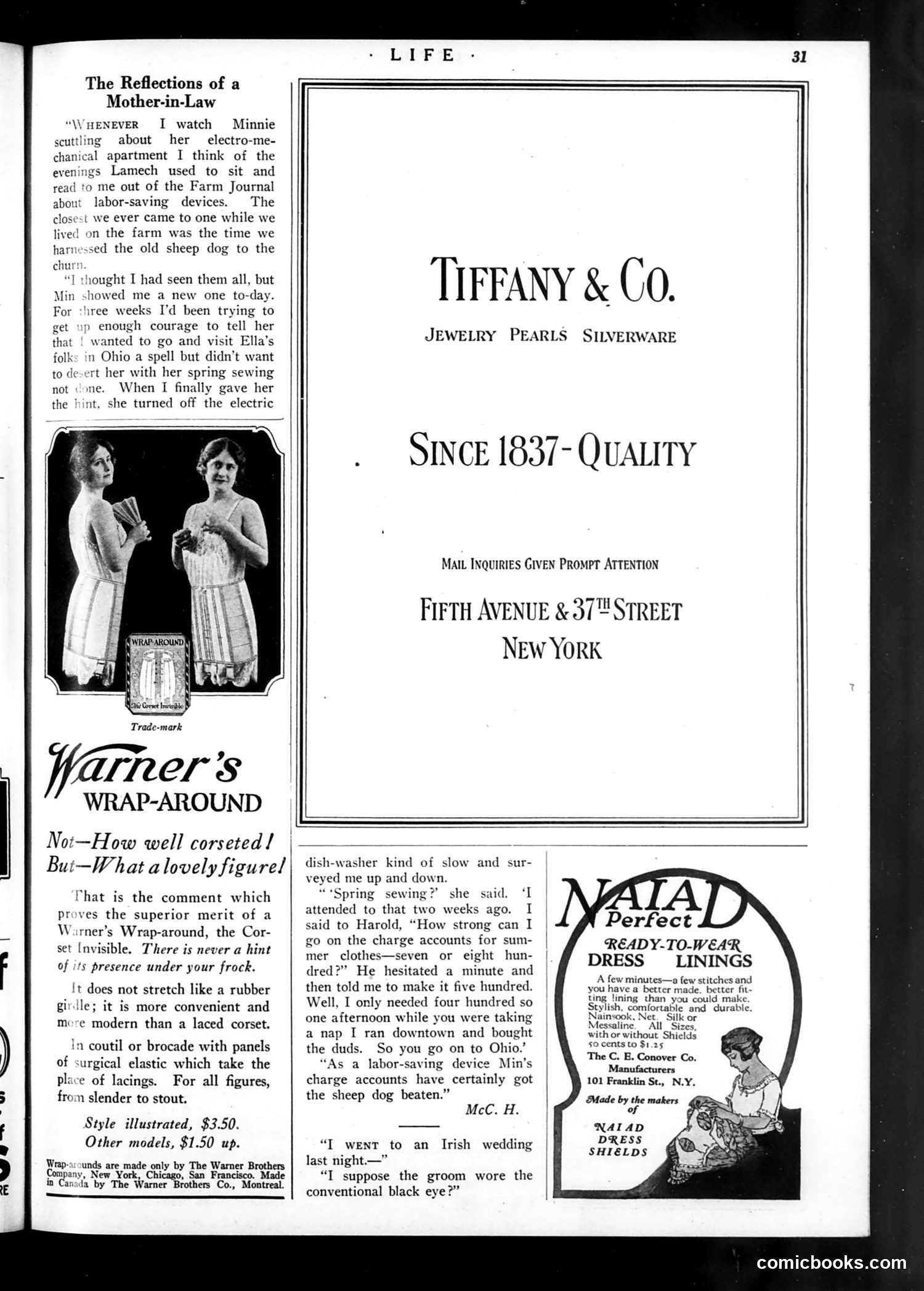
This page is primarily **advertising with a satirical column**. The main content is "The Reflections of a Mother-in-Law," a humorous monologue by a rural mother-in-law observing her modern, urban daughter-in-law Minnie's life. **The Satire:** The joke contrasts old-fashioned farm values with early-1900s consumer culture. The mother-in-law marvels at labor-saving devices like electric appliances, yet notes that Minnie's greatest "labor-saving device" is her ability to charge purchases—she spent money on clothes without asking permission, justifying it as efficiency. The final line ("the sheep dog beaten") implies Minnie's financial independence surpasses even practical farm innovations. **Social Context:** This gently mocks the emerging consumer economy and women's expanding access to credit, while celebrating (somewhat sarcastically) modern conveniences replacing farmwork. The advertisements below promote women's fashion items—corsets and dress linings—typical for the era's Life magazine audience.
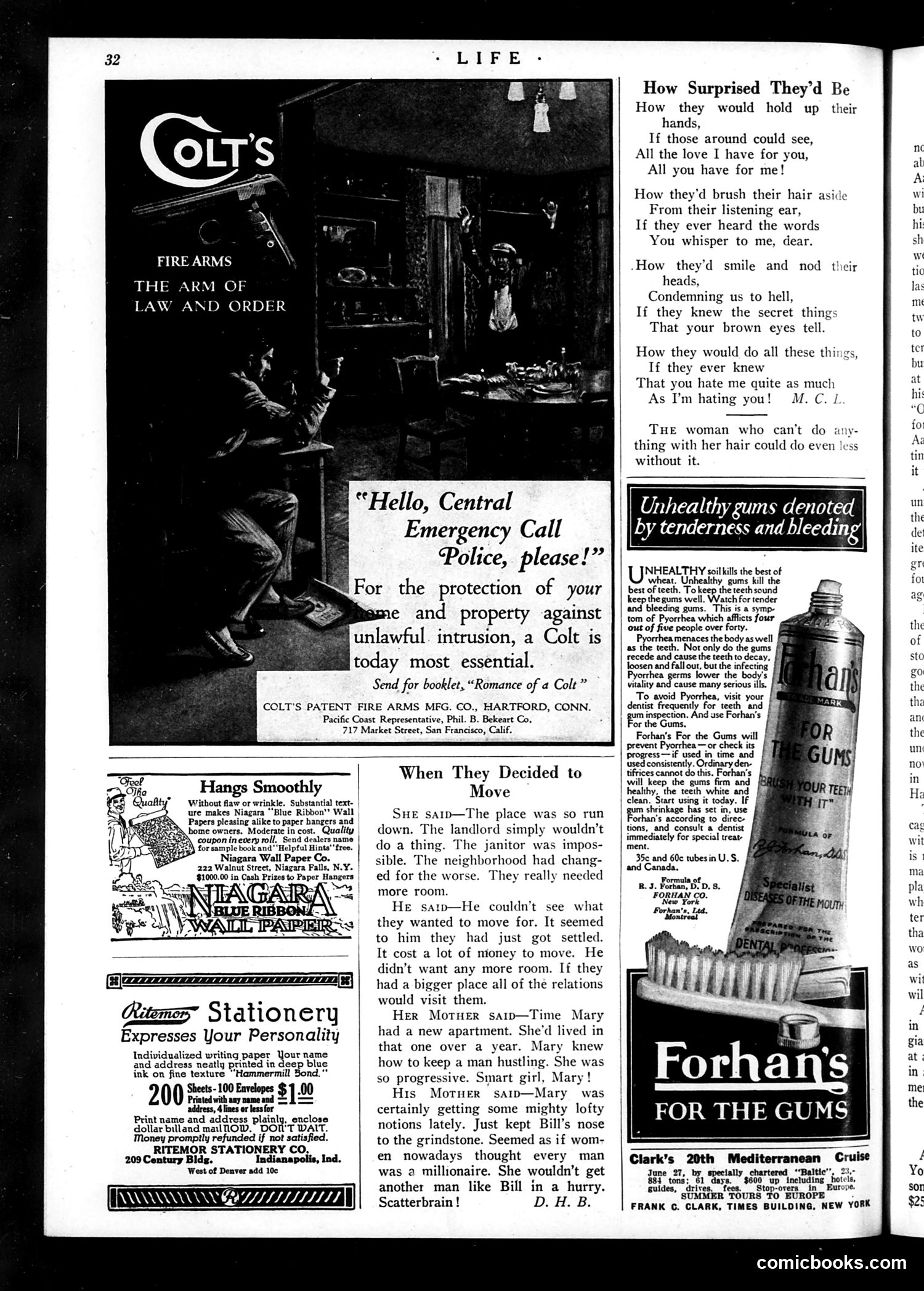
This page is primarily **advertising**, not political satire. It contains several product advertisements typical of early 20th-century magazines: **Main advertisements:** - **Colt Firearms**: Marketed as essential for home protection, with a dramatic image of police responding to an emergency call - **Niagara Wall Paper**: Promoting decorative interior products - **Ritemor Stationery**: Personalized writing paper - **Forhan's For the Gums**: Dental hygiene product warning about pyorrhea (gum disease) **Editorial content includes:** - A sentimental poem about secret love ("How Surprised They'd Be") - A humorous domestic dispute narrative ("When They Decided to Move") depicting conflicting perspectives between spouses and in-laws about relocating—a relatable social commentary on marriage disagreements - Brief observations about hair and appearance The page reflects early-1900s consumer culture and domestic life concerns, with minimal political content. The "satire" is gentle social humor rather than sharp political critique.
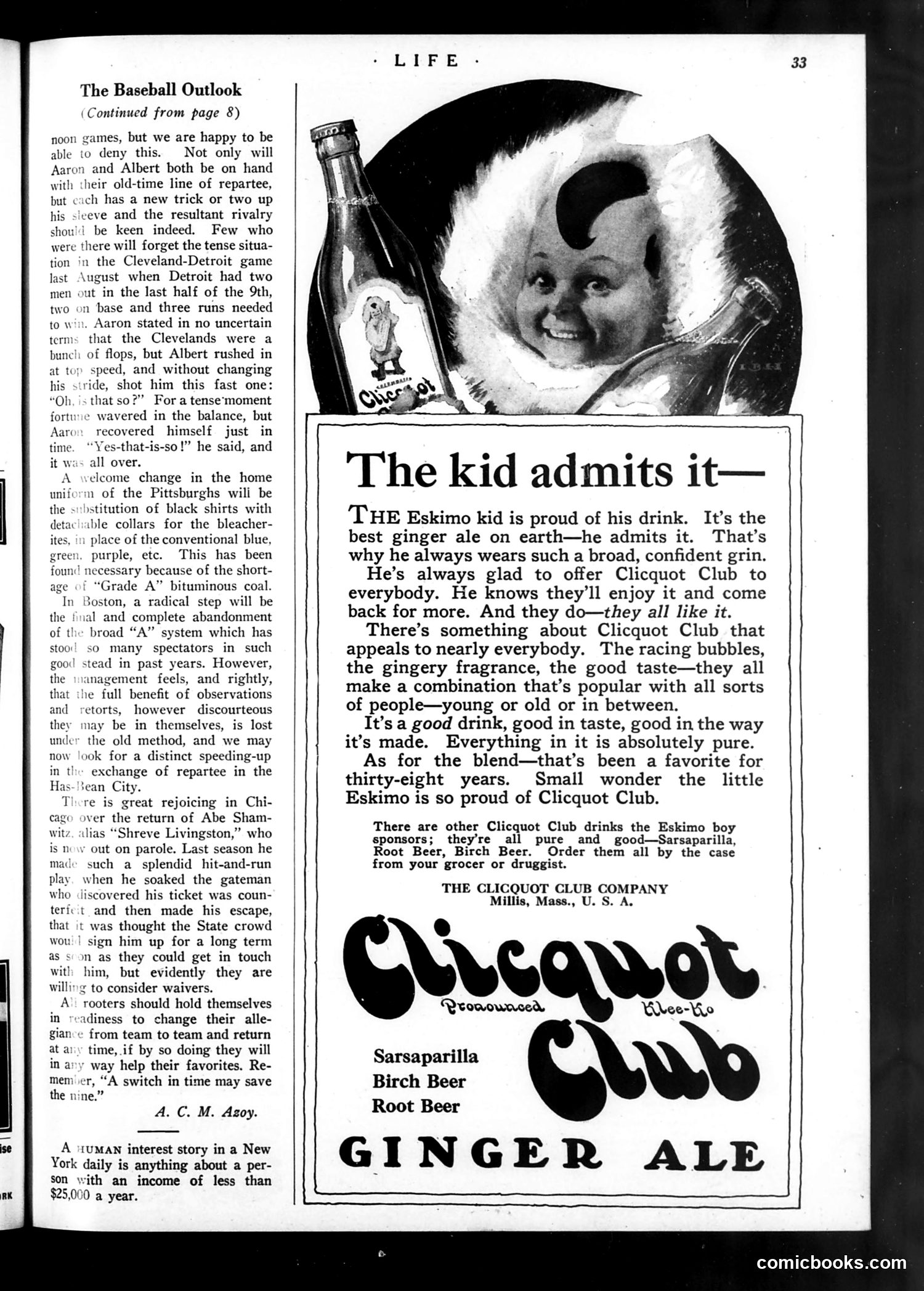
This page contains two distinct elements: a baseball commentary and an advertisement. **"The Baseball Outlook"** is sports satire describing colorful baseball personalities and upcoming season changes. It references actual players "Aaron" and "Albert" (likely old-time baseball figures) known for witty banter, and describes various teams' uniform and procedural changes—including Pittsburgh switching to black shirts due to coal shortages, and Boston abandoning its broad "A" pronunciation system to speed up game commentary. **The Advertisement** features the "Clicquot Club" brand of ginger ale, using an "Eskimo kid" character as a mascot/endorsement figure. This reflects early 20th-century advertising practices where ethnic caricatures were considered acceptable marketing. The ad emphasizes purity, taste, and product longevity (thirty-eight years of popularity), targeting broad demographics including children and families. The humor throughout reflects pre-1920s baseball culture and period advertising conventions now considered outdated or offensive.
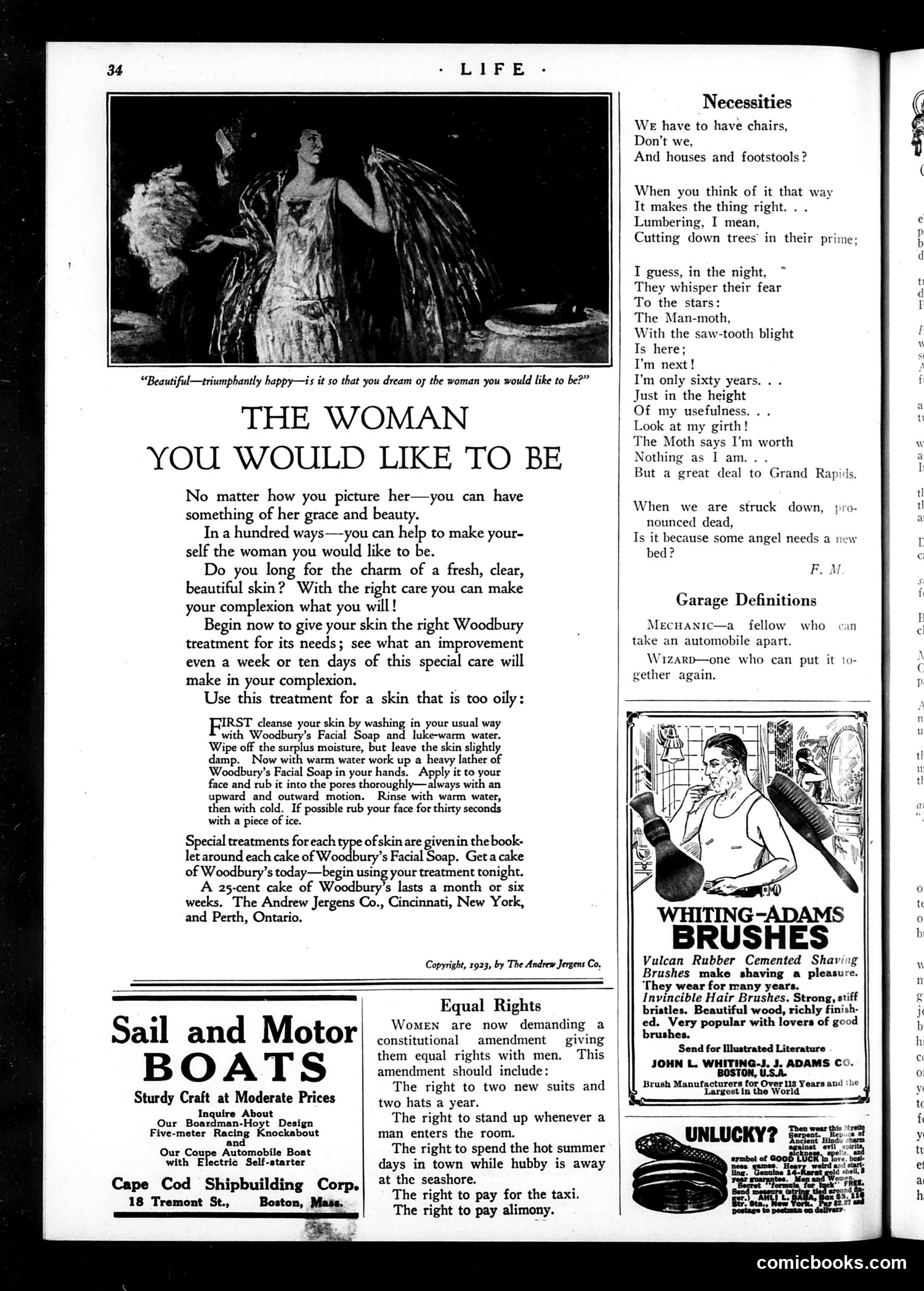
This page combines poetry satire, beauty advertising, and social commentary typical of Life's 1920s format. **The Poetry "Necessities"** satirizes industrial justification for logging. Trees "whisper their fear" as the "Man-moth" (the saw) approaches, personifying nature's perspective. The poem mocks how society rationalizes environmental destruction—trees are reduced to "usefulness" and profit for Grand Rapids (a lumber hub), dismissing their intrinsic worth. **"The Woman You Would Like to Be"** is a Woodbury Facial Soap advertisement using aspirational language about self-improvement through skincare, reflecting 1920s consumer culture targeting women's insecurities. **"Equal Rights"** presents sardonic demands women supposedly made in the suffrage/progressive era: the right to wear multiple suits, stand when men enter, vacation independently, and pay for taxis/alimony. The satire mocks women's liberation movements by presenting "equality" as trivial material desires rather than substantive rights. The page reflects 1920s attitudes: environmental exploitation justified by profit, women defined by appearance and consumption, and feminist demands trivialized as frivolous.
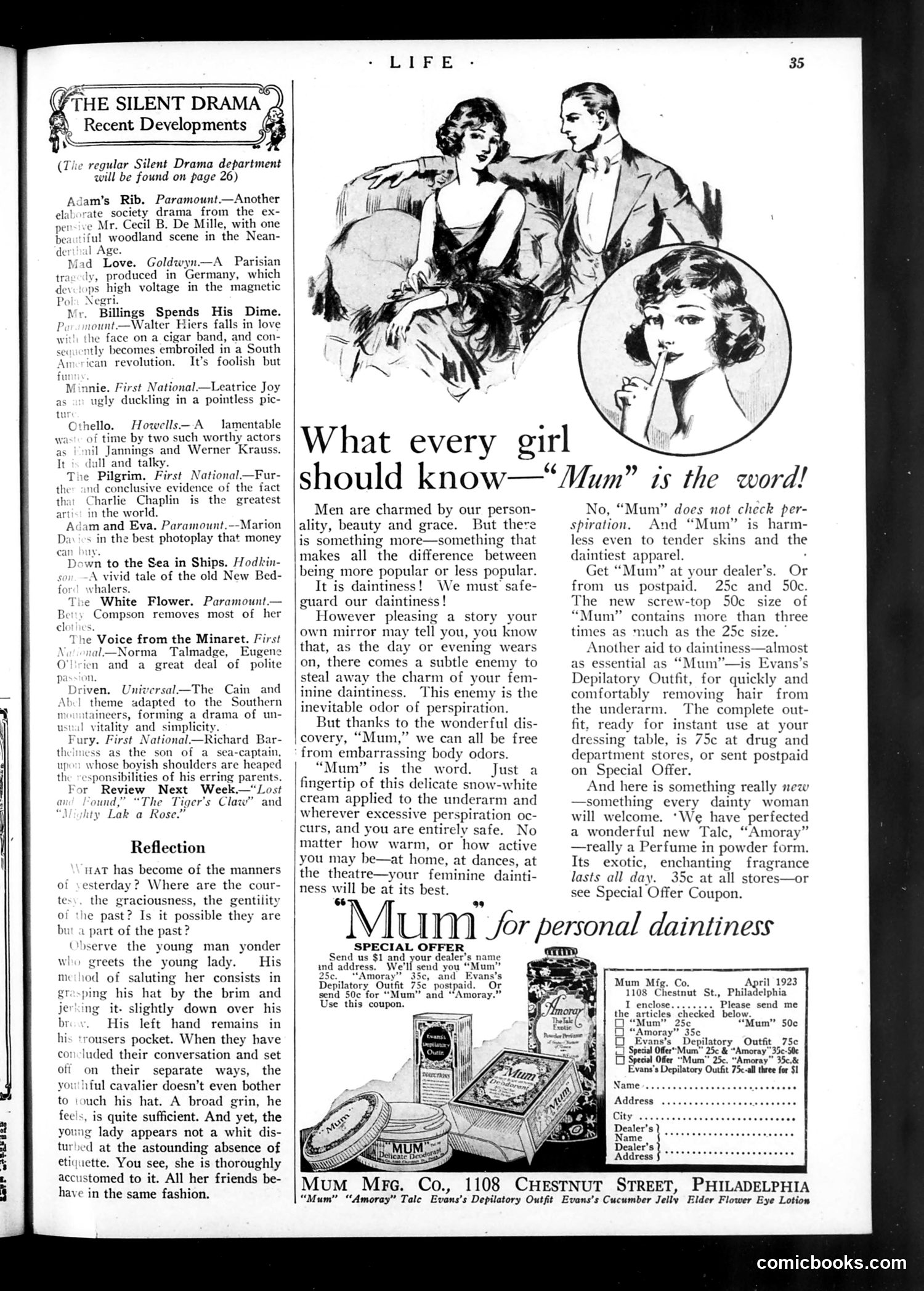
This page is primarily a **deodorant advertisement** disguised as editorial content, with a satirical social commentary section. **The "Reflection" section** (left column) satirizes modern manners by contrasting past courtesies with present informality. The joke: a young man no longer tips his hat when greeting or departing from a young lady—he merely grins—and she's so accustomed to this rudeness that she doesn't mind. The satire targets the erosion of formal etiquette in 1920s American society. **The main advertisement** (right side) for "Mum" deodorant cleverly exploits this social anxiety. The headline "What every girl should know—'Mum' is the word!" plays on the slang phrase while promoting the product as essential to feminine "daintiness." The ad warns that perspiration odor threatens one's charm and popularity, positioning deodorant as necessary for social success—a common advertising strategy that manufactures insecurity to sell products. The page reflects 1920s consumer culture and gender expectations around hygiene and attractiveness.
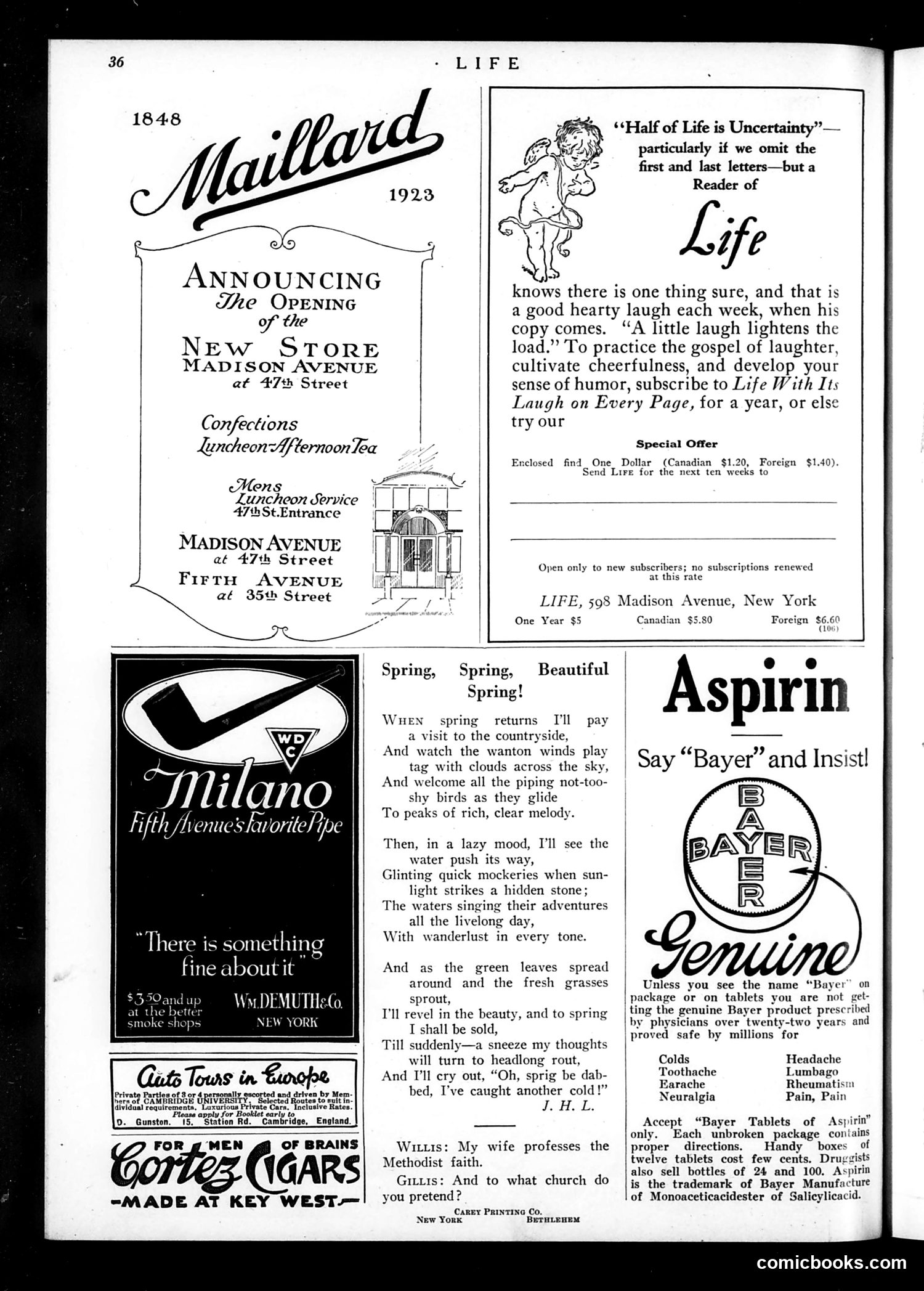
This page is primarily **advertising and self-promotion** for Life magazine itself, with several commercial ads. The main content is a **self-referential subscription pitch**: Life claims readers need their magazine for guaranteed weekly laughter—a humorous meta-joke about the magazine's own value proposition. The tagline plays on uncertainty by removing first and last letters. The page includes a **sentimental spring poem** by J. Hobbs that humorously undercuts itself: the narrator rhapsodizes about spring's beauty, then abruptly sneezes and laments catching cold—deflating the romantic mood for comedic effect. This reflects Life's editorial stance of blending sentiment with humor. Other notable ads include Milano pipes, Bayer Aspirin (emphasizing the brand name to combat counterfeits), and Cortez cigars. These advertisements were typical revenue sources for satirical magazines. No significant political cartoons or caricatures appear on this page—it functions primarily as a commercial vehicle mixed with light humor.
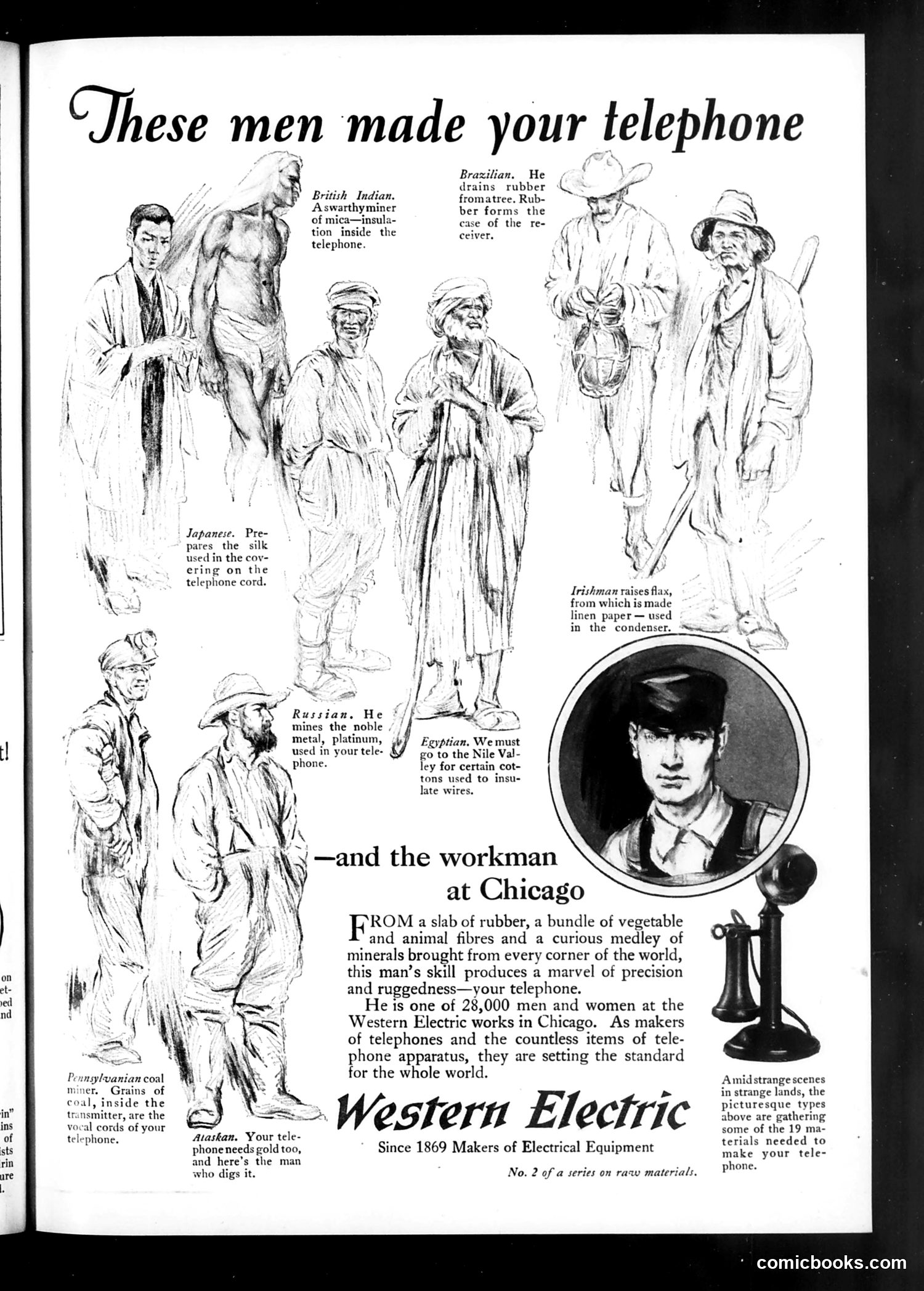
This is a **corporate advertisement** for Western Electric, not political satire. The page uses ethnic and national stereotypes to illustrate global supply chains for telephone components. Each illustrated figure represents a raw material source, identified by nationality: - British Indian (mica insulation) - Brazilian (rubber for receiver) - Japanese (silk cord covering) - Russian (platinum) - Egyptian (cotton insulation) - Irish (flax for paper condenser) - Pennsylvanian (coal for vocal cords) - Alaskan (gold) The implicit message: modern technology depends on international resources and workers. The photograph shows an actual Chicago factory worker—the "workman at Chicago"—who assembles these globally-sourced materials. For modern readers, the caricatured depictions reflect period advertising conventions that would be considered offensive today. The advertisement celebrates industrial achievement and global commerce while emphasizing Western Electric's role as coordinating these diverse inputs into finished products.
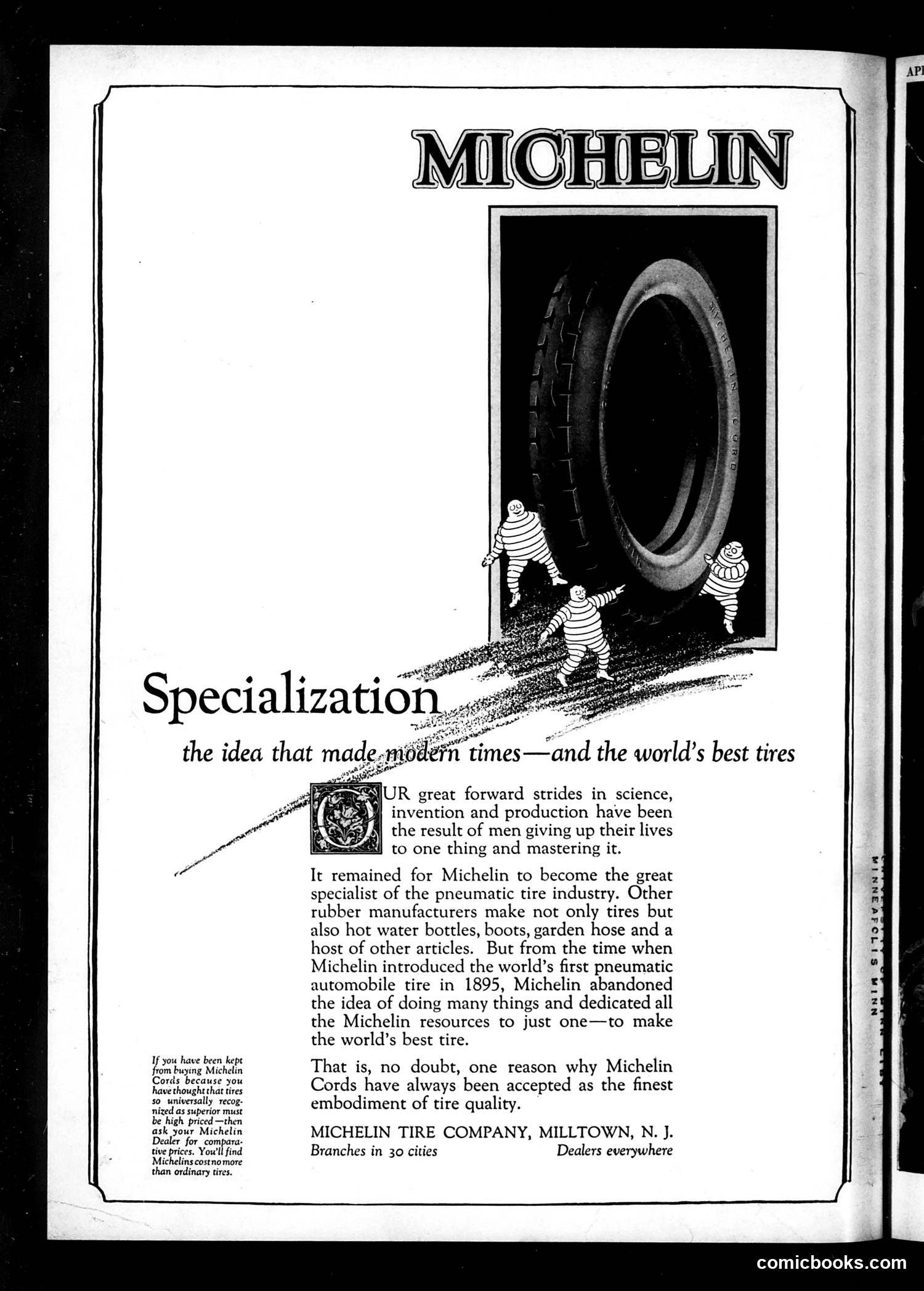
This is a **full-page advertisement**, not political satire. It promotes Michelin pneumatic tires by emphasizing the company's specialization strategy. The central image shows the iconic **Michelin Man** (Bibendum)—a mascot made of stacked tire rings—depicted with smaller figures for scale, highlighting the product's size and prominence. **The advertising argument:** Michelin claims competitive advantage through specialization. While competitors manufacture diverse rubber goods (hot water bottles, boots, hoses), Michelin dedicated all resources exclusively to tire-making since inventing the pneumatic automobile tire in 1895. This focused expertise allegedly explains why Michelin Cords represent "the finest embodiment of tire quality." **The sales pitch** also addresses a likely consumer concern: superior products cost more. The ad explicitly states Michelin tires cost no more than ordinary tires—removing price as a purchasing barrier. This reflects early-20th-century marketing emphasizing industrial specialization as a mark of quality and efficiency.