
Life, 1923-04-05 · page 22 of 40
Life — April 5, 1923 — page 22: what you’re looking at
What you’re looking at
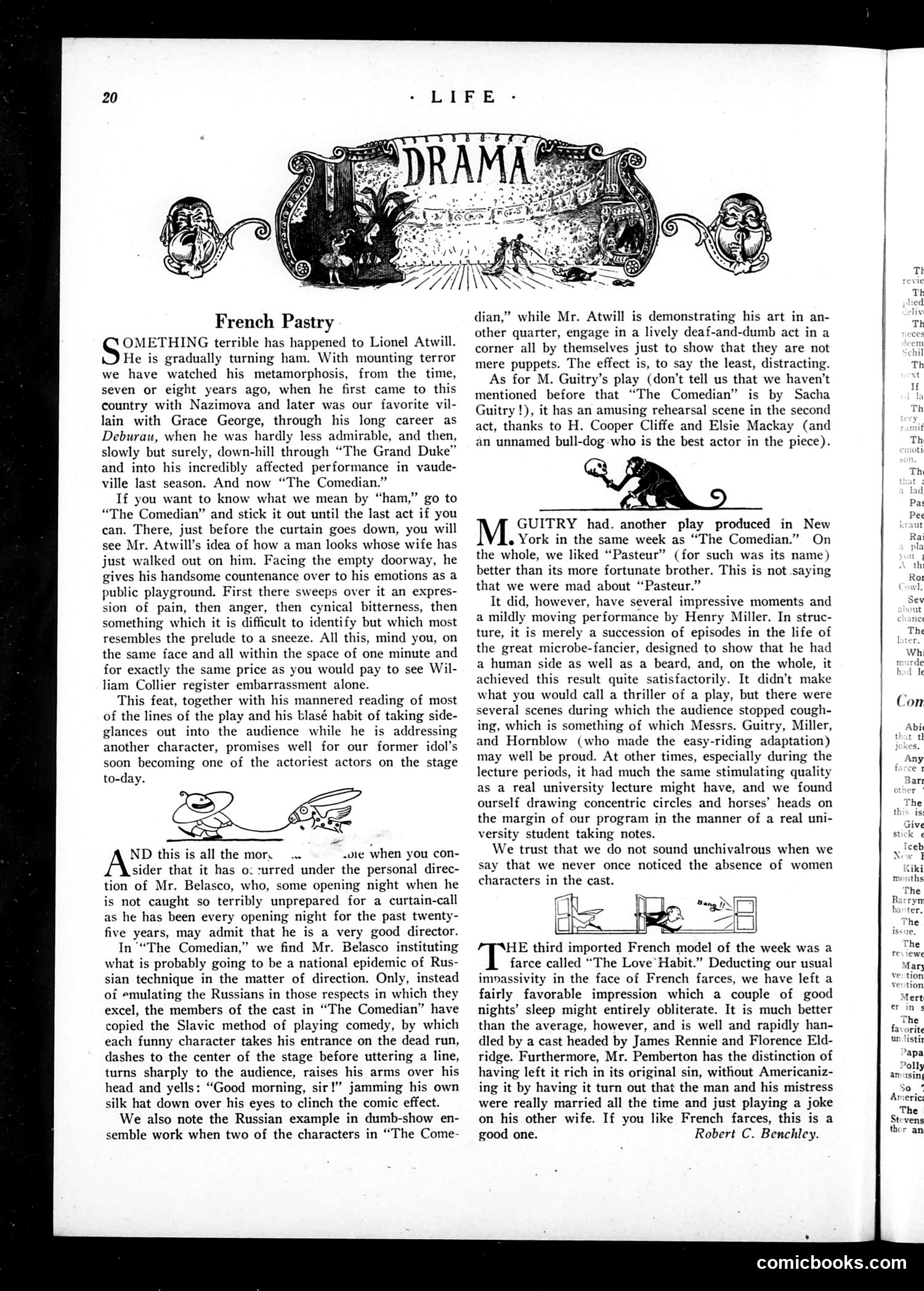
This page contains theater reviews, not political cartoons. The ornamental "DRAMA" header is decorative. The main content critiques actor **Lionel Atwill's** deteriorating performance style in the play "The Comedian" by Sacha Guitry. The reviewer argues Atwill has become an excessive, affected "ham" actor—overacting emotionally and mugging to the audience. A specific scene is mocked: Atwill's exaggerated facial expressions (pain, anger, bitterness, sneeze-like expression) when his character's wife leaves. The review also criticizes director **David Belasco** for instituting what the critic calls "Russian technique"—having actors make grand entrances, shout at audiences, and perform pantomime unnecessarily. This exaggerated style is presented as ridiculous rather than sophisticated. A second review briefly praises another Guitry play, "Pasteur," starring Henry Miller, as superior to "The Comedian" despite its episodic structure. The satire targets theatrical excess and affected acting styles of the 1920s era.
📄 Transcribed text from this page (OCR, searchable)
Machine-transcribed from the original scan — historical spelling and the odd misread are preserved.
French Pastry OMETHING terrible has happened to Lionel Atwill. He is gradually turning ham. With mounting terror we have watched his metamorphosis, from the time, seven or eight years ago, when he first came to this country with Nazimova and later was our favorite vil- lain with Grace George, through his long career as Deburau, when he was hardly less admirable, and then, slowly but surely, down-hill through “The Grand Duke” and into his incredibly affected performance in vaude- ville last season. And now “The Comedian.” If you want to know what we mean by “ham,” go to “The Comedian” and stick it out until the last act if you can. There, just before the curtain goes down, you will see Mr. Atwill’s idea of how a man looks whose wife has just walked out on him. Facing the empty doorway, he gives his handsome countenance over to his emotions as a public playground. First there sweeps over it an expres- sion of pain, then anger, then cynical bitterness, then something which it is difficult to identify but which most resembles the prelude to a sneeze. All this, mind you, on the same face and all within the space of one minute and for exactly the same price as you would pay to see Wil- liam Collier register embarrassment alone. This feat, together with his mannered reading of most of the lines of the play and his blasé habit of taking side- glances out into the audience while he is addressing another character, promises well for our former idol’s soon becoming one of the actoriest actors on the stage to-day. ND this is all the mor, vile when you con- sider that it has o::urred under the personal direc- tion of Mr. Belasco, who, some opening night when he is not caught so terribly unprepared for a curtain-call as he has been every opening night for the past twenty- five years, may admit that he is a very good director. In “The Comedian,” we find Mr. Belasco instituting what is probably going to be a national epidemic of Rus- sian technique in the matter of direction. Only, instead of emulating the Russians in those respects in which they excel, the members of the cast in “The Comedian” have copied the Slavic method of playing comedy, by which each funny character takes his entrance on the dead run, dashes to the center of the stage before uttering a line, turns sharply to the audience, raises his arms over his head and yells: “Good morning, sir!” jamming his own silk hat down over his eyes to clinch the comic effect. We also note the Russian example in dumb-show en- semble work when two of the characters in “The Come- dian,” while Mr. Atwill is demonstrating his art in an- other quarter, engage in a lively deaf-and-dumb act in a corner all by themselves just to show that they are not mere puppets. The effect is, to say the least, distracting. As for M. Guitry’s play (don’t tell us that we haven't mentioned before that “The Comedian” is by Sacha Guitry !), it has an amusing rehearsal scene in the second act, thanks to H. Cooper Cliffe and Elsie Mackay (and an unnamed bull-dog who is the best actor in the piece). GUITRY had. another play produced in New « York in the same week as “The Comedian.” On the whole, we liked “Pasteur” (for such was its name) better than its more fortunate brother. This is not saying that we were mad about “Pasteur.” It did, however, have several impressive moments and a mildly moving performance by Henry Miller. In struc- ture, it is merely a succession of episodes in the life of the great microbe-fancier, designed to show that he had a human side as well as a beard, and, on the whole, it achieved this result quite satisfactorily. It didn’t make what you would call a thriller of a play, but there were several scenes during which the audience stopped cough- ing, which is something of which Messrs. Guitry, Miller, and Hornblow (who made the easy-riding adaptation) may well be proud. At other times, especially during the lecture periods, it had much the same stimulating quality as a real university lecture might have, and we found ourself drawing concentric circles and horses’ heads on the margin of our program in the manner of a real uni- versity student taking notes. We trust that we do not sound unchivalrous when we say that we never once noticed the absence of women characters in the cast. cles A) HE third imported French model of the week was a farce called “The Love’ Habit.” Deducting our usual imnassivity in the face of French farces, we have left a fairly favorable impression which a couple of good nights’ sleep might entirely obliterate. It is much better than the average, however, and is well and rapidly han- dled by a cast headed by James Rennie and Florence Eld- ridge. Furthermore, Mr. Pemberton has the distinction of having left it rich in its original sin, without Americaniz- ing it by having it turn out that the man and his mistress were really married all the time and just playing a joke on his other wife. If you like French farces, this is a good one. Robert C. Benchley. res iewe Mary ve: tion vention Mert erin s The favorite un listis apa Polly amusiny So’ Americ: ‘The Stevens ther an comicbooks.com