
Life, 1923-04-05 · page 9 of 40
Life — April 5, 1923 — page 9: what you’re looking at
What you’re looking at
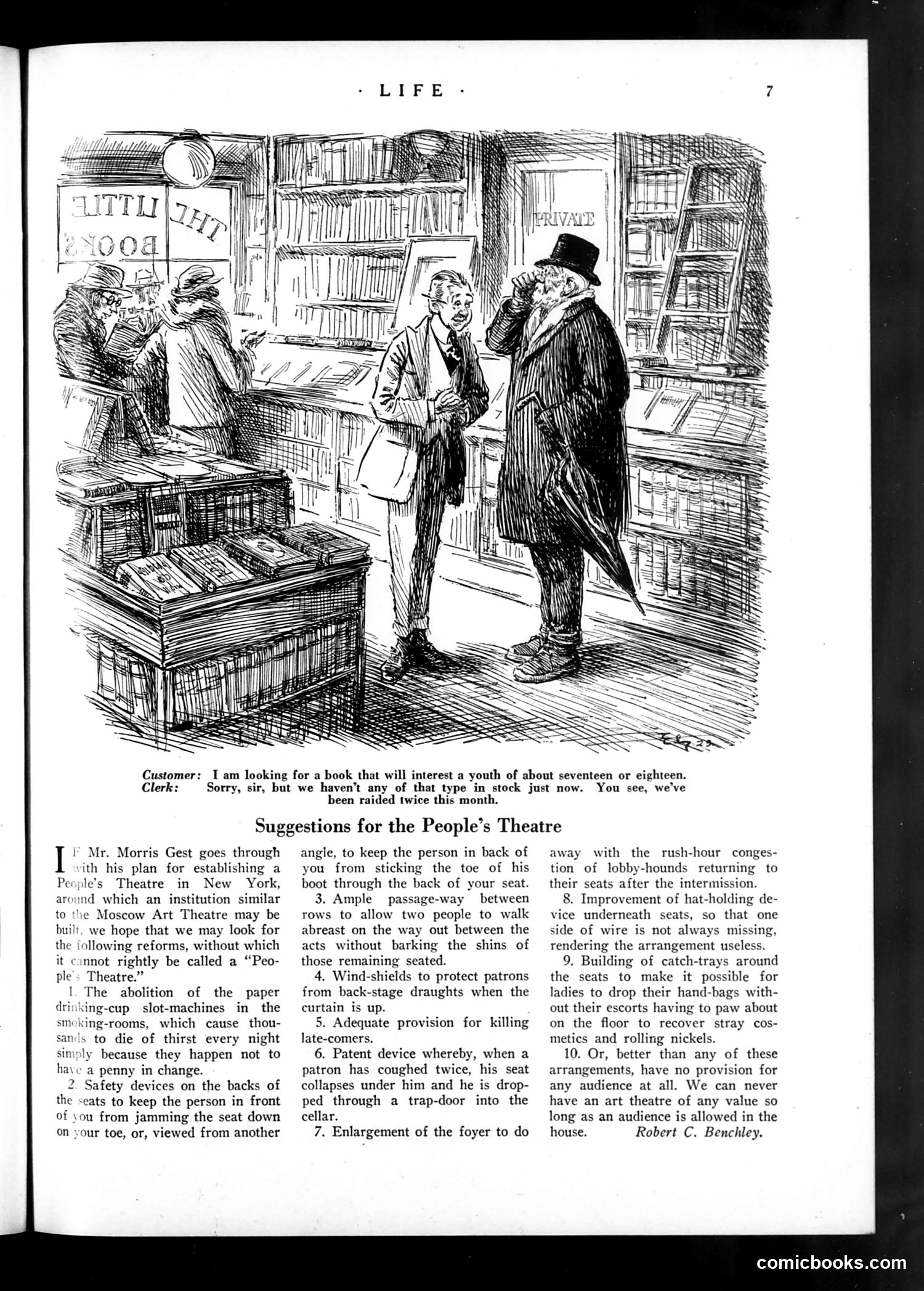
This page contains a single-panel cartoon and an article about theater design. **The Cartoon:** A bookstore clerk tells a customer he cannot stock books for seventeen- or eighteen-year-olds because the store has been "raided twice this month." The joke satirizes censorship efforts targeting youth literature—likely referencing early 20th-century book-banning campaigns. The clerk's matter-of-fact response suggests such raids were common enough to disrupt inventory. **The Article:** "Suggestions for the People's Theatre" by Robert C. Benchley proposes theatrical reforms for a hypothetical "People's Theatre" in New York. It addresses practical audience concerns: seat design, circulation, noise reduction, and preventing late-arrivals from disrupting performances. Benchley humorously advocates for basic theater amenities most patrons would expect. Together, the page reflects Progressive Era concerns about public institutions and social access.
📄 Transcribed text from this page (OCR, searchable)
Machine-transcribed from the original scan — historical spelling and the odd misread are preserved.
he i ne ERS Ss Na i WYa tiny’ | NI \ Customer: I am looking for a book that will interest a youth of about seventeen or eighteen. Clerk: been raided twice this month. Sorry, sir, but we haven’t any of that type in stock just now. You see, we've Suggestions for the People’s Theatre I !’ Mr. Morris Gest goes through ith his plan for establishing a People’s Theatre in New York, vind which an institution similar Moscow Art Theatre may be we hope that we may look for > following reforms, without which nnot rightly be called a “Peo- Theatre.” The abolition of the paper sing-cup slot-machines in the smoking-rooms, which cause thou- sanis to die of thirst every night simply because they happen not to have a penny in change. 2. Safety devices on the backs of the seats to keep the person in front of you from jamming the seat down on your toe, or, viewed from another angle, to keep the person in back of you from sticking the toe of his boot through the back of your seat. 3. Ample passage-way between rows to allow two people to walk abreast on the way out between the acts without barking the shins of those remaining seated. 4. Wind-shields to protect patrons from back-stage draughts when the curtain is up. 5. Adequate provision for killing late-comers. 6. Patent device whereby, when a patron has coughed twice, his seat collapses under him and he is drop- ped through a trap-door into the cellar. 7. Enlargement of the foyer to do away with the rush-hour conges- tion of lobby-hounds returning to their seats after the intermission. 8. Improvement of hat-holding de- vice underneath seats, so that one side of wire is not always missing, rendering the arrangement useless. 9. Building of catch-trays around the seats to make it possible for ladies to drop their hand-bags with- out their escorts having to paw about on the floor to recover stray cos- metics and rolling nickels. 10. Or, better than any of these arrangements, have no provision for any audience at all. We can never have an art theatre of any value so long as an audience is allowed in the house. Robert C. Benchley. comicbooks.com