
Life, 1923-04-05 · page 18 of 40
Life — April 5, 1923 — page 18: what you’re looking at
What you’re looking at
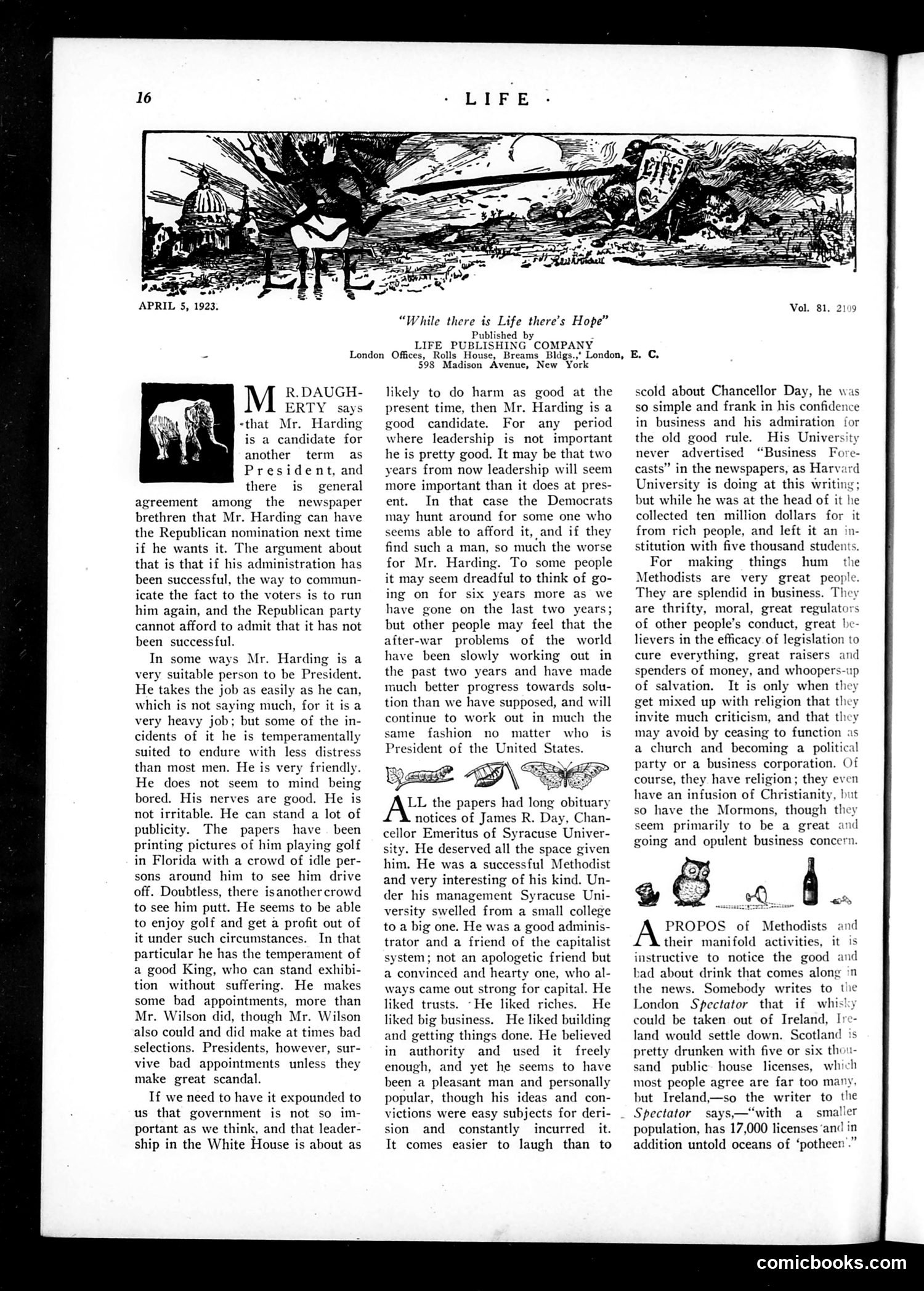
This page contains two satirical political essays rather than traditional cartoons. The first piece, by R. Daugherty, analyzes President Warren G. Harding's suitability for reelection. Daugherty argues Harding is "suitable" precisely because he makes leadership seem unimportant—a backhanded compliment suggesting the post-WWI period requires minimal executive direction. The essay sarcastically praises Harding's temperament: he's friendly, unbored, and handles golf outings well. Daugherty implies Harding's actual weakness (ineffective leadership) could become a liability if circumstances change and strong leadership becomes necessary again. The second piece praises recently deceased Syracuse University Chancellor James R. Day, celebrating his unapologetic capitalist convictions and business-building approach. The tone is affectionate but gently mocking—Day is praised for being "pleasant" despite holding ideas "easy subjects for derision." Both essays employ Life's characteristic satirical approach: praising subjects with qualifications that subtly undermine them, using irony to critique both weak political leadership and unexamined faith in business authority.
📄 Transcribed text from this page (OCR, searchable)
Machine-transcribed from the original scan — historical spelling and the odd misread are preserved.
S ay Woe wi ww _ APRIL 5, 1923. “While there is Life there’s Hope” Published by LIFE PUBLISHING COMPANY London Offices, Rolls House, Breams Bldgs London, E. C, R. DAUGH- ERTY says «that Mr. Harding is a candidate for another term as President, and there is general agreement among the newspaper brethren that Mr. Harding can have the Republican nomination next time if he wants it. The argument about that is that if his administration has been successful, the way to commun- icate the fact to the voters is to run him again, and the Republican party cannot afford to admit that it has not been successful. In some ways Mr. Harding is a very suitable person to be President. He takes the job as easily as he can, which is not saying much, for it very heavy job; but some of the in- cidents of it he is temperamentally suited to endure with less distress than most men. He is very friendly. He does not seem to mind being bored. His nerves are good. He is not irritable. He can stand a lot of publicity. The papers have been printing pictures of him playing golf in Florida with a crowd of idle per- sons around him to see him drive off. Doubtless, there isanother crowd to see him putt. He seems to be able to enjoy golf and get a profit out of it under such circumstances. In that particular he has the temperament of a good King, who can stand exhibi- tion without suffering. He makes some bad appointments, more than Mr. Wilson did, though Mr. Wilson also could and did make at times bad selections. Presidents, however, sur- vive bad appointments unless they make great scandal. If we need to have it expounded to us that government is not so im- portant as we think, and that leader- ship in the White House is about as 598 Madison Avenue, New York likely to do harm as good at the present time, then Mr. Harding is a good candidate. For any period where leadership is not important he is pretty good. It may be that two years from now leadership will seem more important than it does at pres- ent. In that case the Democrats may hunt around for some one who seems able to afford it, and if they find such a man, so much the worse for Mr. Harding. To some people it may seem dreadful to think of go- ing on for six years more as we have gone on the last two years; but other people may feel that the after-war problems of the world have been slowly working out in the past two years and have made much better progress towards solu- tion than we have supposed, and will continue to work out in much the same fashion no matter who is President of the United States. LL the papers had long obituary notices of James R. Day, Chan- cellor Emeritus of Syracuse Univer- sity. He deserved all the space given him. He was a successful Methodist and very interesting of his kind. Un- der his management Syracuse Uni- versity swelled from a small college to a big one. He was a good adminis- trator and a friend of the capitalist system; not an apologetic friend but a convinced and hearty one, who al- ways came out strong for capital. He liked trusts. ~He liked riches. He liked big business. He liked building and getting things done. He believed in authority and used it freely enough, and yet he seems to have been a pleasant man and personally popular, though his ideas and con- victions were easy subjects for deri- sion and constantly incurred it. It comes easier to laugh than to scold about Chancellor Day, he was so simple and frank in his confidence in business and his admiration {for the old good rule. His University never advertised “Business Fore- casts” in the newspapers, as Harvard University is doing at this writing; but while he was at the head of it he collected ten million dollars for it from rich people, and left it an in- stitution with five thousand students. For making things hum the Methodists are very great pec They are splendid in business. Th are thrifty, moral, great regulators of other people’s conduct, great be- lievers in the efficacy of legislation to cure everything, great raisers and spenders of money, and whoopers-up of salvation. It is only when they get mixed up with religion that they invite much criticism, and that they may avoid by ceasing to function as a church and becoming a political party or a business corporation. Of course, they have religion; they even have an infusion of Christianity, but so have the Mormons, though they seem primarily to be a great going and opulent business concern. Ase of Methodists and their manifold activities, it is instructive to notice the good and had about drink that comes along in the news. Somebody writes to tie London Spectator that if whis! could be taken out of Ireland, | land would settle down. Scotland pretty drunken with five or six tho sand public house licenses, whic most people agree are far too man but Ireland—so the writer to the Spectator says,—“with a smaller population, has 17,000 licenses ‘and in addition untold oceans of ‘potheer’.” comicbooks.com