
Life, 1923-04-05 · page 28 of 40
Life — April 5, 1923 — page 28: what you’re looking at
What you’re looking at
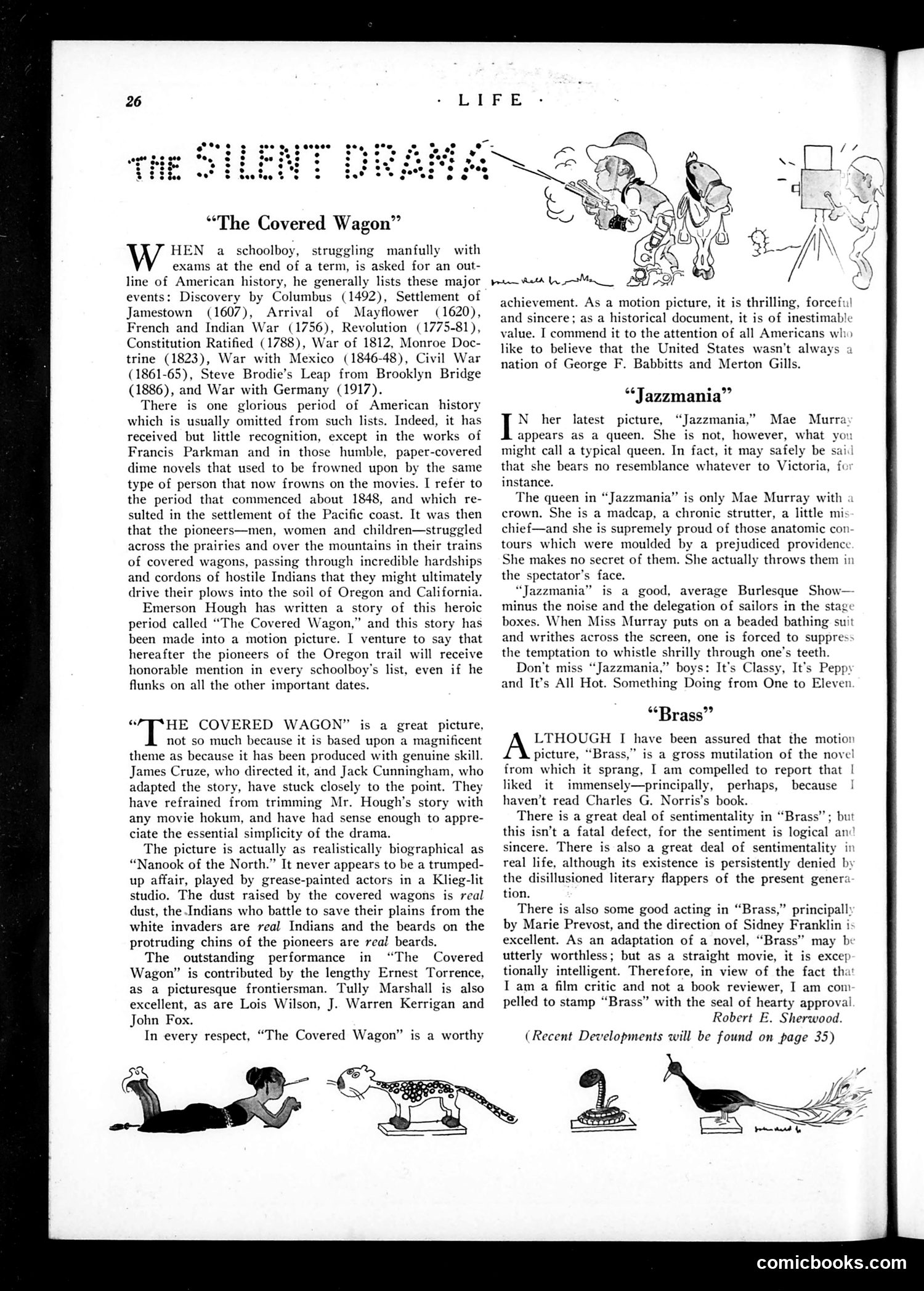
This page reviews three 1920s silent films. **"The Covered Wagon"** receives high praise as a historically significant picture about westward expansion on the Oregon Trail—notably absent from typical schoolboy history lessons. The reviewer commends director James Cruze for authentic filmmaking: real dust, real Native Americans, genuine beards. He argues it will elevate pioneer history to importance alongside Columbus and the Civil War. **"Jazzmania"** features Mae Murray as a scandalous "queen" who is essentially a vain, strutting showgirl proud of her body. The review dismisses the film as average burlesque with crude humor. **"Brass"** receives mixed assessment—sentimental and somewhat worthless as literature, yet competently made with good acting by Marie Prevost. The reference to "George F. Babbits and Merton Gills" (Sinclair Lewis's satirical businessman character) suggests contemporary anxieties about American materialism and shallow values.
📄 Transcribed text from this page (OCR, searchable)
Machine-transcribed from the original scan — historical spelling and the odd misread are preserved.
“The Covered Wagon” HEN a schoolboy, struggling manfully with exams at the end of a term, is asked for an out- line of American history, he generally lists these major events: Discovery by Columbus (1492), Settlement of Jamestown (1607), Arrival of Mayflower (1620), French and Indian War (1756), Revolution (1775-81), Constitution Ratified (1788), War of 1812, Monroe Doc- trine (1823), War with Mexico (1846-48), Civil War (1861-65), Steve Brodie’s Leap from Brooklyn Bridge (1886), and War with Germany (1917). There is one glorious period of American history which is usually omitted from such lists. Indeed, it has received but little recognition, except in the works of Francis Parkman and in those humble, paper-covered dime novels that used to be frowned upon by the same type of person that now frowns on the movies. I refer to the period that commenced about 1848, and which re- sulted in the settlement of the Pacific coast. It was then that the pioneers—men, women and children—struggled across the prairies and over the mountains in their trains of covered wagons, passing through incredible hardships and cordons of hostile Indians that they might ultimately drive their plows into the soil of Oregon and California. Emerson Hough has written a story of this heroic period called “The Covered Wagon,” and this story has been made into a motion picture. I venture to say that hereafter the pioneers of the Oregon trail will receive honorable mention in every schoolboy’s list, even if he flunks on all the other important dates. si HE COVERED WAGON” is a great picture, not so much because it is based upon a magnificent theme as because it has been produced with genuine skill. James Cruze, who directed it, and Jack Cunningham, who adapted the story, have stuck closely to the point. They have refrained from trimming Mr. Hough's story with any movie hokum, and have had sense enough to appre- ciate the essential simplicity of the drama. The picture is actually as realistically biographical as “Nanook of the North.” It never appears to be a trumped- up affair, played by grease-painted actors in a Klieg-lit studio. The dust raised by the covered wagons is real dust, the Indians who battle to save their plains from the white invaders are real Indians and the beards on the protruding chins of the pioneers are real beards. The outstanding performance in “The Covered Wagon” is contributed by the lengthy Ernest Torrence, as a picturesque frontiersman. Tully Marshall is also excellent, as are Lois Wilson, J. Warren Kerrigan and John Fox. In every respect, “The Covered Wagon” is a worthy achievement. As a motion picture, it is thrilling, forceft and sincere; as a historical document, it is of inestimable value. I commend it to the attention of all Americans who like to believe that the United States wasn’t always nation of George F. Babbitts and Merton Gills. “Jazzmania” N_ her latest picture, “Jazzmania,” Mae Murra appears as a queen. She is not, however, what you might call a typical queen. In fact, it may safely be sail that she bears no resemblance whatever to Victoria, {: instance. The queen in “Jazzmania” is only Mae Murray with a crown. She is a madcap, a chronic strutter, a little mi chief—and she is supremely proud of those anatomic con. tours which were moulded by a prejudiced providence She makes no secret of them. She actually throws them in face. is a good, average Burlesque Show— the noise and the delegation of sailors in the stag: boxes. When Miss Murray puts on a beaded bathing su and writhes across the screen, one is forced to suppres the temptation to whistle shrilly through one’s teeth. Don't miss “Jazzmania,” boys: It’s Classy, It’s Peppy and It’s All Hot. Something Doing from One to Eleven “Brass” LTHOUGH I have been assured that the motion picture, “Brass,” is a gross mutilation of the novel from which it sprang, I am compelled to report that | liked it immensely—principally, perhaps, because | haven’t read Charles G. Norris’s book. There is a great deal of sentimentality in “Brass”; but this isn’t a fatal defect, for the sentiment is logical ani! sincere. There is also a great deal of sentimentality in real life, although its existence is persistently denied by the disillusioned literary flappers of the present genera tion. There is also some good acting in “Brass,” principall by Marie Prevost, and the direction of Sidney Franklin is excellent. As an adaptation of a novel, “Brass” may b utterly worthless; but as a straight movie, it is excep tionally intelligent. Therefore, in view of the fact that I am a film critic and not a book reviewer, I am com pelled to stamp “Brass” with the seal of hearty approval Robert E. Sherwood. (Recent Developments will be found on page 35) comicbooks.com