
Life, 1923-04-05 · page 23 of 40
Life — April 5, 1923 — page 23: what you’re looking at
What you’re looking at
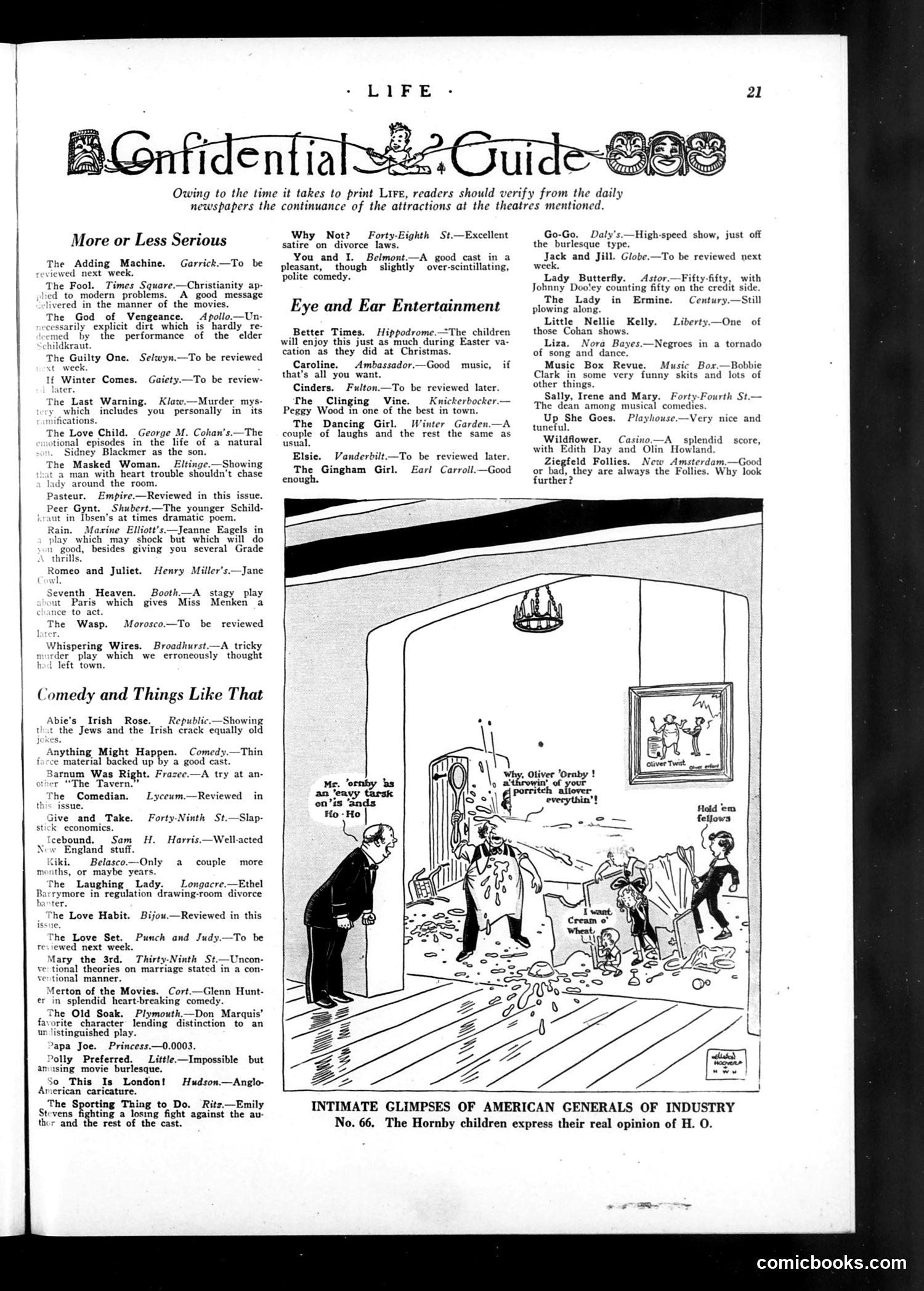
This single-panel cartoon satirizes wealthy industrialists' parenting styles and domestic life. The caption labels it "No. 66," suggesting it's part of a recurring series mocking powerful businessmen. The scene depicts an older gentleman (representing a wealthy "general of industry") observing chaos in a nursery—children destroying furniture, throwing toys, and creating mayhem. The caption quotes him expressing concern about one child's behavior toward "H.O." (likely a household servant or employee). The satire's point: wealthy industrialists who ruthlessly control their business empires are comically helpless against their own children's misbehavior. It suggests hypocrisy—these men demand order and obedience in their companies but cannot manage their own households. The cartoon mocks both the industrialists' loss of control and, implicitly, American wealth and privilege during this period.
📄 Transcribed text from this page (OCR, searchable)
Machine-transcribed from the original scan — historical spelling and the odd misread are preserved.
More or Less Serious The Adding Machine. Garrick—To be iewed next week. The Fool. Times Square.—Christianity ap- lied to. modern problems. A good message livered in the manner of the movies. God of Vengeance. Apollo.—Un- ily explicts dirt which is hardly re- by the performance of the elder To be reviewed The Guilty One. Selwy kK. If Winter Comes. later. The Last Warning. Klaw.—Murder mys- y which includes you personally in its fications. The Love Child. George M. Cohan's.—The otional episodes in the life of a natural Sidney Blackmer as the son. The Masked Woman. Eltinge.—Showing t a man with heart trouble shouldn't chase lady around the room. Pasteur. Empire.—Reviewed in this issue. Peer Gynt. Shubert.—The younger Schild- ut in Ibsen's at times dramatic poem. Rain. Maxine Elliott’s——Jeanne Eagels in play which may shock but which will do 1 good, besides giving you several Grade thrills. Bomee) and Juliet. Henry Miller’s.—Jane Gaiety.—To be review- Seventh Heaven. Booth.—A stagy play ut Paris which gives Miss Menken a nce to act. The Wasp. later Morosco.—To be reviewed Whispering Wires. Broadhurst.—A tricky murder play which we erroneously thought h left town. Comedy and Things Like That Abie’s Irish Rose. Republic.—Showing that the Jews and the Irish crack equally old Anything Might Happen. Comedy.—Thin ‘e material backed up by a good cast Barnum Was Right. Frasee.—A try at an- ther “The Tavern.” The Comedian. issue. Give and Take. tick economics. Lyceum.—Reviewed in Forty-Ninth St.—Slap- cebound. Sam H. Harris.—Well-acted New England stuff. Belasco.—Only a couple more months, or maybe years. The Laughing Lady. Longacre.—Ethel Barrymore in regulation drawing-room divorce banter. The Love Habit. Bijou.—Reviewed in this e. he Love Set. reviewed next week. Mary the 3rd. Thirty-Ninth St.—Uncon- ve tional theories on marriage stated in a con- ventional manner. Merton of the Movies. Cort.—Glenn Hunt- er in splendid heart-breaking comedy. The Old Soak. Plymouth.—Don Marquis’ ite character lending distinction to an un listinguished play. apa Joe. Princess.—0.0003. Polly Preferred. Little.—Impossible but anuusing movie burlesque. So. This Is London! American caricature. ‘The Sporting Thing to Do. Ritz.—Emily Stevens fighting a losing fight against the au- thor and the rest of the cast. Punch and Judy.—To be Hudson.—Anglo- Owing to the time it takes to print Lire, readers should verify from the daily newspapers the continuance of the attractions at the theatres mentioned. Why Not? — Forty-Eighth St.—Excellent satire on divorce laws. You and I. Belmont.—A good cast in a pleasant, though slightly over-scintillating, polite comedy. Eye and Ear Entertainment Better Times. Hippodrome.—The children will enjoy this just as much during Easter va- cation as they did at Christmas. Caroline. Ambassador.—Good music, if that’s all you want. Cinders. Fulton.—To be reviewed later. The Clinging Vine. Knickerbocker.— Peggy Wood in one of the best in town. The Dancing Girl. Winter Garden.—A couple of laughs and the rest the same as usual. Elsie. Vanderbilt—To be reviewed later. The Gingham Girl. Ear! Carroll.—Good enough. Go-Go. Daly's.—High-speed show, just off the burlesque type. Jack and Jill. Globe—To be reviewed next week. Lady Butterfly. Astor.—Fifty-fifty, Johnny Dooley counting fifty on the credit The Lady in Ermine. Century.—Still plowing along. Little Nellie Kelly. Liberty—One of those Cohan shows. Liza. Nora Bayes.—Negroes in a tornado of song and dance. Music Box Revue, Music Box.—Bobbie Clark in some very funny skits and lots of other things. Sally, Irene and Mary. Forty-Fourth St.— The dean among musical comedi Up She Goes. Playhouse.—V nice and tuneful. Wildflower. Casino.—A_ splendid score, with Edith Day and Olin Howland, Ziegfeld Follies. New Amsterdam.—Good or bad, they are always the Follies. Why look further? Aold ‘em felfjows INTIMATE GLIMPSES OF AMERICAN GENERALS OF INDUSTRY No. 66. The Hornby children express their real opinion of H. O. comicbooks.com