
A complete issue · 42 pages · 1922
Life — December 21, 1922
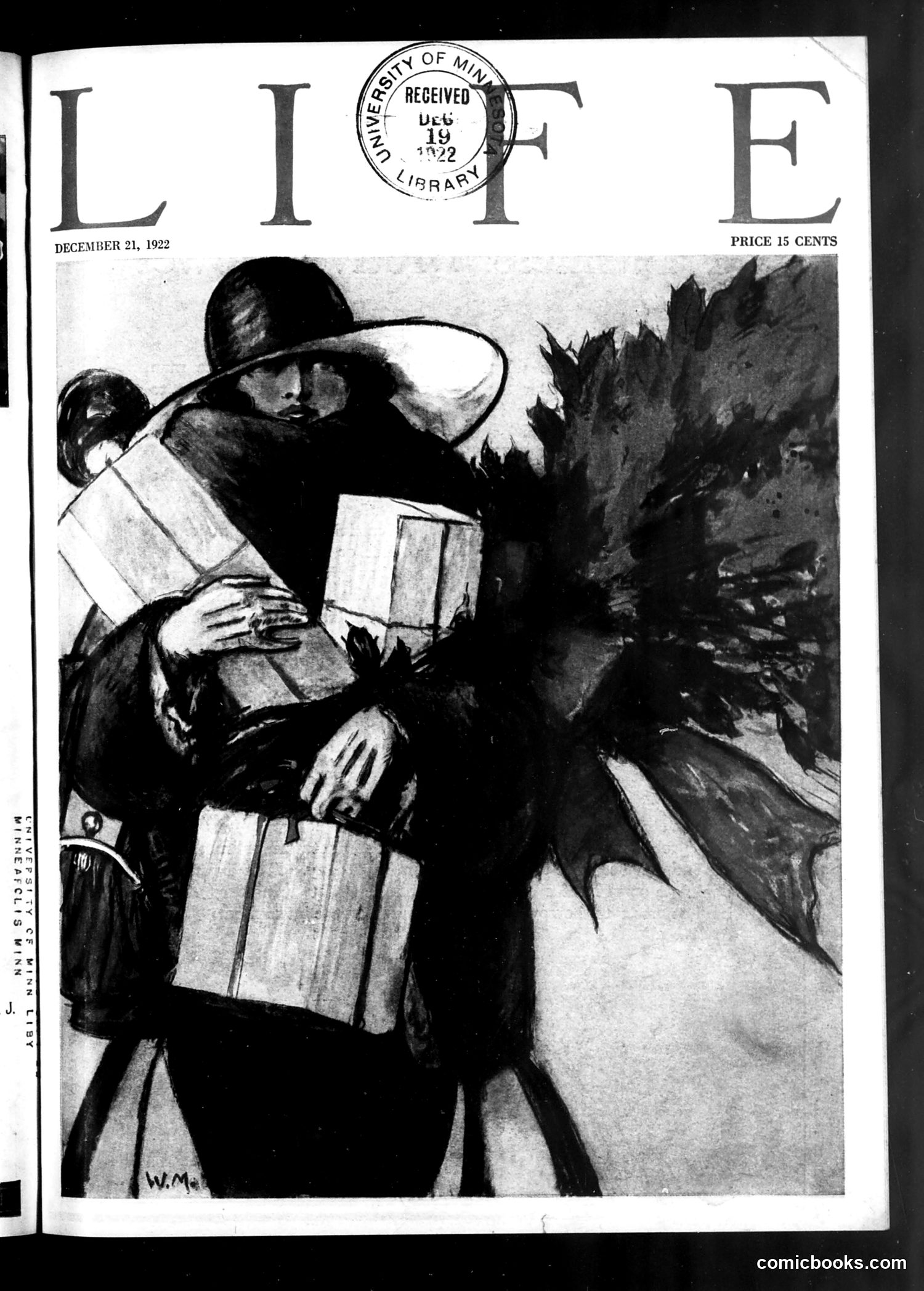
This cover depicts a woman in a wide-brimmed hat carrying multiple wrapped packages or parcels, struggling under their weight. She appears to be on a journey, with mountainous terrain visible behind her. The image likely comments on **holiday shopping burden** — a theme relevant to the December publication date. The woman's strained posture and oversized load suggest satire about the exhaustion of Christmas shopping, particularly the physical and financial demands placed on consumers during the season. The specific identity of the woman remains unclear from the image alone, though her fashionable attire suggests she represents an everyman (or rather, everywoman) consumer figure typical of 1920s middle-class America rather than a particular public figure.
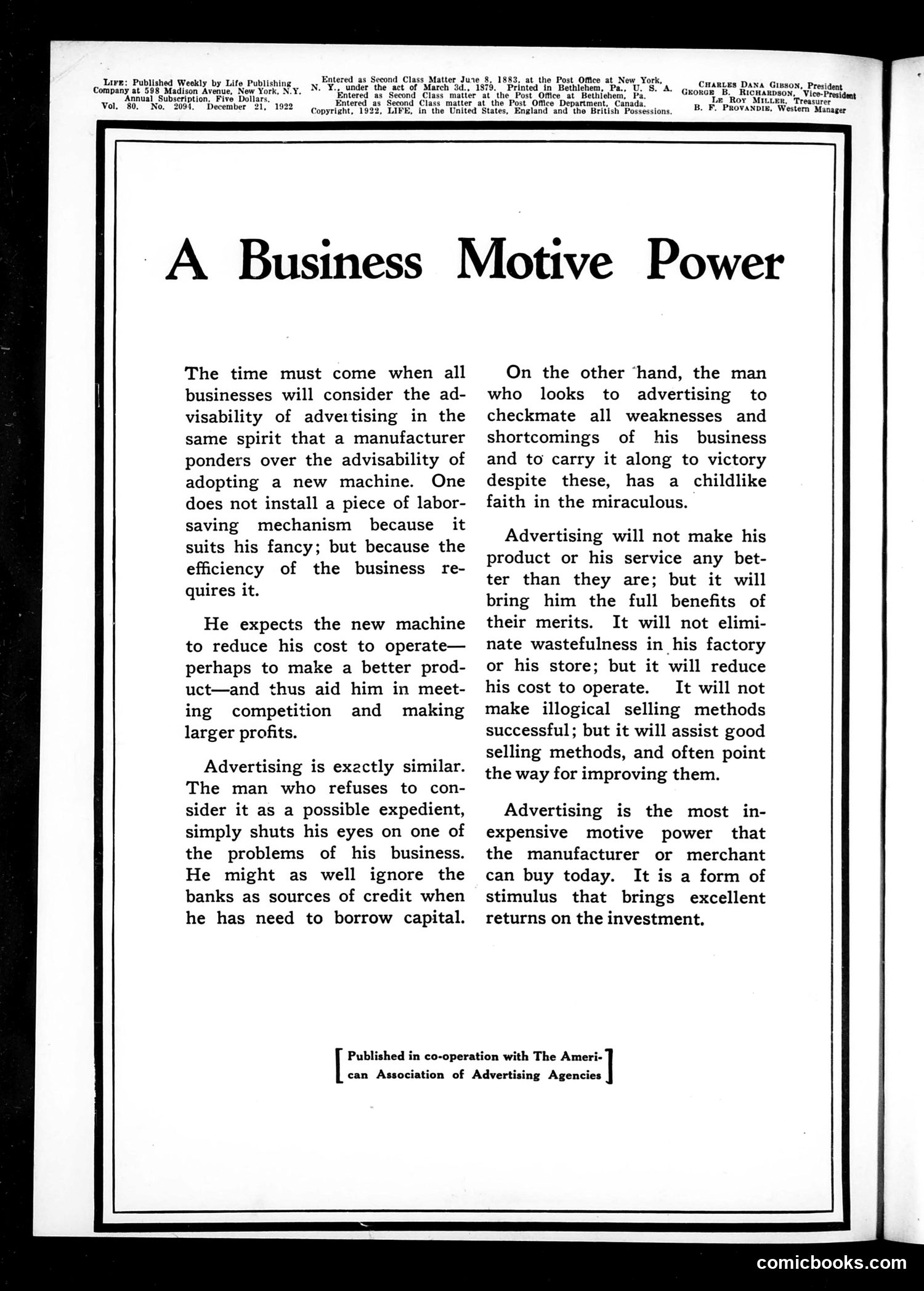
This page contains no cartoon or satirical illustration. Instead, it's a serious argumentative essay titled "A Business Motive Power" advocating for advertising as a legitimate business tool. The piece compares advertising to industrial machinery: just as manufacturers adopt labor-saving equipment for efficiency, businesses should invest in advertising. The author argues advertising shouldn't be dismissed as frivolous but recognized as essential to competitive success—reducing costs, improving profits, and supporting good sales practices. Notably, the essay was "published in co-operation with The American Association of Advertising Agencies," indicating this is promotional content rather than Life magazine's typical satirical commentary. The page represents early 20th-century efforts to legitimize advertising as a respectable business practice.
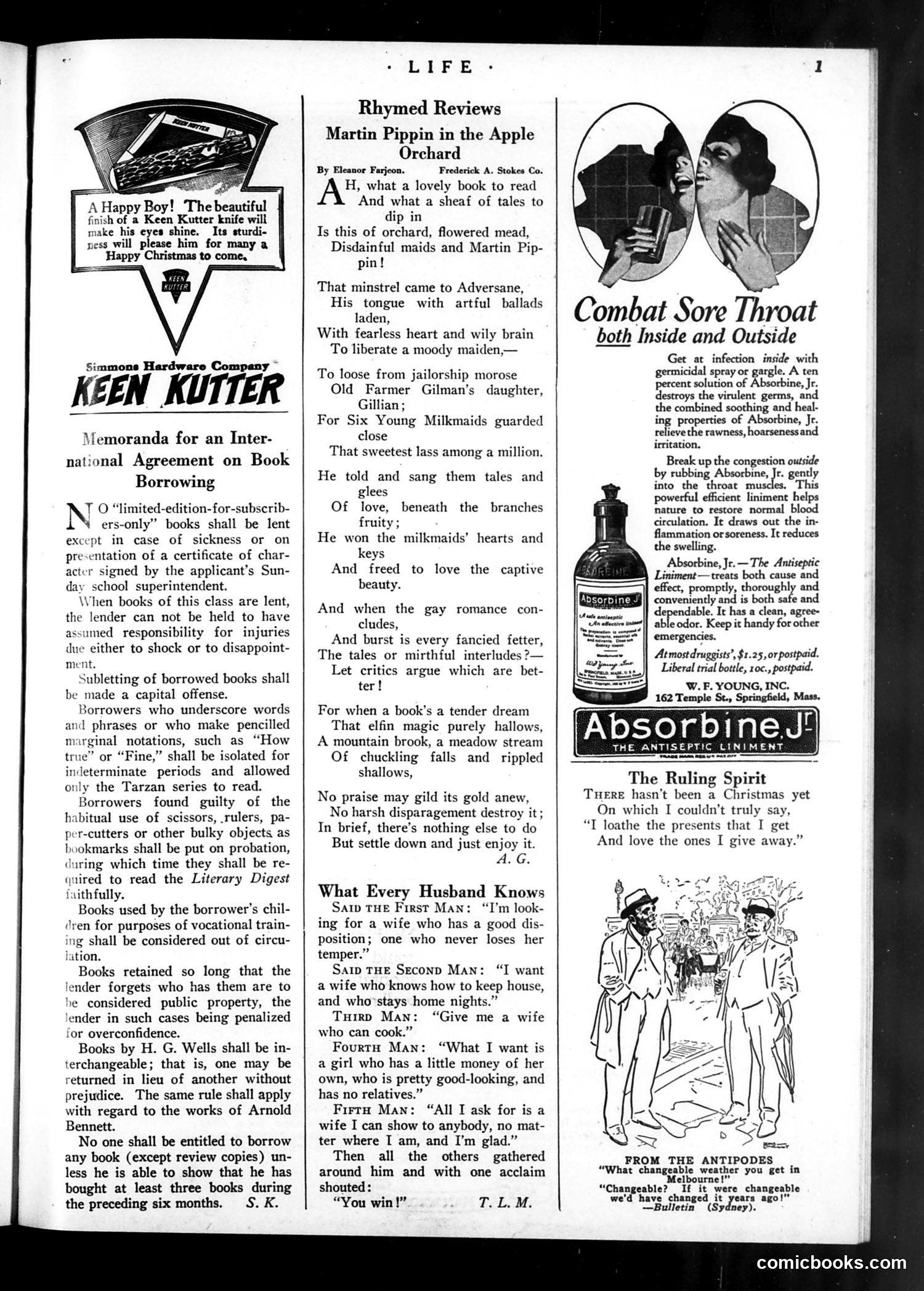
This page contains three distinct sections: 1. **"A Happy Boy!" advertisement** (top left): A commercial for Keen Kutter tools, using a Christmas gift appeal to sell to children. 2. **"Rhymed Reviews: Martin Pippin in the Apple Orchard"** (center): A book review in verse form discussing Eleanor Farjeon's novel, praising its romantic tales and whimsical charm. 3. **"The Ruling Spirit" cartoon** (bottom right): An illustration showing two men in period clothing exchanging gifts, captioned with dialogue from "The Antipodes," discussing changeable Australian weather. This appears to be a humorous excerpt from a play or literary work about climate unpredictability. The page also includes an advertisement for Absorbine Jr., a medicinal liniment product. The content is primarily literary and commercial rather than political satire.
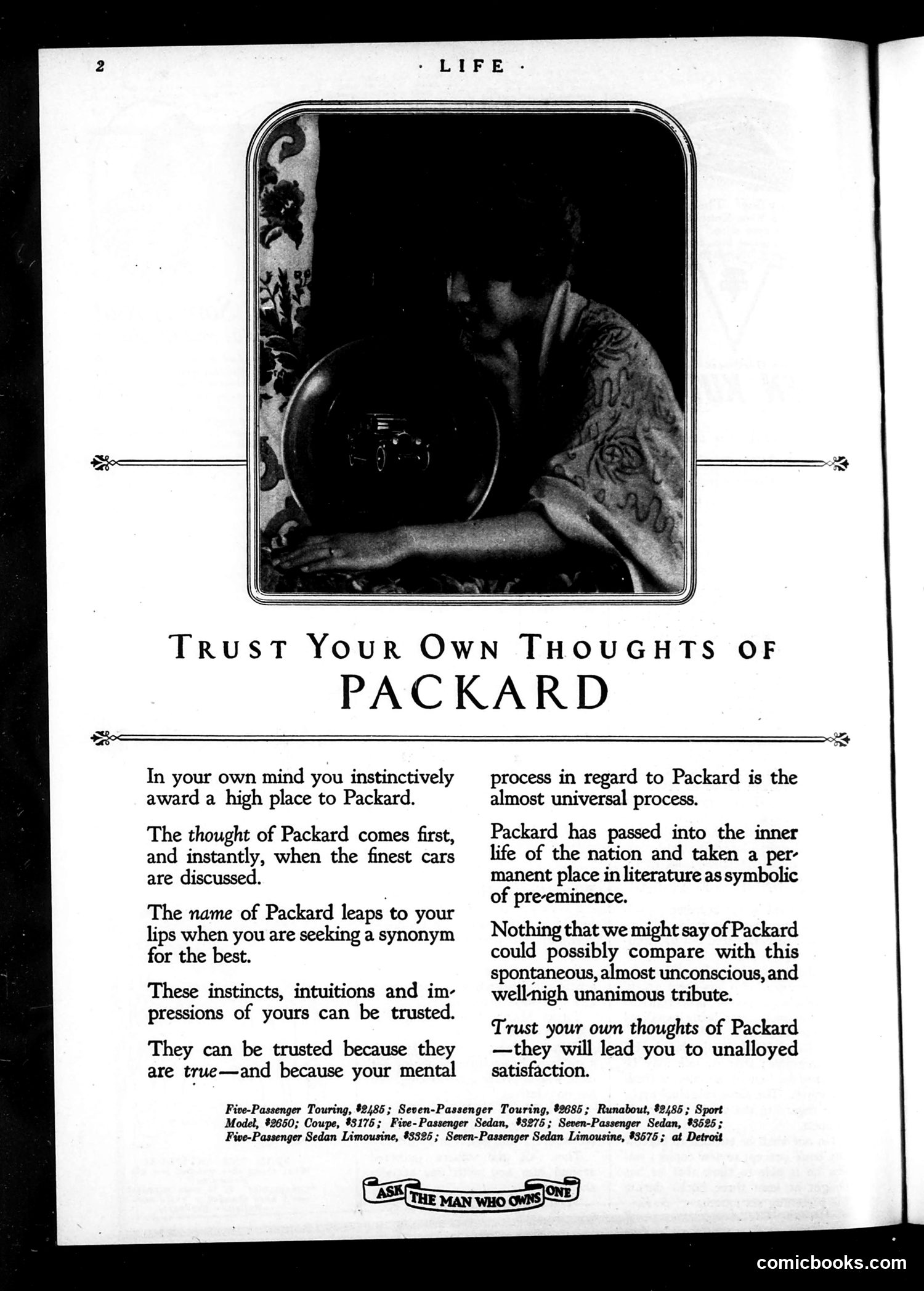
This is a **Packard automobile advertisement**, not satire or political commentary. The page uses persuasive marketing language aimed at affluent buyers. The image shows a woman examining what appears to be a Packard vehicle's engine or mechanical component, positioned as an authority figure validating the product's quality. The advertisement's central argument is that consumers should "trust your own thoughts of Packard"—appealing to readers' instincts and personal judgment rather than external endorsement. It claims Packard has achieved cultural prestige, having "passed into the inner life of the nation" and become "symbolic of pre-eminence." The tagline "Ask the man who owns one" (visible at bottom) was Packard's actual historical slogan, positioning current owners as credible testimonials. This represents early 20th-century luxury marketing targeting the wealthy.
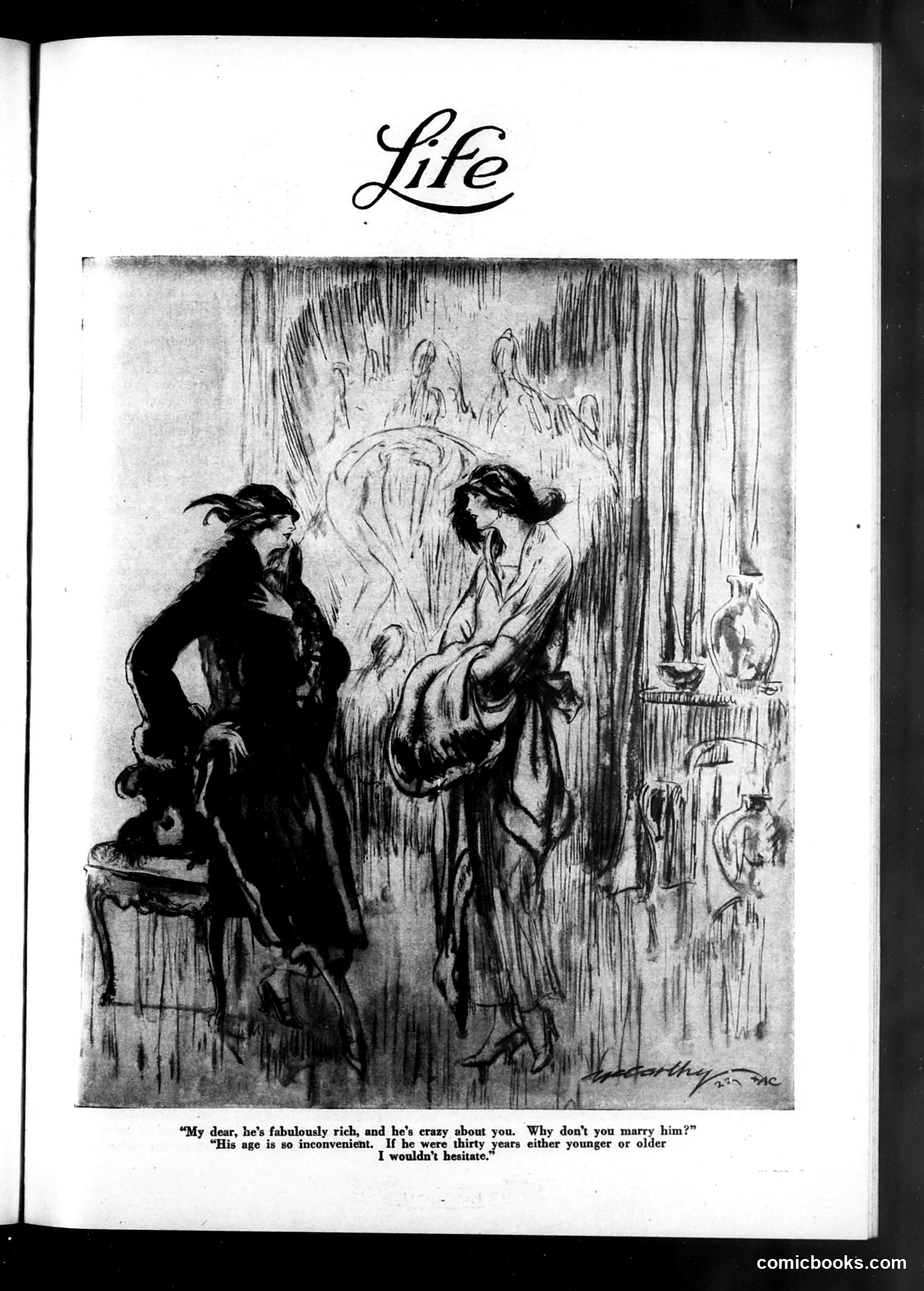
This appears to be a satirical commentary on marriage and wealth dynamics, likely from the early-to-mid 20th century. The cartoon depicts two figures—a woman on the right and a man on the left wearing a coat and hat—in what appears to be an interior setting. The dialogue suggests a conversation about a potential suitor: a wealthy man whose age (around thirty years older or younger) is presented as an obstacle to marriage. The satire targets the social hypocrisy around matrimonial decisions: while the woman is described as "fabulously rich" and the man "crazy about you," age becomes the stated concern rather than genuine affection or character. The joke likely critiques how financial considerations trump other factors in marriage calculations among affluent society.
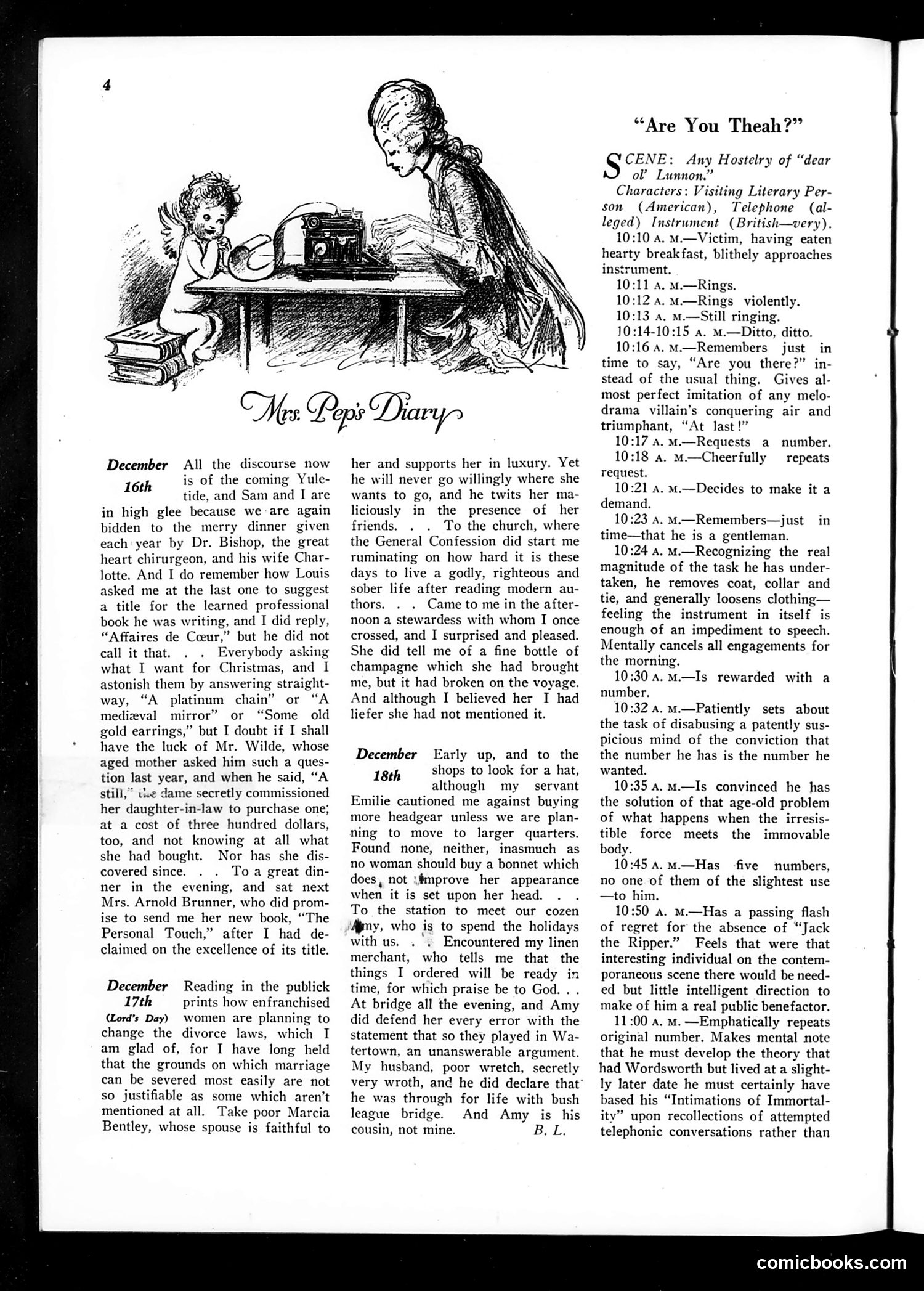
This page features a serialized humor column titled "Mrs. Pep's Diary," a common Life magazine feature. The accompanying illustration shows a woman at a telephone desk, likely the "Mrs. Pep" character. The December 16th entry satirizes upper-class social anxieties about gift-giving and Christmas entertaining, mocking concerns over jewelry choices and household staff efficiency. The December 17th entry appears to reference contemporary debates about divorce law reform, presenting the author's ironic commentary on proposed legal changes. The "Are You Theah?" sketch on the right satirizes a telephone conversation, likely mocking affected upper-class speech patterns and the comedic frustrations of early telephone technology—a popular humor subject in this era. The overall tone is gentle social satire targeting genteel American society customs and pretensions.
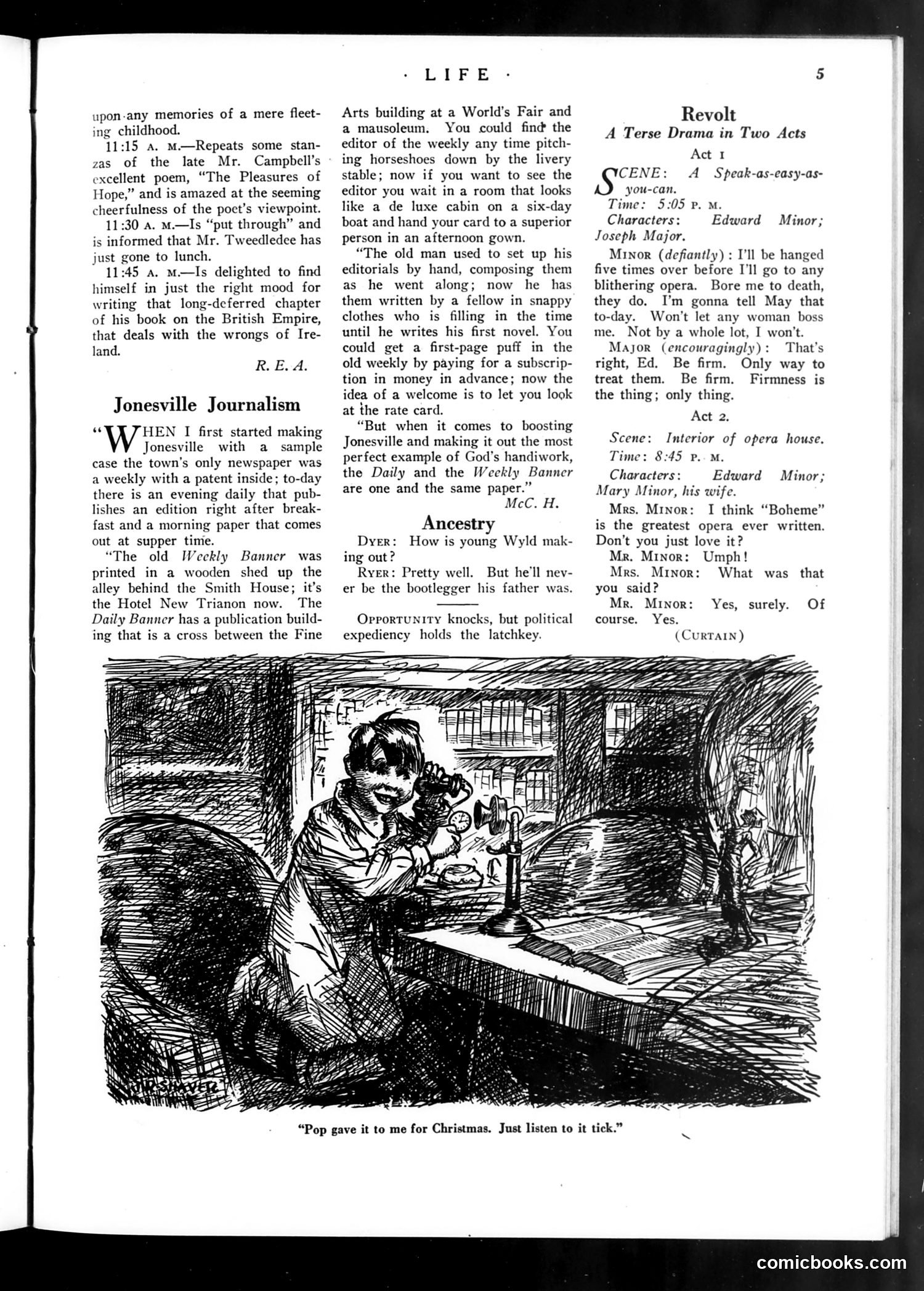
This page contains a one-act play called "Revolt" and an article on "Jonesville Journalism," alongside a single illustration. The cartoon depicts a young child holding what appears to be a mechanical toy or clock, saying "Pop gave it to me for Christmas. Just listen to it tick." The humor relies on the child's innocent enthusiasm for a practical, unglamorous gift—suggesting the parent's economical or utilitarian approach to holiday giving rather than providing exciting toys. The articles discuss local newspaper operations and social conventions of the era, reflecting Life's satirical commentary on American small-town life and media practices. The overall tone is gently mocking of everyday American customs and expectations.
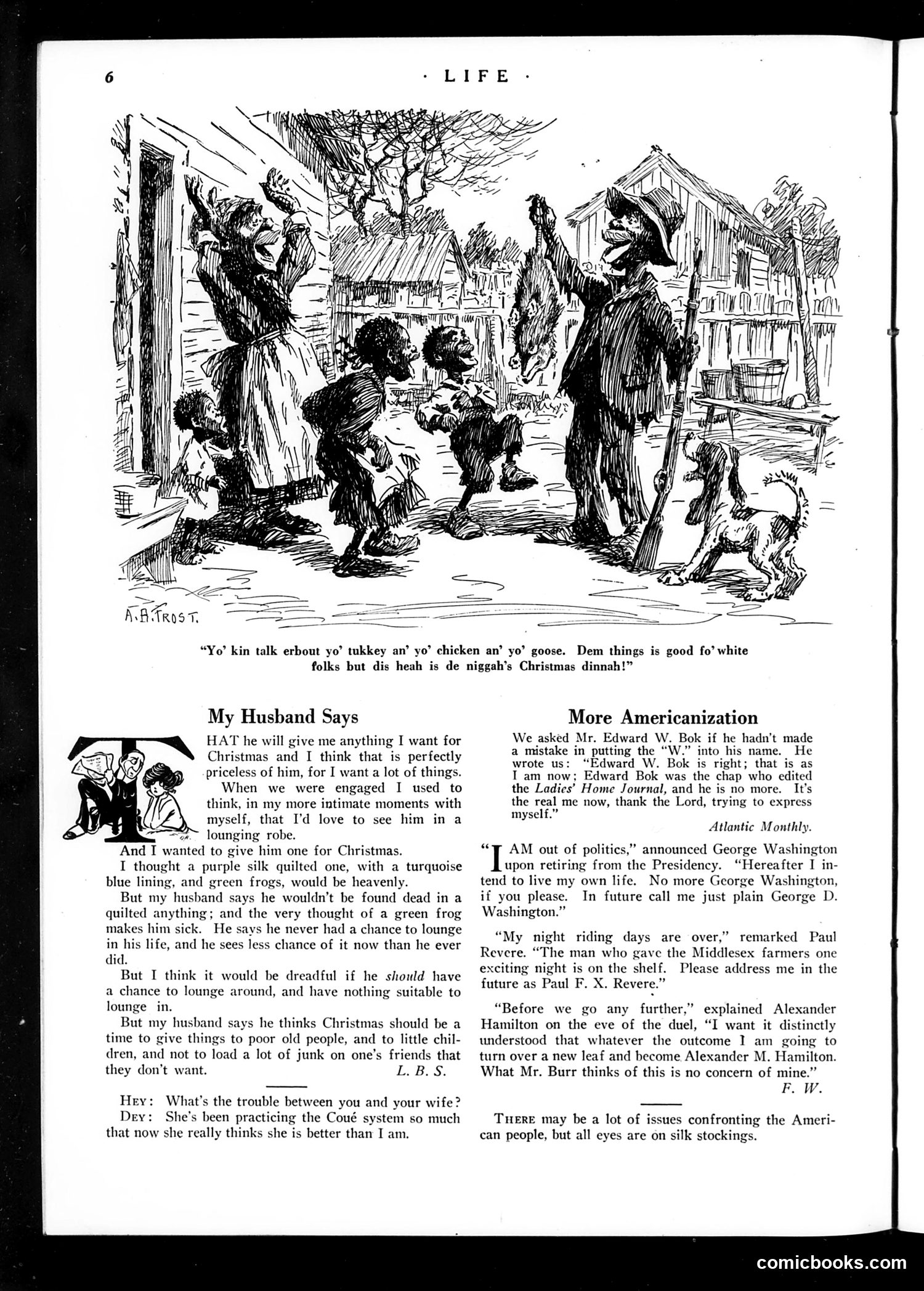
The main cartoon depicts an urban street scene with children and adults. The caption contains dialect humor presenting African American characters discussing Christmas gifts, using stereotypical speech patterns common to early 20th-century satirical publications. Below are three short humor sections. "My Husband Says" presents a domestic disagreement about Christmas gift-giving and loungewear. "More Americanization" collects brief anecdotes about famous men (George Washington, Paul Revere, Alexander Hamilton) adopting simplified versions of their names in modern life—a joke about Americanization reducing grand historical figures to casual informality. The final joke references the Coué system (a self-help method popular in the 1920s), suggesting a wife's practice of it has made her insufferable. The humor reflects period attitudes toward domestic life, immigration, and self-improvement trends.
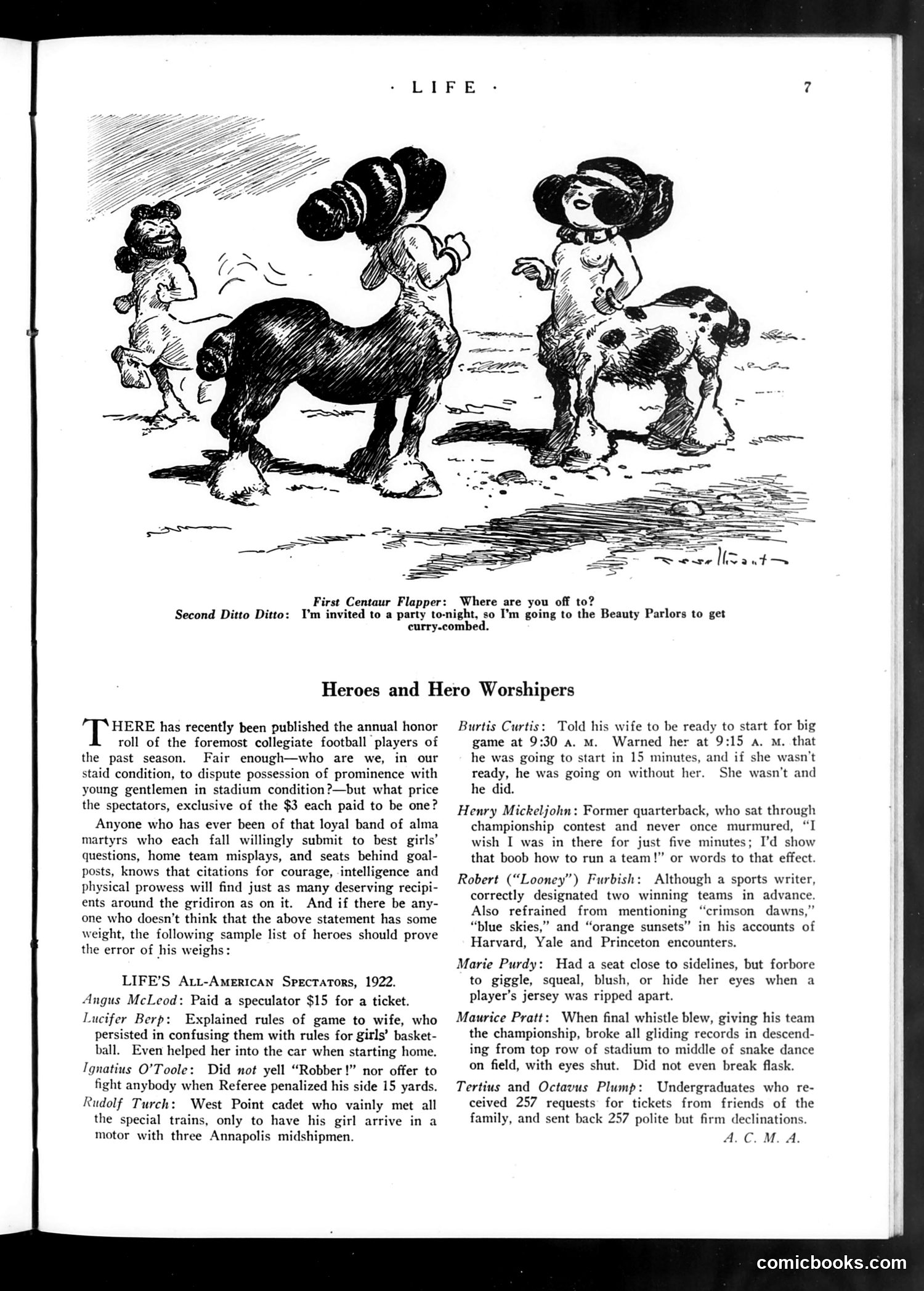
This 1922 *Life* cartoon satirizes the obsessive grooming habits of male athletes preparing for social events. The illustration shows three anthropomorphized dogs at a beauty salon—one getting its hair curled, another wearing a hat, a third waiting. The accompanying dialogue has the central dog explaining he's going to a party and needs his hair "curry-combed" (groomed). The satire mocks male vanity and the perceived excessive attention to appearance among young athletes of the era. The use of dogs emphasizes the absurdity. The accompanying text discusses famous athletes and spectators, suggesting this reflects broader cultural anxieties about masculinity and changing social standards around male self-care in the 1920s.
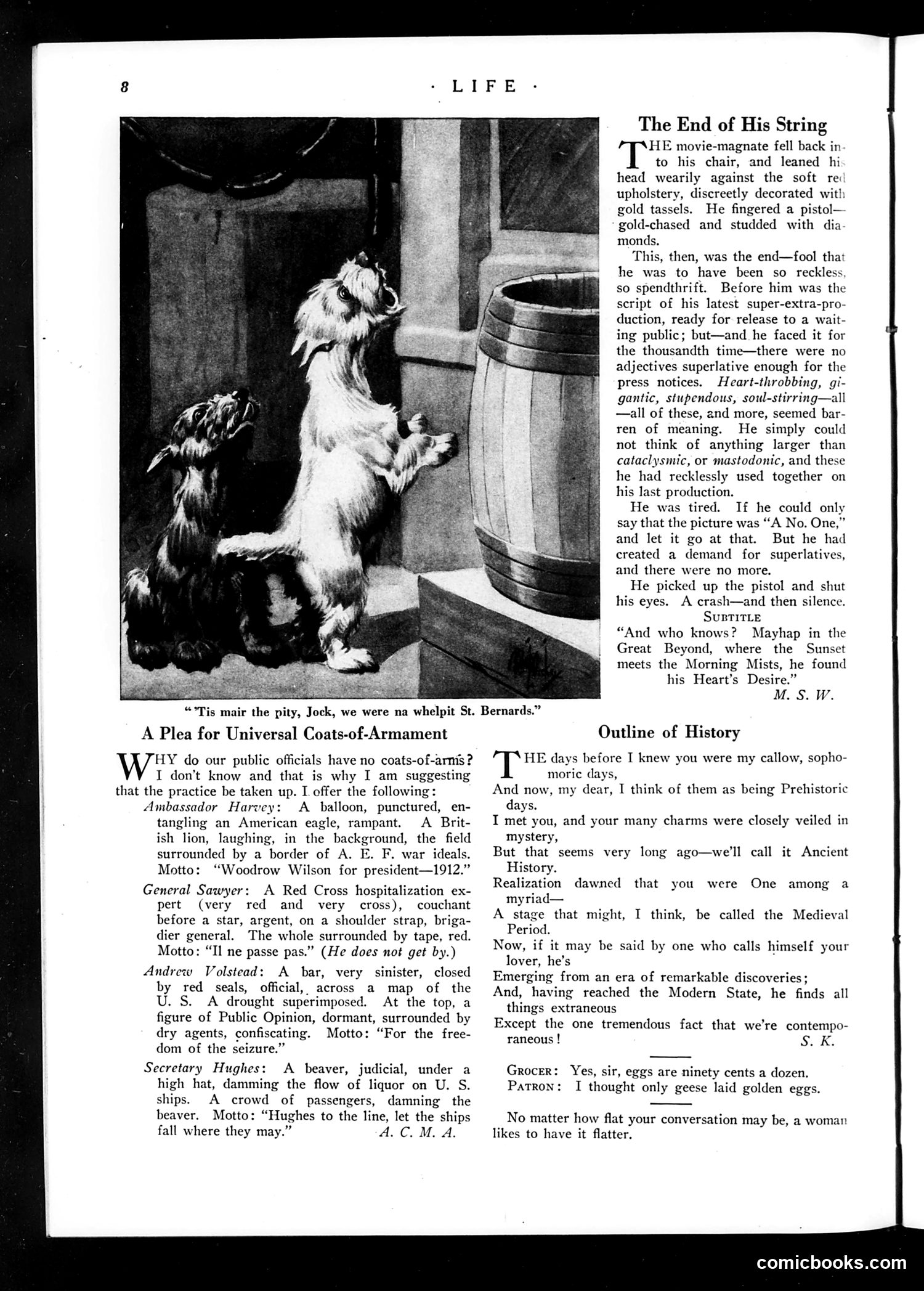
This page contains three separate short humor pieces rather than political cartoons. **"The End of His String"** is a fictional story about a exhausted movie producer who has run out of superlatives to describe his latest film. The satire targets Hollywood's practice of using excessive adjectives ("heart-throbbing," "gigantic," "soul-stirring") in press releases. **"A Plea for Universal Coats-of-Armament"** humorously suggests American public officials should wear military coats-of-arms with symbolic animals and mottos—offering absurd examples like an eagle for an ambassador and a beaver for Secretary Hughes. **"Outline of History"** is a romantic poem using historical periods (Prehistoric, Medieval, Modern) as metaphors for stages in a relationship. These are light satirical pieces on entertainment industry excess, government pretension, and romance—typical of Life magazine's humor approach.
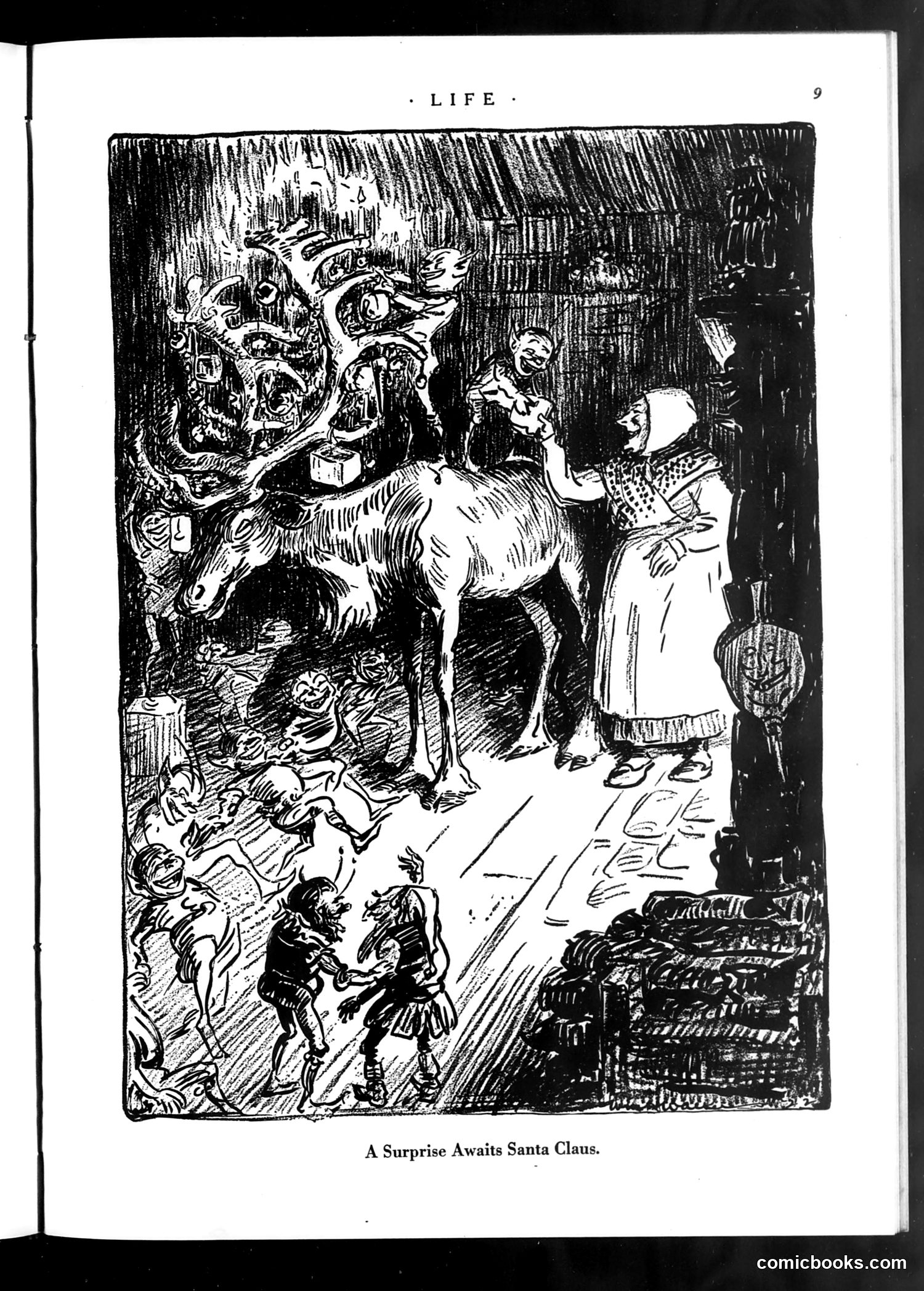
This cartoon satirizes the dangers Santa might encounter during what appears to be a chaotic, crowded holiday scene. The image shows Santa approaching a cottage or indoor setting where multiple figures—appearing to be children and adults—are gathered around what looks like a goat or similar animal. The scene is deliberately grotesque and crowded, filled with exaggerated characters and mayhem. The satire likely mocks the idealized image of Santa's Christmas visit against the messy reality of actual households during the holiday season—the noise, disorder, and unpredictability Santa faces. The "surprise" is presumably the bedlam he encounters rather than the peaceful, orderly homes typically depicted in sentimental Christmas imagery.
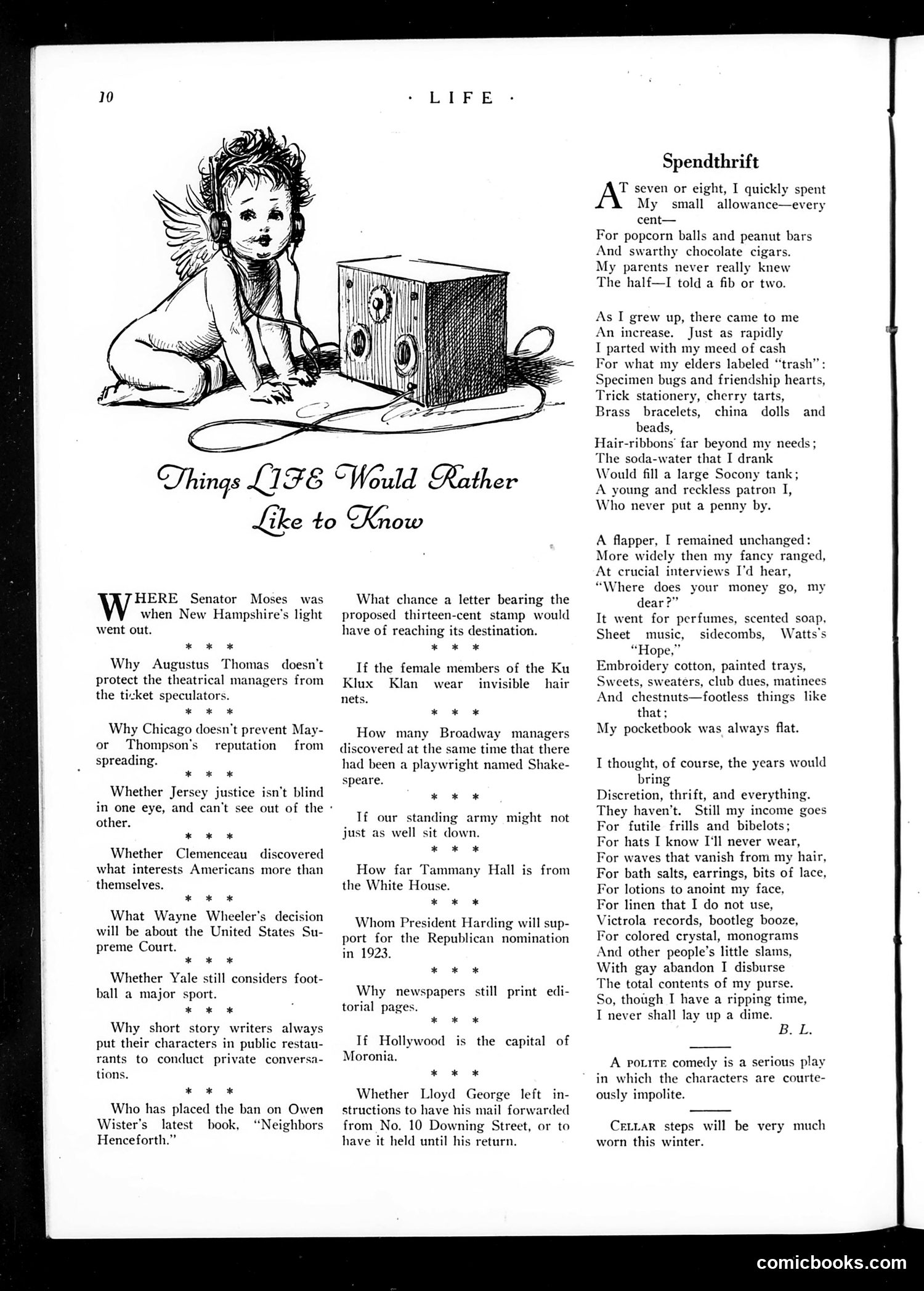
This page features a poem titled "Spendthrift" by B.L., accompanied by an illustration of a cherub or cupid-like figure next to a decorated box. The poem satirizes a young person's frivolous spending habits and lack of financial discipline. It describes how the narrator squandered their allowance on luxury items (chocolate, popcorn, jewelry, perfumes, sweets) rather than saving money. The tone is self-aware and humorous, admitting to wasteful purchases that elders dismissed as "trash." The left column contains miscellaneous trivia questions and observations (about politicians, institutions, and cultural figures), typical of Life's satirical format. The overall message criticizes youthful extravagance and poor money management—a recurring theme in 1920s satire about younger generations' consumption habits.
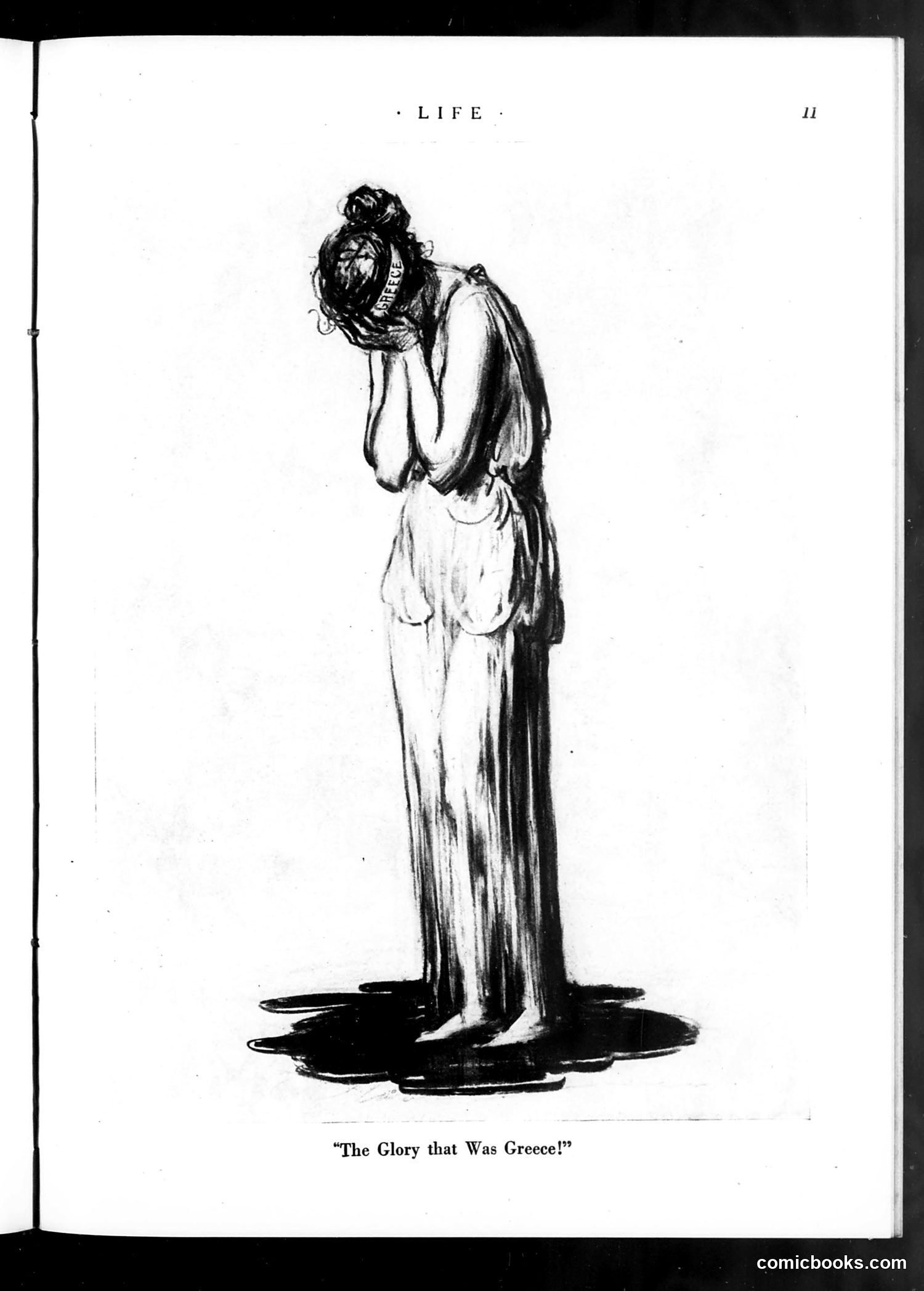
This illustration depicts a woman in classical Greek dress, standing in a contemplative pose with her head bowed or turned away. The caption's ironic quotation marks suggest satire. The image appears to criticize the romanticization of ancient Greece—specifically the contrast between idealized classical imagery and contemporary reality. The phrase "The Glory that Was Greece" references the famous line from Edgar Allan Poe's poem "To Helen," which celebrates Greek beauty and civilization. The satire likely comments on how modern society invokes classical ideals while ignoring their actual historical context or current social conditions. The woman's pose—modest yet vulnerable—may critique how classical aesthetics were selectively mythologized, particularly regarding femininity and beauty standards. Without additional context, the specific social or political target remains somewhat unclear.
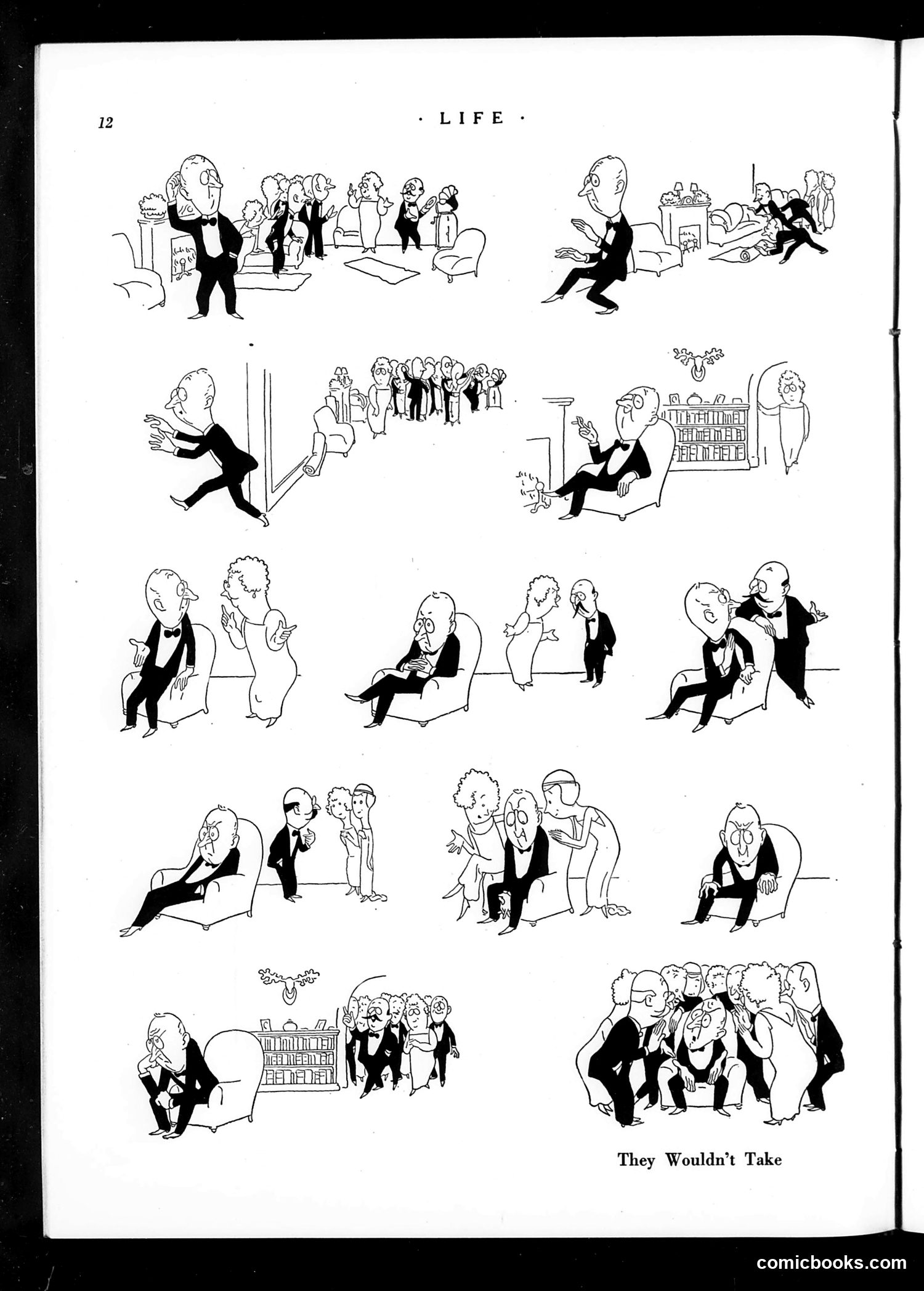
This page from *Life* magazine depicts a series of comic scenarios showing a well-dressed man in formal attire (likely representing a wealthy businessman or diplomat) persistently attempting to give money or bribes to various people—government officials, society figures, and institutions—but being consistently refused. The repeated rejection of his offers suggests satire about either: - A wealthy person's unsuccessful attempts at bribery or corruption - Social climbers unable to "buy" their way into respectability - Political figures rejecting questionable financial inducements The title "They Wouldn't Take" emphasizes the punchline: despite his wealth and efforts, money cannot purchase what he seeks, whether political favor, social acceptance, or institutional cooperation. The satire likely critiques either corruption attempts or misplaced faith in wealth's power.
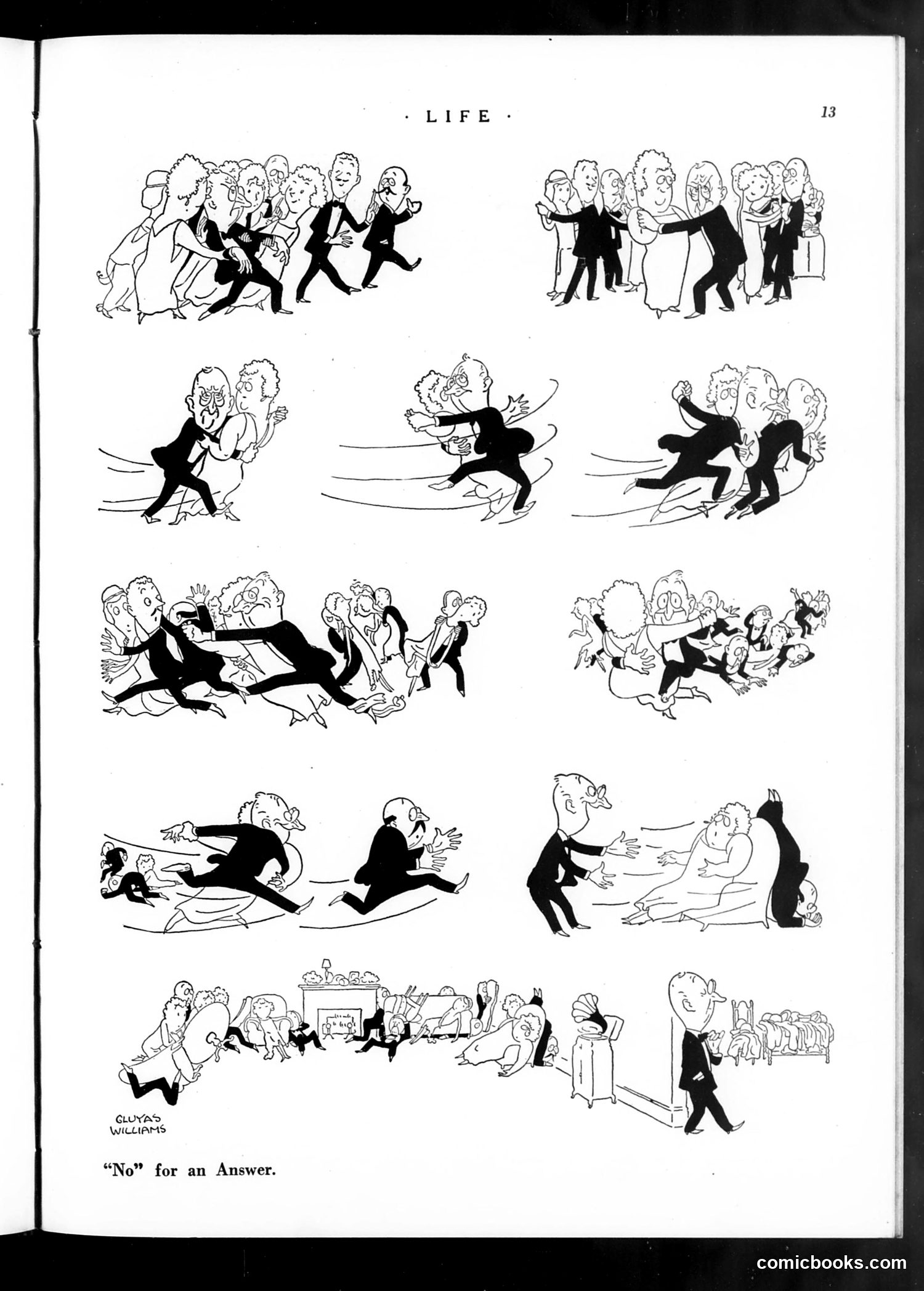
This satirical comic strip by Gluyas Williams shows a man persistently pursuing a woman through various social situations—at parties, on the street, at dining establishments—despite her clear rejection. Each panel depicts him attempting different tactics: following her in crowds, cornering her at gatherings, chasing her physically, and interrupting her meals. The title "'No' for an Answer" indicates the woman's repeated refusals are ineffective against his relentless pursuit. The satire critiques aggressive male persistence in courtship, mocking men who interpret rejection as a negotiable position rather than a final answer. Williams uses exaggerated, comedic illustrations to highlight the absurdity and unacceptability of refusing to accept a woman's stated "no."
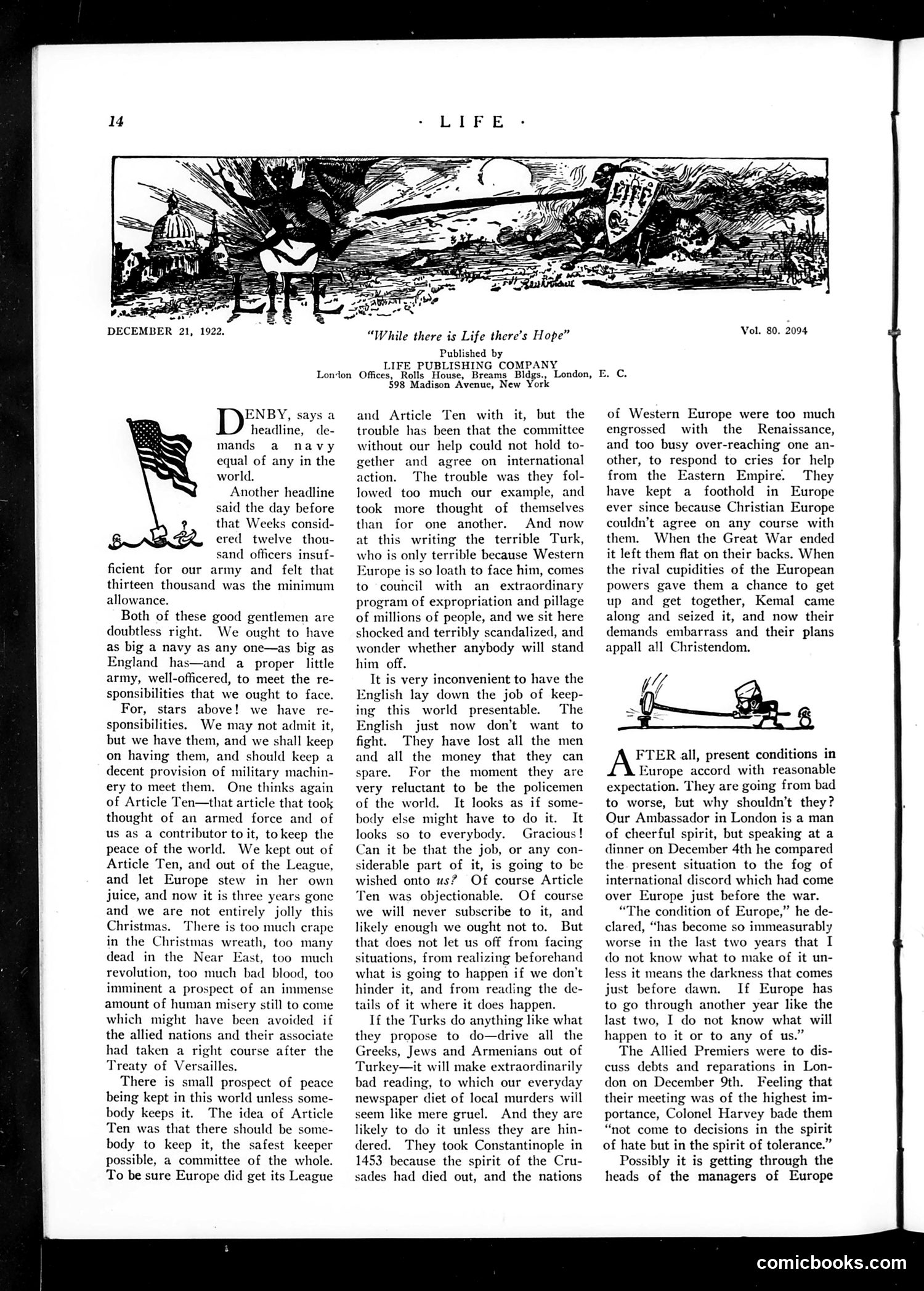
**The Masthead Cartoon:** The ornate header illustration depicts a dramatic scene with classical architectural elements (a domed building, likely representing government institutions) amid chaotic imagery—figures, weapons, and turbulent skies. The motto "While there is Life there's Hope" suggests satirical commentary on post-WWI instability. **The Article's Context:** The text discusses international military concerns, specifically Denby's call for a strong navy. It critiques Europe's disorder following World War I, particularly regarding conflicts in Eastern Europe and tensions with Turkey. The passage references the failed League of Nations efforts to maintain peace and questions whether European powers can achieve stability without American intervention. The satire targets the irony of hope amid widespread diplomatic failure and geopolitical chaos.
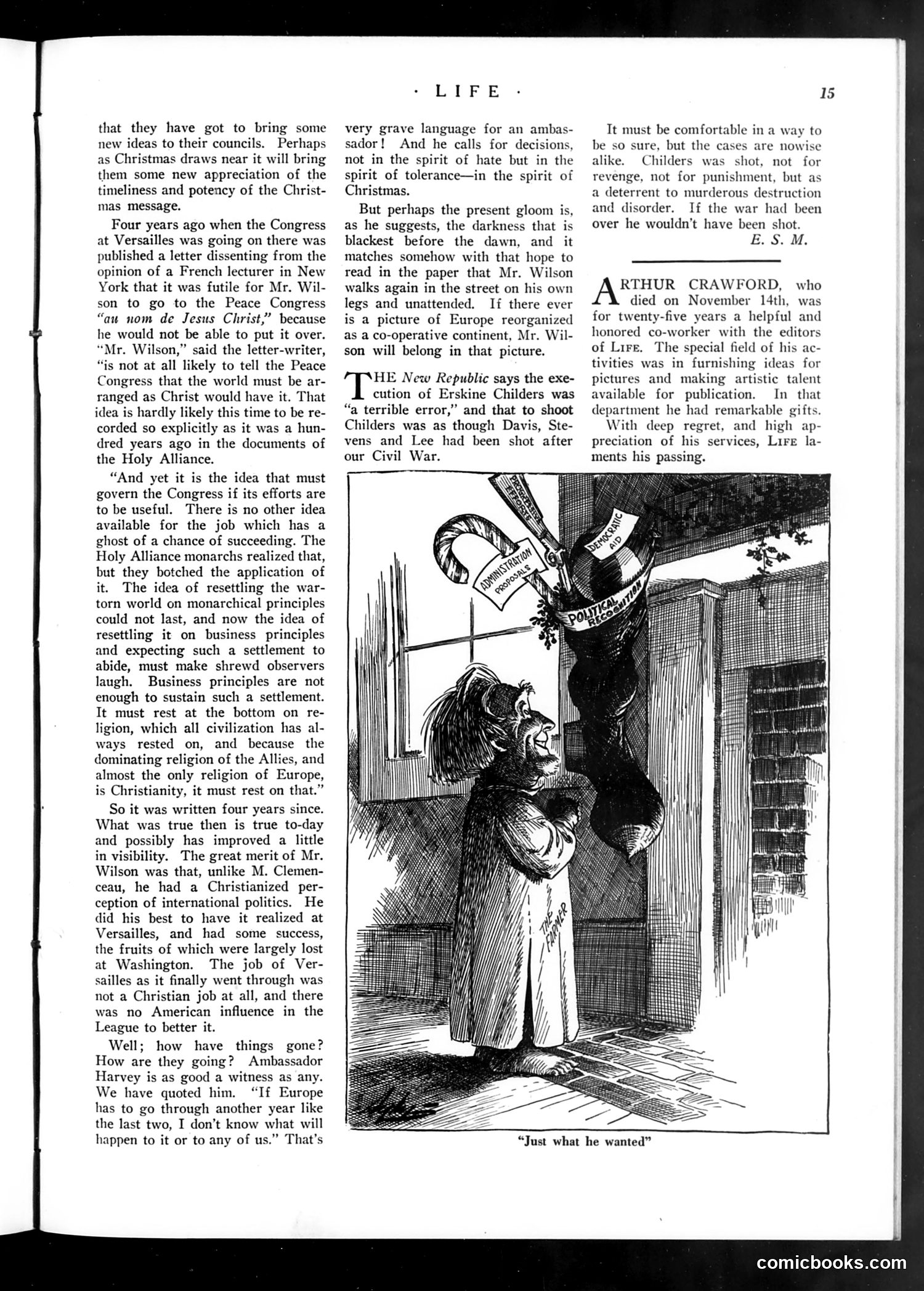
This cartoon satirizes post-World War I European instability and American foreign policy. The figure appears to be a caricatured representation of chaos or disorder in Europe—depicted as a disheveled, aggressive entity climbing or clawing at what looks like a barrier or wall labeled with references to "Police" or governmental authority. The accompanying text discusses President Wilson's idealistic, Christian-based approach to the 1919 Treaty of Versailles and international peace, contrasted with the subsequent failure of those principles at Washington. The cartoon critiques how Europe's post-war settlement, built on business and political expediency rather than moral/Christian principles, has descended into violence and disorder. The caption "Just what he wanted" likely refers ironically to how certain political forces—whether European militarists, revenge-seekers, or cynical realists—achieved exactly the chaotic outcome they desired when idealistic peace efforts failed.
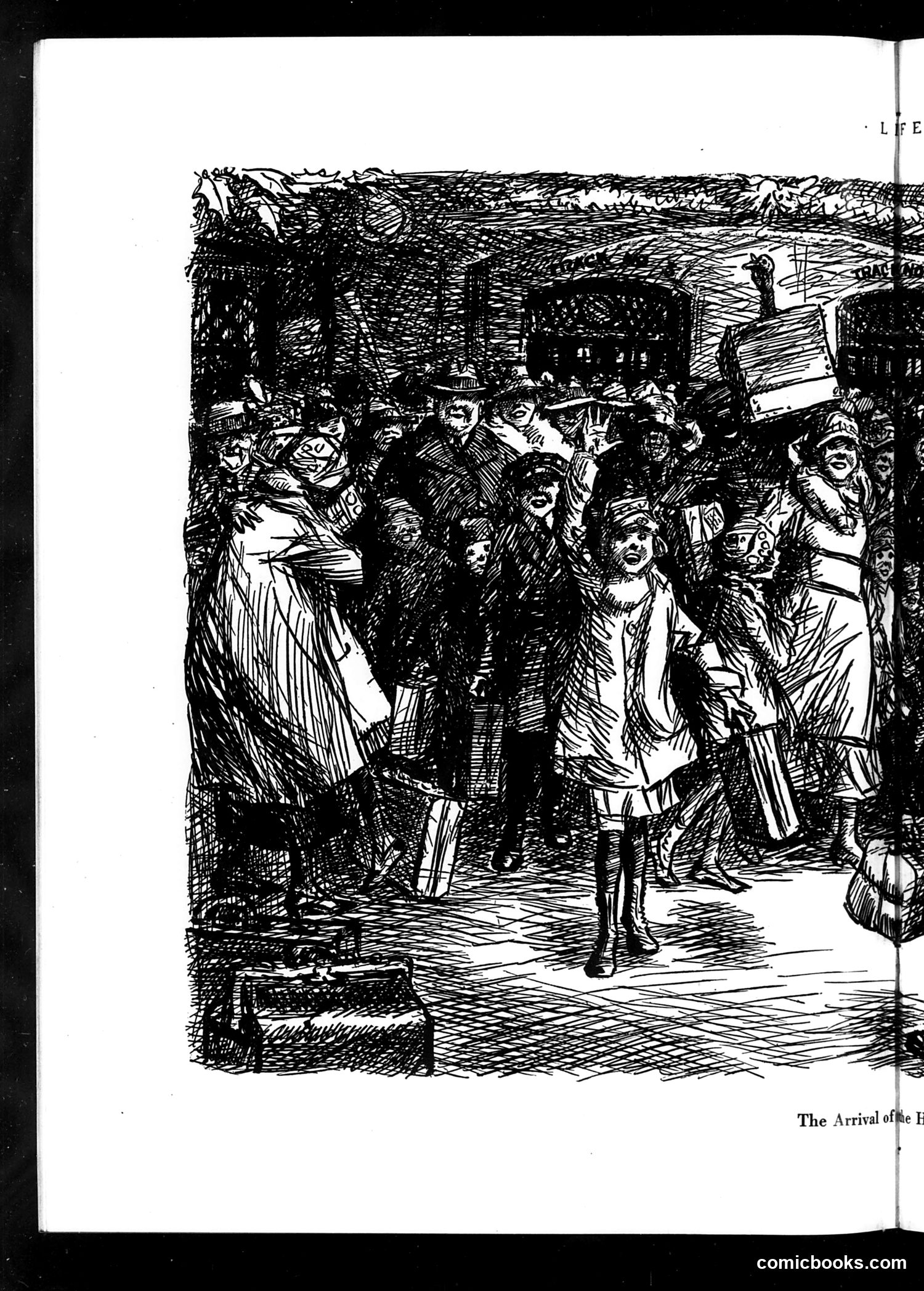
This appears to be a sketch illustration titled "The Arrival of [text cut off]" from Life magazine. The image shows a crowded scene at what looks like a train station or public arrival point, with numerous figures in early 20th-century dress gathered around a central figure. However, the OCR text is severely corrupted and unreadable, making it impossible to determine the specific subject, event, or satirical point being depicted. Without legible text identifying who or what is arriving, I cannot reliably explain what political or social commentary this cartoon intends. The artistic style and composition suggest social satire typical of Life's era, but the specific target remains unclear from this page alone.
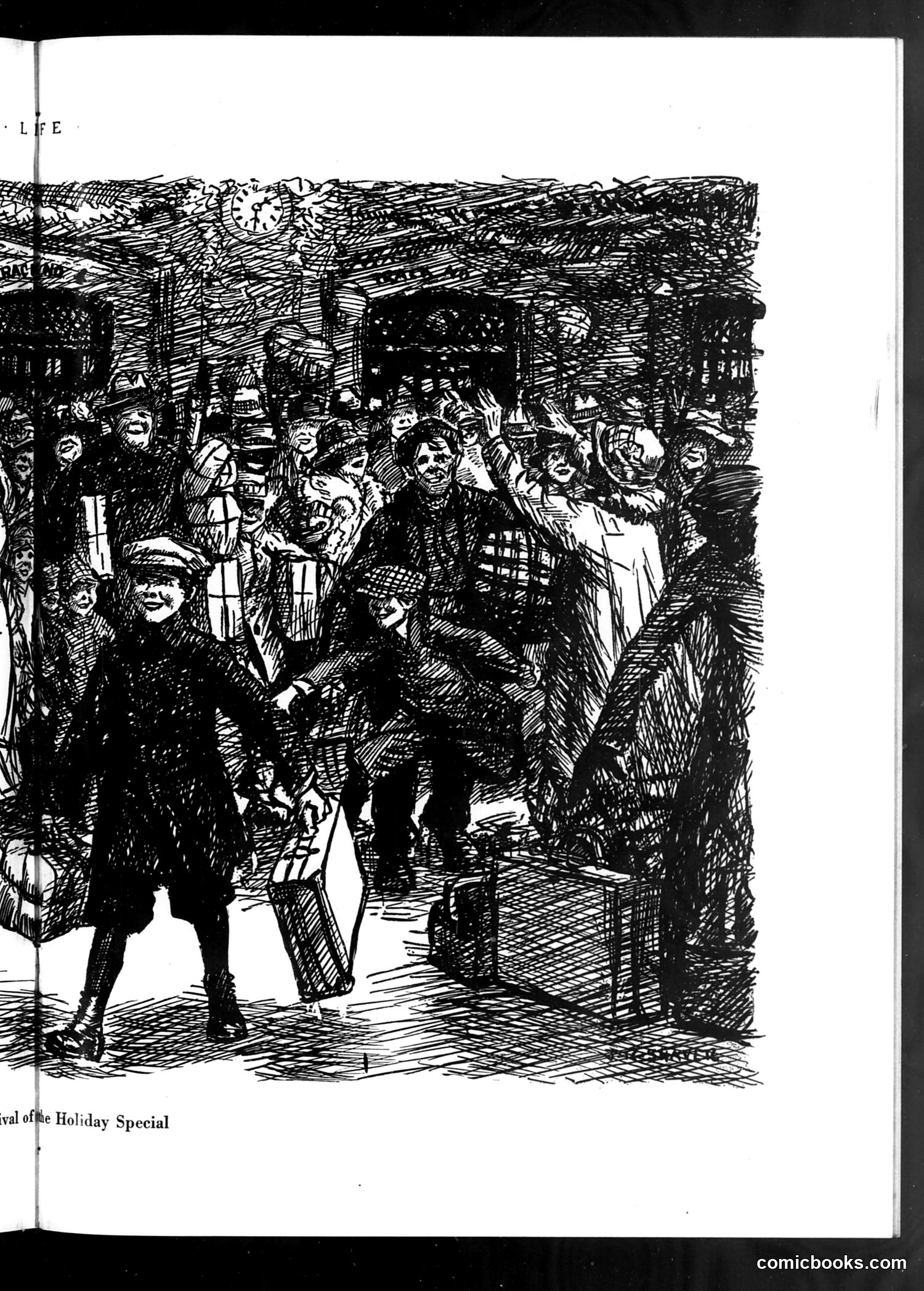
This page appears to be from Life magazine and shows a crowded indoor scene—likely a train station, market, or public gathering—rendered in dense cross-hatching ink style. The figures are dressed in early-to-mid 20th century clothing and hats. The caption references "val of the Holiday Special," suggesting this illustrates holiday shopping or travel chaos. The cartoon satirizes the crowded, hectic nature of holiday season activities—a common Life magazine subject. The mass of humanity packed into the space, with varied expressions and body language, conveys satirical commentary on commercial holiday frenzy and public disorder during the season. However, the OCR text is heavily corrupted, making specific references unclear. Without clearer text or visible publication date, precise dating and intent cannot be definitively determined.
This page reviews Broadway theatrical productions from around 1924. The critic discusses three shows: **"Listening In"** — A supernatural thriller featuring a ghost, haunted house, and spiritualist phenomena (automatic writing, ectoplasm). The reviewer finds it derivative, noting audiences grew immune to such "spook" plays after earlier hits like "The Cat and the Canary" and "The Last Warning," where the ghost predictably turns out to be the District Attorney. **"The Bunch and Judy"** — A musical comedy produced by Dillingham, featuring famous dancers the Astaires and the Brown Brothers. Despite advance hype and talented performers, the critic finds it disappointing because composer Jerome Kern's score is weak compared to his previous work. **"Liza"** — A show featuring an all-Black cast performing with such energetic zest that the reviewer jokes they'll collapse from exhaustion, comparing it favorably to the predecessor "Shuffle Along." The tone is witty and gossipy, typical of Life's satirical theater criticism of the era.
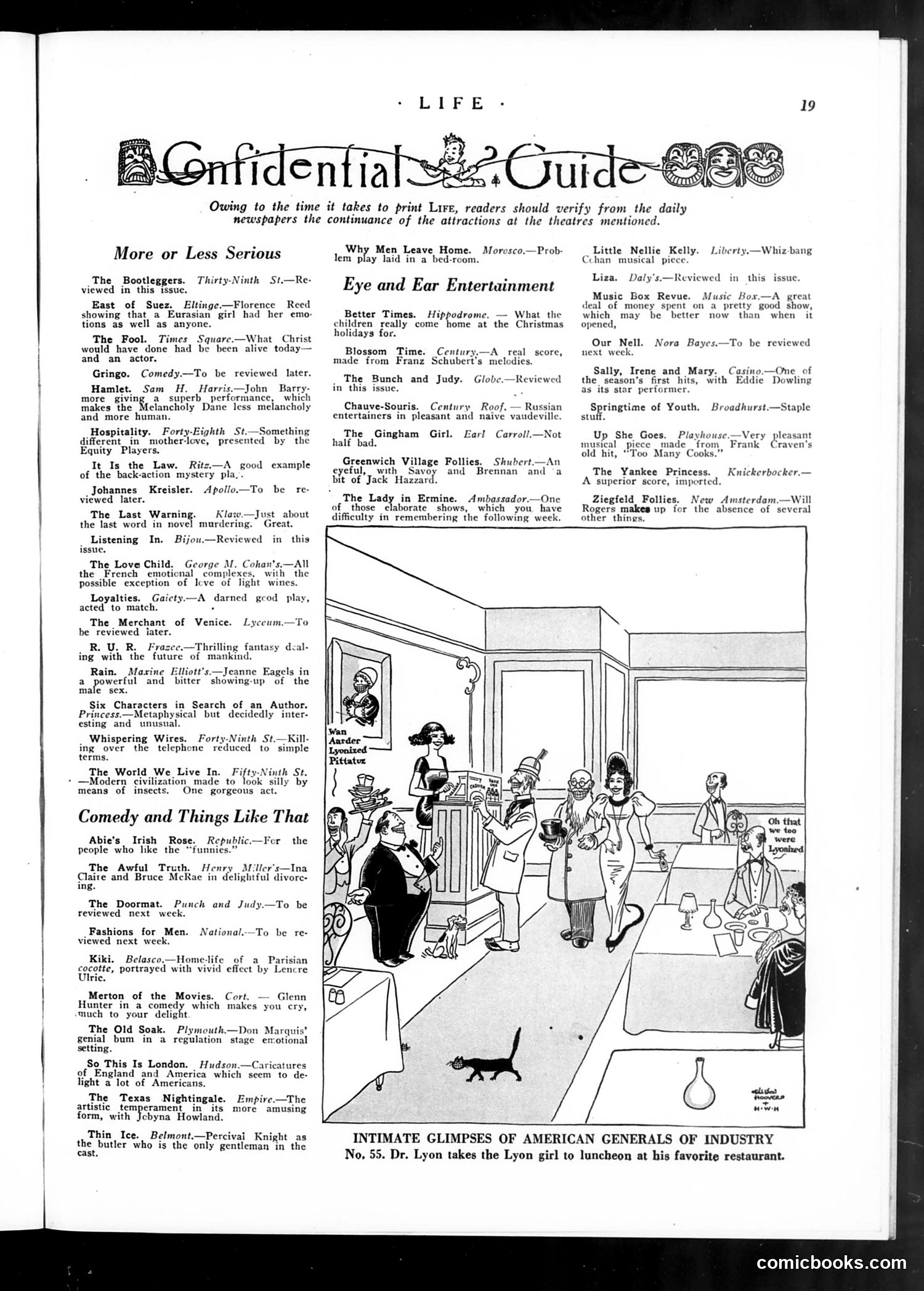
This is a theater review and entertainment guide page from *Life* magazine. The main content lists Broadway shows with brief critical assessments—a standard feature of the era's entertainment journalism. The illustration at bottom depicts "Intimate Glimpses of American Generals of Industry, No. 55: Dr. Lyon takes the Lyon girl to luncheon at his favorite restaurant." This appears to be satirical commentary on wealthy industrialists' leisurely lifestyles during the 1920s. The cartoon shows an elaborate restaurant scene with numerous diners, illustrating how the wealthy conducted business and social life in public dining establishments. The satire's point: American industrial titans enjoyed conspicuous luxury and public visibility, presenting an image of success and sophistication. The caption's playful tone—treating a businessman's lunch outing as newsworthy—gently mocks both the self-importance of such figures and society's fascination with their activities. This reflects post-WWI American culture's complex relationship with its new industrial elite.
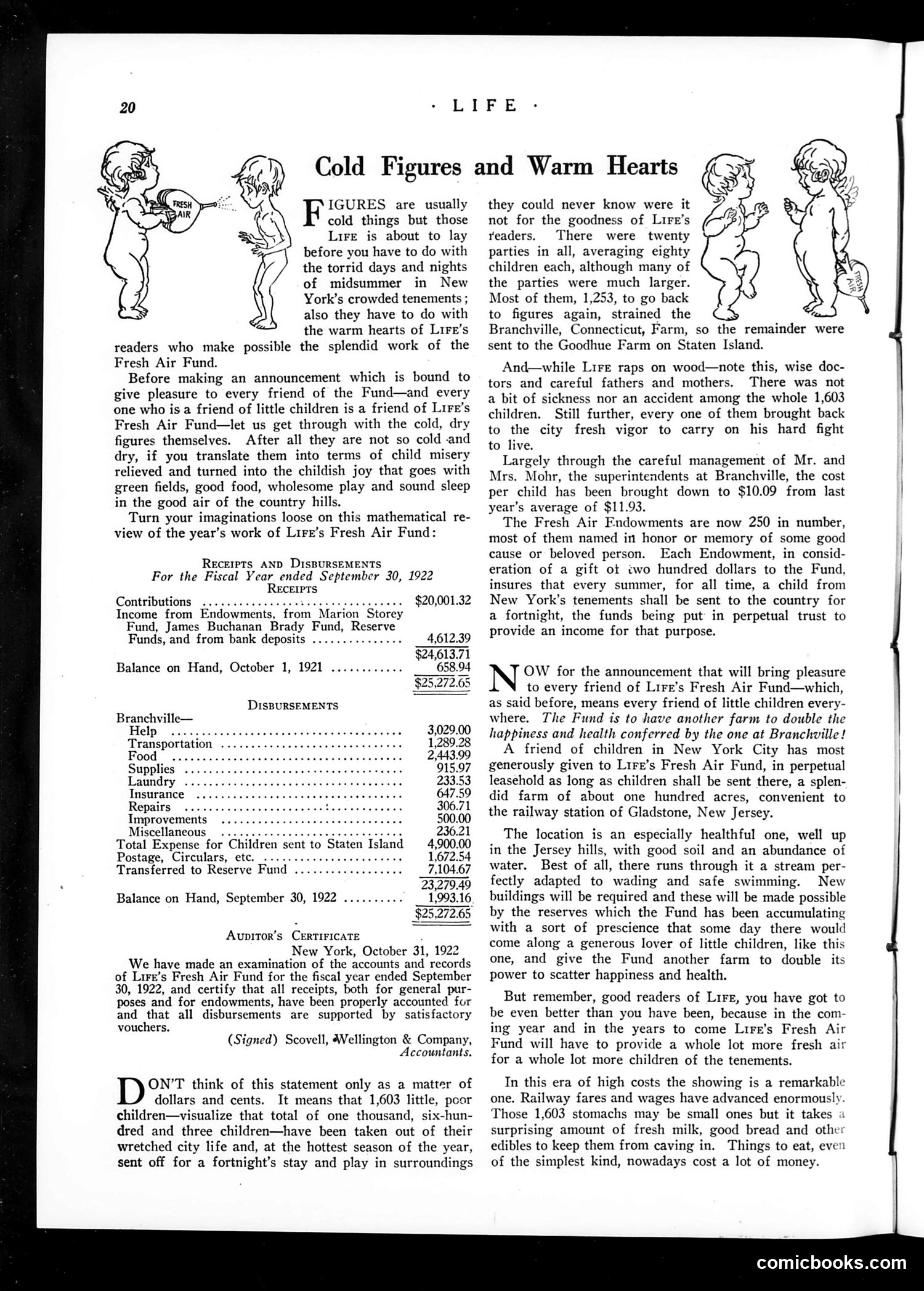
This page announces LIFE magazine's Fresh Air Fund, a charitable initiative sending poor children from New York City tenements to country farms during summer months. The decorative cartoons at the top—simple drawings of cherubic children—illustrate the "warm hearts" of the title, contrasting with financial "cold figures." The article celebrates that 1,603 children were sent to Branchville, Connecticut and Staten Island farms in the 1922 fiscal year, with zero illness or accidents reported. It emphasizes the fund's efficiency: costs dropped from $11.93 to $10.09 per child annually. The "Endowments" section explains how donors could permanently fund a child's annual country visit by contributing $200. This appeals to wealthy readers' philanthropic impulses while addressing a real social problem: tenement children's exposure to disease and hardship during New York's hot summers. The page reflects Progressive Era charity efforts targeting urban poverty, framing rural air and rest as health solutions for working-class families.
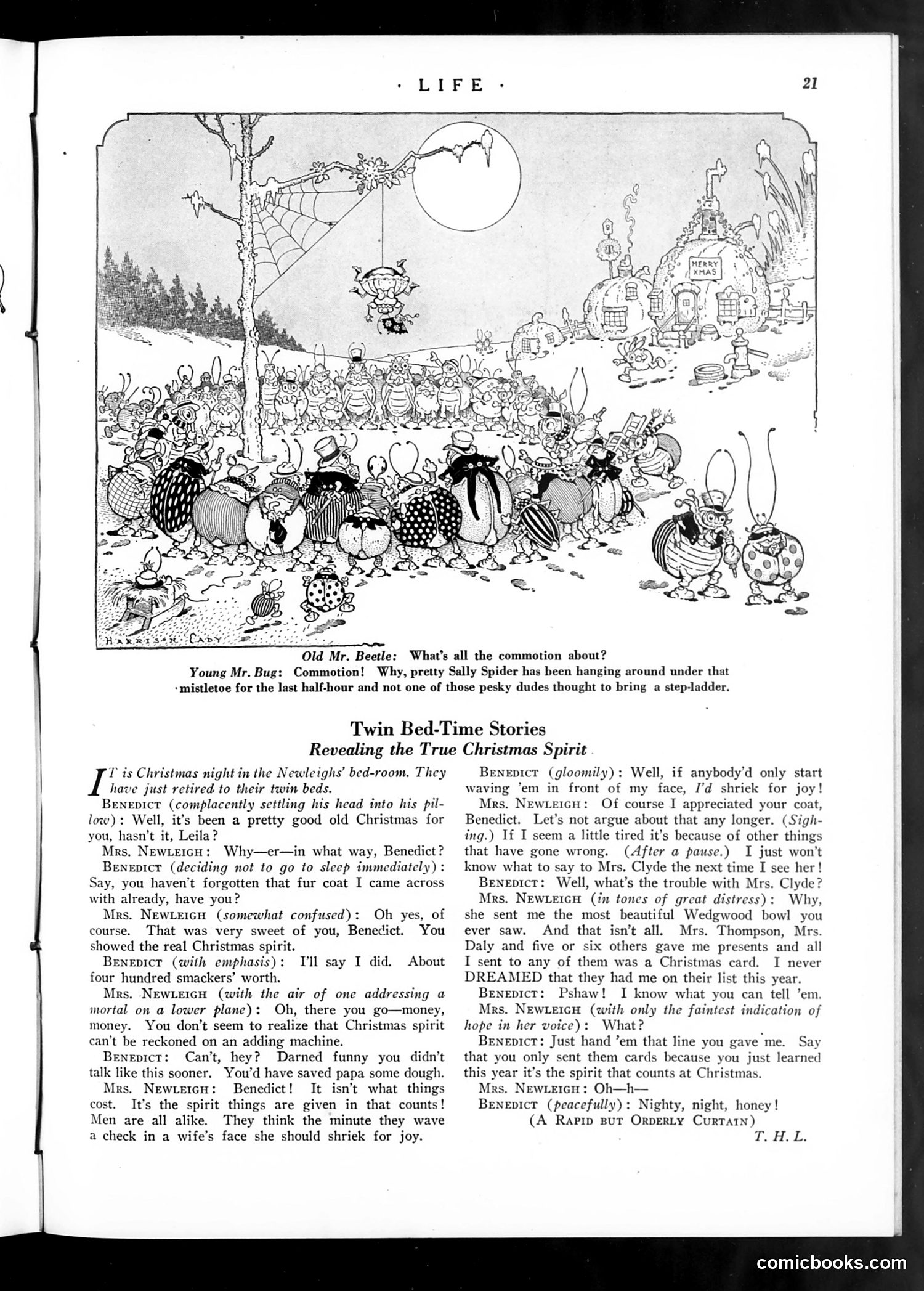
**The Cartoons:** The top cartoon depicts anthropomorphic insects at a Christmas gathering. A spider (Sally) has positioned herself under mistletoe, but the male bugs lack a step-ladder to reach her—a visual gag playing on the mistletoe-kissing tradition while mocking the bugs' practical incompetence. **"Twin Bed-Time Stories" Dialogue:** This satirizes middle-class hypocrisy about Christmas values. Benedict gave his wife Leila an expensive fur coat (costing hundreds of dollars), expecting gratitude. However, Leila rebukes him for equating gift-giving with money rather than "Christmas spirit." The irony emerges when Leila confesses her real distress: she received expensive gifts from acquaintances (Mrs. Clyde's Wedgwood bowl) but only sent them Christmas cards. Benedict cynically suggests she use her own "spirit over materialism" argument as an excuse. **The Satire:** The piece mocks the contradiction between professed Christmas ideals (spiritual generosity) and actual behavior (monetary anxiety and social one-upmanship). Both spouses are exposed as hypocritical—he for materialistic gift-giving, she for social embarrassment over gift imbalances despite her moral posturing.
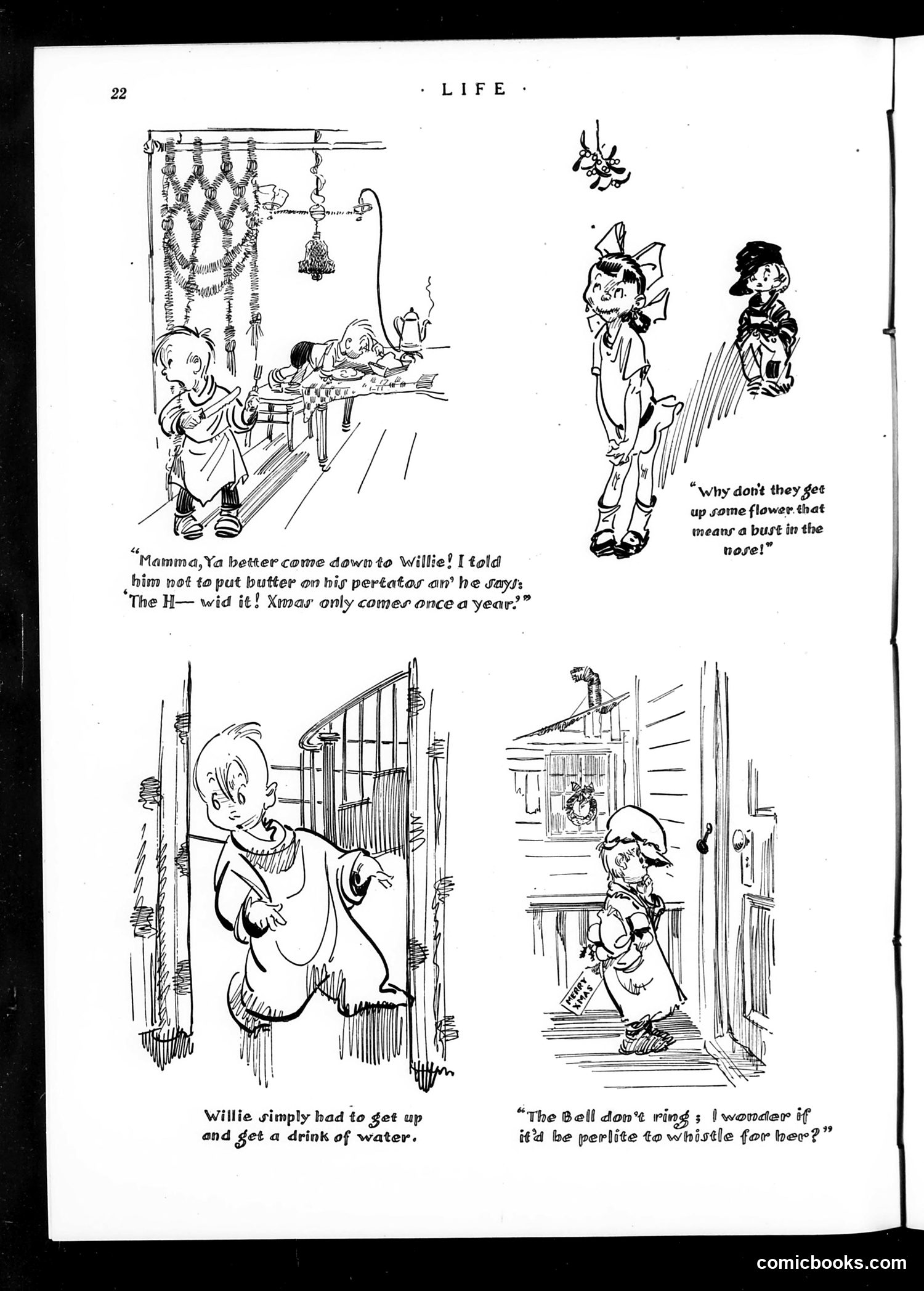
This page contains four domestic humor cartoons centered on childhood misbehavior and parental discipline, typical of early 20th-century Life magazine content. **Key scenarios:** 1. **Top left**: A mother warns about Willie putting butter on potatoes at Christmas dinner—he dismisses her objection with "The H— with it! Xmas only comes once a year," suggesting holiday excess justifies rudeness. 2. **Top right**: Children discuss flowers that cause sneezing, seeking one to prank someone. 3. **Bottom panels**: Willie interrupts his mother's activities first for water, then the doorbell fails and a girl wonders if whistling is proper etiquette. The humor relies on period-specific details: strict Victorian manners, Christmas as rare indulgence, and children's innocent mischief testing parental authority. The "H—" censoring was standard for the era. These cartoons mock both children's logic and adult formality, appealing to readers navigating changing social conventions of the time.
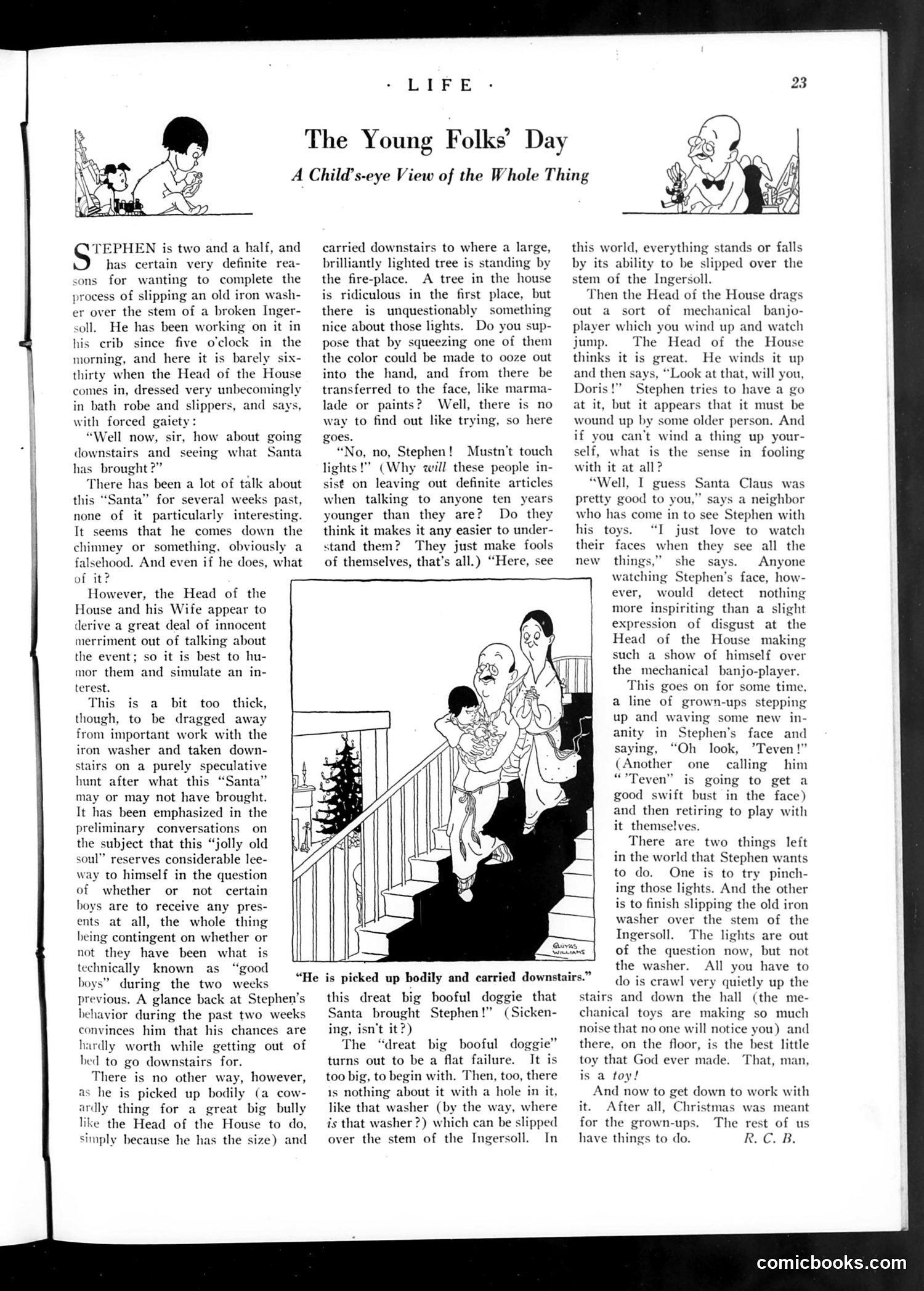
This article humorously presents Christmas morning from a two-and-a-half-year-old boy's perspective. Stephen is unimpressed with adult enthusiasm for Santa Claus and Christmas gifts because they interrupt his real work: trying to slip an iron washer over a broken watch stem. The satire mocks how adults condescend to children—using simplified speech ("dreat big booful doggie," "mustn't touch lights")—while completely misunderstanding what actually interests them. Stephen's new toys (a toy dog, mechanical banjo-player) fail his practical test: nothing can be disassembled or manipulated like his washer. The piece satirizes both children's logic (judging toys by mechanical functionality rather than purpose) and parental delusion about holiday magic. The illustration shows the child being carried downstairs against his will, indifferent to the decorated tree and presents. The joke is that children operate on entirely different values than sentimental adults imagine.
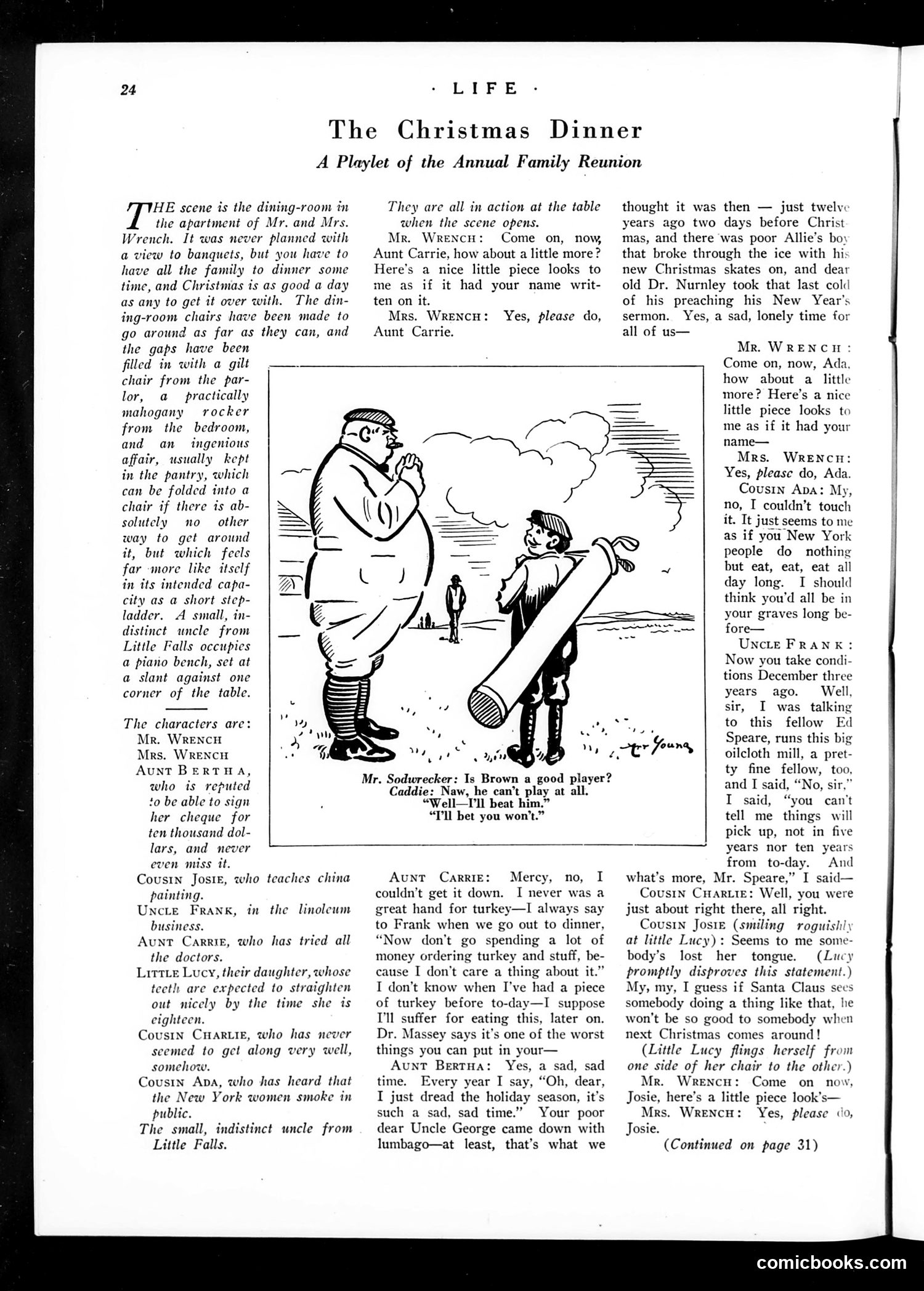
This is a humorous playlet satirizing the typical American family Christmas dinner gathering. The joke lies in depicting the *tedium* of forced family togetherness through overlapping, rambling conversations that reveal the characters' predictable social types. The cartoon shows Mr. Sodwrecker and a caddie discussing golf—a non-sequitur interrupting the dinner scene, emphasizing how disconnected family members are from each other despite sharing a table. The surrounding text captures stereotype relatives: Aunt Bertha complains about holidays being "sad"; Aunt Carrie obsesses over health concerns; Uncle Frank launches into a tangential business anecdote; Cousin Ada criticizes New Yorkers' eating habits. The satire mocks how family members drone on with personal grievances, health anxieties, and self-interested stories rather than genuinely connecting. The setup itself—mismatched borrowed chairs, cramped quarters—reinforces that this gathering is obligatory rather than joyful. The humor targets middle-class family obligation and the performative nature of holiday reunions.
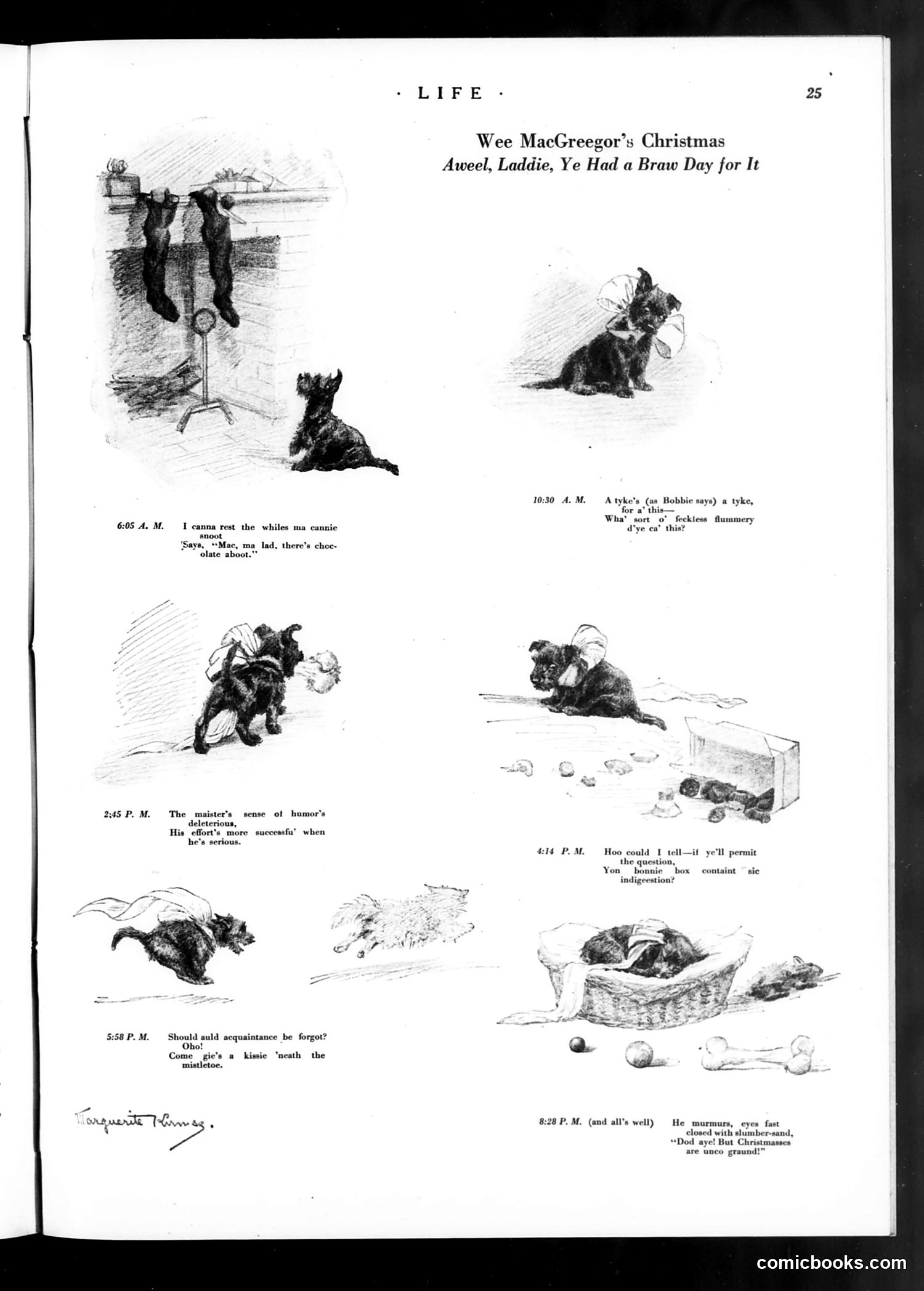
This is a humorous illustrated narrative following a Scottish child named Wee MacGregor through Christmas Day, using Scottish dialect ("Aweel," "feckless," "unco graund"). The comic strips show the boy's activities across key times: unable to sleep at 6:05 AM due to excitement, receiving gifts, playing roughly with an adult at 2:45 PM, finding coal in a stocking at 4:14 PM (a common joke about naughty children), attempting to recite "Auld Lang Syne" at 5:58 PM, and finally contentedly asleep at 8:28 PM, expressing that "Christmasses are unco graund" (uncannily grand/wonderful). The satire gently mocks childhood Christmas excitement and behavior—the impatience, messiness, and eventual exhaustion—while celebrating the holiday's simple joys. It's sentimental rather than sharp political satire, appealing to readers' nostalgia for childhood wonder.
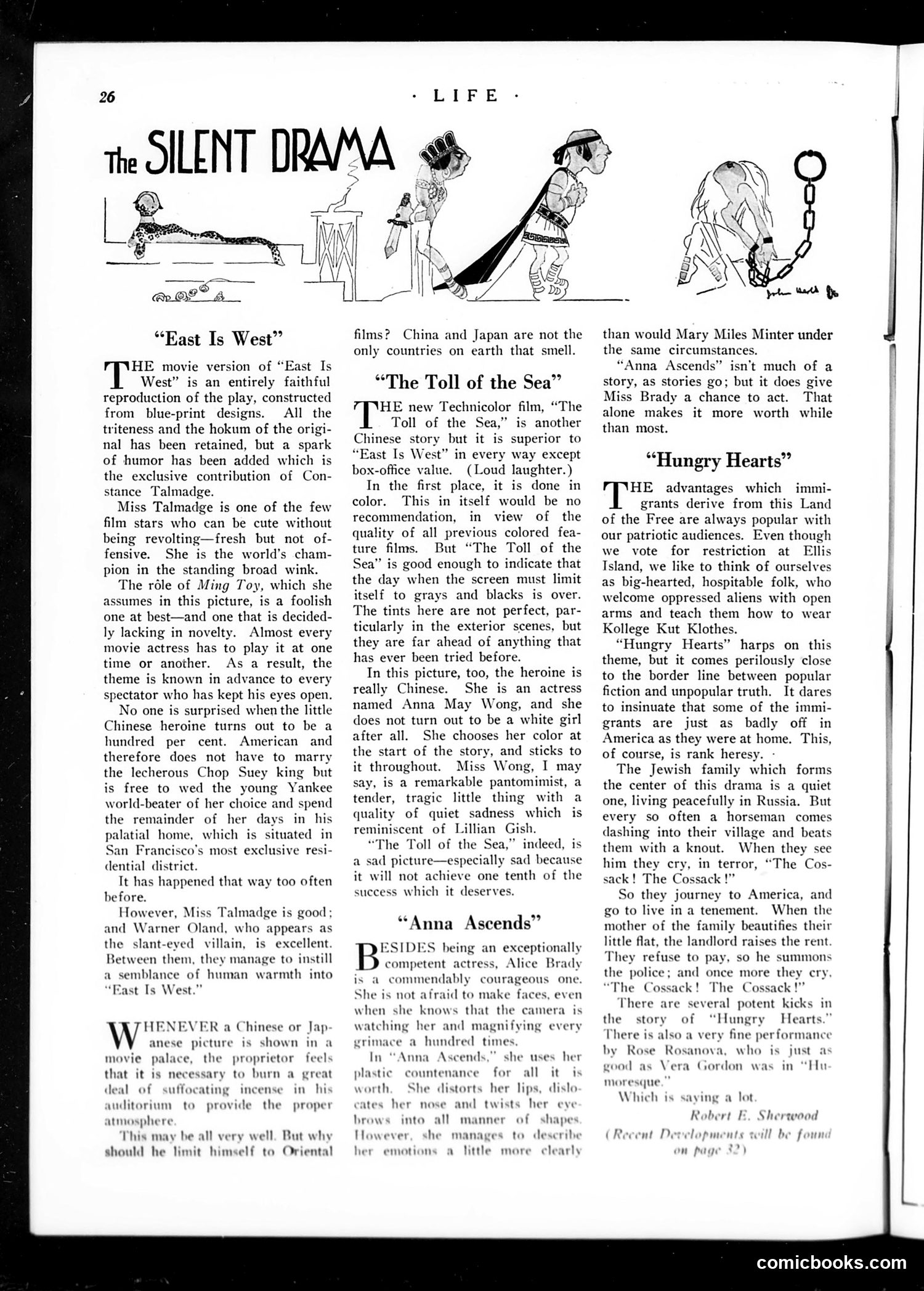
This page contains three film reviews from the silent era (likely early 1920s), with satirical commentary on Hollywood's treatment of Asian characters. **"East Is West"** reviews a movie adaptation where actress Constance Talmadge plays "Ming Toy," a Chinese character who predictably turns out to be fully American, allowing her to marry a white American man rather than a "lecherous Chop Suey king." The reviewer notes this plot has been done "too often before," mocking both the tired stereotype and Hollywood's apparent need for such resolutions. **"The Toll of the Sea"** praises a Technicolor film because its Chinese heroine, played by Anna May Wong, actually *remains* Chinese throughout—a notable distinction. The review treats this as progressive, suggesting Wong's authentic casting and her performance quality elevate the film. **"Anna Ascends"** reviews Alice Brady's expressive acting. The page's opening cartoon satirizes theater owners burning incense during Asian-themed films, suggesting this performative "Orientalism" is unnecessary—a jab at manufactured exoticism in entertainment.
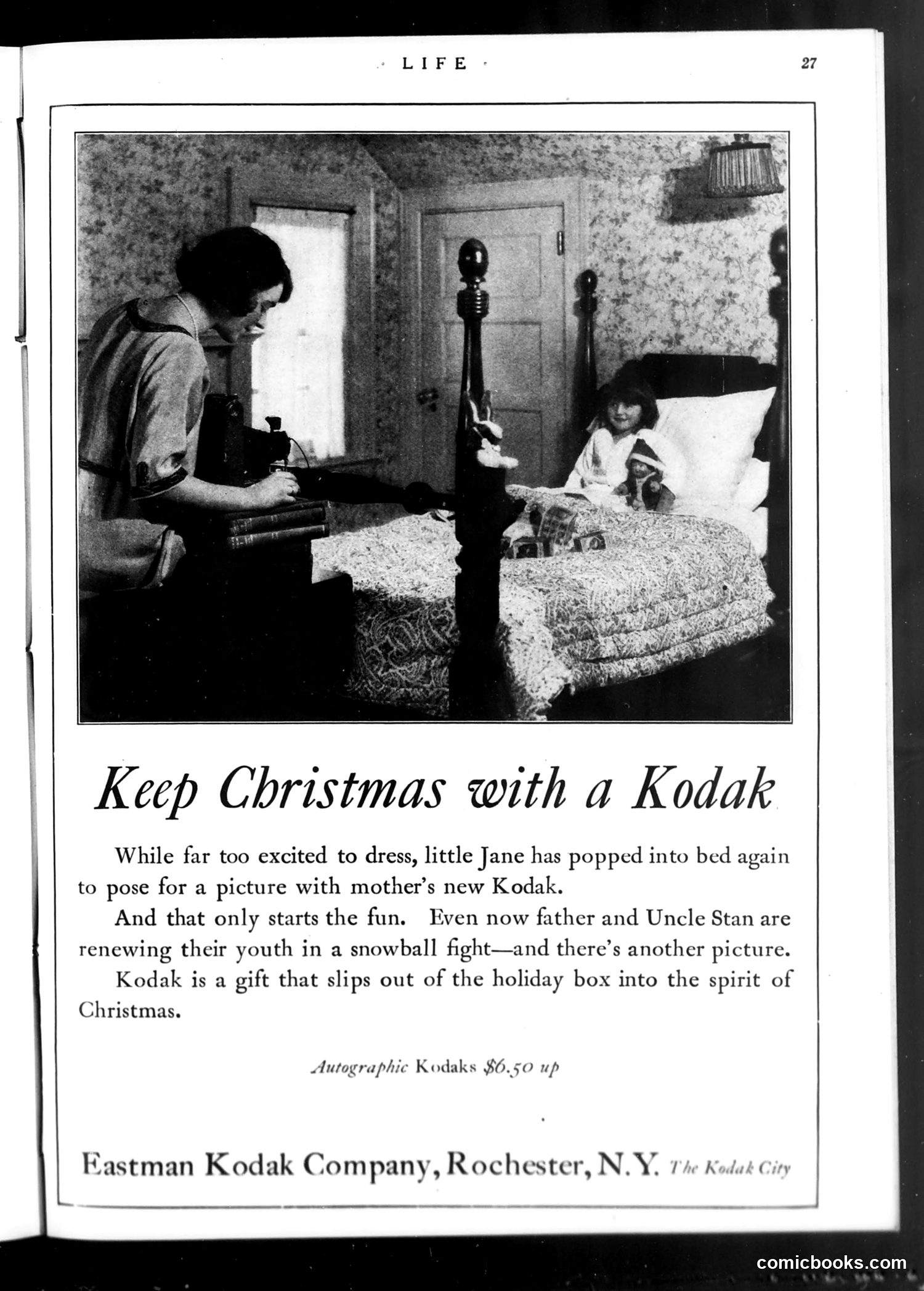
This is **not a cartoon or satire**—it's a straightforward **product advertisement** for Kodak cameras, appearing in *Life* magazine (page 27). The image shows a domestic Christmas scene: a mother photographing her daughter in bed with a new Kodak camera. The accompanying text describes how the camera becomes central to holiday enjoyment—the father and uncle are also taking pictures during a snowball fight. **The appeal:** The ad frames photography not as a luxury but as a way to *capture and preserve* family Christmas moments, making the camera itself a gift that enhances the holiday experience rather than competing with it. **Historical context:** This represents early 20th-century marketing of consumer photography to middle-class families. Kodak's slogan "You press the button, we do the rest" had democratized photography, and this ad emphasizes the emotional value—memory-making—rather than technical specifications. Prices started at $6.50, positioning cameras as accessible holiday gifts. There is no political satire or social commentary here—simply consumer marketing.
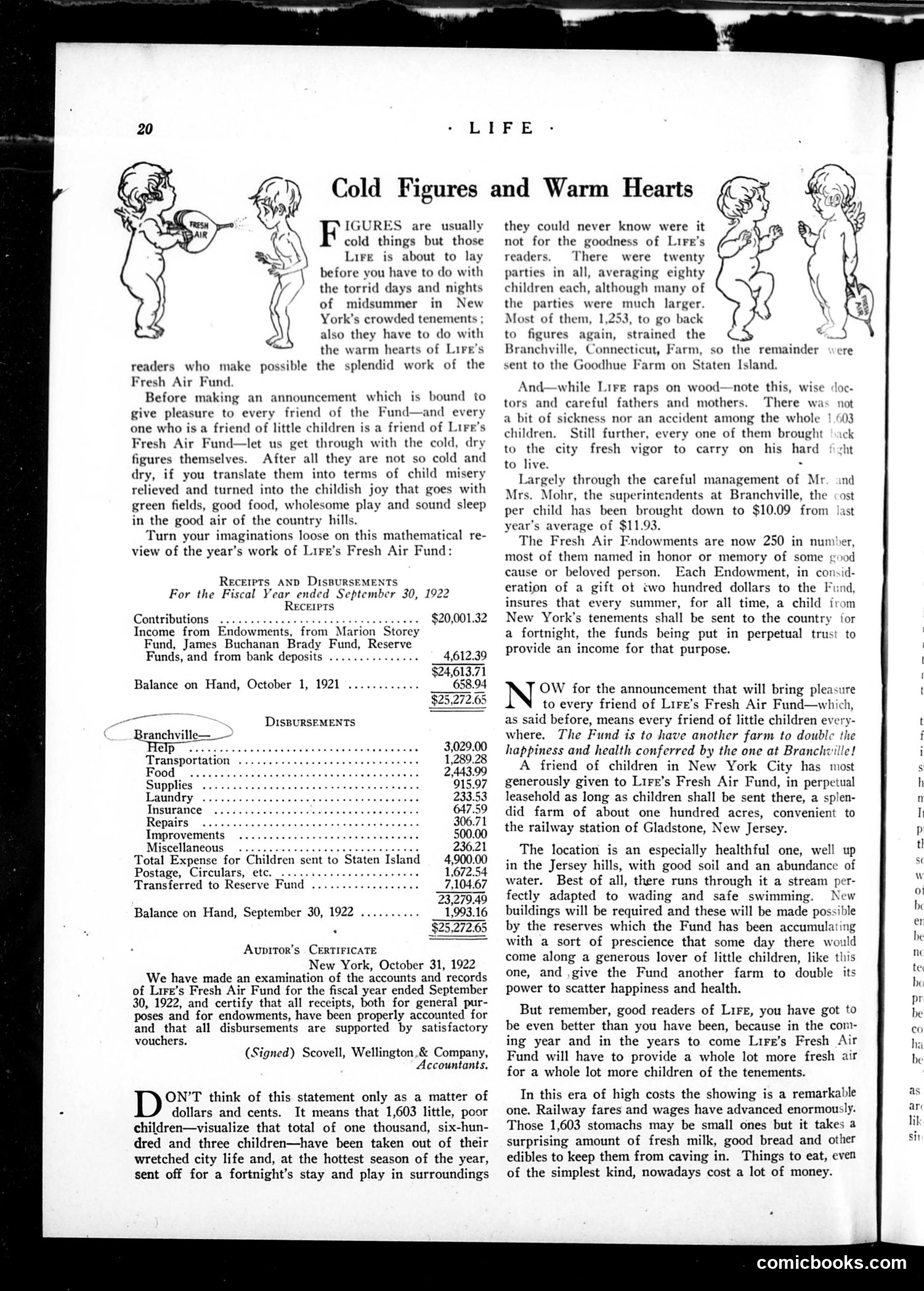
This page announces the financial results of Life magazine's **Fresh Air Fund**—a real charitable program sending poor urban children from New York tenements to countryside farms for summer relief. The small cartoon figures at the top are generic cherubic children, not specific caricatures, illustrating the fund's beneficiaries. The "cold figures" are the financial statements (receipts, disbursements, auditor's certificate); the "warm hearts" refer to donors and Life's readers who funded the initiative. The article uses mathematical language ironically—the real story isn't dollars but human outcomes: 1,603 children receiving health, fresh air, and escape from crowded city life. The tone celebrates that no children got sick and all returned strengthened. This represents **Progressive Era philanthropy**: wealthy magazine readers funding working-class child welfare through organized endowments. The satire gently mocks reducing human benefit to spreadsheets while ultimately promoting charitable giving.
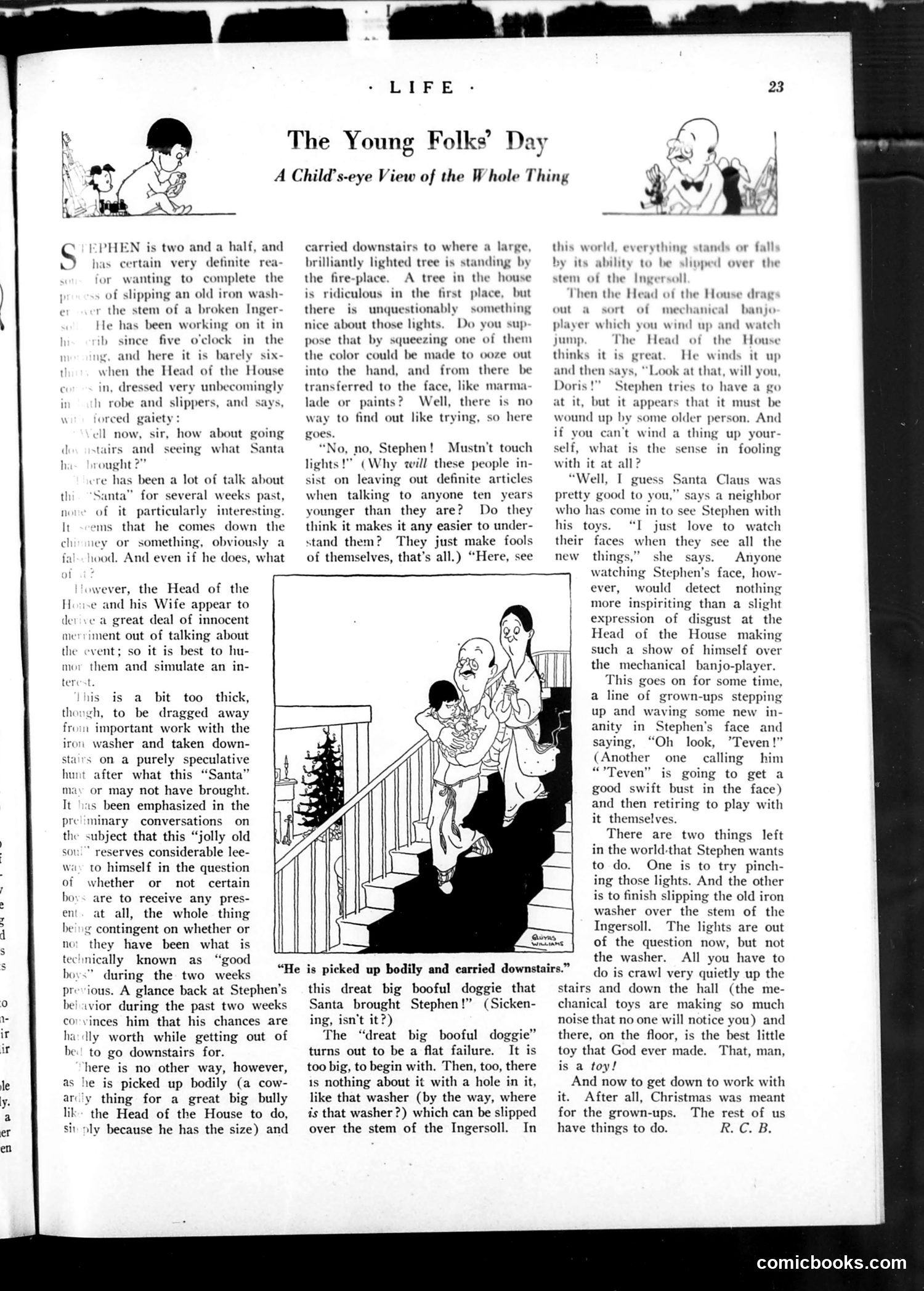
This article satirizes the gap between how adults and children experience Christmas. The narrative follows "Stephen," a two-and-a-half-year-old boy whose priorities are hilariously misaligned with adult gift-giving. **The satire:** Stephen cares nothing for the expensive toys adults provide (a toy dog, mechanical banjo-player). Instead, he obsesses over finishing his "important work"—threading an old iron washer over a broken watch stem—and wants only to squeeze the Christmas tree lights to see if color will ooze out like paint. **The humor targets adults**, particularly the condescending "Head of the House" who: - Uses baby-talk ("dreat big booful doggie") when speaking to a ten-year-old - Monopolizes toys (won't let Stephen wind the mechanical player himself) - Misunderstands childhood entirely The byline notes this is "A Child's-eye View of the Whole Thing"—Life magazine's perspective that children's logic, though incomprehensible to adults, possesses its own complete validity.
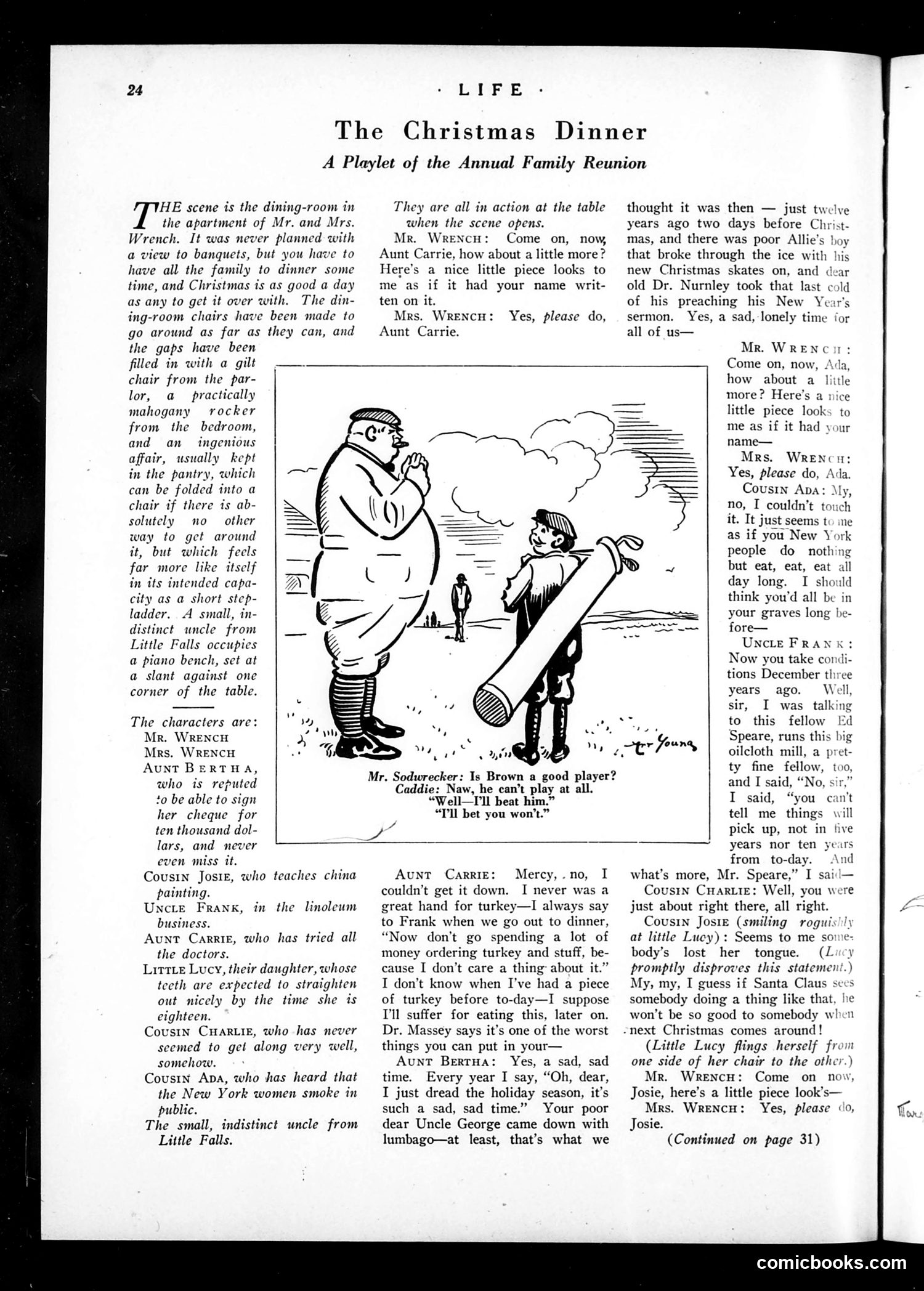
This is a comedic sketch portraying a cramped, uncomfortable family Christmas dinner in a small New York apartment. The humor derives from realistic social observation: the mismatched borrowed furniture (folding chair, piano bench, step-ladder repurposed as seating), the forced gaiety, and—most pointedly—the relatives' tedious conversational habits. The characters embody recognizable types: Aunt Carrie obsessively discussing her health ailments; Uncle Frank launching into irrelevant business anecdotes from three years prior; Cousin Ada complaining that New Yorkers eat too much; Aunt Bertha recycling the same annual lament about dreading holidays. The running joke is that these family members can't simply enjoy a meal—they must narrate their discomfort, anxieties, and tangential memories. The small illustration shows Mr. Sodwrecker and Caddie discussing golf, inserted as comedic relief amid the dinner-table monologues. The satire gently mocks the American middle-class family obligation to gather annually despite genuine mutual incompatibility and conversational tedium.
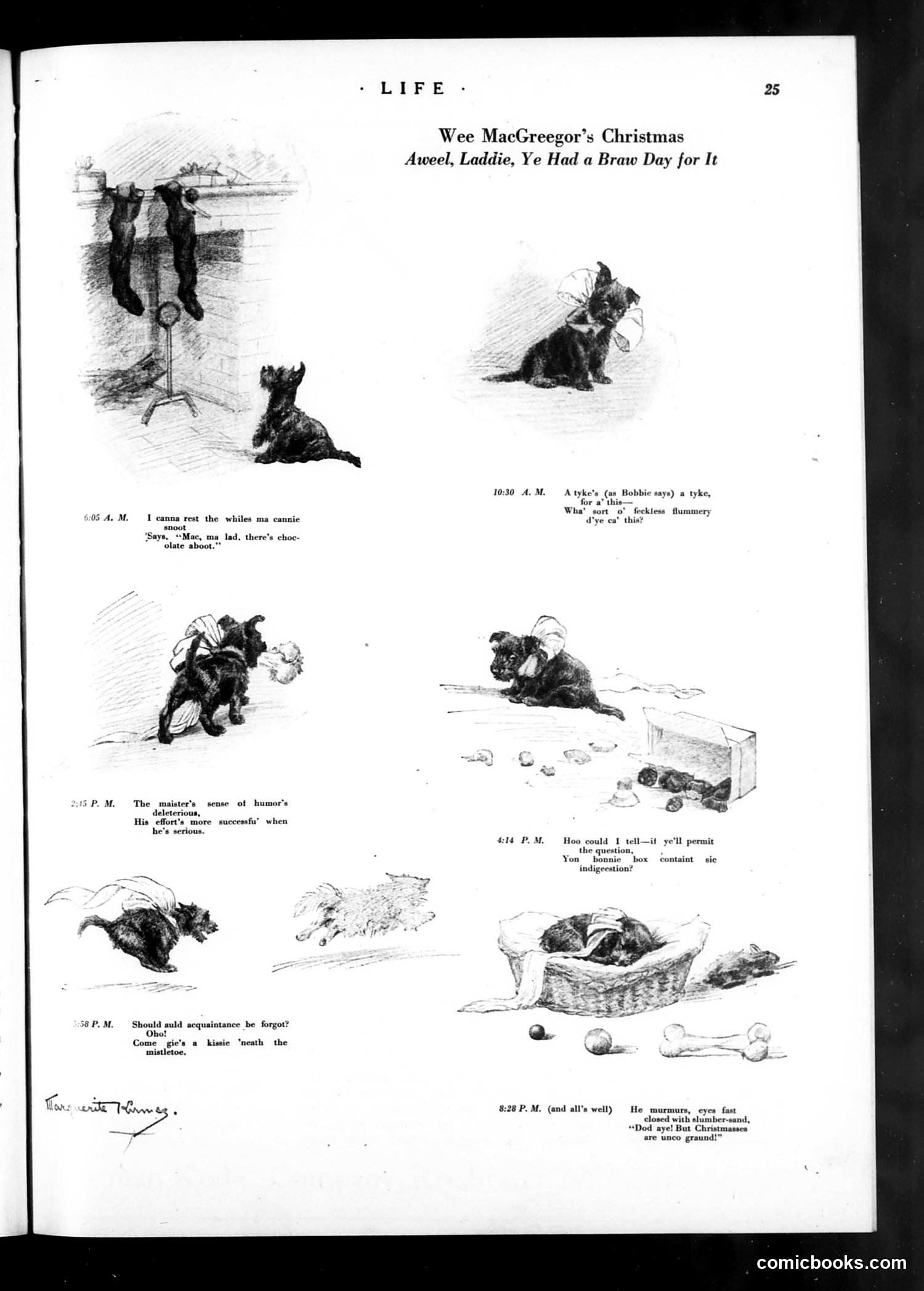
This is a humorous comic strip following a Scottish child's Christmas Day from morning through evening. The title character, "Wee MacGreegor," speaks in Scottish dialect throughout. The strip depicts a boy's typical Christmas activities: waking early hoping for chocolate, playing with toys, his father's attempt at humor under the mistletoe, and the child eventually falling asleep contentedly. The timestamps chronicle the day's progression. The satire is gentle and domestic rather than political—it pokes fun at Scottish speech patterns and family Christmas traditions of the era. The final panel shows the exhausted but happy child declaring "But Christmasses are unco graund!" (wonderfully grand), affirming that despite the day's modest chaos, it was worthwhile. This appears to be family entertainment humor typical of *Life* magazine's lighter content.
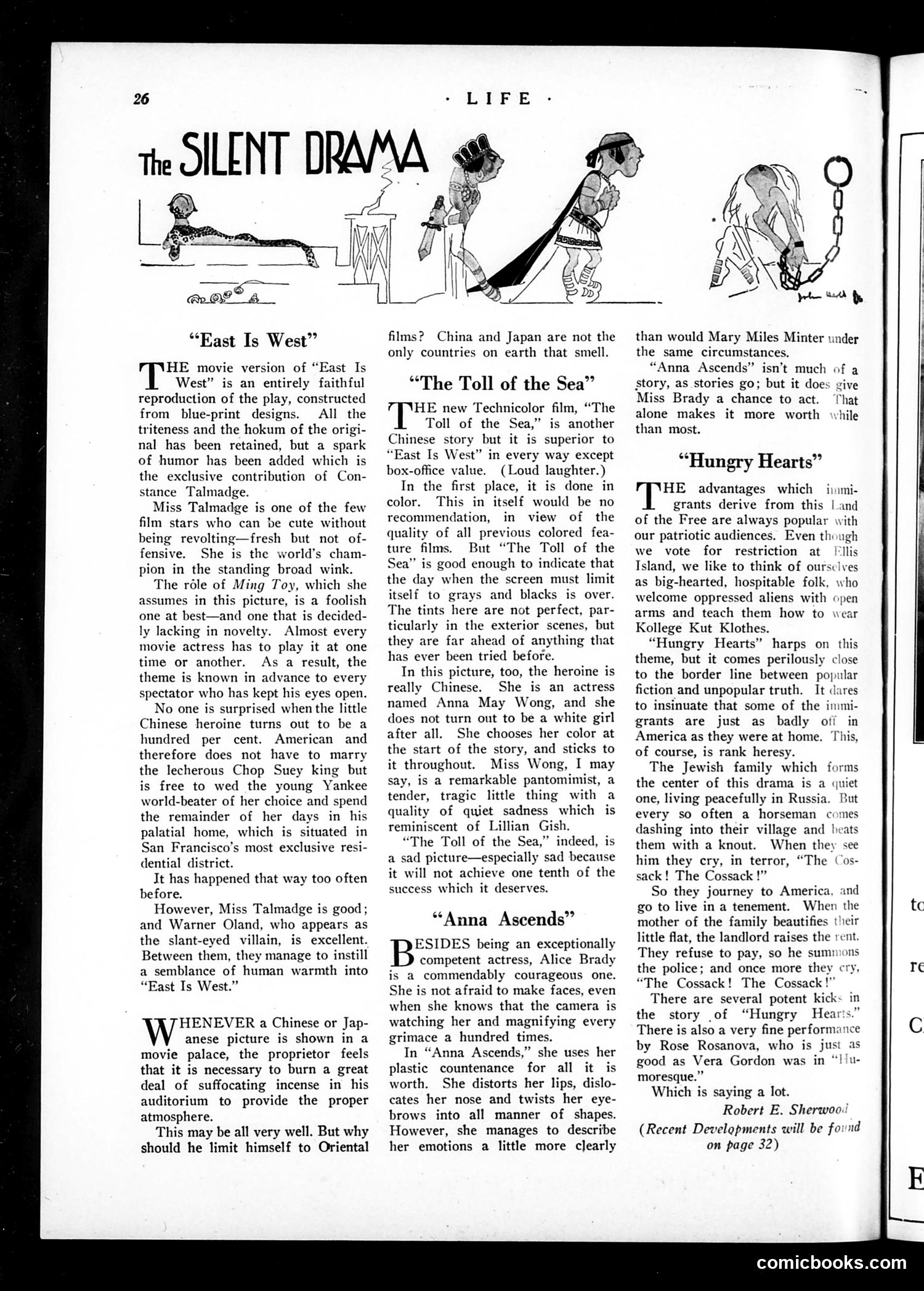
This page reviews three silent films, accompanied by a satirical cartoon about theater owners burning incense during Asian-themed movies. **The Cartoon's Point:** The joke mocks theater proprietors who burn incense to create "atmosphere" when showing Chinese or Japanese films. The satire argues this is absurd stereotyping—suggesting that incense-burning shouldn't be limited to Oriental films since "China and Japan are not the only countries on earth that smell." It's ethnic mockery presented as anti-racist critique: rather than questioning the stereotype itself, the writer jokes that other countries deserve equal stinking. **The Reviews:** The critic discusses three contemporary silent films featuring Asian characters and themes. Notably, he praises "The Toll of the Sea" for casting actual Chinese actress Anna May Wong (rather than a white actress in yellowface, as happened in "East Is West"), though he predicts it will fail commercially. The reviews reflect Hollywood's casual racism and yellowface casting practices of the early 1920s.
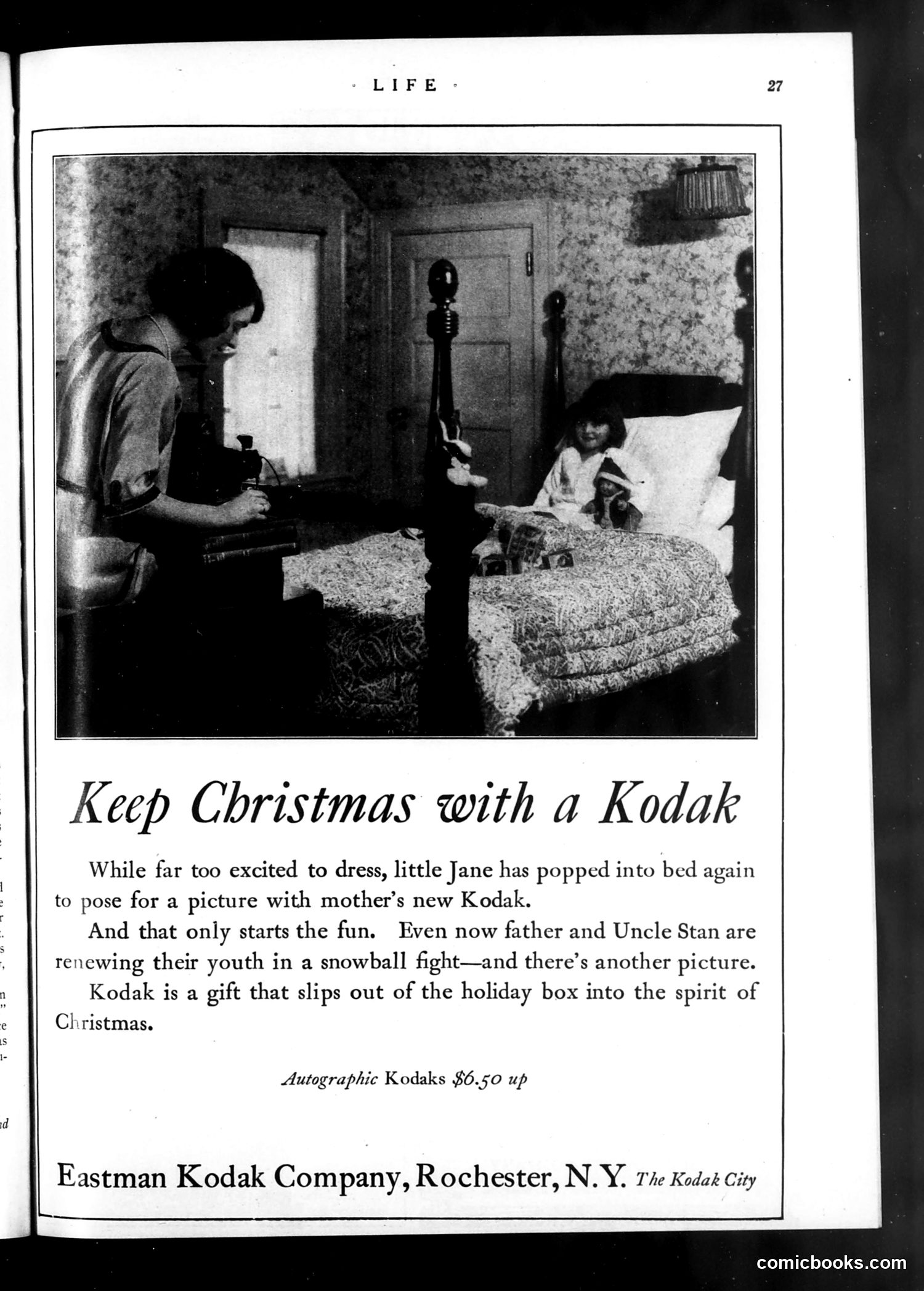
This is **advertising, not satire or political commentary**. It's a Kodak camera advertisement from *Life* magazine's back pages. The page depicts a domestic Christmas scene: a mother photographs her daughter "little Jane" in bed, while the text suggests father and Uncle Stan are having a snowball fight elsewhere—also being photographed. The advertisement's appeal is straightforward: Kodak cameras enable families to *capture* Christmas moments, transforming the holiday from merely experiencing it into *documenting* it. The tagline—"slips out of the holiday box into the spirit of Christmas"—argues the camera itself becomes part of the celebration. The pricing ("$6.50 up") and mention of "Autographic Kodaks" indicate these were consumer-level cameras. The idealized nuclear family composition and emphasis on capturing children reflects early 20th-century marketing to middle-class American households. There's no satire here—just period advertising promoting photography as essential to modern holiday memory-making.
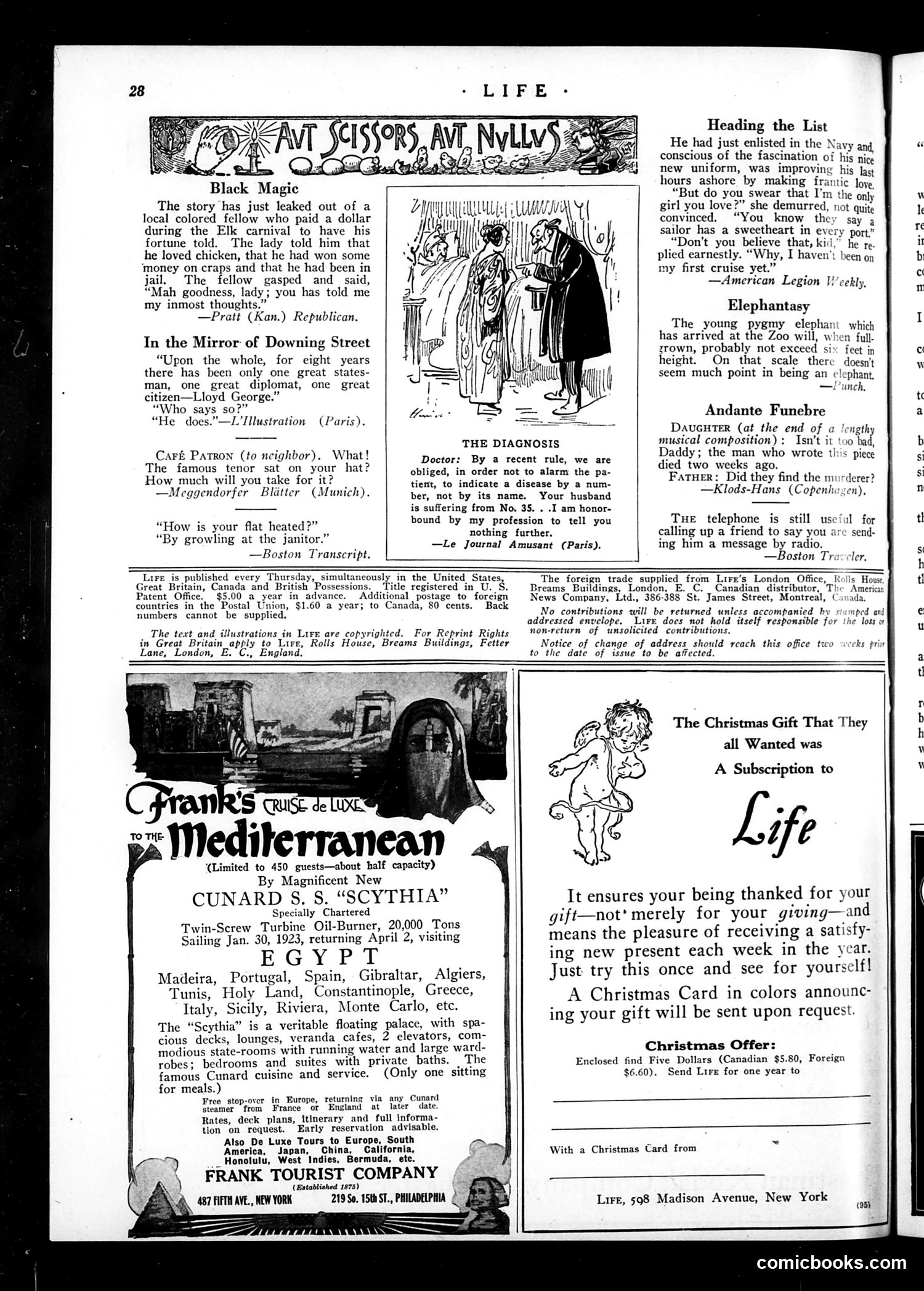
This page collects brief humorous anecdotes typical of *Life* magazine's satirical format. The main cartoon, "Black Magic," mocks racial stereotypes: a Black man pays a fortune teller during an Elk carnival who makes vague predictions (loving chicken, gambling, jail time) that he finds unnervingly accurate—the joke relying on crude period stereotypes about Black Americans. Other items satirize various targets: a British politician (Lloyd George) who self-aggrandizes; a Navy recruit boasting he hasn't yet sailed despite enlisting; and a doctor euphemistically numbering diseases to avoid alarming patients. The page also includes advertisements for luxury Mediterranean cruises and a *Life* magazine subscription gift offer. These brief jokes reflect early 1920s humor conventions—often relying on ethnic caricatures, class commentary, and wordplay that modern readers would find offensive or dated.
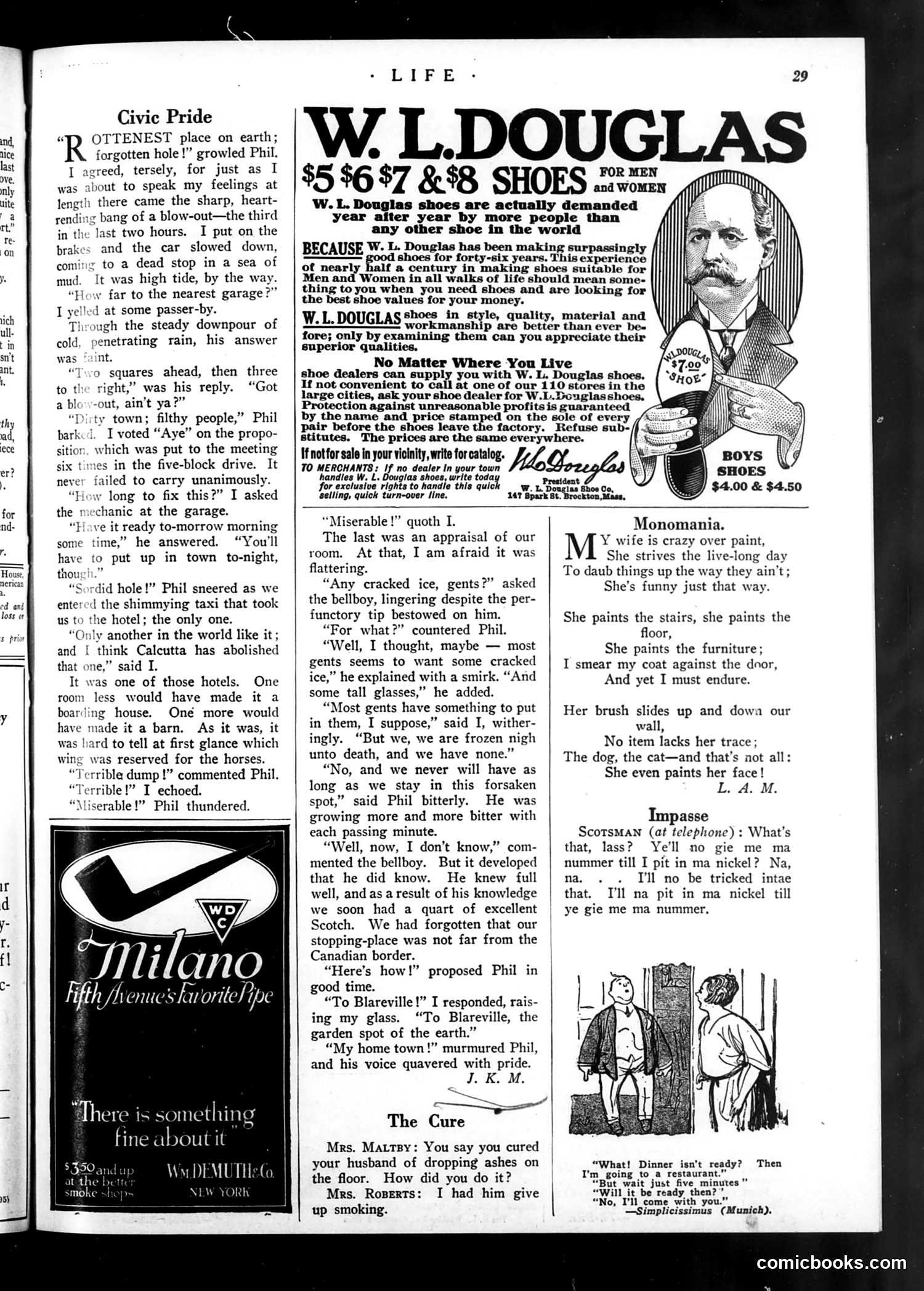
This page contains a satirical short story titled "Civic Pride" rather than a political cartoon. The narrative follows two travelers stranded in a decrepit small town during terrible weather. They initially mock the town's squalor—calling it a "forgotten hole" and "sordid hole"—but the joke subverts their snobbery: the seemingly ignorant bellboy at the town's only shabby hotel cleverly procures them excellent Scotch whisky, revealing hidden sophistication beneath appearances. The satire mocks urban travelers' prejudices against rural America and small-town people. The bellboy's knowing wink suggests that provincial towns contain worldly knowledge the dismissive visitors lacked. The page also contains a large W.L. Douglas shoe advertisement and three brief humorous verses ("Monomania," "Impasse," "The Cure") typical of Life's satirical content.
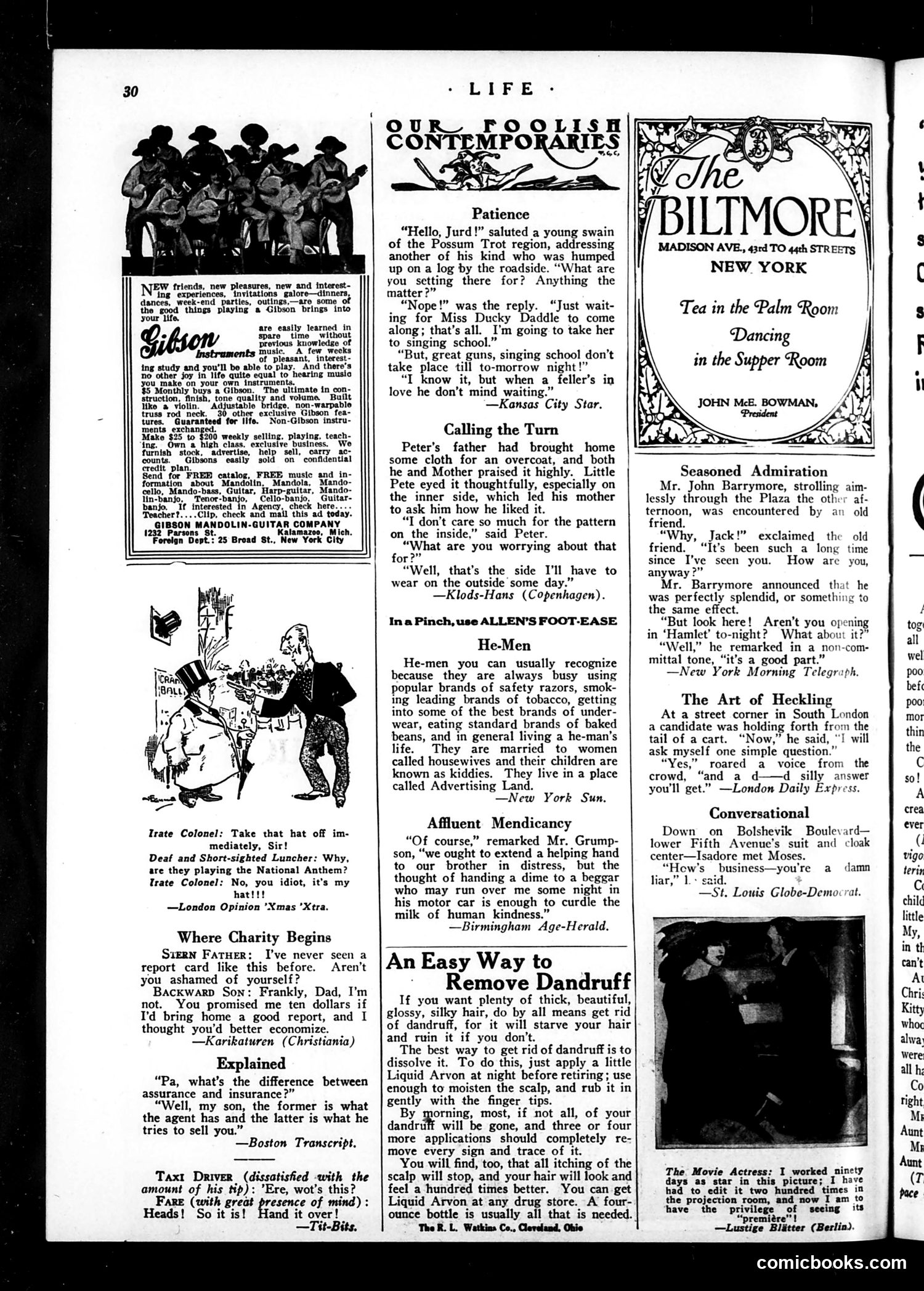
This page from *Life* magazine combines several short humorous pieces typical of early 20th-century satirical journalism. The **main cartoons** mock social pretense and human nature: An "Irate Colonel" mistakes his own hat for the national anthem being played; a "Short-sighted Luncher" misunderstands the situation entirely. Another piece satirizes a son's cynical logic—he deliberately fails school to spare his father the expense of the promised reward money. "**He-Men**" critiques advertising culture, defining "he-men" ironically as consumers dutifully buying branded products (razors, tobacco, underwear, baked beans) while living in "Advertising Land"—a direct jab at how advertising manufactures masculinity through consumption rather than actual character. The **rural anecdotes** (Possum Trot, Kansas City Star) use dialectal humor common to the era, portraying country folk as charmingly simpleminded. The page also includes **product advertisements** (Gibson musical instruments) positioned among editorial content—typical of the era's magazine layout where advertising and satire coexisted. Overall, the page mocks class pretension, gullible consumers, and advertising's power to define identity.
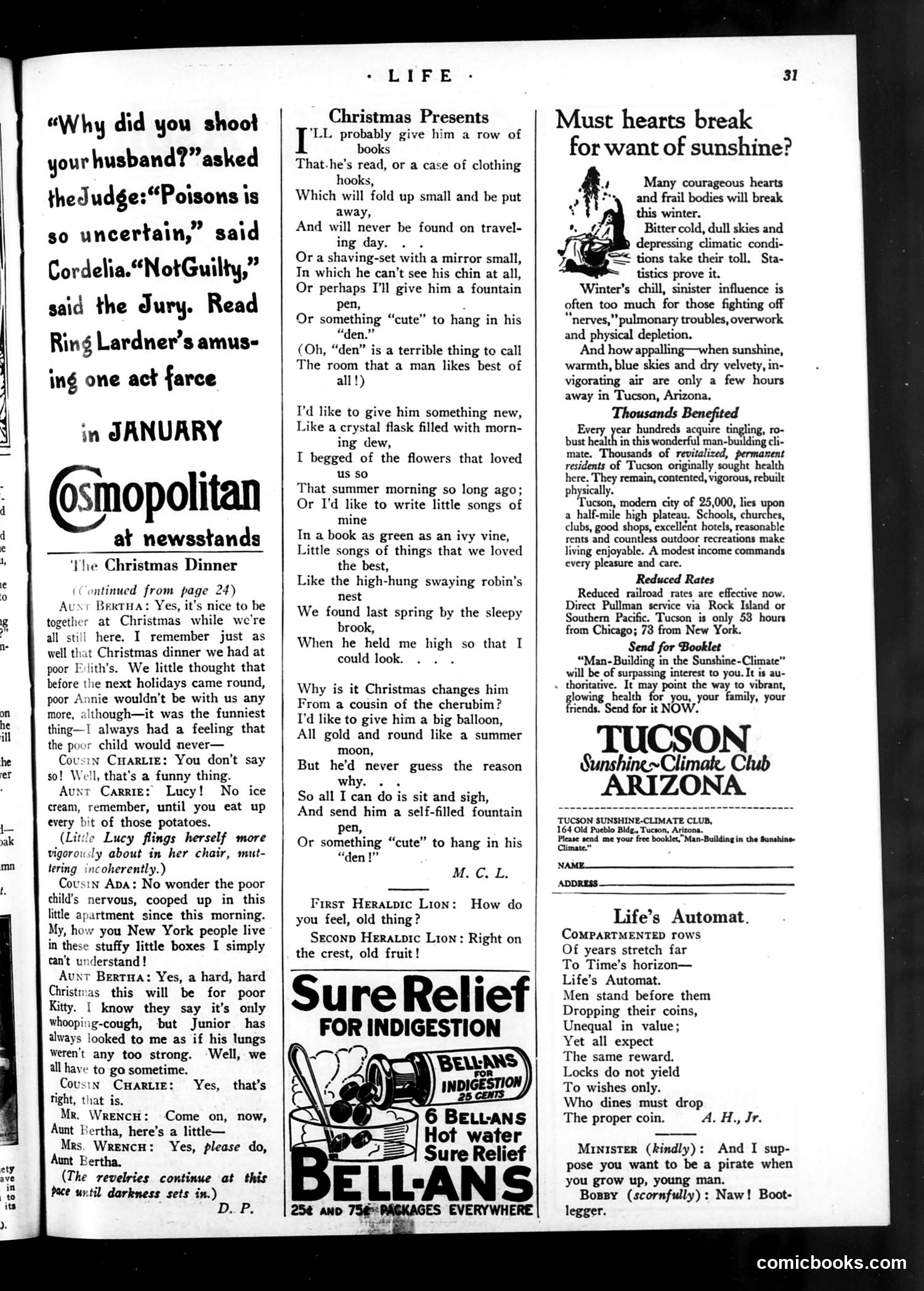
This page mixes humor, poetry, and advertising typical of 1920s Life magazine. The opening joke references a legal trial where a woman shoots her husband, claiming poison is "too uncertain"—dark satire on domestic violence and legal absurdity of the era. The main content features "The Christmas Dinner," a continuation of Ring Lardner's satirical farce depicting a dysfunctional family gathering. The dialogue mocks middle-class pretension and casual cruelty: relatives discuss others' misfortunes (a dead child, whooping cough, weak lungs) with cheerful indifference while eating dinner. The humor targets how families mask anxiety and suffering behind social pleasantries. A poem about Christmas gift-giving expresses romantic longing through mundane present-shopping, juxtaposing genuine emotion against commercial obligation. The page concludes with advertisements—a Bell-Ans indigestion remedy and a Tucson, Arizona tourism promotion claiming the climate cures illness—reflecting period marketing linking consumption to health and happiness.
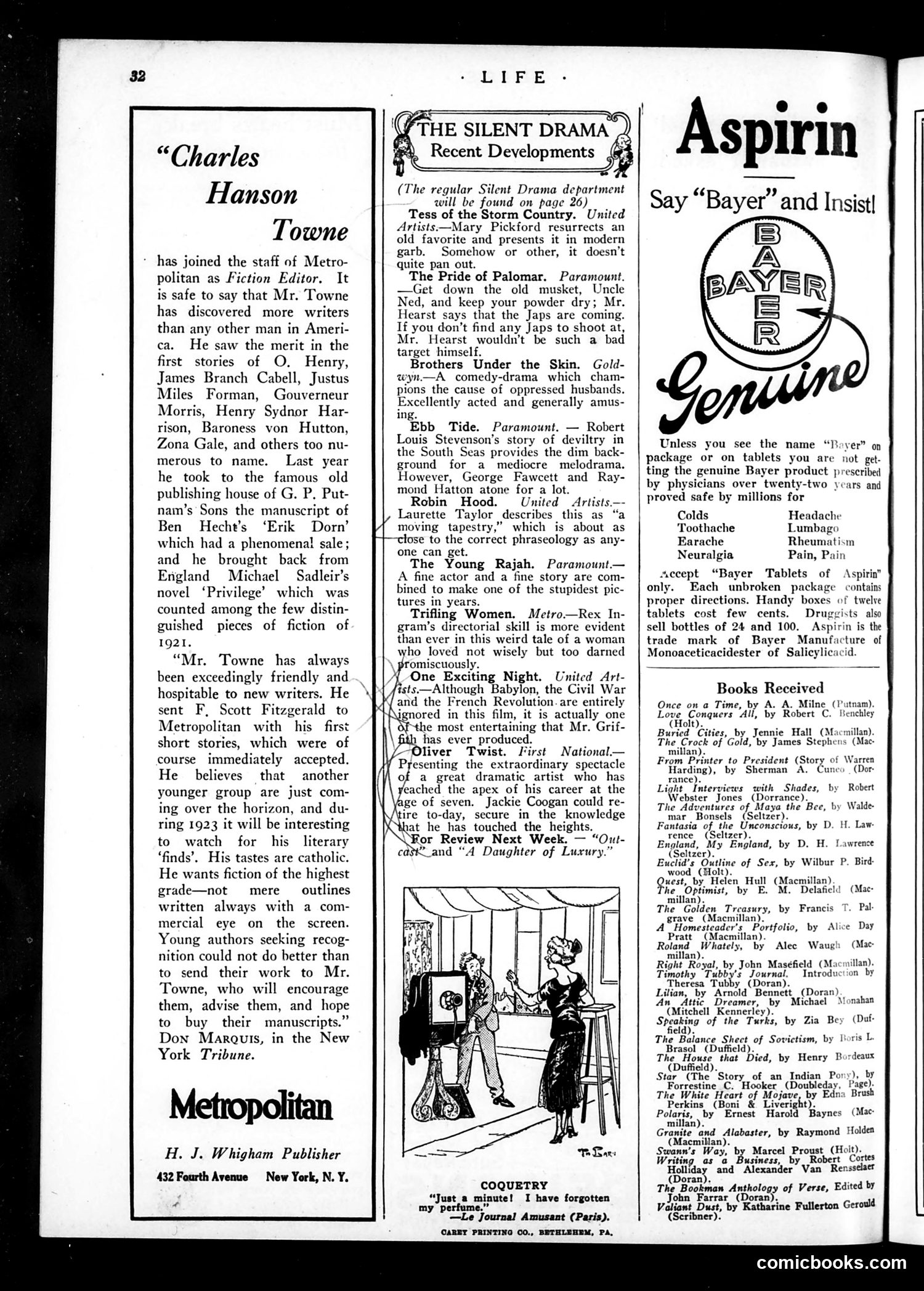
This page is primarily **business/literary news and advertising** rather than political satire. The main content announces that **Charles Hanson Towne** has joined *Metropolitan* magazine as Fiction Editor. The text praises his talent for discovering writers—citing O. Henry, F. Scott Fitzgerald, and others—and encourages young authors to submit work to him. The small cartoon at bottom shows a woman telling a man "Just a minute! I have forgotten my purse"—a joke about female coquetry, implying women use flattery to avoid paying. The page also includes **film reviews** (silent movies like Mary Pickford's *Tess of the Storm Country*) and an **Aspirin advertisement** emphasizing the importance of buying genuine "Bayer" brand rather than imitations. The satirical element is minimal; this is essentially a **trade publication page** mixing literary industry news with consumer advertising.
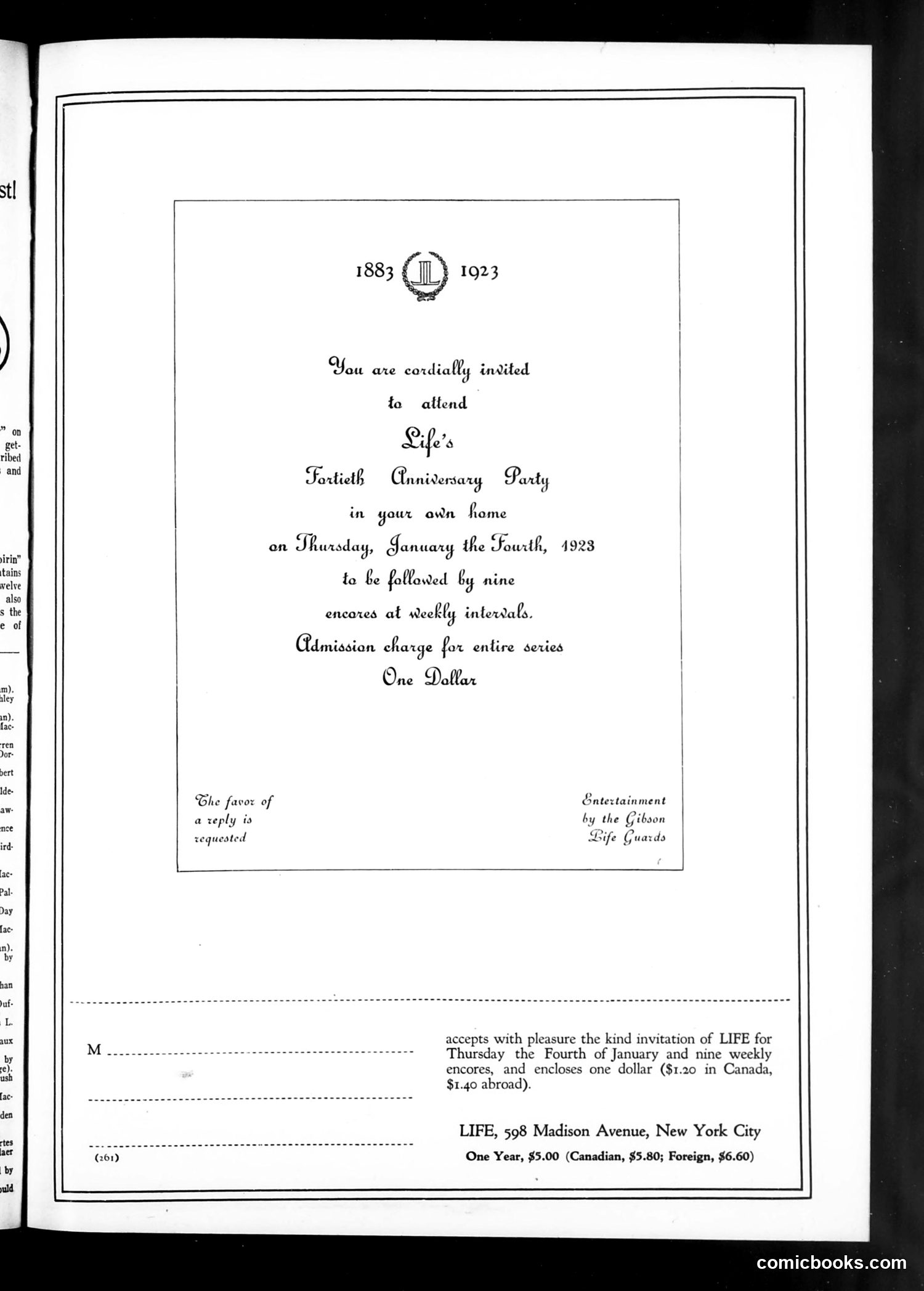
This is a **title page/advertisement**, not a cartoon. It announces Life magazine's 40th anniversary party scheduled for January 4, 1923, with nine weekly follow-up "encores." The page is styled as a formal invitation requesting one dollar admission for the entire series. Notable details: - The magazine references the **Gibson Life Guards** as entertainment providers—likely referring to Charles Dana Gibson's famous "Gibson Girl" illustrations, which were Life's signature visual style - The pricing structure ($5.00/year subscription advertised) suggests Life was positioning this anniversary celebration as a marketing opportunity - The formal, ornate typography mimics genuine party invitations of the era For modern readers: this reflects how early 20th-century magazines promoted themselves through special events and direct reader engagement, treating subscribers almost as members of an exclusive club. The "encores" concept suggests serialized anniversary content planned across nine weeks.
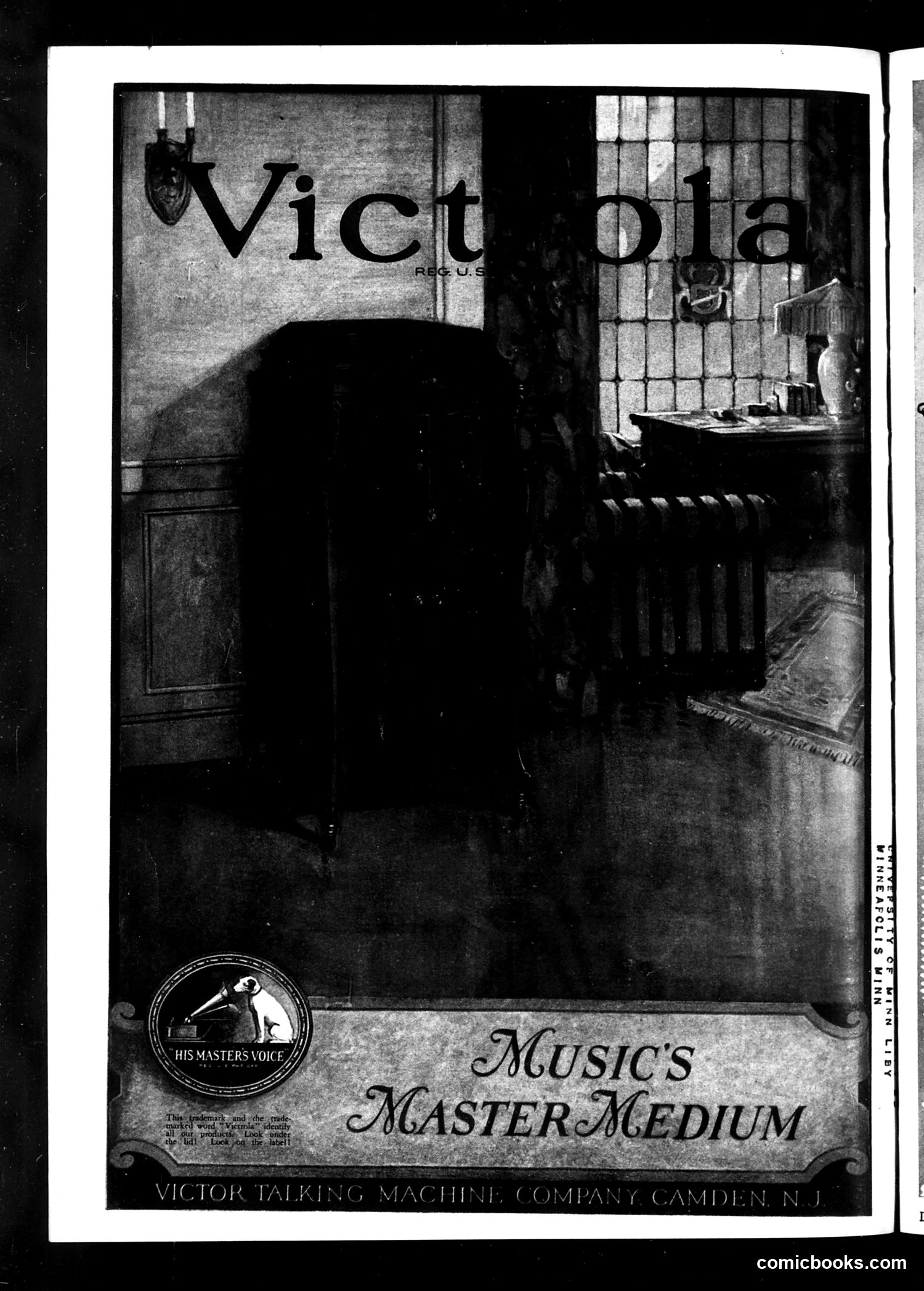
This is primarily a **Victor Talking Machine Company advertisement**, not a political cartoon. The page displays the "Victrola" phonograph brand name prominently at top, with "Music's Master Medium" as the tagline at bottom. The image shows a darkened interior room with a phonograph visible on the right side near a window. A silhouetted figure stands in the foreground, apparently listening to or operating the device. The "His Master's Voice" logo (featuring a dog and gramophone) appears in the lower left corner—the famous trademark of Victor/RCA. **This is commercial advertising** promoting the Victrola as a superior home music-playing device, likely from the early-to-mid 20th century when recorded music was an emerging home entertainment technology. There is no satirical political content visible.