
Life, 1922-12-21 · page 31 of 42
Life — December 21, 1922 — page 31: what you’re looking at
What you’re looking at
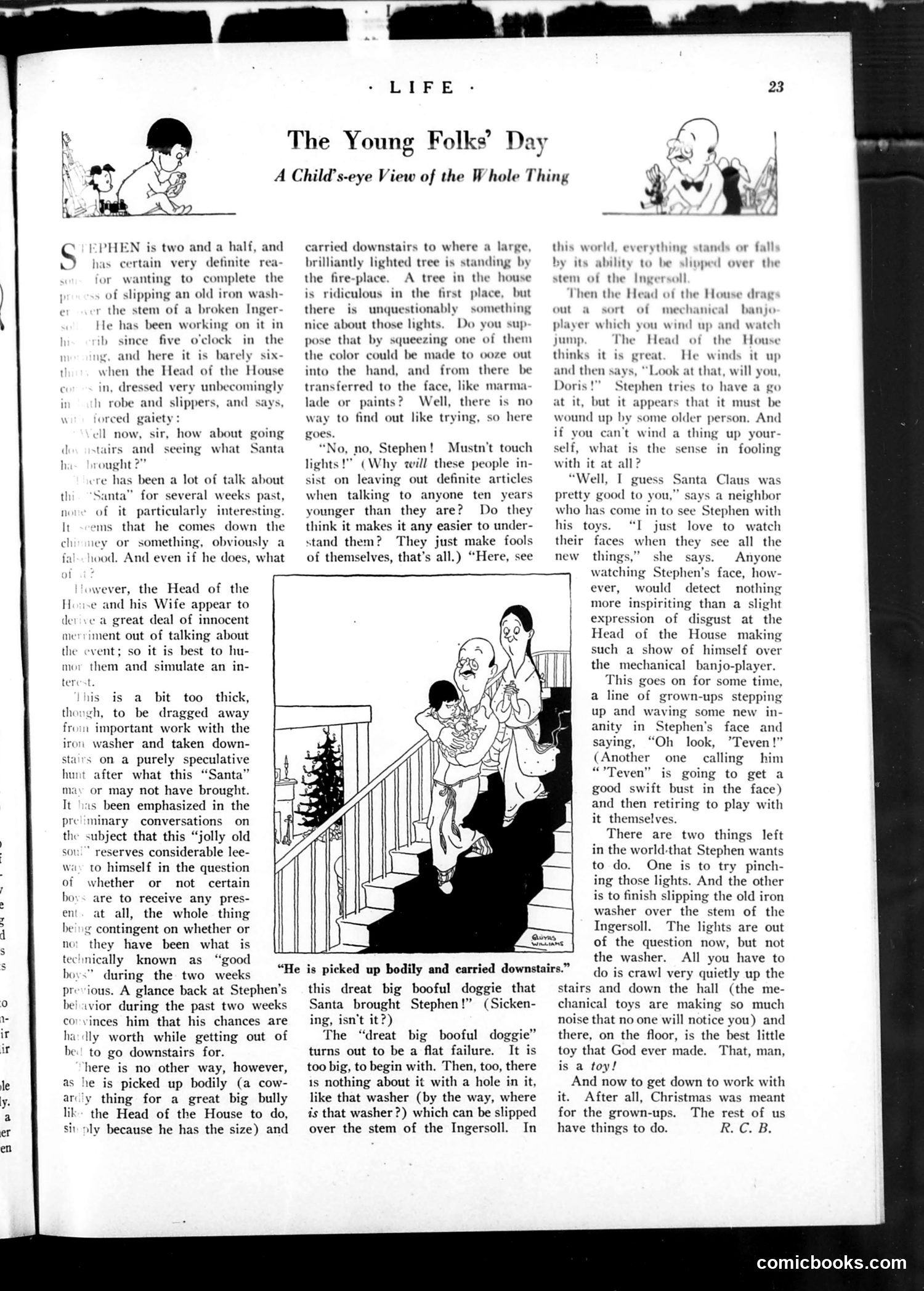
This article satirizes the gap between how adults and children experience Christmas. The narrative follows "Stephen," a two-and-a-half-year-old boy whose priorities are hilariously misaligned with adult gift-giving. **The satire:** Stephen cares nothing for the expensive toys adults provide (a toy dog, mechanical banjo-player). Instead, he obsesses over finishing his "important work"—threading an old iron washer over a broken watch stem—and wants only to squeeze the Christmas tree lights to see if color will ooze out like paint. **The humor targets adults**, particularly the condescending "Head of the House" who: - Uses baby-talk ("dreat big booful doggie") when speaking to a ten-year-old - Monopolizes toys (won't let Stephen wind the mechanical player himself) - Misunderstands childhood entirely The byline notes this is "A Child's-eye View of the Whole Thing"—Life magazine's perspective that children's logic, though incomprehensible to adults, possesses its own complete validity.
📄 Transcribed text from this page (OCR, searchable)
Machine-transcribed from the original scan — historical spelling and the odd misread are preserved.
C Y is two and a half, and nN has certain very detinite rea- for wanting to complete the of slipping an old iron wash- e y the stem of a broken Inger- He has been working on it in ib since five o'clock in the yg. and here it is barely six- when the Head of the House ¢ in, dressed very unbecomingly it 1 robe and slippers, and says, oreed gaiety: cll now, sir, how about going dh tairs and seeing what Santa h ought?” ere has been a lot of talk about tl Santa” for several weeks past, ne of it particularly interesting. It seems that he comes down the chimney or something, obviously a fal hood. And even if he does, what avever, the Head of the House and his Wife appear to der ve a great deal of innocent merriment out of talking about the event; so it is best to hu- mor them and simulate an in- terest. lis is a bit too thick, thongh, to be dragged away froin important work with the iron washer and taken down- stairs on a purely speculative hunt after what this “Santa” may or may not have brought. It ias been emphasized in the preiminary conversations on the subject that this “jolly old sou.” reserves considerable lee- wa: to himself in the question of whether or not certain boys are to receive any pres- ent. at all, the whole thing he'ng contingent on whether or no: they have been what is technically known as “good boys” during the two weeks previous. A glance back at Stephen's bel .vior during the past two weeks corvinces him that his chances are ha:dly worth while getting out of be! to go downstairs for. here is no other way, however, as he is picked up bodily (a cow- arcly thing for a great big bully lik the Head of the House to do, sit nly because he has the size) and - LIFE - The Young Folks’ Day A Child’s-eye View of the Whole Thing carried downstairs to where a large, brilliantly lighted tree is standing by A tree in the house is ridiculous in the first place, but there is unquestionably nice about those lights. pose that by squeezing one of them the fire-place. something Do you sup the color could be made to ooze out into the hand, and from there be transferred to the face, like marma lade or paints? Well, there is no way to find out like trying, so here 0, no, Stephen! Mustn’t touch lights!" (Why will these people in- sist on leaving out definite articles when talking to anyone ten years younger than they are? Do they think it makes it any easier to under- stand them? They just make fools of themselves, that’s all.) “Here, see “He is picked up bodily and carried downstairs.” this dreat big booful doggie that Santa brought Stephen!” (Sicken- ing, isn't it?) The “dreat big booful doggie” turns out to be a flat failure. It is too big, to begin with. Then, too, there is nothing about it with a hole in it, like that washer (by the way, where is that washer?) which can be slipped over the stem of the Ingersoll. In 23 fA) this world, everything stands or fall by its ability to be ped over the stem of the Ingersoll Then the Head of the House drag out a sort of mechanical banjo player which you wind up and watch jump The Head of the House thinks it is gre He winds it up and then says, “Look at that, will you Doris!” Stephen tries to have a go at it, but it appears that it must be wound up by some older person, And if you can't wind a thing up your- self, what is the sense in fooling with it at all? “Well, I guess Santa Claus was pretty good to you, ys a neighbor who has come in to see Stephen with his to “I just love to watch their faces when they see all the new things,” she say Anyone watching Stephen’s face, how- ever, would detect nothing more inspiriting than a slight expression of disgust at the Head of the House making such a show of himself over the mechanical banjo-player. This goes on for some time, a line of grown-ups stepping up and waving some new in- anity in Stephen's face and saying, “Oh look, ’Teven!” (Another one calling him “’Teven” is going to get a good swift bust in the face) and then retiring to play with it themselves. There are two things left in the world-that Stephen wants to do. One is to try pinch- ing those lights. And the other is to finish slipping the old iron washer over the stem of the Ingersoll. The lights are out of the question now, but not the washer. All you have to do is crawl very quietly up the stairs and down the hall (the me- chanical toys are making so much noise that no one will notice you) and there, on the floor, is the best little toy that God ever made. That, man, is a toy! And now to get down to work with it. After all, Christmas was meant for the grown-ups. The rest of us have things to do. R:G..B, comicbooks.com