
Life, 1922-12-21 · page 20 of 42
Life — December 21, 1922 — page 20: what you’re looking at
What you’re looking at
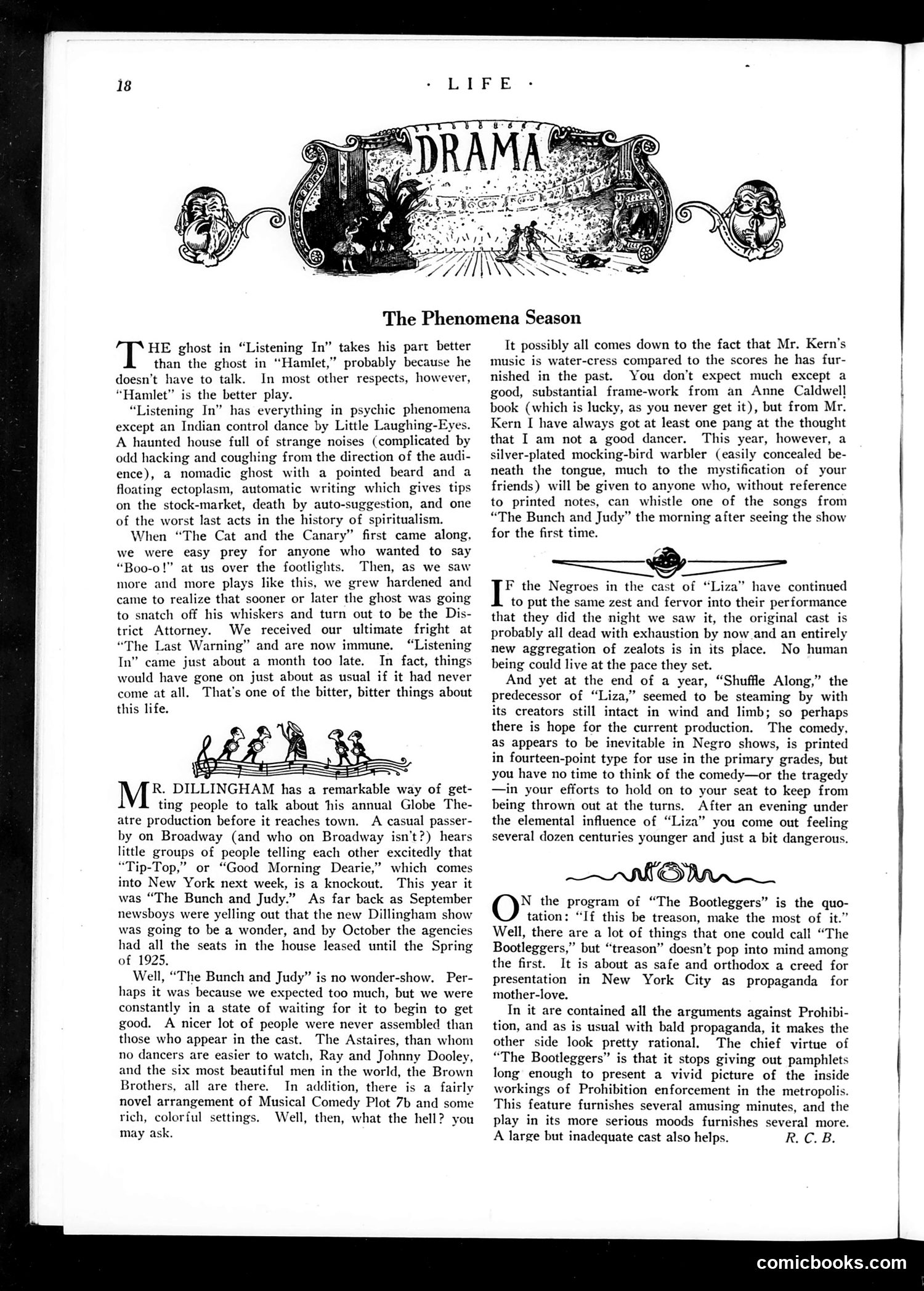
This page reviews Broadway theatrical productions from around 1924. The critic discusses three shows: **"Listening In"** — A supernatural thriller featuring a ghost, haunted house, and spiritualist phenomena (automatic writing, ectoplasm). The reviewer finds it derivative, noting audiences grew immune to such "spook" plays after earlier hits like "The Cat and the Canary" and "The Last Warning," where the ghost predictably turns out to be the District Attorney. **"The Bunch and Judy"** — A musical comedy produced by Dillingham, featuring famous dancers the Astaires and the Brown Brothers. Despite advance hype and talented performers, the critic finds it disappointing because composer Jerome Kern's score is weak compared to his previous work. **"Liza"** — A show featuring an all-Black cast performing with such energetic zest that the reviewer jokes they'll collapse from exhaustion, comparing it favorably to the predecessor "Shuffle Along." The tone is witty and gossipy, typical of Life's satirical theater criticism of the era.
📄 Transcribed text from this page (OCR, searchable)
Machine-transcribed from the original scan — historical spelling and the odd misread are preserved.
HE ghost in “Listening In” takes his part better than the ghost in “Hamlet,” probably because he doesn’t have to talk. In most other respects, however, “Hamlet” is the better play. “Listening In” has everything in psychic phenomena except an Indian control dance by Little Laughing-Eyes. A haunted house full of strange noises (complicated by odd hacking and coughing from the direction of the audi- ence), a nomadic ghost with a pointed beard and a floating ectoplasm, automatic writing which gives tips on the stock-market, death by auto-suggestion, and one of the worst last acts in the history of spiritualism. When “The Cat and the Canary” first came along, we were easy prey for anyone who wanted to say “Boo-o!” at us over the footlights. Then, as we saw more and more plays like this, we grew hardened and came to realize that sooner or later the ghost was going to snatch off his whiskers and turn out to be the Dis- trict Attorney. We received our ultimate fright at “The Last Warning” and are now immune. “Listening In” came just about a month too late. In fact, things would have gone on just about as usual if it had never come at all, That's one of the bitter, bitter things about this life. ting people to talk about ‘his annual Globe The- atre production before it reaches town. A casual passer- by on Broadway (and who on Broadway isn’t?) hears little groups of people telling each other excitedly that “Tip-Top,” or “Good Morning Dearie,” which comes into New York next week, is a knockout. This year it was “The Bunch and Judy.” As far back as September newsboys were yelling out that the new Dillingham show was going to be a wonder, and by October the agencies had all the seats in the house leased until the Spring of 1925. Well, “The Bunch and Judy” is no wonder-show. Per- haps it was because we expected too much, but we were constantly in a state of waiting for it to begin to get good. A nicer lot of people were never assembled than those who appear in the cast. The Astaires, than whom no dancers are easier to watch, Ray and Johnny Dooley, and the six most beautiful men in the world, the Brown Brothers, all are there. In addition, there is a fairly novel arrangement of Musical Comedy Plot 7b and some rich, colorful settings. may ask. Well, then, what the hell? you The Phenomena Season It possibly all comes down to the fact that Mr. Kern's music is water-cress compared to the scores he has fur- nished in the past. You don’t expect much except a good, substantial frame-work from an Anne Caldwell book (which is lucky, as you never get it), but from Mr. Kern I have always got at least one pang at the thought that I am not a good dancer. This year, however, a silver-plated mocking-bird warbler (easily concealed be- neath the tongue, much to the mystification of your friends) will be given to anyone who, without reference to printed notes, can whistle one of the songs from “The Bunch and Judy” the morning after seeing the show for the first time. 5 —_ 6 —— F the Negroes in the cast of “Liza” have continued to put the same zest and fervor into their performance that they did the night we saw it, the original cast is probably all dead with exhaustion by now and an entirely new aggregation of zealots is in its place. No human being could live at the pace they set. And yet at the end of a year, “Shuffle Along,” the predecessor of “Liza,” seemed to be steaming by with its creators still intact in wind and limb; so perhaps there is hope for the current production. The comedy, as appears to be inevitable in Negro shows, is printed in fourteen-point type for use in the primary grades, but you have no time to think of the comedy—or the tragedy —in your efforts to hold on to your seat to keep from being thrown out at the turns. After an evening under the elemental influence of “Liza” you come out feeling several dozen centuries younger and just a bit dangerous. ~~ r~0M Oi. N the program of “The Bootleggers” is the quo- tation: “If this be treason, make the most of it.” Well, there are a lot of things that one could call “The Bootleggers,” but “treason” doesn’t pop into mind among the first. It is about as safe and orthodox a creed for presentation in New York City as propaganda for mother-love. In it are contained all the arguments against Prohibi- tion, and as is usual with bald propaganda, it makes the other side look pretty rational. The chief virtue of “The Bootleggers” is that it stops giving out pamphlets long enough to present a vivid picture of the inside workings of Prohibition enforcement in the metropolis. This feature furnishes several amusing minutes, and the play in its more serious moods furnishes several more. A large but inadequate cast also helps. R.C.B. comicbooks.com