
Life, 1922-12-21 · page 17 of 42
Life — December 21, 1922 — page 17: what you’re looking at
What you’re looking at
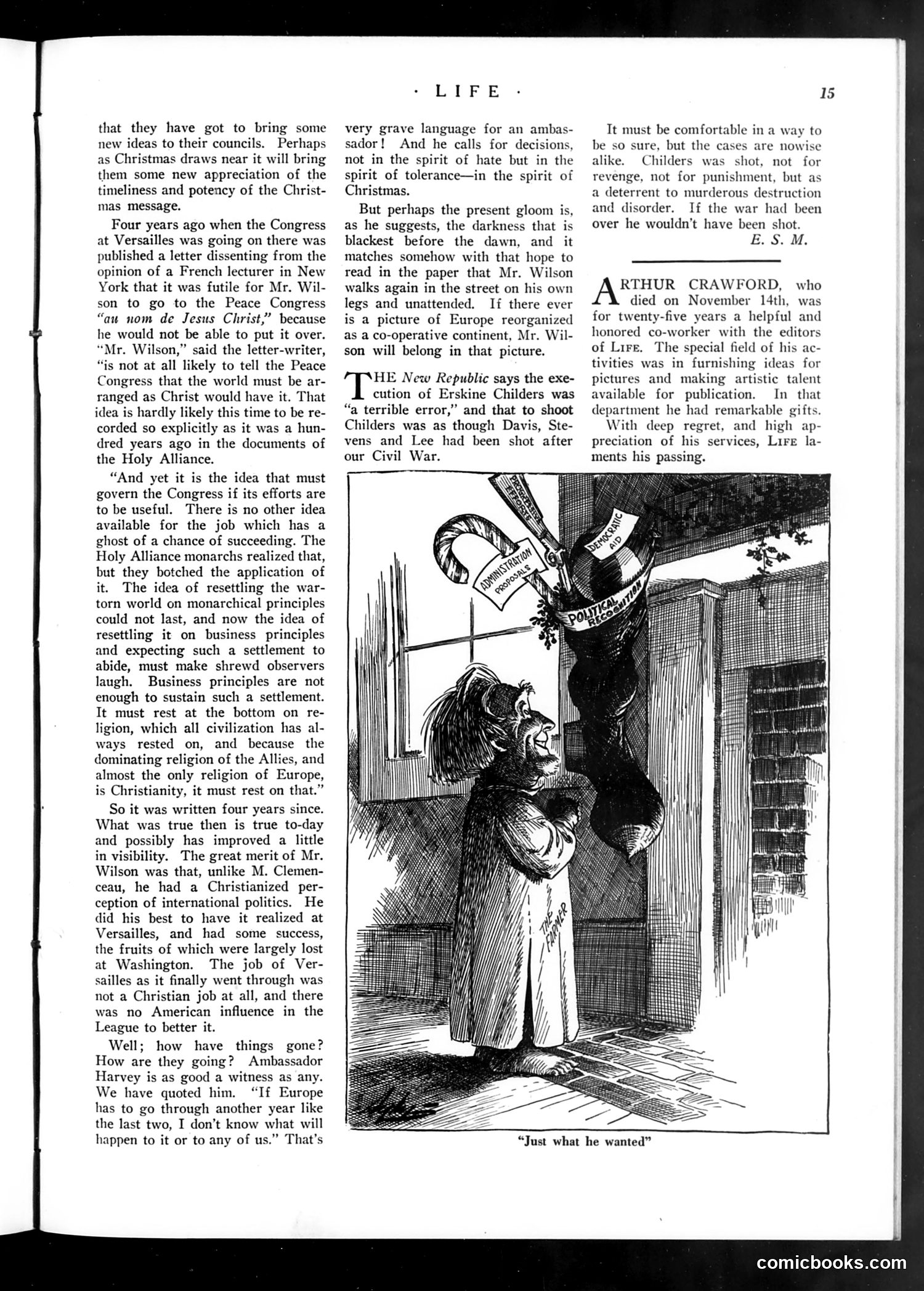
This cartoon satirizes post-World War I European instability and American foreign policy. The figure appears to be a caricatured representation of chaos or disorder in Europe—depicted as a disheveled, aggressive entity climbing or clawing at what looks like a barrier or wall labeled with references to "Police" or governmental authority. The accompanying text discusses President Wilson's idealistic, Christian-based approach to the 1919 Treaty of Versailles and international peace, contrasted with the subsequent failure of those principles at Washington. The cartoon critiques how Europe's post-war settlement, built on business and political expediency rather than moral/Christian principles, has descended into violence and disorder. The caption "Just what he wanted" likely refers ironically to how certain political forces—whether European militarists, revenge-seekers, or cynical realists—achieved exactly the chaotic outcome they desired when idealistic peace efforts failed.
📄 Transcribed text from this page (OCR, searchable)
Machine-transcribed from the original scan — historical spelling and the odd misread are preserved.
that they have got to bring some new ideas to their councils. Perhaps as Christmas draws near it will bring them some new appreciation of the timeliness and potency of the Christ- mas message. Four years ago when the Congress at Versailles was going on there was published a letter dissenting from the opinion of a French lecturer in New York that it was futile for Mr. Wil- son to go to the Peace Congress “au nom de Jesus Christ,’ because he would not be able to put it over. “Mr. Wilson,” said the letter-writer, “is not at all likely to tell the Peace Congress that the world must be ar- ranged as Christ would have it. That idea is hardly likely this time to be re- corded so explicitly as it was a hun- dred years ago in the documents of the Holy Alliance. “And yet it is the idea that must govern the Congress if its efforts are to be useful. There is no other idea available for the job which has a ghost of a chance of succeeding. The Holy Alliance monarchs realized that, but they botched the application of it. The idea of resettling the war- torn world on monarchical principles could not last, and now the idea of resettling it on business principles and expecting such a settlement to abide, must make shrewd observers laugh. Business principles are not enough to sustain such a settlement. It must rest at the bottom on re- ligion, which all civilization has al- ways rested on, and because the dominating religion of the Allies, and almost the only religion of Europe, is Christianity, it must rest on that.” So it was written four years since. What was true then is true to-day and possibly has improved a little in visibility. The great merit of Mr. Wilson was that, unlike M. Clemen- ceau, he had a Christianized per- ception of international politics. He did his best to have it realized at Versailles, and had some success, the fruits of which were largely lost at Washington. The job of Ver- sailles as it finally went through was not a Christian job at all, and there was no American influence in the League to better it. Well; how have things gone? How are they going? Ambassador Harvey is as good a witness as any. We have quoted him. “If Europe has to go through another year like the last two, I don’t know what will happen to it or to any of us.” That’s * LIFE very grave language for an ambas- sador! And he calls for decisions, not in the spirit of hate but in the spirit of tolerance—in the spirit of Christmas. But perhaps the present gloom is, as he suggests, the darkness that is blackest before the dawn, and it matches somehow with that hope to read in the paper that Mr. Wilson walks again in the street on his own legs and unattended. If there ever is a picture of Europe reorganized as a co-operative continent, Mr. Wil- son will belong in that picture. HE New Republic says the exe- cution of Erskine Childers was “a terrible error,” and that to shoot Childers was as though Davis, Ste- vens and Lee had been shot after our Civil War. 15 Tt must be comfortable in a way to be so sure, but the 'S are nowise alike. Childers was shot, not for revenge, not for punishment, but as a deterrent to murderous destruction and disorder. If the war had been over he wouldn't have been shot. E. S. M. RTHUR CRAWFORD, who died on November 14th, was for twenty-five years a helpful and honored co-worker with the editors of Lire. The special field of his ac- tivities was in furnishing ideas for pictures and making artistic talent available for publication. In that department he had remarkable gifts. With deep regret, and high ap- preciation of his services, Lire la- ments his passing. ll Kigult “Just what he wanted” comicbooks.com