
Life, 1922-12-21 · page 16 of 42
Life — December 21, 1922 — page 16: what you’re looking at
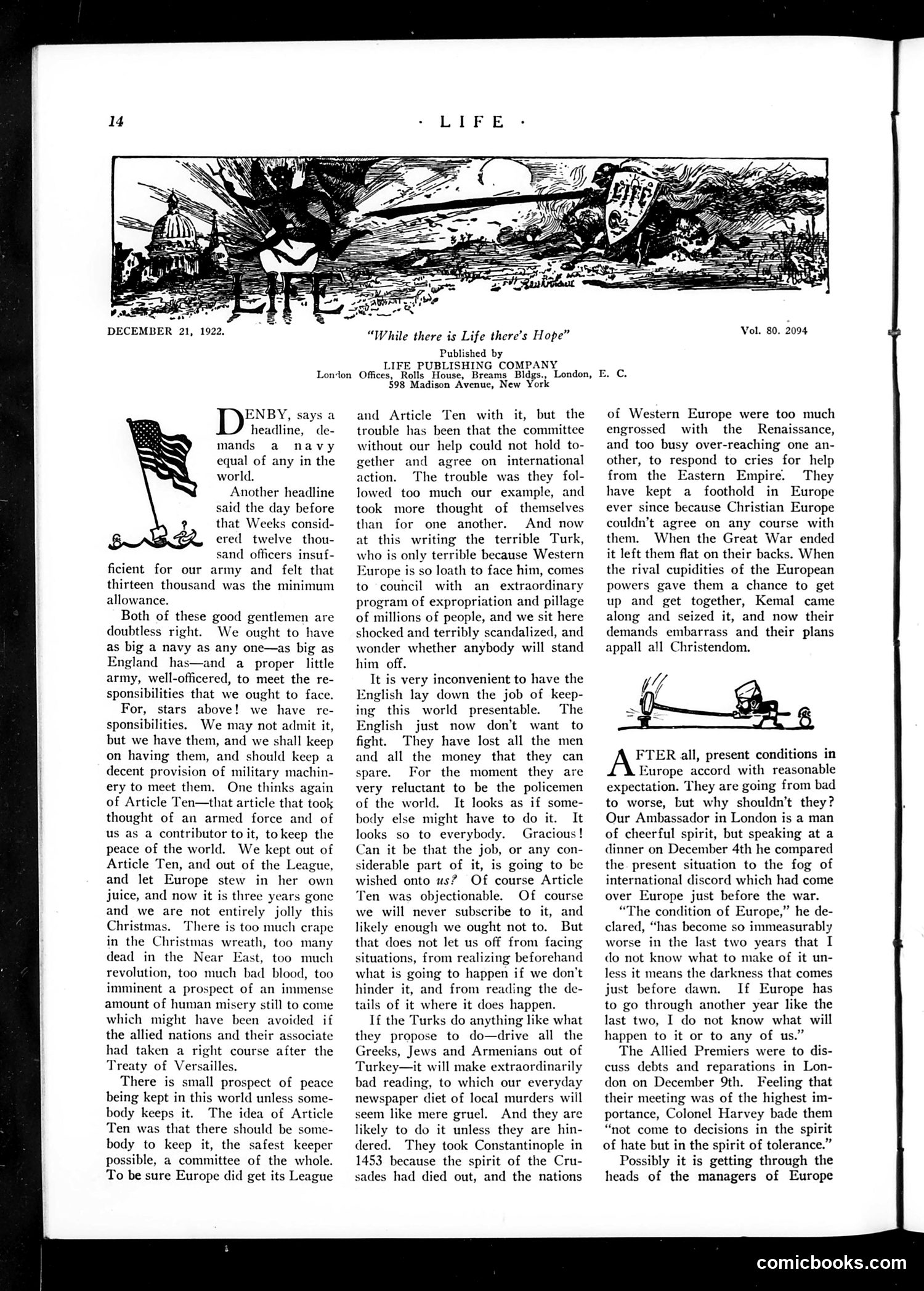
What you’re looking at
**The Masthead Cartoon:** The ornate header illustration depicts a dramatic scene with classical architectural elements (a domed building, likely representing government institutions) amid chaotic imagery—figures, weapons, and turbulent skies. The motto "While there is Life there's Hope" suggests satirical commentary on post-WWI instability. **The Article's Context:** The text discusses international military concerns, specifically Denby's call for a strong navy. It critiques Europe's disorder following World War I, particularly regarding conflicts in Eastern Europe and tensions with Turkey. The passage references the failed League of Nations efforts to maintain peace and questions whether European powers can achieve stability without American intervention. The satire targets the irony of hope amid widespread diplomatic failure and geopolitical chaos.
📄 Transcribed text from this page (OCR, searchable)
Machine-transcribed from the original scan — historical spelling and the odd misread are preserved.
DECEMBER 21, 1922. “While there is Life there's Hope” Published by LIFE PUBLISHING COMPANY Vol. 80. 2094 London Offices, Rolls House, Breams Bldgs., London, E. C. ENBY, says a headline, de- mands a navy equal of any in the world. Another headline said the day before that Weeks consid- ered twelve thou- sand officers insuf- ficient for our army and felt that thirteen thousand was the minimum allowance. Both of these good gentlemen are doubtless right. We ought to have as big a navy as any one—as big as England has—and a proper little army, well-officered, to meet the re- sponsibilities that we ought to face. For, stars above! we have re- sponsibilities. We may not admit it, but we have them, and we shall keep on having them, and should keep a decent provision of military machin- ery to meet them. One thinks again of Article Ten—that article that took thought of an armed force and of us as a contributor to it, tokeep the peace of the world. We kept out of Article Ten, and out of the League, and let Europe stew in her own juice, and now it is three years gone and we are not entirely jolly this Chris . There is too much crape in the Christmas wreath, too many dead in the Near East, too much revolution, too much bad blood, too imminent a prospect of an immense amount of human misery still to come which might have been avoided if the allied nations and their associate had taken a right course after the Treaty of Versailles. There is small prospect of peace being kept in this world unless some- body keeps it. The idea of Article Ten was that there should be some- body to keep it, the safest keeper possible, a committee of the whole. To be sure Europe did get its League 598 Madison Avenue, New York and Article Ten with it, but the trouble has been that the committee without our help could not hold to- gether and agree on international action. The trouble was they fol- lowed too much our example, and took more thought of themselves than for one another. And now at this writing the terrible Turk, who is only terrible because Western Europe is so loath to face him, comes to council with an extraordinary program of expropriation and pillage of millions of people, and we sit here shocked and terribly scandalized, and wonder whether anybody will stand him off. It is very inconvenient to have the English lay down the job of keep- ing this world presentable. The English just now don’t want to fight. They have lost all the men and all the money that they can spare. For the moment they are very reluctant to be the policemen of the world. It looks as if some- body else might have to do it. It looks so to everybody. Gracious! Can it be that the job, or any con- siderable part of it, is going to be wished onto us? Of course Article Ten was objectionable. Of course we will never subscribe to it, and likely enough we ought not to. But that does not let us off from facing situations, from realizing beforehand what is going to happen if we don’t hinder it, and from reading the de- tails of it where it does happen. If the Turks do anything like what they propose to do—drive all the Greeks, Jews and Armenians out of Turkey—it will make extraordinarily bad reading, to which our everyda newspaper diet of local murders seem like mere gruel. And they are likely to do it unless they are hin- dered. They took Constantinople in 1453 because the spirit of the Cru- sades had died out, and the nations of Western Europe were too much engrossed with the Renaissance, and too busy over-reaching one an- other, to respond to cries for help from the Eastern Empire. They have kept a foothold in Europe ever since because Christian Europe couldn’t agree on any course with them. When the Great War ended it left them flat on their backs. When the rival cupidities of the European powers gave them a chance to get up and get together, Kemal came along and seized it, and now their demands embarrass and their plans appall all Christendom. Uy fi. FTER all, present conditions in Europe accord with reasonable expectation. They are going from bad to worse, but why shouldn’t they? Our Ambassador in London is a man of cheerful spirit, but speaking at a dinner on December 4th he compared the present situation to the fog of international discord which had come over Europe just before the war. “The condition of Europe,” he de- clared, “has become so immeasurably worse in the last two years that I do not know what to make of it un- less it means the darkness that comes just before dawn. If Europe has to go through another year like the last two, I do not know what will happen to it or to any of us.” The Allied Premiers were to dis- cuss debts and reparations in Lon- don on December 9th. Feeling that their meeting was of the highest im- portance, Colonel Harvey bade them “not come to decisions in the spirit of hate but in the spirit of tolerance.” Possibly it is getting through the heads of the managers of Europe comicbooks.com