
Life, 1922-12-21 · page 7 of 42
Life — December 21, 1922 — page 7: what you’re looking at
What you’re looking at
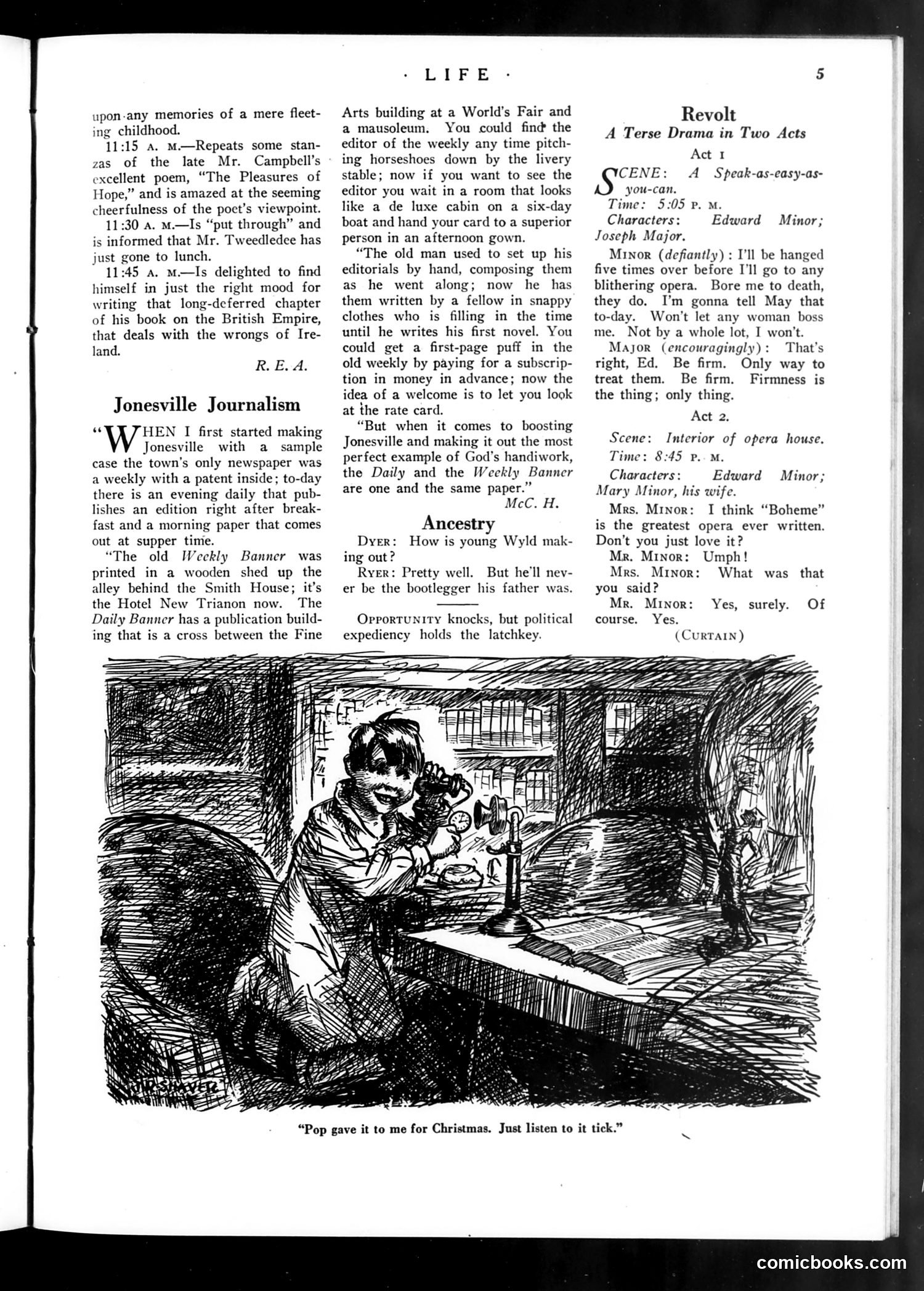
This page contains a one-act play called "Revolt" and an article on "Jonesville Journalism," alongside a single illustration. The cartoon depicts a young child holding what appears to be a mechanical toy or clock, saying "Pop gave it to me for Christmas. Just listen to it tick." The humor relies on the child's innocent enthusiasm for a practical, unglamorous gift—suggesting the parent's economical or utilitarian approach to holiday giving rather than providing exciting toys. The articles discuss local newspaper operations and social conventions of the era, reflecting Life's satirical commentary on American small-town life and media practices. The overall tone is gently mocking of everyday American customs and expectations.
📄 Transcribed text from this page (OCR, searchable)
Machine-transcribed from the original scan — historical spelling and the odd misread are preserved.
upon-any memories of a mere fleet- ing childhood. 11:15 a. M.—Repeats some stan- zas of the late Mr. Campbell’s excellent poem, “The Pleasures of Hope,” and is amazed at the seeming cheerfulness of the poet’s viewpoint. 11:30 a. M.—Is “put through” and is informed that Mr. Tweedledee has just gone to lunch. 11:45 a. M—lIs delighted to find himself in just the right mood for writing that long-deferred chapter of his book on the British Empire, that deals with the wrongs of Ire- land. Ri EAs Jonesville Journalism ae HEN I first started making Jonesville with a sample case the town’s only newspaper was a weekly with a patent inside; to-day there is an evening daily that pub- lishes an edition right after break- fast and a morning paper that comes out at supper time. “The old Weekly Banner was printed in a wooden shed up the alley behind the Smith House; it’s the Hotel New Trianon now. The Daily Banner has a publication build- ing that is a cross between the Fine “Pop gave it to me for Christmas. LIFE Arts building at a World’s Fair and a mausoleum. You could find the editor of the weekly any time pitch- ing horseshoes down by the livery stable; now if you want to see the editor you wait in a room that looks like a de luxe cabin on a six-day boat and hand your card to a superior person in an afternoon gown. “The old man used to set up his editorials by hand, composing them as he went along; now he has them written by a fellow in snappy clothes who is filling in the time until he writes his first novel. You could get a first-page puff in the old weekly by paying for a subscrip- tion in money in advance; now the idea of a welcome is to let you look at the rate card. “But when it comes to boosting Jonesville and making it out the most perfect example of God’s handiwork, the Daily and the Weekly Banner are one and the same paper.” McC. H. Ancestry Dyer: How is young Wyld mak- ing out? Ryer: Pretty well. But he'll nev- er be the bootlegger his father was. Opportunity knocks, but political expediency holds the latchkey. Revolt A Terse Drama in Two Acts Act 1 CENE: A_ Speak-as-easy-as- you-can. Time: 5:05 Pp. M. Characters: Edward Minor; Joseph Major. Minor (defiantly) : I’ll be hanged five times over before I'll go to any blithering opera. Bore me to death, they do. I’m gonna tell May that to-day. Won't let any woman boss me. Not by a whole lot, I won't. Major (encouragingly): That's right, Ed. Be firm. Only way to treat them. Be firm. Firmness is the thing; only thing. Act 2. Scene: Interior of opera house. Time: 8:45 P.M. Characters: Edward Minor; Mary Minor, his wife. Mrs. Minor: I think “Boheme” is the greatest opera ever written. Don’t you just love it? Mr. Minor: Umph! Mrs. Minor: What you said? Mr. Minor: course. Yes. (Curtain) was that Yes, surely. Of . Just listen to it tick.” comicbooks.com