
Life, 1922-12-21 · page 28 of 42
Life — December 21, 1922 — page 28: what you’re looking at
What you’re looking at
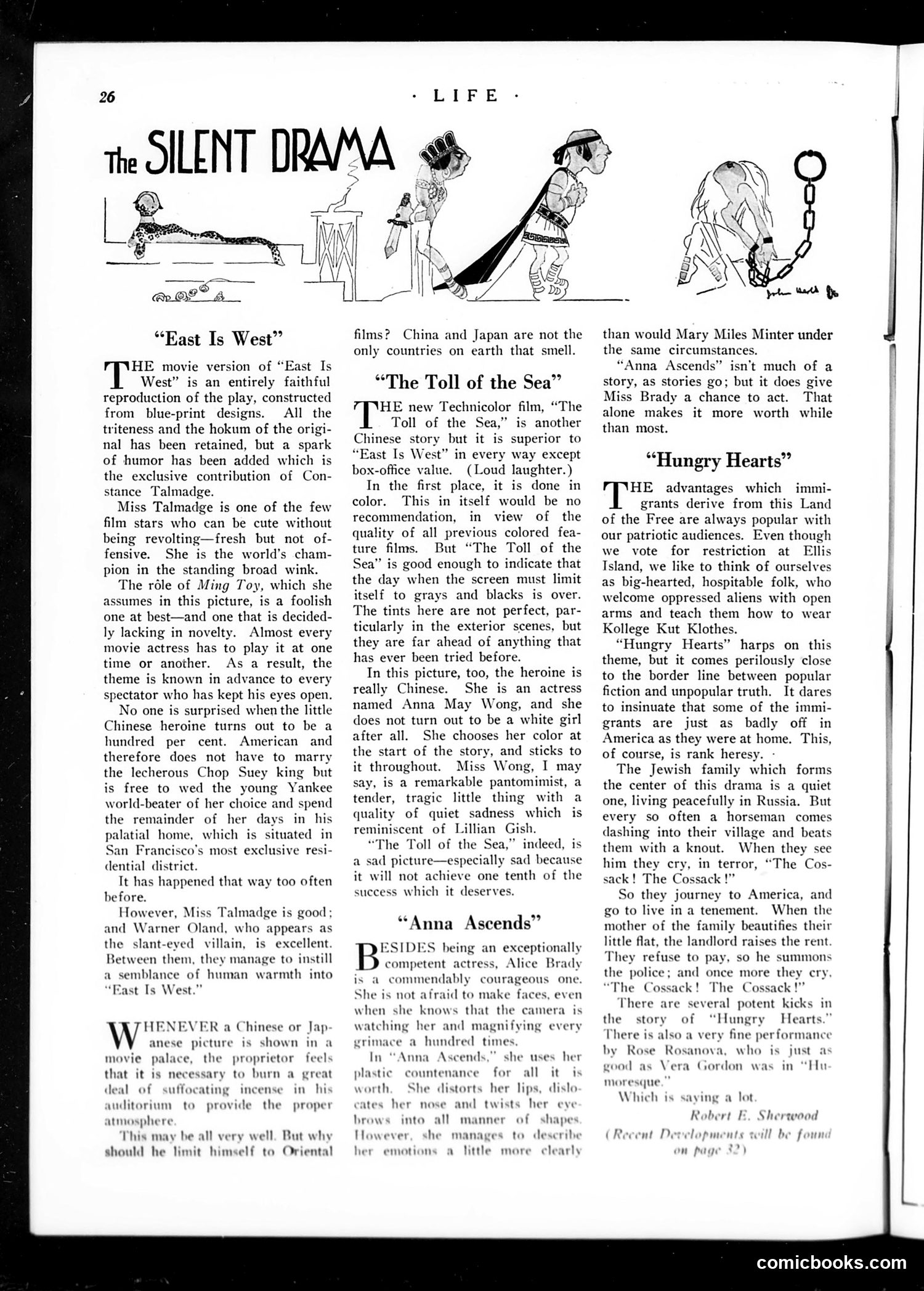
This page contains three film reviews from the silent era (likely early 1920s), with satirical commentary on Hollywood's treatment of Asian characters. **"East Is West"** reviews a movie adaptation where actress Constance Talmadge plays "Ming Toy," a Chinese character who predictably turns out to be fully American, allowing her to marry a white American man rather than a "lecherous Chop Suey king." The reviewer notes this plot has been done "too often before," mocking both the tired stereotype and Hollywood's apparent need for such resolutions. **"The Toll of the Sea"** praises a Technicolor film because its Chinese heroine, played by Anna May Wong, actually *remains* Chinese throughout—a notable distinction. The review treats this as progressive, suggesting Wong's authentic casting and her performance quality elevate the film. **"Anna Ascends"** reviews Alice Brady's expressive acting. The page's opening cartoon satirizes theater owners burning incense during Asian-themed films, suggesting this performative "Orientalism" is unnecessary—a jab at manufactured exoticism in entertainment.
📄 Transcribed text from this page (OCR, searchable)
Machine-transcribed from the original scan — historical spelling and the odd misread are preserved.
26 RAO? s Bi. “East Is West” HE movie version of “East Is West” is an entirely faithful reproduction of the play, constructed from blue-print designs. All the triteness and the hokum of the origi- nal has been retained, but a spark of humor has been added which is the exclusive contribution of Con- stance Talmadge. Miss Talmadge is one of the few film stars who can be cute without being revolting—fresh but not of- fensive. She is the world’s cham- pion in the standing broad wink. The role of Ming Toy, which she assumes in this picture, is a foolish one at best—and one that is decided- ly lacking in novelty. Almost every movie actress has to play it at one time or another. As a result, the theme is known in advance to every spectator who has kept his eyes open. No one is surprised when the little Chinese heroine turns out to be a hundred per cent. American and therefore does not have to marry the lecherous Chop Suey king but is free to wed the young Yankee world-beater of her choice and spend the remainder of her days in his palatial home, which is situated in San Francisco's most exclusive resi- dential district. It has happened that way too often before. However, Miss Talmadge is good; and Warner Oland, who appears as the slant-eyed villain, is excellent. Between them, they manage to instill a semblance of human warmth into “East Is West.” HENEVER a Chinese or Jap anese picture is shown in a movie palace, the proprietor feels that it is necessary to burn a great deal of suffocating incense in his suditorium to provide the proper atmosphere This may be all very well. But why should he limit himself to Oriental se SILENT DRAMA _J_ films? China and Japan are not the only countries on earth that smell. “The Toll of the Sea” HE new Technicolor film, “The Toll of the Sea,” is another hinese story but it is superior to East Is West” in every way except box-office value. (Loud laughter.) In the first place, it is done in color. This in itself would be no recommendation, in view of the quality of all previous colored fea- ture films. But “The Toll of the Sea” is good enough to indicate that the day when the screen must limit itself to grays and blacks is over. The tints here are not perfect, par- ticularly in the exterior scenes, but they are far ahead of anything that has ever been tried before. In this picture, too, the heroine is really Chinese. She is an actress named Anna May Wong, and she does not turn out to be a white girl after all. She chooses her color at the start of the story, and sticks to it throughout. Miss Wong, I may say, is a remarkable pantomimist, a tender, tragic little thing with a quality of quiet sadness which is reminiscent of Lillian Gish. “The Toll of the Sea,” indeed, is a sad picture—especially sad because it will not achieve one tenth of the success which it deserves. “Anna Ascends” ESIDES being an eptionally competent actress, Alice Brady commendably cou is geous one. She is not afraid to make faces, even when she knows that the camera is watching her and magnifying every grimace a hundred times. In “Anna Ascends,” plastic countenance for all it is she uses her worth, She distorts her lips, dislo cates her nose and twists her eve brows into all manner of shape However, she manages to describe her emotions a little more clearly than would Mary Miles Minter under the same circumstances. “Anna Ascends” isn’t much of a story, as stories go; but it does give Miss Brady a chance to act. That alone makes it more worth while than most. “Hungry Hearts” HE advantages which immi- grants derive from this Land of the Free are always popular with our patriotic audiences. Even though we vote for restriction at Ellis Island, we like to think of ourselves as big-hearted, hospitable folk, who welcome oppressed aliens with open arms and teach them how to wear Kollege Kut Klothes. “Hungry Hearts” harps on this theme, but it comes perilously close to the border line between popular fiction and unpopular truth. It dares to insinuate that some of the immi- grants are just as badly off in America as they were at home. This, of course, is rank here: The Jewish family which forms the center of this drama is a quiet one, living peacefully in Russia. But every so often a horseman comes dashing into their village and beats them with a knout. When they see him they cry, in terror, “The Cos- sack! The Cossack !” So they journey to America, and go to live in a tenement. When the mother of the family beautifies their little flat, the landlord raises the rent They refuse to pay, so he summons the police; and once more they cry, “The Cossack! The Cossack !” There are several potent kicks in “Hungry Hearts.’ There is also a very fine performance the story of by Rose Rosanova, who is just as good as Vera Gordon was in “Hu moresque Which is saying a lot Robert E. She (Recent Developments will | comicbooks.com