
A complete issue · 40 pages · 1922
Life — September 14, 1922
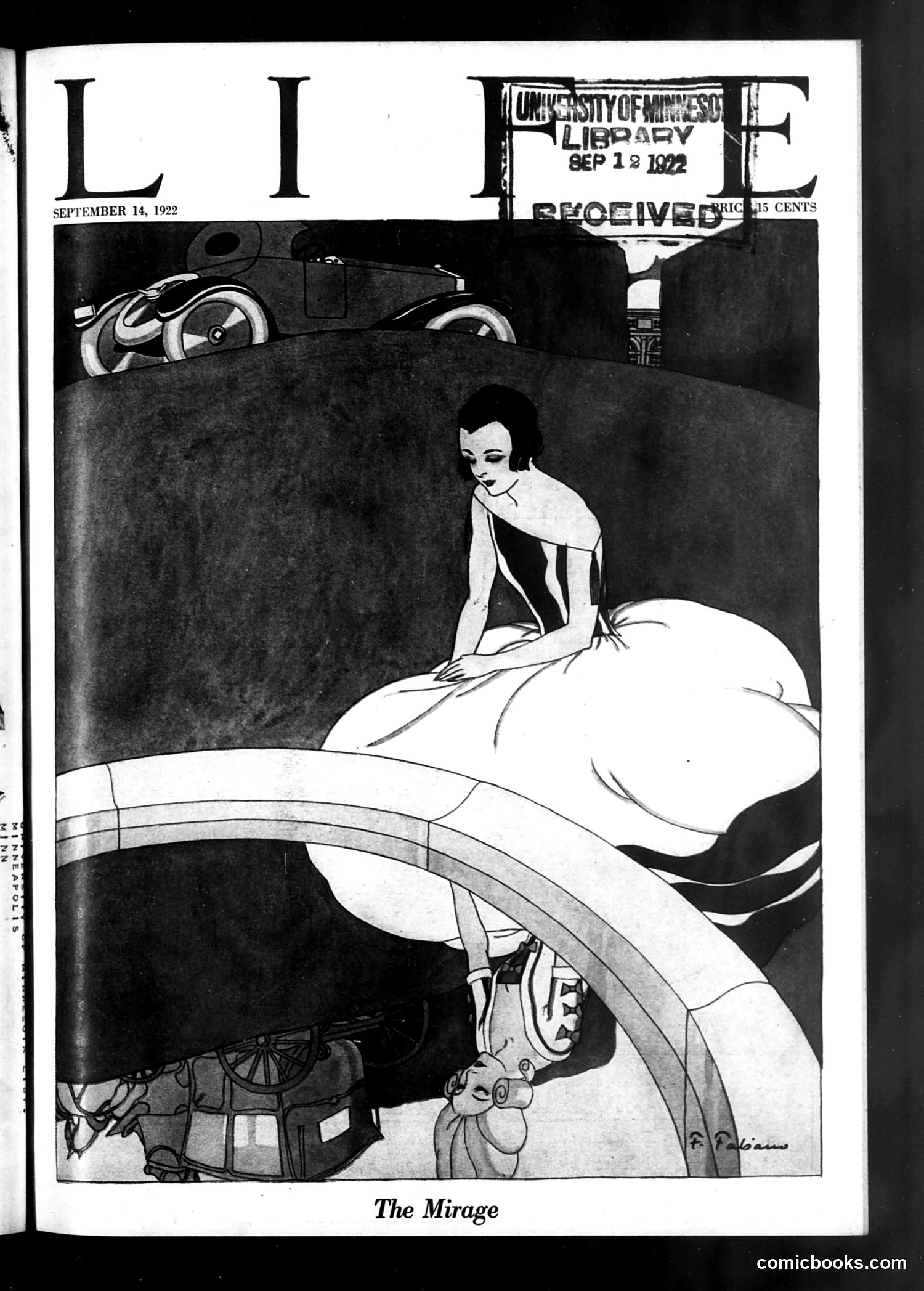
This cover illustration titled "The Mirage" depicts a woman in an elegant, flowing white dress gazing at luxury automobiles in the distance—which appear as a shimmering, dream-like vision. The satire likely comments on the aspirational consumerism of the 1920s, particularly regarding expensive automobiles as status symbols. The woman's enchanted, almost hypnotic gaze suggests the seductive appeal of material wealth during the Jazz Age. The "mirage" metaphor implies these luxuries are illusory or unattainable for most people, critiquing the gap between advertising promises and economic reality. This reflects broader 1920s anxieties about consumer culture and the tension between prosperity and inequality during the post-World War I economic boom.
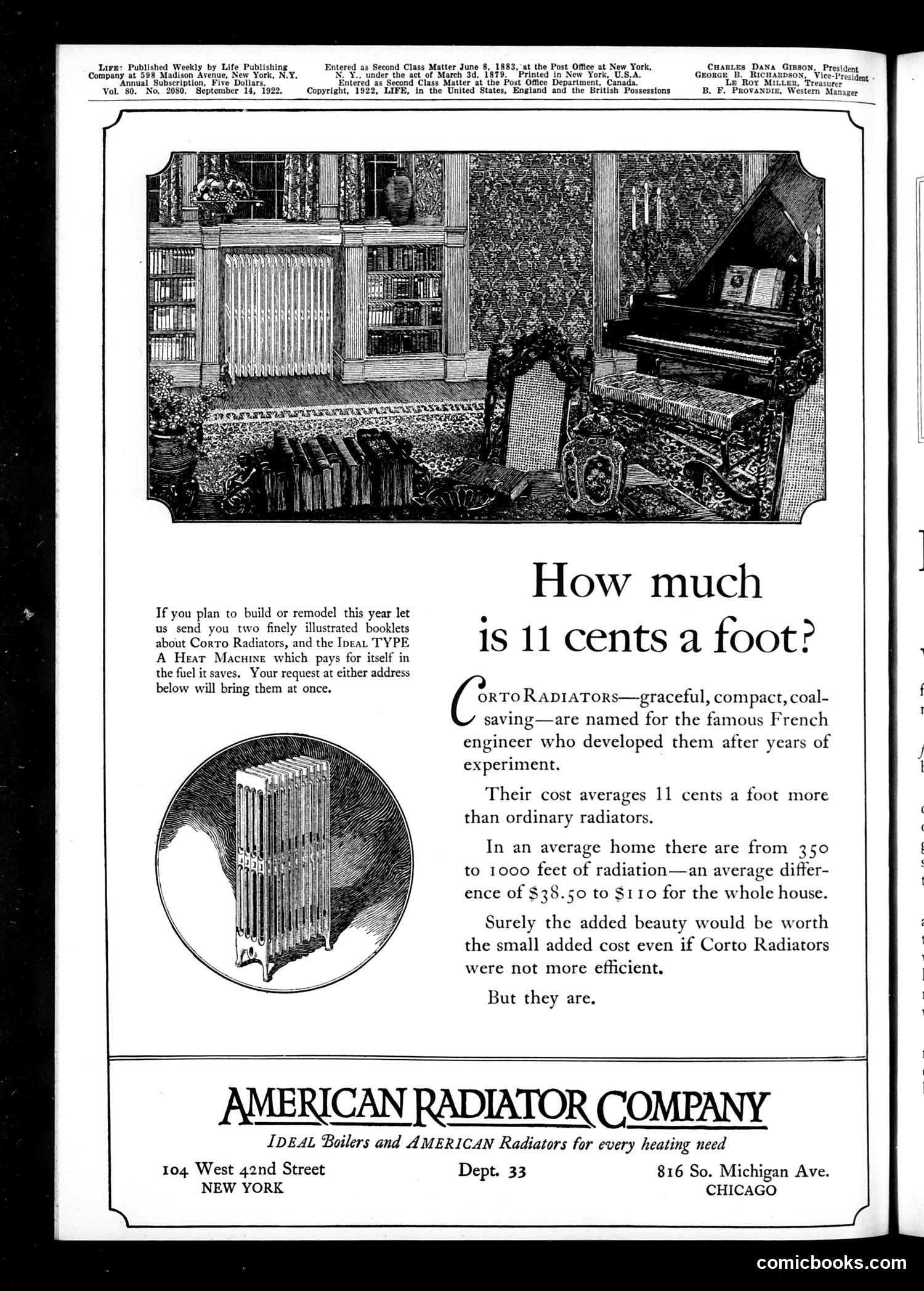
This page is **primarily an advertisement**, not satirical content. It's a 1922 ad for Corto Radiators from the American Radiator Company. The top illustration shows an elegant home interior with a piano and furnishings. The ad's central claim is that Corto Radiators cost only 11 cents more per foot than standard radiators, yet provide superior aesthetics and efficiency. For an average home with 350-1000 feet of radiator space, this amounts to a $38.50-$110 premium for the entire house. The circular inset shows a close-up of the radiator's design. The ad argues that the added beauty justifies the minimal cost difference, while asserting the radiators are also more efficient than competitors. This is straightforward commercial advertising typical of *Life* magazine in the early 1920s, with no apparent political satire or cartoon humor present.
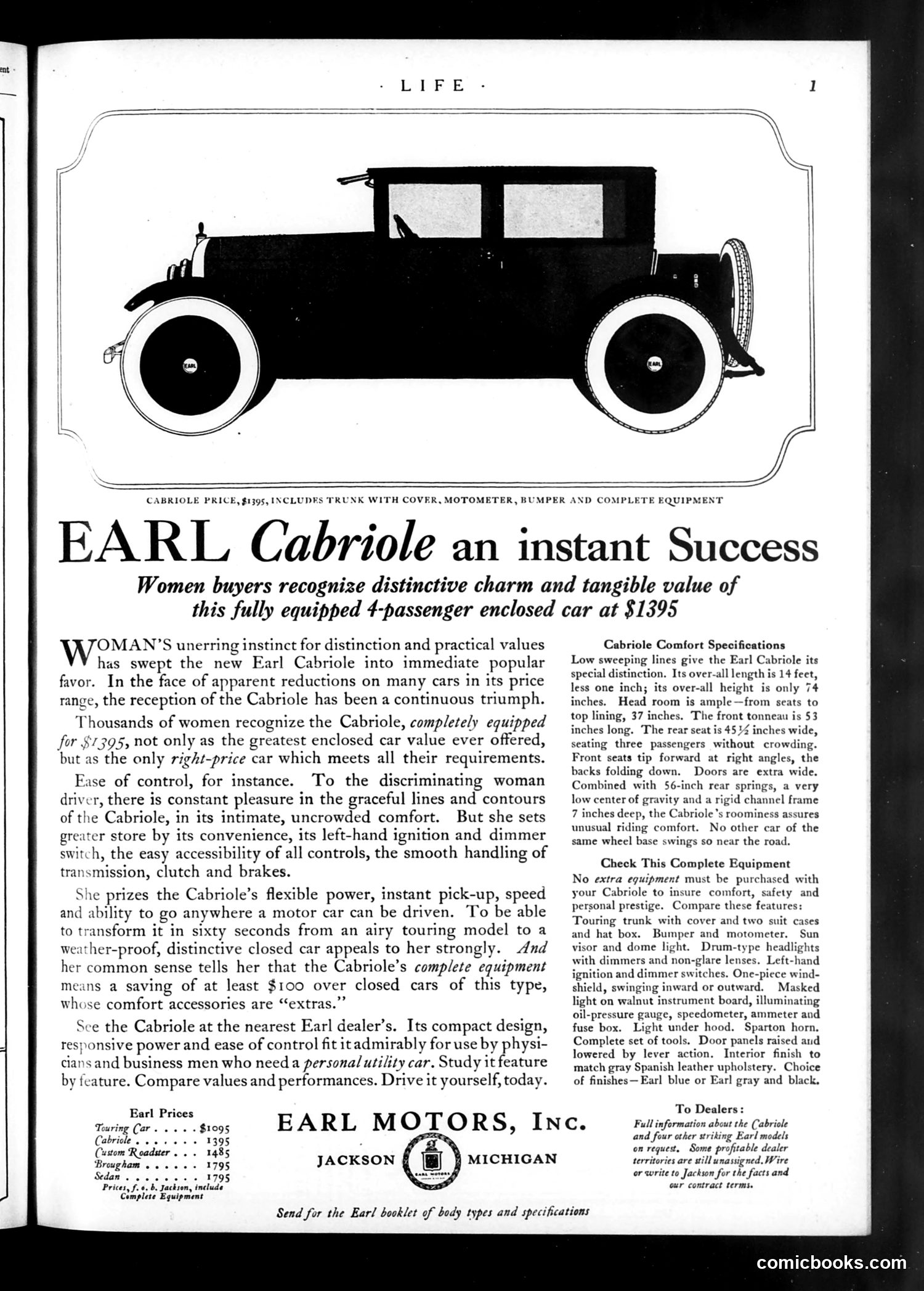
This page is **not a political cartoon or satire**—it's a straightforward automobile advertisement for the Earl Cabriolet, placed in *Life* magazine. The image shows a side-view silhouette of a 1920s touring car with an enclosed cabin. The ad targets female buyers specifically, emphasizing "Woman's unerring instinct for distinction and practical values." It highlights the car's features: convertible design (transforms from open touring car to closed car in 60 seconds), comfort specifications, complete equipment, and price ($1,395). The marketing pitch appeals to women's desire for both practical functionality and aesthetic appeal—positioning the Cabriolet as offering luxury at value pricing compared to competitors. This reflects 1920s-era marketing attempting to expand the automobile market beyond wealthy men to include female consumers.
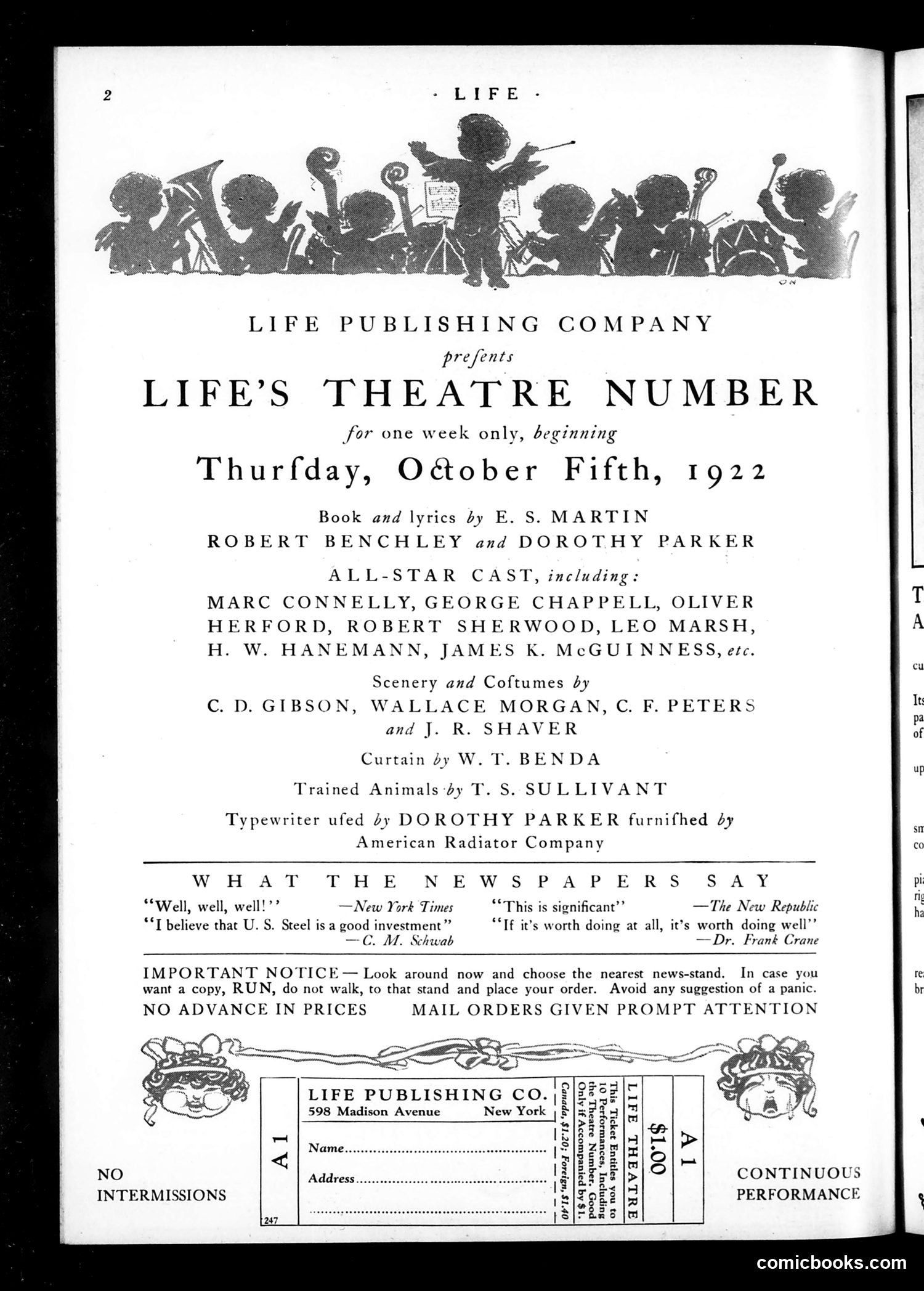
This page is primarily **advertising** for Life Publishing Company's "Theatre Number" special issue (October 5, 1922). The top illustration shows silhouetted theatrical figures—cherubs or cupids with theatrical props (masks, instruments)—representing the theatrical/entertainment theme of this special edition. The page lists an "all-star cast" of performers including Marc Connelly, George Chappell, and Oliver Herford, with credits for scenery, costumes, and trained animals, indicating this was a theatrical production or entertainment-focused issue. The "What the Newspapers Say" section quotes positive reviews from the *New York Times*, *New Republic*, and others praising the publication. The bottom contains a mail-order coupon and an urgent notice encouraging readers to purchase copies immediately at newsstands, warning against delays and panicked buying—possibly referencing post-WWI supply concerns.
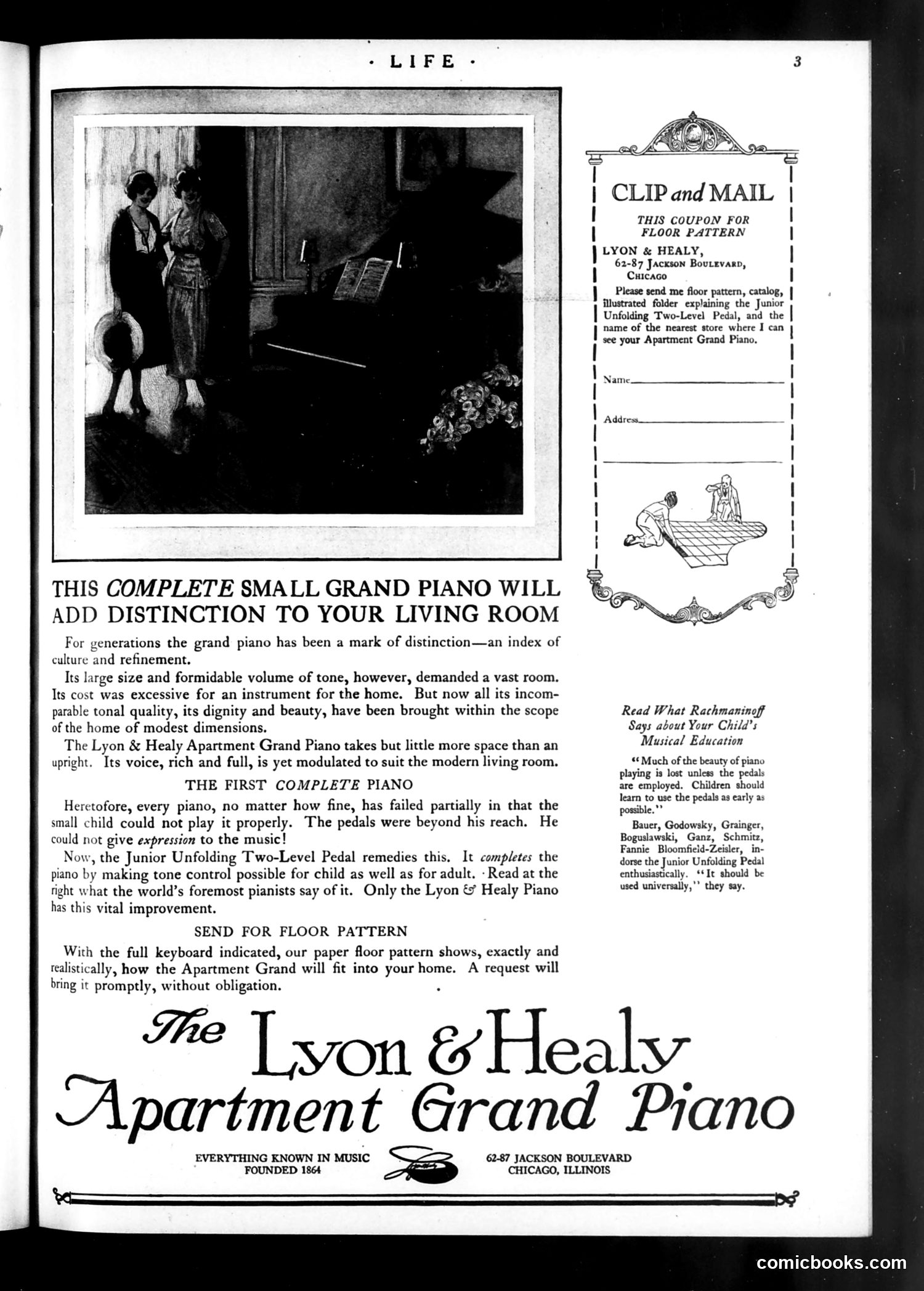
This page is **primarily an advertisement** for the Lyon & Healy Apartment Grand Piano, not a political cartoon or satire. The image shows a domestic interior scene with figures near a piano, illustrating how such an instrument would fit into a home. The accompanying text emphasizes that grand pianos, traditionally large and expensive status symbols, can now fit modest apartment living spaces. The advertisement highlights a practical innovation: the "Junior Unfolding Two-Level Pedal," which allows children to reach the pedals properly—a feature marketed as unique to Lyon & Healy pianos. There's a mail-in coupon for a floor pattern showing how the piano fits in a room. This represents early 20th-century consumer marketing targeting middle-class home ownership and musical education for children.
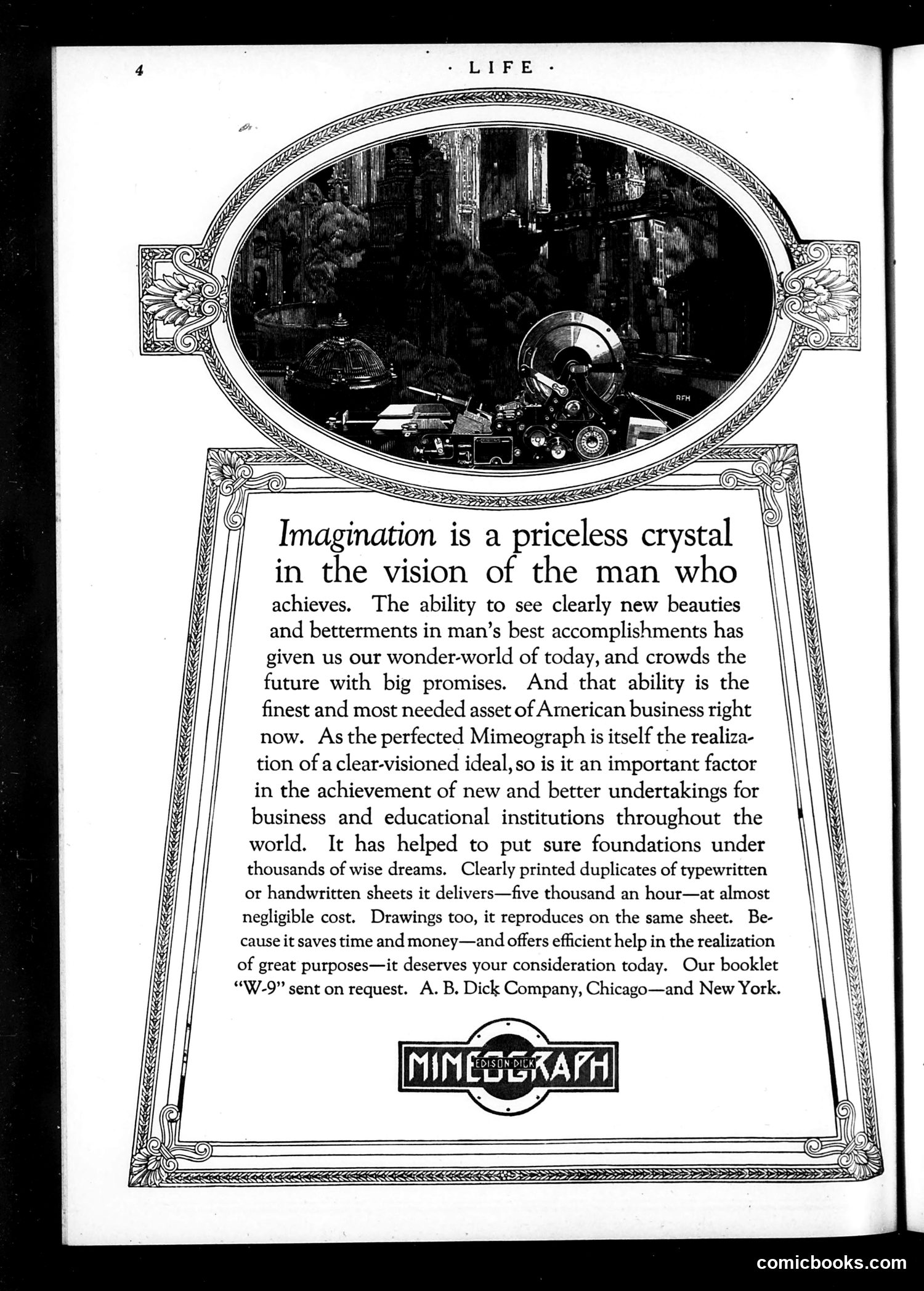
This page is primarily an **advertisement for the Mimeograph**, a duplicating machine made by A.B. Dick Company. The ad is not satirical or political. The text celebrates imagination as essential to American business success, arguing that the mimeograph—by efficiently reproducing documents at scale—helps realize ambitious ideas. It claims the machine produces "five thousand an hour—at almost negligible cost" and can duplicate both typewritten and handwritten sheets. The oval image shows the mimeograph machine itself. The ornate border and placement in *Life* magazine suggests this was premium advertising space. The message targets business and educational institutions by positioning the technology as vital infrastructure for modern American enterprise.
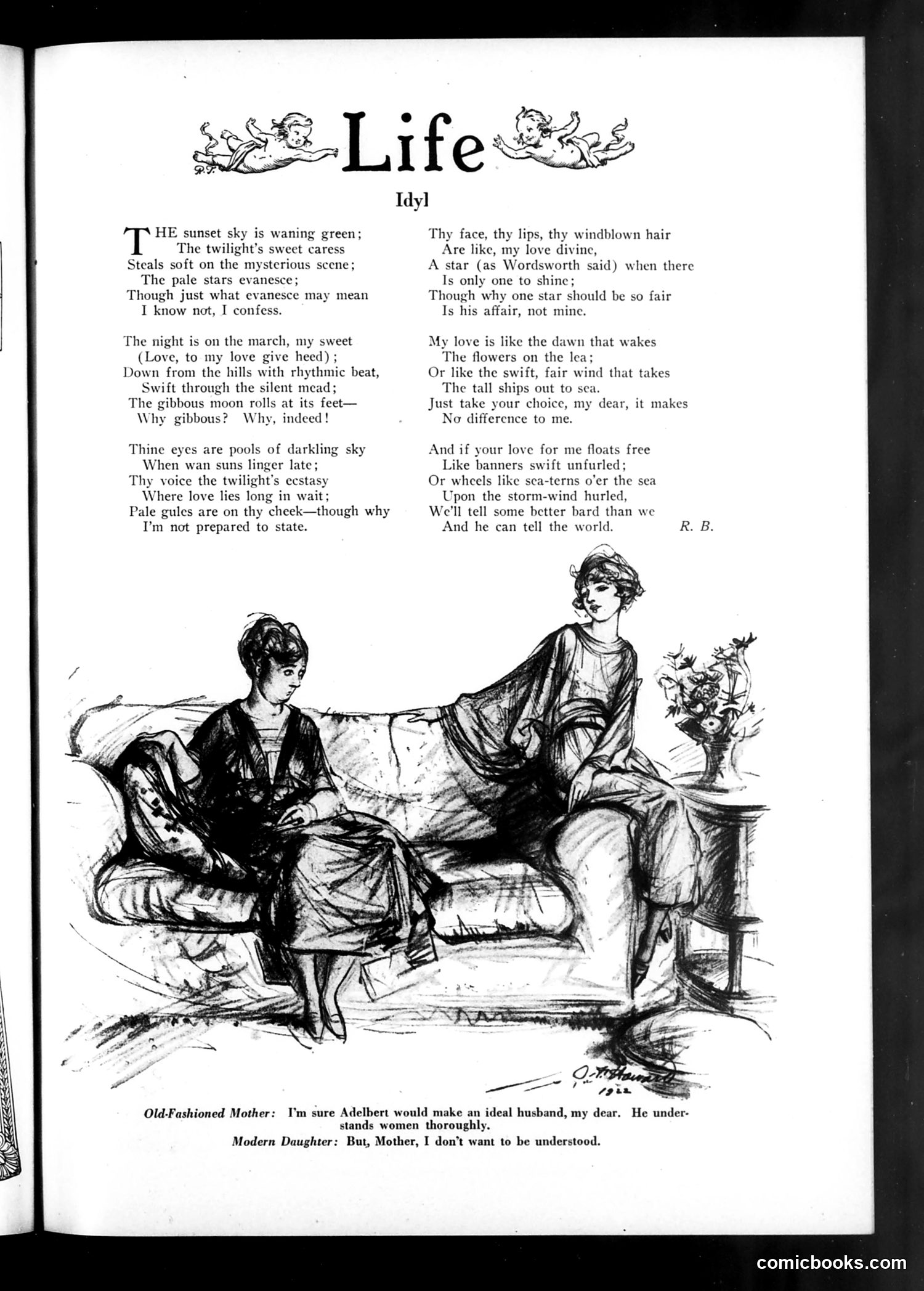
This page contains a romantic poem titled "Idyl" (signed R.B.) followed by a satirical cartoon illustrating generational conflict. The illustration shows an older mother and younger daughter in conversation, with the mother praising a potential husband named Adelbert as understanding and thorough with women. The daughter's modern response—"But, Mother, I don't want to be understood"—captures early 20th-century tensions between Victorian and progressive values. The cartoon satirizes how younger women rejected traditional expectations of being "understood" (controlled/managed) by husbands. Instead, they sought independence and autonomy, positioning themselves as subjects rather than objects of male comprehension. This reflects the emerging "New Woman" attitude challenging Victorian matrimonial ideals.
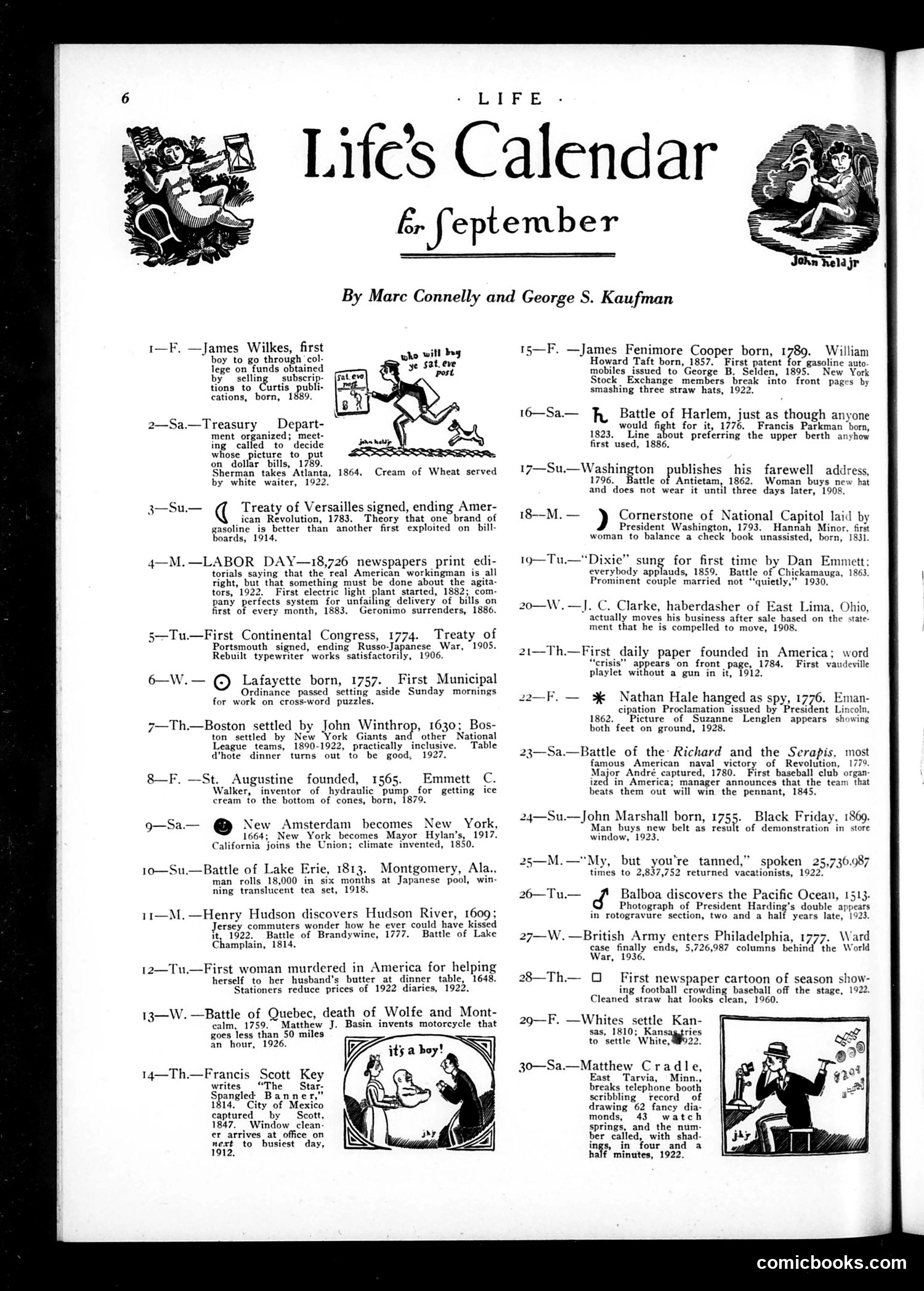
This page presents a calendar of historical events and notable births for September, compiled by Marc Connelly and George S. Kaufman. The small illustrations are humorous vignettes rather than political cartoons. The visible cartoons show everyday scenes: one depicts someone running with text about "Cream of Wheat served" (entry 2), another shows a figure at what appears to be a dining table ("It's a boy!"), and a third shows a man with papers (entry 30). These are light domestic humor rather than political satire—typical of Life magazine's approach during this era (1922, based on visible dates). The calendar mixes significant historical events (Treaty of Versailles, Battle of Lake Erie) with trivial contemporary observations about returning vacationers, typewriter improvements, and window cleaning—reflecting the magazine's blend of serious and humorous content.
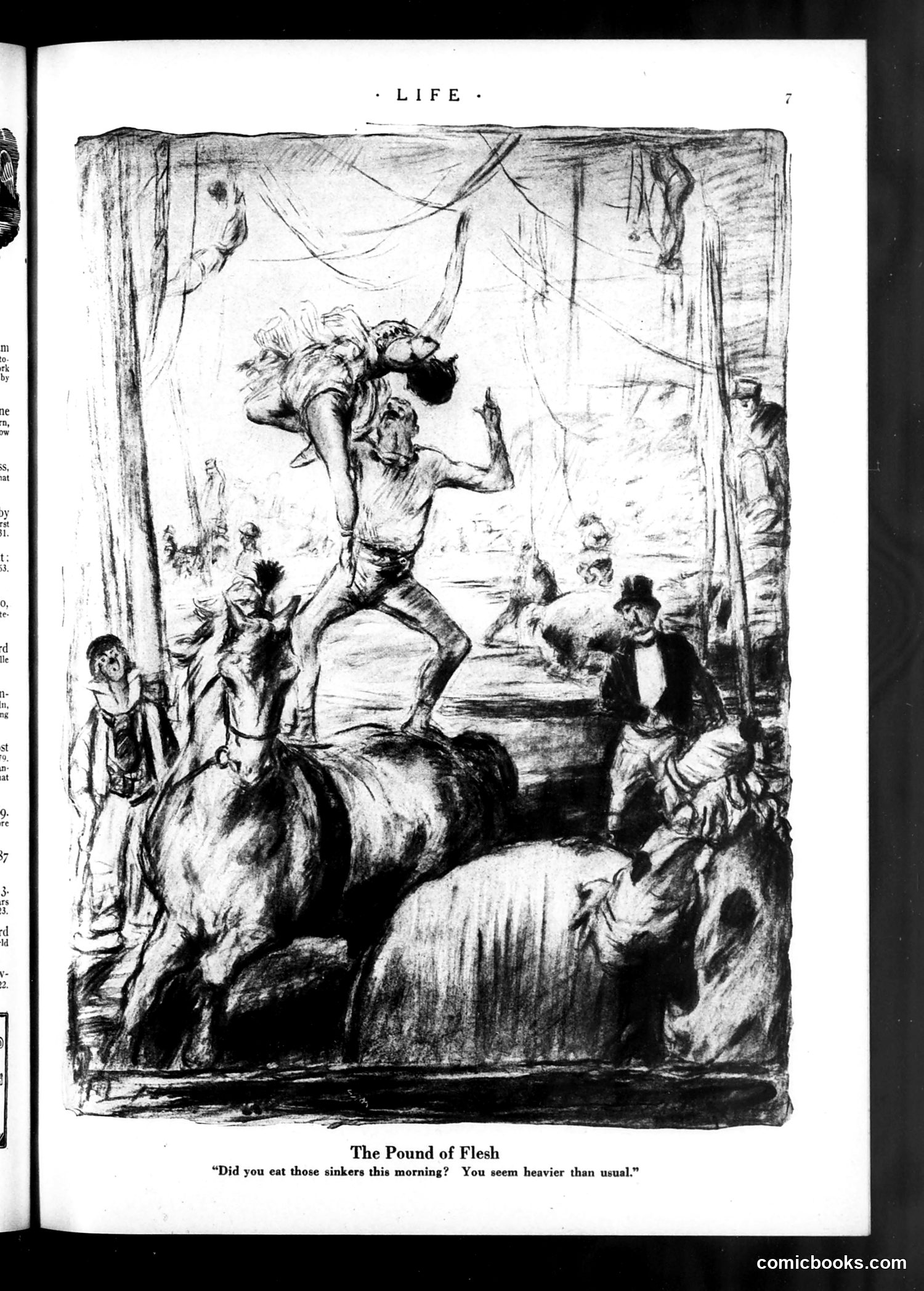
This illustration depicts a circus or acrobatic performance. A muscular performer balances on horseback while holding another person overhead, demonstrating physical strength and skill. Spectators watch from the sides in what appears to be a tent setting. The caption reads: "Did you eat those sinkers this morning? You seem heavier than usual." The humor relies on wordplay: "sinkers" (a colloquial term for heavy foods like donuts) and the performer's comment about the increased weight he must support. This is straightforward circus-based humor rather than political satire. The "Pound of Flesh" title may reference Shakespeare's *Merchant of Venice*, though the connection to the cartoon's actual content remains unclear.
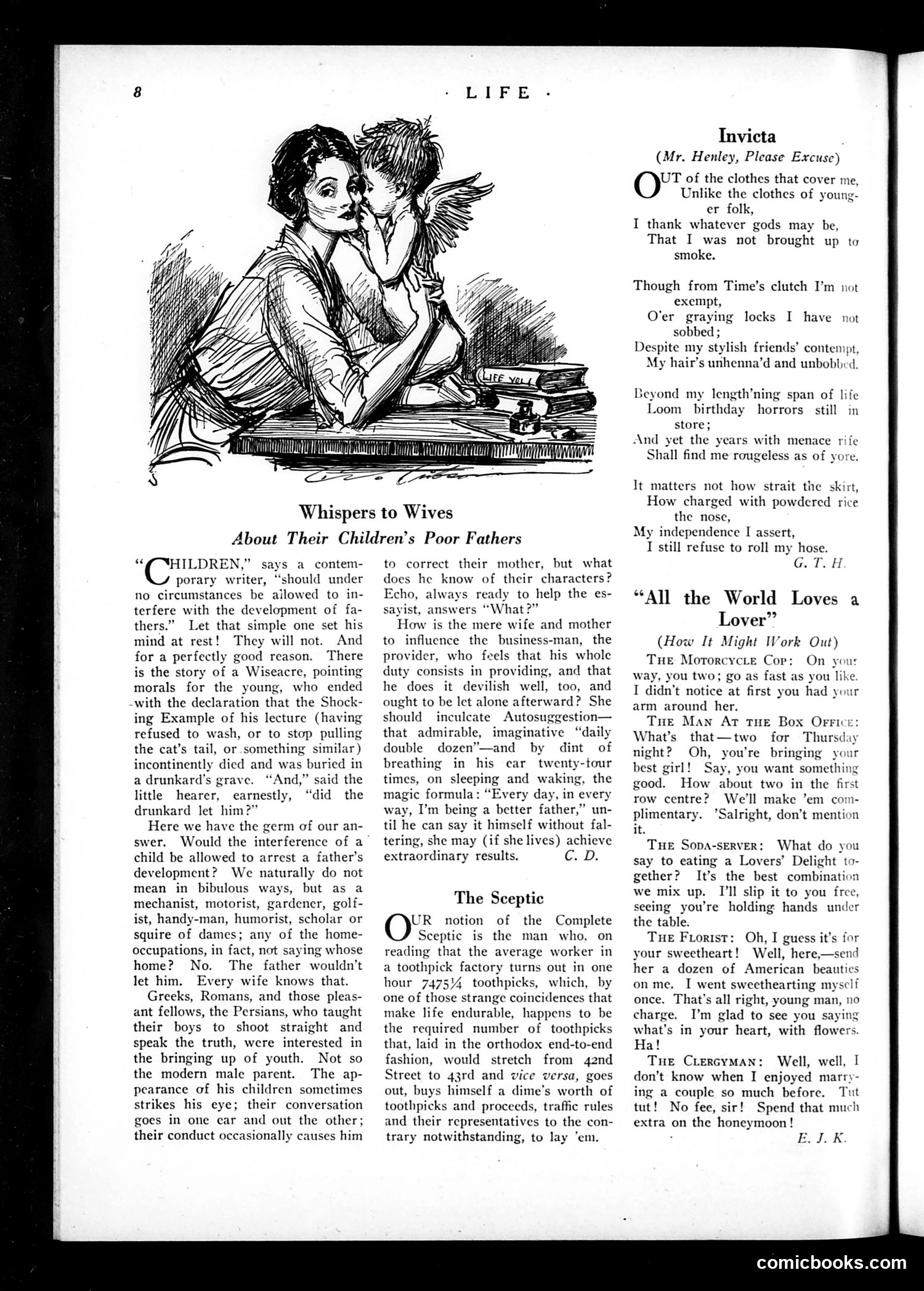
This page contains three distinct pieces of satirical content about courtship and marriage: 1. **"Invcita" poem** (top right): A woman's witty defense of her independence and aging, rejecting social pressures to smoke or conform to fashion trends. 2. **"Whispers to Wives" article** (center): Social commentary advising wives not to interfere with their husbands' parenting, suggesting men's involvement with children should be limited. The satire targets outdated gender roles and absent fathers. 3. **"The Sceptic" dialogue** (lower right): A humorous exchange about consumer culture—a man obsessively counting toothpicks from a factory, illustrating absurd materialism and working-class preoccupations. 4. **"All the World Loves a Lover"** (right): A comedic romantic conversation about motorcycles and courtship. The page satirizes early-20th-century domestic relations, gender expectations, and consumer culture.
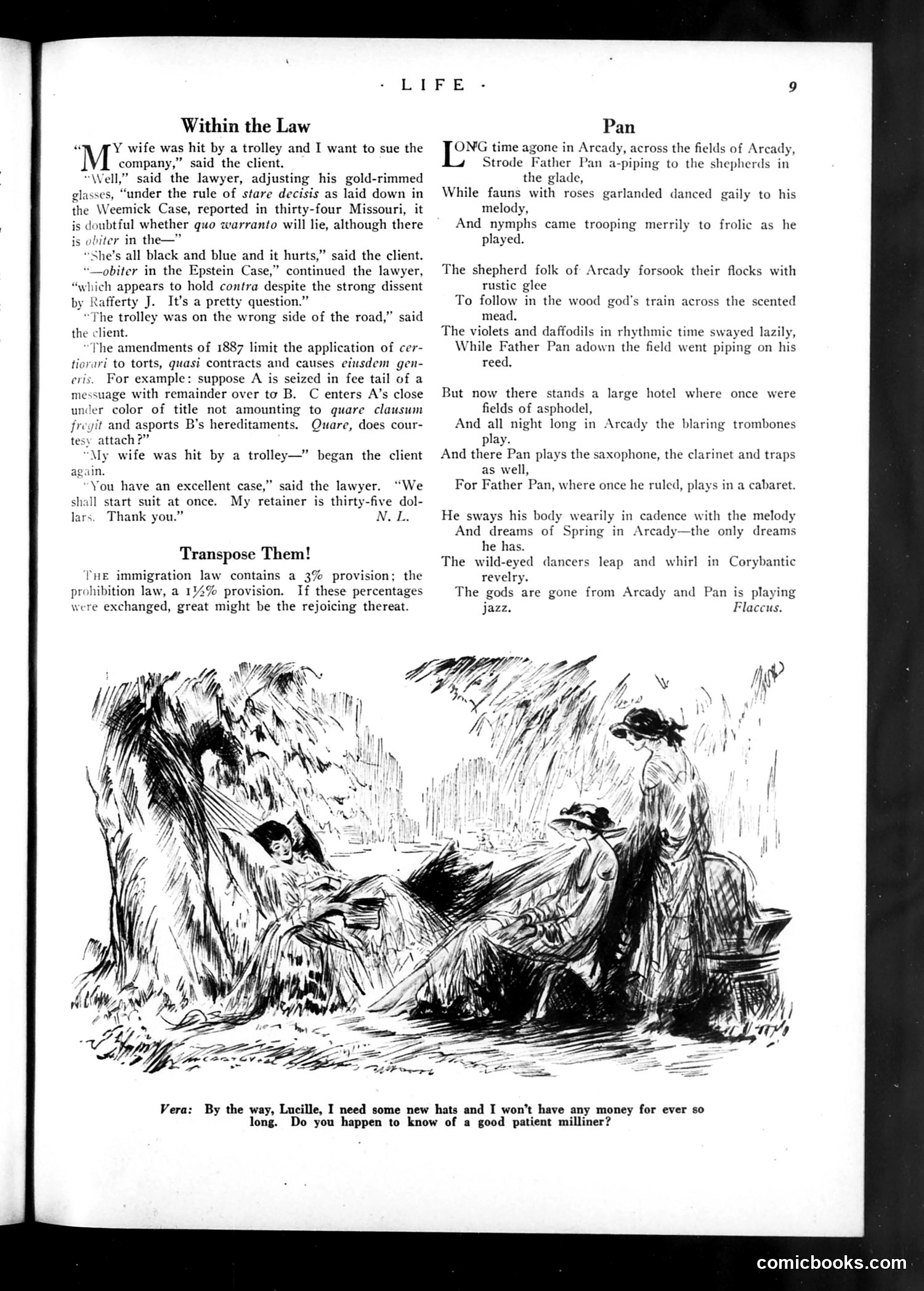
This page contains three distinct pieces: **"Within the Law"** (left column): A satirical legal dialogue where a lawyer discusses a tort case involving a trolley accident. The satire mocks legal technicalities and precedent-based reasoning—the lawyer cites obscure case law to explain why the client's straightforward injury claim is actually complicated. **"Pan"** (right column): A poetic piece contrasting Arcady (idealized pastoral landscape with Pan playing pipes) with modern industrial reality—a large hotel and jazz cabaret have replaced the pastoral fields. The satire laments how commercialism destroys natural beauty and classical mythology. **Bottom cartoon**: Depicts figures reclining outdoors. The caption shows one person (Père/Father) asking about finding a patient milliner, as he lacks money. The humor involves financial desperation masked by casual conversation. The page satirizes legal absurdity, nostalgia for lost pastoralism, and economic hardship.
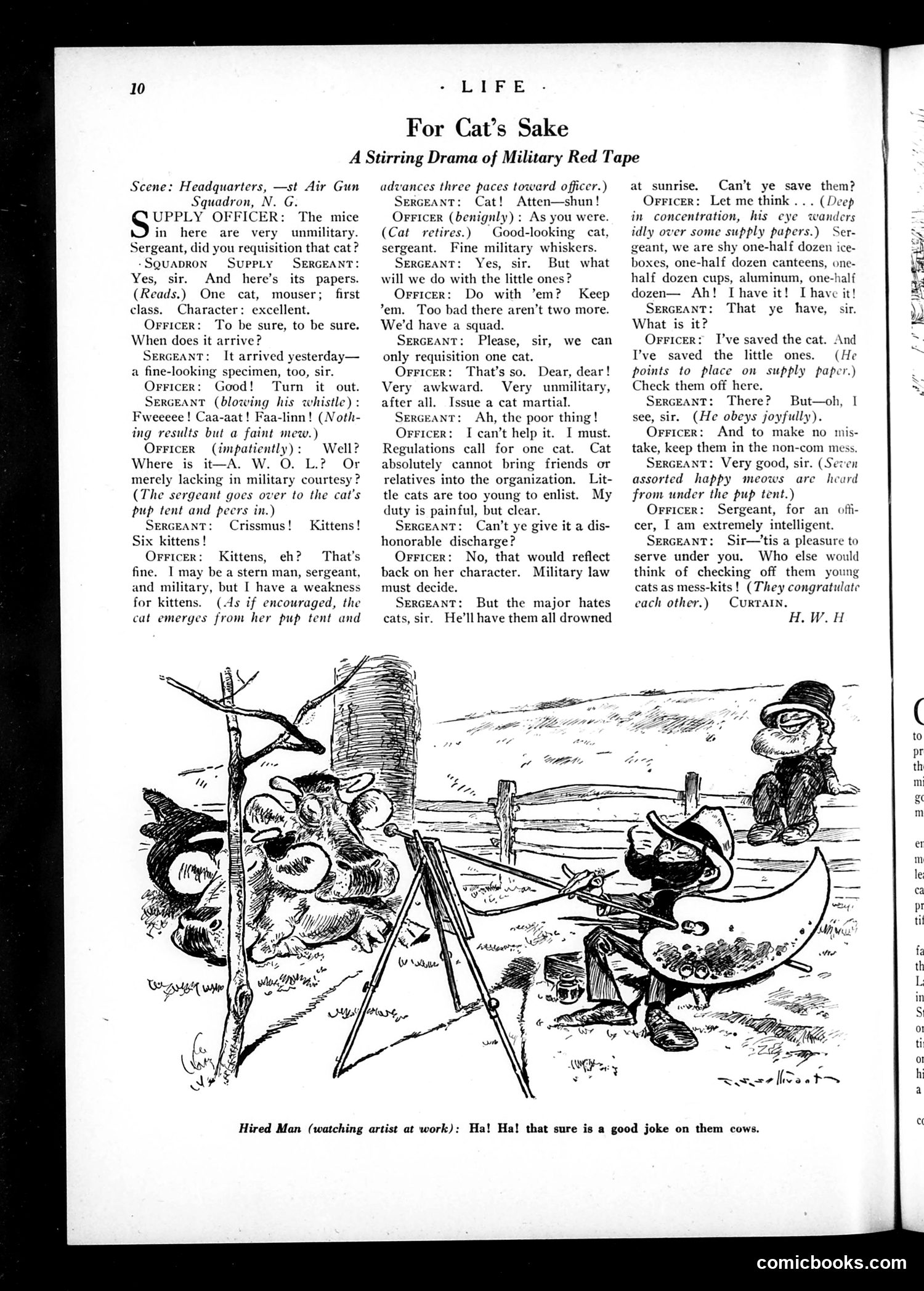
This is a satirical play script mocking military bureaucracy. The plot concerns supply officers and sergeants debating what to do with surplus mice and kittens discovered in military stores. Despite the absurdity, they rigidly apply regulations, unable to simply discard the animals because "military law must decide." The satire targets how military institutions prioritize procedure over common sense—here, treating the disposition of unwanted animals as a formal matter requiring official channels rather than practical solution. The accompanying illustration shows rural workers observing the military absurdity, with the caption "Ha! Ha! that sure is a good joke on them cows"—reinforcing that even civilians recognize the ridiculousness of such rigid bureaucratic thinking.
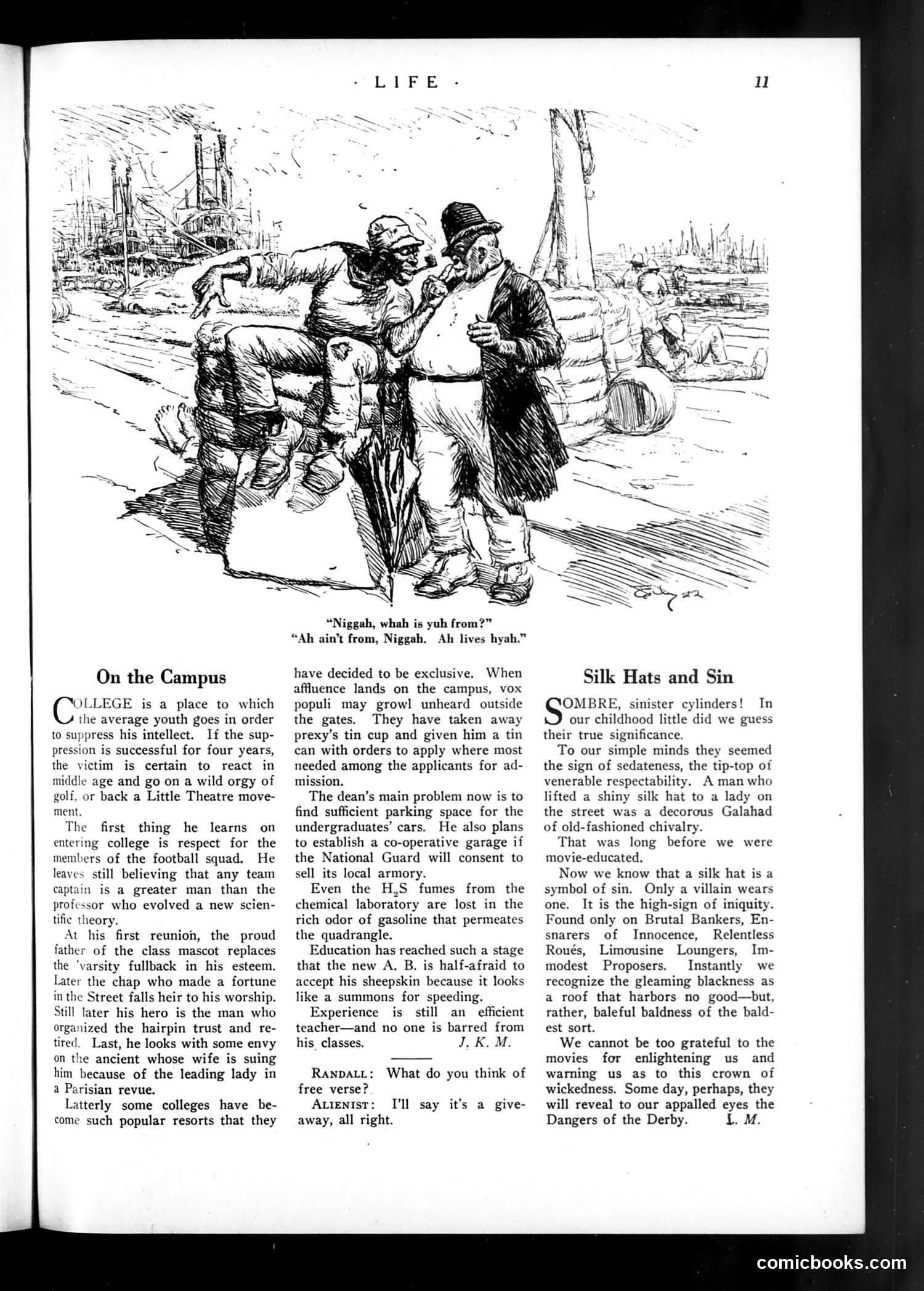
This page from *Life* magazine contains two satirical pieces about American social pretension. **"On the Campus"** mocks college culture's exclusivity and snobbery. The cartoon depicts college as a place where intellectually mediocre students learn primarily to respect hierarchies and social status. The piece satirizes how colleges have become "resorts" rather than educational institutions, criticizing students who care more about class mascots, parking spaces, and garages than actual learning. **"Silk Hats and Sin"** ridicules the assumption that formal dress (silk hats) signals moral respectability. The author argues that society wrongly equates "genteel respectability" with virtue, when in fact "snarers of Innocence, Relentless Roués, Libidinous Loungers" wear such hats. The satire warns readers not to be deceived by superficial markers of propriety. Both pieces critique American social pretension and class consciousness.
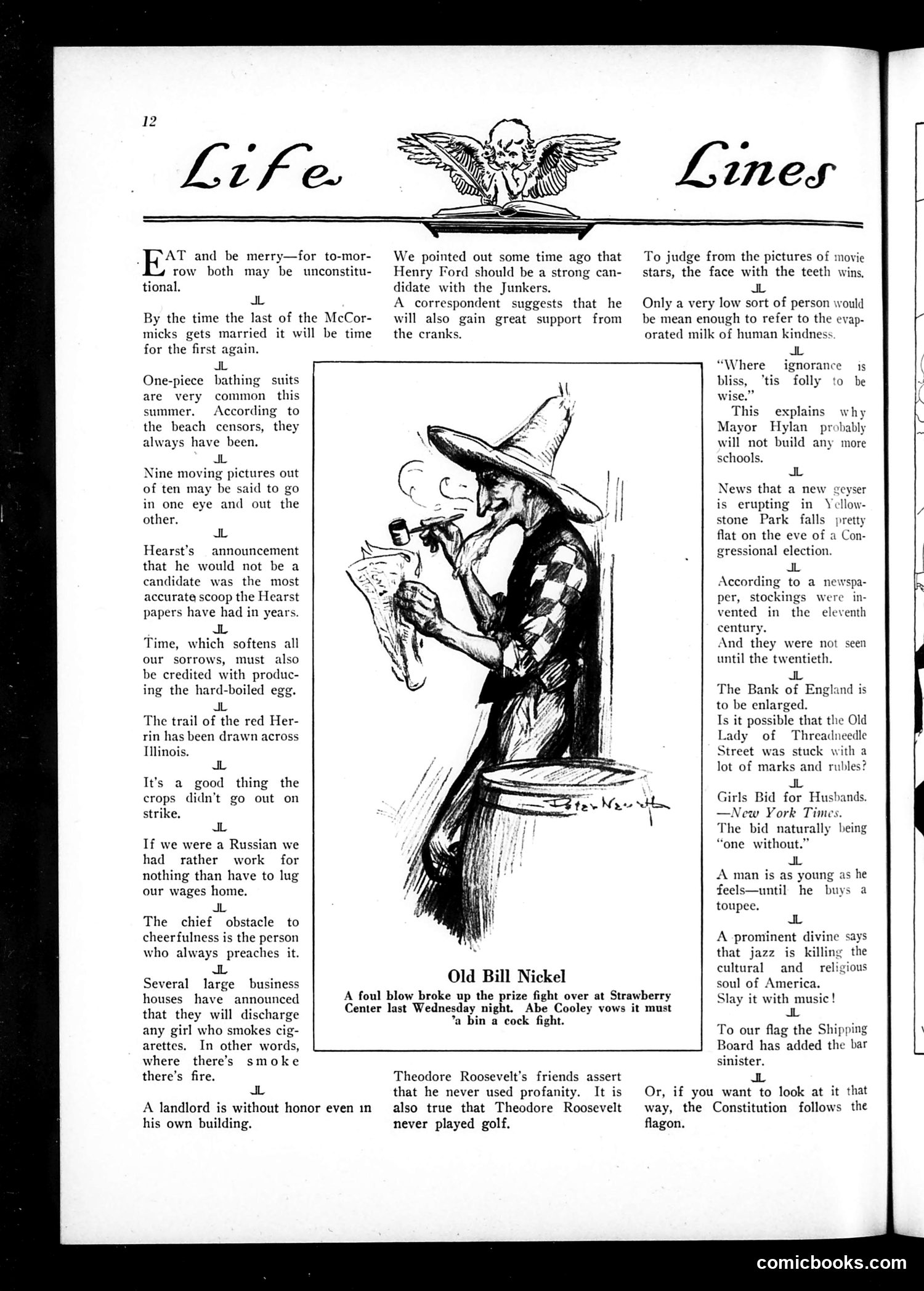
The central illustration depicts a caricatured man in a wide-brimmed hat examining what appears to be currency or documents. The caption reads: "A foul blow broke up the prize fight over at Strawberry Center last Wednesday night. Abe Cooley vows it must 'a' bim a cock fight." This appears to be rural/frontier humor playing on class and sophistication differences. The joke suggests that someone named Abe Cooley witnessed such brutal fighting at a local event that he can't believe it was human combat—implying it was so vicious it resembled cockfighting instead. The cartoon mocks both the violence of backwoods prize fighting and the vernacular speech ("bim" for "been") of rural Americans unfamiliar with formal boxing.
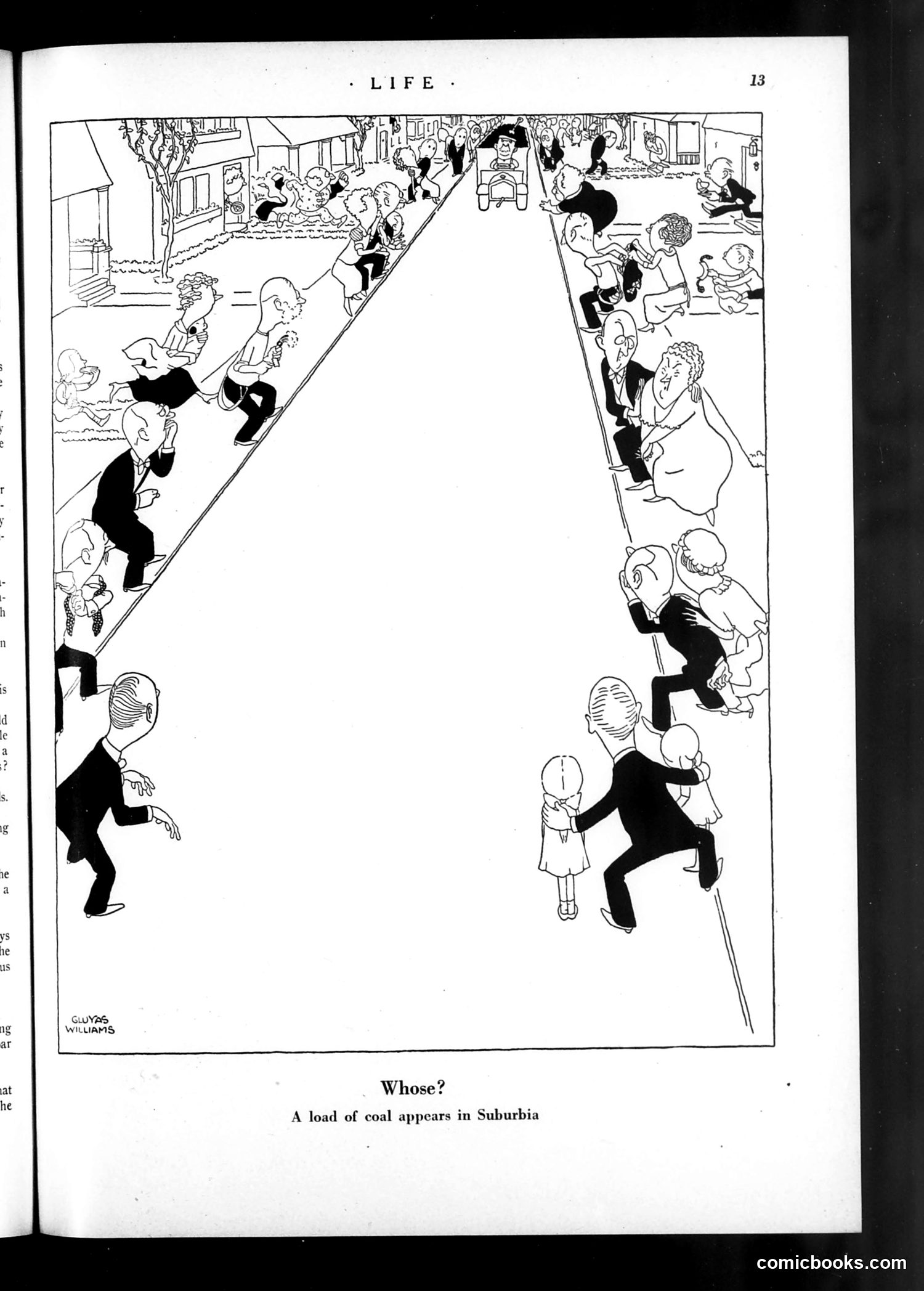
This cartoon satirizes suburban wealth and class anxiety. The image shows a wealthy suburban neighborhood divided by a street. On one side, well-dressed men in suits and their families engage in leisure activities (playing, relaxing). On the opposite side, similar-looking figures appear to be doing the same. The caption "Whose? A load of coal appears in Suburbia" suggests the joke: a delivery of coal—then a common heating fuel—has arrived in this affluent neighborhood. The satire likely mocks suburban paranoia about property values, social status, and "undesirable" intrusions into exclusive communities. The mirrored composition emphasizes how indistinguishable these suburban residents are from one another, yet how concerned they are about maintaining social hierarchies. The cartoon critiques suburban pretension and class consciousness.
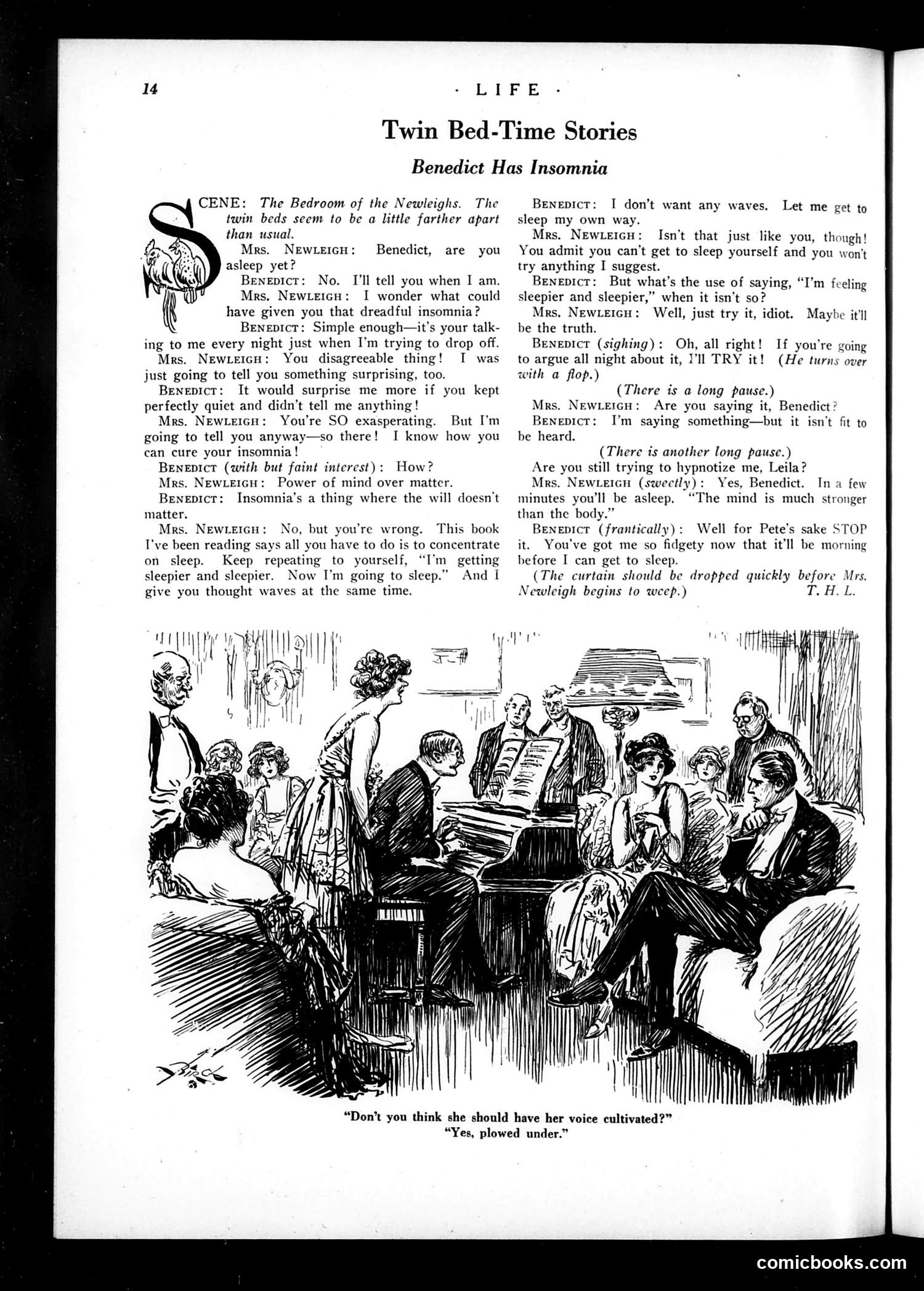
This is a humorous domestic sketch about a husband (Benedict) suffering from insomnia while his wife Mrs. Newleigh offers unsolicited advice. The joke centers on marital frustration: while she suggests mind-over-matter techniques like self-hypnosis and repeating "I'm getting sleepier," Benedict grows increasingly exasperated by her talking, which ironically prevents *him* from sleeping. The accompanying illustration shows a formal social gathering with a woman at a piano, captioned "Don't you think she should have her voice cultivated?" / "Yes, plowed under"—a period insult suggesting the woman's voice is unpleasant and should be silenced. Both pieces mock nagging spouses and unpleasant female voices, reflecting early 20th-century domestic humor stereotypes.
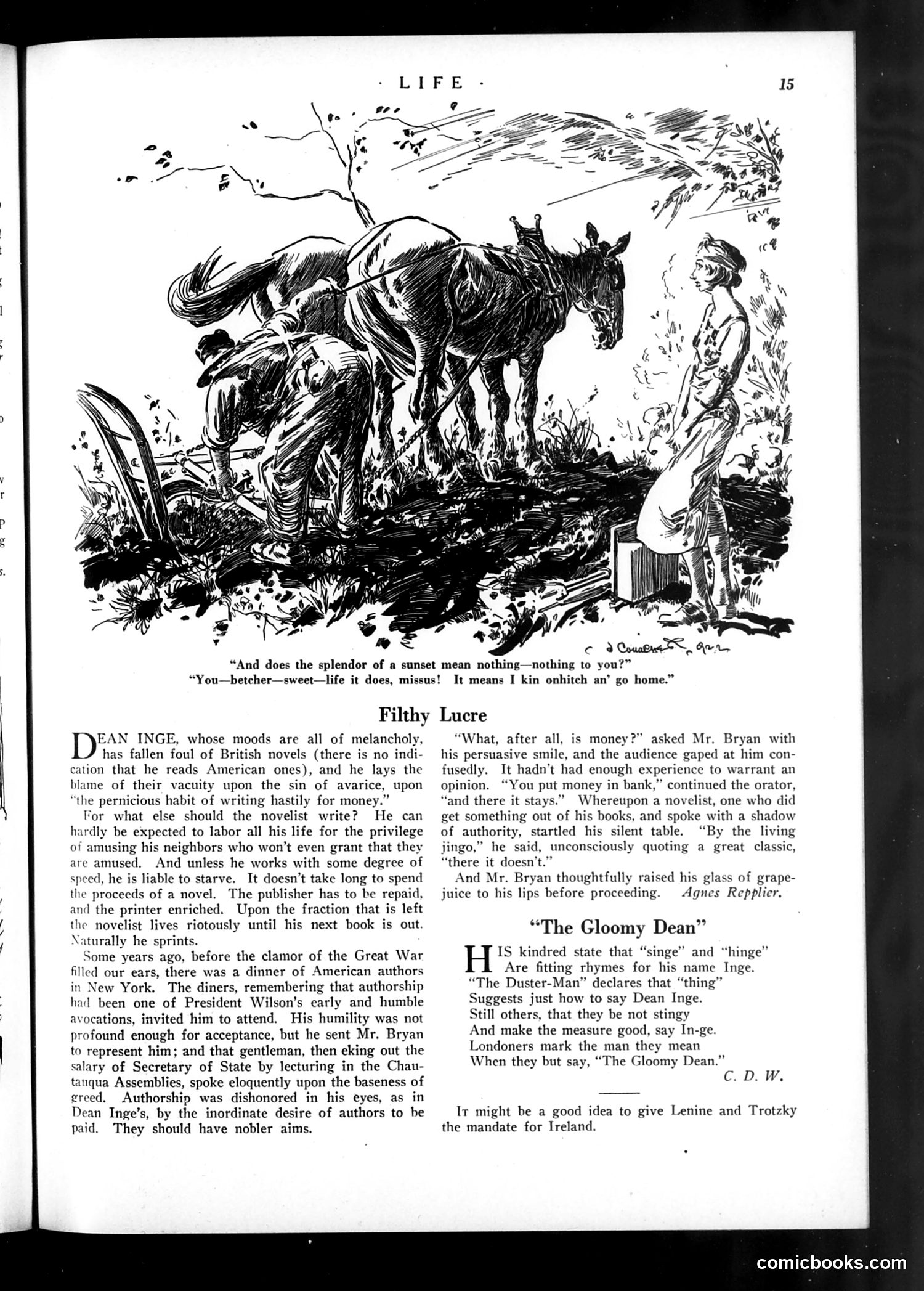
This page satirizes the hypocrisy of criticizing authors for seeking payment. The cartoon depicts a farmer and laborer—working-class men who understand that earning money enables survival—rejecting sentimental notions about sunsets in favor of practical needs. The accompanying article mocks Dean Inge (a British clergyman who criticized novels written "hastily for money") and William Jennings Bryan (former presidential candidate and Secretary of State) for lecturing authors about greed and "nobler aims" while ignoring economic reality. Bryan famously lectured that money "stays" in banks, prompting a novelist to retort it doesn't—exposing Bryan's disconnect from actual financial struggle. The satire's point: privileged figures condemned authors for valuing payment, yet working people understood earning wages was essential. The page ridicules this moral posturing as disconnected from material necessity. The secondary poems mock Dean Inge's name pronunciation, adding lighter mockery to the critique.
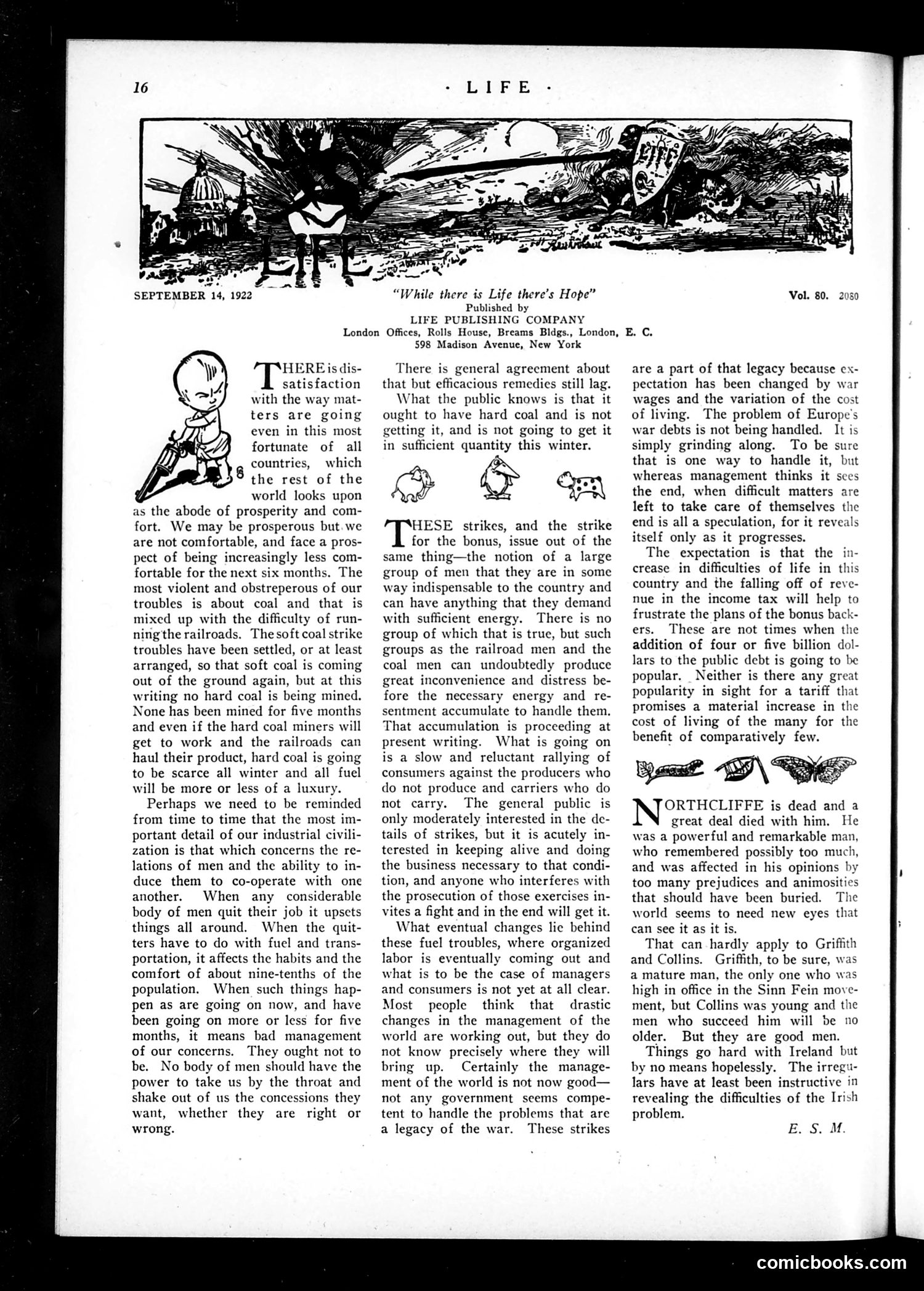
The page's masthead illustration depicts a stark post-war landscape with ruins, suggesting societal upheaval. The editorial addresses America's coal crisis and labor strikes—specifically a hard coal miners' strike that has lasted five months without resolution. The author argues that while America is materially prosperous, it faces acute discomfort from fuel shortages affecting transportation and heating. The strikes represent a broader problem: organized labor groups (railroad workers, coal miners) leveraging their indispensability to demand concessions, disrupting the general population's daily life. The piece expresses frustration that management and government cannot resolve these issues, attributing the labor unrest to post-WWI expectations—workers' demands for higher wages and better conditions were shaped by wartime employment. The author suggests public patience is exhausted and consumer resistance is building against the producers/carriers causing inconvenience. The tone is critical of both strikers' methods and management's incompetence, framing the conflict as symptomatic of post-war societal breakdown.
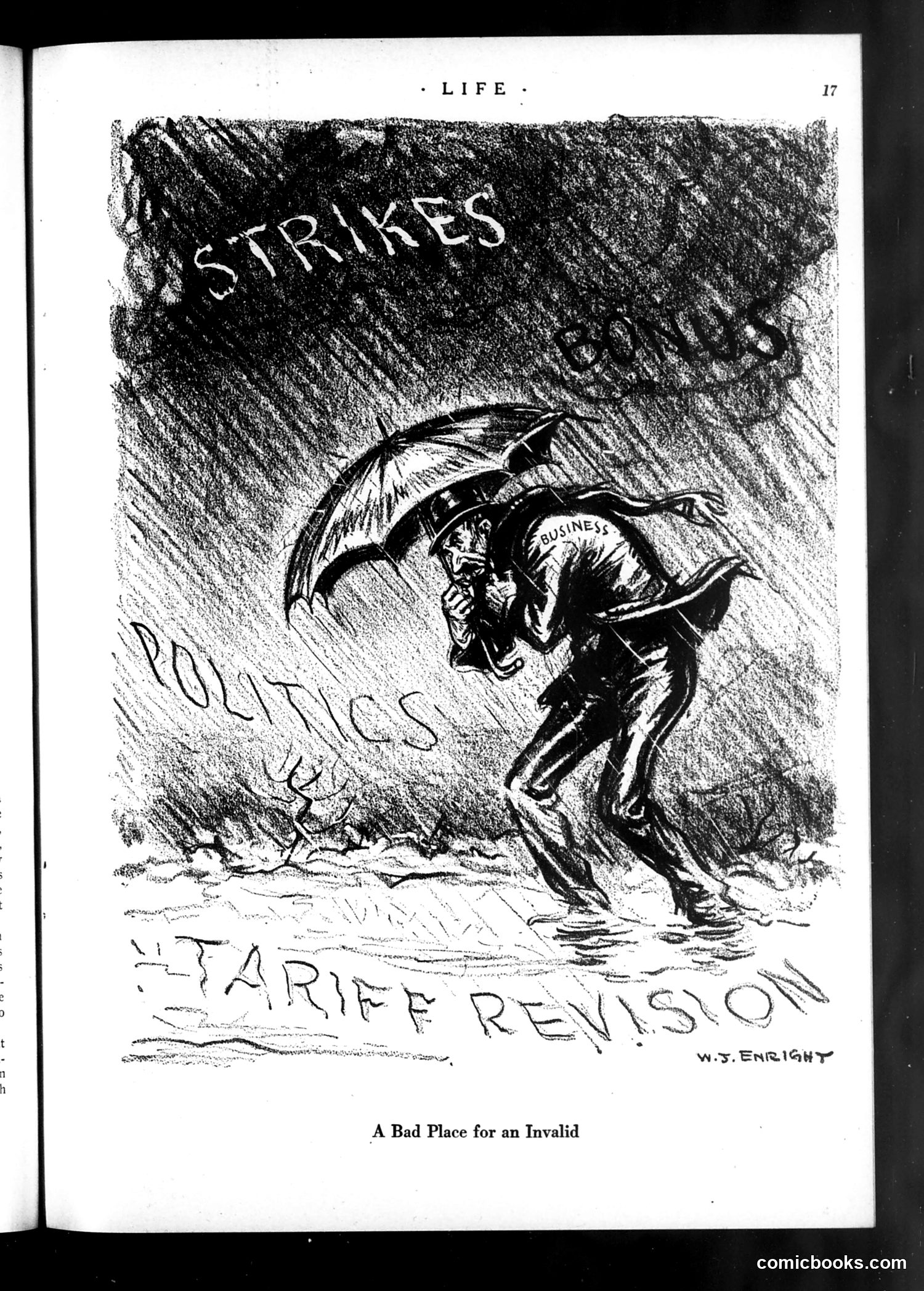
This political cartoon by W.J. Enright depicts a businessman labeled "BUSINESS" struggling against severe weather—rain and wind—while holding an umbrella. Text overlays read "STRIKES," "POLITICS," and "SCARE REVISION." The cartoon satirizes how business conditions are buffeted by multiple destabilizing forces: labor strikes, political turmoil, and economic fears (likely related to tariff revision, a major political debate in early 20th-century America). The "invalid" metaphor suggests the economy or business sector is weakened and vulnerable. The cartoon argues that these external pressures make it a poor environment for economic recovery or stability. This reflects contemporary anxieties about industrial conflict, political instability, and economic uncertainty.
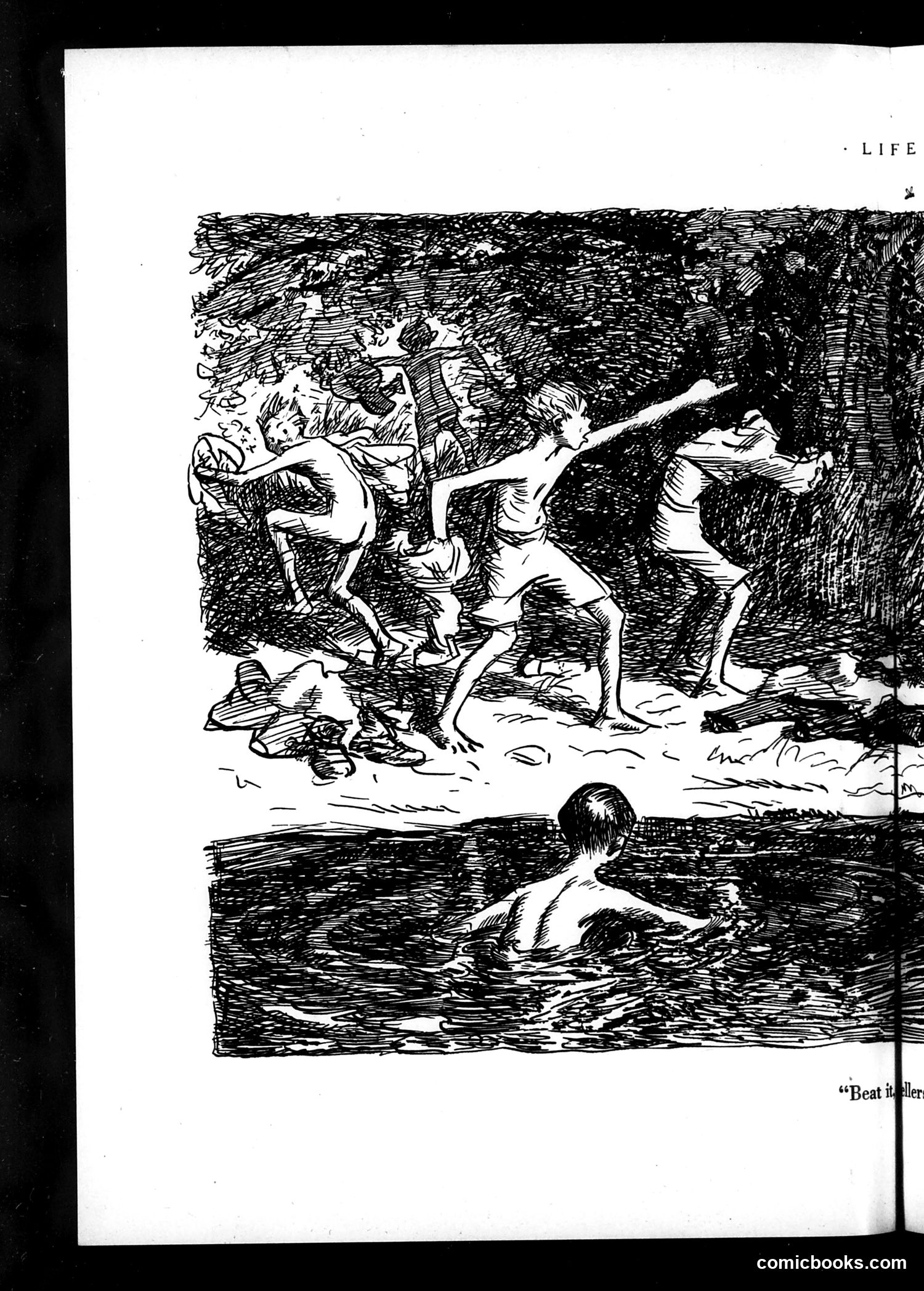
This page from *Life* magazine contains two cartoon panels depicting a swimming scene. The upper panel shows several nude or semi-nude figures on a beach or shoreline engaged in what appears to be playful activity near a wooded area. The lower panel shows a single figure swimming in water, viewed from behind. The caption "Beat it, feller" suggests the swimmer is being told to leave or move along. The cartoons appear to satirize public bathing or beach behavior, likely poking fun at social awkwardness, intrusion, or impropriety around swimming areas—common subjects for satirical humor in early-to-mid 20th century American magazines. The specific social commentary remains unclear without additional context about the magazine's date and surrounding articles.
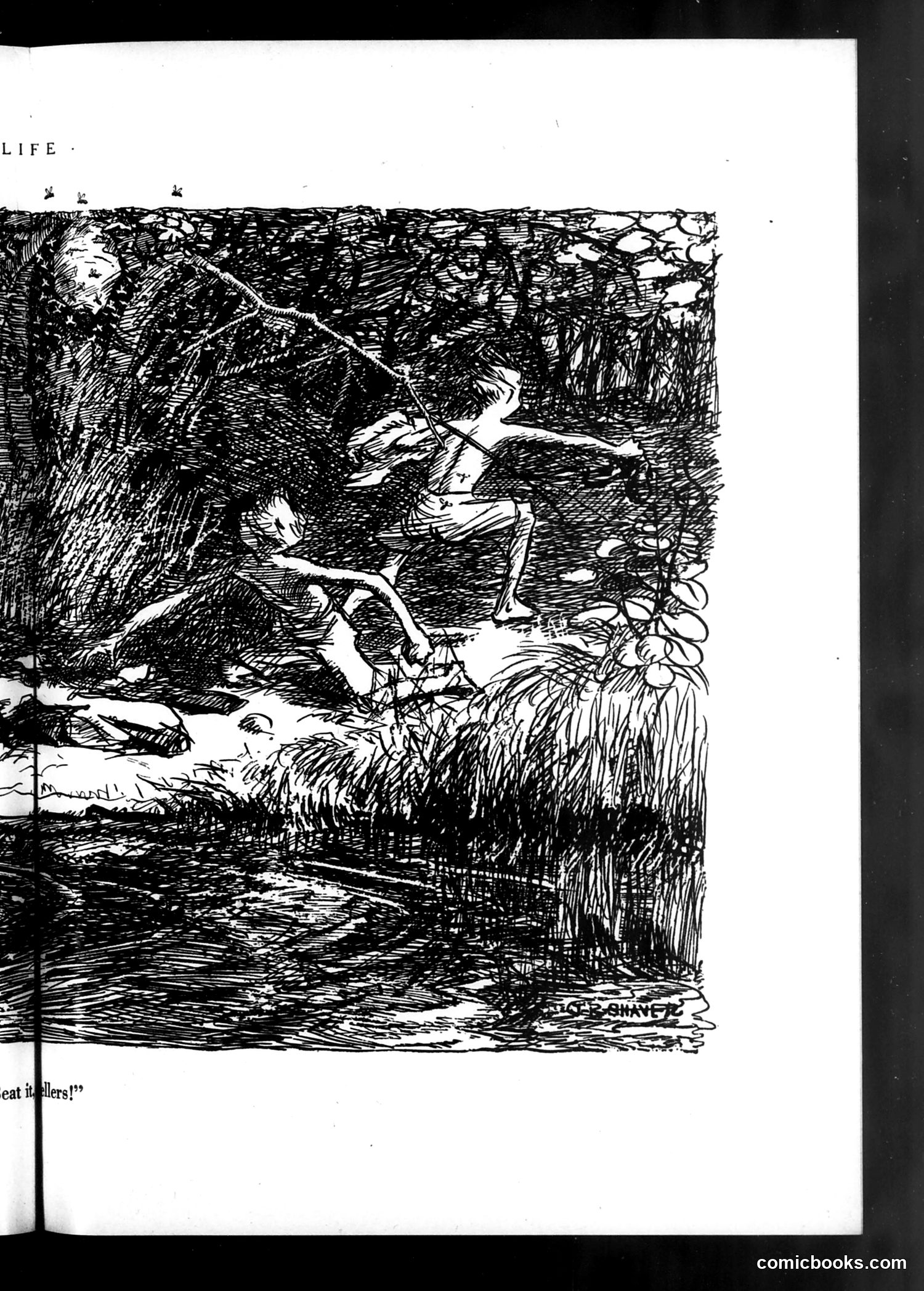
This page appears to be from *Life* magazine and shows a detailed pen-and-ink illustration of a natural scene. The drawing depicts what looks like a wooded or swampy area with dense vegetation, trees, and water in the foreground. The artist's signature "SHAFER" is visible in the lower right. The partial text fragment visible at bottom left reads "eat it fellers!!" suggesting this may be a cartoon with accompanying dialogue or caption, though the full context is cut off. Without seeing the complete caption or surrounding text, the specific satirical point remains unclear. The detailed naturalistic rendering doesn't obviously suggest political commentary, so this may be humorous content about hunting, outdoor life, or wildlife—but I cannot definitively identify the satirical target without more information.
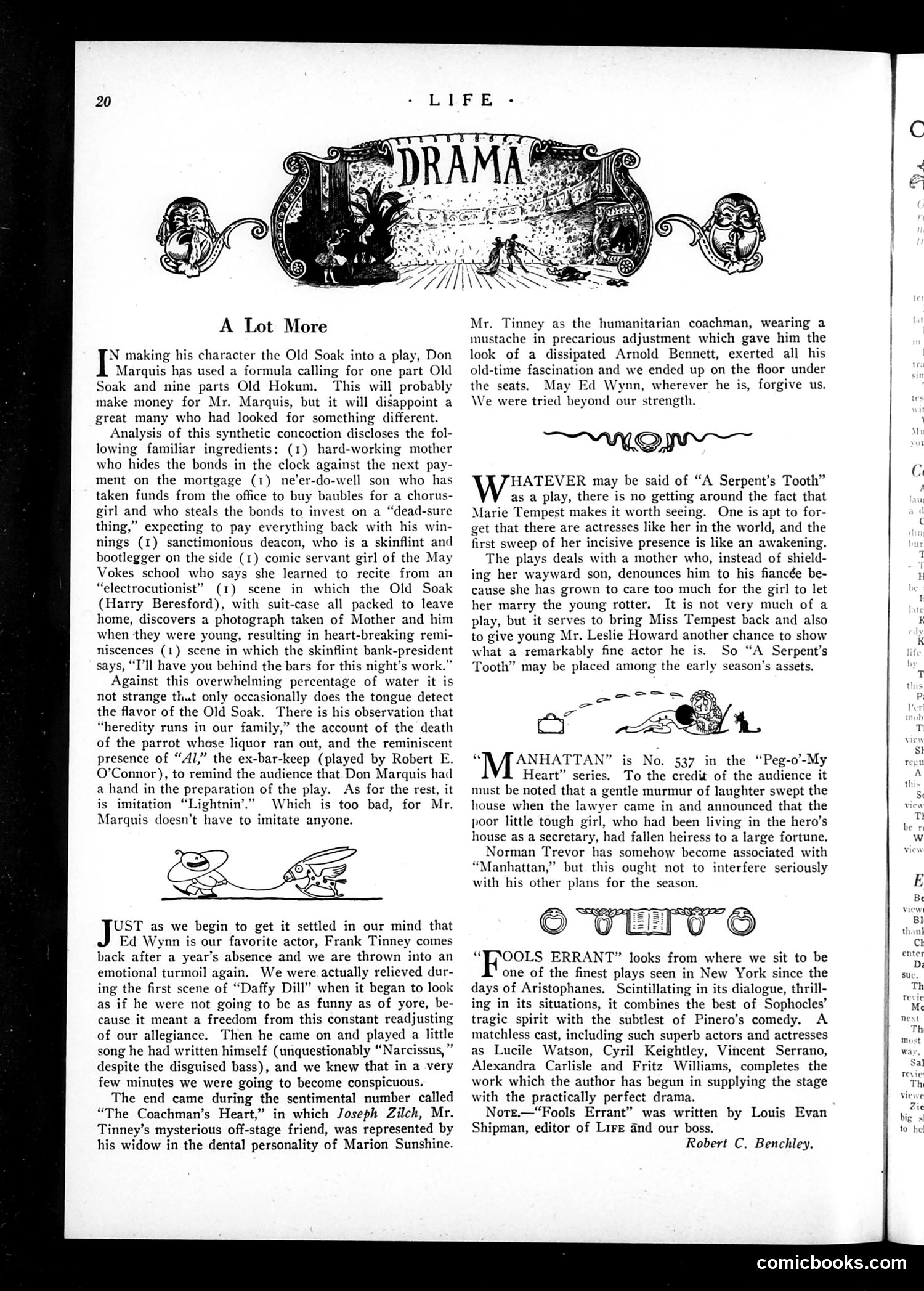
This page reviews three Broadway plays with satirical commentary. **"A Lot More"** critiques Don Marquis's stage adaptation of his "Old Soak" character, arguing it's diluted with tired theatrical formulas—sympathetic mothers, wayward sons, hypocritical deacons, and sentimental photo-discovery scenes. The reviewer complains Marquis relies on clichéd hokum rather than his original wit. **"Daffy Dill"** praises Frank Tinney's comedic return after a year's absence, noting his irresistible charm nearly forces the audience into conspicuous laughter during a sentimental number featuring his "mysterious off-stage friend" Joseph Zilch (represented by Marion Sunshine). **"A Serpent's Tooth"** acknowledges the play itself is mediocre but celebrates actress Marie Tempest's commanding presence and Leslie Howard's talent, suggesting the cast transcends weak material. The reviews exemplify *Life*'s theatrical criticism: witty, gossipy, focused on performer personalities as much as dramatic merit.
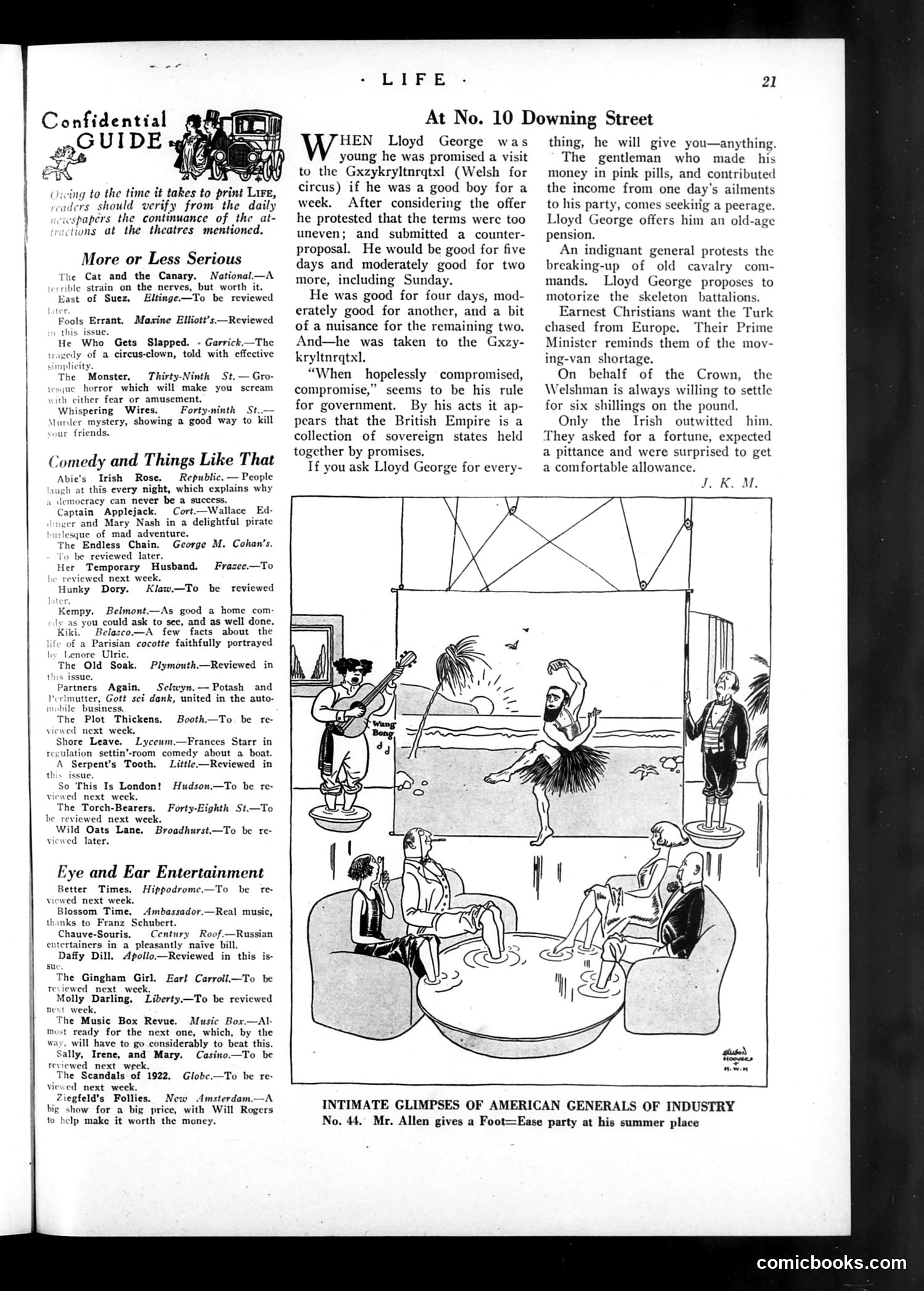
This satirical piece attacks British Prime Minister Lloyd George's governing style through a childhood anecdote. The text claims that as a boy, Lloyd George negotiated down a promised circus visit from a week to five days—establishing his lifelong pattern of "compromise." The satire portrays Lloyd George as someone who: - Habitually compromises from positions of weakness rather than principle - Treats the British Empire as merely "a collection of sovereign states held together by promises" rather than genuine unity - Cynically exploits patronage (offering peerages and pensions strategically) - Makes contradictory decisions (motorizing cavalry instead of maintaining tradition) The cartoon below illustrates an "Intimate Glimpse of American Generals of Industry"—Mr. Allen hosting a foot-ease party at his summer home, likely satirizing wealthy industrialists' leisure pursuits. The main critique is that Lloyd George's government operates through expedient deal-making rather than coherent policy, weakening imperial authority.
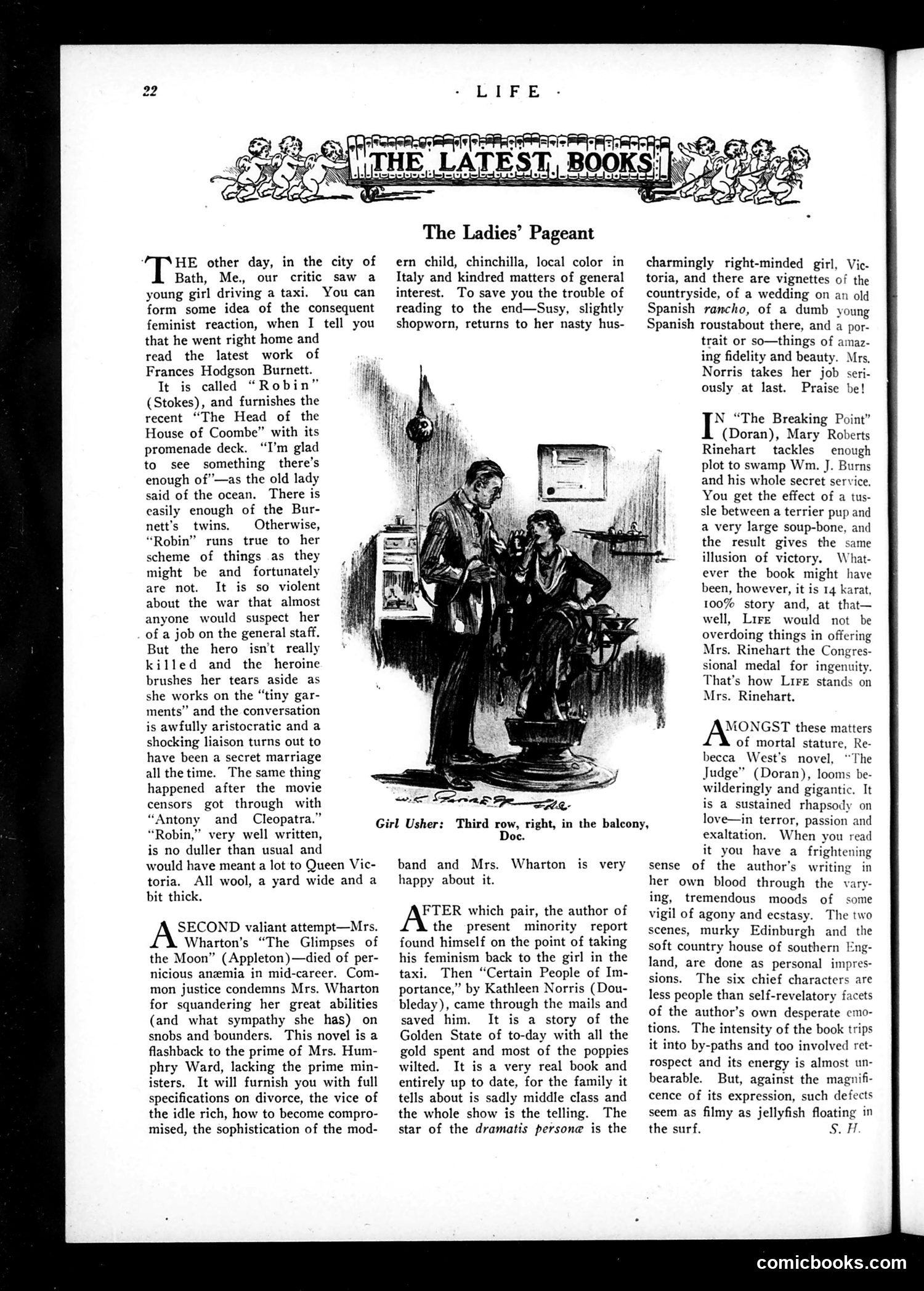
This page contains literary reviews of contemporary novels, framed by a satirical opening anecdote. A Life critic, disturbed by seeing a young woman taxi driver (a sign of feminist progress), reads Frances Hodgson Burnett's novel "Robin" to recover his conservative sensibilities. The reviews mock both the novels and their readers' expectations. Burnett's work is dismissed as predictably aristocratic and pro-war propaganda dressed in sentimentality. Edith Wharton's novel is criticized as a tired rehash of her earlier style, obsessing over wealthy divorce scandals. The reviewer uses backhanded compliments throughout—praising Kathleen Norris's competent but unremarkable family drama and Mary Roberts Rinehart's plot-heavy thriller as "100% story." Rebecca West's "The Judge" alone receives genuine praise for ambitious emotional scope. The satire targets both formulaic women novelists and readers who prefer comfortable, class-conscious narratives over genuine literary innovation.
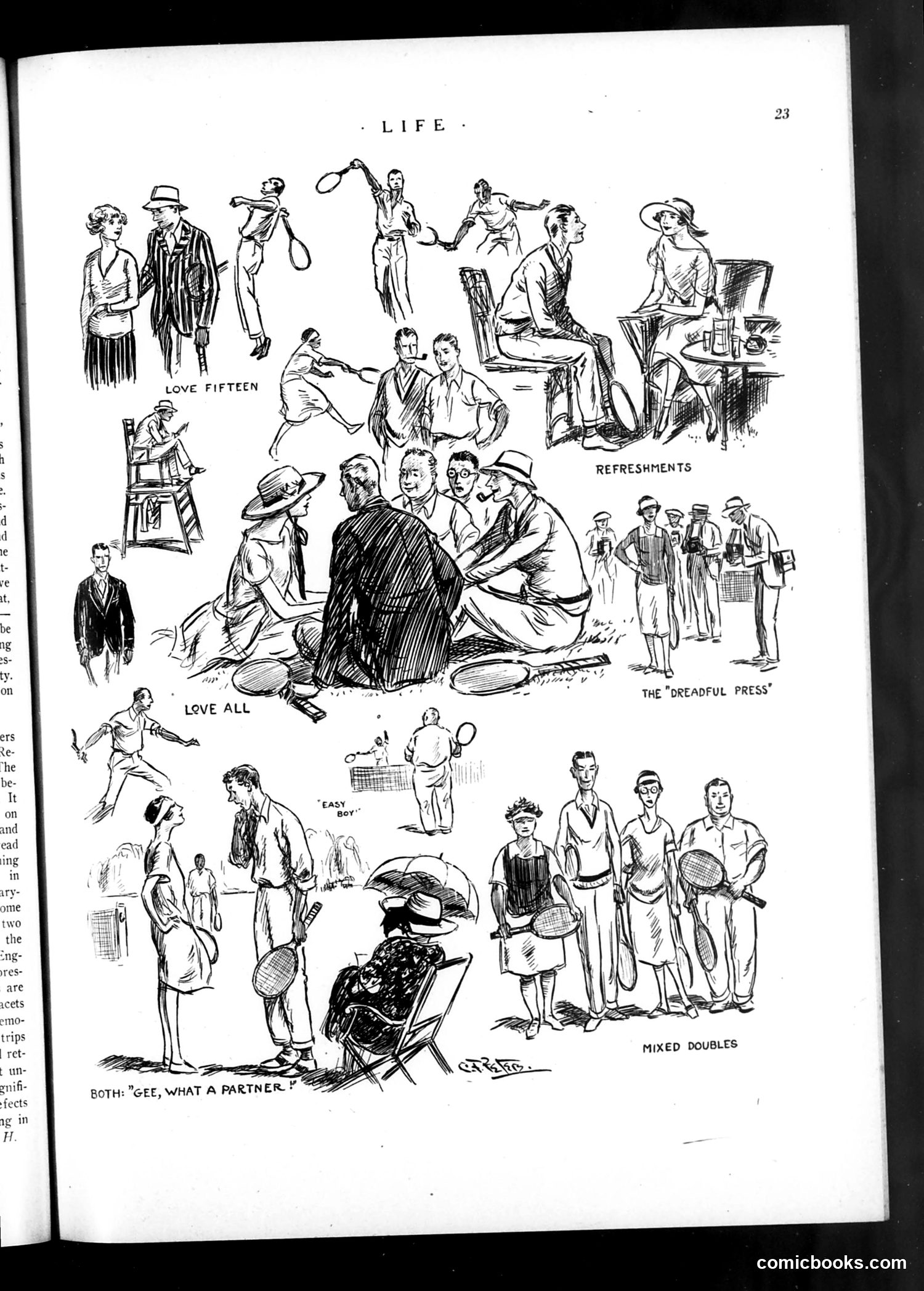
This page satirizes lawn tennis culture through multiple vignettes labeled with tennis terminology. The sketches depict: - **"Love Fifteen"** through **"Mixed Doubles"**: Various scenes of people playing tennis or socializing at tennis events - **"Love All"**: A couple playing, with the caption "Both: 'Gee, What a Partner!'" — a double entendre suggesting romantic as well as athletic pairing - **"Refreshments"**: Players taking breaks - **"The Dreadful Press"**: Journalists covering the sport - **"Easy Boy"**: A seated player The satire targets tennis as a leisure activity for the affluent, capturing romantic flirtation, social pretension, and the sport's cultural prominence. The use of tennis scoring terminology as labels creates wordplay. Without a specific date visible, this appears to be early-to-mid 20th century commentary on upper-class recreation and courtship rituals.
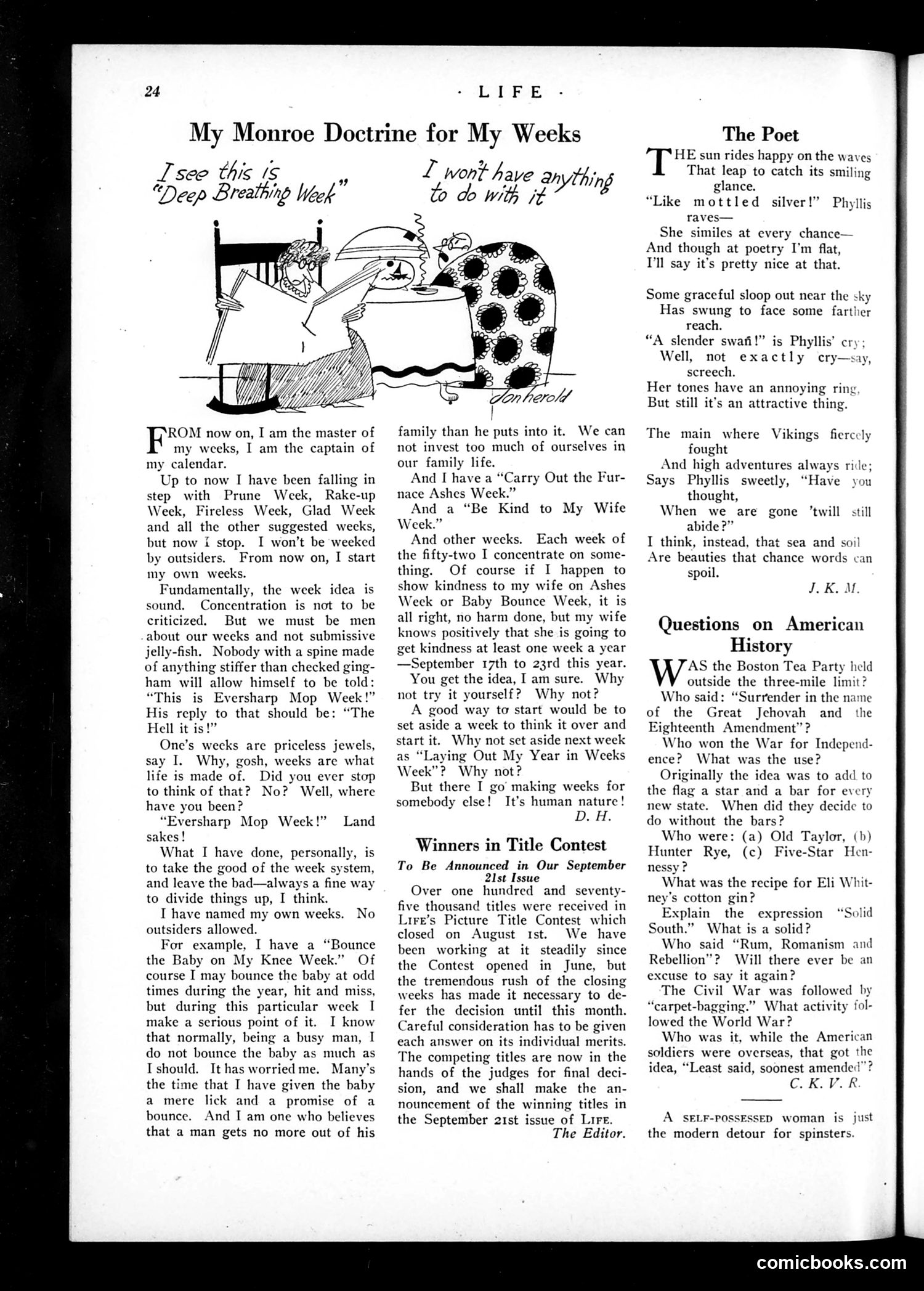
This page satirizes the early 20th-century trend of corporate and civic "designated weeks"—promotional campaigns encouraging Americans to focus on specific activities (like "Fireless Week" for fuel conservation or "Prune Week" for eating prunes). The cartoon's protagonist rebels against this manufactured enthusiasm, declaring personal autonomy over his calendar. He mocks the invasive nature of these campaigns (joking about "Eversharp Mop Week") by establishing his own weeks: "Bounce the Baby on My Knee Week," "Be Kind to My Wife Week," and "Carry Out the Furnace Ashes Week." The satire targets two things: (1) corporate manipulation of daily life through organized campaigns, and (2) the underlying admission that without designated time, ordinary family duties get neglected. The "Monroe Doctrine" reference (an isolationist foreign policy) humorously positions personal time as a protected territory. The page also includes unrelated content: a poem about nature observations, and announcements of a picture-titling contest—typical magazine filler of the era.
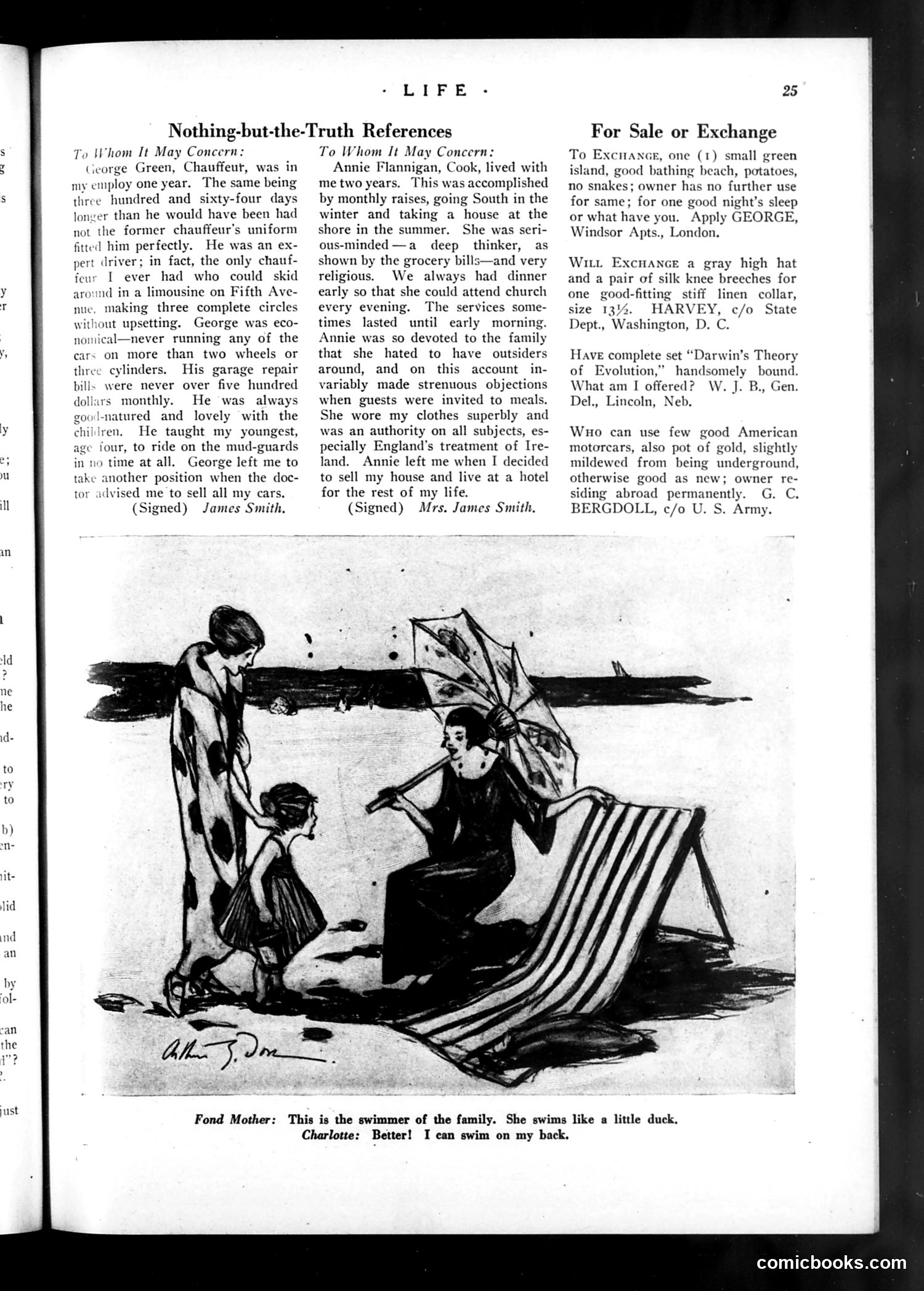
This page combines character references with a humorous cartoon and classified ads, likely referencing the 1916 film "Nothing but the Truth." **The References:** Two mock employer testimonials use backhanded compliments to satirize household staff. George Green (the chauffeur) is praised for reckless driving and dangerous antics; Annie Flannigan (the cook) is credited with extravagant spending and religious fanaticism that interferes with her duties. **The Cartoon:** Shows a beach scene where a proud mother boasts her daughter swims "like a little duck," while the daughter boasts she can "swim on my back"—a child's innocent one-upmanship that deflates the mother's pride. **The Exchange Ads:** Parody classified advertisements offering absurd trades—an island for sleep, diplomatic attire for a collar collar, Darwin's book with unknown value, and American cars allegedly from someone (likely draft-dodger Grover Cleveland Bergdoll) hiding abroad. The satire targets pretension, exaggeration, and the gap between adults' self-importance and children's straightforward logic.
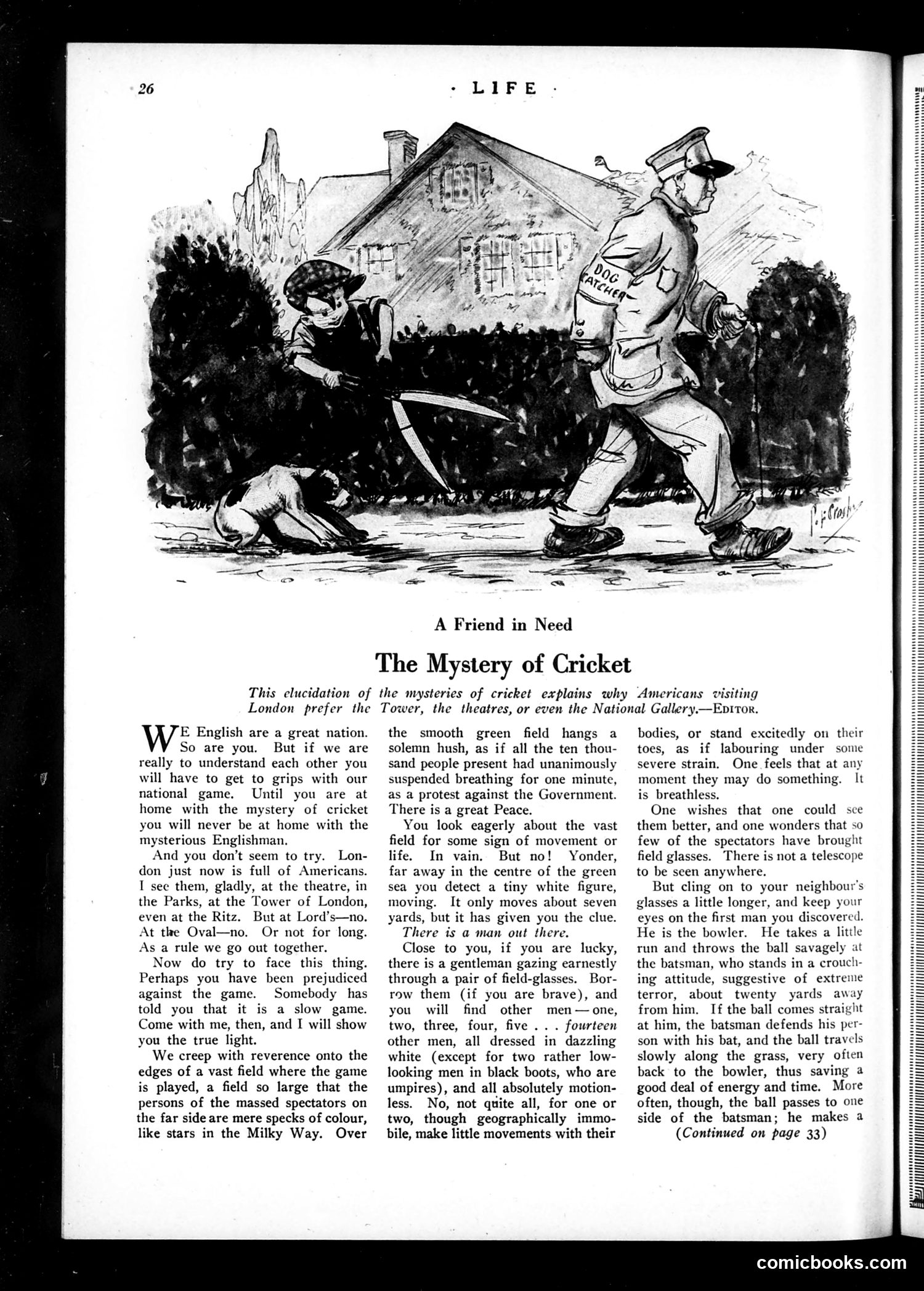
This satirical article uses cricket as a metaphor to gently mock both English cultural superiority and American visitors' bewilderment at English traditions. The cartoon shows an American soldier encountering cricket—depicted as an incomprehensibly slow, motionless game where nothing appears to happen. The humor operates on two levels: First, the author (writing to American readers) playfully chides them for avoiding Lord's and the Oval cricket grounds while visiting London, suggesting they prefer more obviously entertaining attractions. Second, the detailed explanation of cricket's rules ironically demonstrates *why* Americans find it baffling—emphasizing the vast field, thousands of silent spectators, nearly motionless players, and minimal action. The piece's subtitle confirms the joke: Americans prefer the Tower, theatres, or art galleries—anything but cricket. It's affectionate criticism of transatlantic cultural gaps, published when American visitors were numerous in London.
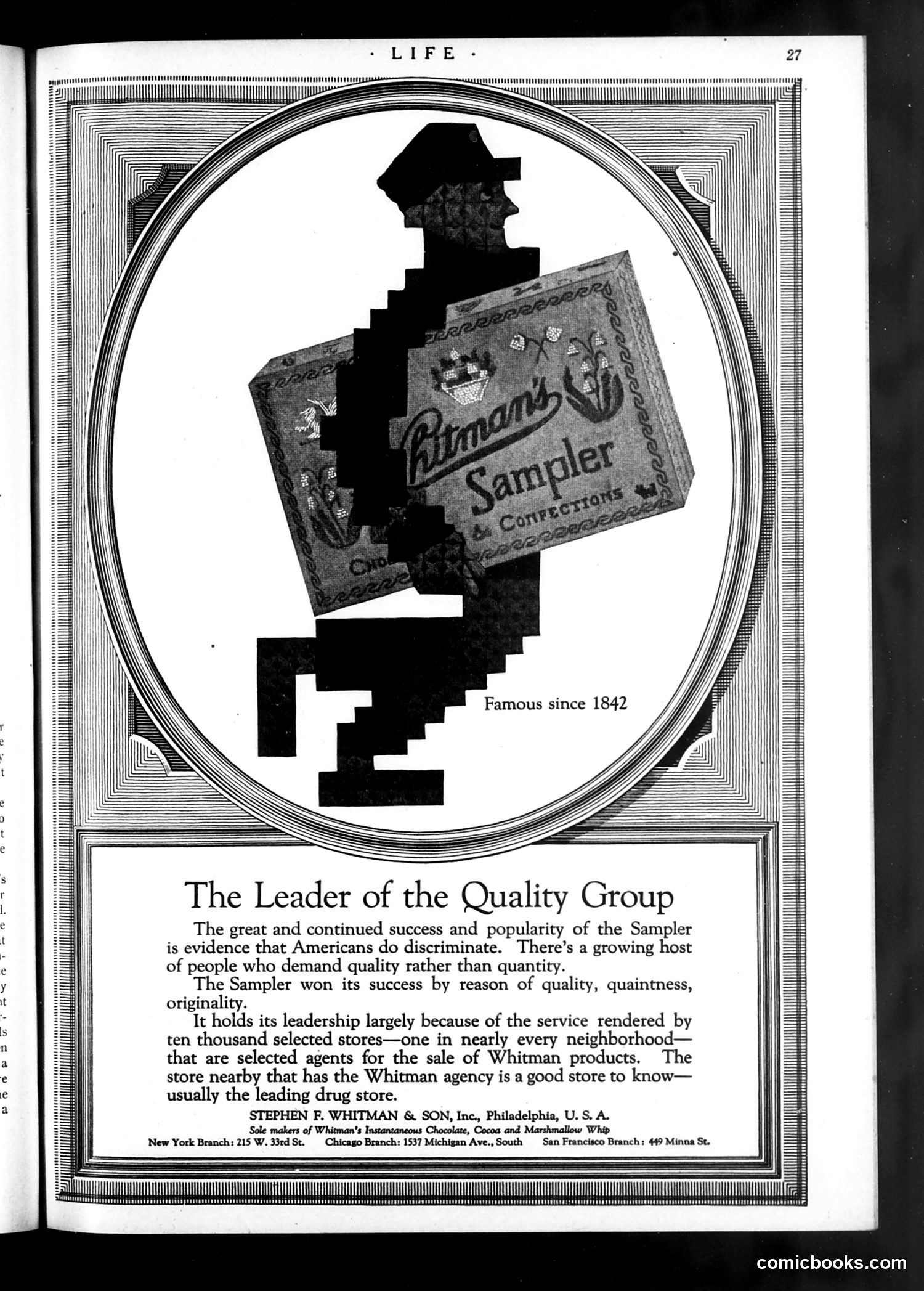
This is primarily a **product advertisement**, not political satire. It promotes Whitman's Sampler chocolates, established 1842. The visual shows a stylized silhouette of a well-dressed man in a hat holding a Whitman's Sampler box. The accompanying text argues that Americans increasingly "discriminate" by choosing **quality over quantity**—a marketing pitch suggesting discriminating consumers prefer Whitman's refined product. The "Quality Group" reference implies market segmentation: affluent, tasteful buyers who value "quaintness, originality," and premium goods. The text emphasizes Whitman's distribution network through "ten thousand selected stores," typically leading drugstores, positioning the brand as accessible yet exclusive. For modern readers: this reflects early 20th-century advertising strategy equating luxury consumption with refined taste and social status, while the word "discriminate" carried no negative connotation—it simply meant "to distinguish" between superior and inferior products.
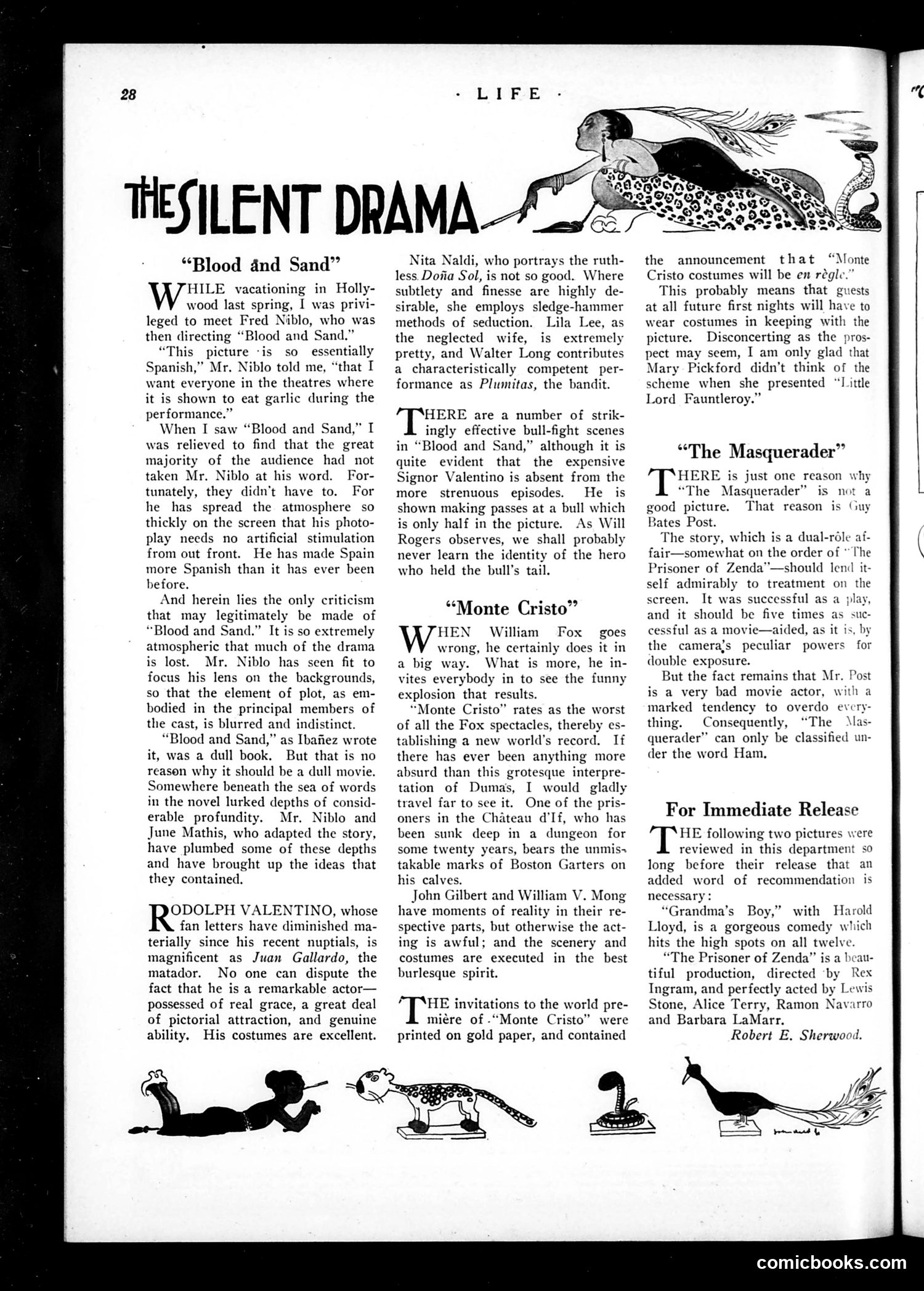
This page reviews three silent films from the 1920s. The main critiques are: **"Blood and Sand"**: Director Fred Niblo's adaptation is praised for its Spanish atmosphere but criticized for prioritizing visual spectacle over plot. Rudolph Valentino is lauded as an excellent matador actor, though the reviewer humorously notes that Valentino appears absent from dangerous bullfighting scenes—only "half in the picture." **"Monte Cristo"**: William Fox's adaptation is savagely mocked as absurdly bad, establishing "a new world's record" for terrible spectacles. A specific joke: a prisoner supposedly imprisoned twenty years still bears visible marks from Boston Garters (men's sock supporters), revealing the film's careless anachronisms. **"The Masquerader"**: Briefly noted as worthwhile due to Guy Bates Post's acting talents. The page exemplifies 1920s film criticism's focus on spectacle versus substance, while poking fun at Hollywood's excesses and technical oversights.
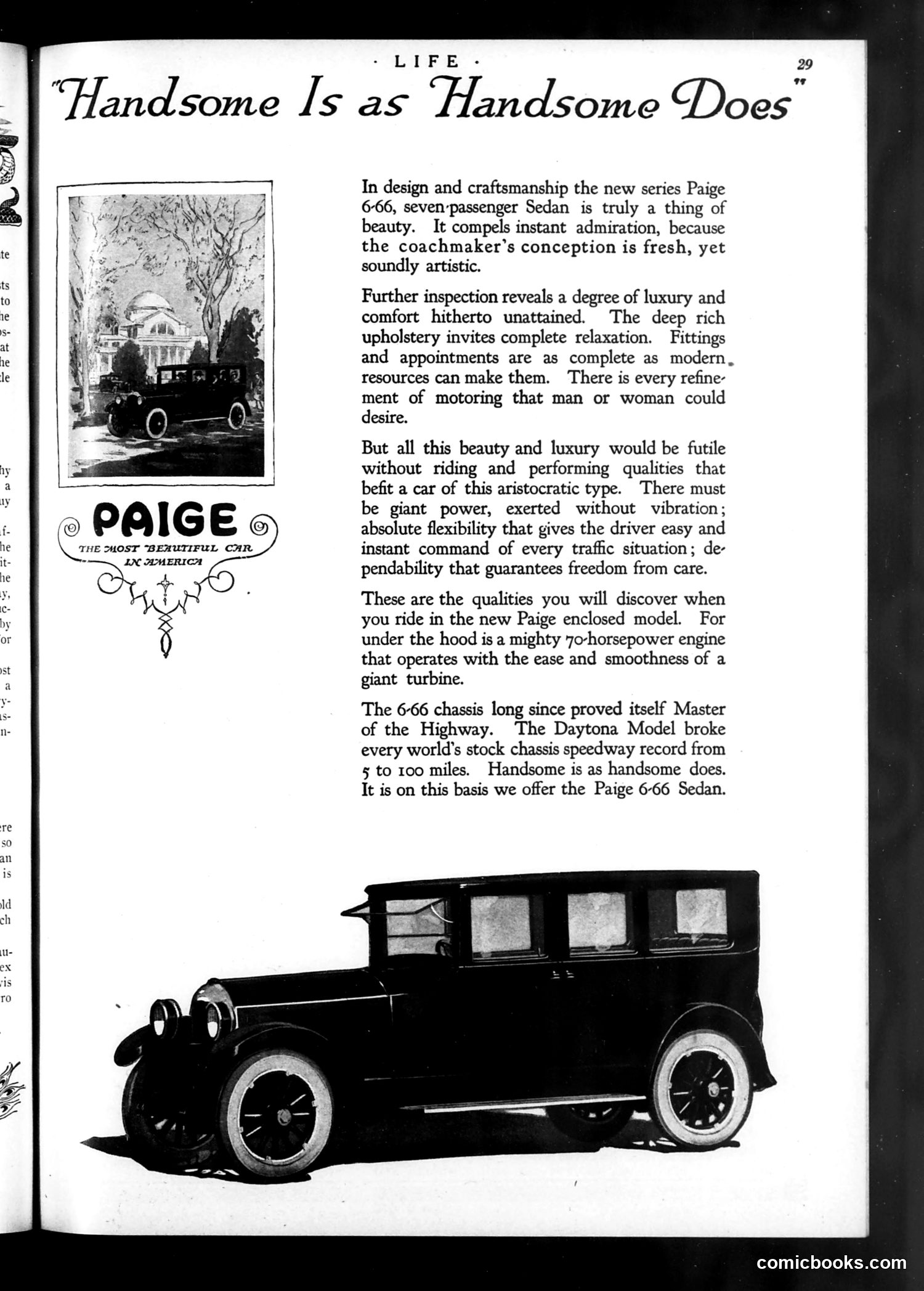
This is a **Paige automobile advertisement**, not a political cartoon. The page uses the phrase "Handsome is as handsome does" as a marketing strategy, arguing that the Paige 6-66 Sedan's beauty isn't merely superficial but backed by genuine performance. The two vehicle illustrations show the car's elegant design. The advertisement emphasizes luxury features (upholstery, appointments) while stressing mechanical superiority: a 70-horsepower engine, vibration-free operation, and a proven track record (the Daytona Model allegedly broke speedway records from 5 to 100 miles). For modern readers: this represents early automotive advertising targeting affluent buyers who valued both aesthetic refinement and mechanical reliability—positioning the Paige as an "aristocratic" vehicle that performs as beautifully as it looks. The slogan cleverly deflects concerns that ornate design might compromise functionality.
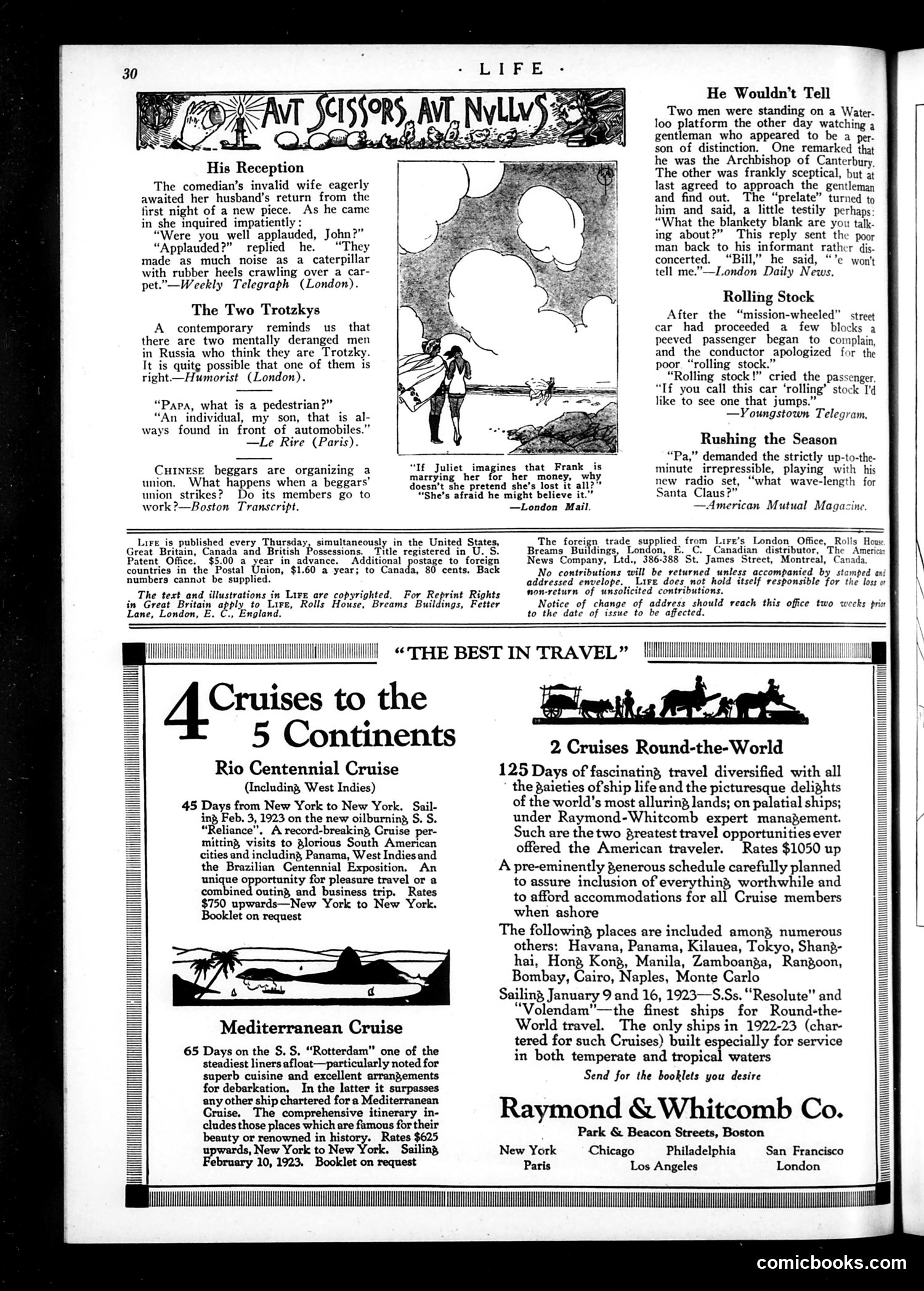
This page primarily contains **humorous short anecdotes** rather than political cartoons. The jokes reflect early 1920s sensibilities: **Key Content:** - "His Reception": A comedian's wife asks about applause; he replies the audience made noise "like a caterpillar with rubber heels"—absurdist humor. - "The Two Trotzkys": References the Russian political figure Trotsky, joking that two mentally ill men in Russia both claim to be him, suggesting political instability or the difficulty distinguishing Soviet leaders. - "He Wouldn't Tell": Humor about mistaking a stranger for the Archbishop of Canterbury on a London platform. - "Rushing the Season": A joke about Chinese beggars organizing a union—reflecting contemporary labor concerns and ethnic stereotyping. - A child asks about "wave-length for Santa Claus" on a radio—referencing the novelty of radio technology. **Context:** This is primarily a humor/joke compilation page with travel advertisements below, typical of *Life* magazine's satirical format. The humor is genteel, class-conscious, and occasionally reflects period prejudices.
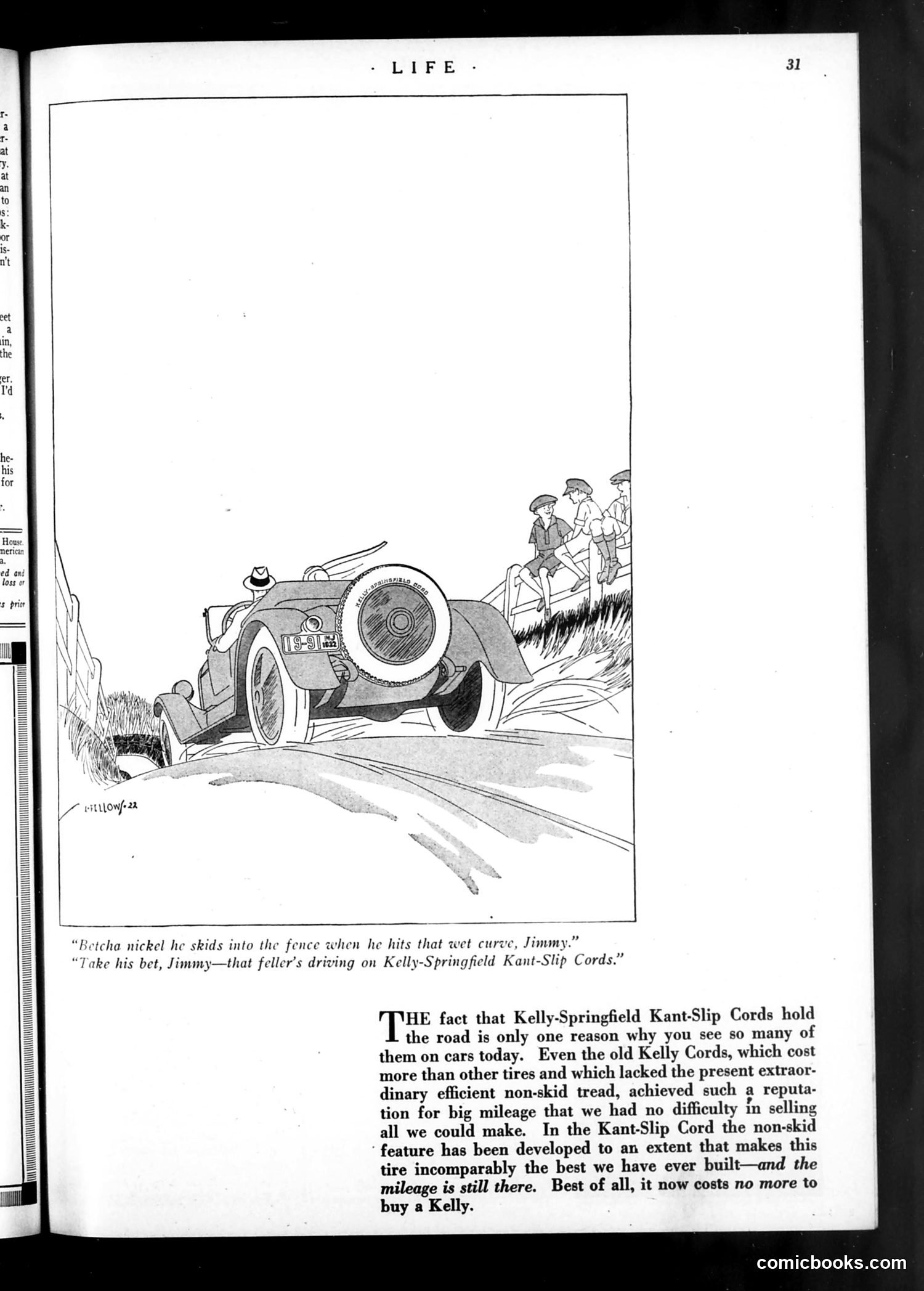
This is a **tire advertisement**, not political satire. The cartoon illustrates a wager between two boys watching a reckless driver navigate a wet curve. One bet predicts a skid into the fence; the other confidently counters that the driver is safe because he's using Kelly-Springfield Kant-Slip Cord tires. The advertisement exploits the humor of the boys' contrasting predictions to sell tires by demonstrating their superior grip and safety. The "non-skid tread" feature—a selling point of early 20th-century tire technology—prevents the crash the first boy expects. The ad's appeal centers on **practical safety and reliability**: even in dangerous conditions (wet roads, sharp curves), these tires won't fail. The closing pitch emphasizes that this superior product now costs no more than competitors, making it an economical choice for car owners concerned with both safety and mileage.
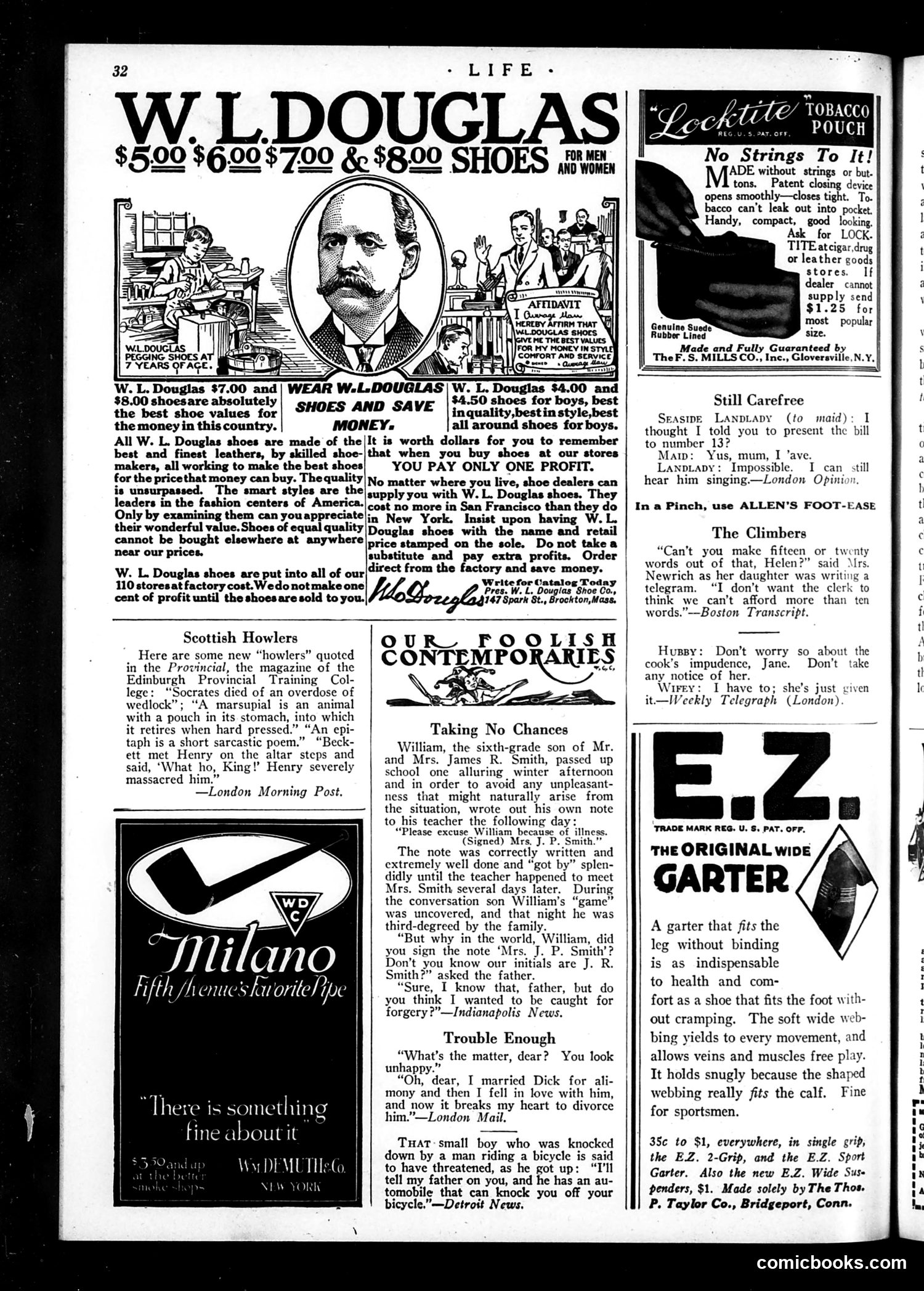
This page is primarily **advertising and humor columns** rather than political commentary. The main advertisement promotes **W.L. Douglas shoes** ($5-$8), emphasizing their factory-direct sales model eliminates middleman profits. The ad features Douglas's portrait and argues consumers save money buying directly. The humor sections include: **"Scottish Howlers"**: Funny quotes from Edinburgh students—absurd definitions like "marsupial is an animal with a pouch in its stomach, into which it retires when hard pressed." **"Our Foolish Contemporaries"**: Brief satirical anecdotes mocking human behavior: - "Taking No Chances": A boy forges a school absence note but signs the *wrong parent's name* to avoid suspicion - "Trouble Enough": A woman married for money but fell in love, now regrets divorce - A child threatens to report a cyclist to his father's automobile The satire targets everyday foolishness and domestic absurdities rather than political figures. The page reflects early-20th-century American humor focused on ironies of modern life, class commerce, and family relations.
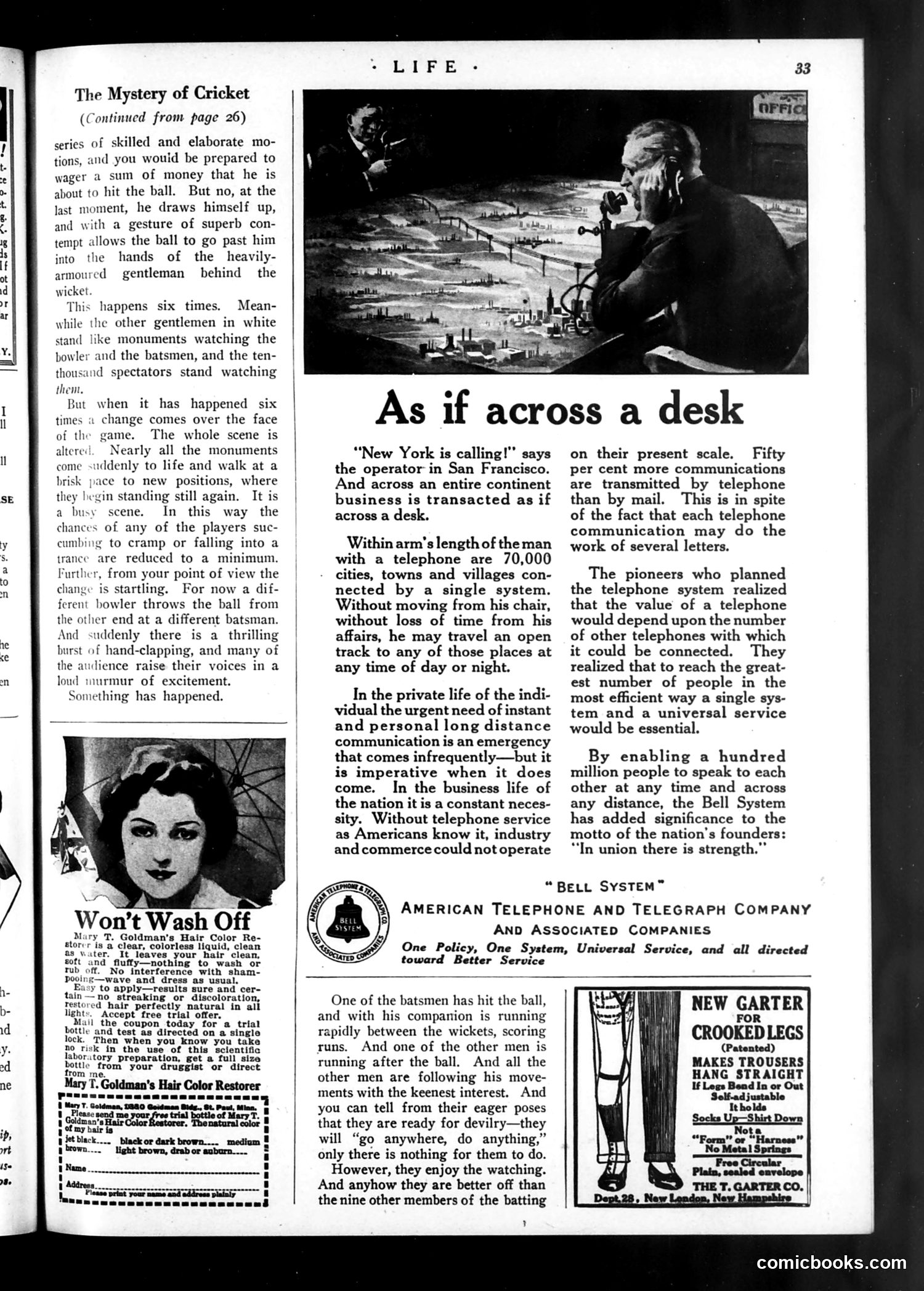
This page combines cricket commentary with a Bell System telephone advertisement. **"The Mystery of Cricket"** (top left) is satirical commentary on cricket's seemingly incomprehensible rules and tedious pacing for American readers unfamiliar with the sport. The author mocks the elaborate, repetitive motions and long periods of apparent inactivity, punctuated by sudden bursts of spectator excitement when the bowler changes position. **"As if Across a Desk"** (center/right) is a corporate advertisement celebrating the telephone system's ability to enable instant long-distance business communication across the continent. The imagery shows businessmen using telephones and maps to conduct affairs without physical travel. **"Won't Wash Off"** (bottom left) is an advertisement for Mary T. Goldman's Hair Color Restorer, a product marketed to restore graying hair—likely targeting women concerned with maintaining youthful appearance. The page reflects 1920s-30s American attitudes: bemusement toward foreign customs (cricket), optimism about technological progress (telephones), and consumer culture focused on personal grooming and beauty standards.
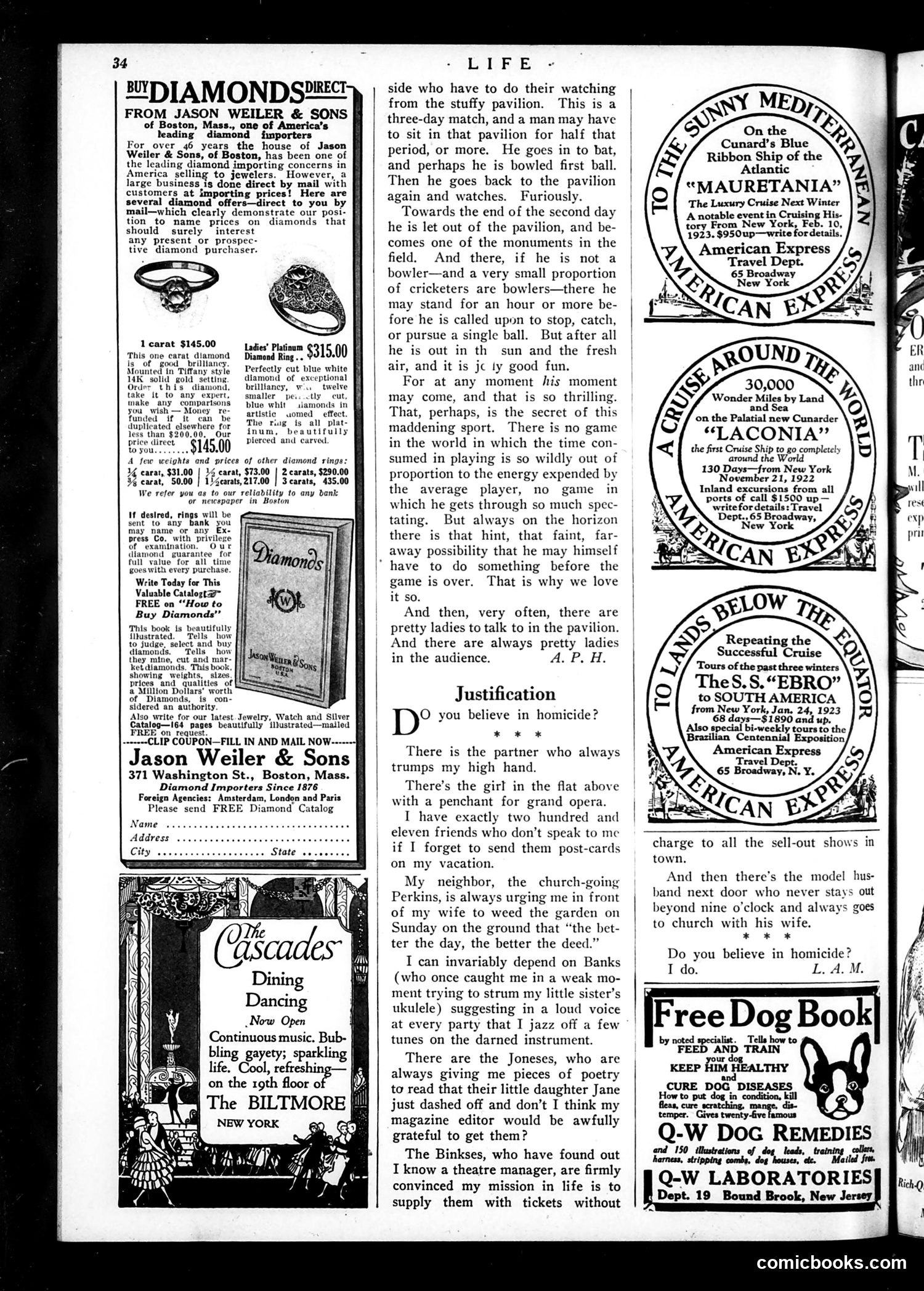
This page is primarily **advertising and filler content**, not political satire. The main elements are: 1. **Diamond advertisements** from Jason Weiler & Sons (Boston), dominating the left side with product images and pricing 2. **Cruise ship advertisements** (right margin) for luxury voyages on the Cunard Line's "Mauretania" and other vessels 3. **A brief humorous essay** titled "Justification" discussing cricket and homicide, which is light social commentary rather than political satire—it catalogs minor annoyances (a card partner who trumps your hand, noisy neighbors, neglectful friends) 4. **A dog remedies advertisement** at bottom right The cricket passage describes the tedium of the sport with gentle irony, while the "homicide" section uses exaggeration for comedic effect about everyday frustrations. There are **no political cartoons or caricatures** on this page—it's typical 1920s magazine content mixing commerce with light entertainment.
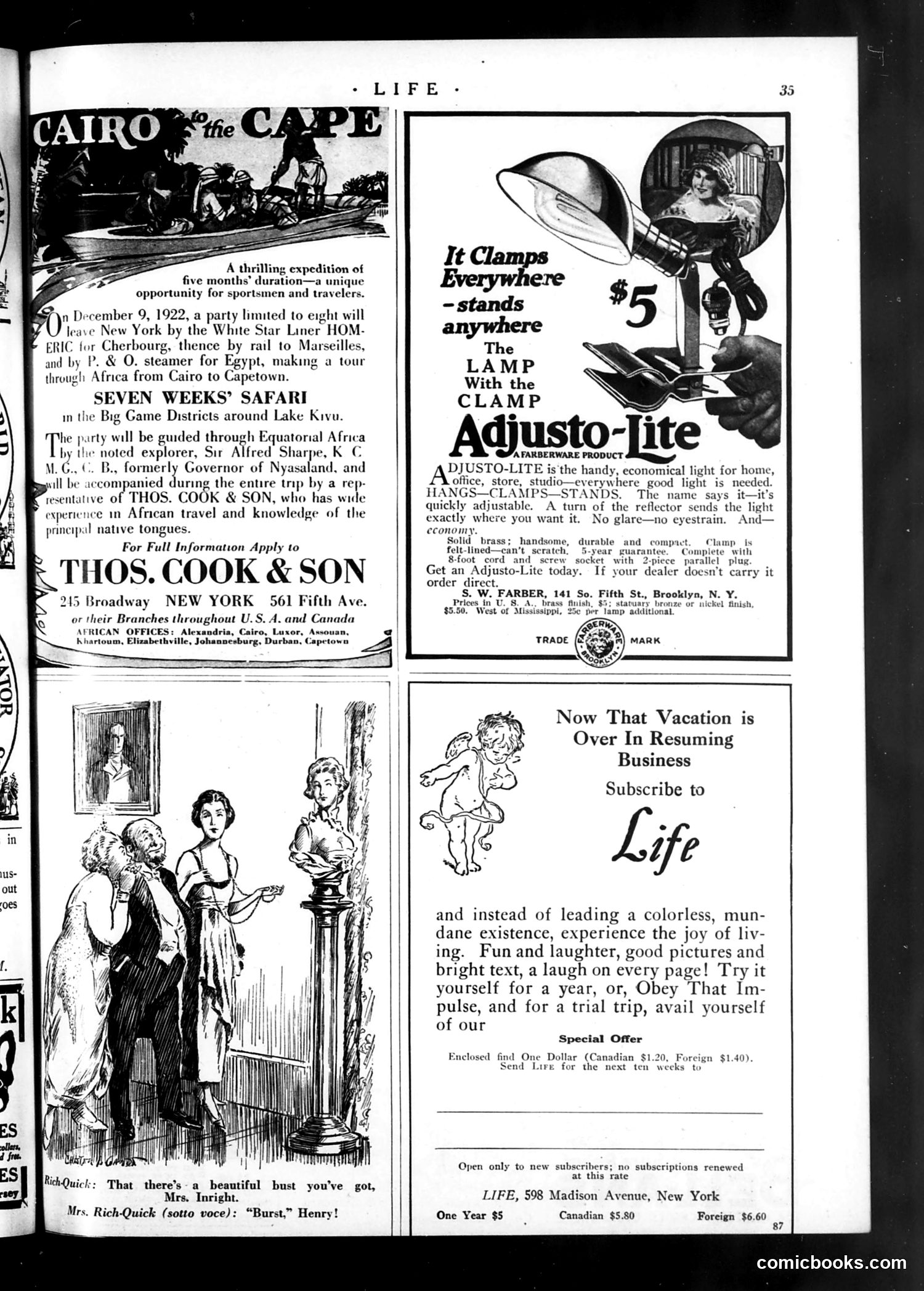
This page is primarily **advertising** with one cartoon joke. The main content includes: **Travel Advertisement**: Thos. Cook & Son promotes an African safari expedition departing December 9, 1922—a five-month luxury tour from Cairo to Capetown, guided by explorer Sir Alfred Sharpe, with Cook & Son representatives managing logistics. **Cartoon Joke** (bottom left): A wealthy couple views a classical bust sculpture. The husband (Mr. Rich-Quick) compliments "Mrs. Inright" on her "beautiful bust," to which she responds sotto voce: "Burst, Henry!"—a pun suggesting the sculpture will burst/break, or mocking his double entendre about her physique. The joke plays on the ambiguity of "bust" (sculpture vs. female form). **Product Ads**: The Adjusto-lite lamp ($5, with clamp) and Life magazine subscription offers round out the page. The overall context reflects 1920s leisure culture for the wealthy—exotic travel and consumer goods as markers of status.
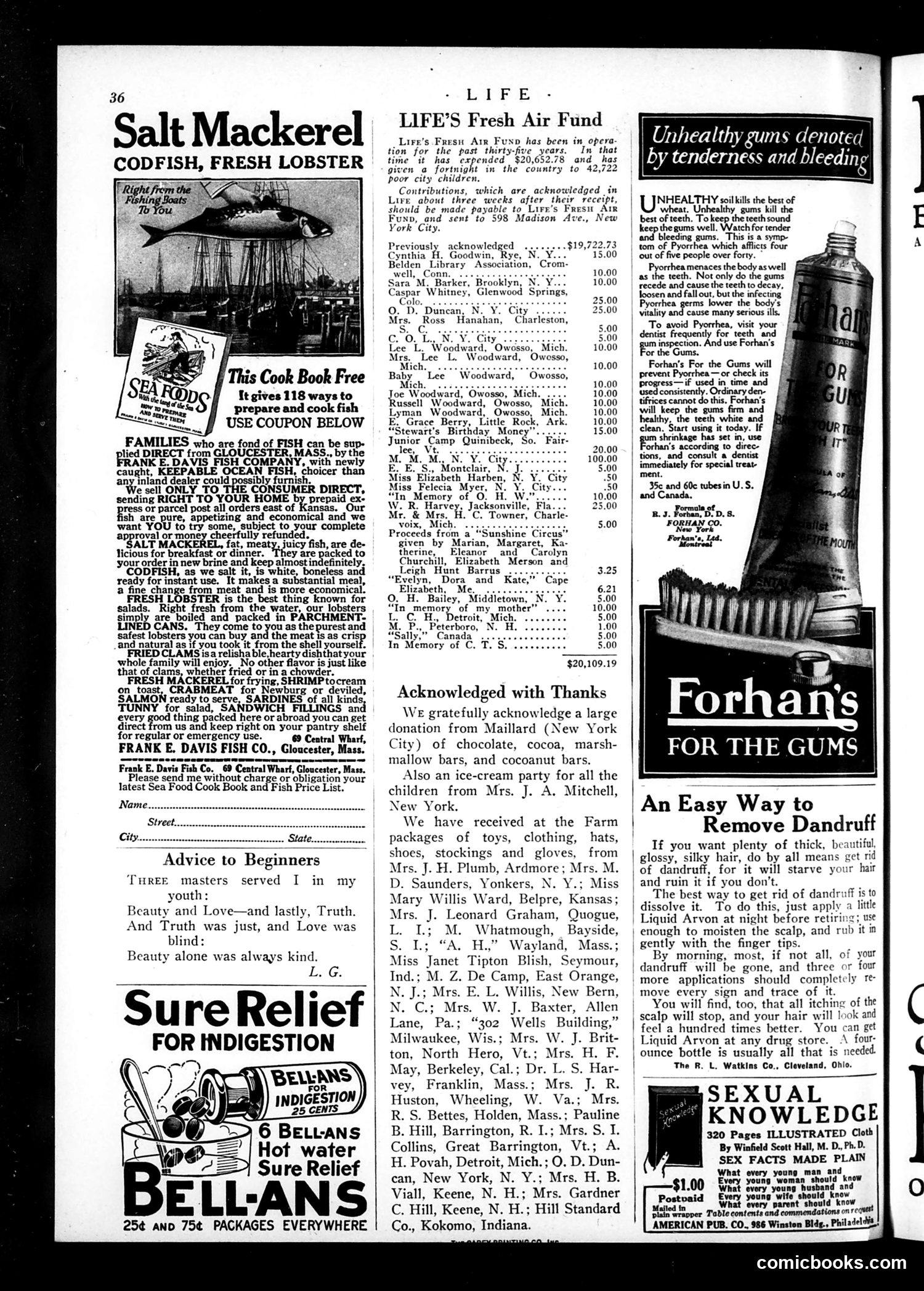
This page is primarily **advertising and charitable announcements** rather than satirical content. The main elements are: 1. **Fish Company Ads**: Frank E. Davis Fish Co. dominates the left side, promoting mail-order "salt mackerel," cod, lobster, and other preserved seafood direct to homes. This reflects early-20th-century commerce before widespread refrigeration. 2. **Life's Fresh Air Fund**: A charitable organization providing country vacations for poor urban children—a Progressive Era social reform effort to improve children's health. 3. **Product Advertisements**: Bellans indigestion relief and Forhan's toothpaste (for unhealthy gums) are typical period remedies. 4. **Moralistic Verse**: The "Advice to Beginners" section about Beauty, Love, and Truth represents the sentimental moralizing common in the era. There is **no obvious political satire or cartoon** on this page. It appears to be a standard early-20th-century magazine page mixing commercial advertising with charitable fundraising and uplift content.
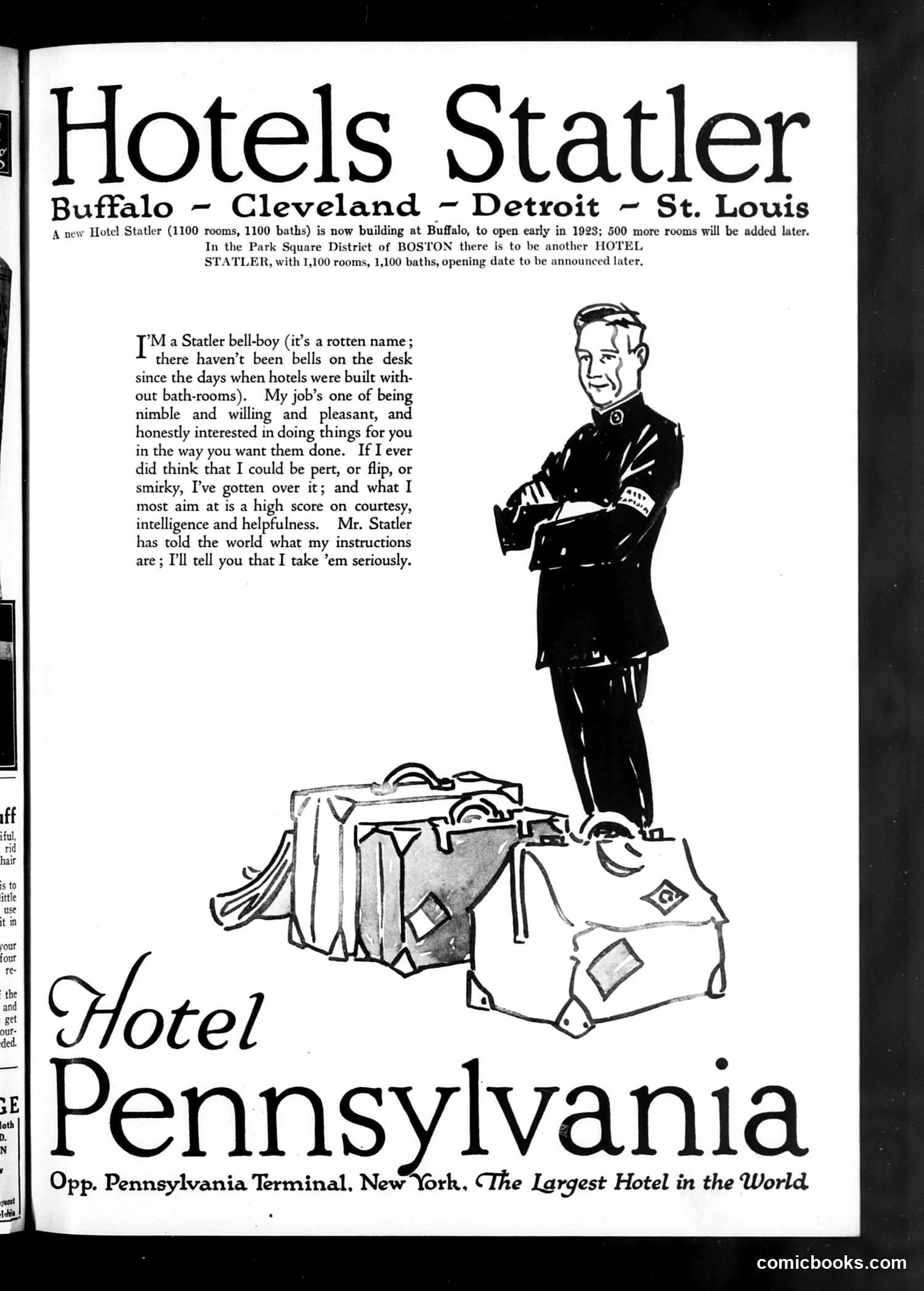
This is primarily **advertising**, not satire or political commentary. It promotes two Hotel Statler locations: existing properties in Buffalo, Cleveland, Detroit, and St. Louis, plus a new flagship hotel in Boston opposite Pennsylvania Terminal in New York. The "cartoon" is a **mascot/brand character**: a bellboy speaking directly to readers, explaining the Statler hotel philosophy. He emphasizes courtesy, helpfulness, and taking guest service seriously—positioning Statler hotels as modern, professionally-managed establishments. The reference to "rotten name" (bell-boy) humorously acknowledges the old-fashioned title while promoting contemporary standards: hotels now have bathrooms built-in (a relatively recent luxury in the 1920s). The packed luggage at his feet visually reinforces travel and hospitality themes. This represents early corporate branding through personified service values rather than satire.
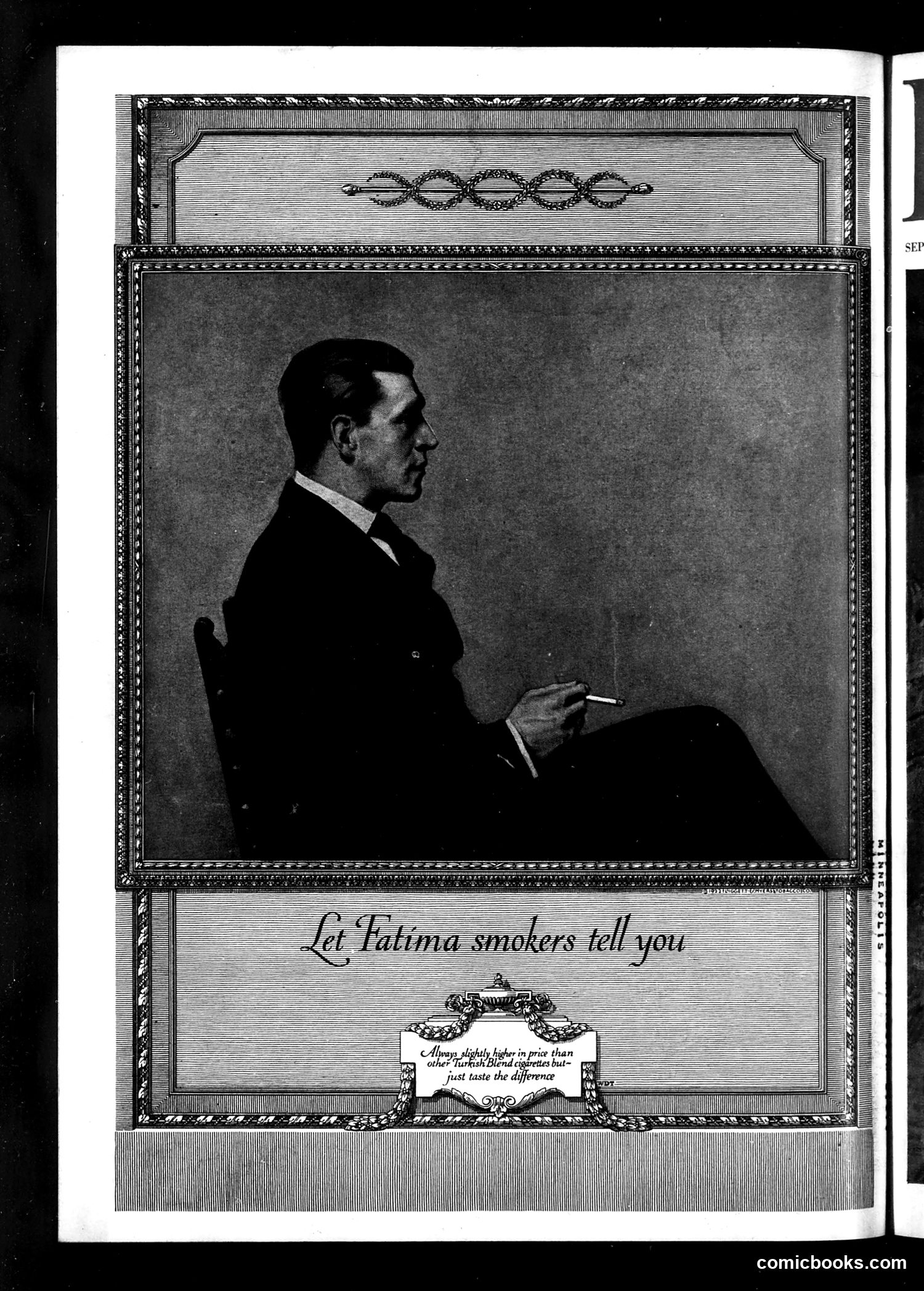
This is a **cigarette advertisement** for Fatima brand Turkish tobacco, not political satire. The page features a formal portrait photograph of a well-dressed man in profile, smoking a cigarette, seated and positioned as if for a sophisticated portrait sitting. The headline "Let Fatima smokers tell you" introduces a testimonial-style advertisement. The small text beneath (partially legible) claims Fatima cigarettes are "Always slightly lower in price than other Turkish blend cigarettes but—just taste the difference," positioning the product as affordable yet quality. This represents early 20th-century cigarette marketing that associated smoking with refinement, masculinity, and respectability—a common advertising approach before health warnings existed.