
Life, 1922-09-14 · page 22 of 40
Life — September 14, 1922 — page 22: what you’re looking at
What you’re looking at
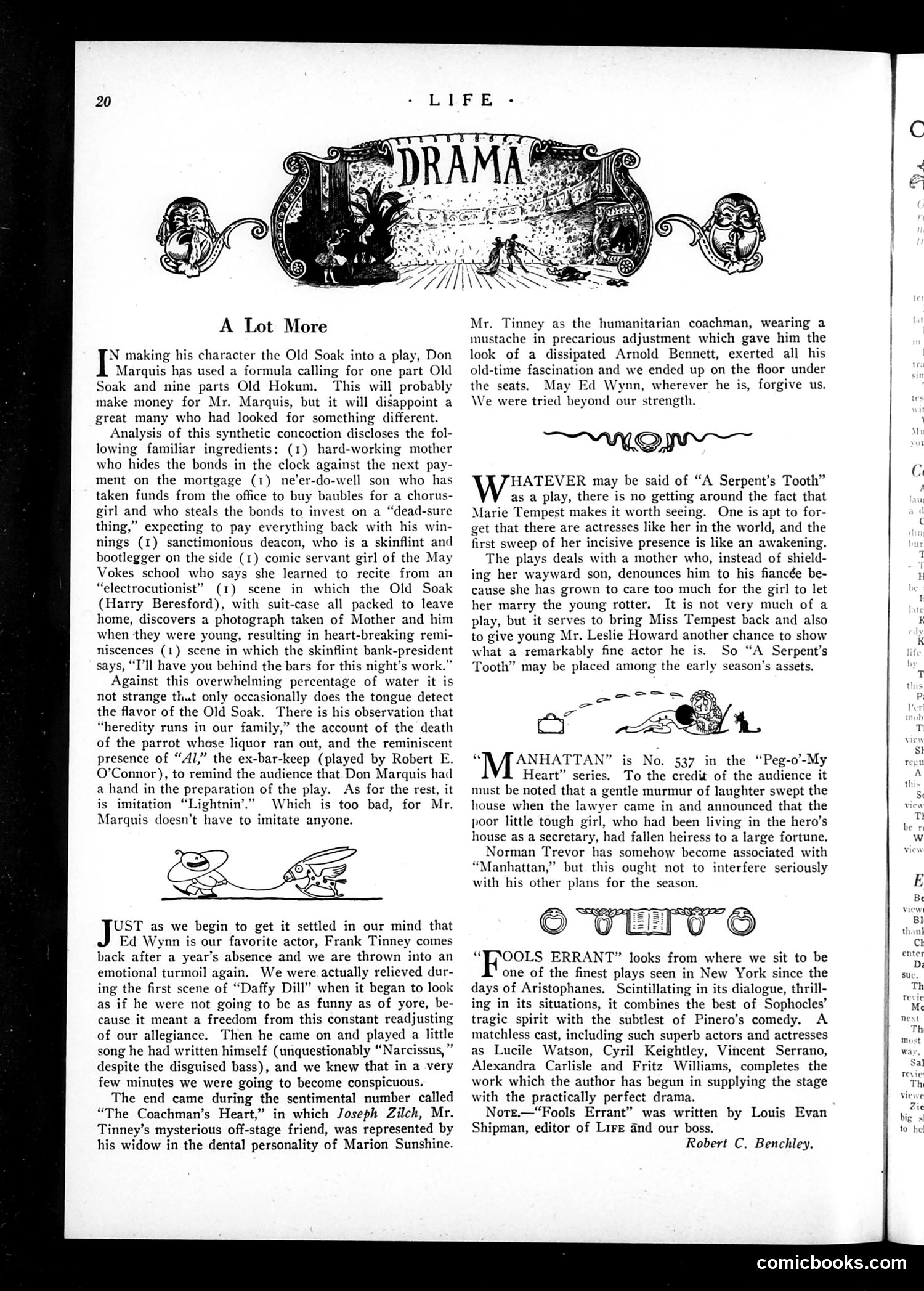
This page reviews three Broadway plays with satirical commentary. **"A Lot More"** critiques Don Marquis's stage adaptation of his "Old Soak" character, arguing it's diluted with tired theatrical formulas—sympathetic mothers, wayward sons, hypocritical deacons, and sentimental photo-discovery scenes. The reviewer complains Marquis relies on clichéd hokum rather than his original wit. **"Daffy Dill"** praises Frank Tinney's comedic return after a year's absence, noting his irresistible charm nearly forces the audience into conspicuous laughter during a sentimental number featuring his "mysterious off-stage friend" Joseph Zilch (represented by Marion Sunshine). **"A Serpent's Tooth"** acknowledges the play itself is mediocre but celebrates actress Marie Tempest's commanding presence and Leslie Howard's talent, suggesting the cast transcends weak material. The reviews exemplify *Life*'s theatrical criticism: witty, gossipy, focused on performer personalities as much as dramatic merit.
📄 Transcribed text from this page (OCR, searchable)
Machine-transcribed from the original scan — historical spelling and the odd misread are preserved.
A Lot More making his character the Old Soak into a play, Don Marquis has used a formula calling for one part Old Soak and nine parts Old Hokum. This will probably make money for Mr. Marquis, but it will disappoint a great many who had looked for something different. Analysis of this synthetic concoction discloses the fol- lowing familiar ingredients: (1) hard-working mother who hides the bonds in the clock against the next pay- ment on the mortgage (1) ne’er-do-well son who has taken funds from the office to buy baubles for a chorus- girl and who steals the bonds to invest on a “dead-sure thing,” expecting to pay everything back with his win- nings (1) sanctimonious deacon, who is a skinflint and bootlegger on the side (1) comic servant girl of the May Vokes school who says she learned to recite from an “electrocutionist” (1) scene in which the Old Soak (Harry Beresford), with suit-case all packed to leave home, discovers a photograph taken of Mother and him when they were young, resulting in heart-breaking remi- niscences (1) scene in which the skinflint bank-president says, “I'll have you behind the bars for this night’s work.” Against this overwhelming percentage of water it is not strange thut only occasionally does the tongue detect the flavor of the Old Soak. There is his observation that “heredity runs in our family,” the account of the death of the parrot whose liquor ran out, and the reminiscent presence of “Al,” the ex-bar-keep (played by Robert E. O'Connor), to remind the audience that Don Marquis had a hand in the preparation of the play. As for the rest, it is imitation “Lightnin’.”. Which is too bad, for Mr. Marquis doesn’t have to imitate anyone. UST as we begin to get it settled in our mind that Ed Wynn is our favorite actor, Frank Tinney comes back after a year’s absence and we are thrown into an emotional turmoil again. We were actually relieved dur- ing the first scene of “Daffy Dill” when it began to look as if he were not going to be as funny as of yore, be- cause it meant a freedom from this constant readjusting of our allegiance. Then he came on and played a little song he had written himself (unquestionably “Narcissus, ” despite the disguised bass), and we knew that in a very few minutes we were going to become conspicuous. The end came during the sentimental number called “The Coachman’s Heart,” in which Joseph Zilch, Mr. Tinney’s mysterious off-stage friend, was represented by his widow in the dental personality of Marion Sunshine. Mr. Tinney as the humanitarian coachman, wearing a mustache in precarious adjustment which gave him the look of a dissipated Arnold Bennett, exerted all his old-time fascination and we ended up on the floor under the seats. May Ed Wynn, wherever he is, forgive us. We were tried beyond our strength. —-wieyww~ HATEVER may be said of “A Serpent’s Tooth” s a play, there is no getting around the fact that Marie Tempest makes it worth seeing. One is apt to for- get that there are actresses like her in the world, and the first sweep of her incisive presence is like an awakening. The plays deals with a mother who, instead of shield- ing her wayward son, denounces him to his fiancée be- cause she has grown to care too much for the girl to let her marry the young rotter. It is not very much of a play, but it serves to bring Miss Tempest back and also to give young Mr. Leslie Howard another chance to show what a remarkably fine actor he is. So “A Serpent's Tooth” may be placed among the early season's assets. - ANHATTAN” is No. 537 in the “Peg-o’-My Heart” series. To the credit of the audience it must be noted that a gentle murmur of laughter swept the house when the lawyer came in and announced that the poor little tough girl, who had been living in the hero’s house as a secretary, had fallen heiress to a large fortune. Norman Trevor has somehow become associated with “Manhattan,” but this ought not to interfere seriously with his other plans for the season. “EXOOLS ERRANT” looks from where we sit to be one of the finest plays seen in New York since the days of Aristophanes. Scintillating in its dialogue, thrill- ing in its situations, it combines the best of Sophocles’ tragic spirit with the subtlest of Pinero’s comedy. A matchless cast, including such superb actors and actresses as Lucile Watson, Cyril Keightley, Vincent Serrano, Alexandra Carlisle and Fritz Williams, completes the work which the author has begun in supplying the stage with the practically perfect drama. Note.—“Fools Errant” was written by Louis Evan Shipman, editor of Lire and our boss. Robert C. Benchley. comicbooks.com