
Life, 1922-09-14 · page 30 of 40
Life — September 14, 1922 — page 30: what you’re looking at
What you’re looking at
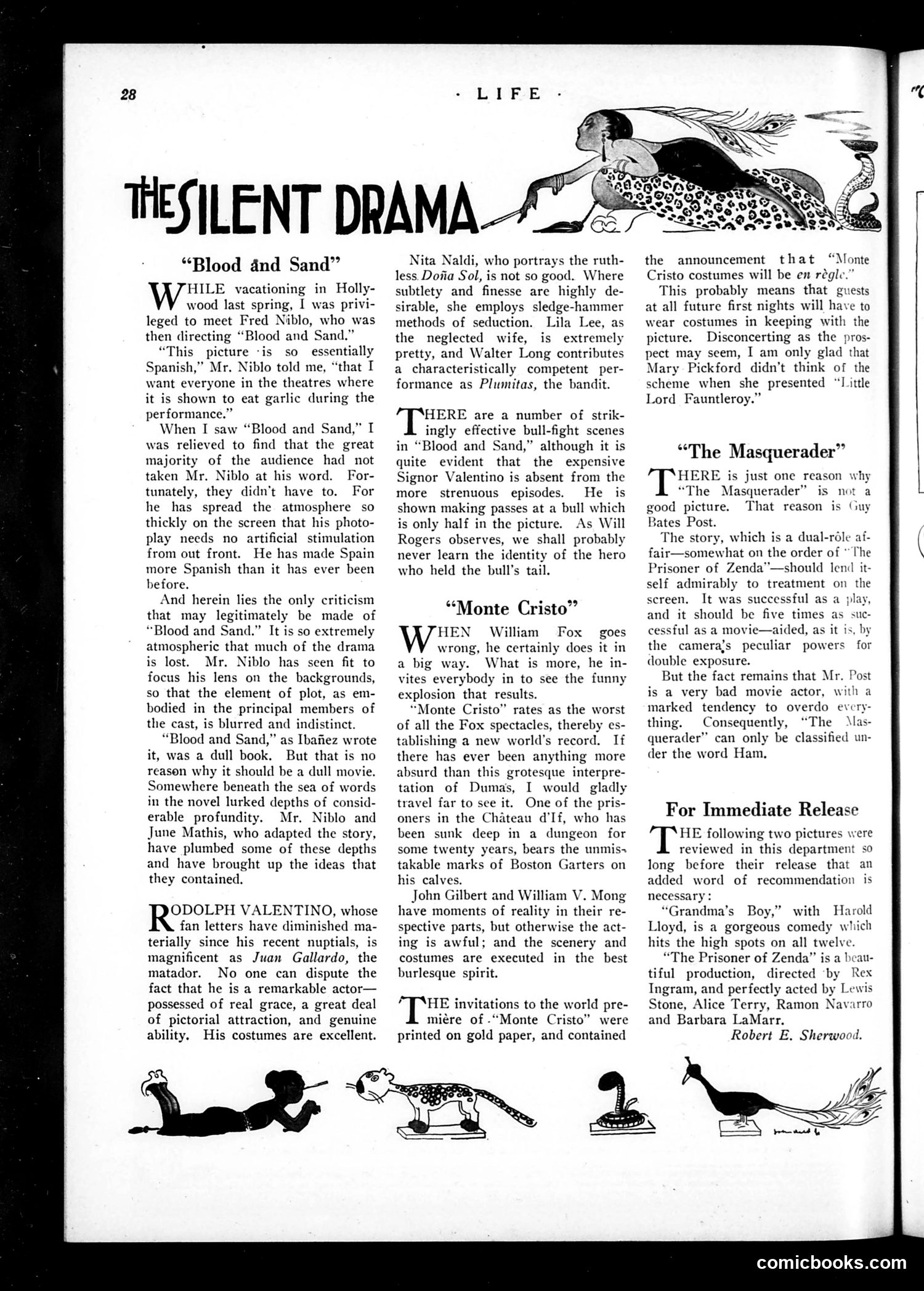
This page reviews three silent films from the 1920s. The main critiques are: **"Blood and Sand"**: Director Fred Niblo's adaptation is praised for its Spanish atmosphere but criticized for prioritizing visual spectacle over plot. Rudolph Valentino is lauded as an excellent matador actor, though the reviewer humorously notes that Valentino appears absent from dangerous bullfighting scenes—only "half in the picture." **"Monte Cristo"**: William Fox's adaptation is savagely mocked as absurdly bad, establishing "a new world's record" for terrible spectacles. A specific joke: a prisoner supposedly imprisoned twenty years still bears visible marks from Boston Garters (men's sock supporters), revealing the film's careless anachronisms. **"The Masquerader"**: Briefly noted as worthwhile due to Guy Bates Post's acting talents. The page exemplifies 1920s film criticism's focus on spectacle versus substance, while poking fun at Hollywood's excesses and technical oversights.
📄 Transcribed text from this page (OCR, searchable)
Machine-transcribed from the original scan — historical spelling and the odd misread are preserved.
THESILENT DRAMA “= “Blood 4nd Sand” HILE vacationing in Holly- wood last spring, I was privi- leged to meet Fred Niblo, who was then directing “Blood and Sand.” “This picture -is so essentially Spanish,” Mr. Niblo told me, “that I want everyone in the theatres where it is shown to eat garlic during the performance.” When I saw “Blood and Sand,” T was relieved to find that the great majority of the audience had not taken Mr. Niblo at his word. For- tunately, they didn’t have to. For he has spread the atmosphere so thickly on the screen that his photo- play needs no artificial stimulation from out front. He has made Spain more Spanish than it has ever been before. And herein lies the only criticism that may legitimately be made of “Blood and Sand.” It is so extremely atmospheric that much of the drama is lost. Mr. Niblo has seen fit to focus his lens on the backgrounds, so that the element of plot, as em- bodied in the principal members of the cast, is blurred and indistinct. “Blood and Sand,” as Ibafiez wrote it, was a dull book. But that is no reason why it should be a dull movie. Somewhere beneath the sea of words in the novel lurked depths of consid- erable profundity. Mr. Niblo and June Mathis, who adapted the story, have plumbed some of these depths and have brought up the ideas that they contained. ODOLPH VALENTINO, whose fan letters have diminished ma- terially since his recent nuptials, is magnificent as Juan Gallardo, the matador. No one can dispute the fact that he is a remarkable actor— possessed of real grace, a great deal of pictorial attraction, and genuine ability. His costumes are excellent. @ Nita Naldi, who portrays the ruth- less. Dojia Sol, is not so good. Where subtlety and finesse are highly de- sirable, she employs sledge-hammer methods of seduction. Lila Lee, as the neglected wife, is extremely pretty, and Walter Long contributes a characteristically competent per- formance as Plumitas, the bandit. HERE are a number of strik- ingly effective bull-fight scenes in “Blood and Sand,” although it is quite evident that the expensive Signor Valentino is absent from the more strenuous episodes. He is shown making passes at a bull which is only half in the picture. As Will Rogers observes, we shall probably never learn the identity of the hero who held the bull's tail. “Monte Cristo” HEN William Fox goes wrong, he certainly does it in a big way. What is more, he in- vites everybody in to see the funny explosion that results. “Monte Cristo” rates as the worst of all the Fox spectacles, thereby es- tablishing a new world’s record. If there has ever been anything more absurd than this grotesque interpre- tation of Dumas, I would gladly travel far to see it. One of the pris- oners in the Chateau d’If, who has been sunk deep in a dungeon for some twenty years, bears the unmis+ takable marks of Boston Garters on his calves. John Gilbert and William V. Mong have moments of reality in their re- spective parts, but otherwise the act- ing is awful; and the scenery and costumes are executed in the best burlesque spirit. *TMHE invitations to the world pre- miére of .“Monte Cristo” were printed on gold paper, and contained the announcement that “Monte Cristo costumes will be en régle.” This probably means that guests at all future first nights will have to wear costumes in keeping with the picture. Disconcerting as the pros- pect may seem, I am only glad that Mary Pickford didn’t think of the scheme when she presented “Little Lord Fauntleroy.” “The Masquerader” HERE is just one reason why “The Masquerader” not a good picture. That reason is (Guy Bates Post. The story, which is a dual-réle af- fair—somewhat on the order of “The Prisoner of Zenda’—should lend it- self admirably to treatment on the screen. It was successful as a play, and it should be five times as suc- cessful as a movie—aided, as it is, by the camera’s peculiar powers for double exposure. But the fact remains that Mr. Post is a very bad movie actor, with a marked tendency to overdo every- thing. Consequently, “The Ma querader” can only be classified un- der the word Ham, For Immediate Release HE following two pictures were reviewed in this department so long before their release that an added word of recommendation is necessary : “Grandma’s Boy,” with Harold Lloyd, is a gorgeous comedy which hits the high spots on all twelve. “The Prisoner of Zenda” is a | tiful production, directed ‘by Rex Ingram, and perfectly acted by Lewis Stone, Alice Terry, Ramon Navarro and Barbara LaMarr. Robert E. Sherwood. comicbooks.com