
Life, 1922-09-14 · page 13 of 40
Life — September 14, 1922 — page 13: what you’re looking at
What you’re looking at
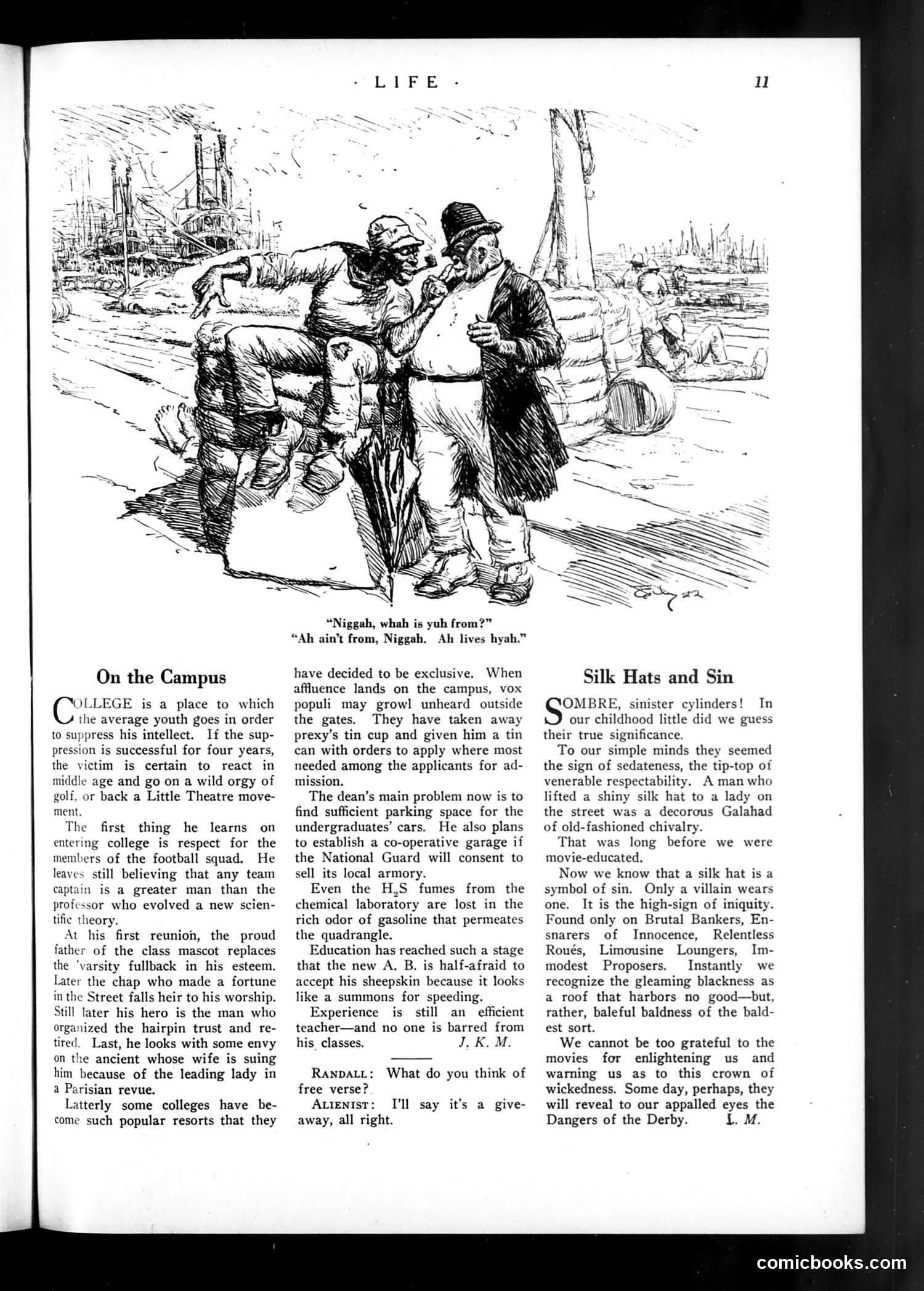
This page from *Life* magazine contains two satirical pieces about American social pretension. **"On the Campus"** mocks college culture's exclusivity and snobbery. The cartoon depicts college as a place where intellectually mediocre students learn primarily to respect hierarchies and social status. The piece satirizes how colleges have become "resorts" rather than educational institutions, criticizing students who care more about class mascots, parking spaces, and garages than actual learning. **"Silk Hats and Sin"** ridicules the assumption that formal dress (silk hats) signals moral respectability. The author argues that society wrongly equates "genteel respectability" with virtue, when in fact "snarers of Innocence, Relentless Roués, Libidinous Loungers" wear such hats. The satire warns readers not to be deceived by superficial markers of propriety. Both pieces critique American social pretension and class consciousness.
📄 Transcribed text from this page (OCR, searchable)
Machine-transcribed from the original scan — historical spelling and the odd misread are preserved.
On the Campus C )LLEGE is a place to which the average youth goes in order to suppress his intellect. pression is successful for four years, If the sup- the victim is certain to react in middle age and go on a wild orgy of golf, or back a Little Theatre move- ment. The first thing he learns on entering college is respect for the members of the football squad. He ill believing that any team is a greater man than the professor who evolved a new scien- tific theory. At his first reunion, the proud father of the class mascot replaces the ‘varsity fullback in his esteem. Later the chap who made a fortune in the Street falls heir to his worship. Still later his hero is the man who organized the hairpin trust and re- tired. Last, he looks with some envy on the ancient whose wife is suing him because of the leading lady in a Parisian revue. Latterly some colleges have be- come such popular resorts that they “Niggah, whah is yuh from?” “Ah ain’t from, Niggah. Ah lives hyah.” have decided to be exclusive. When affluence lands on the campus, vox populi may growl unheard outside the gates. They have taken away prexy’s tin cup and given him a tin can with orders to apply where most needed among the applicants for ad- mission. The dean’s main problem now is to find sufficient parking space for the undergraduates’ cars. He also plans to establish a co-operative garage if the National Guard will consent to sell its local armory. Even the H,S fumes from the chemical laboratory are lost in the rich odor of gasoline that permeates the quadrangle. Education has reached such a stage that the new A. B. is half-afraid to accept his sheepskin because it looks like a summons for speeding. Experience is still an_ efficient teacher—and no one is barred from his_ classes. JLK.M. RANDALL: free verse? AurentIst: I'll say it’s a give- away, all right. What do you think of Silk Hats and Sin OMBRE, sinister cylinders! In our childhood little did we guess their true significance. To our simple minds they seemed the sign of sedateness, the tip-top of venerable respectability. A man who lifted a shiny silk hat to a lady on the street was a decorous Galahad of old-fashioned chivalry. That was long before we were movie-educated. Now we know that a silk hat is a symbol of sin. Only a villain wears one. It is the high-sign of iniquity. Found only on Brutal Bankers, En- snarers of Innocence, Relentless Roués, Limousine Loungers, Im- modest Proposers. Instantly we recognize the gleaming blackness as a roof that harbors no good—but, rather, baleful baldness of the bald- est sort. We cannot be too grateful to the movies for enlightening us and warning us as to this crown of wickedness. Some day, perhaps, they will reveal to our appalled eyes the Dangers of the Derby. L. M. comicbooks.com