
Life, 1922-09-14 · page 17 of 40
Life — September 14, 1922 — page 17: what you’re looking at
What you’re looking at
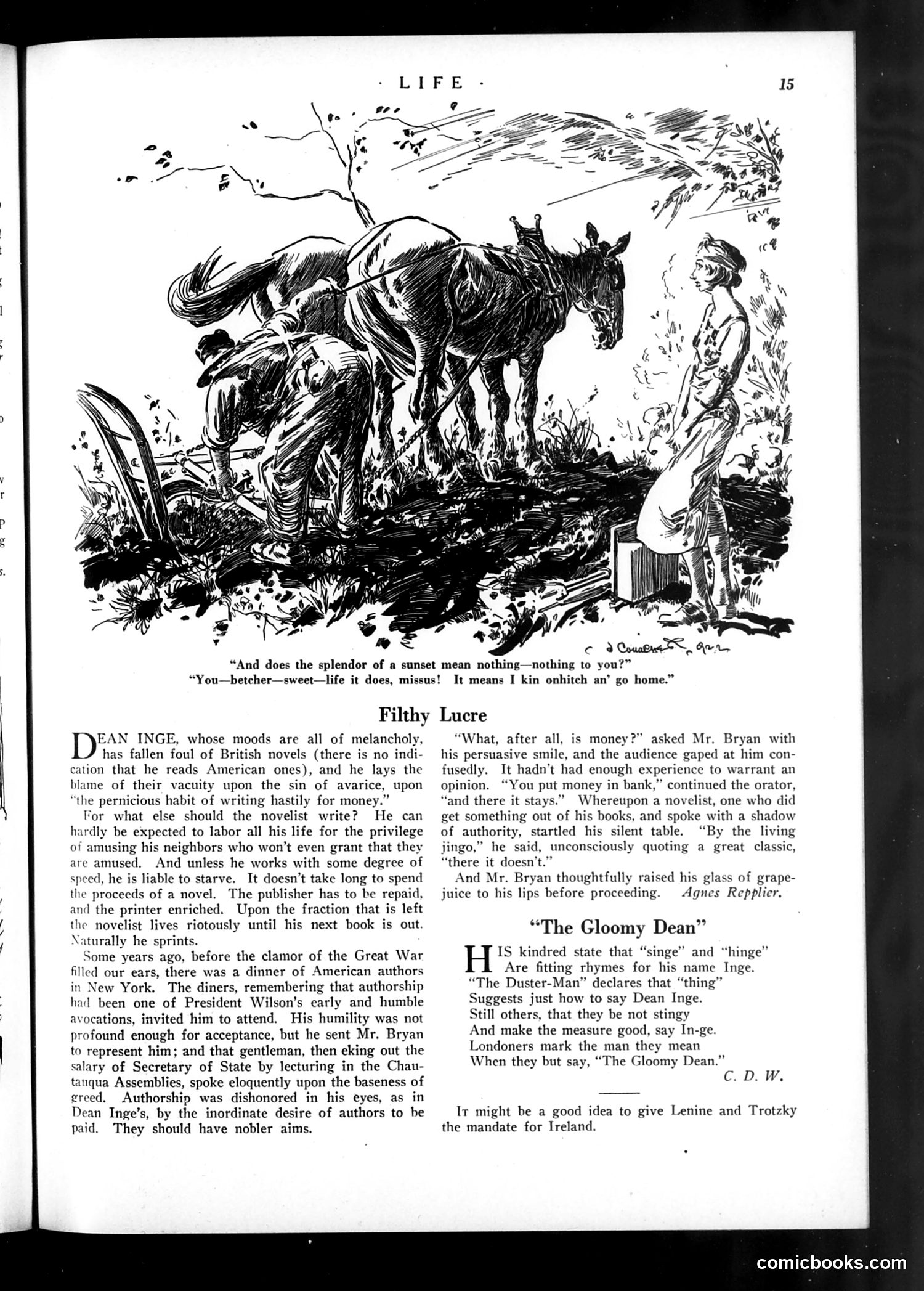
This page satirizes the hypocrisy of criticizing authors for seeking payment. The cartoon depicts a farmer and laborer—working-class men who understand that earning money enables survival—rejecting sentimental notions about sunsets in favor of practical needs. The accompanying article mocks Dean Inge (a British clergyman who criticized novels written "hastily for money") and William Jennings Bryan (former presidential candidate and Secretary of State) for lecturing authors about greed and "nobler aims" while ignoring economic reality. Bryan famously lectured that money "stays" in banks, prompting a novelist to retort it doesn't—exposing Bryan's disconnect from actual financial struggle. The satire's point: privileged figures condemned authors for valuing payment, yet working people understood earning wages was essential. The page ridicules this moral posturing as disconnected from material necessity. The secondary poems mock Dean Inge's name pronunciation, adding lighter mockery to the critique.
📄 Transcribed text from this page (OCR, searchable)
Machine-transcribed from the original scan — historical spelling and the odd misread are preserved.
“And does the splendor of a sunset mean nothing—nothing to you?” “You—betcher—sweet—life it does, missus! Filthy EAN INGE, whose moods are all of melancholy, has fallen foul of British novels (there is no indi- cation that he reads American ones), and he lays the blame of their vacuity upon the sin of avarice, upon “the pernicious habit of writing hastily for money.” For what else should the novelist write? He can hardly be expected to labor all his life for the privilege of amusing his neighbors who won’t even grant that they are amused. And unless he works with some degree of speed, he is liable to starve. It doesn’t take long to spend the proceeds of a novel. The publisher has to be repaid, and the printer enriched. Upon the fraction that is left the novelist lives riotously until his next book is out. Naturally he sprints. Some years ago, before the clamor of the Great War filled our ears, there was a dinner of American authors in New York. The diners, remembering that authorship had been one of President Wilson’s early and humble avocations, invited him to attend. His humility was not profound enough for acceptance, but he sent Mr. Bryan to represent him; and that gentleman, then eking out the salary of Secretary of State by lecturing in the Chau- tauqua Assemblies, spoke eloquently upon the baseness of greed. Authorship was dishonored in his eyes, as in Dean Inge’s, by the inordinate desire of authors to be paid. They should have nobler aims. It means I kin onhitch an’ go home.” Lucre “What, after all, is money?” asked Mr. Bryan with his persuasive smile, and the audience gaped at him con- fusedly. It hadn’t had enough experience to warrant an opinion. “You put money in bank,” continued the orator, “and there it stays.” Whereupon a novelist, one who did get something out of his books, and spoke with a shadow of authority, startled his silent table. “By the living jingo,” he said, unconsciously quoting a great classic, “there it doesn’t.” And Mr. Bryan thoughtfully raised his glass of grape- juice to his lips before proceeding. | Agnes Repplier. “The Gloomy Dean” IS kindred state that “singe” and “hinge” Are fitting rhymes for his name Inge. “The Duster-Man” declares that “thing” Suggests just how to say Dean Inge. Still others, that they be not stingy And make the measure good, say In-ge. Londoners mark the man they mean When they but say, “The Gloomy Dean.” Cc. D. W. It might be a good idea to give Lenine and Trotzky the mandate for Ireland. comicbooks.com