
Life, 1922-09-14 · page 18 of 40
Life — September 14, 1922 — page 18: what you’re looking at
What you’re looking at
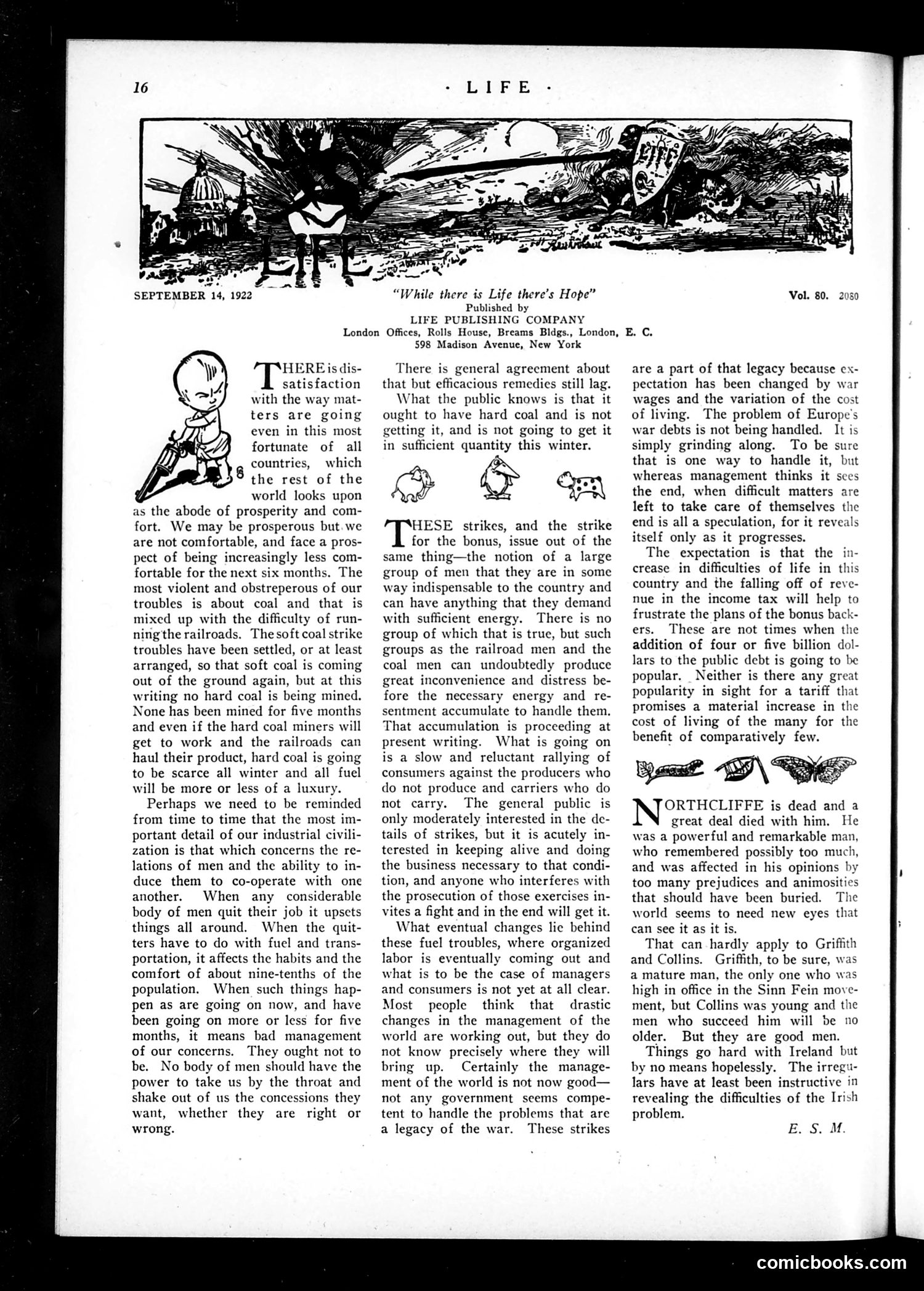
The page's masthead illustration depicts a stark post-war landscape with ruins, suggesting societal upheaval. The editorial addresses America's coal crisis and labor strikes—specifically a hard coal miners' strike that has lasted five months without resolution. The author argues that while America is materially prosperous, it faces acute discomfort from fuel shortages affecting transportation and heating. The strikes represent a broader problem: organized labor groups (railroad workers, coal miners) leveraging their indispensability to demand concessions, disrupting the general population's daily life. The piece expresses frustration that management and government cannot resolve these issues, attributing the labor unrest to post-WWI expectations—workers' demands for higher wages and better conditions were shaped by wartime employment. The author suggests public patience is exhausted and consumer resistance is building against the producers/carriers causing inconvenience. The tone is critical of both strikers' methods and management's incompetence, framing the conflict as symptomatic of post-war societal breakdown.
📄 Transcribed text from this page (OCR, searchable)
Machine-transcribed from the original scan — historical spelling and the odd misread are preserved.
SEPTEMBER 14, 1922 “While there is Life there’s Hope” Published by LIFE PUBLISHING COMPANY Vol. 80. 2080 London Offices, Rolls House, Breams Bldgs., London, E. C. HERE is dis- satisfaction with the way mat- ters are going even in this most fortunate of all countries, which the rest of the world looks upon as the abode of prosperity and com- fort. We may be prosperous but. we are not comfortable, and face a pros- pect of being increasingly less com- fortable for the next six months. The most violent and obstreperous of our troubles is about coal and that is mixed up with the difficulty of run- ning'the railroads. The soft coal strike troubles have been settled, or at least arranged, so that soft coal is coming out of the ground again, but at this writing no hard coal is being mined. None has been mined for five months and even if the hard coal miners will get to work and the railroads can haul their product, hard coal is going to be scarce all winter and all fuel will be more or less of a luxury. Perhaps we need to be reminded from time to time that the most i portant detail of our industrial ci zation is that which concerns the re- lations of men and the ability to in- duce them to co-operate with one another. When any considerable body of men quit their job it upsets things all around. When the quit- ters have to do with fuel and trans- portation, it affects the habits and the comfort of about nine-tenths of the population. When such things hap- pen as are going on now, and have been going on more or less for five months, it means bad management of our concerns. They ought not to be. No body of men should have the power to take us by the throat and shake out of us the concessions they want, whether they are right or wrong. 598 Madison Avenue, New York There is general agreement about that but efficacious remedies still lag. What the public knows is that it ought to have hard coal and is not getting it, and is not going to get it in sufficient quantity this winter. HESE strikes, and the strike for the bonus, issue out of the same thing—the notion of a large group of men that they are in some way indispensable to the country and can have anything that they demand with sufficient energy. There is no group of which that is true, but such groups as the railroad men and the coal men can undoubtedly produce great inconvenience and distress be- fore the necessary energy and re- sentment accumulate to handle them. That accumulation is proceeding at present writing. What is going on is a slow and reluctant rallying of consumers against the producers who do not produce and carriers who do not carry. The general public is only moderately interested in the de- tails of strikes, but it is acutely in- terested in keeping alive and doing the business necessary to that condi- tion, and anyone who interferes with the prosecution of those exercises in- vites a fight and in the end will get it. What eventual changes lie behind these fuel troubles, where organized labor is eventually coming out and what is to be the case of managers and consumers is not yet at all clear. Most people think that drastic changes in the management of the world are working out, but they do not know precisely where they will bring up. Certainly the manage- ment of the world is not now good— not any government seems compe- tent to handle the problems that are a legacy of the war. These strikes are a part of that legacy because ex- pectation has been changed by war wages and the variation of the cost of living. The problem of Europe's war debts is not being handled. It is simply grinding along. To be sure that is one way to handle it, but whereas management thinks it sees the end, when difficult matters are left to take care of themselves the end is all a speculation, for it reveals itself only as it progresses. The expectation is that the in- crease in difficulties of life in this country and the falling off of reve- nue in the income tax will help to frustrate the plans of the bonus back- ers. These are not times when the addition of four or five billion dol- lars to the public debt is going to be popular. Neither is there any great popularity in sight for a tariff that promises a material increase in the cost of living of the many for the benefit of comparatively few. et ORTHCLIFFE is dead and a great deal died with him. He was a powerful and remarkable man, who remembered possibly too much, and was affected in his opinions by too many prejudices and animosities that should have been buried. The world seems to need new eyes that can see it as it is. That can hardly apply to Griffith and Collins. Griffith, to be sure, was a mature man, the only one who was high in office in the Sinn Fein move- ment, but Collins was young and the men who succeed him will be no older. But they are good men. Things go hard with Ireland but by no means hopelessly. The irregu- lars have at least been instructive in revealing the difficulties of the Irish problem. E. S. M. comicbooks.com