
Life, 1922-09-14 · page 10 of 40
Life — September 14, 1922 — page 10: what you’re looking at
What you’re looking at
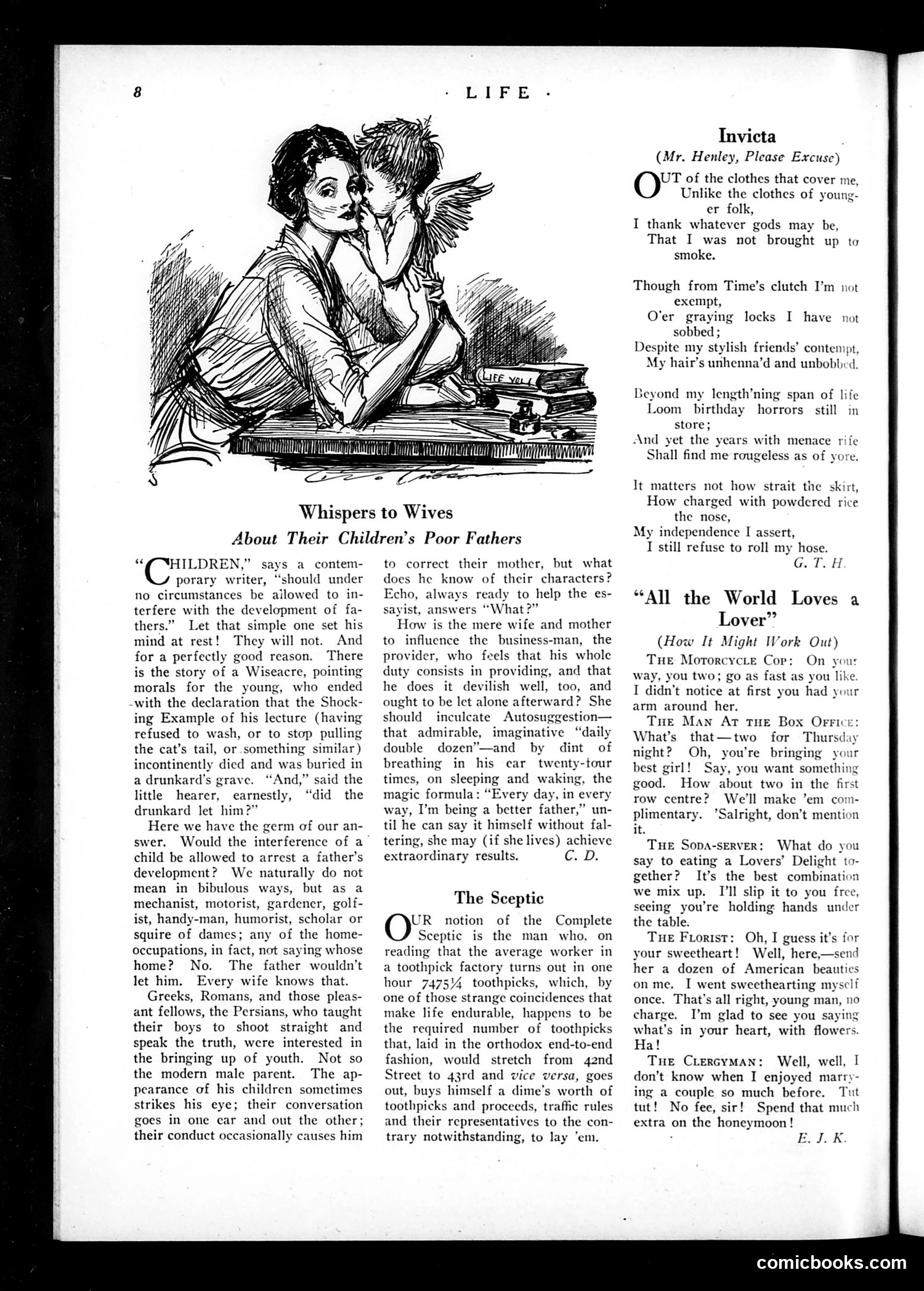
This page contains three distinct pieces of satirical content about courtship and marriage: 1. **"Invcita" poem** (top right): A woman's witty defense of her independence and aging, rejecting social pressures to smoke or conform to fashion trends. 2. **"Whispers to Wives" article** (center): Social commentary advising wives not to interfere with their husbands' parenting, suggesting men's involvement with children should be limited. The satire targets outdated gender roles and absent fathers. 3. **"The Sceptic" dialogue** (lower right): A humorous exchange about consumer culture—a man obsessively counting toothpicks from a factory, illustrating absurd materialism and working-class preoccupations. 4. **"All the World Loves a Lover"** (right): A comedic romantic conversation about motorcycles and courtship. The page satirizes early-20th-century domestic relations, gender expectations, and consumer culture.
📄 Transcribed text from this page (OCR, searchable)
Machine-transcribed from the original scan — historical spelling and the odd misread are preserved.
SESS ao Whispers to Wives About Their Children’s Poor Fathers se IHILDREN,” says a contem- porary writer, “should under no circumstances be ailowed to in- terfere with the development of fa- thers.” Let that simple one set his mind at rest! They will not. And for a perfectly good reason. There is the story of a Wiseacre, pointing morals for the young, who ended with the declaration that the Shock- ing Example of his lecture (having refused to wash, or to stop pulling the cat’s tail, or something similar) incontinently died and was buried in a drunkard’s grave. “And,” said the little hearer, earnestly, “did the drunkard let him?” Here we have the germ of our an- swer. Would the interference of a child be allowed to arrest a father’s development? We naturally do not mean in bibulous ways, but as a mechanist, motorist, gardener, golf- ist, handy-man, humorist, scholar or squire of dames; any of the home- occupations, in fact, not saying whose home? No. The father wouldn’t let him. Every wife knows that. Greeks, Romans, and those pleas- ant fellows, the Persians, who taught their boys to shoot straight and speak the truth, were interested in the bringing up of youth. Not so the modern male parent. The ap- pearance of his children sometimes strikes his eye; their conversation goes in one car and out the other; their conduct occasionally causes him to correct their mother, but what does he know of their characters? Echo, always ready to help the es- sayist, answers “What?” How is the mere wife and mother to influence the business-man, the provider, who feels that his whole duty consists in providing, and that he does it devilish well, too, and ought to be Ict alone afterward? She should inculcate Autosuggestion— that admirable, imaginative “daily double dozen”’—and by dint of breathing in his ear twenty-four times, on sleeping and waking, the magic formula: “Every day, in every way, I’m being a better father,” un- til he can say it himself without fal- tering, she may (if she lives) achieve extraordinary results. C.D. The Sceptic UR notion of the Complete Sceptic is the man who, on reading that the average worker in a toothpick factory turns out in one hour 7475%4 toothpicks, which, by one of those strange coincidences that make life endurable, happens to be the required number of toothpicks that, laid in the orthodox end-to-end fashion, would stretch from 42nd Street to 43rd and vice versa, goes out, buys himself a dime’s worth of toothpicks and proceeds, traffic rules and their representatives to the con- trary notwithstanding, to lay ‘em. Invicta (Mr. Henley, Please Excuse) UT of the clothes that cover me, Unlike the clothes of young- er folk, I thank whatever gods may be, That I was not brought up to smoke. Though from Time's clutch I’m not exempt, O’er graying locks I have not sobbed ; Despite my stylish friends’ contempt, My hair’s unhenna’d and unbobbed. Beyond my length’ning span of life Loom birthday horrors. still in store; And yet the years with menace rife Shall find me rougeless as of yore. It matters not how strait the skirt, How charged with powdered rice the nose, y independence I assert, I still refuse to roll my hose. G.T. H M “All the World Loves a Lover” (How It Might Work Out) Tue Mororcycte Cop: On your way, you two; go as fast as you like. I didn’t notice at first you had your arm around her. Tue Man Art Tue Box Orrice: What’s that—two for Thursday night? Oh, you're bringing your best girl! Say, you want something good. How about two in the first row centre? We'll make ’em com- plimentary. ’Salright, don’t mention it. Tue Sopa-server: What do you say to eating a Lovers’ Delight to- gether? It’s the best combination we mix up. I'll slip it to you free, seeing you're holding hands under the table. Tue Fiorist: Oh, I guess it’s for your sweetheart! Well, here,—send her a dozen of American beauties on me. I went sweethearting myscif once. That's all right, young man, 10 charge. I’m glad to see you saying what's in your heart, with flowers. Ha! Tue CLerGyMAN: Well, well, I don’t know when I enjoyed marry- ing a couple so much before. Tut tut! No fee, sir! Spend that much extra on the honeymoon! B..5.-K. comicbooks.com