
Life, 1922-09-14 · page 24 of 40
Life — September 14, 1922 — page 24: what you’re looking at
What you’re looking at
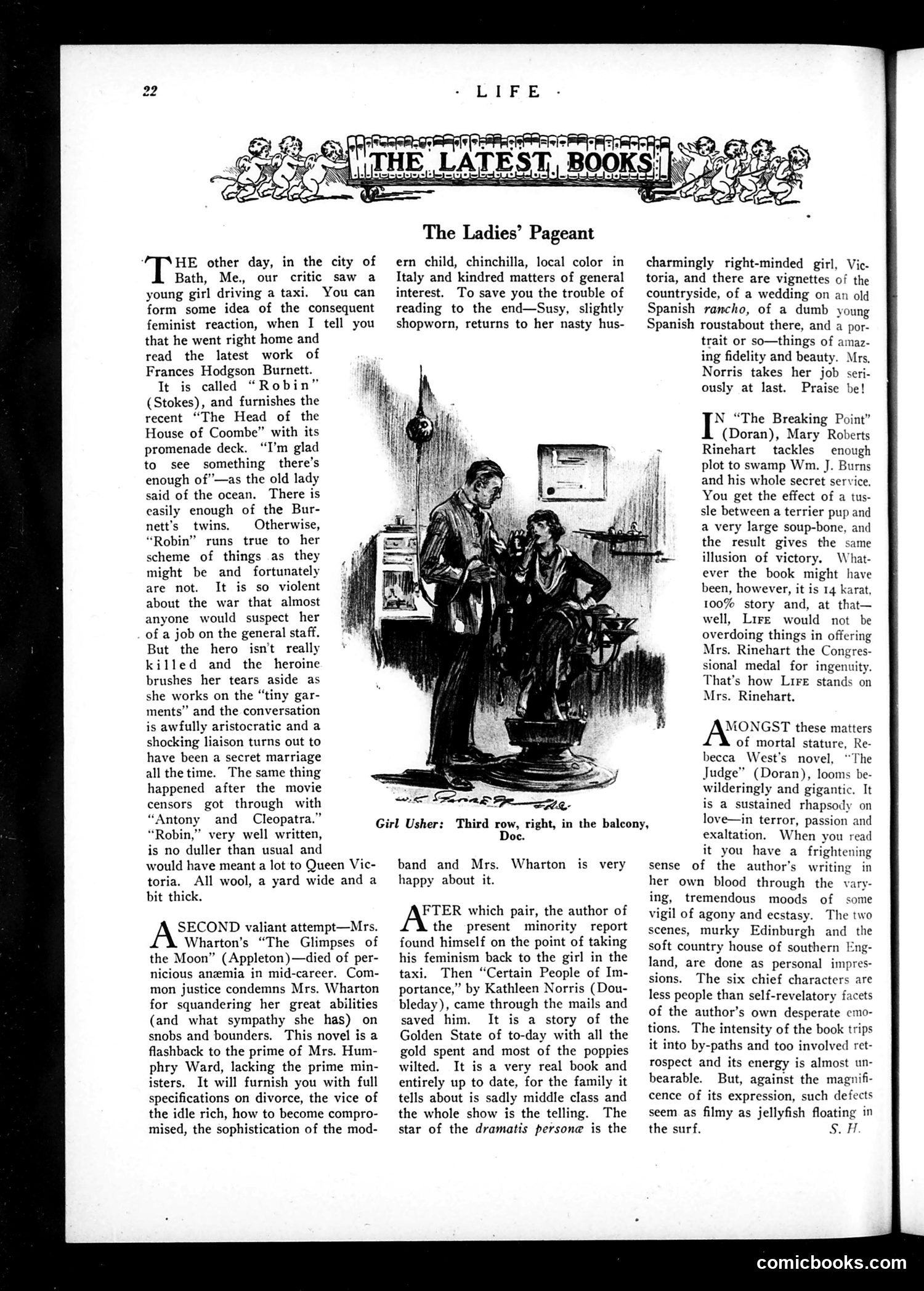
This page contains literary reviews of contemporary novels, framed by a satirical opening anecdote. A Life critic, disturbed by seeing a young woman taxi driver (a sign of feminist progress), reads Frances Hodgson Burnett's novel "Robin" to recover his conservative sensibilities. The reviews mock both the novels and their readers' expectations. Burnett's work is dismissed as predictably aristocratic and pro-war propaganda dressed in sentimentality. Edith Wharton's novel is criticized as a tired rehash of her earlier style, obsessing over wealthy divorce scandals. The reviewer uses backhanded compliments throughout—praising Kathleen Norris's competent but unremarkable family drama and Mary Roberts Rinehart's plot-heavy thriller as "100% story." Rebecca West's "The Judge" alone receives genuine praise for ambitious emotional scope. The satire targets both formulaic women novelists and readers who prefer comfortable, class-conscious narratives over genuine literary innovation.
📄 Transcribed text from this page (OCR, searchable)
Machine-transcribed from the original scan — historical spelling and the odd misread are preserved.
HE other day, in the city of Bath, Me. our critic saw a young girl driving a taxi. You can form some idea of the consequent feminist reaction, when I tell you that he went right home and read the latest work of Frances Hodgson Burnett. It is called “Robin” (Stokes), and furnishes the recent “The Head of the House of Coombe” with its promenade deck. “I’m glad to see something there’s enough of”—as the old lady said of the ocean. There is easily enough of the Bur- nett’s twins. Otherwise, “Robin” runs true to her scheme of things as they might be and fortunately are not. It is so violent about the war that almost anyone would suspect her of a job on the general staff. But the hero isn’t really killed and the heroine brushes her tears aside as she works on the “tiny gar- ments” and the conversation is awfully aristocratic and a shocking liaison turns out to have been a secret marriage all the time. The same thing happened after the movie censors got through with “Antony and Cleopatra.” “Robin,” very well written, is no duller than usual and would have meant a lot to Queen Vic- toria. All wool, a yard wide and a bit thick. SECOND valiant attempt—Mrs. Wharton’s “The Glimpses of the Moon” (Appleton)—died of per- nicious anemia in mid-career. Com- mon justice condemns Mrs. Wharton for squandering her great abilities (and what sympathy she has) on snobs and bounders. This novel is a flashback to the prime of Mrs. Hum- phry Ward, lacking the prime min- isters. It will furnish you with full specifications on divorce, the vice of the idle rich, how to become compro- mised, the sophistication of the mod- wee Ges Girl Usher: The Ladies’ Pageant ern child, chinchilla, local color in Italy and kindred matters of general interest. To save you the trouble of reading to the end—Susy, slightly shopworn, returns to her nasty hus- Doc. band and Mrs. Wharton is very happy about it. FTER which pair, the author of the present minority report found himself on the point of taking his feminism back to the girl in the taxi. Then “Certain People of Im- portance,” by Kathleen Norris (Dou- bleday), came through the mails and saved him. It is a story of the Golden State of to-day with all the gold spent and most of the poppies wilted. It is a very real book and entirely up to date, for the family it tells about is sadly middle class and the whole show is the telling. The star of the dramatis persone is the Third row, right, in the balcony, charmingly right-minded girl, Vic- toria, and there are vignettes of the countryside, of a wedding on an old Spanish rancho, of a dumb young Spanish roustabout there, and a por- trait or so—things of amaz- ing fidelity and beauty. Mrs, Norris takes her job seri- ously at last. Praise be! IX “The Breaking Point” (Doran), Mary Roberts Rinehart tackles enough plot to swamp Wm. J. Burns and his whole secret service. You get the effect of a tus- sle between a terrier pup and a very large soup-bone, and the result gives the same illusion of victory. What- ever the book might have been, however, it is 14 karat, 100% story and, at that— well, LiFe would not be overdoing things in offering Mrs. Rinehart the Congres- sional medal for ingenuity. That’s how Lire stands on Mrs. Rinehart. MONGST these matters of mortal stature, Re- becca West's novel, “The Judge” (Doran), looms be- wilderingly and gigantic. It is a sustained rhapsody on love—in terror, passion and exaltation. When you read it you have a frightening sense of the author’s writing in her own blood through the vary- ing, tremendous moods of some vigil of agony and ecstasy. The two scenes, murky Edinburgh and the soft country house of southern Eng- land, are done as personal impres- sions. The six chief characters are less people than self-revelatory facets of the author’s own desperate emo- tions. The intensity of the book trips it into by-paths and too involved ret- rospect and its energy is almost un- bearable. But, against the magnifi- cence of its expression, such defects seem as filmy as jellyfish floating in the surf. S.H comicbooks.com