
Life, 1922-09-14 · page 28 of 40
Life — September 14, 1922 — page 28: what you’re looking at
What you’re looking at
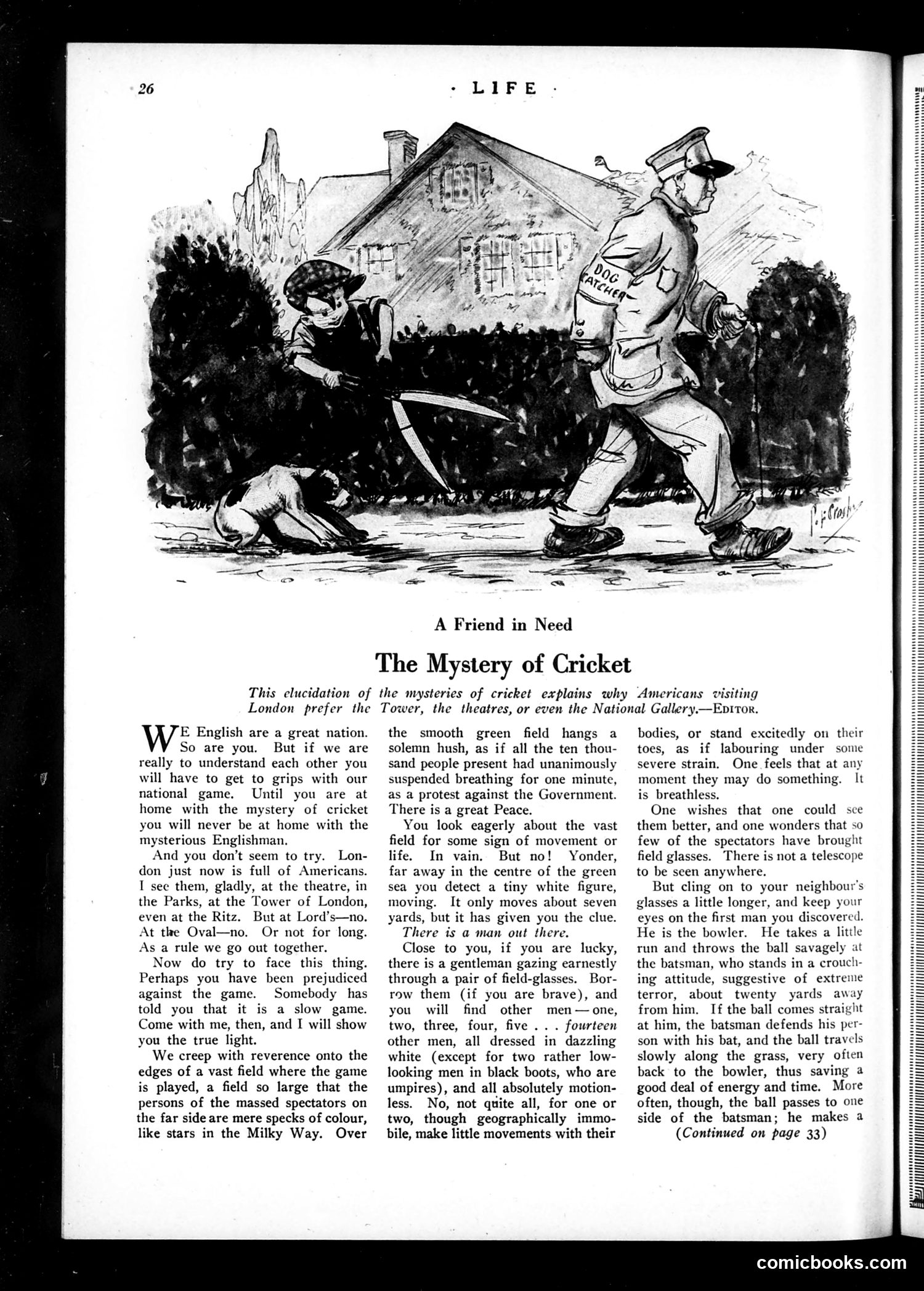
This satirical article uses cricket as a metaphor to gently mock both English cultural superiority and American visitors' bewilderment at English traditions. The cartoon shows an American soldier encountering cricket—depicted as an incomprehensibly slow, motionless game where nothing appears to happen. The humor operates on two levels: First, the author (writing to American readers) playfully chides them for avoiding Lord's and the Oval cricket grounds while visiting London, suggesting they prefer more obviously entertaining attractions. Second, the detailed explanation of cricket's rules ironically demonstrates *why* Americans find it baffling—emphasizing the vast field, thousands of silent spectators, nearly motionless players, and minimal action. The piece's subtitle confirms the joke: Americans prefer the Tower, theatres, or art galleries—anything but cricket. It's affectionate criticism of transatlantic cultural gaps, published when American visitors were numerous in London.
📄 Transcribed text from this page (OCR, searchable)
Machine-transcribed from the original scan — historical spelling and the odd misread are preserved.
E English are a great nation. So are you. But if we are really to understand each other you will have to get to grips with our national game. Until you are at home with the mystery of cricket you will never be at home with the mysterious Englishman. And you don’t seem to try. Lon- don just now is full of Americans. I see them, gladly, at the theatre, in the Parks, at the Tower of London, even at the Ritz. But at Lord’s—no. At the Oval—no. Or not for long. As a rule we go out together. Now do try to face this thing. Perhaps you have been prejudiced against the game. Somebody has told you that it is a slow game. Come with me, then, and I will show you the true light. We creep with reverence onto the edges of a vast field where the game is played, a field so large that the persons of the massed spectators on the far side are mere specks of colour, like stars in the Milky Way. Over A Friend in Need The Mystery of Cricket This elucidation of the mysteries of cricket explains why Americans visiting London prefer the Tower, the theatres, or even the National Gallery —Ep1tor. the smooth green field hangs a solemn hush, as if all the ten thou- sand people present had unanimously suspended breathing for one minute, as a protest against the Government. There is a great Peace. You look eagerly about the vast field for some sign of movement or life. In vain, But no! Yonder, far away in the centre of the green sea you detect a tiny white figure, moving. It only moves about seven yards, but it has given you the clue. There is a man out there. Close to you, if you are lucky, there is a gentleman gazing earnestly through a pair of field-glasses. Bor- row them (if you are brave), and you will find other men— one, two, three, four, five .. . fourteen other men, all dressed in dazzling white (except for two rather low- looking men in black boots, who are umpires), and all absolutely motion- less. No, not quite all, for one or two, though geographically immo- bile, make little movements with their bodies, or stand excitedly on their toes, as if labouring under some severe strain. One feels that at any moment they may do something. It is breathless. One wishes that one could them better, and one wonders that so few of the spectators have brought field glasses. There is not a telescope to be seen anywhere. But cling on to your neighbour's glasses a little longer, and keep your eyes on the first man you discovered. He is the bowler. He takes a little run and throws the ball savagely at the batsman, who stands in a crouch- ing attitude, suggestive of extreme terror, about twenty yards away from him. If the ball come: i at him, the batsman defends his per- son with his bat, and the ball travels slowly along the grass, very often back to the bowler, thus saving a good deal of energy and time. More often, though, the ball passes to one side of the batsman; he makes 2 (Continued on page 33) see comicbooks.com