
A complete issue · 36 pages · 1922
Life — August 3, 1922
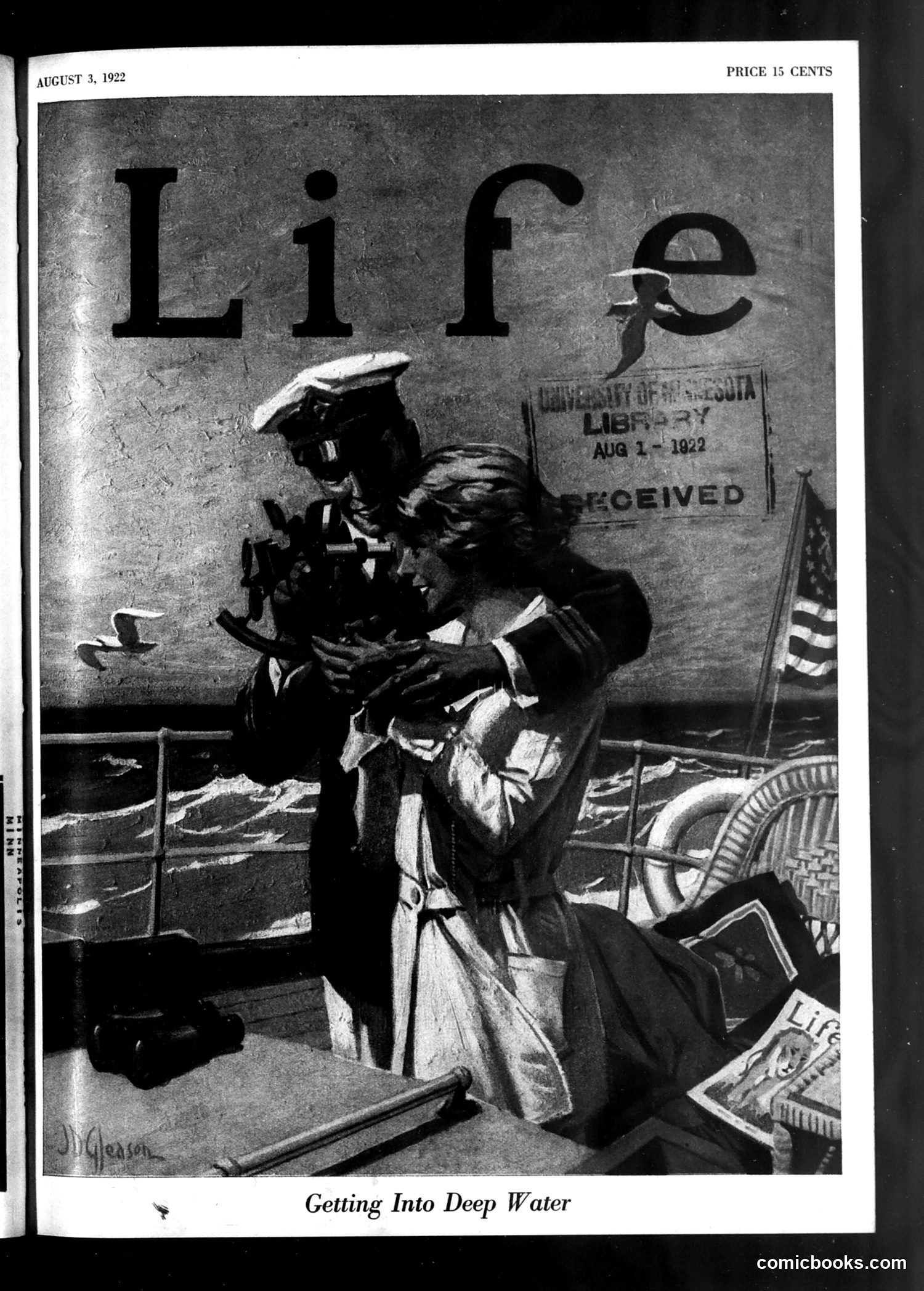
This cover depicts a woman in sailor outfit holding a telescope on a ship's deck, gazing toward the horizon. The title "Life" appears above with a small figure seemingly diving or falling through the "e." The caption reads "Getting Into Deep Water," a double entendre suggesting both nautical adventure and figurative trouble. The sailor woman—likely representing an independent or adventurous "modern woman" of the 1920s—appears to be literally and metaphorically entering uncertain territory. The American flag visible in the background grounds this in national context. The satire likely comments on women's expanding social freedoms during the Jazz Age, presenting this independence as both exciting and potentially risky or scandalous. The magazine used such cover illustrations regularly for social commentary and humor about contemporary American culture.
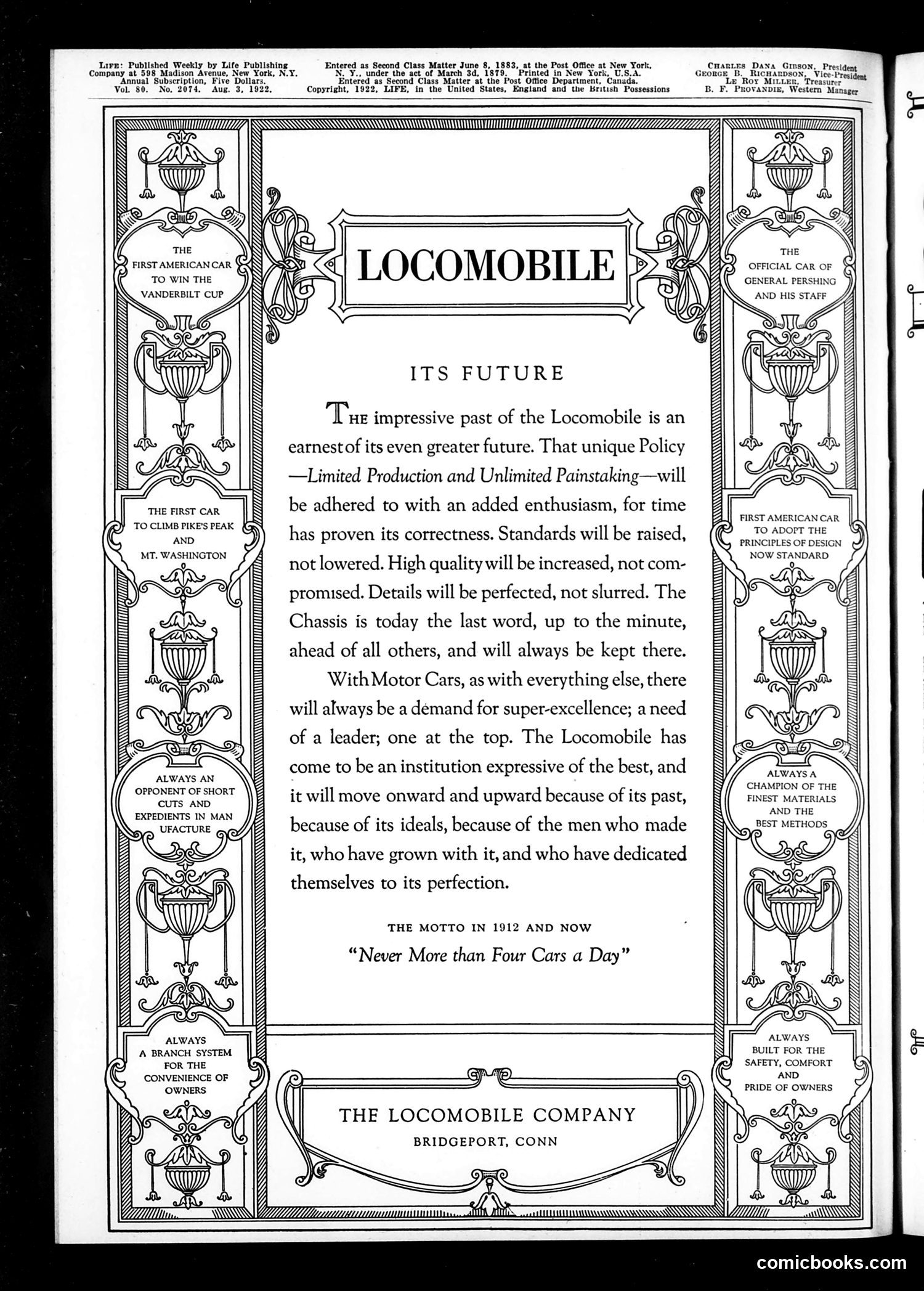
This is a **Locomobile automobile advertisement**, not a political cartoon. The page promotes the Locomobile Company of Bridgeport, Connecticut, emphasizing their manufacturing philosophy of "Limited Production and Unlimited Painstaking." The decorative borders feature classical urns and scrollwork, with text praising Locomobile's achievements: "First American Car to Win the Vanderbilt Cup," "First Car to Climb Pike's Peak," and claims about chassis superiority and design principles. The central text argues that quality over quantity ensures the Locomobile's future dominance in motor cars, positioning it as a luxury product requiring leadership and excellence. The 1912 motto—"Never More than Four Cars a Day"—emphasizes exclusivity and craftsmanship over mass production. This is purely commercial messaging, not satire.
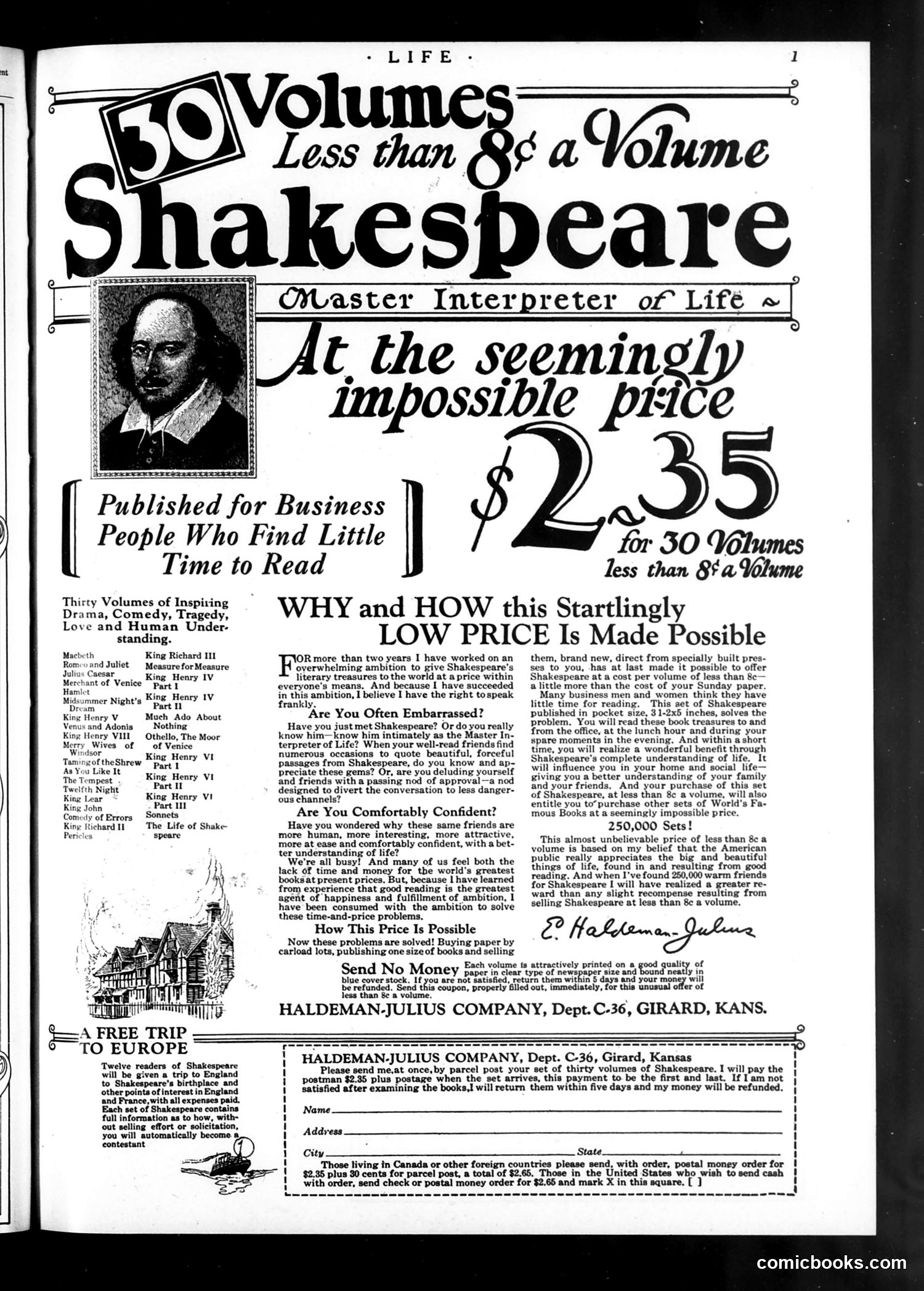
This page is primarily an **advertisement**, not editorial content or satire. It promotes a 30-volume Shakespeare collection sold by the Haldeman-Julius Company of Girard, Kansas. The ad emphasizes affordability ($2.35 for 30 volumes—"less than 8¢ a volume"), marketed toward busy professionals with limited reading time. The portrait shows Shakespeare himself. The copy includes testimonial language from the publisher, explaining the low price through economical production methods (small format, direct printing). A tear-out coupon at the bottom invites mail orders. The only potentially satirical element is the framing device—presenting Shakespeare as accessible to ordinary Americans through mass-market publishing—but this reflects genuine 1920s-era optimism about democratizing literature rather than mockery.
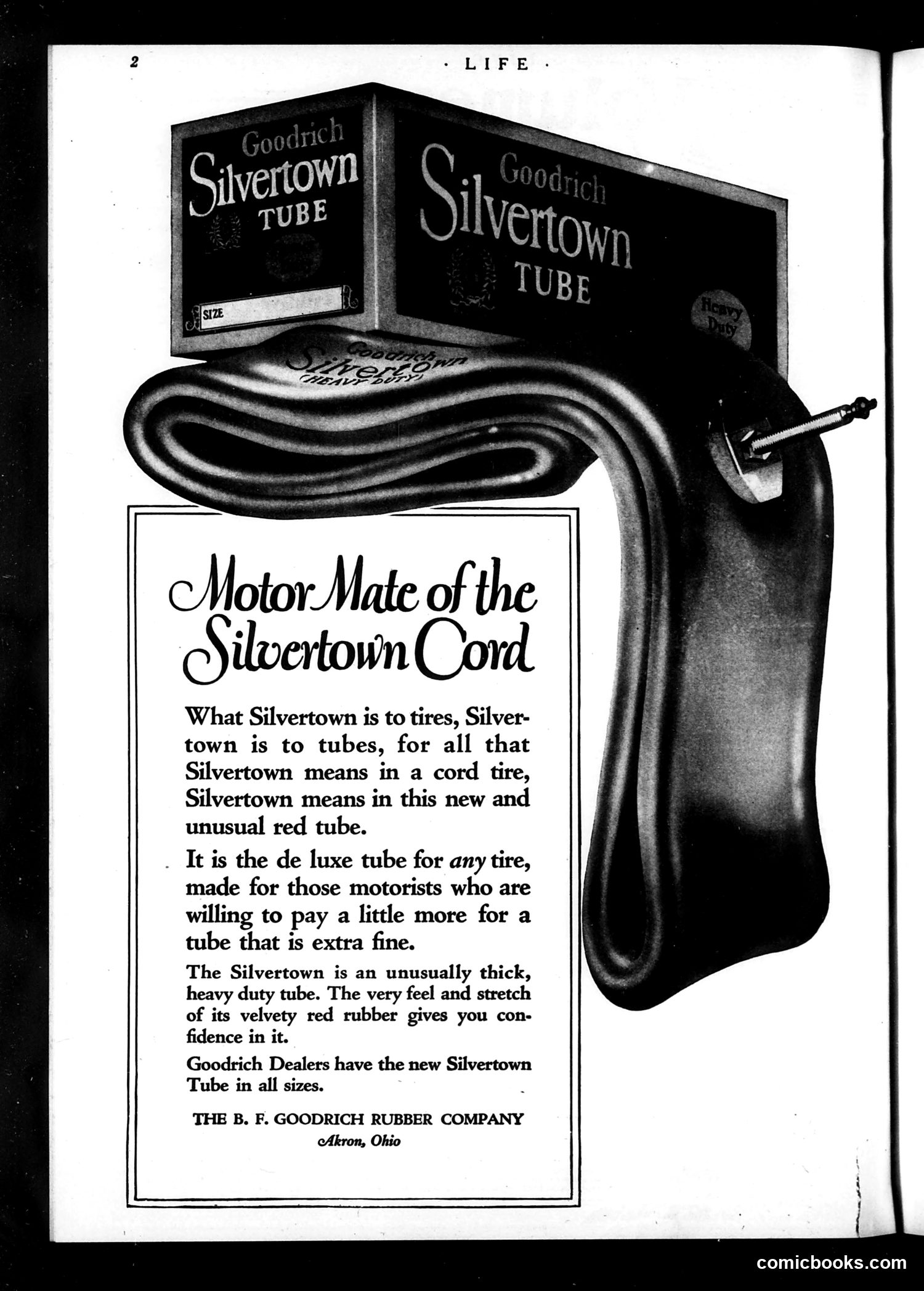
This page is **not a political cartoon or satirical content**—it's a straightforward **advertisement for Goodrich Silvertown inner tubes**, a tire/automotive product. The ad uses marketing language typical of early-to-mid 20th century advertising, emphasizing the tube as a premium "de luxe" product with "velvety red rubber" for motorists willing to pay more. The visual shows the tube itself alongside its packaging box, with a valve stem visible. The phrase "Motor Mate of the Silvertown Cord" positions the tube as a complementary product to Goodrich's existing cord tires. The Goodrich Rubber Company was based in Akron, Ohio—a major tire manufacturing hub. This is simply vintage product advertising, not satire or political commentary.
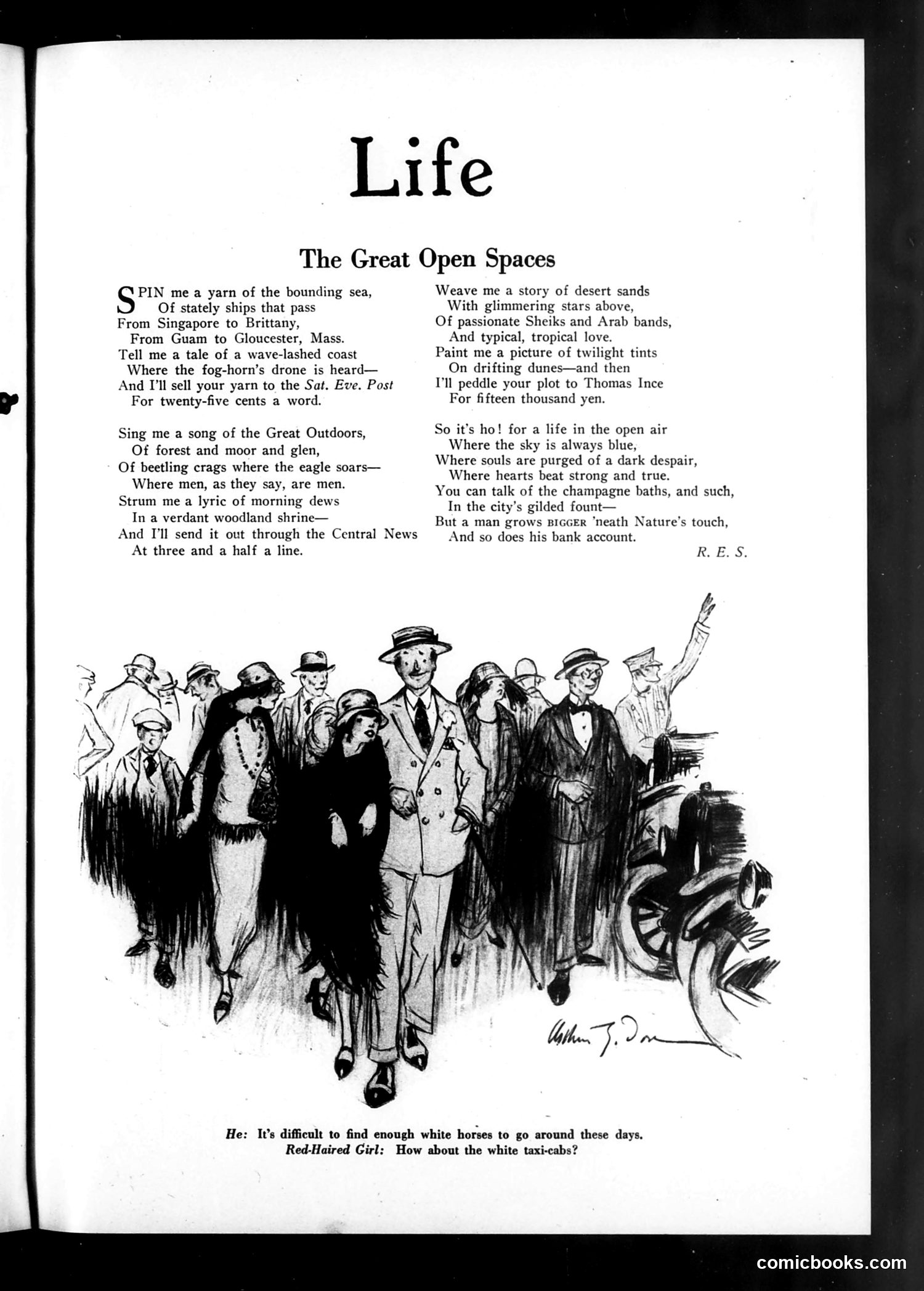
This page features a poem celebrating rural and adventurous living, contrasting open-air freedom with urban constraints. The accompanying illustration depicts a diverse group of well-dressed urbanites (men and women in 1920s attire) who appear to be embarking on or discussing an excursion. The bottom caption contains a joke about transportation scarcity: a man complains about difficulty finding white horses for travel, and a "Red-Haired Girl" suggests white taxi-cabs as an alternative. This reflects post-WWI urban concerns about transportation options and horse shortages, while satirizing the growing prevalence of automobiles replacing traditional horse-drawn vehicles. The overall satire suggests tension between idealized rural escape fantasies and modern urban realities.
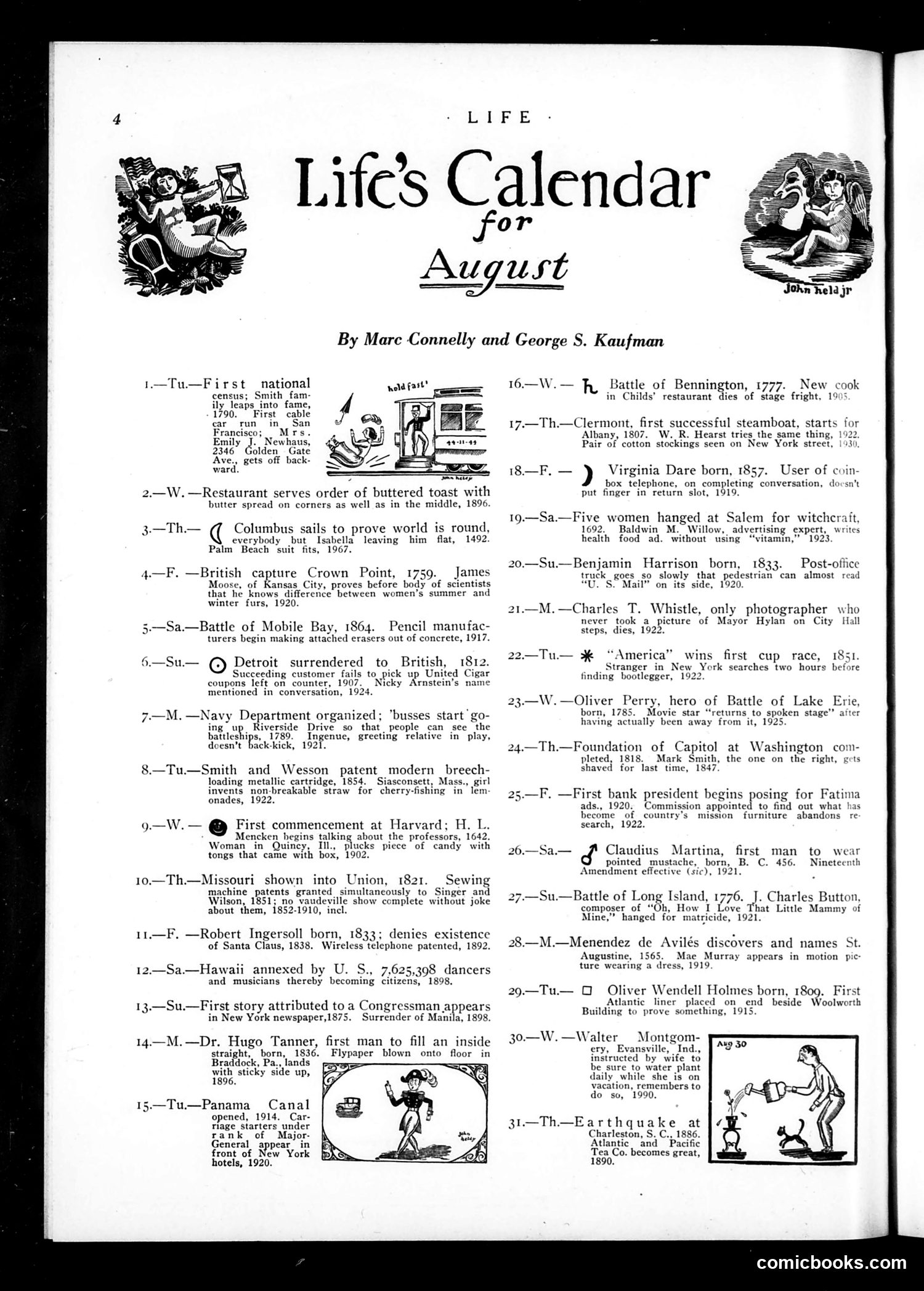
This is a "Life's Calendar for August" — a humorous daily almanac mixing genuine historical facts with satirical observations about American life, 1920s-era. The page contains small woodcut illustrations paired with date entries. Notable entries include: - **August 2**: A joke about restaurant butter service (spread on corners, not just middle) - **August 9**: Harvard's "first commencement" — sarcastically claiming a woman ate candy during it - **August 14**: Dr. Hugo Tanner "first man to fill an inside straight" — a poker reference, illustrated with a gambling figure - **August 15**: Panama Canal opening, illustrated with a figure carrying cargo The cartoon style and entries mock American institutions, pretension, and everyday absurdities. The calendar blends genuine historical dates (Battle of Bennington, Missouri statehood) with fabricated or exaggerated "firsts" to create humor through anachronism and social commentary.
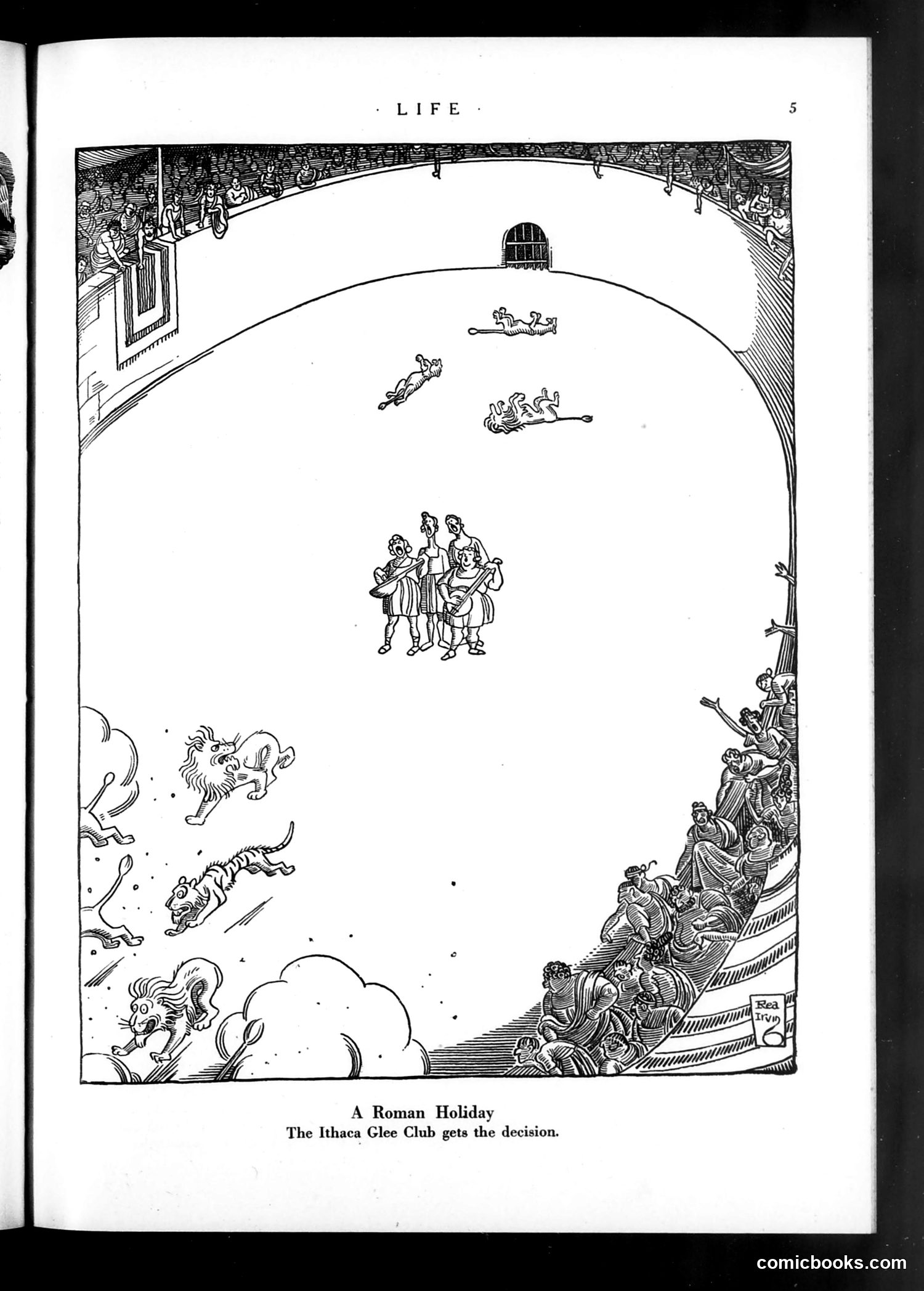
This is a satirical cartoon titled "A Roman Holiday" with the subtitle "The Ithaca Glee Club gets the decision." The image depicts what appears to be a Roman amphitheater or coliseum scene. In the arena, several figures engage in combat or struggle while spectators crowd the tiered seating above. The cartoon references the ancient Roman practice of gladiatorial games, where crowds witnessed violent spectacles. The specific satire targets the "Ithaca Glee Club"—likely a singing group from Ithaca College or Cornell University. The joke appears to mock their performance or competition as brutal entertainment, comparing what was probably an academic competition or musical event to violent Roman gladiatorial games. The satirical point seems to critique either the competitive nature of such events or the audience's enthusiasm for them.
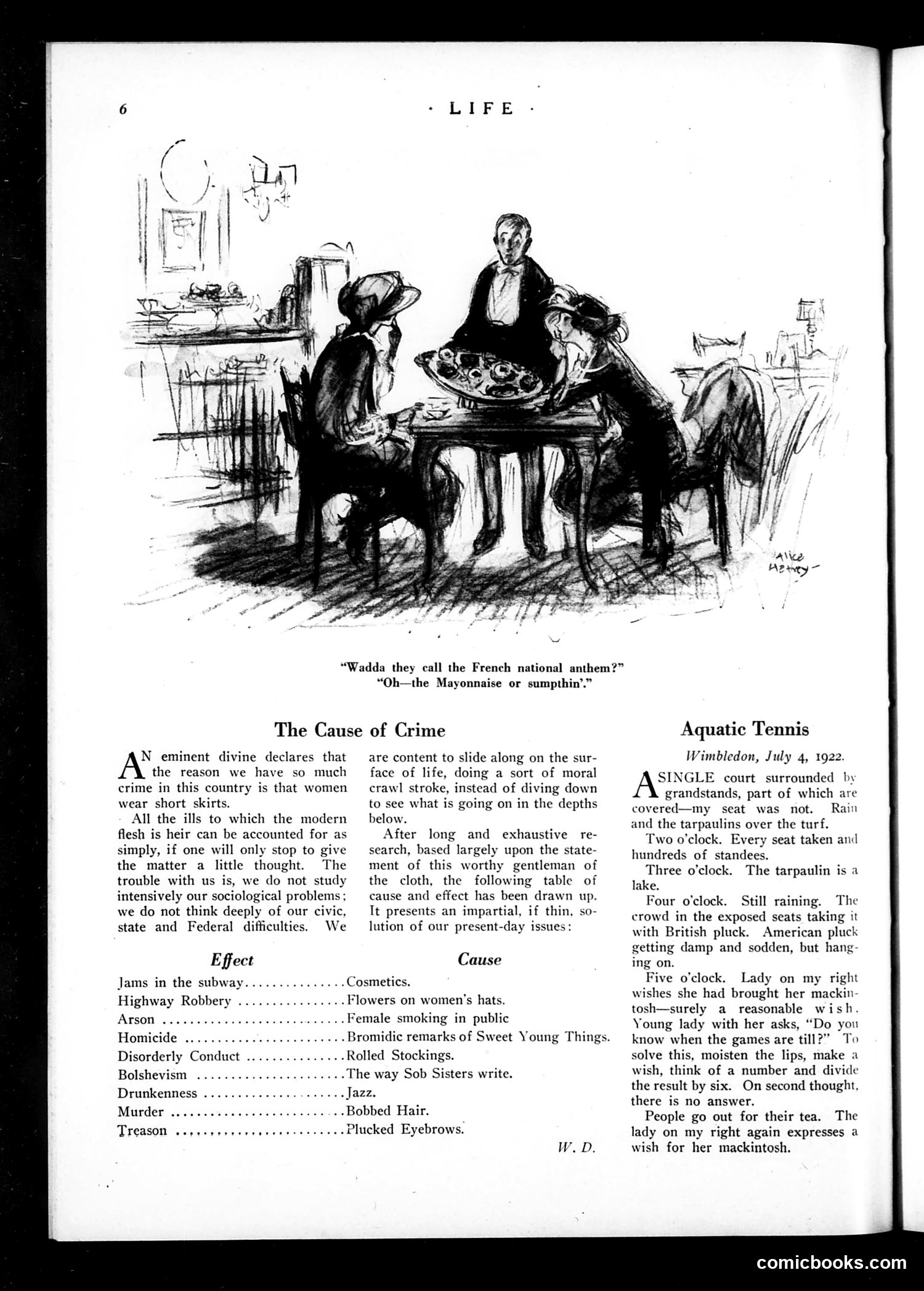
The cartoon shows three men dining together, with the caption joke: "Wadda they call the French national anthem?" / "Oh—the Mayonnaise or sumphin'." This is a crude ethnic/linguistic joke mocking both French culture and working-class American dialect. The humor relies on a pun: "Mayonnaise" sounds like "La Marseillaise" (France's actual national anthem) to an ear unfamiliar with French, and the misspelled response ("sumphin'") mimics lower-class American speech patterns. The facing articles include satirical commentary on social issues: "The Cause of Crime" humorously blames women's short skirts, female smoking, and other modern behaviors, while "Aquatic Tennis" appears to be a humorous account of sporting events at Wimbledon in July 1922.
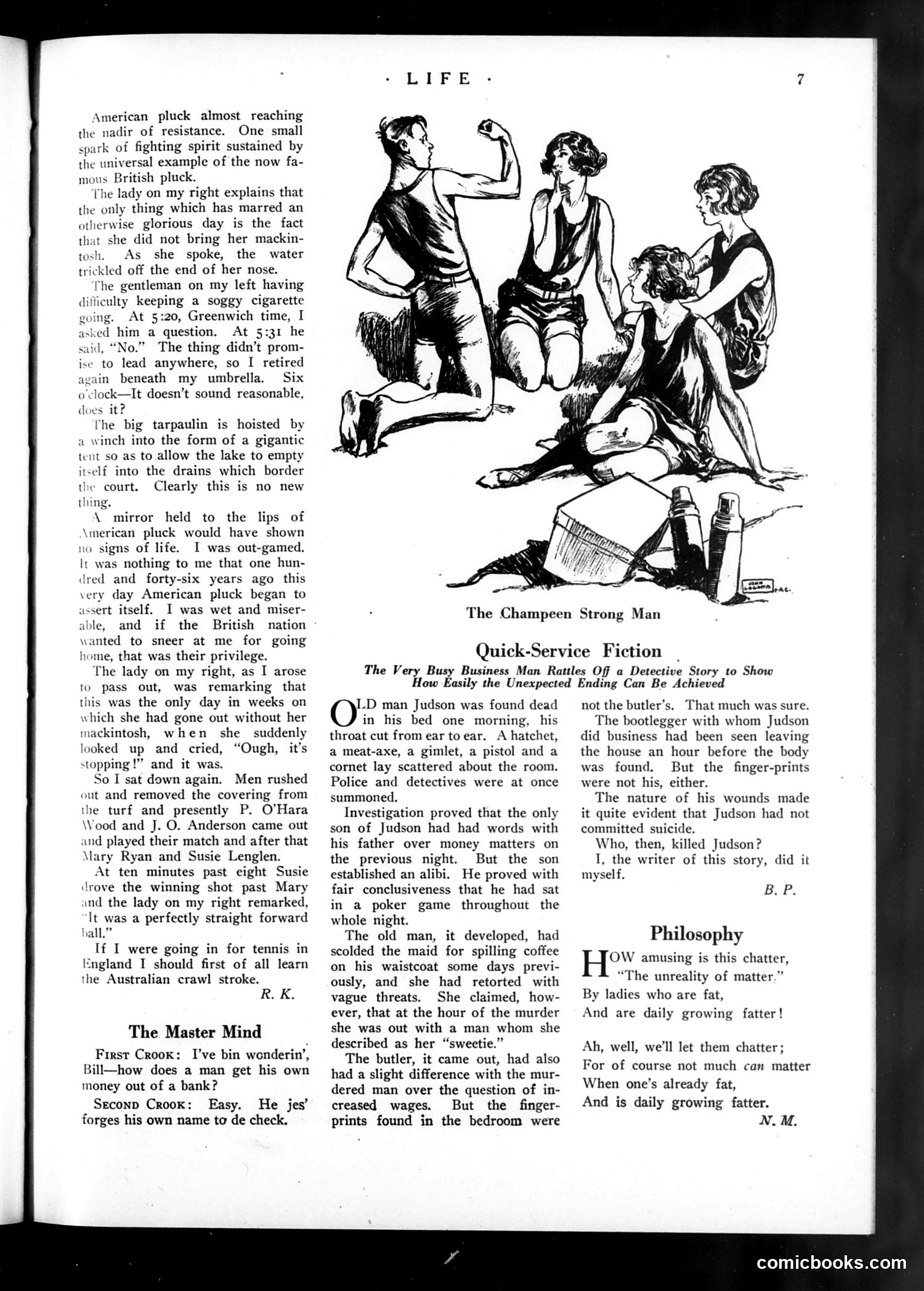
This cartoon satirizes physical culture and bodybuilding fads popular in early 20th-century America. The illustration shows a muscular man flexing his bicep while surrounded by admiring women of various ages, who gaze at him with evident fascination. A bottle and what appears to be exercise equipment lie on the ground. The satire targets how "strong man" exhibitions and physical fitness trends attracted celebrity worship and female attention. The exaggerated musculature and the women's rapt expressions mock both the vanity of bodybuilders and the public's (particularly women's) infatuation with these performers. This reflects contemporary anxieties about changing gender dynamics and the commercialization of the male body as spectacle.
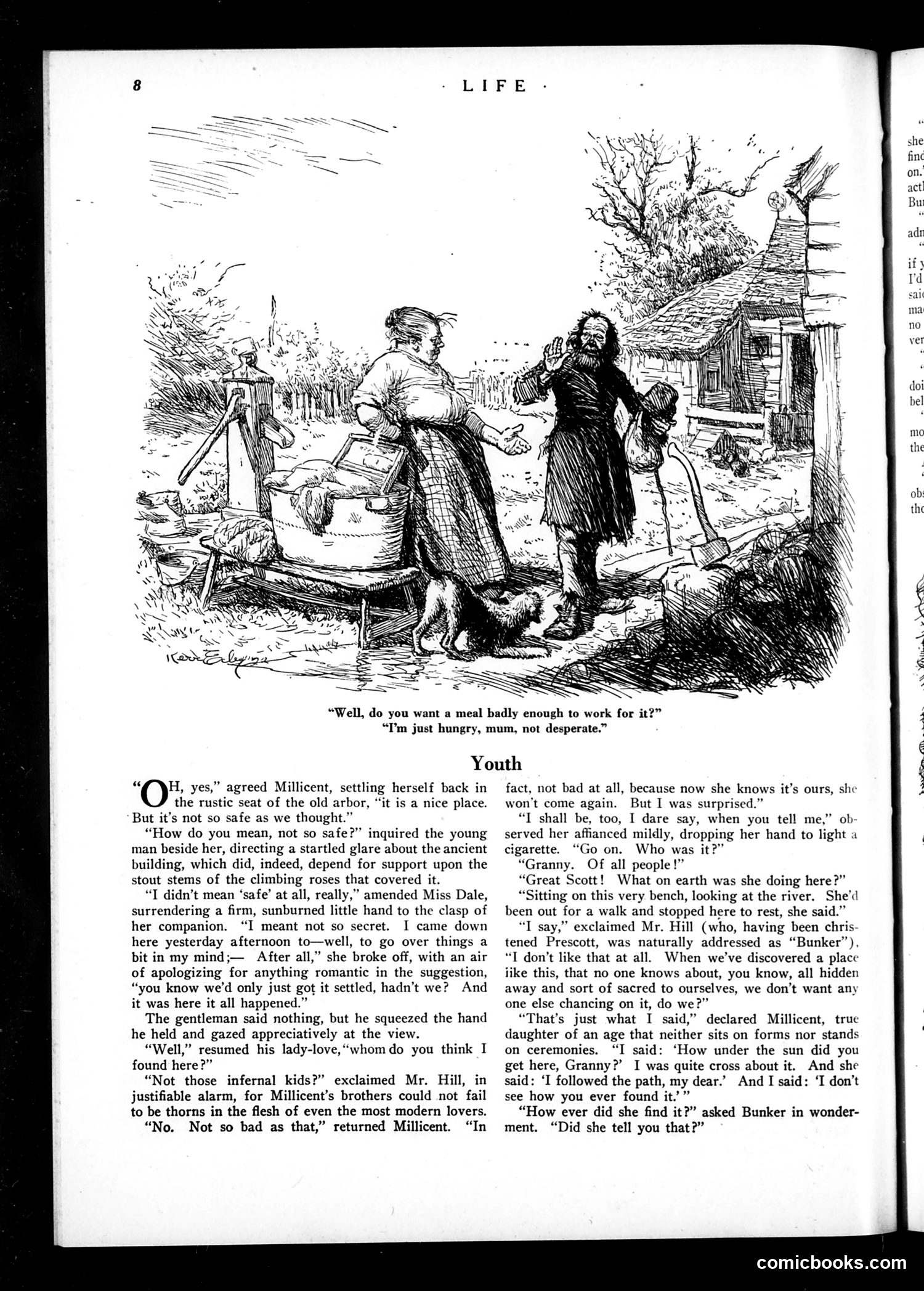
This page contains a sketch and story titled "Youth." The illustration depicts a rural scene where a young woman (Millicent) encounters an elderly man and woman. The dialogue reveals social commentary on class and propriety: when asked if she wants "a meal badly enough to work for it," Millicent claims hunger rather than desperation—a distinction about maintaining dignity. The subsequent narrative mocks Victorian sensibilities through characters like Mr. Hill and the genteel Millicent, who follows strict social conventions while others behave more freely. The satire targets rigid class consciousness and hypocrisy: characters judge behavior harshly while engaging in questionable conduct themselves. The "infernal kids" reference suggests generational conflict and moral anxiety about youth's independence from traditional constraints.
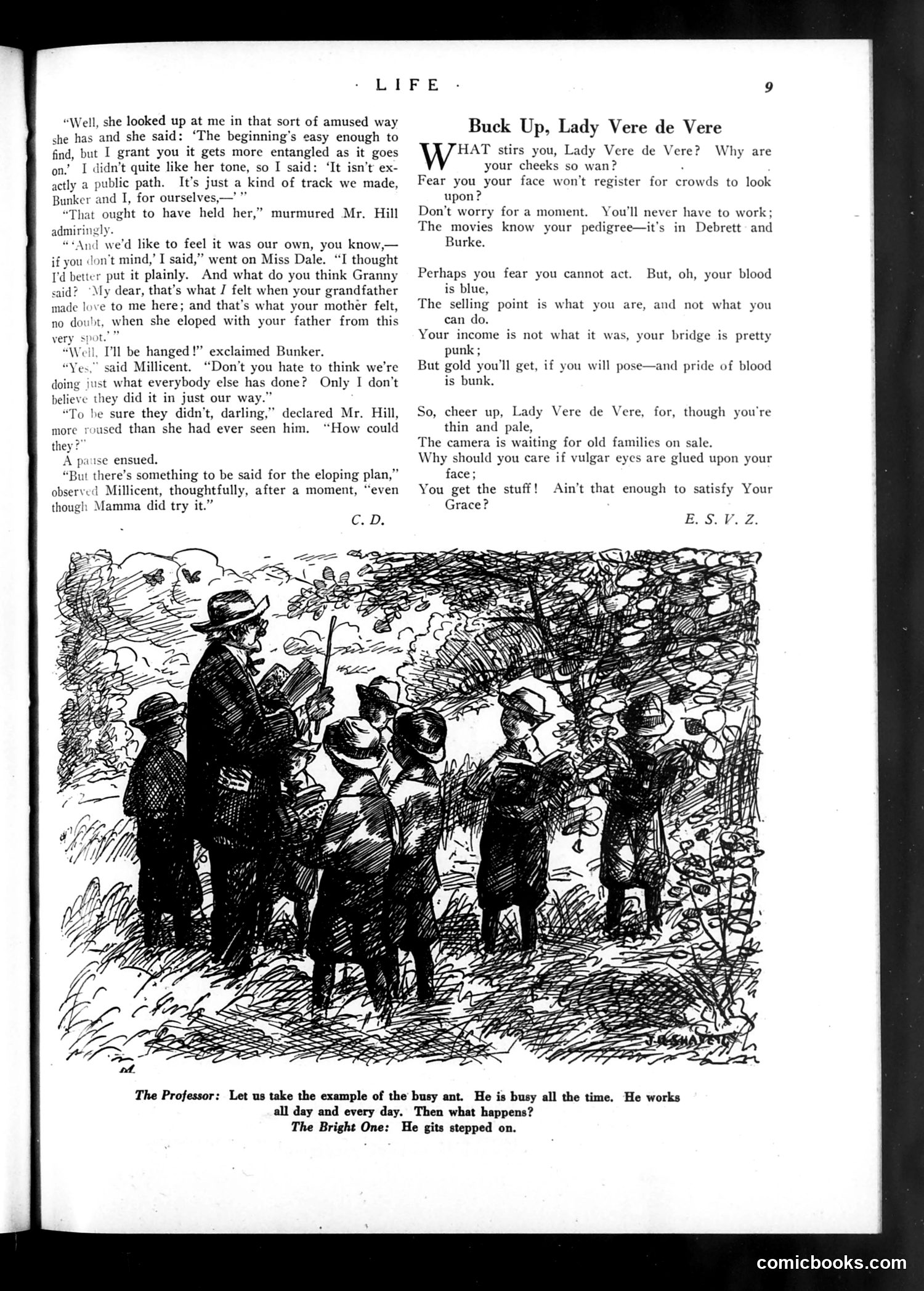
This page contains a poem addressing "Lady Vere de Vere," a name referencing old English aristocracy. The satire mocks a wealthy but struggling noblewoman worried about her social reputation and appearance for crowds and cameras. The poem reassures her that her blue blood and family pedigree matter more than her current financial difficulties—she needn't work, as her aristocratic status suffices. The accompanying illustration shows a professor teaching children about industriousness using an ant metaphor, concluding with dark humor: the busy ant "gets stepped on." Together, these pieces satirize both class pretension (aristocratic anxiety despite poverty) and the gap between work ethic ideology and actual outcomes for ordinary people.
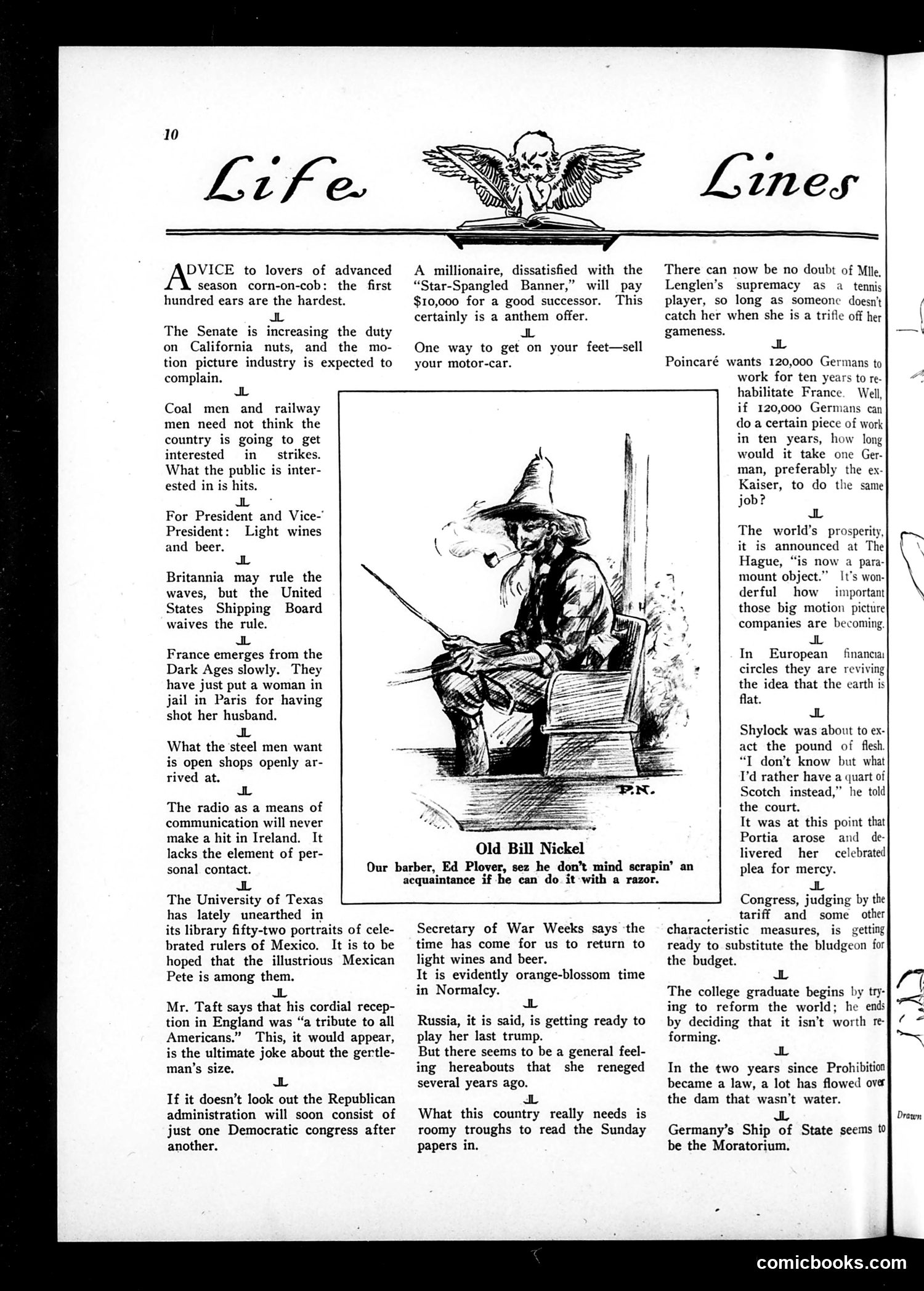
The central cartoon depicts a disheveled man in a witch's hat sitting on a stump, labeled "Old Bill Nickel." The caption reads: "Our barber, Ed Flover, see he don't mind scrapin' an acquaintance if he can do it with a razor." This appears to be a visual pun playing on "nickel" (five cents) and the phrase "scraping an acquaintance"—suggesting the barber might literally scrape or harm this character for a small payment. The witch's hat suggests foolishness or bad luck. The surrounding "Life Lines" column contains typical early 20th-century satirical commentary on politics, war, labor strikes, and social issues, using humor to critique contemporary events. Without additional context about "Ed Flover" or this specific barber reference, the exact historical target remains unclear.
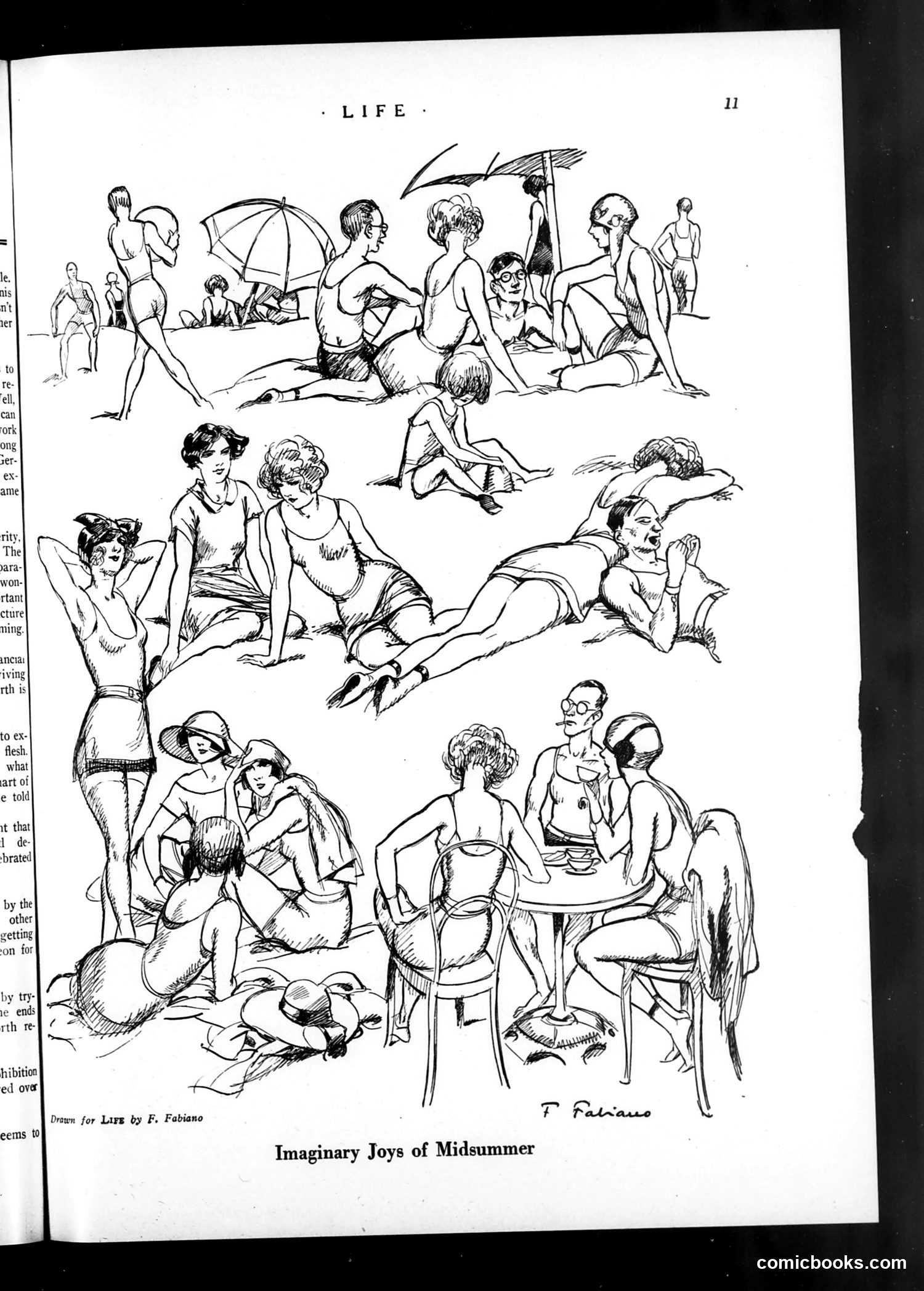
This is a lighthearted satirical illustration by F. Fabiano depicting various beach and summer leisure activities. The drawing shows groups of people in 1920s-style swimwear engaging in typical vacation pursuits: swimming, sunbathing, playing games, socializing, and relaxing under umbrellas. The satire appears gentle rather than biting—it's a humorous observation of summer beach culture and modern leisure habits of the era. The title suggests these are "imaginary" joys, possibly poking fun at the gap between romantic expectations of summer vacations and actual experience, or the aspirational nature of leisure activities portrayed in advertising and popular culture of the time. The illustration serves as social commentary on emerging American consumer culture and recreational practices.
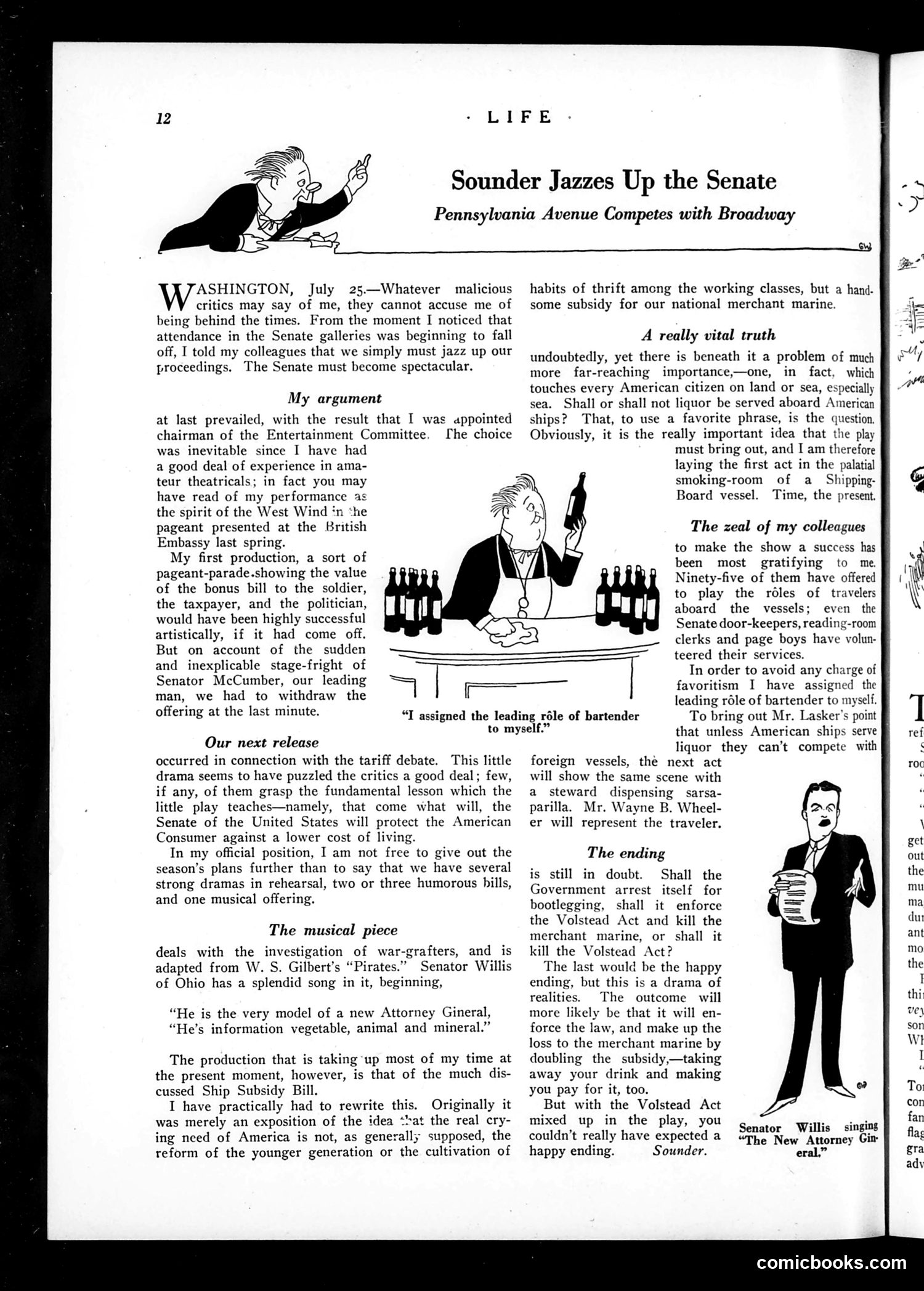
This is a humorous article by Senator William S. Saunders describing his theatrical production about maritime and political issues. The cartoons illustrate his entertainment schemes involving: 1. **The bartender illustration**: Shows Saunders claiming he "assigned the leading role of bartender to myself," satirizing his self-promotion and desire for spotlight. 2. **The steward character**: Depicts another role in what appears to be a play about ships and liquor service, likely mocking debates over alcohol regulation (Prohibition-era context). 3. **Senator Willis singing**: Shows a colleague performing "The New Attorney General," suggesting partisan political satire through musical theater. The satire targets Saunders' attempt to use entertainment—plays, songs, and elaborate schemes—to promote his political agenda regarding ship subsidies and maritime commerce while entertaining the Senate. The tone mocks his theatrical self-aggrandizement and the somewhat absurd nature of conducting serious policy debates through vaudeville-style productions.
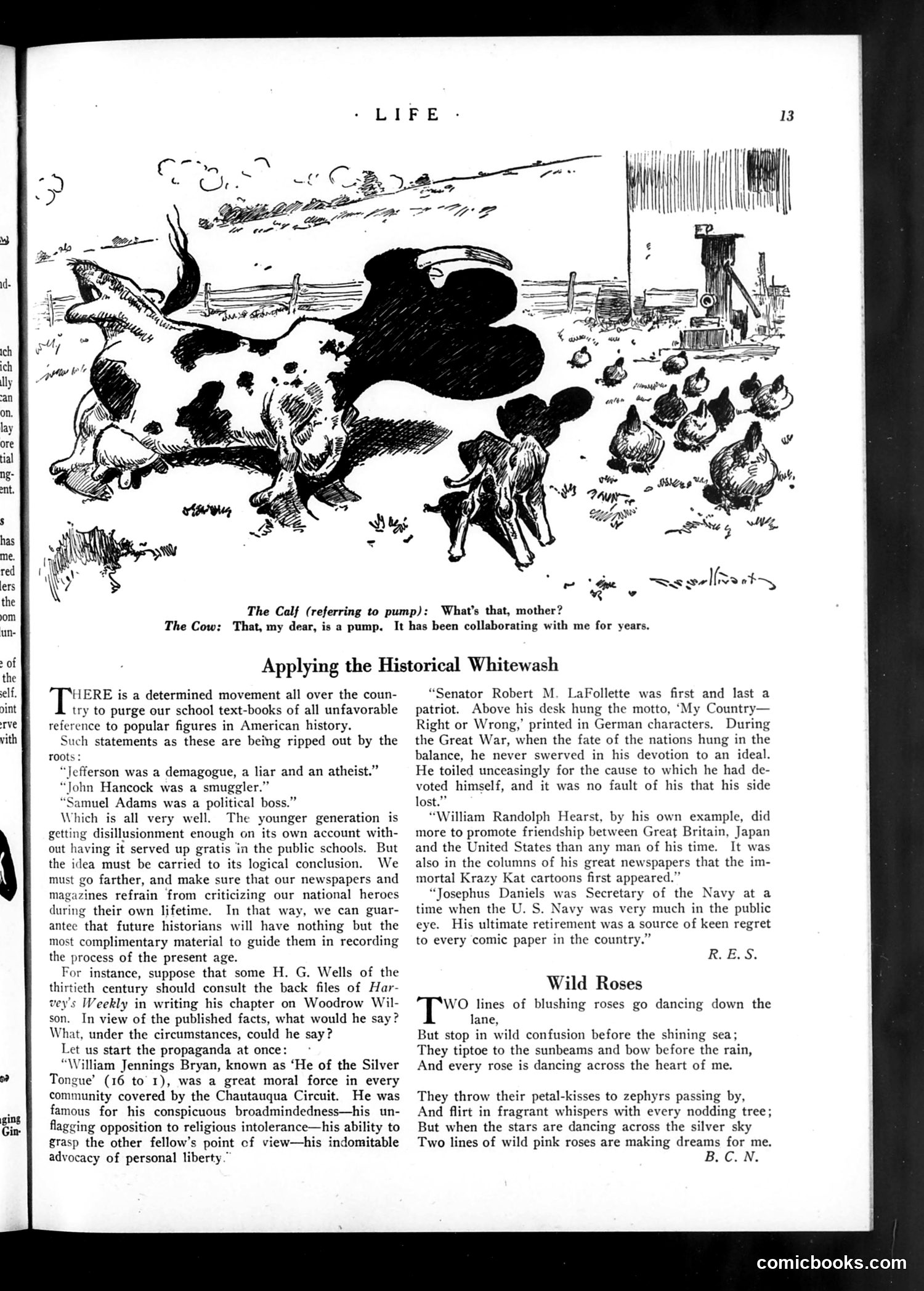
The cartoon at top depicts a cow labeled "The Cow" speaking to a calf ("The Call") about being a "pump"—a visual metaphor for the censorship debate discussed below. The article "Applying the Historical Whitewash" criticizes a nationwide movement to remove "unfavorable references to popular figures in American history" from school textbooks. Examples cited include retroactive sanitization of Jefferson (called a demagogue), John Hancock (smuggler), and Samuel Adams (political boss). The satire targets attempts to rewrite history by removing criticism of American historical figures from educational materials. The author argues this whitewashing prevents future historians from accessing honest records and essentially "pumps" propaganda into schoolchildren rather than teaching balanced truth.
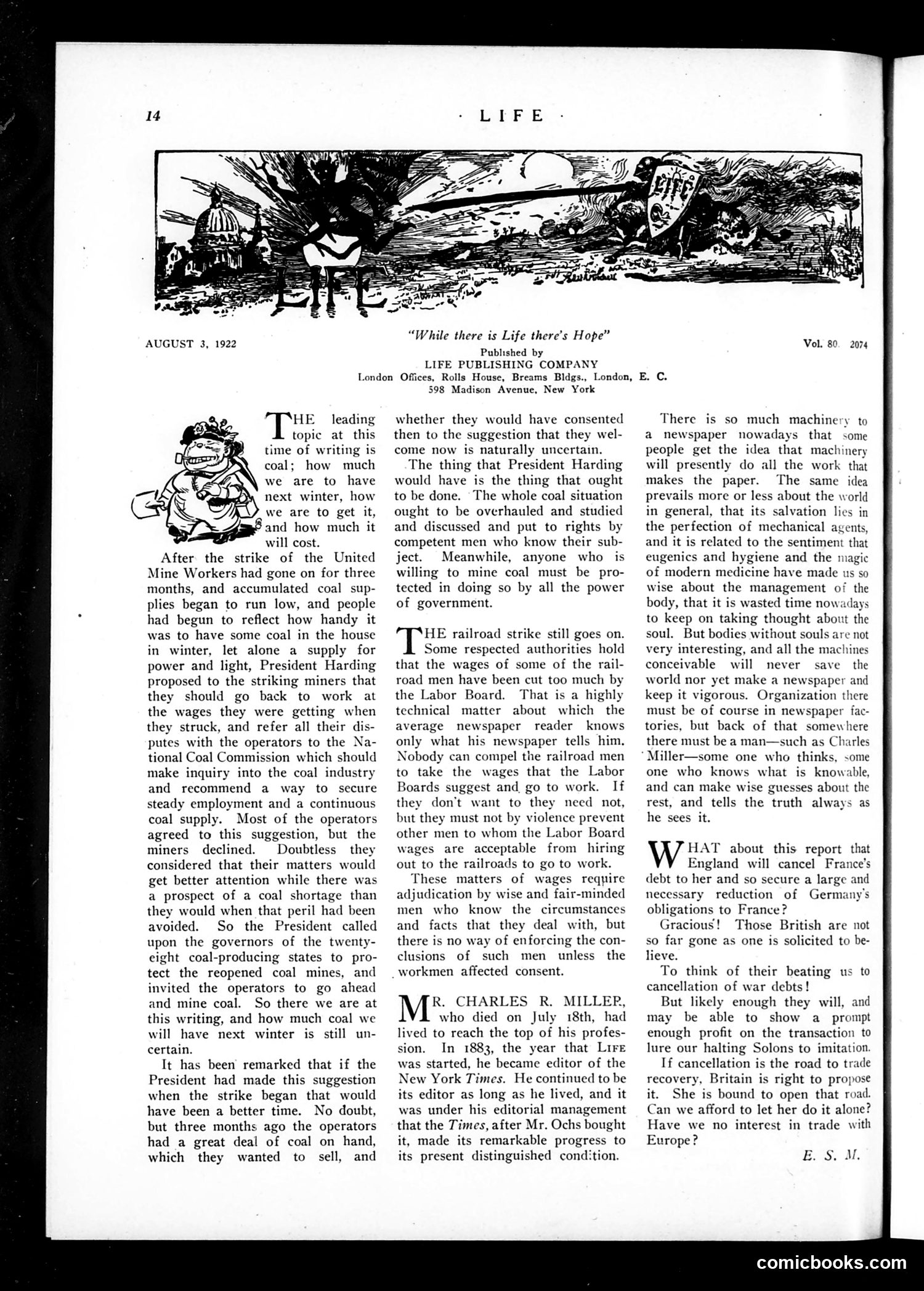
**The Masthead Cartoon:** The illustration at the top depicts a symbolic figure (appears to be representing "Life" or hope personified) amid industrial and pastoral imagery, reinforcing the magazine's motto "While there is Life there's Hope." **The Content:** The page's lead editorial addresses the United Mine Workers strike and resulting coal shortage. It discusses President Harding's proposed solution: having coal operators resume mining at higher wages to secure steady employment and supply. The editorial also references Charles R. Miller's recent death (July 18th), noting his long editorship of the *New York Times*. The final section satirizes Britain's proposal to cancel French war debts, with the author sarcastically questioning whether America should forgive loans to Europe. The satire targets both labor disputes and international economic policy of the early 1920s.
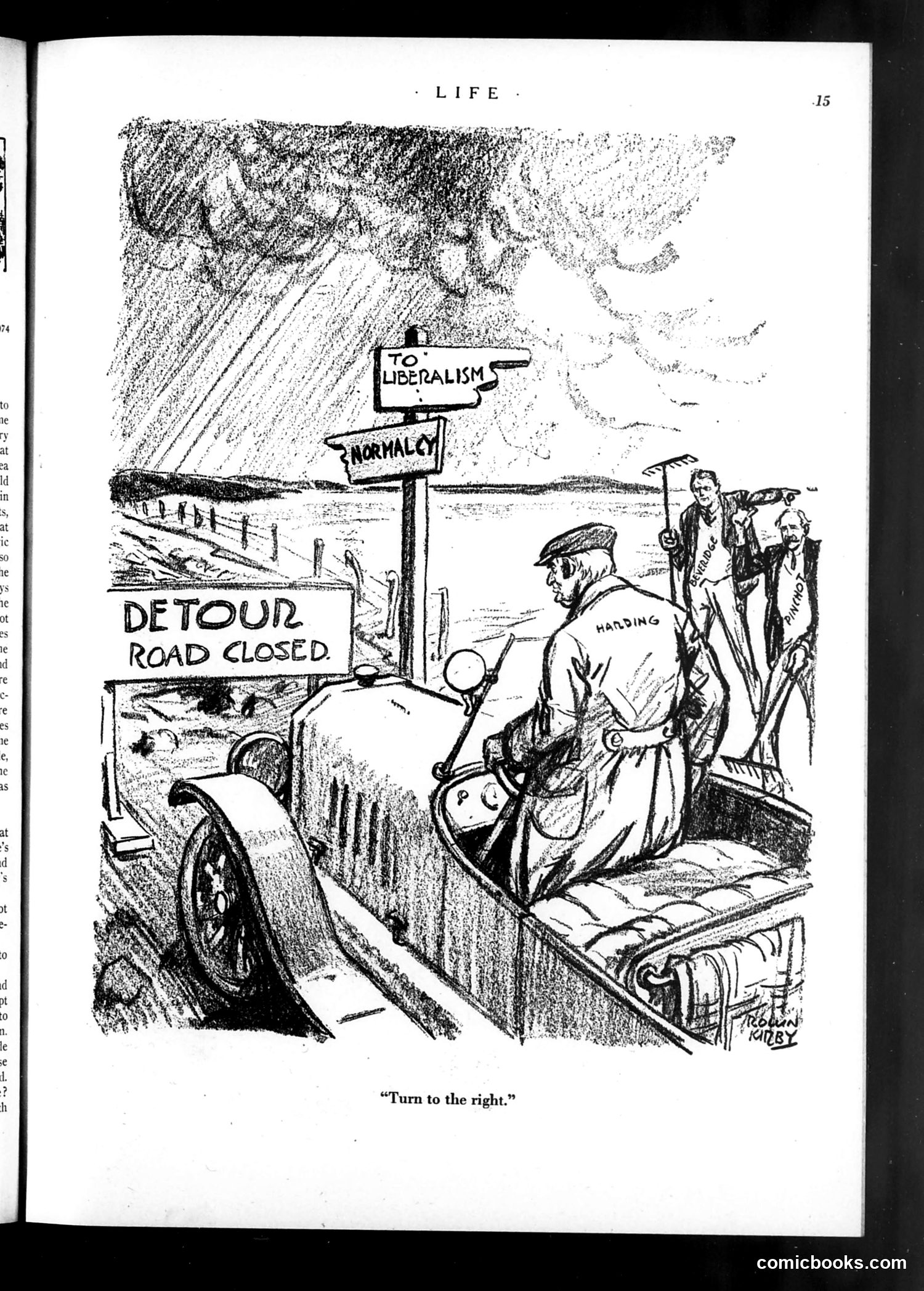
This cartoon satirizes American political directions during a period of social upheaval. A figure labeled "HARDING" (President Warren G. Harding) stands at a signpost pointing toward "LIBERALISM" and "NORMALCY," while the road to normalcy is marked "DETOUR—ROAD CLOSED." The cartoon suggests that despite Harding's campaign promise of a return to "normalcy" after World War I and the turbulent Progressive era, such a return is actually impossible or blocked. The detour sign indicates that the straightforward path backward is not available. Other figures appear to represent different political factions or the public awaiting direction. The satire critiques the gap between Harding's rhetoric and political reality—that genuine normalcy cannot simply be restored through rhetoric alone.
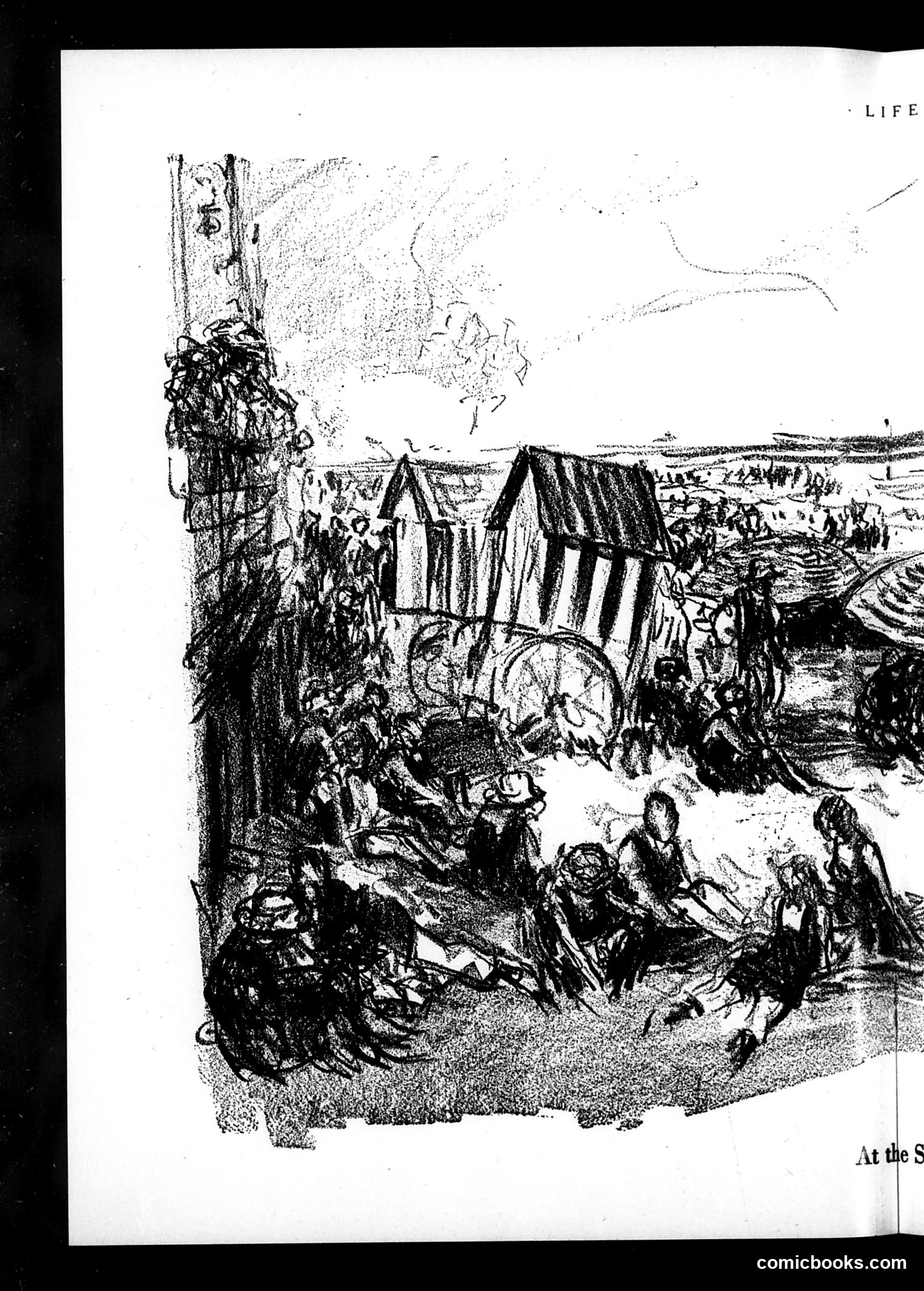
This page appears to be primarily a sketch or illustration rather than a political cartoon with clear satirical intent. The image shows what looks like a peasant or working-class encampment scene, with a prominent tall structure (possibly a pole or fortification) on the left, several figures in the foreground, and tents or temporary shelters in the background with people scattered throughout a landscape. The OCR text is largely illegible characters, providing no readable caption or context. Without clear text identifying the subject, figures, or historical reference, I cannot confidently determine what specific political or social event this depicts or what the satire targets. The artistic style suggests early-to-mid 20th century origin, but the specific meaning remains unclear from the visible page content alone.
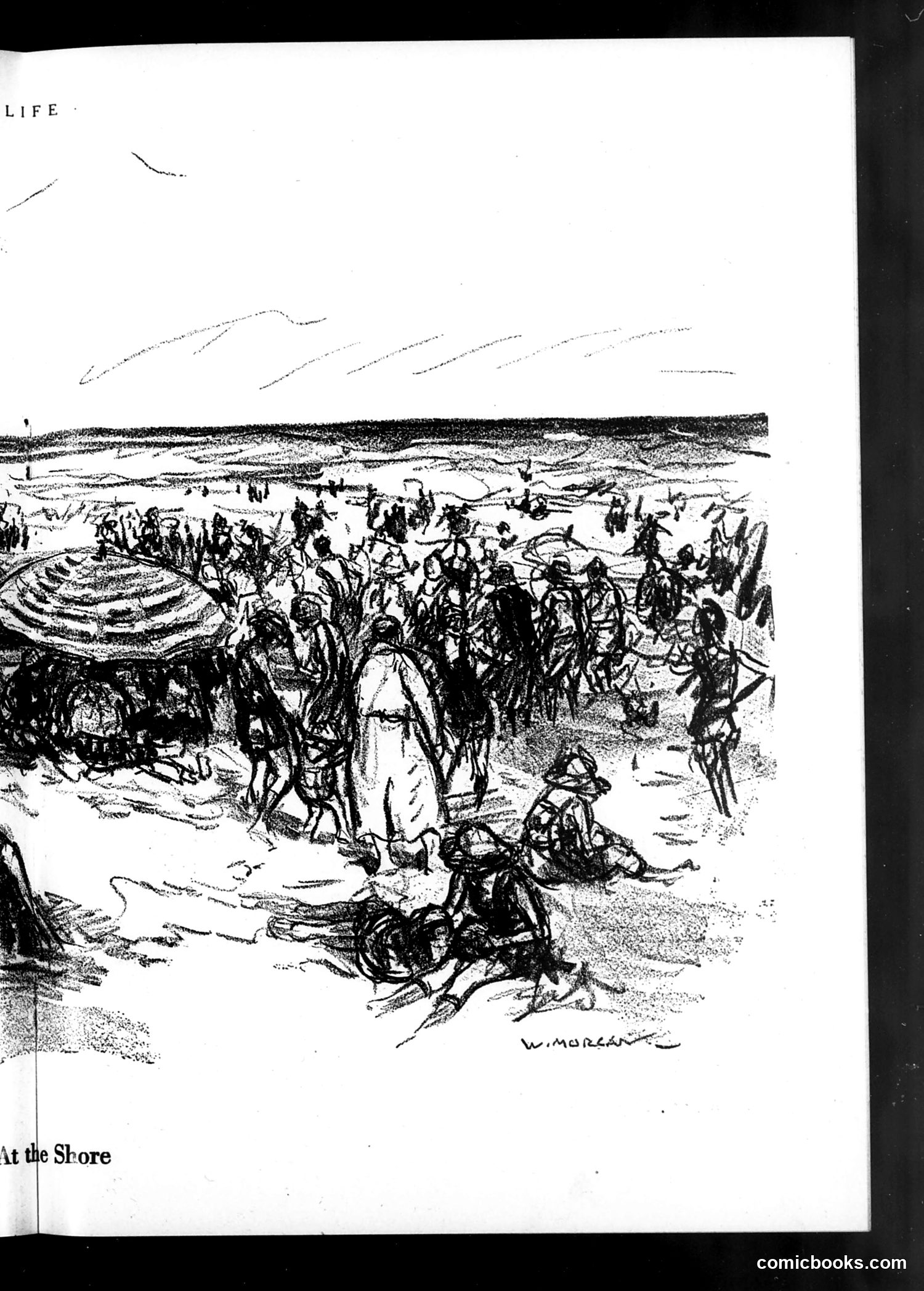
This page from *Life* magazine shows a sketch titled "At the Shore" signed by W. Macbeth. The drawing depicts a crowded beach scene with numerous figures gathered near the water's edge and on the sand. The satirical point appears to be social commentary on beach culture—likely poking fun at the crowds, behaviors, or fashion of beachgoers during the era when this was published. The dense clustering of figures and the artist's exaggerated style suggest mockery of either overcrowding at popular beaches or the pretensions of leisure activities. Without additional context or clearer OCR text, the specific satirical target remains unclear—whether it's criticizing class behaviors, fashion trends, or simply the chaos of public beach recreation. The loose, energetic drawing style is characteristic of *Life*'s satirical approach.
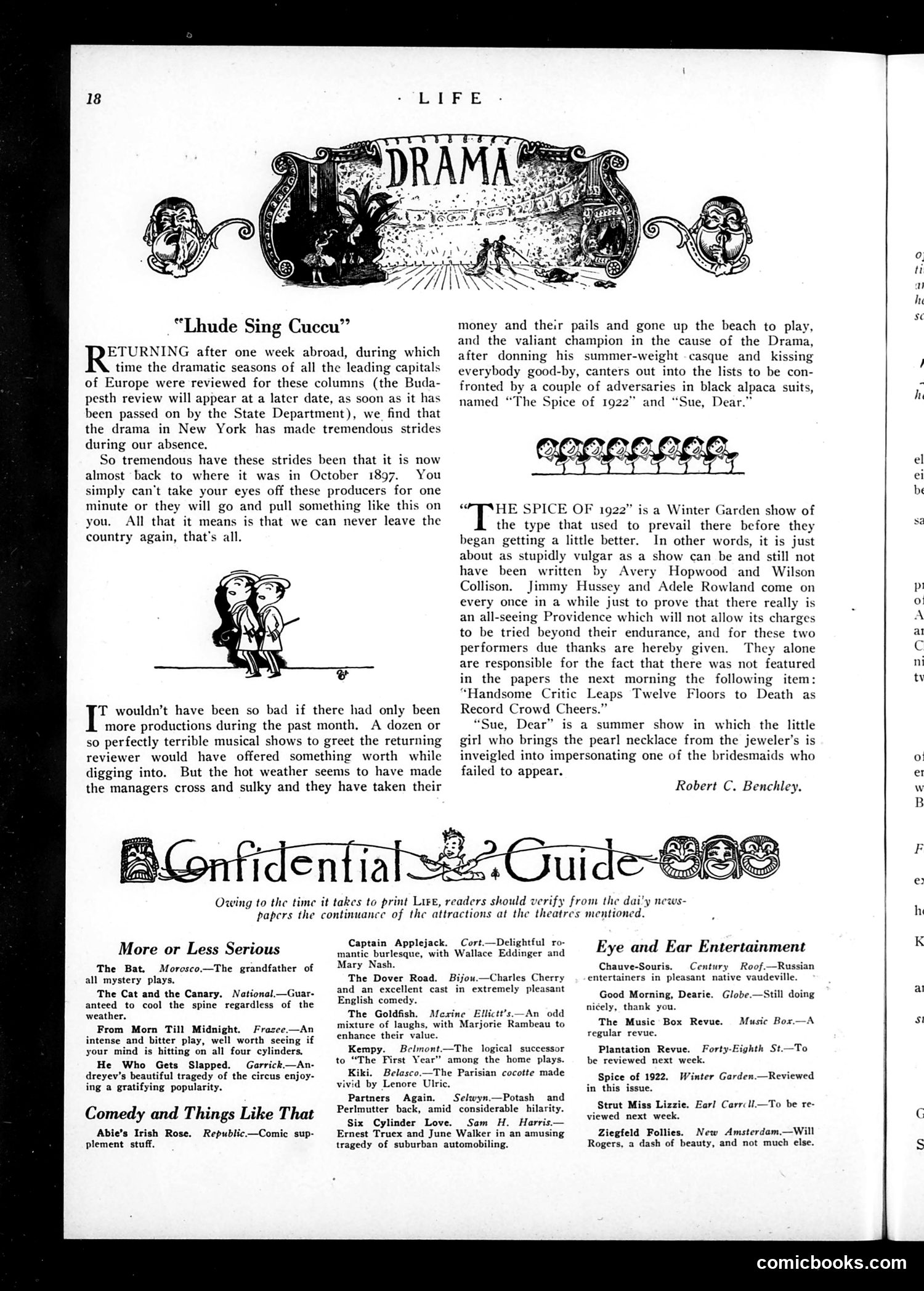
This is a theater review page from Life magazine (circa 1922, based on references). The main content is critic Robert C. Benchley's satirical commentary on New York theater. **The central joke:** Benchley sarcastically claims that while he was away reviewing European theater, New York's dramatic output declined so badly that it's "almost back to where it was in October 1897"—a 25-year regression. He mock-blames theater managers for abandoning their posts to go to the beach during hot weather, leaving only two mediocre shows ("The Spice of 1922" and "Sue, Dear") for his return. **The satire:** Benchley uses exaggeration and deadpan humor to criticize these summer productions as stupidly vulgar, only redeemable by performances from Jimmy Hussey and Adele Rowland. He jokingly suggests the shows were so bad, a critic might jump from a window. The page also lists other theatrical offerings categorized as "More or Less Serious" and "Comedy and Things Like That," providing contemporary entertainment guidance for readers.
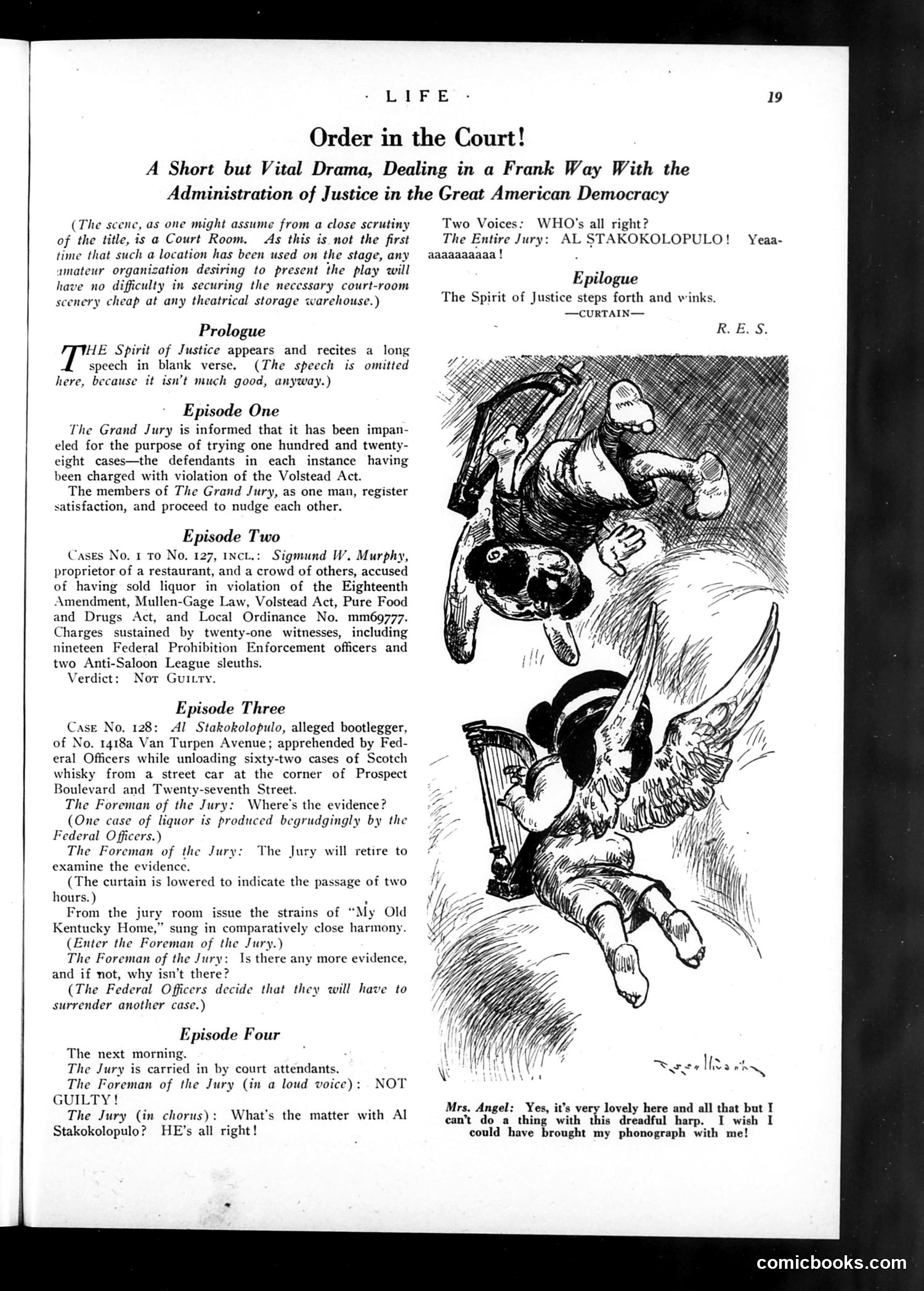
This is a satirical play mocking Prohibition-era justice and jury nullification. The sketch depicts absurdly lenient treatment of bootleggers during the 1920s alcohol ban (the Volstead Act). The satire's point: while 127 liquor-selling cases result in convictions despite strong evidence from 21 witnesses, the final case (Al Stakokolopulo, a Greek bootlegger apprehended with 62 cases of Scotch) results in acquittal—the jury apparently dining and singing rather than seriously reviewing evidence. They acquit him so enthusiastically they chant his name. The joke targets jury corruption or the public's resistance to Prohibition enforcement: juries actively protect bootleggers despite overwhelming evidence. The Spirit of Justice "winks" at the finale, suggesting the entire legal system is complicit in the farce. The accompanying cartoon shows Justice herself struggling with her responsibilities, reinforcing that the system has become unworkable. This reflects real 1920s frustration with Prohibition's failure and pervasive flouting of the law.
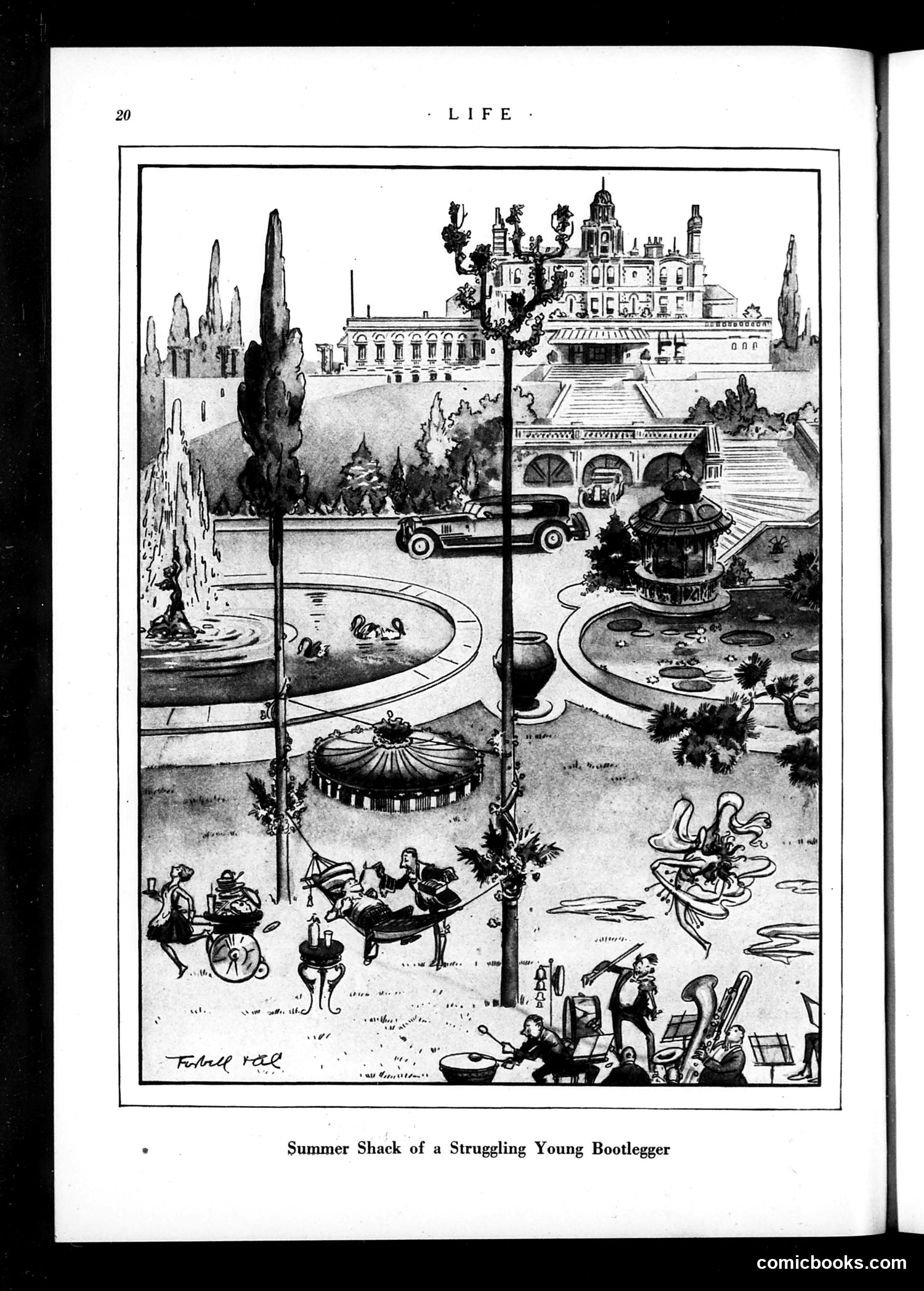
This single-panel cartoon satirizes Prohibition-era bootleggers during the 1920s-30s. The caption's irony is key: what appears to be an elaborate, luxurious estate—complete with mansions, formal gardens, fountains, manicured grounds, and a fancy automobile—belongs to a "struggling" bootlegger. The joke mocks the contradiction: illegal alcohol production was wildly profitable, yet bootleggers pretended to be ordinary citizens. The cartoonist reveals the absurdity by depicting ostentatious wealth that contradicts the claim of financial struggle. The detailed architectural showiness emphasizes how visibly successful these criminals had become, despite Prohibition's intent to eliminate such vice. The comic critiques both bootlegger hypocrisy and Prohibition's obvious failure to prevent organized crime's enrichment.
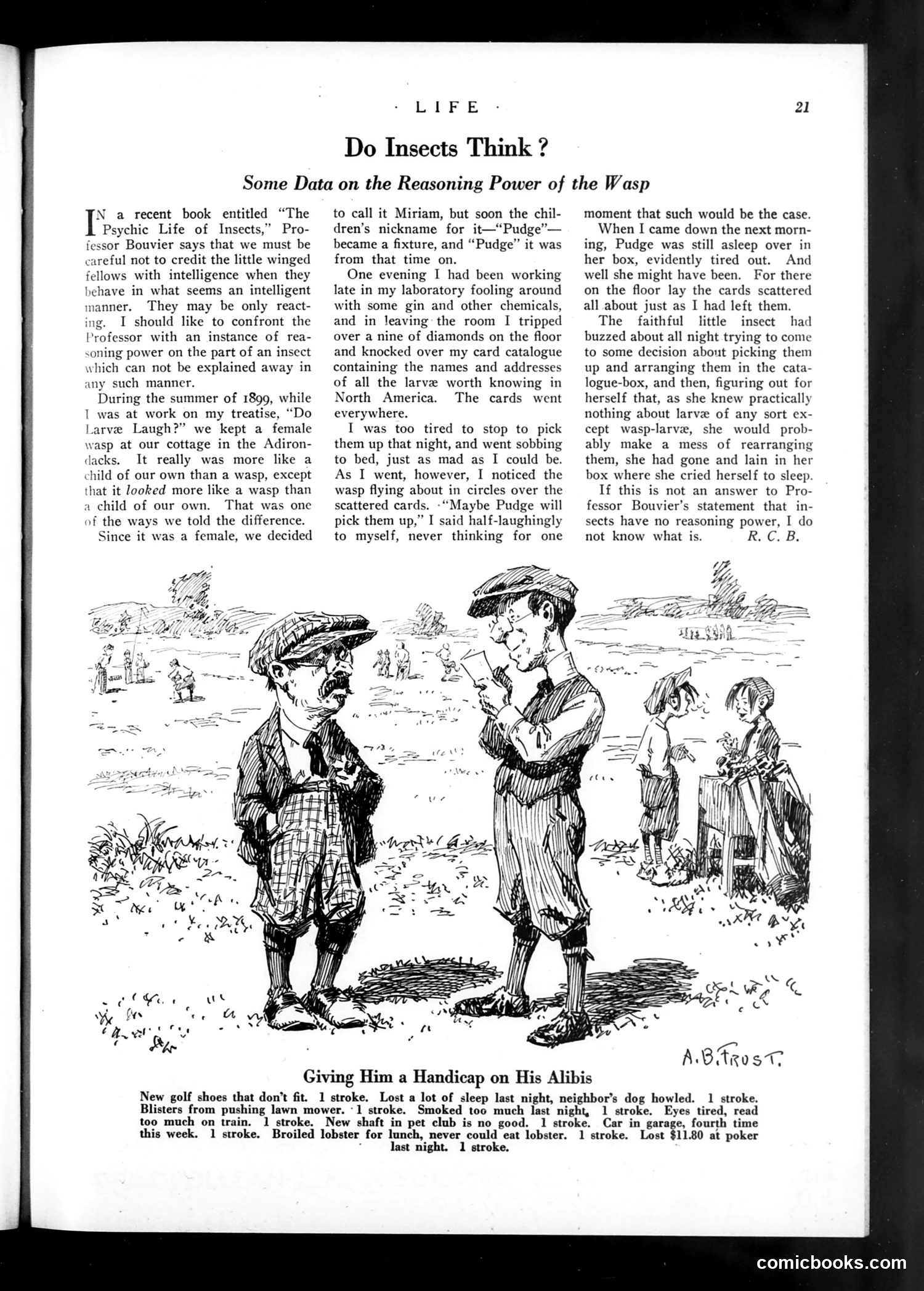
This page contains two unrelated satirical pieces: **Upper Article: "Do Insects Think?"** The author humorously argues for insect reasoning by recounting an anecdote about a pet wasp named "Pudge." After the author spills playing cards across his lab floor, he jokingly suggests the wasp might organize them. Next morning, the cards remain scattered—but the author claims this *proves* the wasp's intelligence: she supposedly reasoned that, knowing nothing about larva except wasp-larva, she'd make a mess, so she wisely refused the task and went to sleep instead. This absurdist logic satirizes pseudoscientific claims about animal cognition, poking fun at Professor Bouvier's theories on insect psychology. **Lower Cartoon: "Giving Him a Handicap on His Alibis"** A golfer lists humorous excuses for poor performance (ill-fitting shoes, neighbor's howling dog, lack of sleep, overeating, etc.), each counting as a "stroke." The satire mocks men's tendency to blame external circumstances rather than admit poor skill—a common complaint about male golfers.
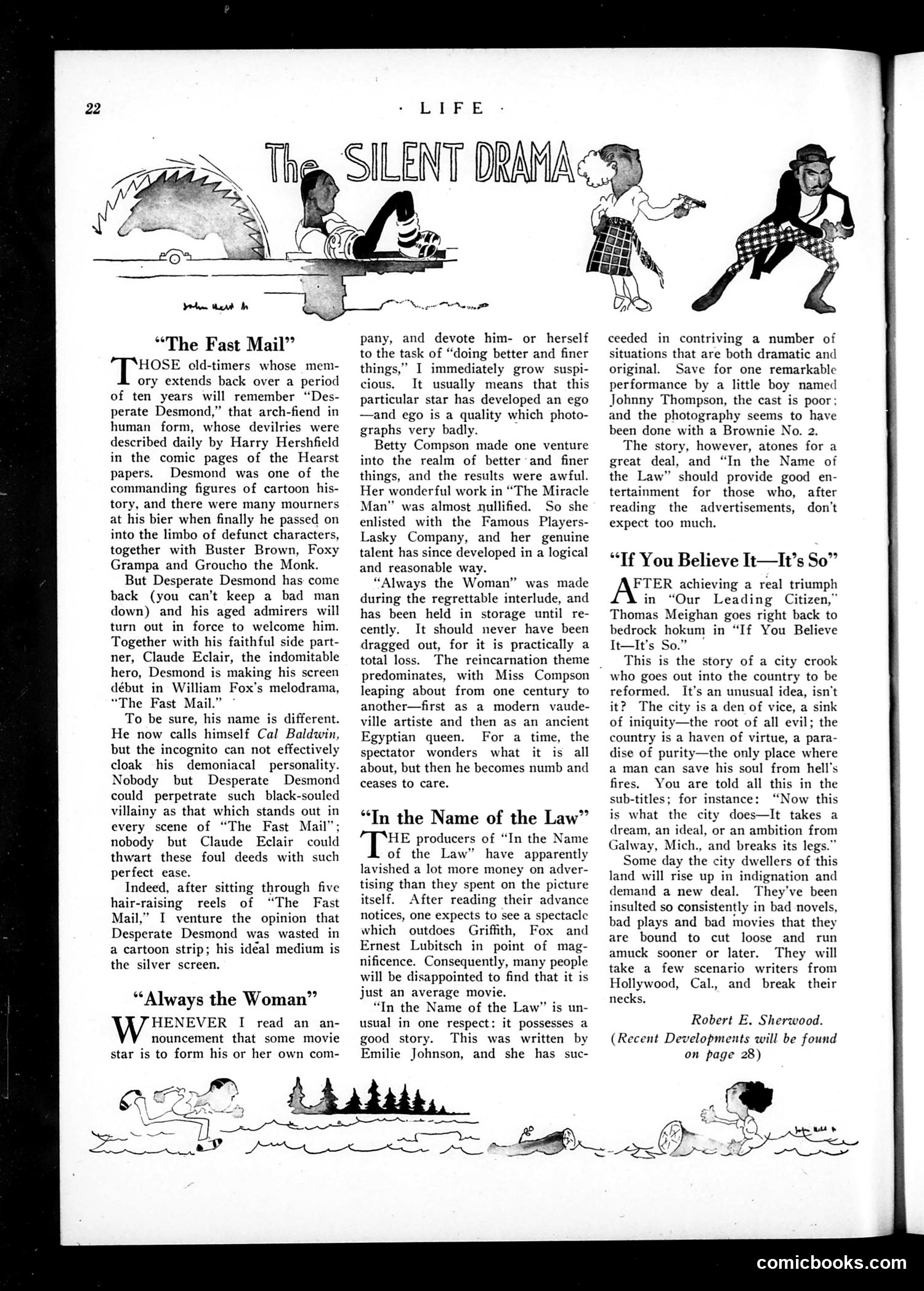
This page contains three film reviews from Life's movie criticism column. The cartoons at top and bottom are decorative flourishes typical of the era. **"The Fast Mail"** reviews a William Fox melodrama starring an actor playing "Cal Baldwin"—though the critic notes this is clearly meant to evoke the famous cartoon villain "Desperate Desmond" from Harry Hershfield's Hearst comics strip. The critic argues the character's villainy translates better to cinema than comics. **"Always the Woman"** critiques Betty Compson's vanity project film. The reviewer dismisses it as wasteful, noting her ego-driven independent venture failed, whereas her work for Famous Players-Lasky Company (a major studio) succeeded. **"In the Name of the Law"** praises the story by Emilie Johnson but criticizes the cast and photography as poor quality, suggesting the producers spent more on advertising than production. The broader satire: movie stars' self-produced "prestige" projects typically fail due to ego, while studio discipline produces better work.
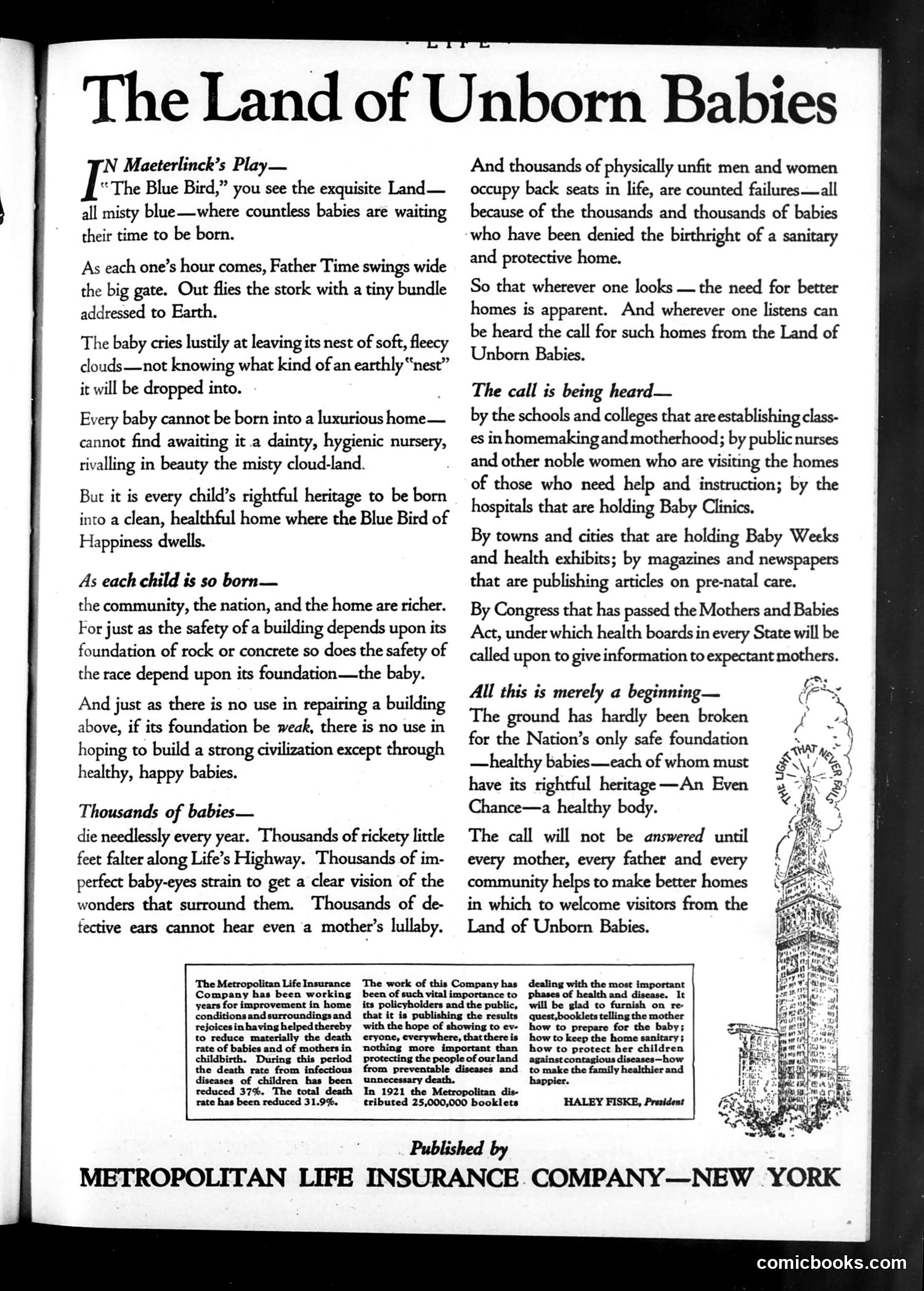
This is **not satire**—it's a public health advocacy advertisement by Metropolitan Life Insurance. The page references Maeterlinck's symbolist play *The Blue Bird* (about seeking happiness) as a metaphorical frame for a serious social campaign. The piece argues that healthy babies are civilization's "foundation," and that thousands of infants die or suffer preventable defects yearly due to poor home conditions. It's a Progressive Era call-to-action: schools should teach motherhood; hospitals should hold baby clinics; Congress should pass health legislation (the Mothers and Babies Act); and communities must improve housing. The illustration (right side) appears to show a tower or beacon—likely representing hope or guidance toward better conditions. **Context for modern readers**: This reflects early-20th-century public health anxiety about infant mortality, tied to housing reform and maternal education movements. The insurance company positions itself as a civic-minded actor, distributing millions of educational booklets—combining corporate image-building with genuine health advocacy.
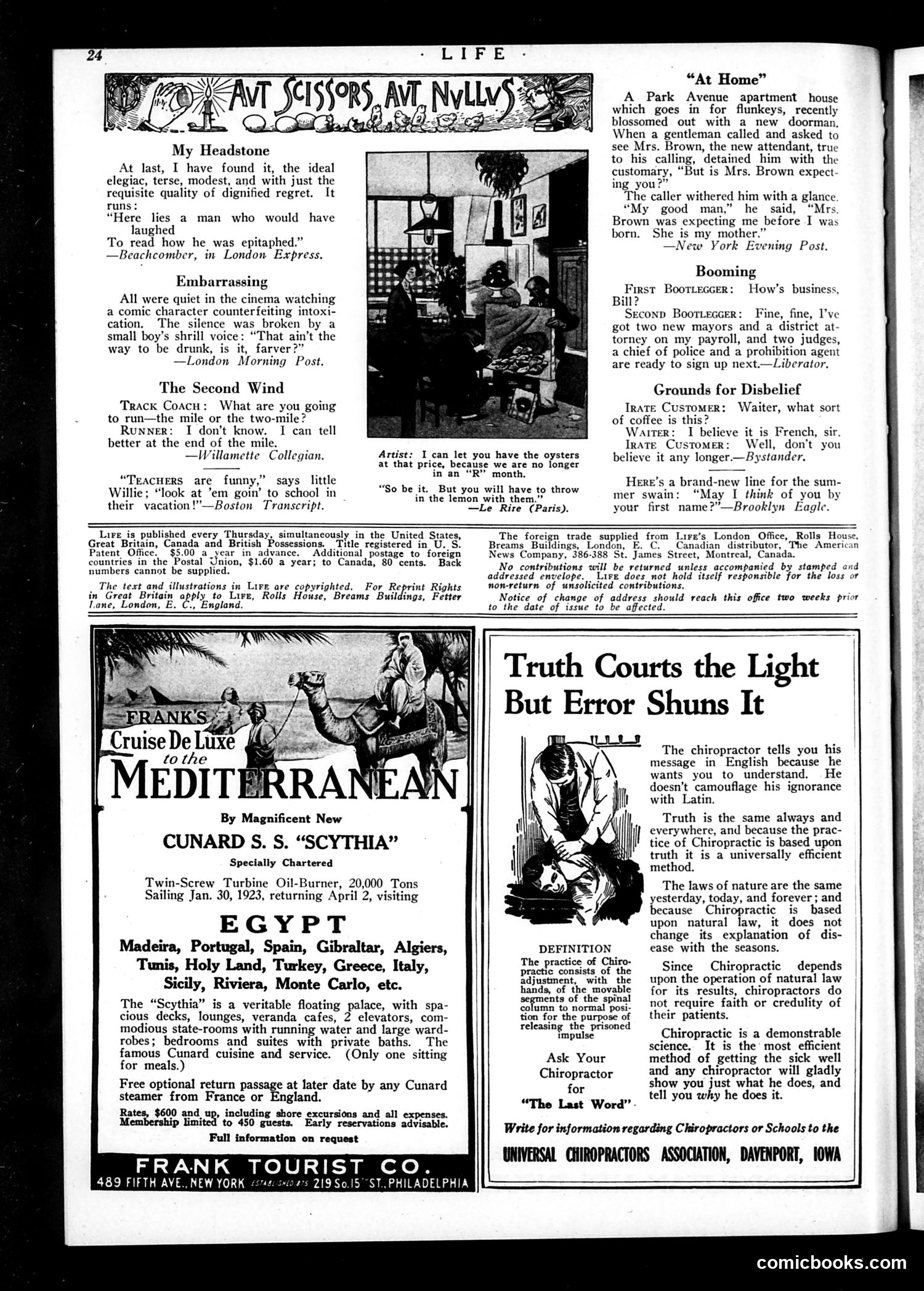
This page presents brief humorous anecdotes and advertisements from circa 1923. The cartoon section consists of short jokes rather than visual cartoons: **"My Headstone"** satirizes obituary writing—a man's epitaph ironically notes he would have laughed at being epitaphed, creating recursive humor about death notices. **"Embarrassing"** jokes about propriety: a child loudly corrects a cinema actor's portrayal of drunkenness, undermining the performance through innocent honesty. **"The Second Wind"** and other snippets mock human logic and social pretension—a runner can't assess his capability mid-race; teachers are funny because they work during vacation. **"At Home"** mocks nouveau riche doormen: a snobbish new attendant questions whether a visitor is expected; the man replies his mother naturally knew him before birth—deflating the doorman's affected formality. The humor relies on incongruity, class commentary, and puncturing false dignity. This reflects Life's satirical tradition targeting social pretension and bureaucratic absurdity in 1920s America.

This is primarily a **commercial advertisement**, not political satire. It features Fisk Tires' famous mascot—a cherubic baby or "Fisk Boy" character—holding an oversized tire and the caption "Time to Re-tire? (Buy Fisk)." The ad emphasizes product qualities (bigness, strength, resilience, safety, mileage) and encourages customers to request Fisk tires by name when purchasing. The Fisk Boy mascot was iconic to the brand's early 20th-century marketing. This appears in *Life* magazine's advertising section, representing typical commercial content from that era rather than satirical editorial material.
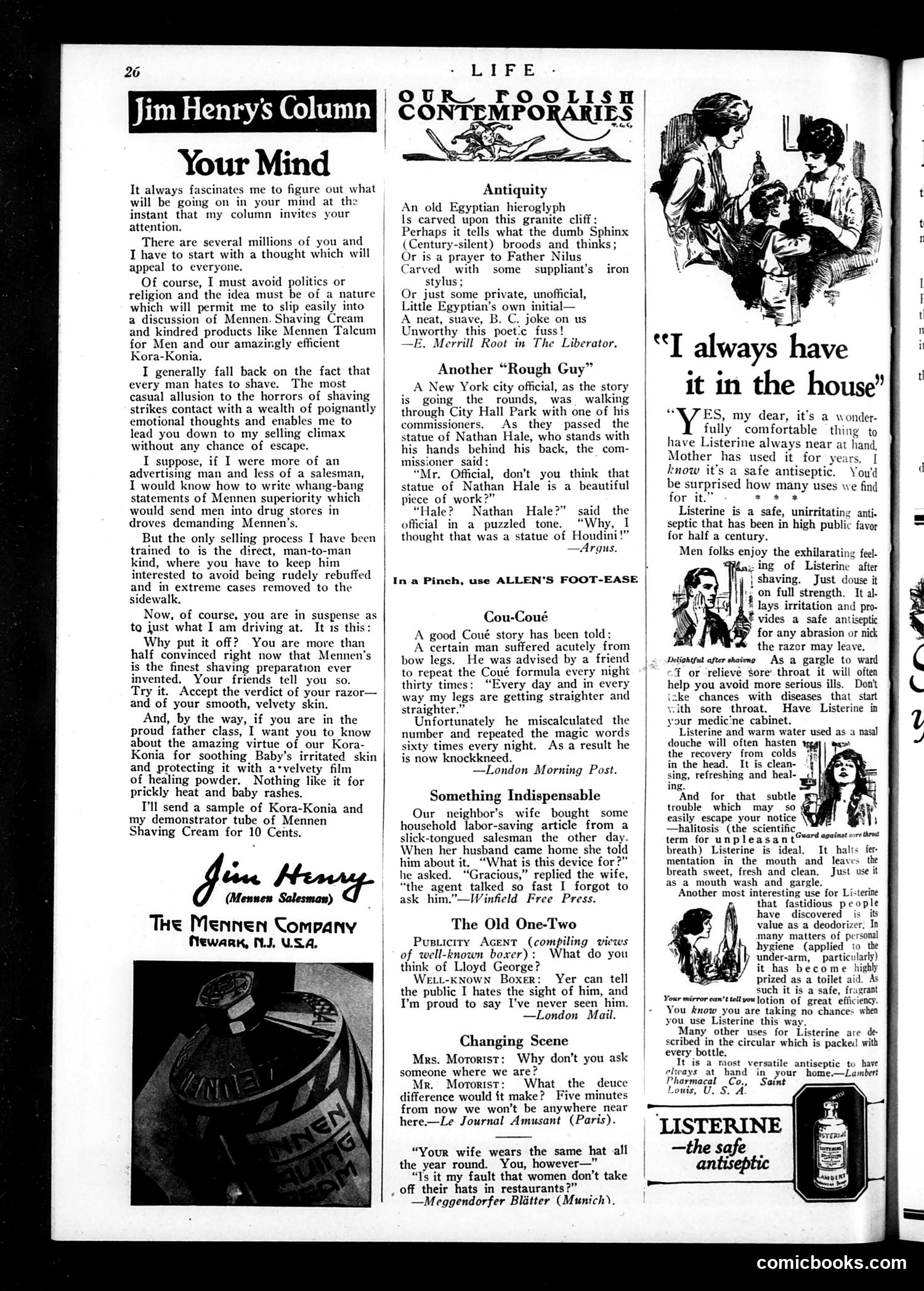
This page contains Jim Henry's column promoting Mennen shaving products, framed as friendly sales advice rather than advertising. Henry uses relatable humor about shaving's unpleasantness to build rapport before pitching the product—a direct-sales technique he explicitly describes. The "Our Foolish Contemporaries" section satirizes contemporary absurdities: - **"Antiquity"**: Mock-serious poem about Egyptian hieroglyphics, poking fun at over-intellectual interpretation of ancient symbols - **"Another 'Rough Guy'"**: Jokes about a NYC official so uncultured he mistakes Nathan Hale's statue for Houdini's - **"Coué" story**: Satire of Émile Coué's popular "autosuggestion" self-help movement, where a man's overdose of positive thinking accidentally makes his legs worse - **"Something Indispensable"**: A wife buys a gadget from a fast-talking salesman without even learning its purpose—mocking both aggressive salesmanship and consumer gullibility The Listerine advertisement on the right promotes antiseptic mouthwash. Overall, the page blends commercial promotion with satire of contemporary fads and social types.
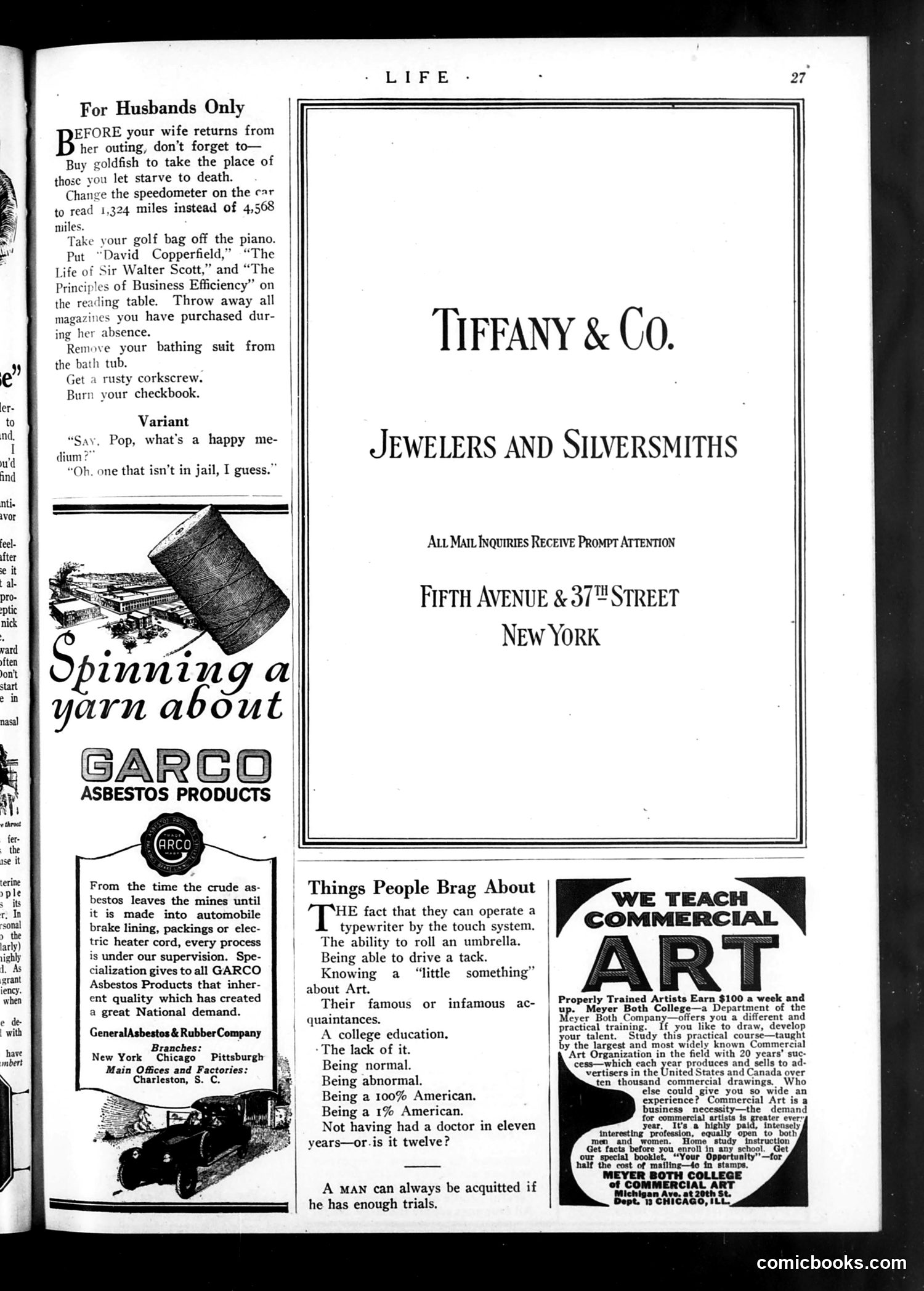
This page contains period humor and advertisements rather than political cartoons. **"For Husbands Only"** is satirical advice mocking husbands' deceptive behavior before wives return home—hiding evidence of neglect (dead goldfish), covering up activities (altering the car's mileage), removing personal items (golf bag, bathing suit), and destroying financial records (burning the checkbook). The joke targets marital dishonesty and male irresponsibility. **"Things People Brag About"** is a humorous list of contradictory or trivial accomplishments people claim—ability with typewriters, rolling umbrellas, and trivial skills—alongside contradictory status claims (being "100% American" versus "1% American," having/not having doctors). The final aphorism mocks the justice system: acquittal depends on having resources for repeated trials, not innocence. The page also features advertisements for Tiffany & Co. jewelry, Garco asbestos products, and Meyer Both's commercial art college—typical period advertising reflecting early 20th-century consumer culture and the era's tragic lack of asbestos-hazard awareness.
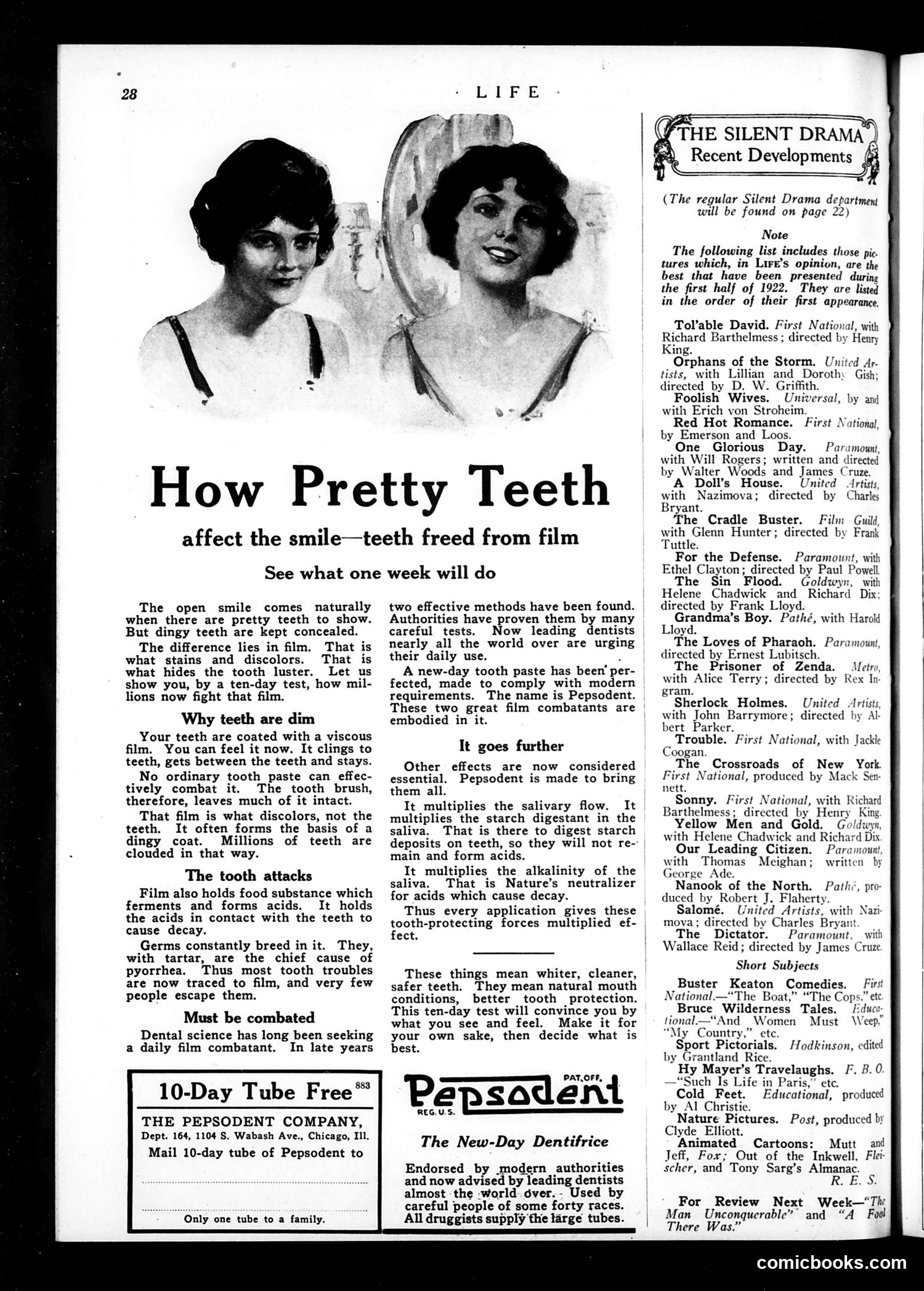
This page is primarily a **Pepsodent toothpaste advertisement**, not satire or political content. The two photographs show women with and without tooth film—a visual "before and after" demonstrating the product's claimed benefits. The text educates readers about dental science: a sticky film coating teeth causes discoloration, harbors bacteria and acid-forming food deposits, and leads to decay and pyorrhea (gum disease). Pepsodent, the "new-day dentifrice," supposedly combats this film while multiplying saliva's natural protective alkalinity. This reflects early 1920s dental marketing, when toothpaste companies began claiming scientific endorsement by dentists—a relatively new advertising strategy. The page includes a mail-in offer for a free 10-day trial tube. The right column lists acclaimed silent films from 1922, unrelated to the advertisement.
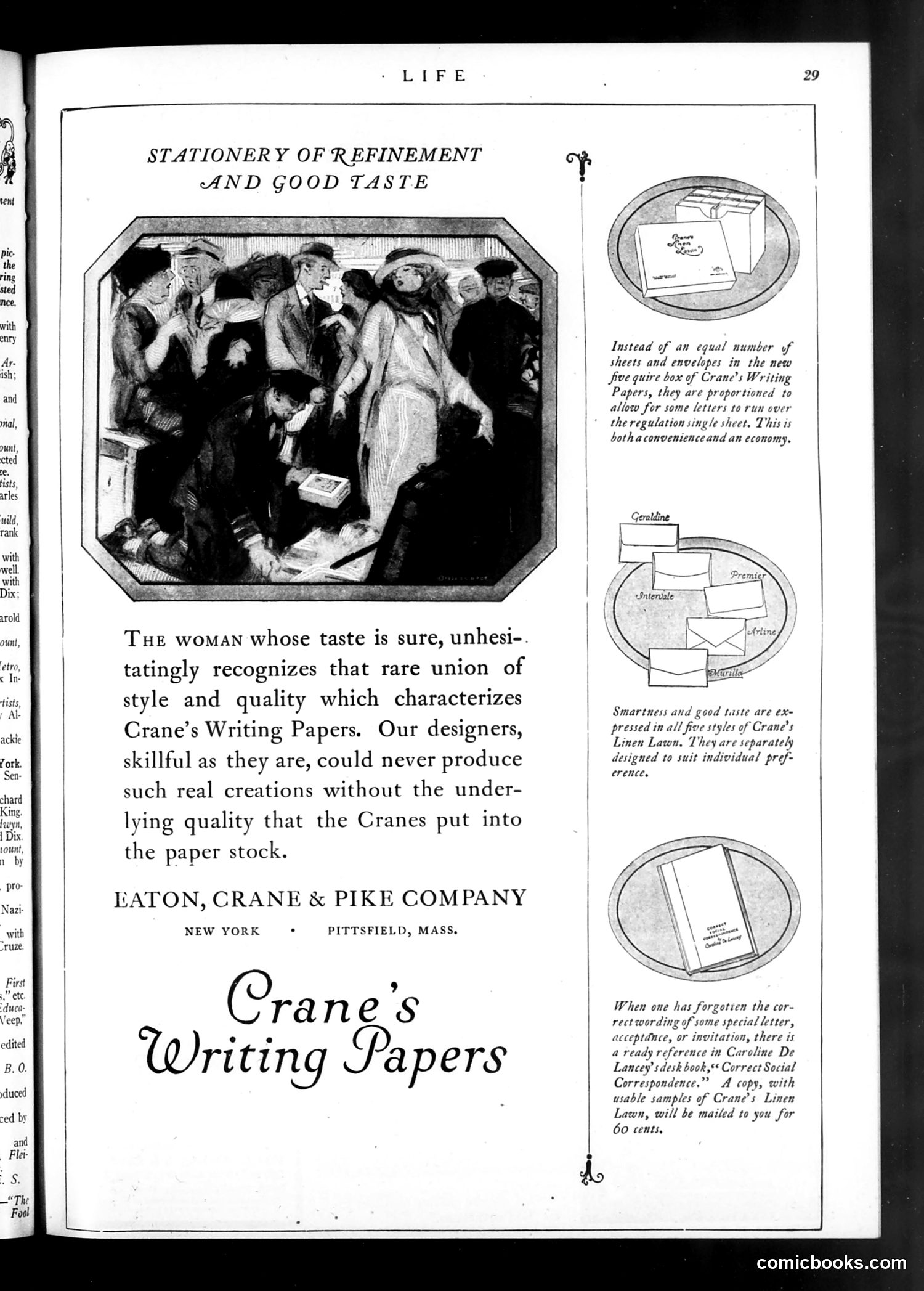
This is primarily **advertising**, not political satire. The page promotes Crane's Writing Papers, a stationery brand by Eaton, Crane & Pike Company. The large illustration at top left depicts a crowded social scene—appears to be a gathering of well-dressed people, possibly at a social event or salon. It's used to establish the aspirational context: refined, cultured society. The text emphasizes that discerning women recognize Crane's papers as representing "style and quality." The advertisement positions the product as essential for proper social correspondence—a marker of good taste and refinement. The right side shows product samples and variations (different envelope styles). One callout references Caroline De Lancey's etiquette book, "Correct Social Correspondence," available with samples for 60 cents—a period marketing tie-in. **The satire is subtle**: the page gently mocks the anxiety around social propriety and "correct" stationery choices that preoccupied upper-class readers, while selling the solution to that very anxiety.
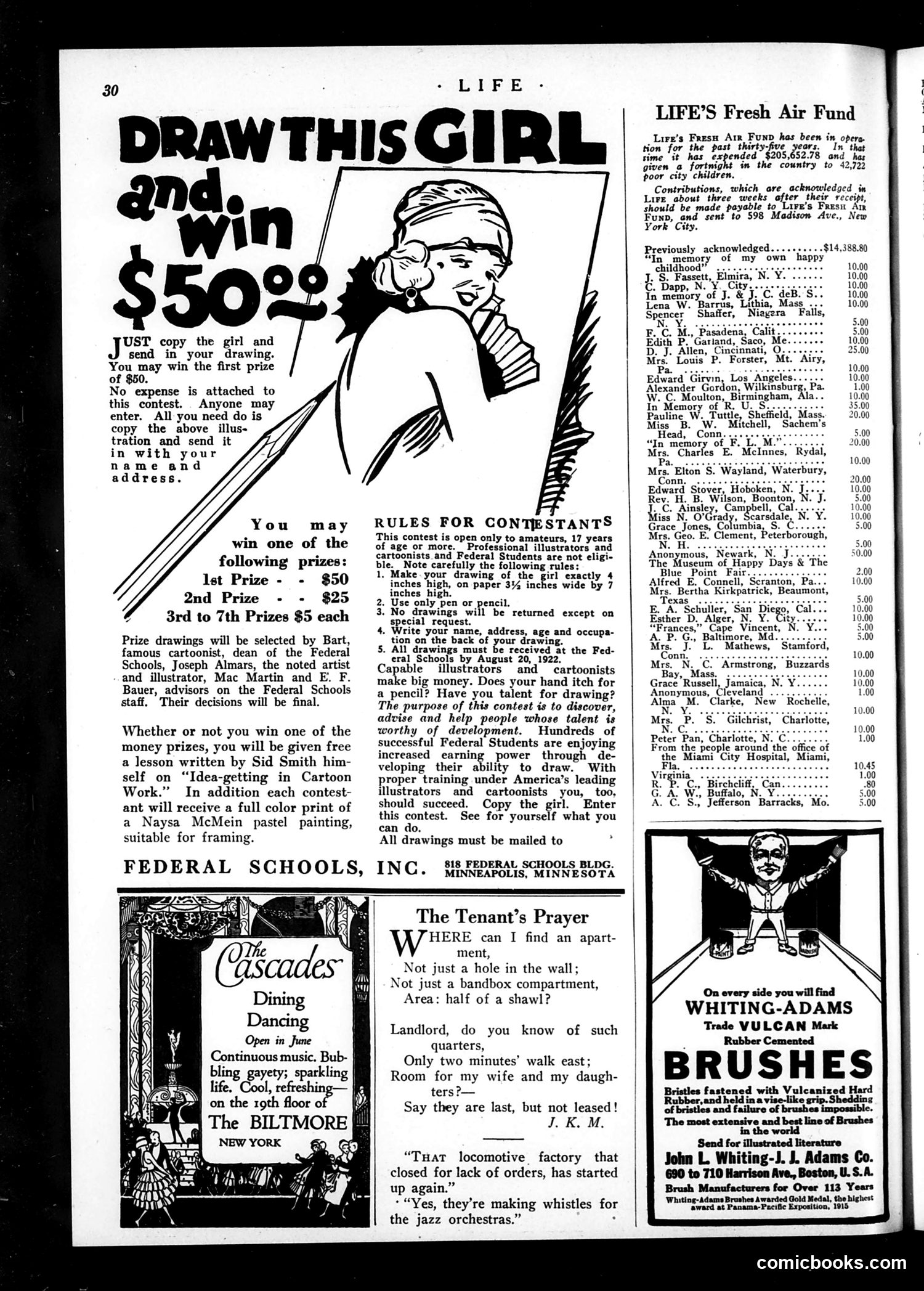
This page features a drawing contest advertisement from Federal Schools, a correspondence school for aspiring cartoonists and illustrators. The contest invited amateur artists to copy a simple illustration of a girl's head and mail it in for judging by prominent cartoonists including Bart (dean of Federal Schools) and Joseph Almars. The appeal was straightforward: free art instruction and a cash prize (up to $50 for first place) if selected. This was genuine vocational advertising—Federal Schools promoted that "capable illustrators and cartoonists make big money," advertising their training as a pathway to earning power. The page also includes Life magazine's charitable "Fresh Air Fund" (providing country breaks for poor city children) and period humor pieces including "The Tenant's Prayer" about apartment hunting, reflecting post-WWI housing shortages.
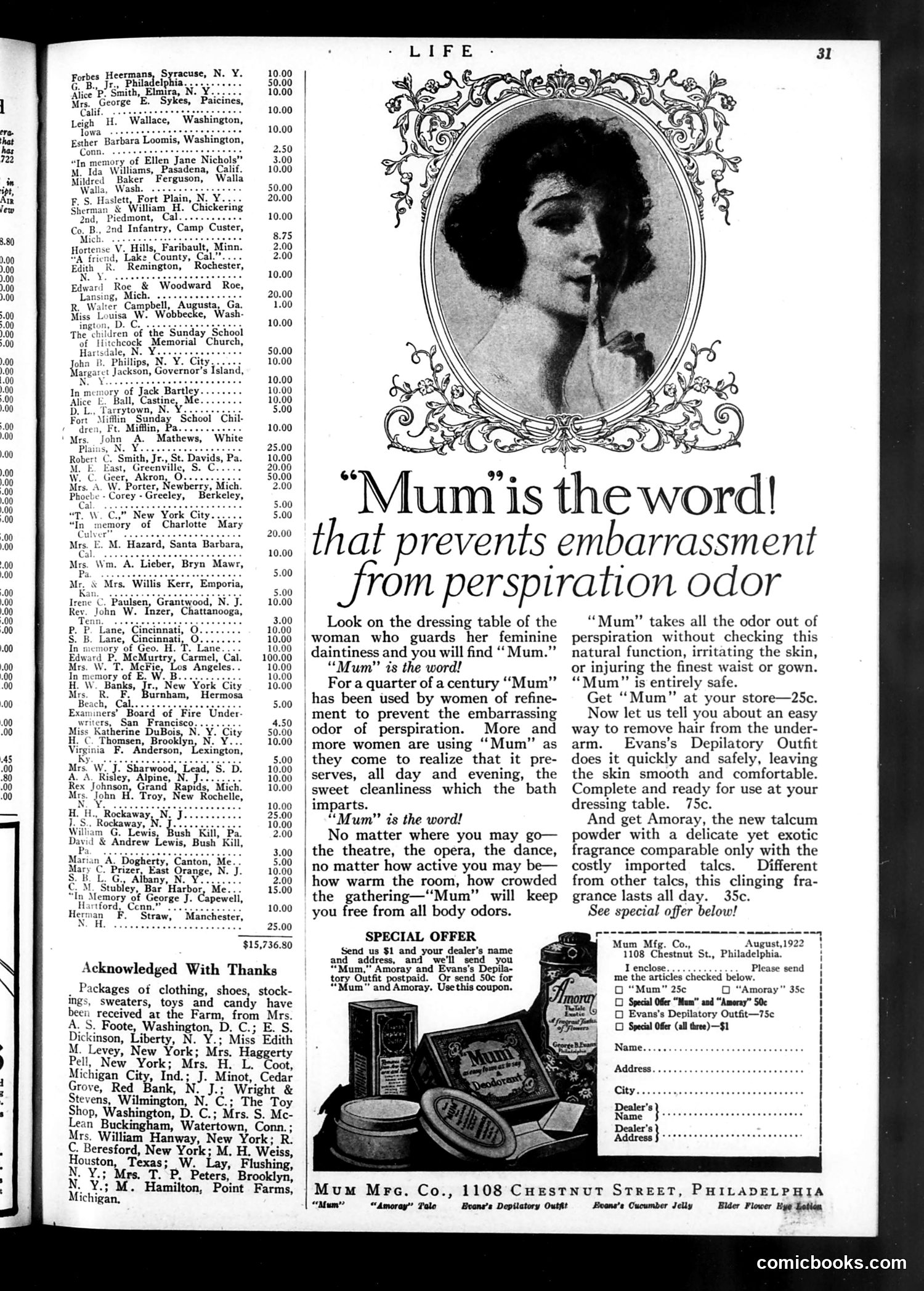
This page is primarily **advertising**, not satire or political commentary. The main content is a full-page advertisement for "Mum," an antiperspirant deodorant product. The ad features a portrait photograph of a woman's face in an ornate frame, alongside marketing text emphasizing that "Mum" prevents perspiration odor while remaining "entirely safe" and not irritating skin or clothing. The copy repeatedly uses the phrase "Mum is the word!" as a marketing slogan. The surrounding text includes acknowledgments of charitable donations and a mail-order coupon offering a special bundle deal (Mum, Amoray depilatory product, and Evans's Depilatory Outfit for $1). This represents typical **1920s consumer advertising** targeting women's hygiene and beauty concerns. The emphasis on "daintiness" and preventing "embarrassment" reflects period attitudes toward women's bodies and social propriety rather than satire or political content.
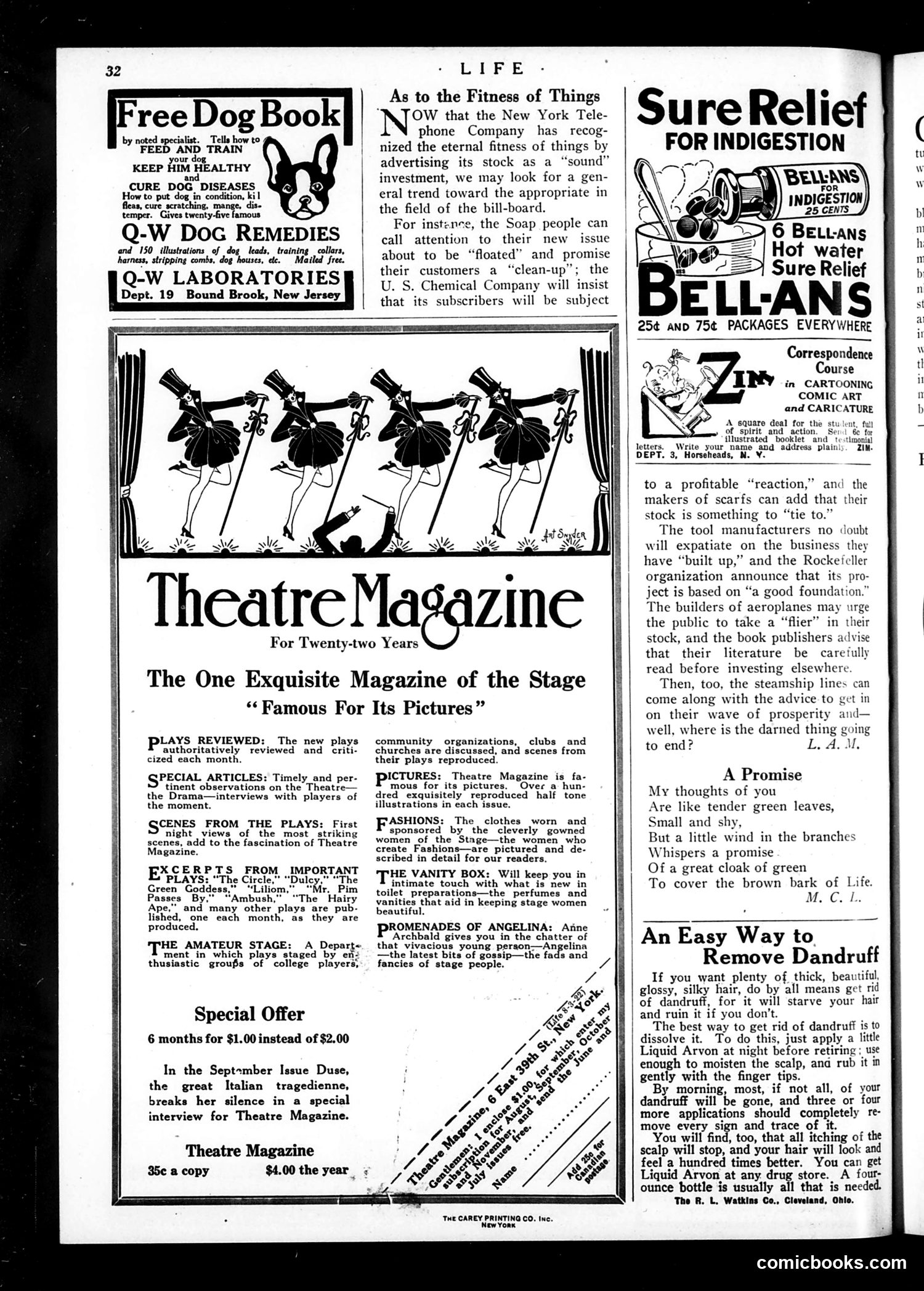
This page is primarily **advertising and magazine promotions** rather than political satire. The main content includes: 1. **Theatre Magazine advertisement** - promoting a theatrical publication featuring stage reviews, play excerpts, fashion from stage productions, and gossip about theater people. The special offer reflects Depression-era pricing ($1 for 6 months). 2. **Satirical editorial snippet** - "As to the Fitness of Things" mocks corporate advertising's use of financial puns. It jokes that the telephone company advertised stock as a "sound" investment, predicting other companies will use similarly corny wordplay (soap companies promising "clean-ups," tool manufacturers touting what they've "built up," airlines urging people to take a "flier"). 3. **Product advertisements** - including dog care remedies, Bel-Ans indigestion relief, and cartooning correspondence courses. The satire targets **1920s corporate marketing excess** and reliance on cheap puns to sell securities to ordinary investors.
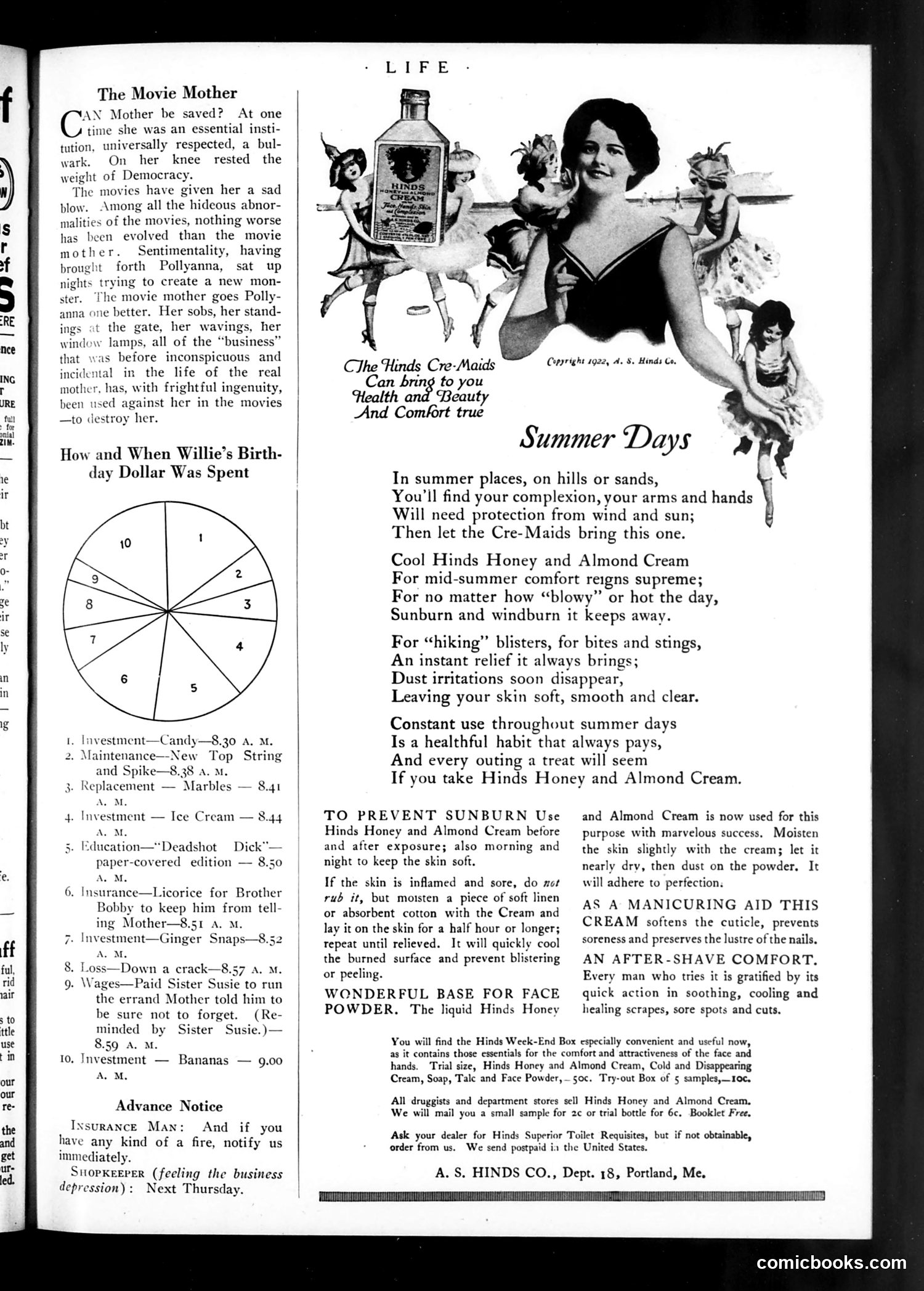
This page contains two distinct elements: editorial satire and advertising. **The Editorial Piece ("The Movie Mother"):** Life criticizes how cinema has corrupted the traditional image of motherhood. The article argues that movies, particularly those influenced by sentimental melodrama (referencing "Pollyanna"), have exaggerated and weaponized maternal theatricality—excessive sobbing, window-lamp vigils, gate-waiting—turning genuine maternal dignity into overwrought caricature. The author laments that films use these exaggerated "business" (theatrical gestures) to undermine rather than honor motherhood, treating it as a tool for emotional manipulation rather than respecting it as a democratic institution. **"Willie's Birthday Dollar" Chart:** A humorous breakdown showing how a child spends a dollar, with entries like "Insurance—Licorice for Brother Bobby to keep him from telling Mother." This satirizes both childhood penny-pinching and parental management. **The Advertising Section:** The Hinds Cre-Maids cream advertisement (occupying most space) is unrelated to the editorial content—typical for Life magazine pages mixing commentary with commercial content.
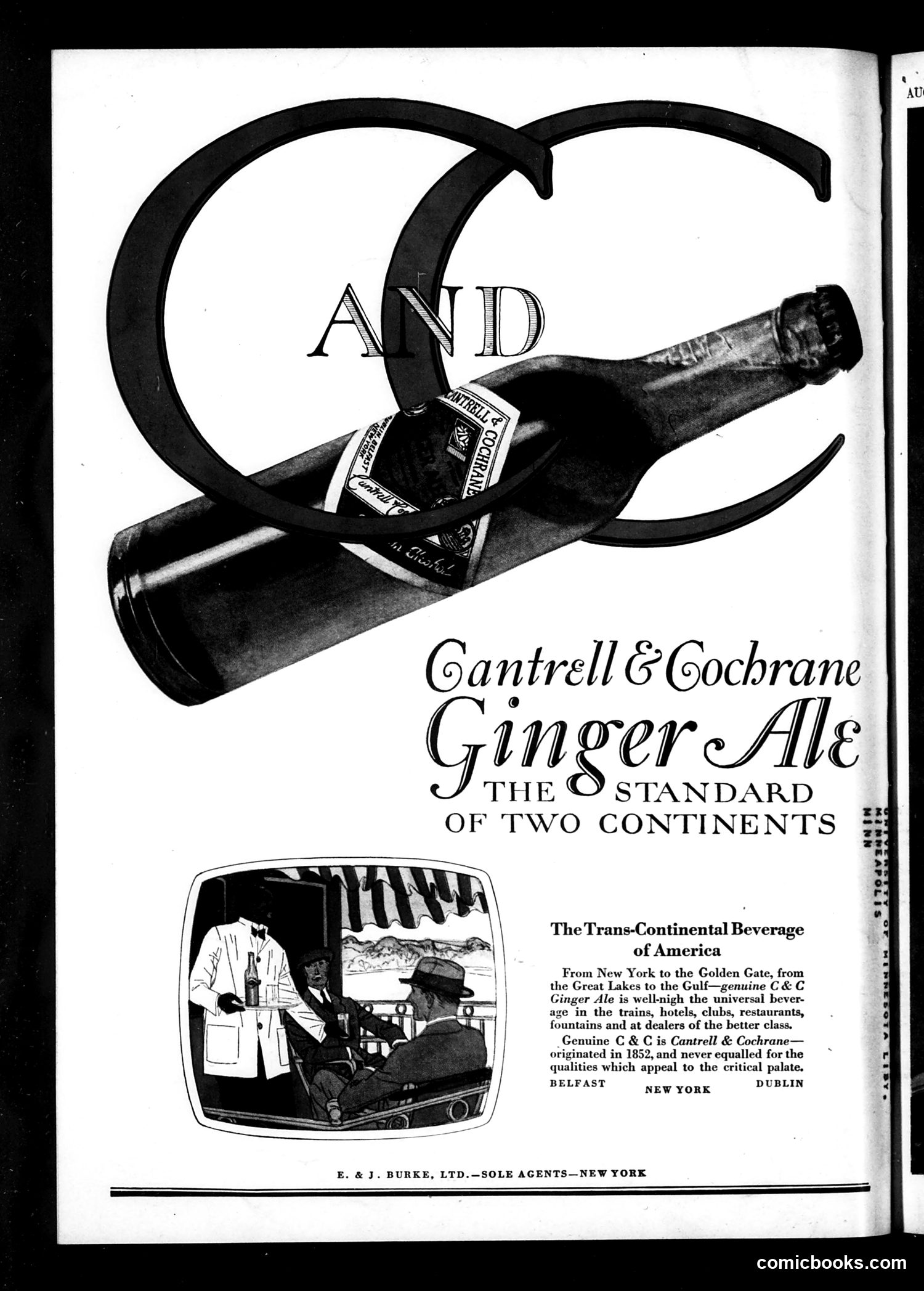
This is primarily a **product advertisement**, not a political cartoon. It promotes Cantrell & Cochrane Ginger Ale, a beverage brand originated in Belfast in 1852. The visual elements include a large decorative "C&C" logo formed by cow horns cradling a bottle, and an inset illustration showing what appears to be a train service scene with passengers and staff—referencing the product's availability across America "from New York to the Golden Gate." The text emphasizes the drink's prestigious status as "the standard of two continents" and claims universal availability in upscale venues (trains, hotels, clubs, restaurants). The mention of "critical palate" appeals to refined consumers. **This is an early 20th-century commercial advertisement designed to establish brand prestige and distribution reach, not satirical content.**