
Life, 1922-08-03 · page 16 of 36
Life — August 3, 1922 — page 16: what you’re looking at
What you’re looking at
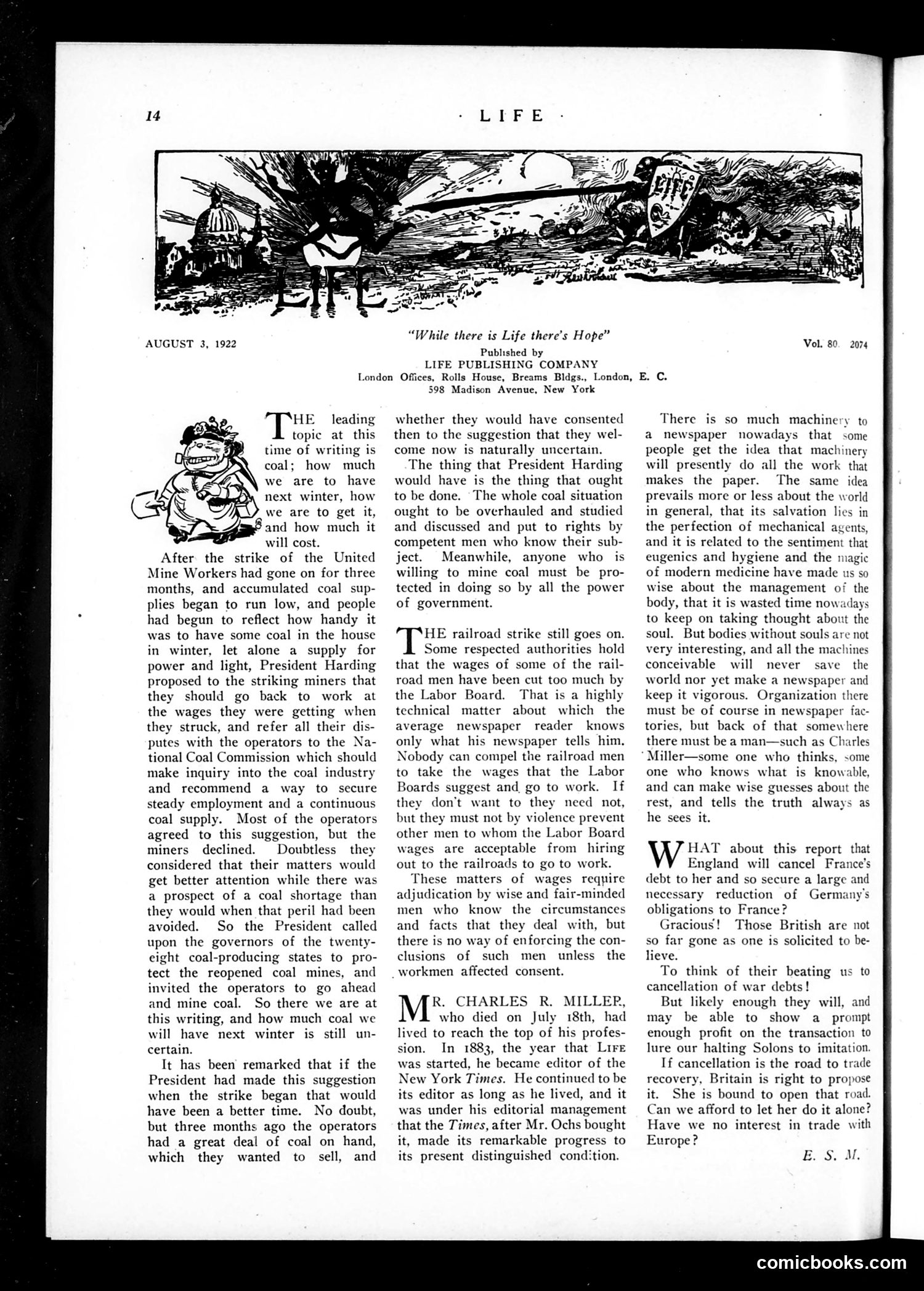
**The Masthead Cartoon:** The illustration at the top depicts a symbolic figure (appears to be representing "Life" or hope personified) amid industrial and pastoral imagery, reinforcing the magazine's motto "While there is Life there's Hope." **The Content:** The page's lead editorial addresses the United Mine Workers strike and resulting coal shortage. It discusses President Harding's proposed solution: having coal operators resume mining at higher wages to secure steady employment and supply. The editorial also references Charles R. Miller's recent death (July 18th), noting his long editorship of the *New York Times*. The final section satirizes Britain's proposal to cancel French war debts, with the author sarcastically questioning whether America should forgive loans to Europe. The satire targets both labor disputes and international economic policy of the early 1920s.
📄 Transcribed text from this page (OCR, searchable)
Machine-transcribed from the original scan — historical spelling and the odd misread are preserved.
NK AUGUST 3, 1922 “While there is Life there’s Hope” Published by LIFE PUBLISHING COMPANY Vol. 80. 2074 London Offices, Rolls House, Breams Bldgs., London, E. C. HE leading topic at this time of writing is coal; how much we are to have next winter, how we are to get it, and how much it will cost. After the strike of the United Mine Workers had gone on for three months, and accumulated coal sup- plies began to run low, and people had begun to reflect how handy it was to have some coal in the house in winter, let alone a supply for power and light, President Harding proposed to the striking miners that they should go back to work at the wages they were getting when they struck, and refer all their dis- putes with the operators to the Na- tional Coal Commission which should make inquiry into the coal industry and recommend a way to secure steady employment and a continuous coal supply. Most of the operators agreed to this suggestion, but the miners declined. Doubtless they considered that their matters would get better attention while there was a prospect of a coal shortage than they would when that peril had been avoided. So the President called upon the governors of the twenty- eight coal-producing states to pro- tect the reopened coal mines, and invited the operators to go ahead and mine coal. So there we are at this writing, and how much coal we will have next winter is still un- certain. It has been remarked that if the President had made this suggestion when the strike began that would have been a better time. No doubt, but three months ago the operators had a great deal of coal on hand, which they wanted to sell, and 598 Madison Avenue, New York whether they would have consented then to the suggestion that they wel- come now is naturally uncertain. The thing that President Harding would have is the thing that ought to be done. The whole coal situation ought to be overhauled and studied and discussed and put to rights by competent men who know their sub ject. Meanwhile, anyone who is willing to mine coal must be pro- tected in doing so by all the power of government. HE railroad strike still goes on. Some respected authorities hold that the wages of some of the rail- road men have been cut too much by the Labor Board. That is a highly technical matter about which the average newspaper reader knows only what his newspaper tells him, Nobody can compel the railroad men to take the wages that the Labor Boards suggest and, go to work. If they don't want to they need not, but they must not by violence prevent other men to whom the Labor Board wages are acceptable from hiring out to the railroads to go to work. These matters of wages reqpire adjudication by wise and fair-minded men who know the circumstances and facts that they deal with, but there is no way of enforcing the con- clusions of such men unless the workmen affected consent. M* CHARLES R. MILLER, who died on July 18th, had lived to reach the top of his profes- sion. In 1883, the year that Lire was started, he became editor of the New York Times. He continued to be its editor as long as he lived, and it was under his editorial management that the Times, after Mr. Ochs bought it, made its remarkable progress to its present distinguished condition. There is so much machinery to a newspaper nowadays that some people get the idea that machinery will presently do all the work that makes the paper. The same idea prevails more or less about the world in general, that its salvation lies in the perfection of mechanical agents, and it is related to the sentiment that eugenics and hygiene and the magic of modern medicine have made us so wise about the management o/ the body, that it is wasted time nowadays to keep on taking thought about the soul. But bodies without souls are not very interesting, and all the machines conceivable will never save the world nor yet make a newspaper and keep it vigorous. Organization there must be of course in newspa tories, but back of that there must be a man—such as Charles *“Miller—some one who thinks, some one who knows what is knowable, and can make wise guesses about the rest, and tells the truth always as he sees it. HAT about this report that England will cancel France's debt to her and so secure a large and necessary reduction of Germany's obligations to France? Gracious! Those British are not so far gone as one is solicited to be- lieve. To think of their beating us to cancellation of war debts! But likely enough they will, and may be able to show a prompt enough profit on the transaction to lure our halting Solons to imitation. If cancellation is the road to trade recovery, Britain is right to propose it. She is bound to open that road. Can we afford to let her do it alone? Have we no interest in trade with Europe? ESS, MM. comicbooks.com