
Life, 1922-08-03 · page 24 of 36
Life — August 3, 1922 — page 24: what you’re looking at
What you’re looking at
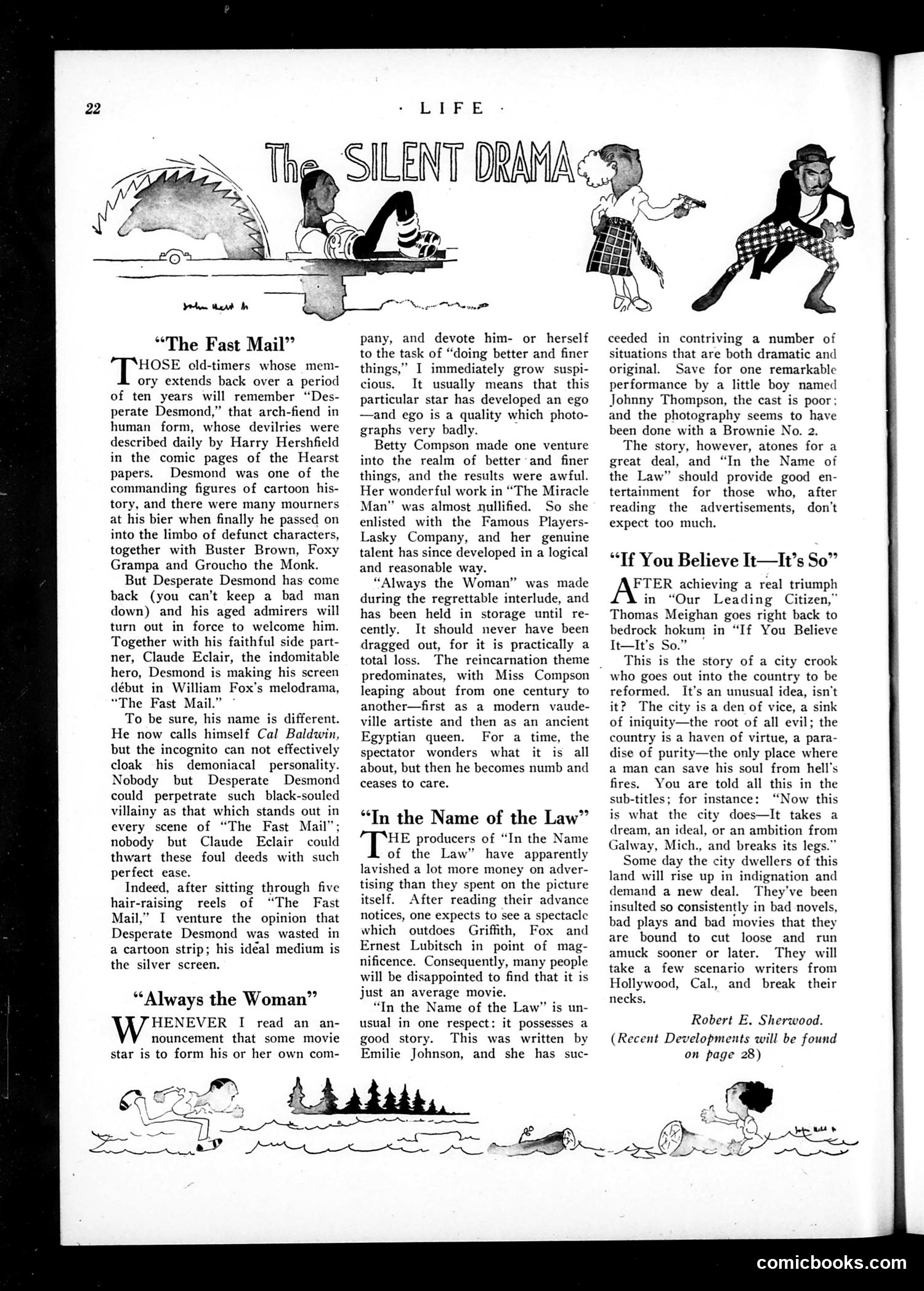
This page contains three film reviews from Life's movie criticism column. The cartoons at top and bottom are decorative flourishes typical of the era. **"The Fast Mail"** reviews a William Fox melodrama starring an actor playing "Cal Baldwin"—though the critic notes this is clearly meant to evoke the famous cartoon villain "Desperate Desmond" from Harry Hershfield's Hearst comics strip. The critic argues the character's villainy translates better to cinema than comics. **"Always the Woman"** critiques Betty Compson's vanity project film. The reviewer dismisses it as wasteful, noting her ego-driven independent venture failed, whereas her work for Famous Players-Lasky Company (a major studio) succeeded. **"In the Name of the Law"** praises the story by Emilie Johnson but criticizes the cast and photography as poor quality, suggesting the producers spent more on advertising than production. The broader satire: movie stars' self-produced "prestige" projects typically fail due to ego, while studio discipline produces better work.
📄 Transcribed text from this page (OCR, searchable)
Machine-transcribed from the original scan — historical spelling and the odd misread are preserved.
whe tot bh “The Fast Mail” HOSE old-timers whose mem- ory extends back over a period of ten years will remember “Des- perate Desmond,” that arch-fiend in human form, whose devilries were described daily by Harry Hershfield in the comic pages of the Hearst papers. Desmond was one of the commanding figures of cartoon his- tory, and there were many mourners at his bier when finally he passed on into the limbo of defunct characters, together with Buster Brown, Foxy Grampa and Groucho the Monk. But Desperate Desmond has come back (you can’t keep a bad man down) and his aged admirers will turn out in force to welcome him. Together with his faithful side part- ner, Claude Eclair, the indomitable hero, Desmond is making his screen début in William Fox’s melodrama, “The Fast Mail.” To be sure, his name is different. He now calls himself Cal Baldwin, but the incognito can not effectively cloak his demoniacal personality. Nobody but Desperate Desmond could perpetrate such black-souled villainy as that which stands out in every scene of “The Fast Mail”; nobody but Claude Eclair could thwart these foul deeds with such perfect ease. Indeed, after sitting through five ir-raising reels of “The Fast ’ I venture the opinion that Desperate Desmond was wasted in a cartoon strip; his ideal medium is the silver screen. “Always the Woman” HENEVER I read an an- nouncement that some movie star is to form his or her own com- LIFE pany, and devote him- or herself to the task of “doing better and finer things,” I immediately grow suspi- cious. It usually means that this particular star has developed an ego —and ego is a quality which photo- graphs very badly. Betty Compson made one venture into the realm of better and finer things, and the results were awful. Her wonderful work in “The Miracle Man” was almost nullified. So she enlisted with the Famous Players- Lasky Company, and her genuine talent has since developed in a logical and reasonable way. “Always the Woman” was made during the regrettable interlude, and has been held in storage until re- cently. It should never have been dragged out, for it is practically a total loss. The reincarnation theme predominates, with Miss Compson leaping about from one century to another—first as a modern vaude- ville artiste and then as an ancient Egyptian queen. For a time, the spectator wonders what it is all about, but then he becomes numb and ceases to care. “In the Name of the Law” HE producers of “In the Name of the Law” have apparently lavished a lot more money on adver- tising than they spent on the picture itself. After reading their advance notices, one expects to see a spectacle which outdoes Griffith, Fox and Ernest Lubitsch in point of mag- nificence. Consequently, many people will be disappointed to find that it is just an average movie. “In the Name of the Law” is un- usual in one respect: it possesses a good story. This was written by Emilie Johnson, and she has suc- ceeded in contriving a number of situations that are both dramatic and original. Save for one remarkable performance by a little boy named Johnny Thompson, the cast is poor; and the photography seems to have been done with a Brownie No. 2. The story, however, atones for a great deal, and “In the Name of the Law” should provide good en- tertainment for those who, after reading the advertisements, don't expect too much. “If You Believe It—It’s So” FTER achieving a real triumph in “Our Leading Citizen,” Thomas Meighan goes right back to bedrock hokum in “If You Believe It—It’s 7 : This is the story of a city crook who goes out into the country to be reformed. It’s an unusual idea, isn’t it? The city is a den of vice, a sink of iniquity—the root of all evil; the country is a haven of virtue, a para- dise of purity—the only place where a man can save his soul from hell's fires. You are told all this in the sub-titles; for instance: “Now this is what the city does—It takes a dream, an ideal, or an ambition from Galway, Mich., and breaks its legs.” Some day the city dwellers of this land will rise up in indignation and demand a new deal. They've been insulted so consistently in bad novels, bad plays and bad movies that they are bound to cut loose and run amuck sooner or later. They will take a few scenario writers from Hollywood, Cal., and break their necks. Robert E. Sherwood. (Recent Developments will be found on page 28) comicbooks.com