
Life, 1922-08-03 · page 14 of 36
Life — August 3, 1922 — page 14: what you’re looking at
What you’re looking at
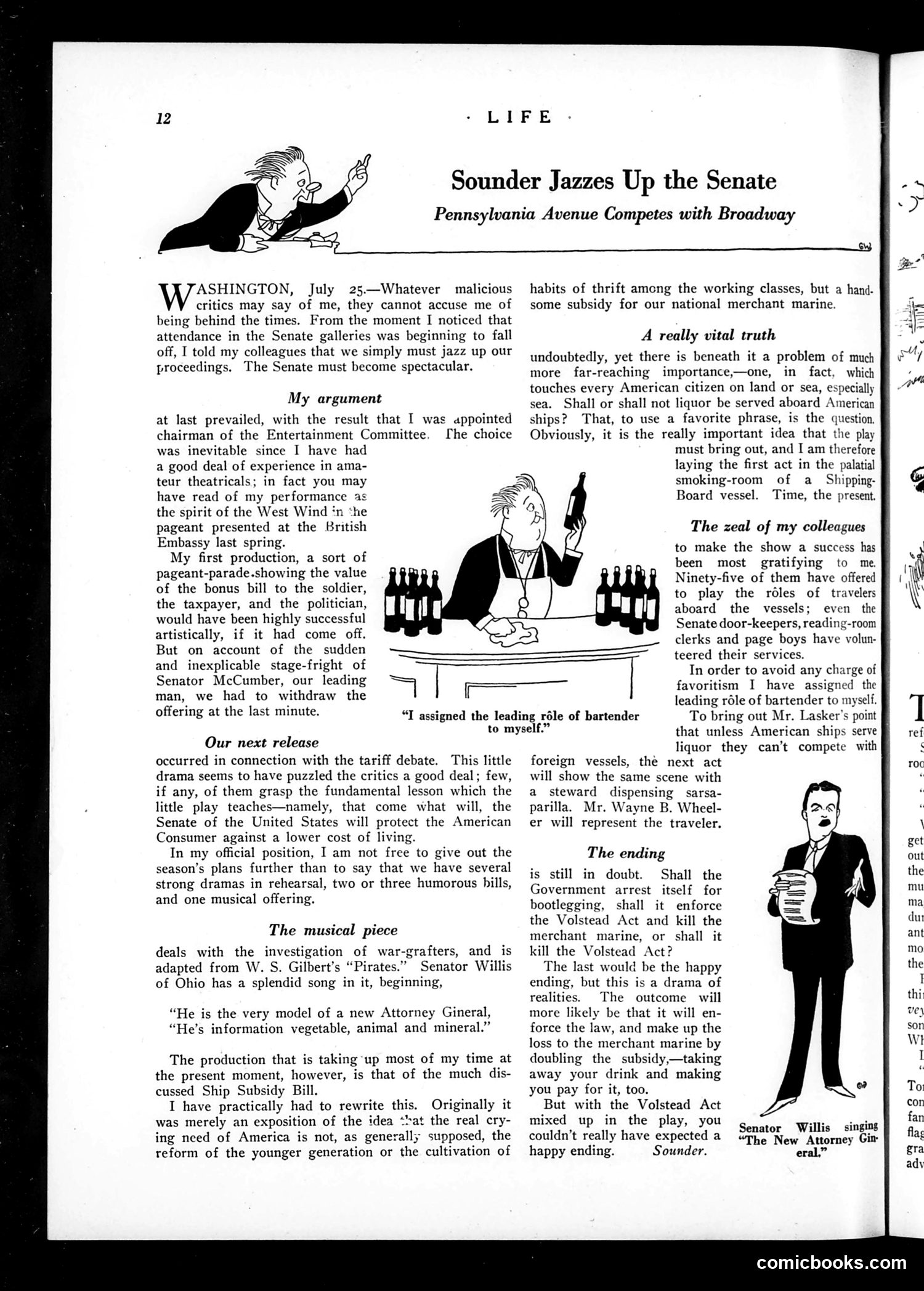
This is a humorous article by Senator William S. Saunders describing his theatrical production about maritime and political issues. The cartoons illustrate his entertainment schemes involving: 1. **The bartender illustration**: Shows Saunders claiming he "assigned the leading role of bartender to myself," satirizing his self-promotion and desire for spotlight. 2. **The steward character**: Depicts another role in what appears to be a play about ships and liquor service, likely mocking debates over alcohol regulation (Prohibition-era context). 3. **Senator Willis singing**: Shows a colleague performing "The New Attorney General," suggesting partisan political satire through musical theater. The satire targets Saunders' attempt to use entertainment—plays, songs, and elaborate schemes—to promote his political agenda regarding ship subsidies and maritime commerce while entertaining the Senate. The tone mocks his theatrical self-aggrandizement and the somewhat absurd nature of conducting serious policy debates through vaudeville-style productions.
📄 Transcribed text from this page (OCR, searchable)
Machine-transcribed from the original scan — historical spelling and the odd misread are preserved.
LIFE Sounder Jazzes Up the Senate Pennsylvania Avenue Competes with Broadway ASHINGTON, July 25.—Whatever malicious critics may say of me, they cannot accuse me of being behind the times. From the moment I noticed that attendance in the Senate galleries was beginning to fall off, I told my colleagues that we simply must jazz up our proceedings. The Senate must become spectacular. My argument at last prevailed, with the result that I was appointed chairman of the Entertainment Committee. [he choice was inevitable since I have had a good deal of experience in ama- teur theatricals; in fact you may have read of my performance as the spirit of the West Wind ‘n the pageant presented at the British Embassy last spring. My first production, a sort of pageant-parade.showing the value of the bonus bill to the soldier, the taxpayer, and the politician, would have been highly successful artistically, if it had come off. But on account of the sudden habits of thrift among the working classes, but a hand- some subsidy for our national merchant marine. A really vital truth undoubtedly, yet there is beneath it a problem of much more far-reaching importance,—one, in fact, which touches every American citizen on land or sea, especially sea. Shall or shall not liquor be served aboard American ships? That, to use a favorite phrase, is the question. Obviously, it is the really important idea that the play must bring out, and I am therefore laying the first act in the palatial smoking-room of a Shipping- Board vessel. Time, the present. The zeal of my colleagues to make the show a success has been most gratifying to me. Ninety-five of them have offered to play the roles of travelers aboard the vessels; even the Senate door-keepers, reading-room clerks and page boys have volun- teered their services. and inexplicable stage-fright of Senator McCumber, our leading man, we had to withdraw the offering at the last minute. Our next release occurred in connection with the tariff debate. This little drama seems to have puzzled the critics a good deal; few, if any, of them grasp the fundamental lesson which the little play teaches—namely, that come what will, the Senate of the United States will protect the American Consumer against a lower cost of living. In my official position, I am not free to give out the season’s plans further than to say that we have several strong dramas in rehearsal, two or three humorous bills, and one musical offering. The musical piece deals with the investigation of war-grafters, and is adapted from W. S. Gilbert’s “Pirates.” Senator Willis of Ohio has a splendid song in it, beginning, “He is the very model of a new Attorney Gineral, “He’s information vegetable, animal and mineral.” The production that is taking ‘up most of my time at the present moment, however, is that of the much dis- cussed Ship Subsidy Bill. I have practically had to rewrite this. Originally it was merely an exposition of the idea ‘hat the real cry- ing need of America is not, as generally supposed, the reform of the younger generation or the cultivation of “I assigned the leading réle of bartender to myself.” In order to avoid any charge of favoritism I have assigned the leading réle of bartender to myself. To bring out Mr. Lasker's point that unless American ships serve liquor they can’t compete with foreign vessels, the next act will show the same scene with a steward dispensing sarsa- parilla. Mr. Wayne B. Wheel- er will represent the traveler. The ending is still in doubt. Shall the Government arrest itself for bootlegging, shall it enforce the Volstead Act and kill the merchant marine, or shall it kill the Volstead Act? The last would be the happy ending, but this is a drama of realities. The outcome will more likely be that it will en- force the law, and make up the loss to the merchant marine by doubling the subsidy,—taking away your drink and making you pay for it, too. But with the Volstead Act mixed up in the play, you couldn’t really have expected a happy ending. Sounder. Senator Willis singing “The New Attorney Gir eral,” comicbooks.com