
Life, 1922-08-03 · page 15 of 36
Life — August 3, 1922 — page 15: what you’re looking at
What you’re looking at
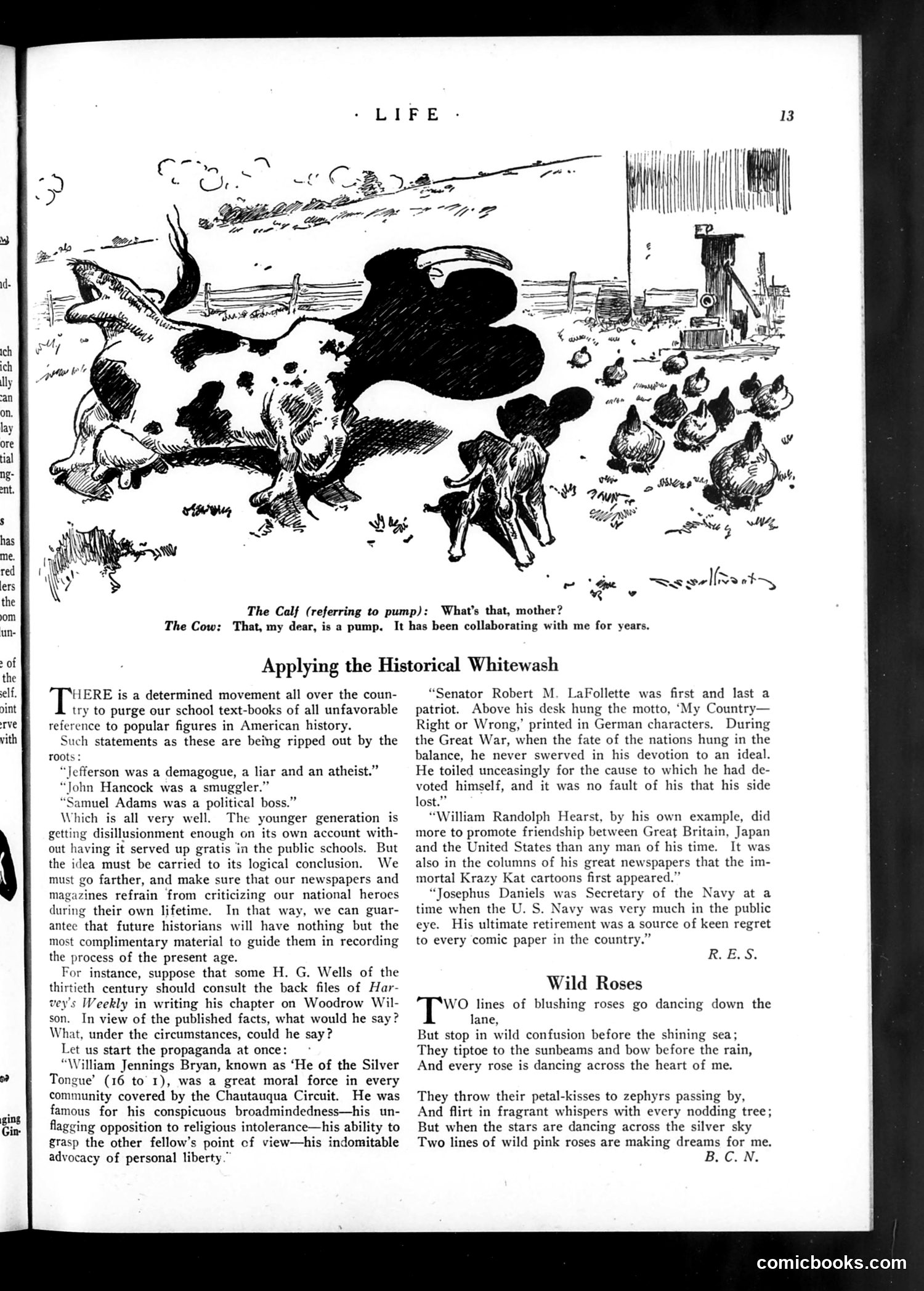
The cartoon at top depicts a cow labeled "The Cow" speaking to a calf ("The Call") about being a "pump"—a visual metaphor for the censorship debate discussed below. The article "Applying the Historical Whitewash" criticizes a nationwide movement to remove "unfavorable references to popular figures in American history" from school textbooks. Examples cited include retroactive sanitization of Jefferson (called a demagogue), John Hancock (smuggler), and Samuel Adams (political boss). The satire targets attempts to rewrite history by removing criticism of American historical figures from educational materials. The author argues this whitewashing prevents future historians from accessing honest records and essentially "pumps" propaganda into schoolchildren rather than teaching balanced truth.
📄 Transcribed text from this page (OCR, searchable)
Machine-transcribed from the original scan — historical spelling and the odd misread are preserved.
et The Calf (referring to pump): It has been collaborating with me for years. The Cow: That, my dear, is a pump. nt What's that, mother? Applying the Historical Whitewash HERE is a determined movement all over the coun- try to purge our school text-books of all unfavorable reference to popular figures in American history. Such statements as these are being ripped out by the roots: “Jefferson was a demagogue, a liar and an atheist.” “John Hancock was a smuggler.” “Samuel Adams was a political boss.” Which is all very well. The younger generation is getting disillusionment enough on its own account with- out having it served up gratis in the public schools. But the idea must be carried to its logical conclusion. We must go farther, and make sure that our newspapers and magazines refrain from criticizing our national heroes during their own lifetime. In that way, we can guar- antee that future historians will have nothing but the most complimentary material to guide them in recording the process of the present age. For instance, suppose that some H. G. Wells of the thirtieth century should consult the back files of Har- vey's Weekly in writing his chapter on Woodrow Wil- son. In view of the published facts, what would he say? What, under the circumstances, could he say? Let us start the propaganda at once: “William Jennings Bryan, known as ‘He of the Silver Tongue’ (16 to'1), was a great moral force in every community covered by the Chautauqua Circuit. He was famous for his conspicuous broadmindedness—his un- flagging opposition to religious intolerance—his ability to grasp the other fellow’s point cf view—his indomitable advocacy of personal liberty.” “Senator Robert M. LaFollette was first and last a patriot. Above his desk hung the motto, ‘My Country— Right or Wrong,’ printed in German characters. During the Great War, when the fate of the nations hung in the balance, he never swerved in his devotion to an ideal. He toiled unceasingly for the cause to which he had de- voted himself, and it was no fault of his that his side lost.” “William Randolph Hearst, by his own example, did more to promote friendship between Great Britain, Japan and the United States than any man of his time. It was also in the columns of his great newspapers that the im- mortal Krazy Kat cartoons first appeared.” “Josephus Daniels was Secretary of the Navy at a time when the U. S. Navy was very much in the public eye. His ultimate retirement was a source of keen regret to every comic paper in the country.” R.E.S. Wild Roses WO lines of blushing roses go dancing down the lane, But stop in wild confusion before the shining sea; They tiptoe to the sunbeams and bow before the rain, And every rose is dancing across the heart of me. They throw their petal-kisses to zephyrs passing by, And flirt in fragrant whispers with every nodding tree; But when the stars are dancing across the silver sky Two lines of wild pink roses are making dreams for me. B.C. N. comicbooks.com