
A complete issue · 38 pages · 1922
Life — April 6, 1922
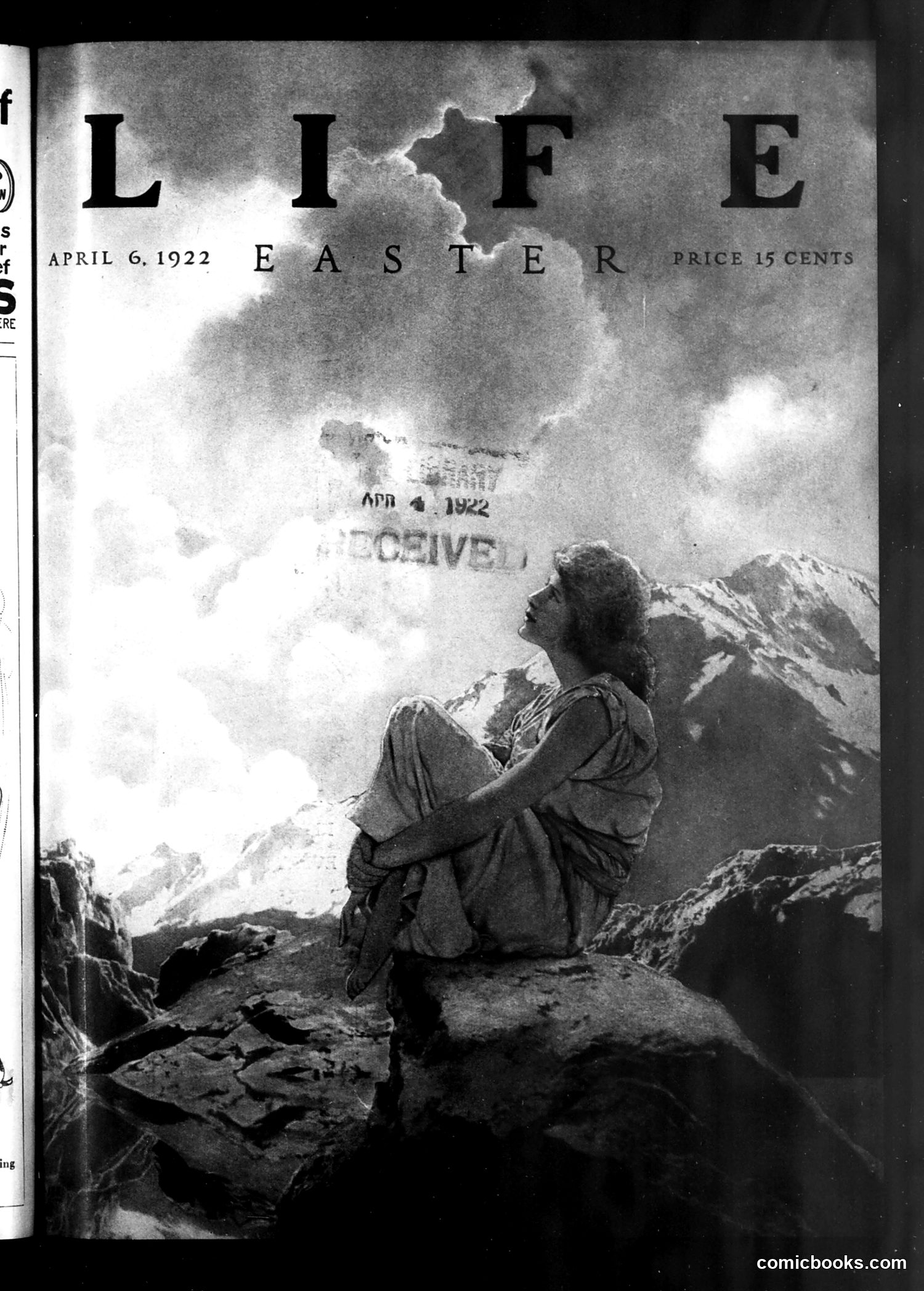
This cover features a contemplative figure seated on a rocky outcrop, gazing upward at a mountainous landscape with dramatic clouds. The image suggests spiritual or philosophical reflection—appropriate for an Easter-themed publication. The figure appears to be in a meditative pose, possibly representing humanity's relationship with nature or the divine during the Easter season. The mountainous, cloud-filled backdrop evokes transcendence or spiritual yearning. Without additional context from the magazine's interior content, the specific satirical or political meaning isn't clear from the cover alone. However, Life magazine typically combined sentimental or philosophical imagery with satirical commentary on contemporary social issues. The 15-cent price and 1922 date confirm this is the original publication.
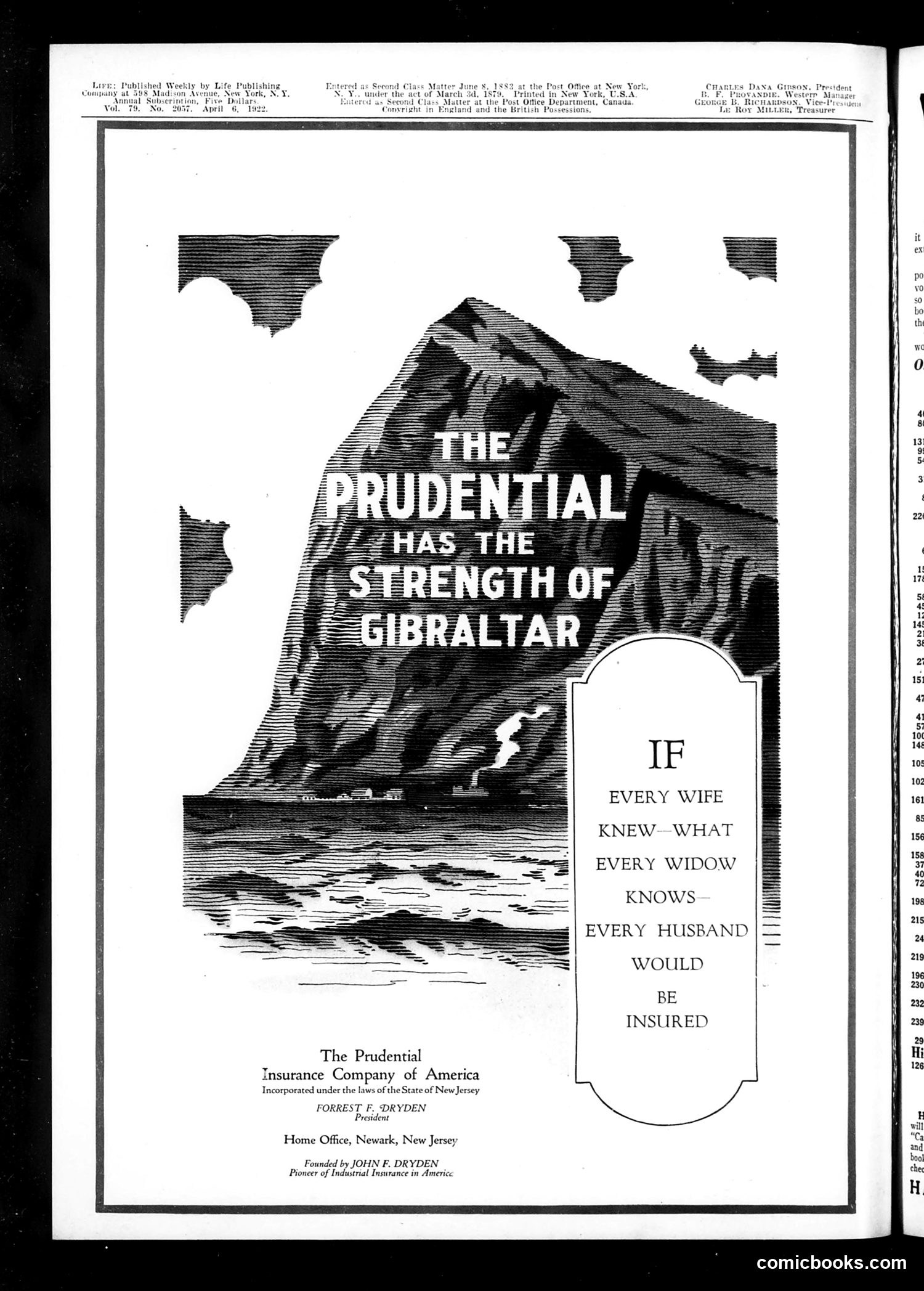
This is primarily a **full-page advertisement** for The Prudential Insurance Company of America, not a political cartoon or satire. The ad features the Rock of Gibraltar as a visual metaphor for strength and stability. The headline reads: "THE PRUDENTIAL HAS THE STRENGTH OF GIBRALTAR / IF EVERY WIFE KNEW—WHAT EVERY WIDOW KNOWS—EVERY HUSBAND WOULD BE INSURED." **The pitch**: The ad uses the widely-recognized metaphor of Gibraltar's impregnability to suggest insurance provides financial security. The secondary text implies that widows—who've faced the financial hardship of losing their breadwinner—understand the necessity of life insurance. The ad appeals to wives' and husbands' sense of family responsibility. This represents early 20th-century insurance marketing, using emotional appeals about family welfare rather than complex actuarial arguments.
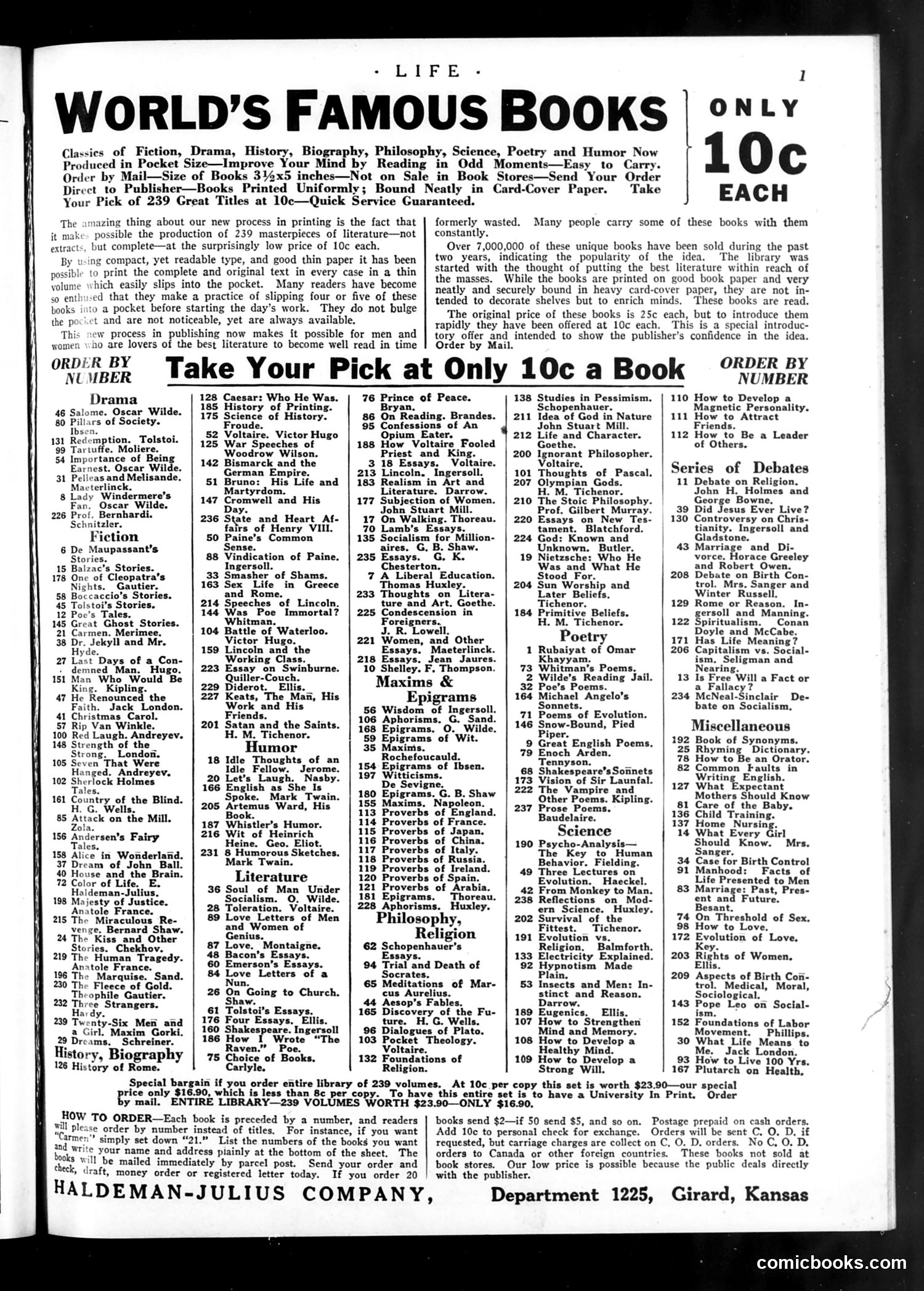
This page is **entirely advertising**, not satire or political commentary. It's a full-page advertisement for the Haldeman-Julius Company's "World's Famous Books" series—a mail-order book club offering 239 classic titles at 10 cents each. The ad emphasizes accessibility: these are compact, affordable editions of canonical literature (drama, history, philosophy, poetry) designed for working people who couldn't afford full-price books. The company advertised these aggressively in publications like *Life*, targeting middle and working-class readers during the early 20th century. This reflects a genuine historical phenomenon: Haldeman-Julius democratized classic literature through cheap mass production, making "high culture" accessible to ordinary Americans for the first time. The catalog listing hundreds of titles serves as both advertisement and actual ordering guide.
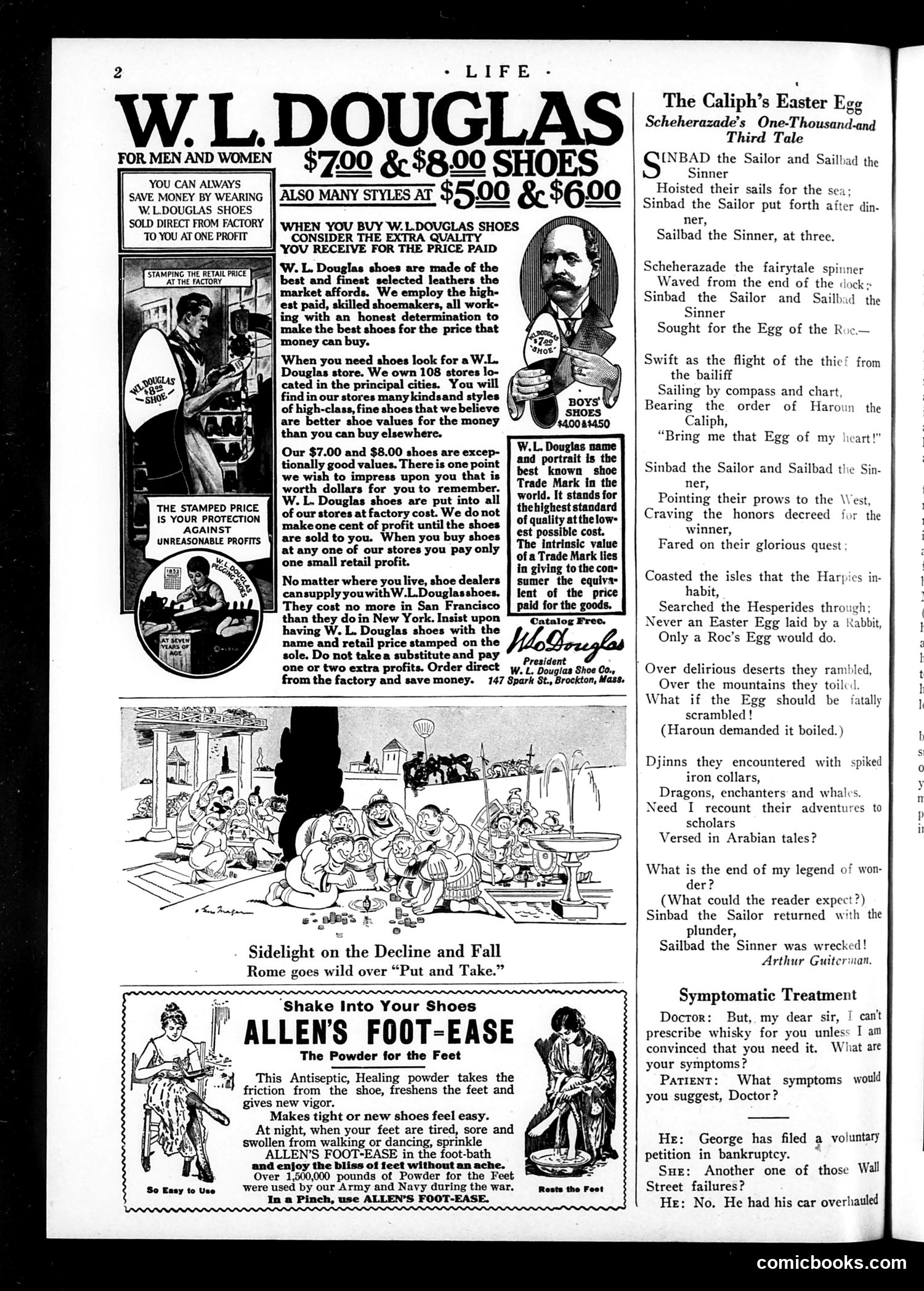
This page is primarily **advertising and entertainment content** rather than political satire. The main visual cartoon, "Sidelight on the Decline and Fall" (captioned "Home goes wild over 'Put and Take'"), depicts a chaotic domestic scene with numerous figures engaged in what appears to be gambling or a parlor game. This likely satirizes the contemporary craze for "Put and Take," a popular dice game of the 1920s that swept America. The cartoon mocks how the game consumed household time and attention, suggesting social concern about the game's addictive appeal. The page otherwise features shoe advertisements (W.L. Douglas) and Allen's Foot-Ease powder ads—typical commercial content. A serialized story, "The Caliph's Easter Egg," appears on the right side. The "Symptomatic Treatment" comic strip provides mild humor about doctor-patient interactions.
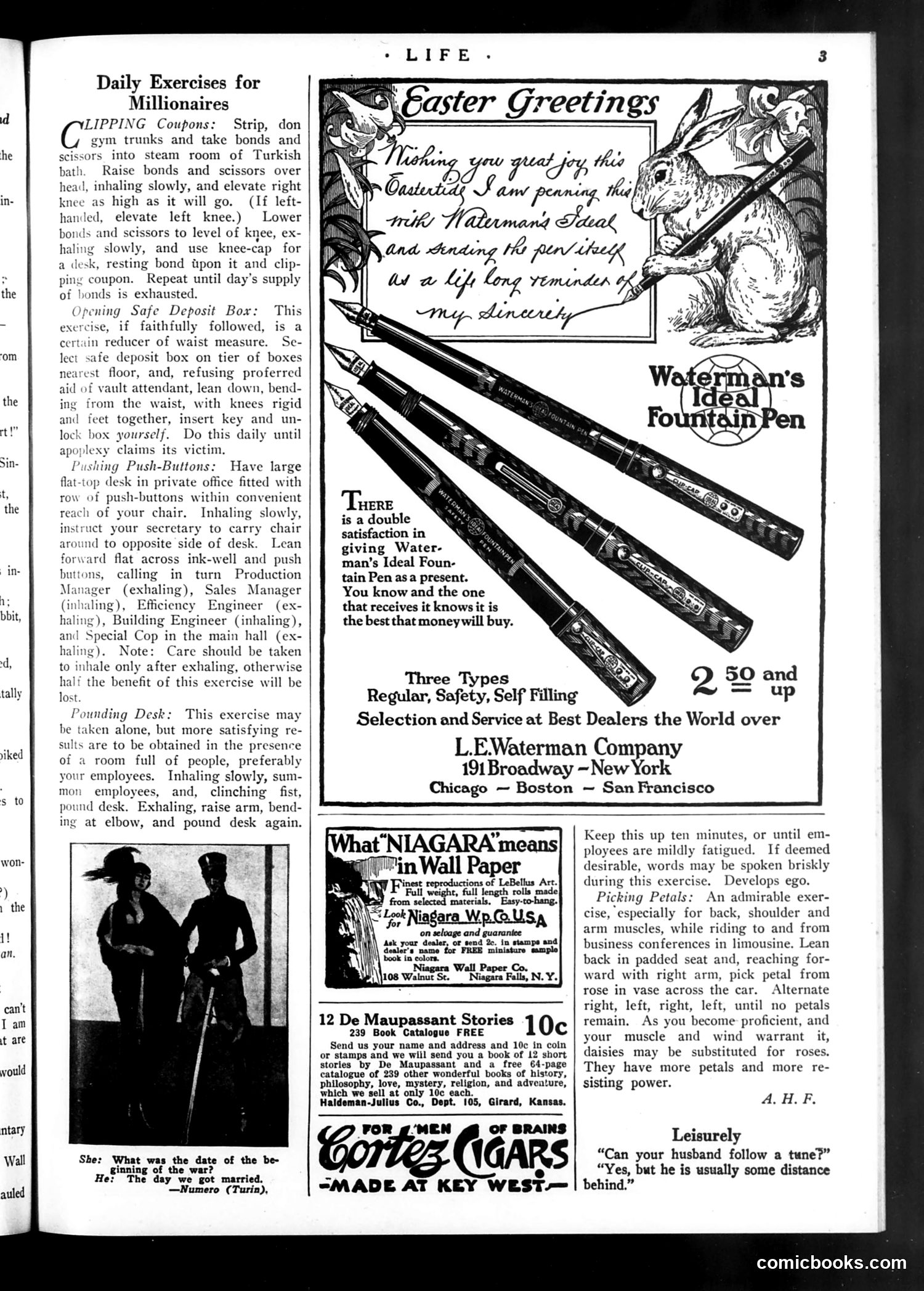
This page is primarily **advertising and lifestyle content** rather than political satire. The main visual elements include: 1. **Easter Greetings card** featuring rabbits and decorative imagery—a seasonal commercial message 2. **Waterman's Ideal Fountain Pen advertisement** promoting pens as gifts 3. **"What Niagara Means in Wall Paper"** - a product advertisement 4. **De Maupassant Stories catalog offer** - a mail-order book promotion 5. **Cortes Cigars advertisement** - "For Men of Brains" 6. A small cartoon captioned "She: What was the date of the beginning of the war? He: The day we got married" (a domestic humor joke, likely referencing WWI) The left column contains **"Daily Exercises for Millionaires"**—fitness tips presented tongue-in-cheek for wealthy readers. The page reflects early 20th-century consumer culture and mild domestic humor rather than pointed political commentary.
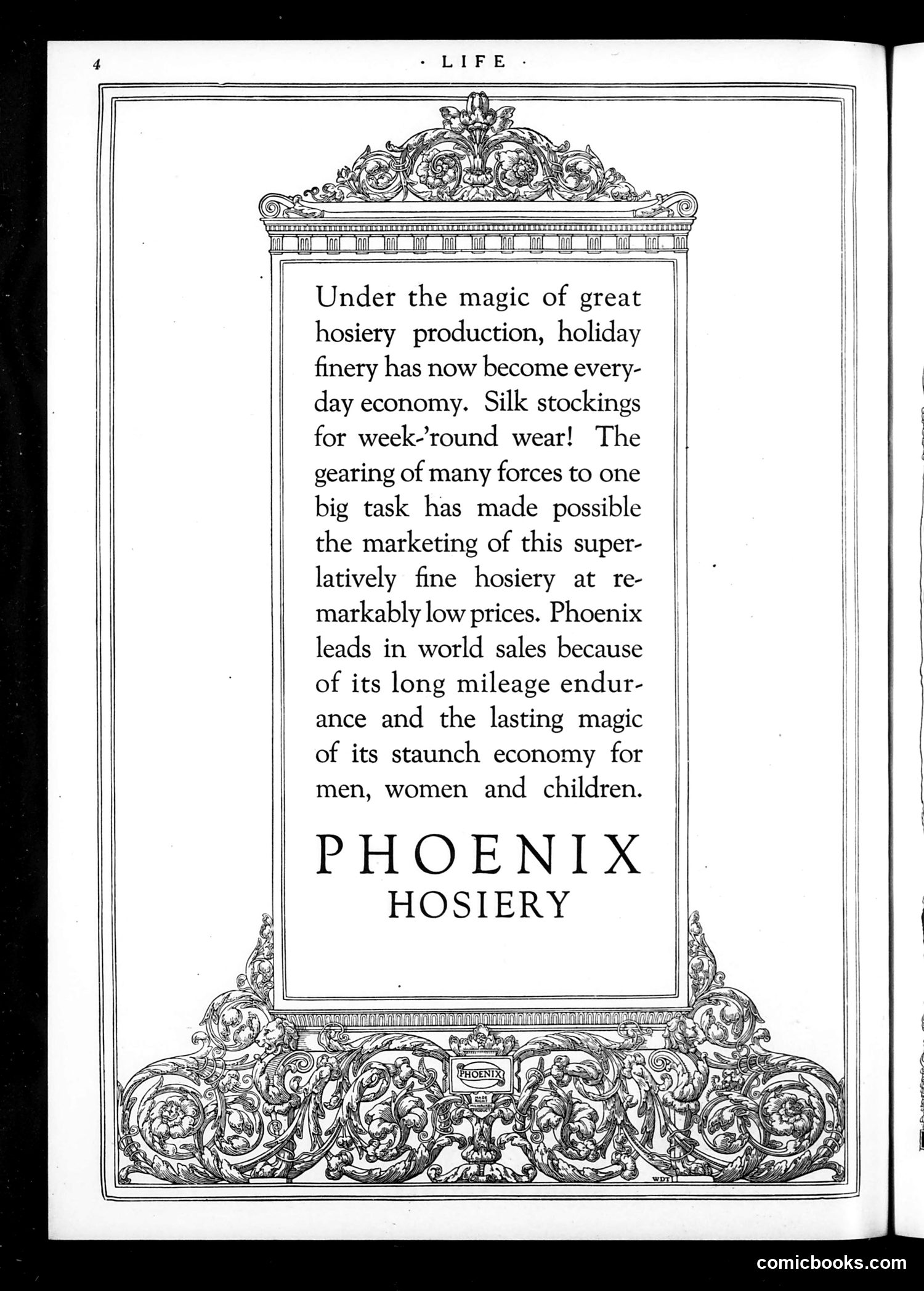
This is a **product advertisement**, not satire or political commentary. The page promotes Phoenix brand silk stockings, marketed as affordable luxury goods made possible by mass production efficiency. The ornate decorative border frames the ad in a style typical of early 20th-century magazine design. The text emphasizes that Phoenix hosiery brings "holiday finery" to everyday wear through economies of scale—fine silk stockings at low prices. The advertisement targets all consumers ("men, women and children"), highlighting Phoenix's market dominance through durability and affordability. There are no political figures, caricatures, or satirical commentary present. This represents straightforward commercial messaging typical of *Life* magazine's revenue model, where ads subsidized editorial content.
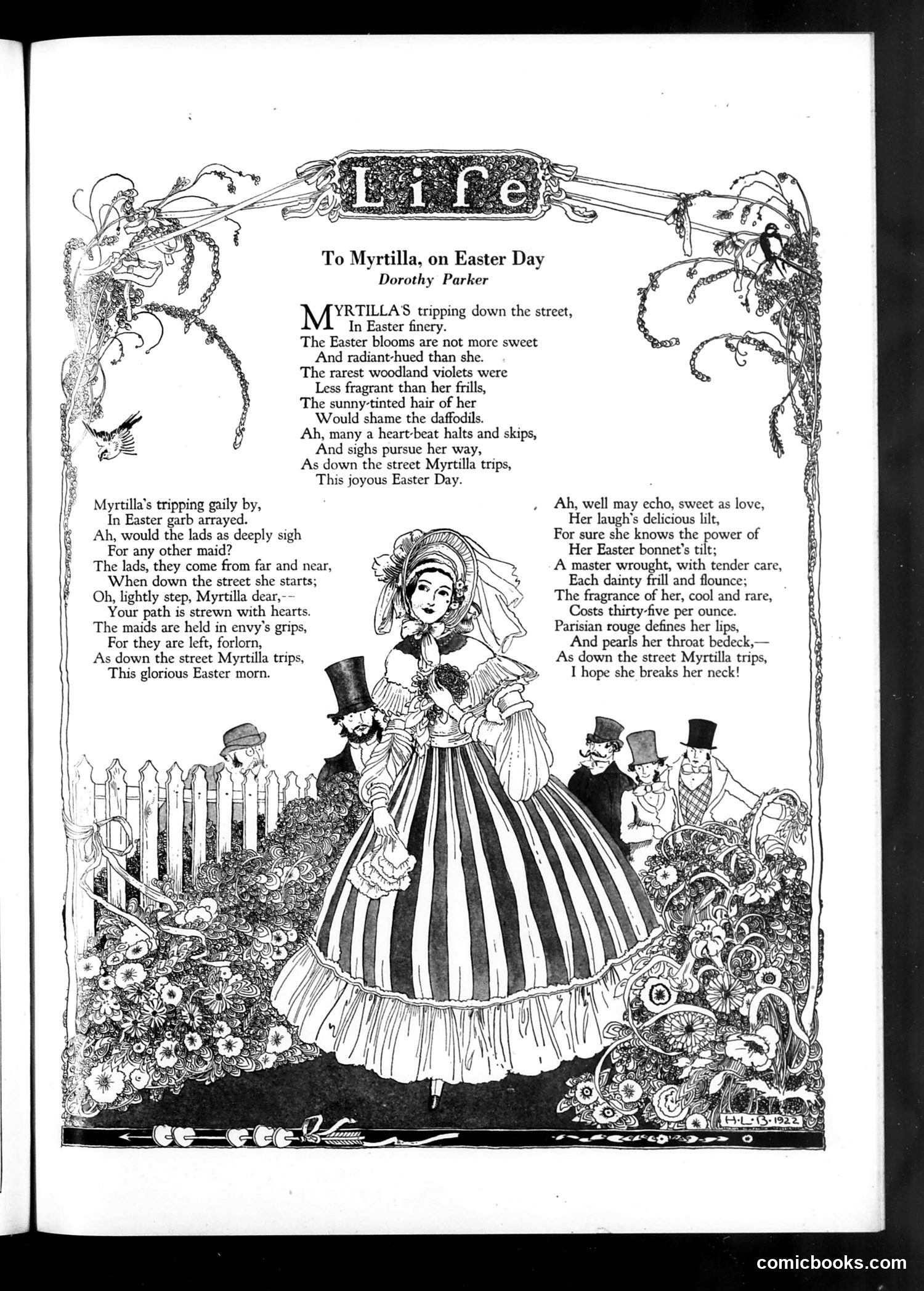
This is a poem rather than a political cartoon. Parker's verses mock a frivolous young woman named Myrtilla who struts about on Easter in fancy dress, attracting male admirers. The poem's tone shifts dramatically in the second half—Parker's biting sarcasm becomes clear as she wishes Myrtilla would "break her neck," suggesting the poem is a satirical attack on superficiality and vanity. The elaborate Art Nouveau illustration shows Myrtilla in an ornate Easter bonnet surrounded by admiring gentlemen and spring flowers. Parker uses the contrast between the illustration's romanticized presentation and her caustic verses to critique both feminine vanity and male infatuation with mere appearance—characteristic of Parker's sharp social commentary on 1920s society.
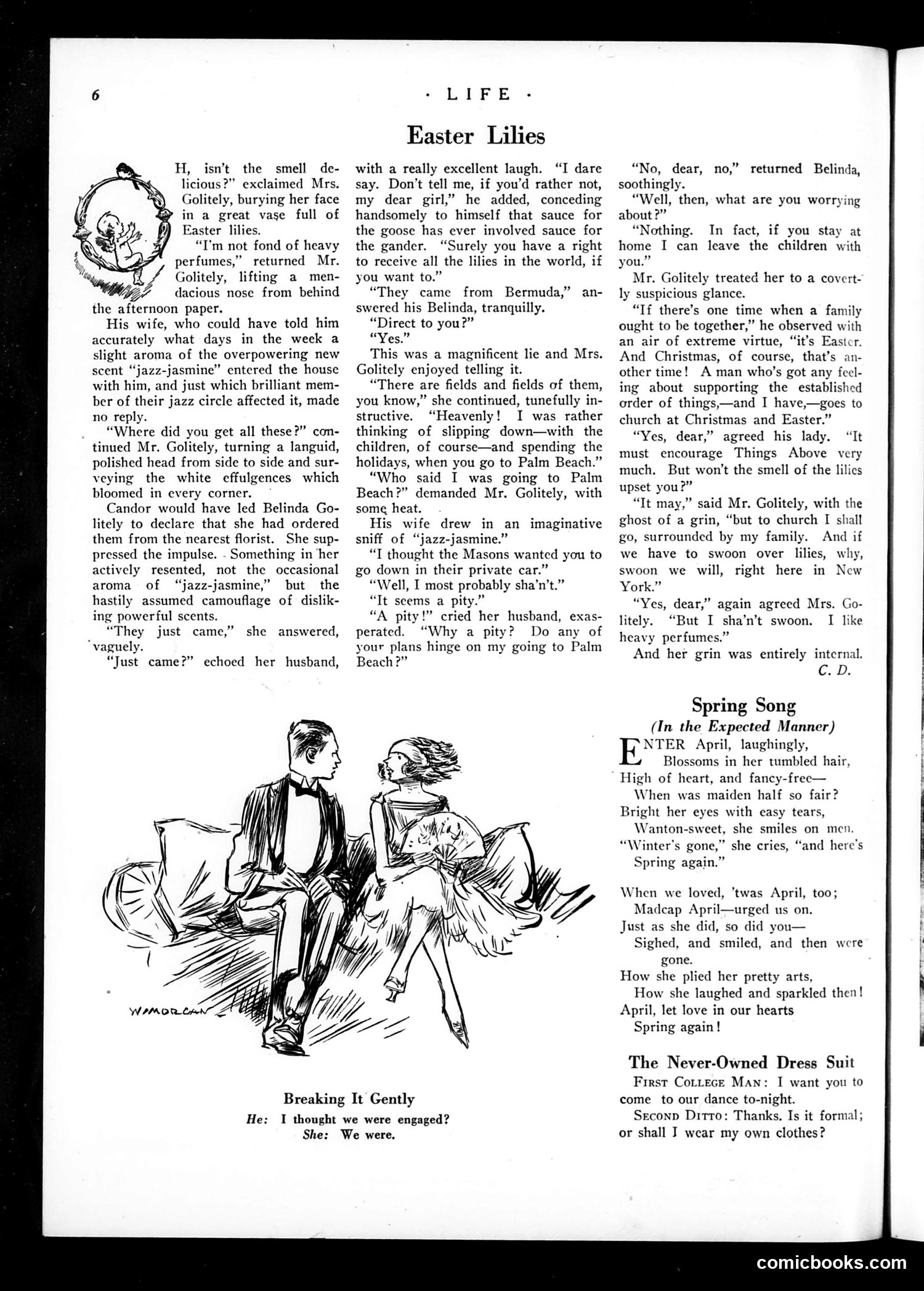
This page from *Life* magazine contains three distinct pieces: **"Easter Lilies"** (main story): A humorous domestic dialogue where Mr. Golitely brings home expensive Easter lilies. Mrs. Golitely objects to the cost and their overpowering "jazz-jasmine" scent. The satire targets upper-middle-class consumer excess and Easter tradition—specifically the wealthy's wasteful spending on elaborate floral displays. References to "Palm Beach" suggest leisure travel associated with the wealthy. **"Breaking It Gently"** (cartoon): A simple joke about an engagement breakup, illustrated with a couple on a bench. **"Spring Song"** and **"The Never-Owned Dress Suit"**: Brief poems/comic dialogues about romance and fashion etiquette. The content reflects 1920s satirical humor targeting consumerism, social pretension, and courtship customs among the affluent.
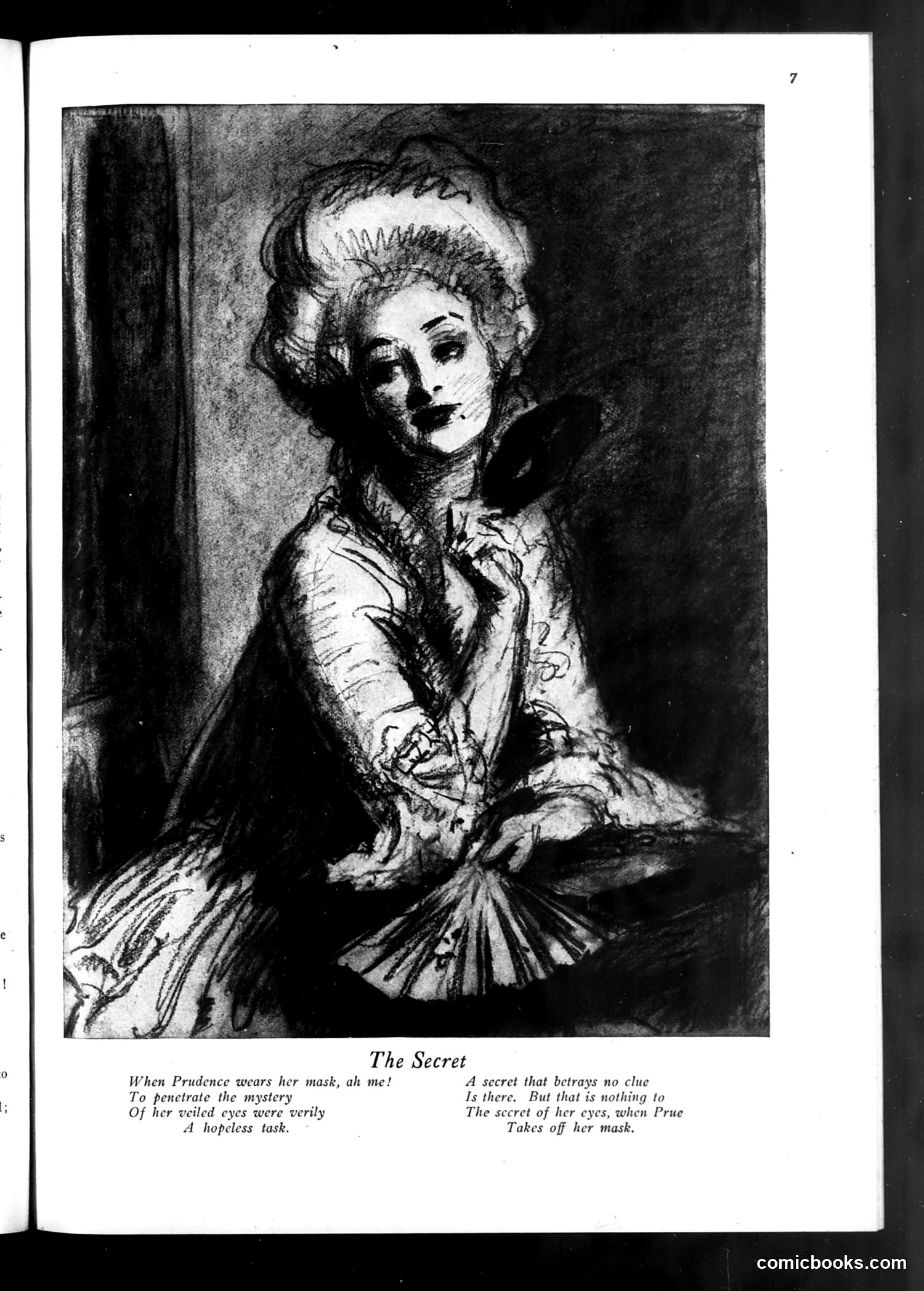
This illustration depicts a woman wearing an elaborate mask and period costume, likely 18th-century dress based on the ornate details and fan. The accompanying poem explores the theme of hidden identity and concealment. The satire appears to address how women, particularly those of higher social standing, use various forms of disguise—literal masks or fashionable veils—to maintain mystery and social propriety. "Prudence," personified in the verse, uses external masks to hide secrets, yet the poem suggests her eyes betray her true nature when the mask is removed. The work likely satirizes Victorian-era social conventions around female respectability, propriety, and the gap between public persona and private reality. The emphasis on "her eyes" when the mask drops suggests authentic emotion or character cannot be fully concealed.
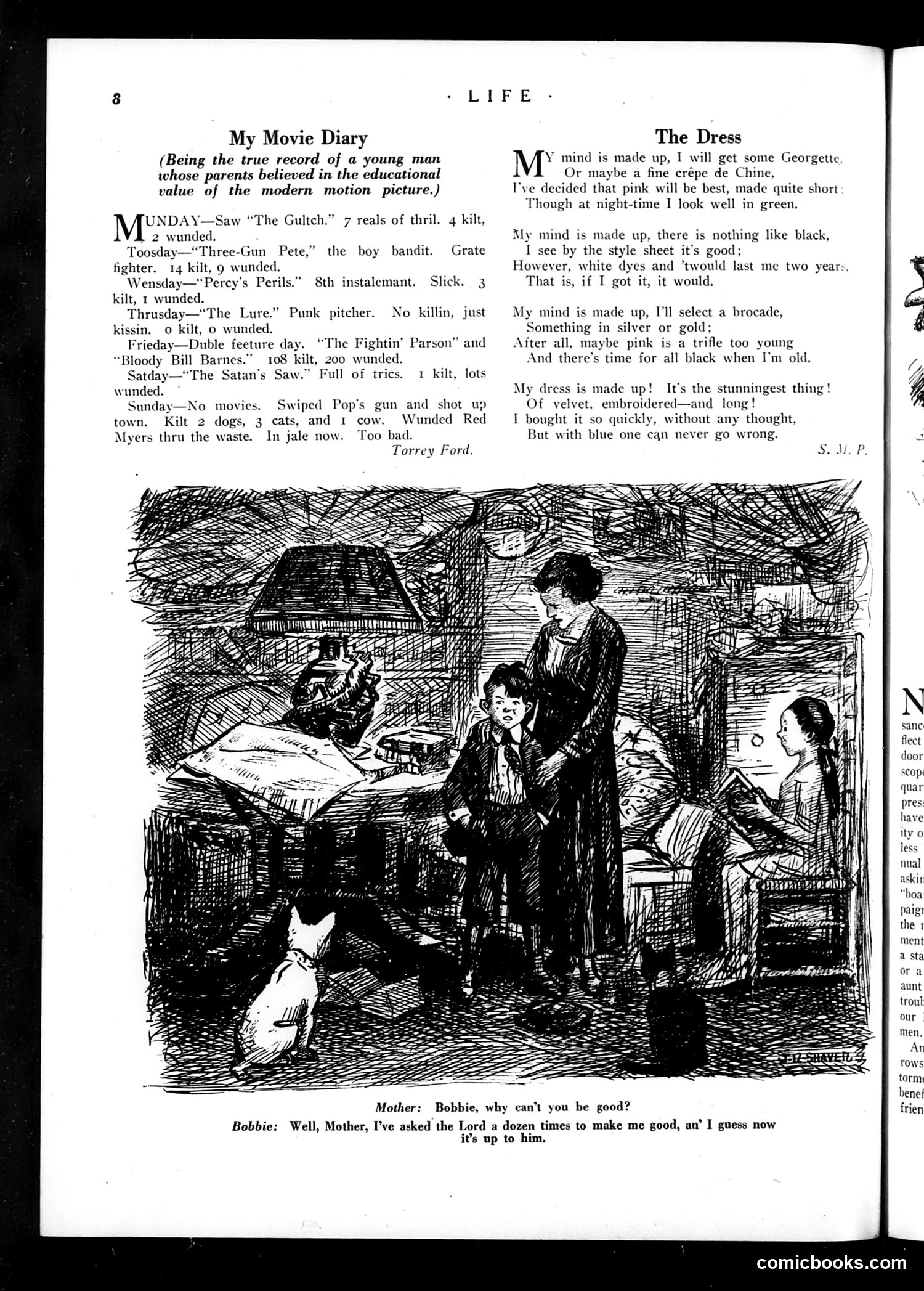
This page contains two distinct pieces: **"My Movie Diary"** (left column) is a humorous weekly log by Torrey Ford documenting violent Western films he watched—"The Gutch," "Three-Gun Pete," "The Lure," etc.—culminating in shooting up the town, wounding animals and people. The satire critiques the era's proliferation of violent movie content and its potential influence on viewers. **"The Dress"** (right column) is a poem by S. M. P. about deciding what dress to wear, debating between Georgette, crepe de Chine, and black fabrics. The accompanying illustration shows a domestic interior scene with a mother and children, captioned with dialogue where "Bobbie" deflects responsibility for misbehavior to God, suggesting parental frustration with childhood discipline—likely satirizing modern parenting attitudes.
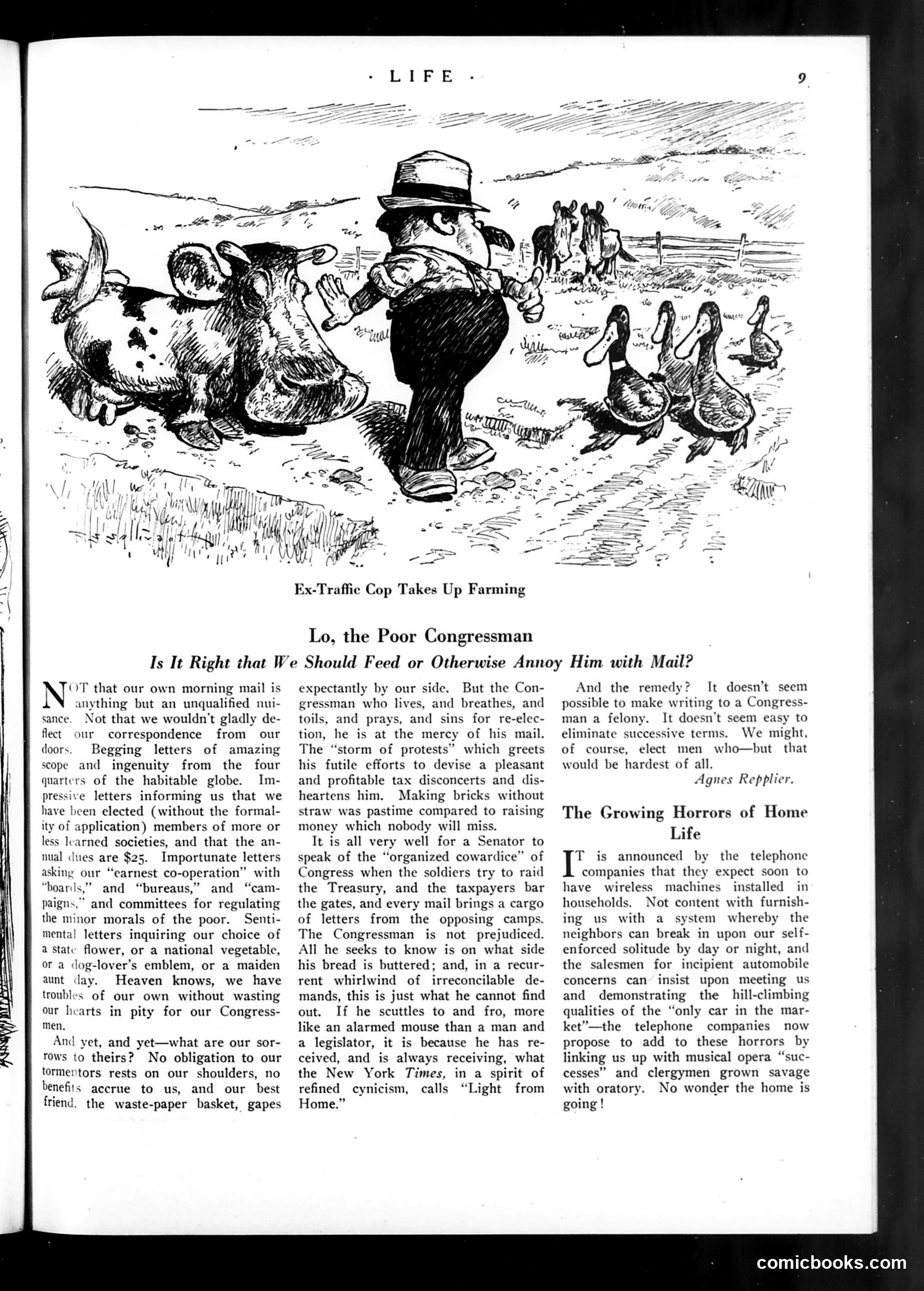
The cartoon depicts a man in formal attire and hat being chased by a cow and geese on a farm. The caption reads "Ex-Traffic Cop Takes Up Farming." The accompanying article "Lo, the Poor Congressman" satirizes congressmen being inundated with mail from constituents. The article complains that representatives receive excessive, often trivial correspondence—letters about flowers, vegetables, and personal matters—that distract from serious legislative work. It compares the congressman's predicament to "making bricks without straw." The cartoon likely illustrates this same idea through visual metaphor: just as the ex-cop is overwhelmed by farm animals, congressmen are overwhelmed by constituent demands. The joke appears to be that switching careers (from traffic cop to farmer) doesn't provide escape from chaos and harassment—a commentary on how demanding public service is, or how inescapable life's difficulties can be.
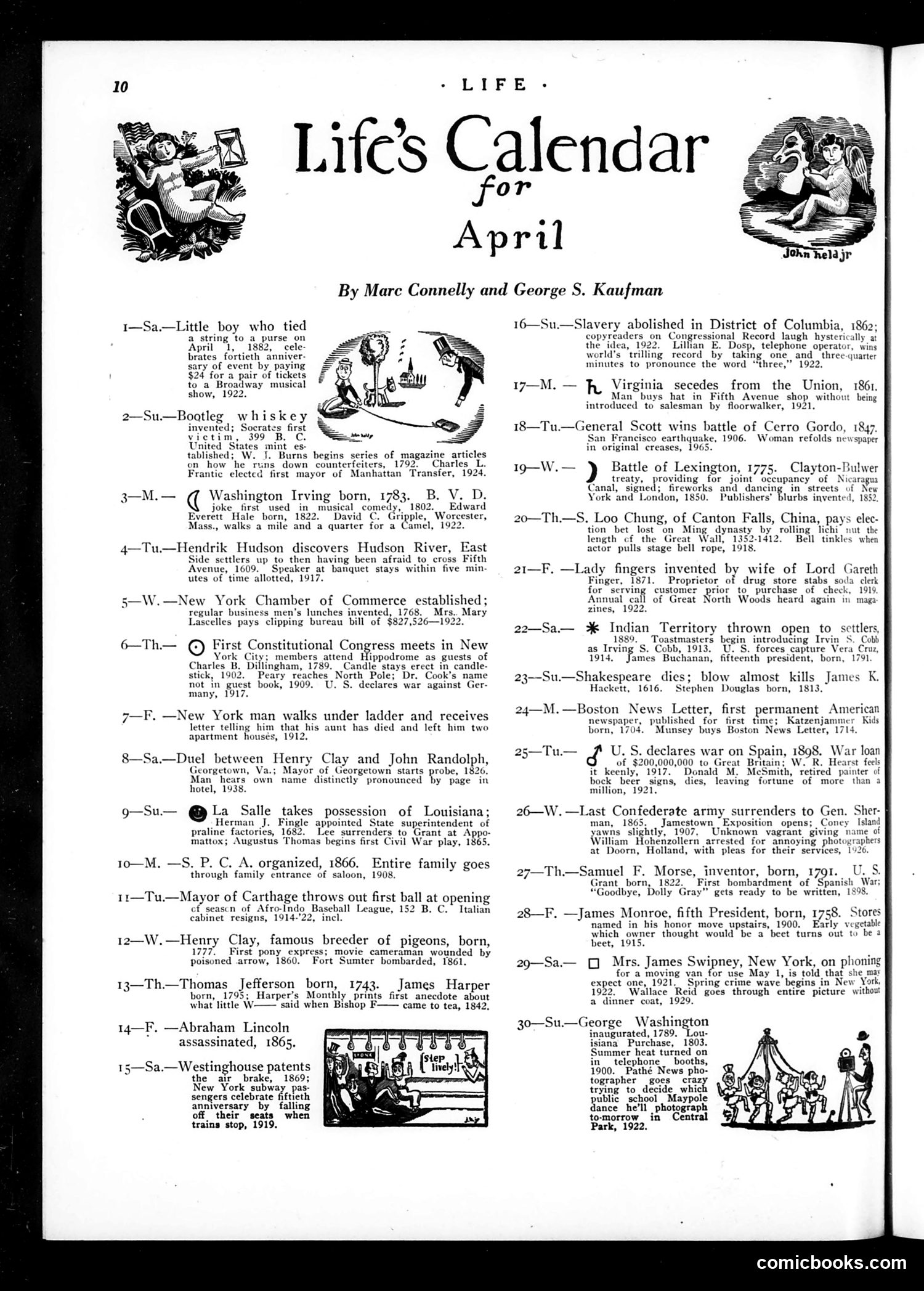
This is an educational calendar page listing historical events and notable births/deaths for each day in April. The small illustrations are decorative vignettes—cherubs and period scenes—typical of Life magazine's design aesthetic. The content itself isn't satirical; it's factual history. Notable entries include slavery's abolition in DC (April 16), General Scott's battle at Cerro Gordo (April 18), and Abraham Lincoln's assassination (April 14). The page includes births of figures like James Monroe and George Washington. One illustration shows what appears to be a factory or industrial scene, reflecting the magazine's interest in modern progress. This is essentially a reference/informational page rather than satirical commentary—common filler content in early 20th-century magazines to provide readers with educational material alongside humor and advertisements.
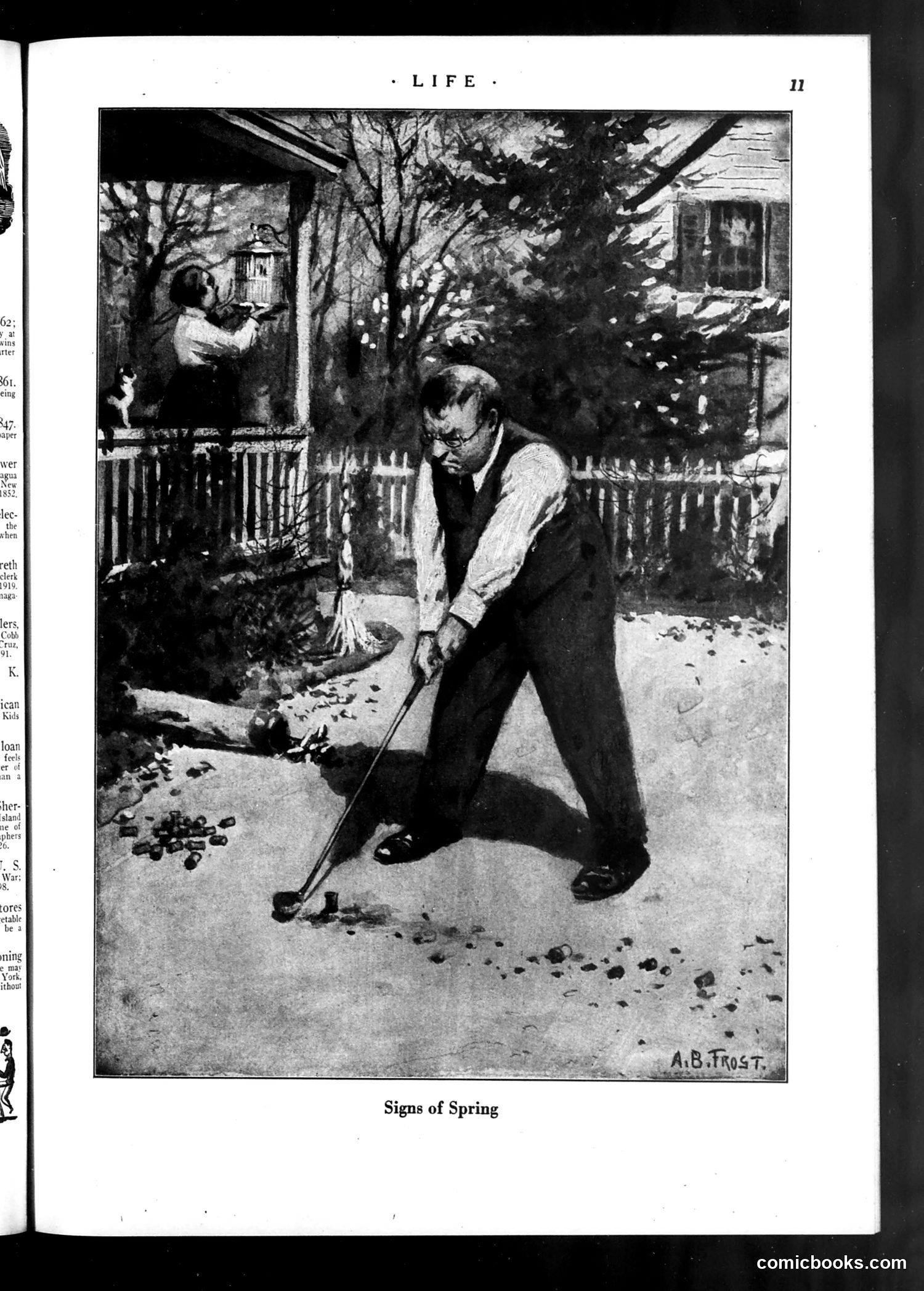
This illustration depicts a man in formal attire (vest and rolled-up sleeves) using a garden hoe on what appears to be a residential property, with a white picket fence and house visible in the background. A woman can be seen in the background on the porch or upper level. The cartoon's title, "Signs of Spring," suggests this is satirical commentary on seasonal domestic activities. The image appears to humorously document spring yard work—specifically gardening or clearing debris from the ground. The formal dress of the man engaging in manual labor may be the joke: the incongruity of a well-dressed gentleman performing working-class yard maintenance, perhaps mocking urban professionals attempting rural or domestic tasks, or commenting on springtime domestic obligations that interrupt normal routines. The photographer is credited as A.B. Frost.
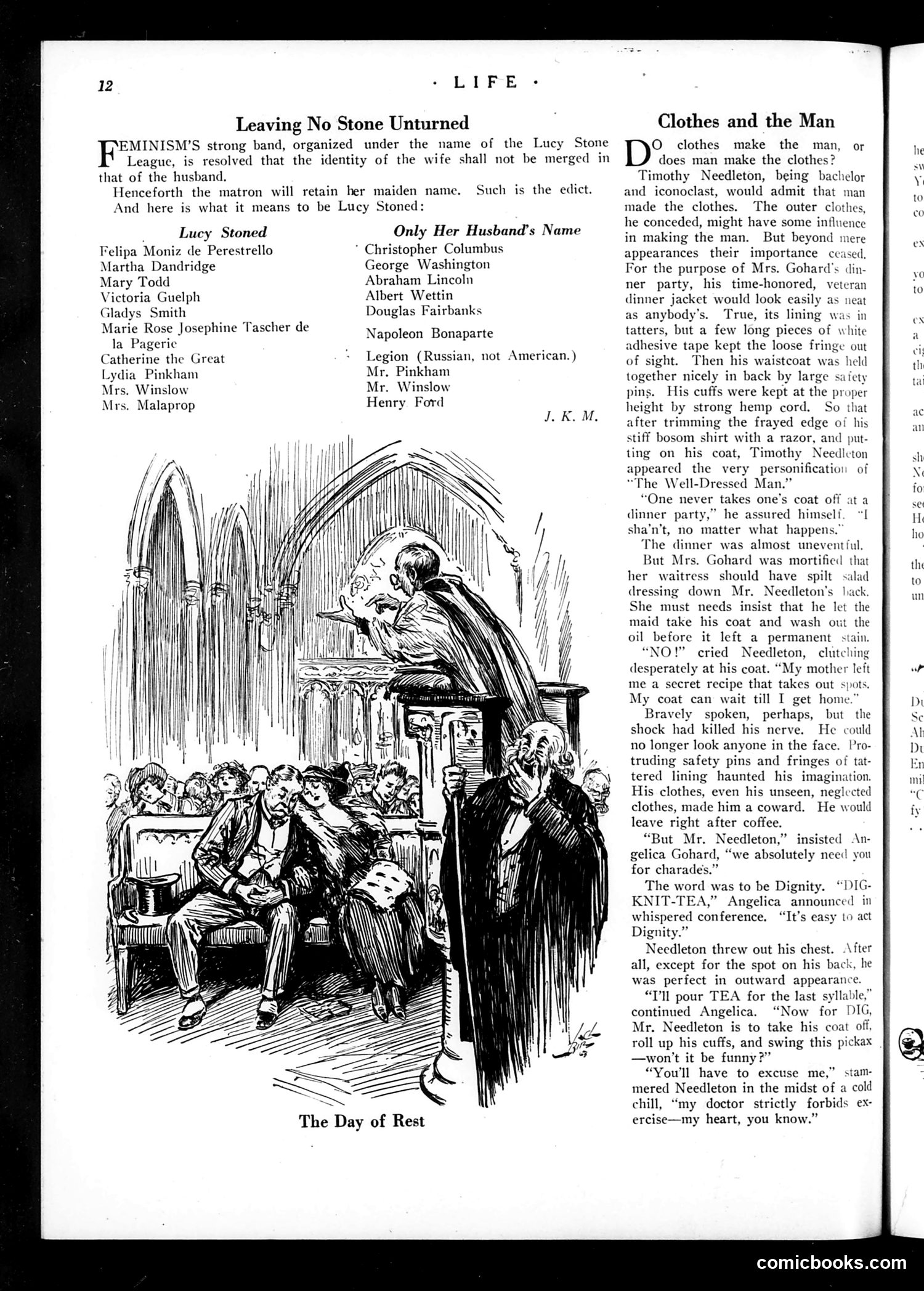
This page contains two separate pieces from Life magazine: **Left side:** "Leaving No Stone Unturned" lists women who retained their maiden names in marriage under the Lucy Stone League (a real feminist organization). The accompanying illustration titled "The Day of Rest" shows a woman resting while a man serves tea—satirizing the reversal of traditional gender roles that such women's independence might represent. **Right side:** "Clothes and the Man" mocks Timothy Needleton, a bachelor obsessed with his appearance and clothing maintenance. The satire suggests his vanity and concern with fashion details (cuffs, fringe, oil stains) make him fussy and overly particular—stereotypically "feminine" behavior. The story ridicules him for prioritizing his coat's cleanliness over social obligations. Both pieces satirize perceived gender role inversions of early 20th-century feminism.
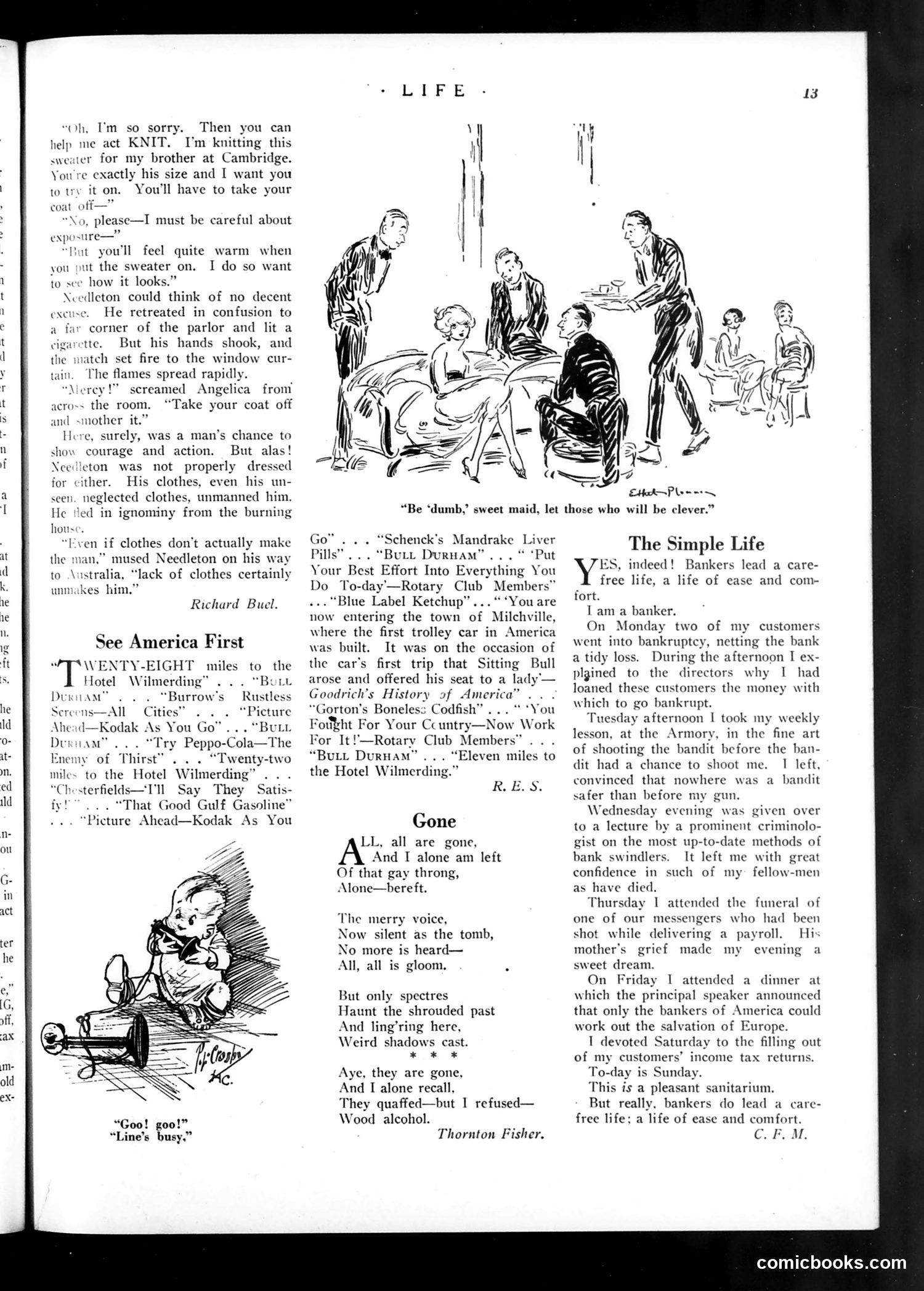
This page contains a satirical article by C.F.M. titled "The Simple Life," which mocks bankers' claims to lead carefree existences. The author, a banker himself, ironically describes his week: attending bankruptcy proceedings, lectures on bank swindlers, and a funeral of a messenger shot during payroll delivery. The piece concludes by noting that bankers actually lead lives of "ease and comfort"—clearly tongue-in-cheek. The accompanying illustration shows a child in a toy car, captioned "Goo! goo!" and "Line's busy." This appears to be unrelated advertising or filler content. The satire targets early 20th-century banking culture and its pretense of simplicity, exposing the actual dangers and moral compromises inherent in the profession.
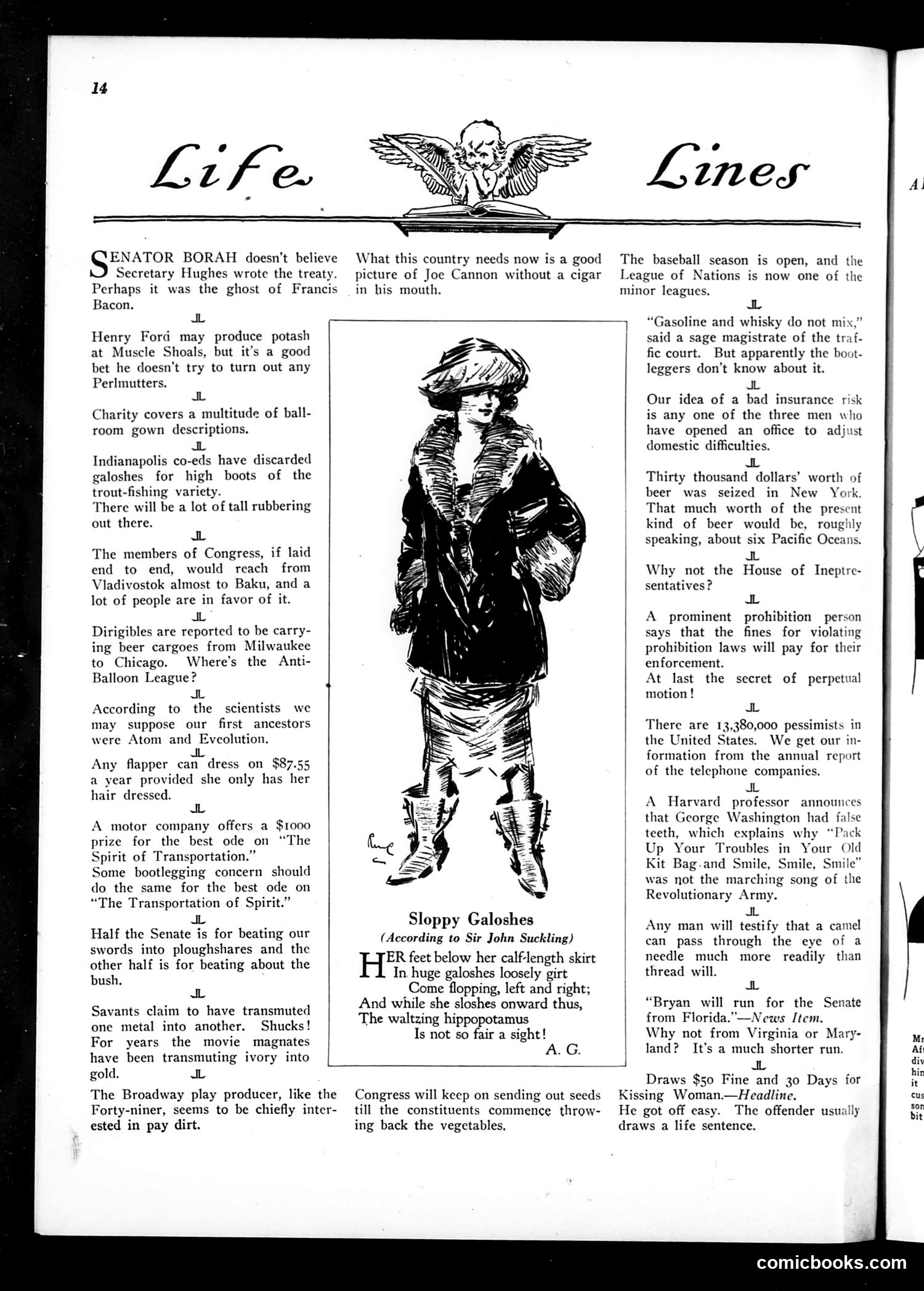
The central cartoon depicts a woman in fashionable 1920s attire with loose-fitting galoshes (rubber overshoes), captioned "Sloppy Galoshes (According to Sir John Suckling)." The satire mocks both women's fashion and pretentious literary references. The poem below ridicules how women wear galoshes loosely and messily rather than properly fastened—a small but visible fashion faux pas that contradicts the era's emphasis on put-together appearance. By attributing this observation to "Sir John Suckling" (a 17th-century poet), the cartoonist satirizes how critics use historical literary authority to comment on contemporary women's fashion choices, treating trivial sartorial matters with undeserved gravitas. The surrounding "Life Lines" offer other satirical one-liners on politics, Prohibition, and social trends of the period.
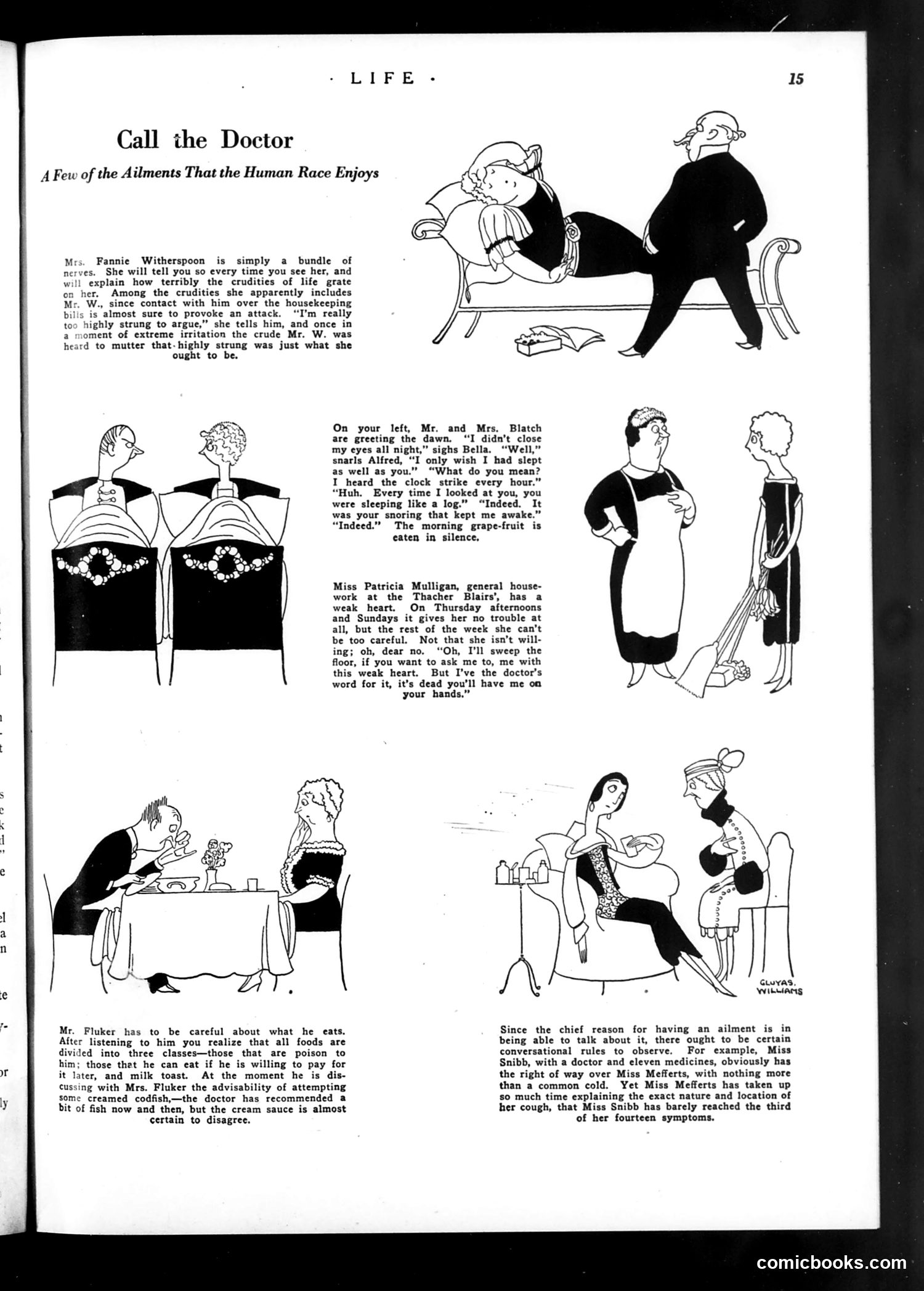
This page satirizes hypochondriacs and those who use minor ailments as social currency or excuses. Each illustrated vignette presents a recognizable type: **Mrs. Witherspoon** is "highly strung"—a nervous woman who blames life's "crudities" (including her husband) for her ailments, using fragility to avoid argument. **Mr. and Mrs. Blatch** bicker through a sleepless night, each blaming the other's snoring/wakefulness, their resentment simmering silently over breakfast. **Miss Mulligan**, despite a "weak heart," uses her ailment strategically—offering to work while invoking her doctor's warnings to avoid actual labor. **Mr. Fluker** obsesses over which foods will cause digestive suffering. The final commentary critiques "ailment etiquette": those with serious conditions should monopolize conversation over minor sufferers. The satire targets a culture where illness becomes a form of status and social performance rather than genuine medical concern.
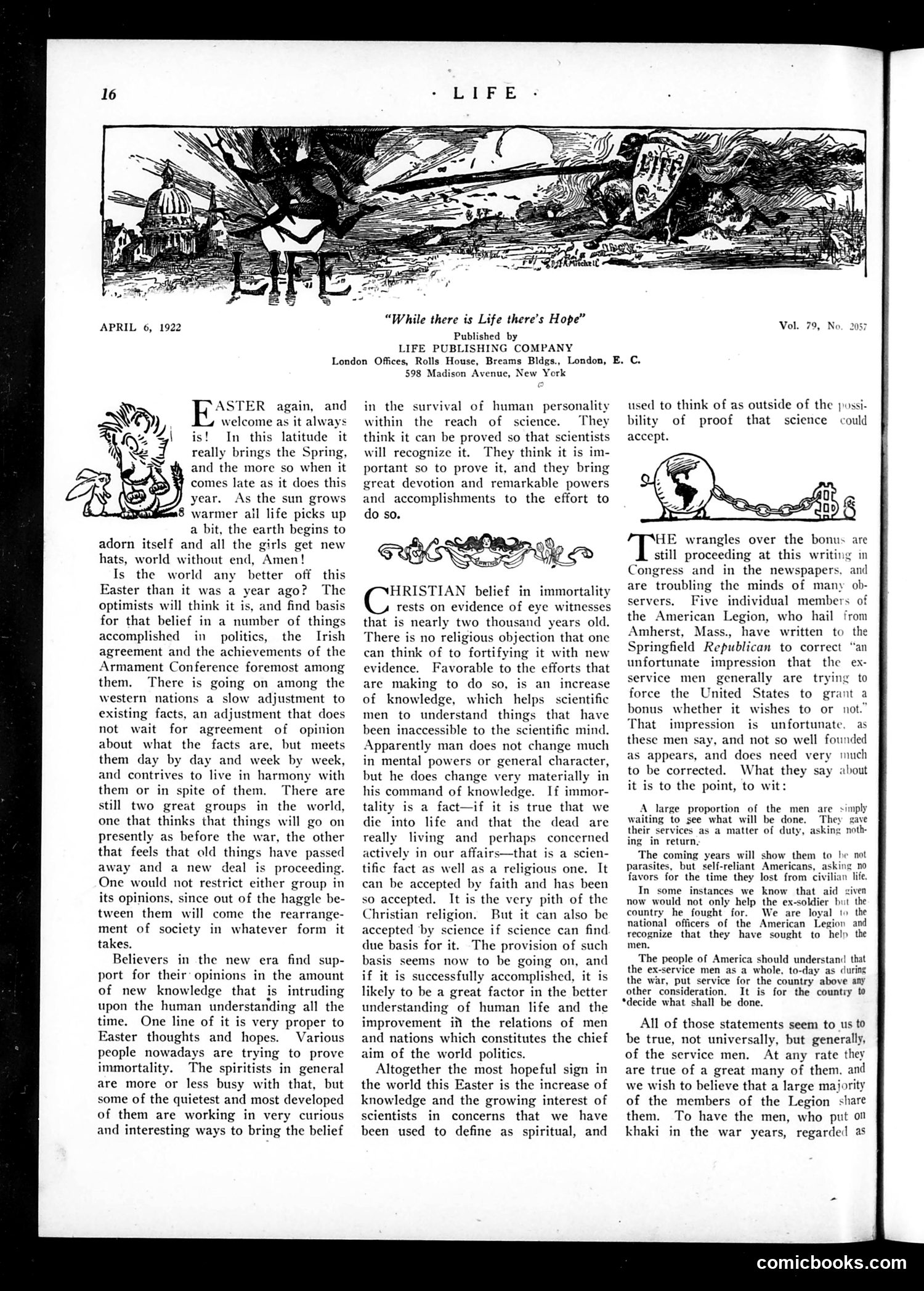
This is an Easter editorial reflecting on post-WWI optimism and spiritual progress. The main illustration shows the word "LIFE" in decorative lettering overlooking a pastoral landscape—symbolizing renewal and hope. The text discusses two competing worldviews among Western nations: those believing pre-war conditions will return, and those accepting permanent social change. The editorial argues the most hopeful sign is scientists increasingly investigating immortality and spiritual matters scientifically, moving beyond traditional faith-only approaches. References include the recent Irish Agreement and Armament Conference (post-war peace efforts). The piece reflects 1920s-era spiritualism's cultural prominence—séances and mediums attempting scientific validation of afterlife claims. The editorial suggests bridging religious and scientific perspectives on immortality offers hope for human understanding and improved international relations. The tone is cautiously optimistic about modernizing Christian belief through empirical investigation.
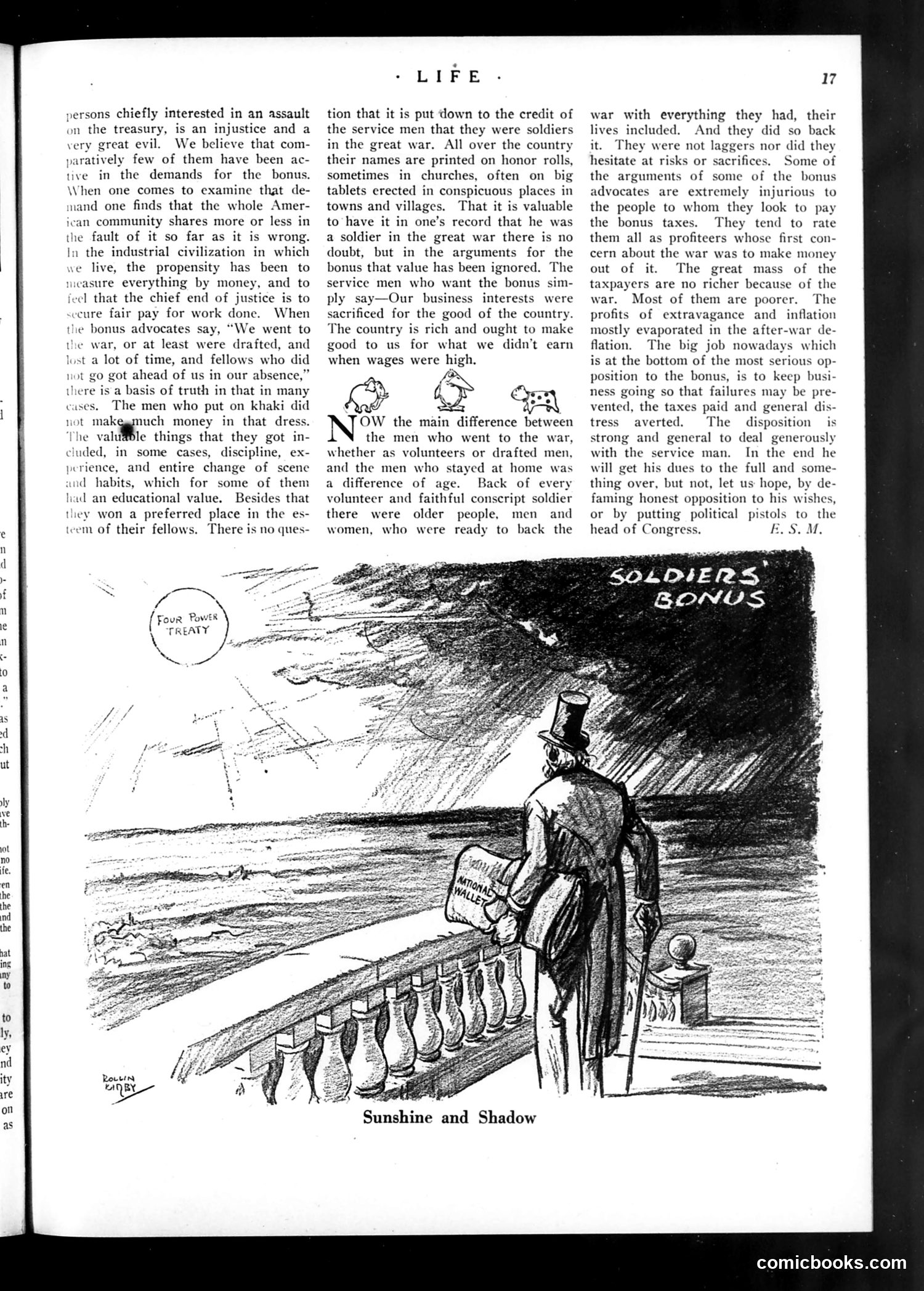
This editorial cartoon addresses the heated 1920s debate over a soldiers' bonus. The figure in the foreground—labeled with what appears to be "Profiteer" or similar—represents those who grew wealthy during WWI while soldiers sacrificed. The "Four Power Treaty" reference (visible in the speech bubble) likely dates this to the early 1920s. The accompanying text argues against the bonus, claiming soldiers already received intangible benefits (honor rolls, social esteem, discipline). The author contends that many civilians and taxpayers also sacrificed—particularly older family members who supported the war effort—and that the nation's economy couldn't afford generous payouts without harming working people. The cartoon's title "Sunshine and Shadow" suggests the contrasting fortunes of those who profited versus those who suffered during the war. The overall message warns against framing the bonus as compensation for business interests that allegedly exploited the war effort.
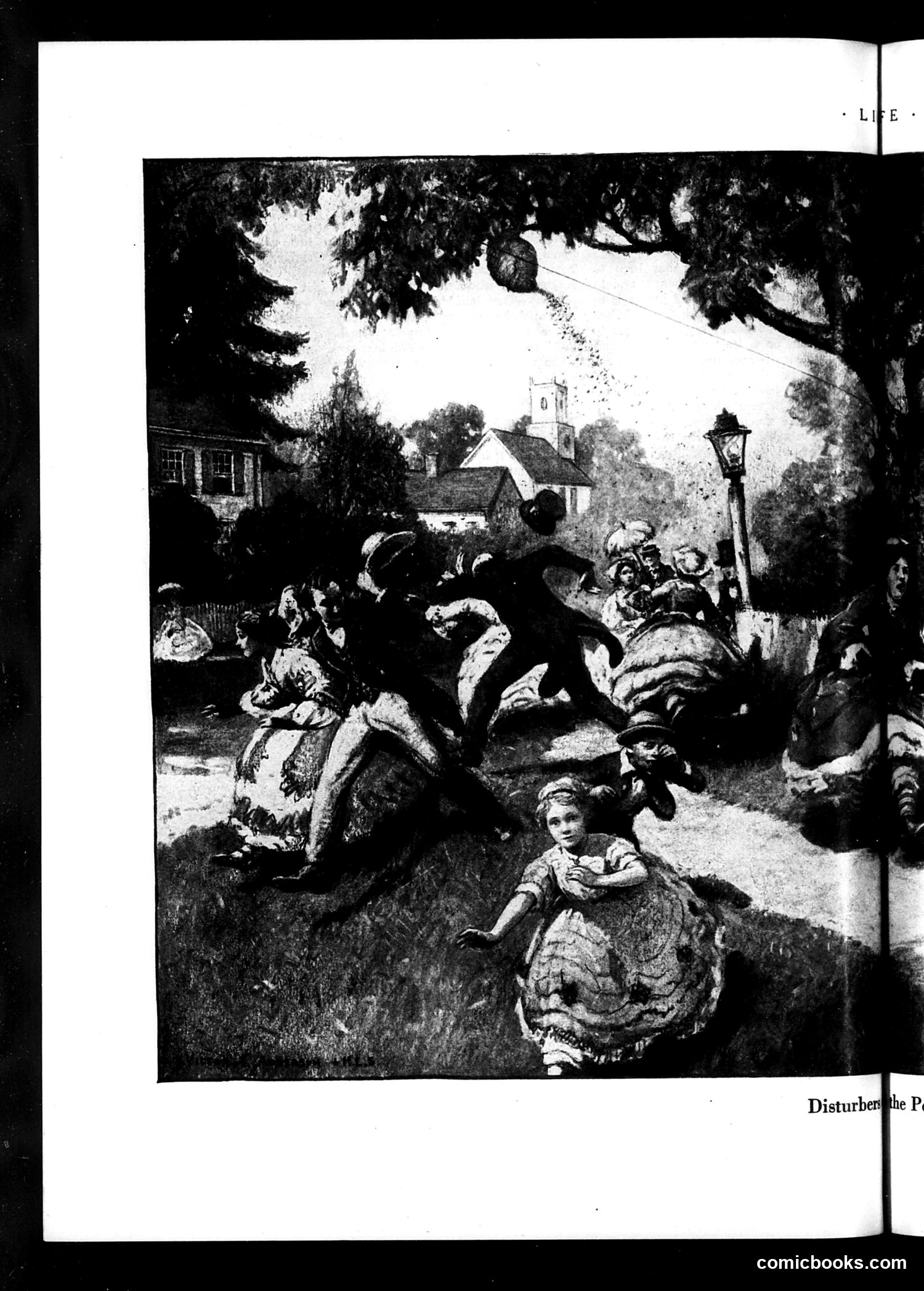
This appears to be a satirical illustration from *Life* magazine depicting a village or town scene with a church visible in the background. The caption at the bottom reads "Disturben the P[eace]" (text cut off). The image shows what appears to be a chaotic public gathering or disturbance—multiple figures in period dress (likely 19th century based on the clothing and engraving style) are engaged in some form of commotion or altercation in a village street. Without seeing the complete caption or accompanying article text, I cannot definitively identify the specific political or social event being satirized. The satire likely comments on public disorder, social upheaval, or a particular incident of civil unrest, but the exact historical reference remains unclear from the visible portions alone.
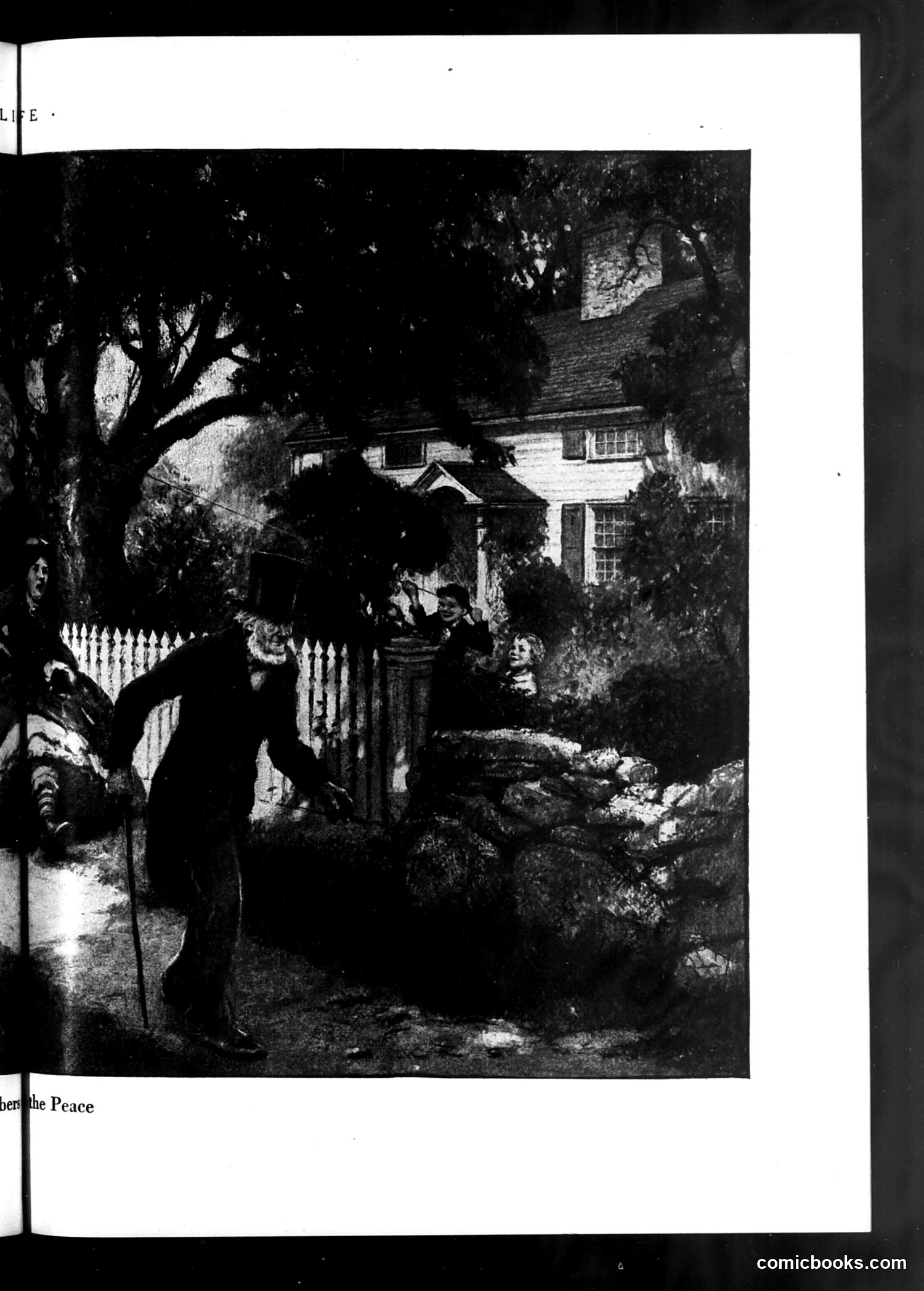
This appears to be a satirical illustration from *Life* magazine showing a nighttime domestic scene. Several figures in dark clothing stand outside a house with a white picket fence, beneath large trees. The caption reads "Remember the Peace," though the specific historical context isn't entirely clear from the image alone. The scene seems to critique or comment on domestic or political tensions, possibly related to post-war circumstances or social upheaval. The nighttime setting, the gathering of figures, and the somewhat ominous atmosphere suggest commentary on unrest or conflict during a period when "peace" was being discussed or promised. Without additional publication date or context, the exact political reference remains unclear, but the satirical tone is evident.
This page reviews three theatrical productions from Life magazine's drama section. The main content critiques: 1. **"Voltaire"** - A historical play by young playwrights Leila Taylor and Gertrude Purcell, starring Arnold Daly as the aged French philosopher. The reviewer mocks the play's slow first act, filled with confusing French character names and tedious exposition about pre-Revolutionary France (set in 1765). The criticism satirizes both the play's construction and the actors' overwrought delivery—comparing their declamatory style to schoolchildren at "Friday afternoon visitors' hour in the Seventh Grade." 2. **"The Truth About Blayds"** - Praised as superior to "Voltaire," this play humorously explores how a spurious poet gains undeserved literary fame, prompting the reviewer's tongue-in-cheek distrust of all literary reputations. The small decorative cartoons show theatrical figures but lack specific identifiable caricatures of named individuals. The satire targets theatrical conventions and amateur playwriting rather than political figures.
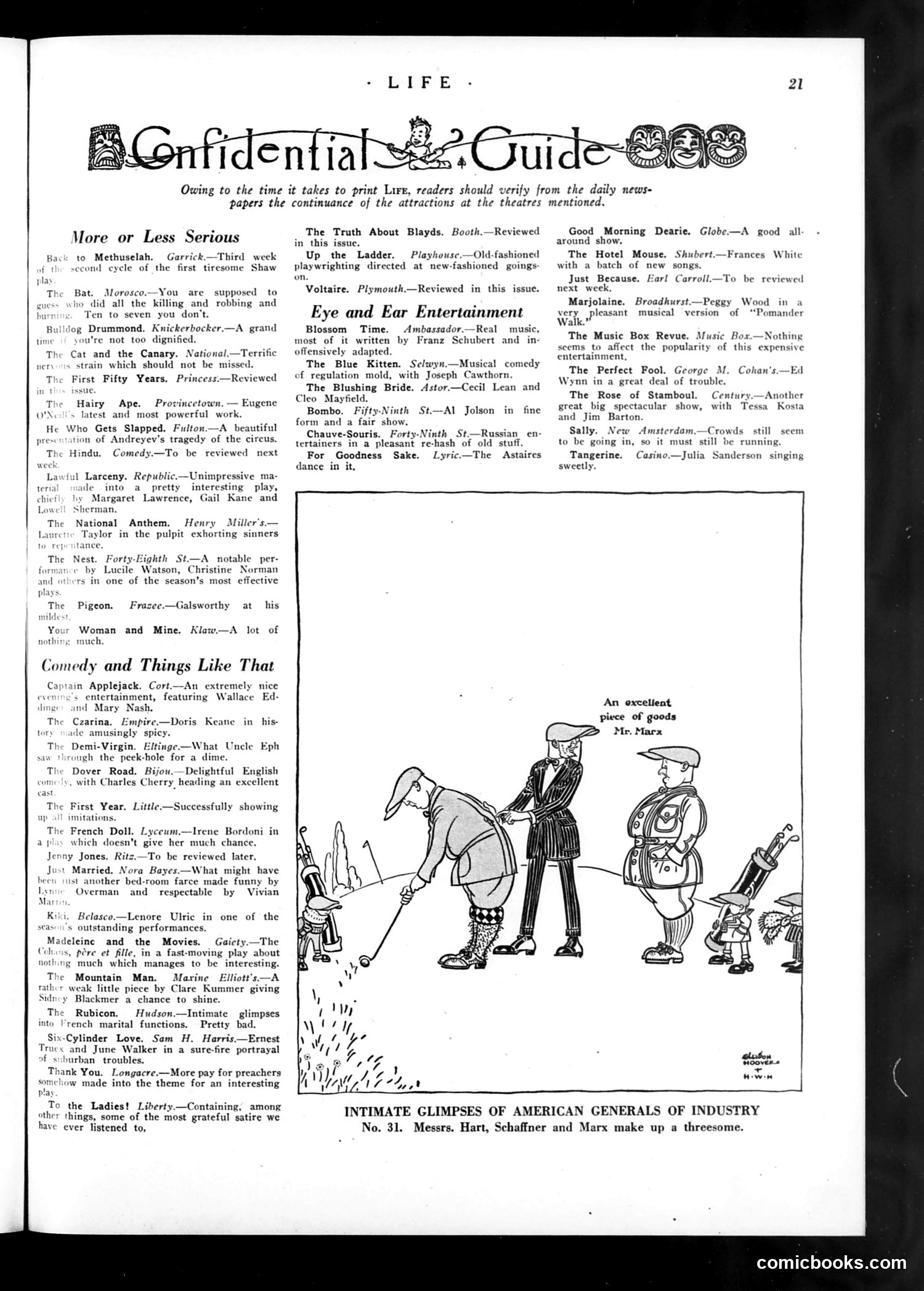
This page is primarily a **theater review section** listing Broadway productions currently running, with brief critical assessments. The content is not primarily political satire but entertainment criticism. The main illustration at bottom depicts "**Intimate Glimpses of American Generals of Industry**" — specifically "Messrs. Hart, Schaffner and Marx make up a threesome." This is a **commercial joke**: the three figures represent the clothing company Hart, Schaffner & Marx, humorously styled as "industrial generals." One figure swings a golf club while others carry briefcases, satirizing wealthy businessmen as both industrialists and leisure-class golfers. The page itself serves as an **advertisement masquerading as editorial content** — the theater listings subtly promote shows while appearing to offer genuine criticism. The disclaimer at top acknowledges printing delays make listings potentially outdated. The satire is gentle, focused on entertainment rather than politics or serious social commentary.
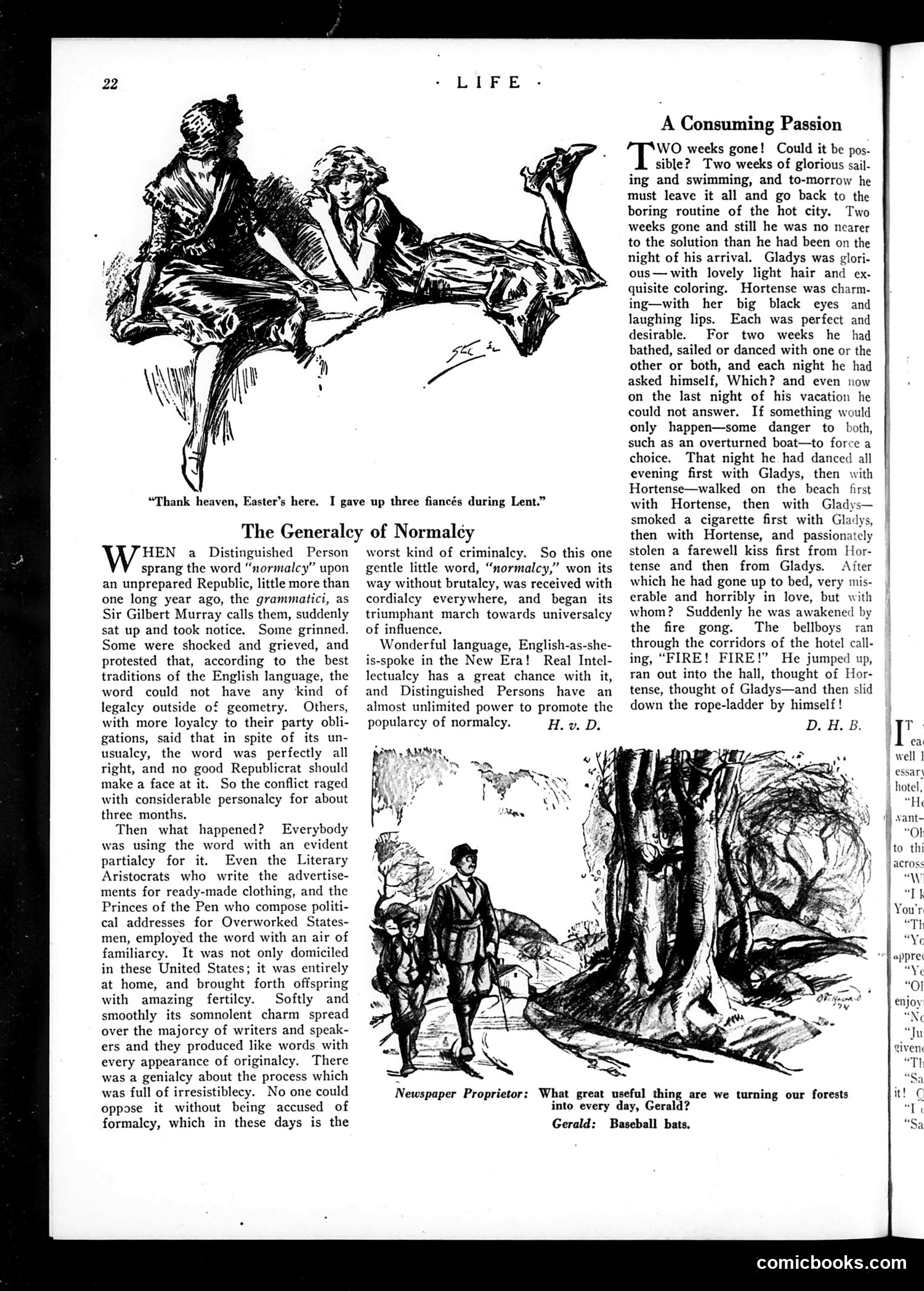
This page contains two satirical pieces typical of Life's early 20th-century humor. **"The Generalcy of Normalcy"** mocks President Warren G. Harding's coinage of "normalcy" (1920-1921). The article satirizes how intellectuals initially resisted this grammatically questionable word, then surrendered as it became ubiquitous. The author humorously invents "-cy" suffix variations ("personalcy," "fertilcy," "criminalcy") to mock both the word's acceptance and how language evolves through popular usage rather than rules. **"A Consuming Passion"** is a comedic short story about a man vacationing with two romantic interests—Gladys and Hortense—unable to choose between them. The joke's punchline: when a hotel fire forces a decision, he saves himself by rope-ladder, abandoning both women. It's dark humor satirizing male indecision and selfishness. **The cartoon below** shows a newspaper proprietor asking what useful forest products exist; the editor replies "Baseball bats"—mocking wasteful industrialization during an era of forest conservation debates. All three pieces employ Life's signature satirical approach: social commentary through exaggeration and unexpected reversals.
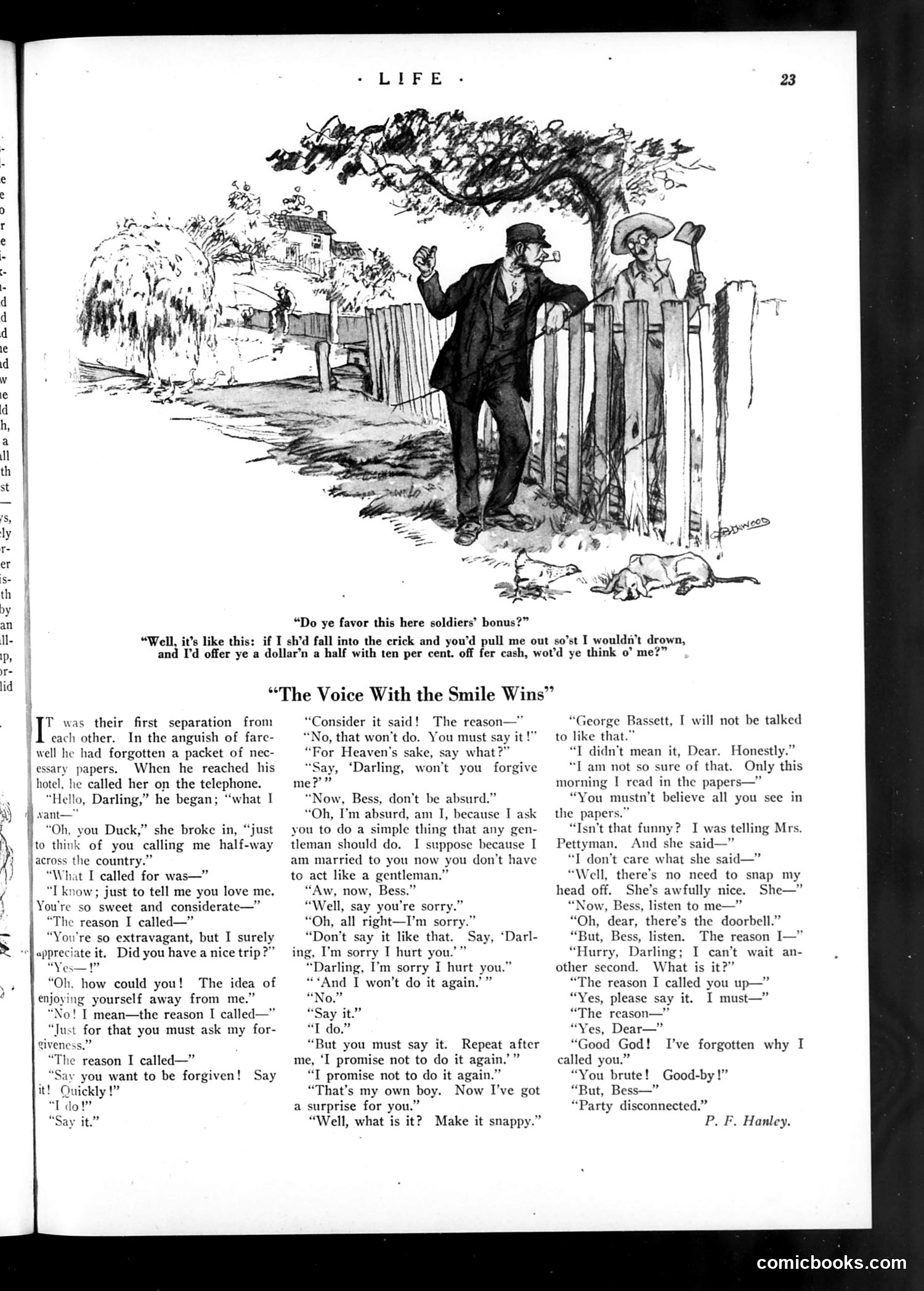
This satirical story by P.F. Hanley mocks the dynamics of an argumentative married couple through a telephone conversation. A husband calls his wife from his hotel, intending to ask about forgotten papers, but she repeatedly interrupts and misinterprets his purpose—assuming he's calling to express love and apologize. The humor lies in her manipulation: she keeps him repeating scripted apologies and promises ("Say it like this..."), derailing his actual reason for calling. By the story's end, after this exhausting emotional performance, he genuinely forgets why he originally called. The title ironically suggests that the "voice with the smile"—her sweet manipulation—"wins" the interaction, though the victory is hollow: she gets compliance but loses the actual information exchange. The satire targets manipulative relationship tactics and how excessive emotional demands can defeat practical communication between spouses.
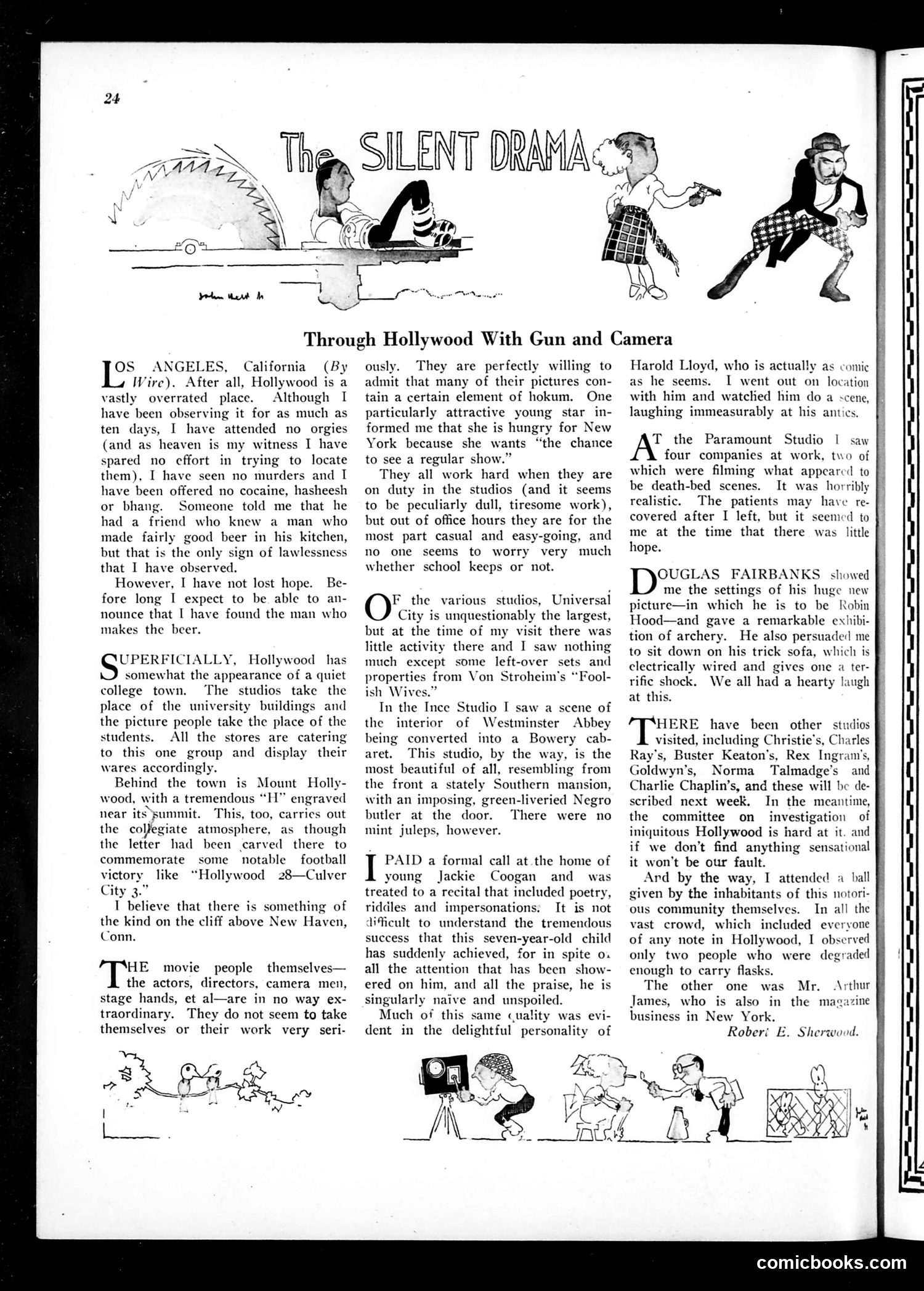
This is a satirical travel report mocking Hollywood's reputation and reality. The author visits for ten days expecting scandalous behavior—orgies, drug use, violence—but finds Hollywood disappointingly ordinary: a quiet college town where movie people work hard but remain casual and unpretentious. The satire targets both Hollywood's exaggerated public image and the industry itself. The writer visits major studios (Universal, Ince, Paramount) and meets stars like Douglas Fairbanks, Harold Lloyd, and child actor Jackie Coogan, noting they're surprisingly normal and humble despite their fame. The cartoons at bottom appear to illustrate the filmmaking process humorously. The overall tone suggests Life's readership should be amused by the gap between Hollywood's scandalous reputation and its mundane reality—deflating both celebrity mystique and moralistic concerns about the film industry's depravity.
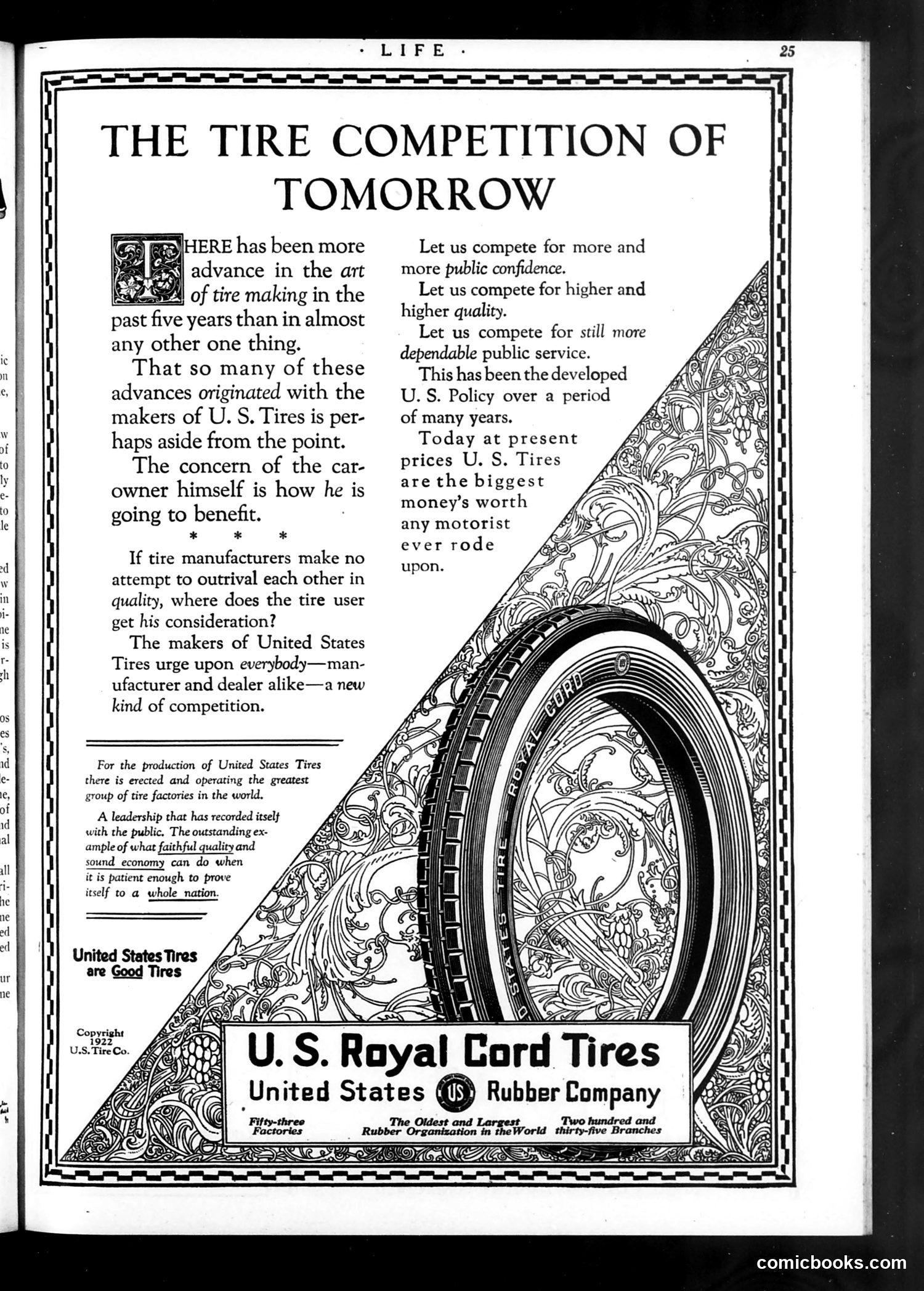
This is **not a cartoon or satire**, but rather a **corporate advertisement** for United States Rubber Company's tire division. The ad argues that tire manufacturers should compete on **quality and reliability** rather than price-cutting. It frames this as an ethical business philosophy: rather than competing destructively, manufacturers should vie for "public confidence," "higher quality," and "dependable service." The ornate decorative border and formal design suggest this appeals to readers' sense of propriety—that competition *should* be gentlemanly and focused on merit. The company boasts of its "fifty-three factories" and status as "the oldest and largest rubber organization in the world." The implicit message: U.S. Tires competes the "right way" and offers the best value. For modern readers, this reflects early 20th-century business rhetoric before aggressive marketing became standard—pitching restraint and quality as competitive advantages rather than undercutting rivals on cost.
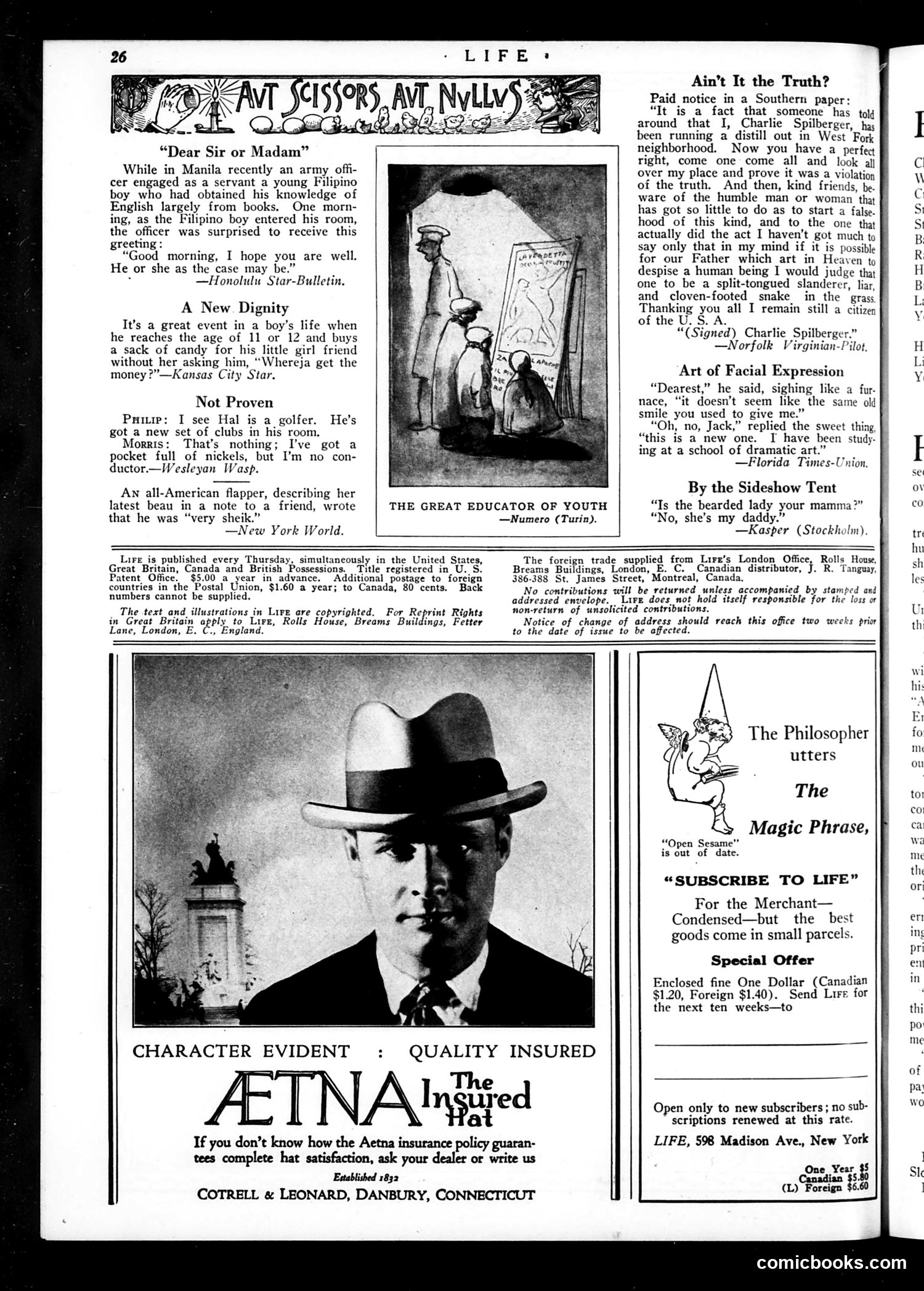
This page contains **mostly humorous anecdotes and advertisements** rather than political cartoons. The content reflects early 20th-century American humor: **Key items:** 1. **"Dear Sir or Madam"** — A Filipino servant's overly formal English greeting, mocking both linguistic pretension and colonial-era servant dynamics. 2. **"The Great Educator of Youth"** — A cartoon showing a child studying from a large book labeled "Numero," satirizing how youth learn from questionable sources. 3. **"Ain't It the Truth?"** — A lengthy rural complaint notice from someone named Charlie Spilberger denying moonshine distilling rumors, presented as absurdly humorous small-town drama. 4. **Various brief jokes** about golfers, flappers (modern young women), and gender roles. 5. **The AETNA hat advertisement** features a stern-faced man promoting insurance quality. The satire targets pretension, rural gullibility, changing social mores (flappers), and immigrant/colonial labor dynamics. The tone is lighthearted, reflecting 1920s-era American magazine humor—genteel rather than sharp political commentary.
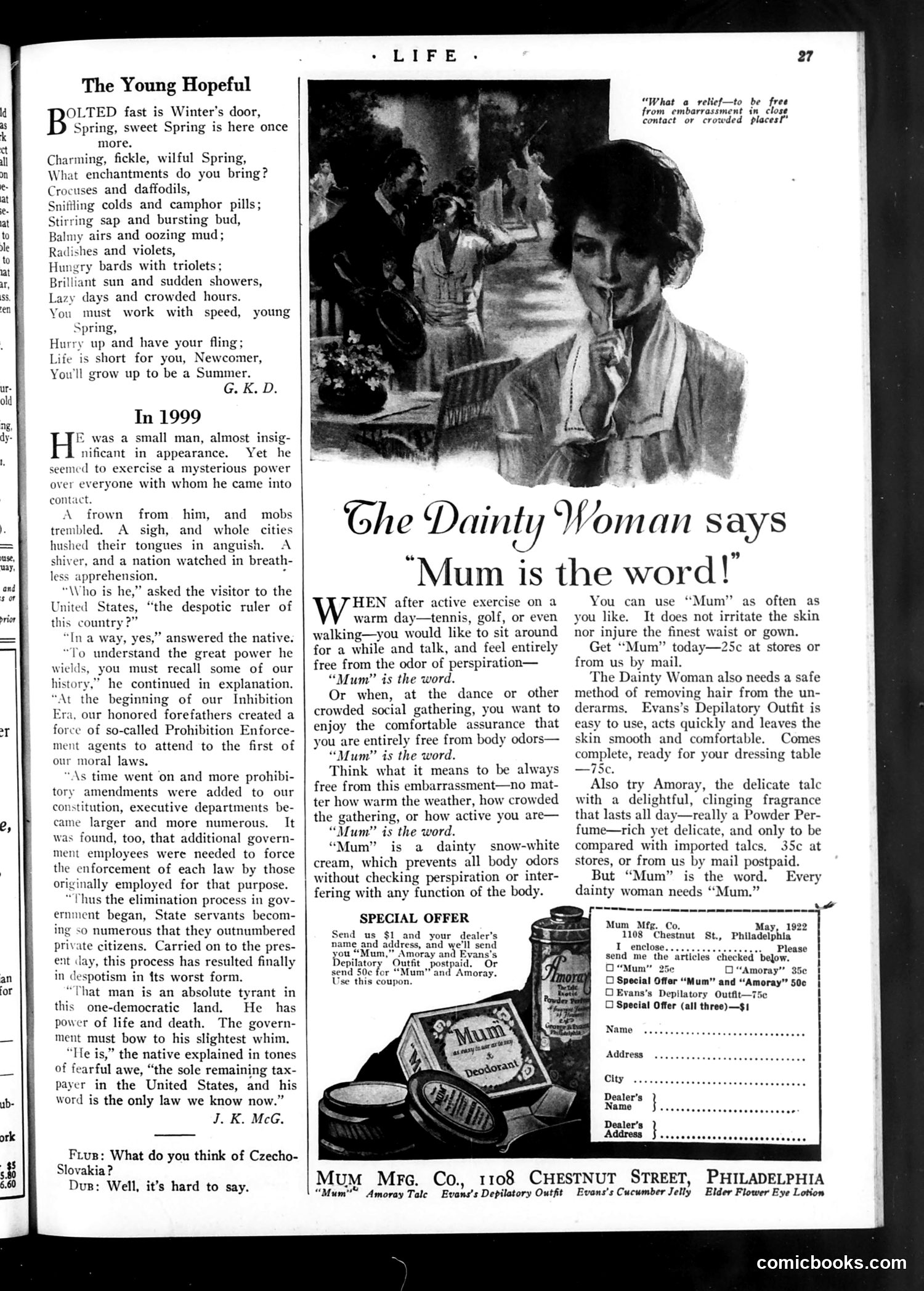
This page contains two distinct pieces of satire: **"The Young Hopeful"** is a poem mocking spring's arrival and the pressure on youth to seize the moment—a gentle social satire about mortality and ambition. **"In 1999"** is the sharper political satire. It depicts a dystopian future where a single bureaucrat has become an absolute dictator. The scenario illustrates anxiety about government overreach during Prohibition era America. The joke: endless bureaucratic expansion to enforce increasingly numerous laws eventually creates a tyrant—the "sole remaining taxpayer" whose authority becomes absolute because there are more government employees than citizens. The final jab at the end references Czechoslovakia's political instability (newly independent post-WWI), implying America risks similar autocracy. The satire critiques both Prohibition enforcement and the bloated bureaucratic apparatus it spawned—reflecting widespread 1920s skepticism about government power. The remainder of the page is a **"Mum" deodorant advertisement** targeting women, offering products to prevent body odor and unwanted hair—period marketing emphasizing social embarrassment and feminine propriety.
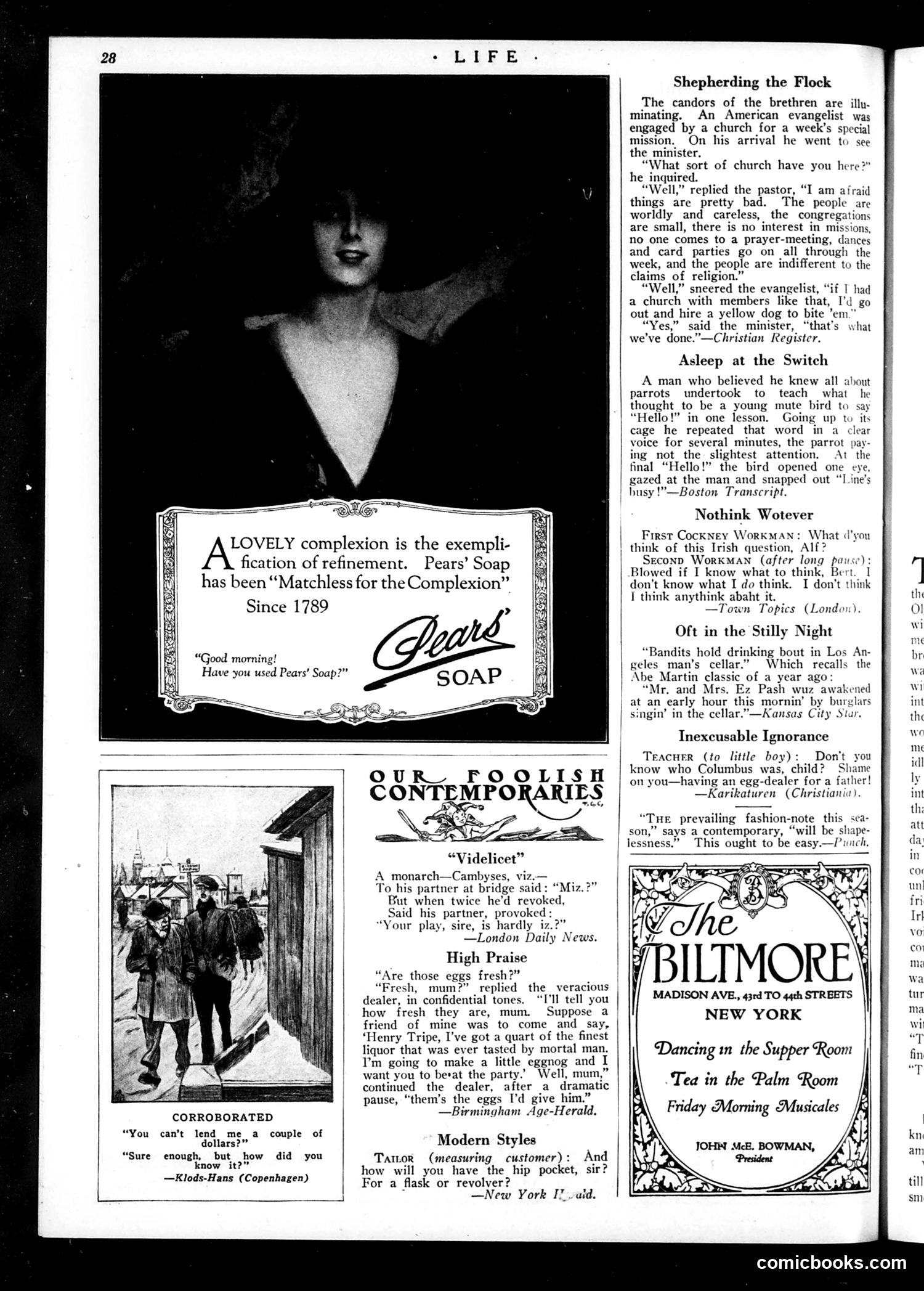
This page contains multiple short satirical anecdotes and jokes typical of Life magazine's humor section, plus advertisements. **Key satire includes:** - **"Shepherding the Flock"**: Mocks both a complacent pastor and a self-righteous evangelist. The pastor admits his congregation is worldly and indifferent to religion; the evangelist, rather than offering spiritual solutions, suggests hiring a dog to bite them. The punchline—"that's what we've done"—suggests the congregation is already beyond redemption, satirizing evangelical self-righteousness. - **"Modern Styles"**: A tailor asks a customer whether he wants a hip pocket for a flask or revolver, joking that both are fashionable—a reference to Prohibition-era drinking and contemporary violence concerns. - **"Nothink Wotever"**: Two cockney workmen discuss the Irish Question (Irish independence), with one admitting complete ignorance, satirizing working-class political indifference. The page is primarily humorous commentary on contemporary social issues: religious hypocrisy, Prohibition, and political apathy.
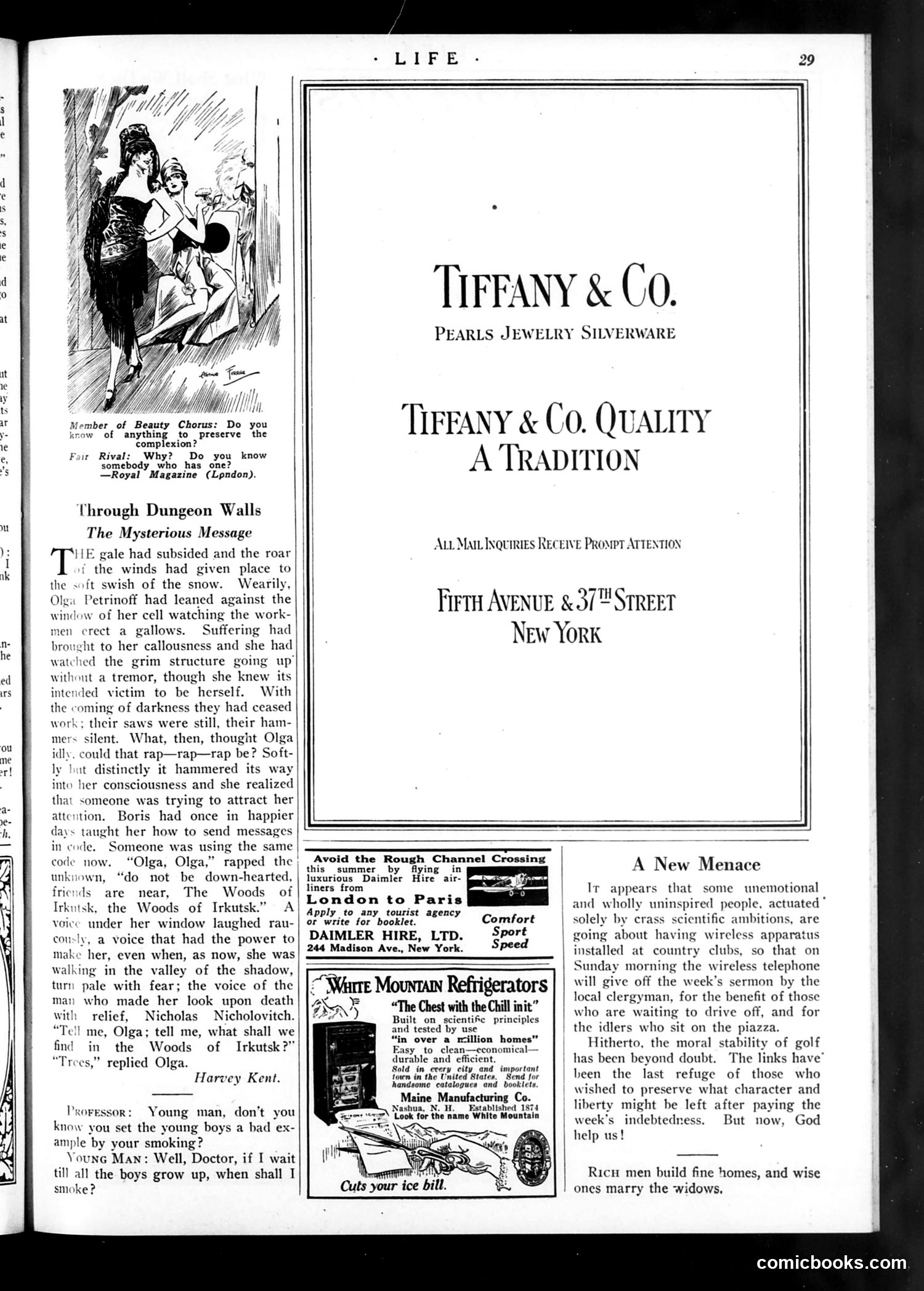
This page contains several distinct elements: **The Cartoon/Joke** (top left): A beauty chorus member asks a rival if she knows anything to preserve complexion. The rival replies, "Why? Do you know somebody who has one?" — a catty insult suggesting the questioner has no complexion worth preserving. This is typical 1920s-era salon humor about women's appearances and competitive vanity. **The Serial Story** ("Through Dungeon Walls"): A melodramatic spy/romance narrative about a woman named Olga imprisoned in Russia, awaiting execution, receiving coded messages. This appears to be serialized fiction, a common Life magazine feature. **The Jokes** (bottom): A professor-student exchange about smoking sets up an absurdist punchline about procrastination. **Advertisements**: Tiffany & Co., Daimler Hire airline service, White Mountain Refrigerators, and Maine Manufacturing Company comprise most of the page's content. **"A New Menace"** (right column): Social commentary mocking wealthy people installing wireless radios at country clubs to broadcast Sunday sermons to golfers—critiquing both excessive technology and the pretense of forced piety.
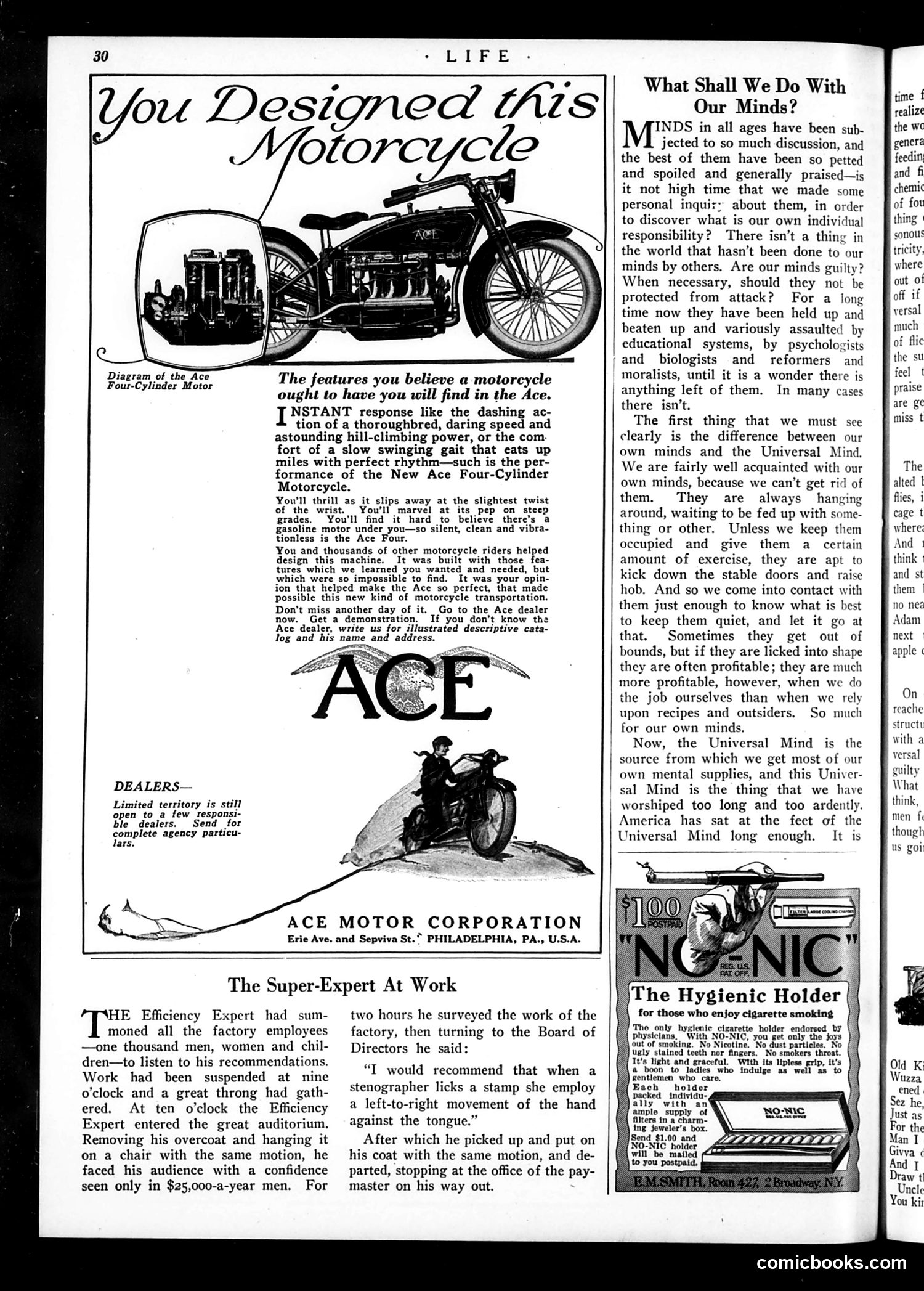
This page contains **advertisement and philosophical essay**, not political satire. ## The Ace Motorcycle Ad The dominant left-side content advertises the Ace Four-Cylinder Motorcycle, claiming it incorporates features riders requested. The accompanying diagram and sales copy emphasize the bike's performance ("instant response," hill-climbing power, silent running). This is straightforward commercial advertising seeking dealer inquiries. ## "What Shall We Do With Our Minds?" The right-side essay (author unclear) presents a philosophical argument about mental self-determination. It distinguishes between individual minds—which require exercise and discipline—and the "Universal Mind," which the author argues America has "worshiped too long." The piece advocates for intellectual independence from external systems (education, psychology, moralism) that have "assaulted" minds. The essay's tone is critical of intellectual dependence but doesn't reference specific political figures or events. It reads as general cultural commentary about American over-reliance on external authorities for thinking. The bottom section briefly describes an "Efficiency Expert" addressing factory workers, likely setting up a separate piece elsewhere in the magazine.
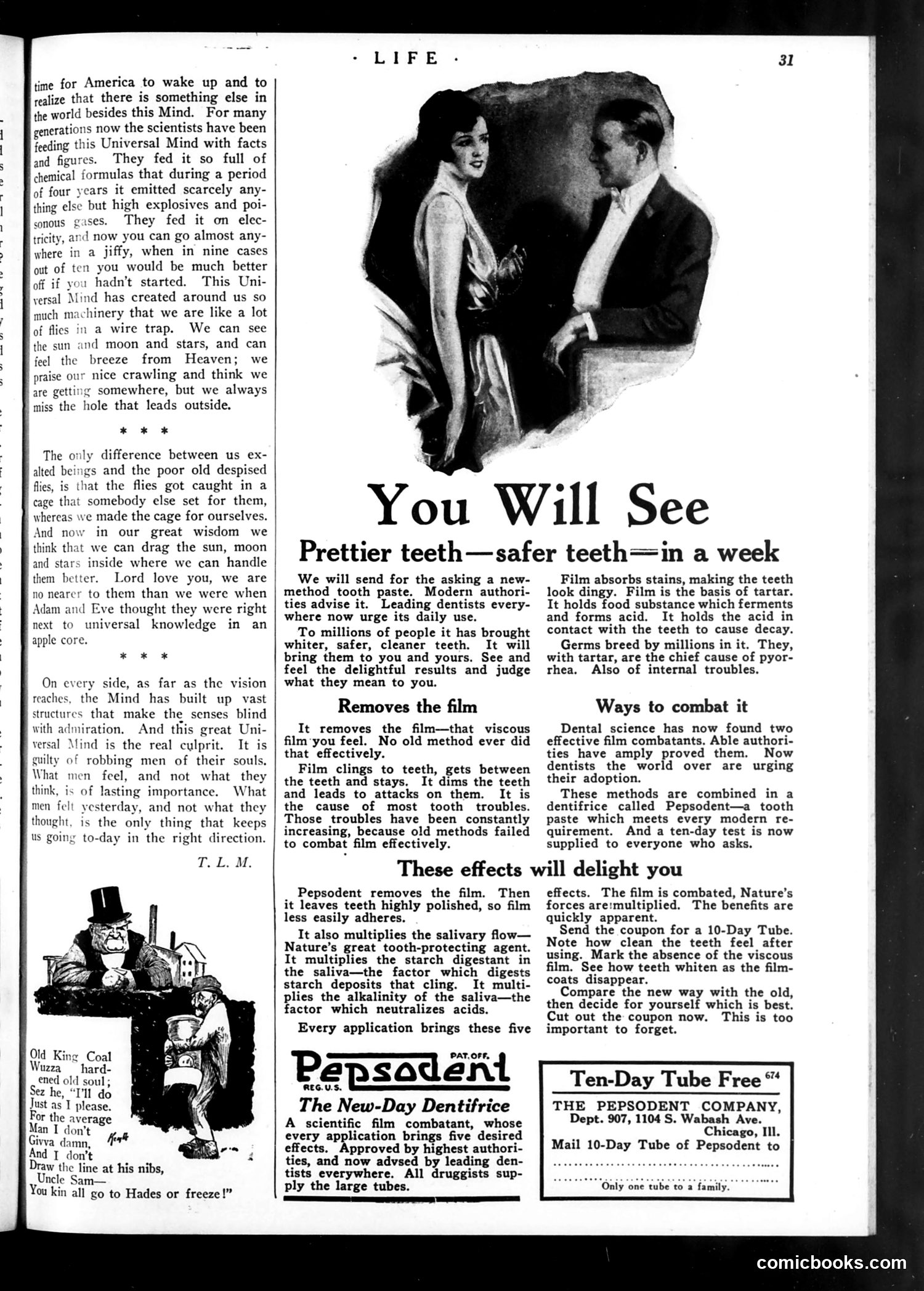
This page combines **editorial commentary with advertising**. The upper text is a philosophical essay (bylined T.L.M.) criticizing modern industrial civilization. It argues that scientific advancement and machinery have trapped humanity like "flies in a wire trap"—we've built cages for ourselves and lost touch with what truly matters: human feeling rather than intellectual achievement. The essay references World War I ("four years it emitted scarcely anything else but high explosives"), blaming the "Universal Mind" of science for technological horrors. The **"Old King Coal" cartoon** (lower left) appears to satirize industrial resistance to regulation, depicting a defiant coal magnate who refuses oversight and tells everyone to "go to Hades or freeze"—mocking the power of coal interests. The **bulk of the page is a Pepsodent toothpaste advertisement**, which ironically undercuts the essay's anti-technology message by promoting a modern scientific product (film-combating dentifrice) using the very rational, scientific arguments the editorial just criticized.
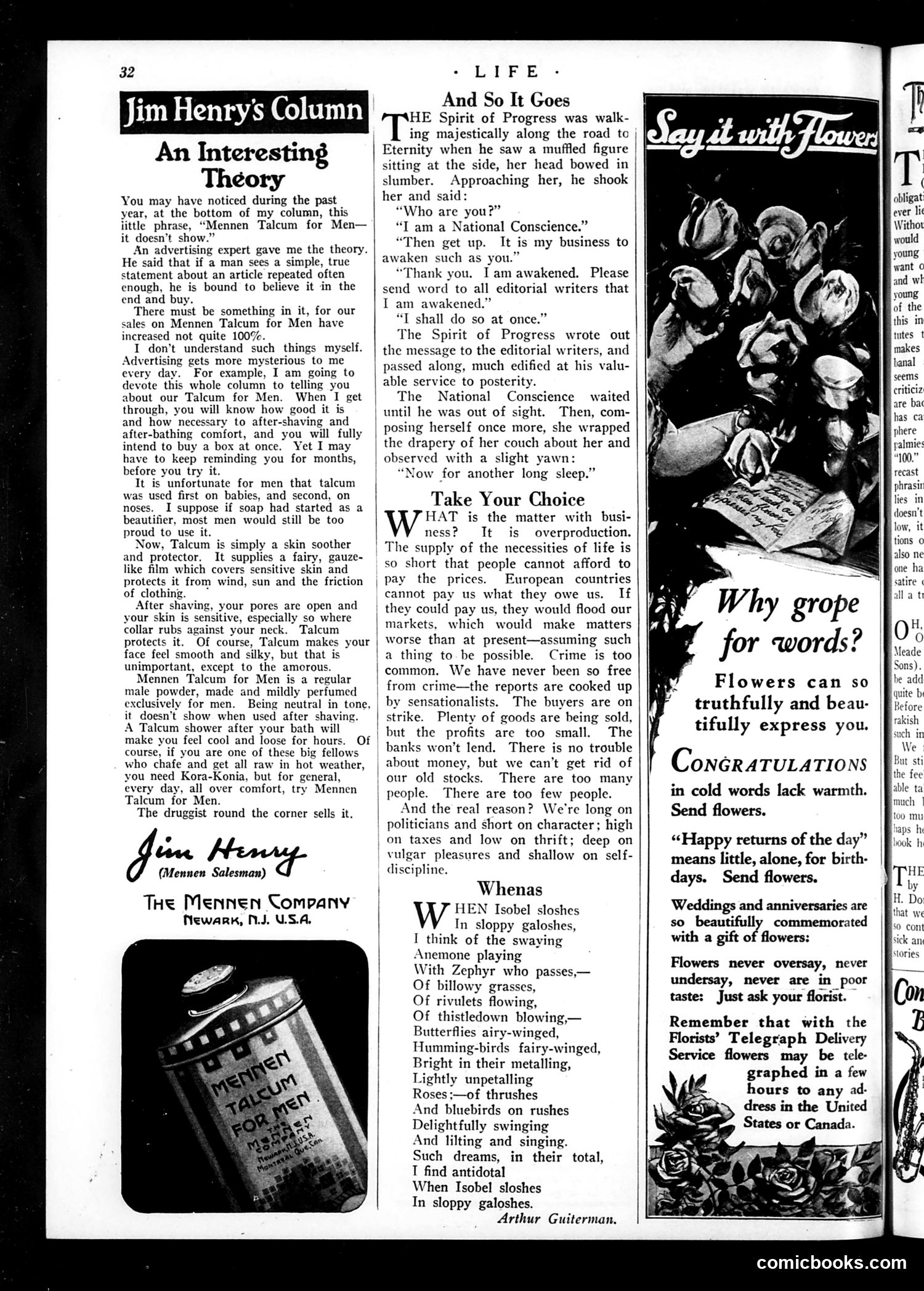
This page contains **Jim Henry's Column** promoting Mennen Talcum for Men—essentially advertorial content disguised as journalism. Henry, identified as a "Mennen Salesman," uses psychology-based argument: repeated simple claims create buyer belief, even if readers don't immediately purchase. The satirical piece **"And So It Goes"** allegorizes postwar economic contradictions. A personified "National Conscience" awakens momentarily to progress, then immediately returns to sleep—suggesting public indifference to systemic problems. The accompanying prose "Take Your Choice" catalogs paradoxes: overproduction yet scarcity, unemployment yet labor surplus, crime waves yet cooking the statistics. The satire mocks how business leaders blame conflicting causes simultaneously rather than address root problems. The **flower advertisement** (right side) offers sentimental solutions to social disconnection—"words lack warmth," so send flowers instead. Together, the page satirizes how 1920s America addresses serious economic/social issues through distraction, advertising, and superficial sentiment rather than substantive reform.
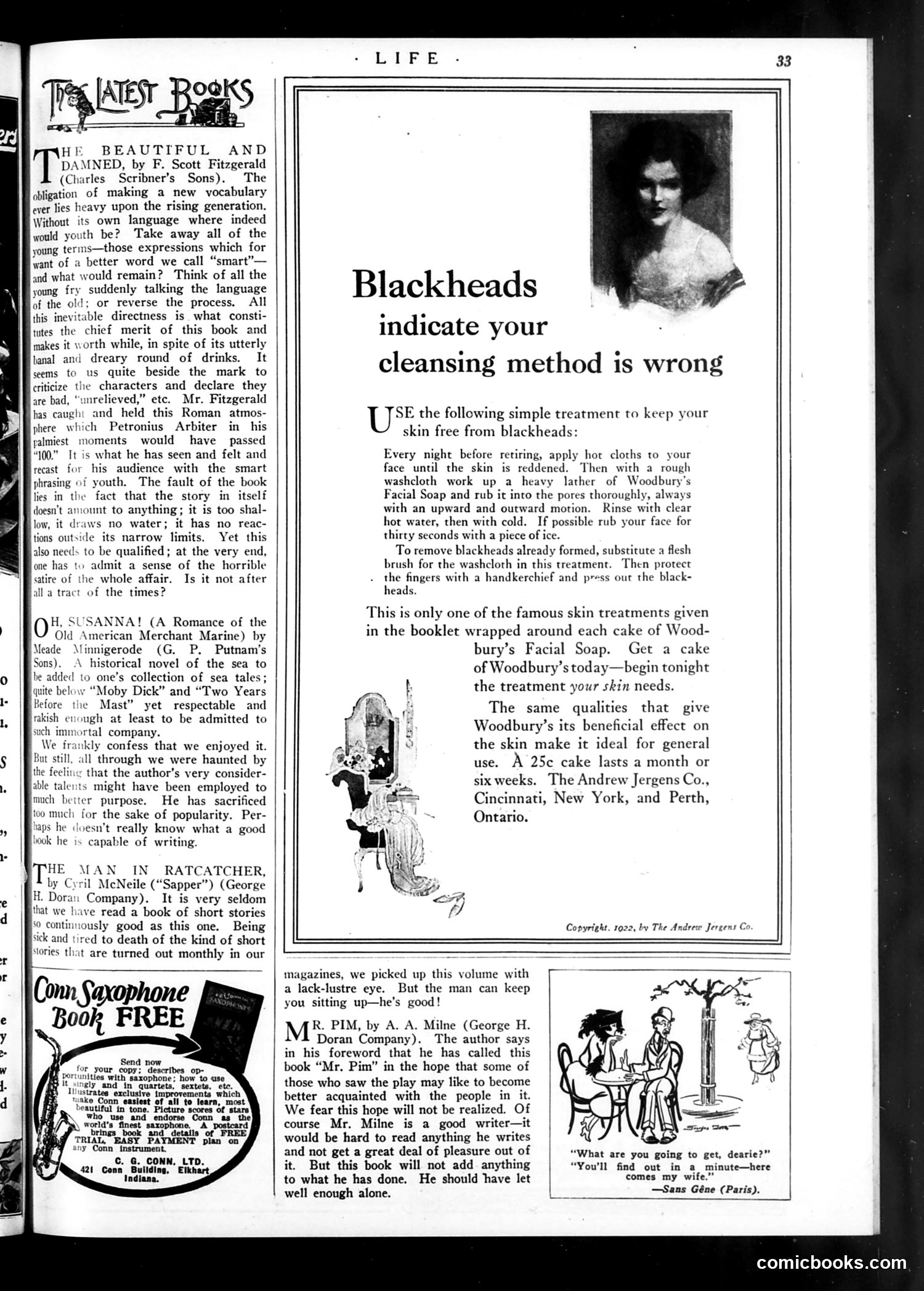
This page is primarily **advertising for Woodbury's Facial Soap**, disguised as editorial content about skincare. The large advertisement uses before-and-after imagery and pseudoscientific language to promote a specific cleansing regimen for "blackheads"—a common skin concern. The page also contains book reviews in the left column, notably of F. Scott Fitzgerald's *The Beautiful and Damned*, which the reviewer praises for capturing youth's distinctive slang and "smart" language, though criticizes as shallow in plot. The small cartoon at bottom-right is a generic domestic joke about husbands and wives—typical filler humor for the era. **Key historical context**: This represents early 20th-century advertising strategy—disguising product promotion within magazine editorial to appear as genuine advice rather than commercial pitch. The pseudo-medical tone was common before modern FDA regulation of cosmetic claims.
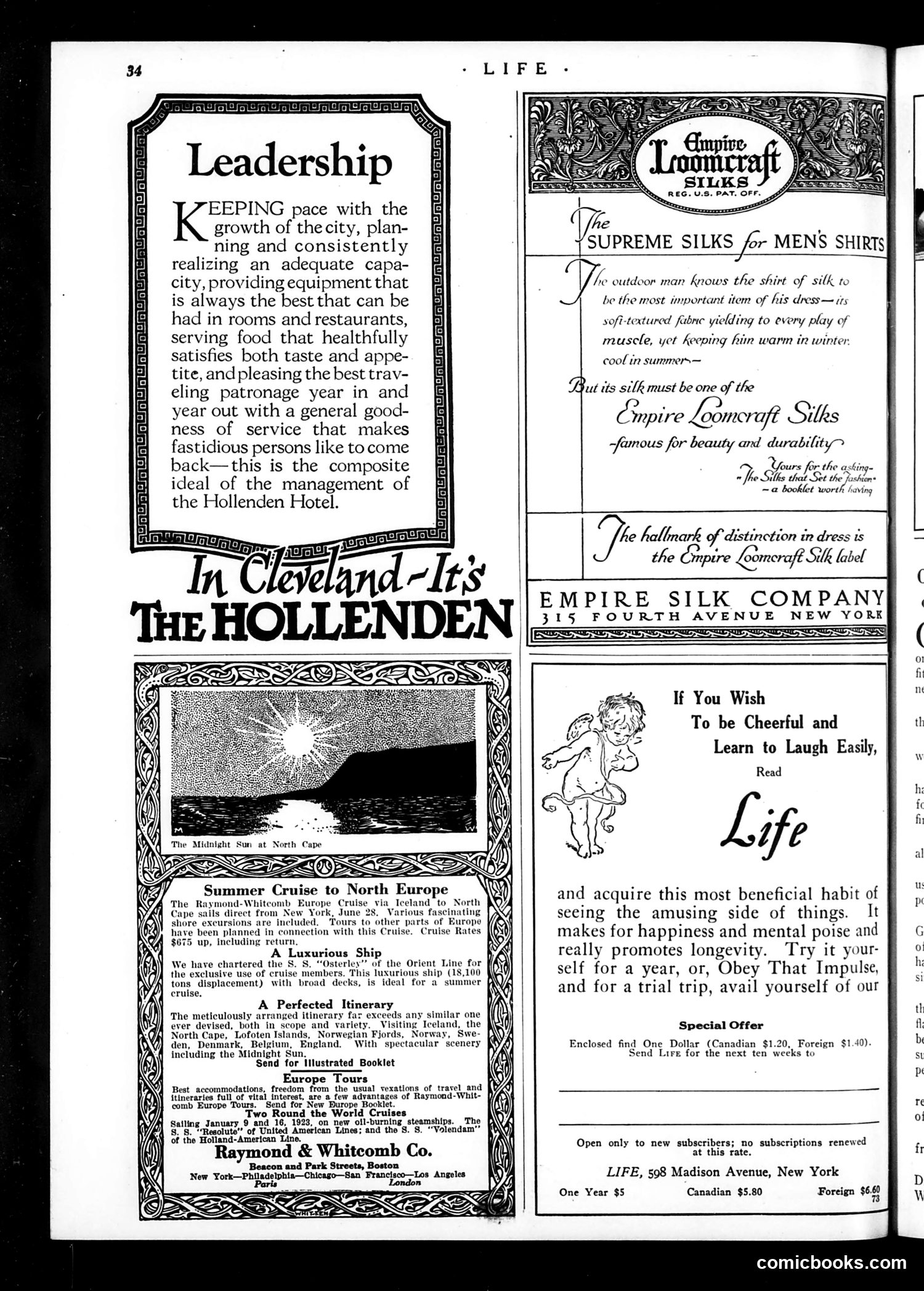
This page is **primarily advertising** with no political cartoons or satirical content. The left side features an advertisement for the Hollenden Hotel in Cleveland, emphasizing "Leadership" in hospitality management—service quality, food, and amenities that appeal to traveling customers. Below this is a Raymond & Whitcomb travel advertisement promoting European cruises and tours, with an image of "The Midnight Sun at North Cape." The right side contains advertisements for Empire Loomcraft Silks (men's dress shirts) and a subscription offer for *Life* magazine itself. The silk ad emphasizes durability and comfort for outdoor men. The only illustrative element is a cherub or cupid figure accompanying the *Life* magazine subscription pitch, which promotes reading the magazine for humor and mental well-being. This is a typical early 1920s magazine page mixing editorial space with paid advertising.
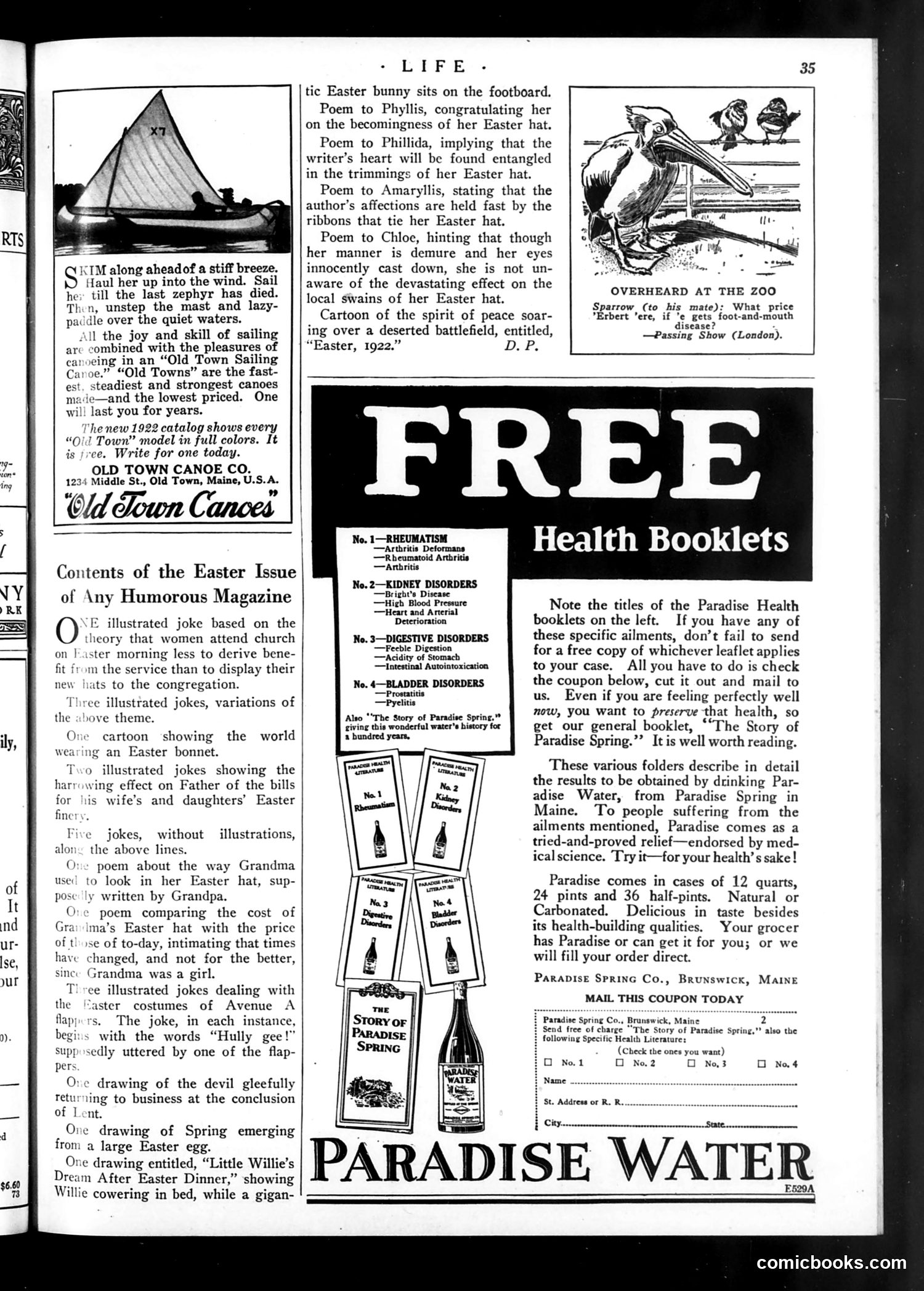
This page is primarily **advertising and filler content** rather than political satire. The main elements are: **Easter-themed humor section** ("Contents of the Easter Issue"): A collection of jokes and poems satirizing women's obsession with Easter hats—a genuine 1920s social phenomenon. The humor targets the frivolity of fashionable women attending church primarily to display their elaborate bonnets rather than for religious devotion. Referenced are poems to women ("Phyllis," "Amaryllis," "Chloe") whose charm is supposedly inseparable from their Easter hat trim and ribbons. **War-related cartoon**: A single panel titled "Easter, 1922" depicts the "spirit of peace" flying over a deserted battlefield—a post-WWI reference suggesting hollow peace efforts amid ongoing conflict. **Bottom half is advertisements**: Paradise Spring Water (medical tonic), Old Town Canoes, and free health booklets dominating the page. The Easter hat satire reflects genuine 1920s social commentary on women's fashion consumption; the war cartoon suggests contemporary anxieties about peace's fragility.
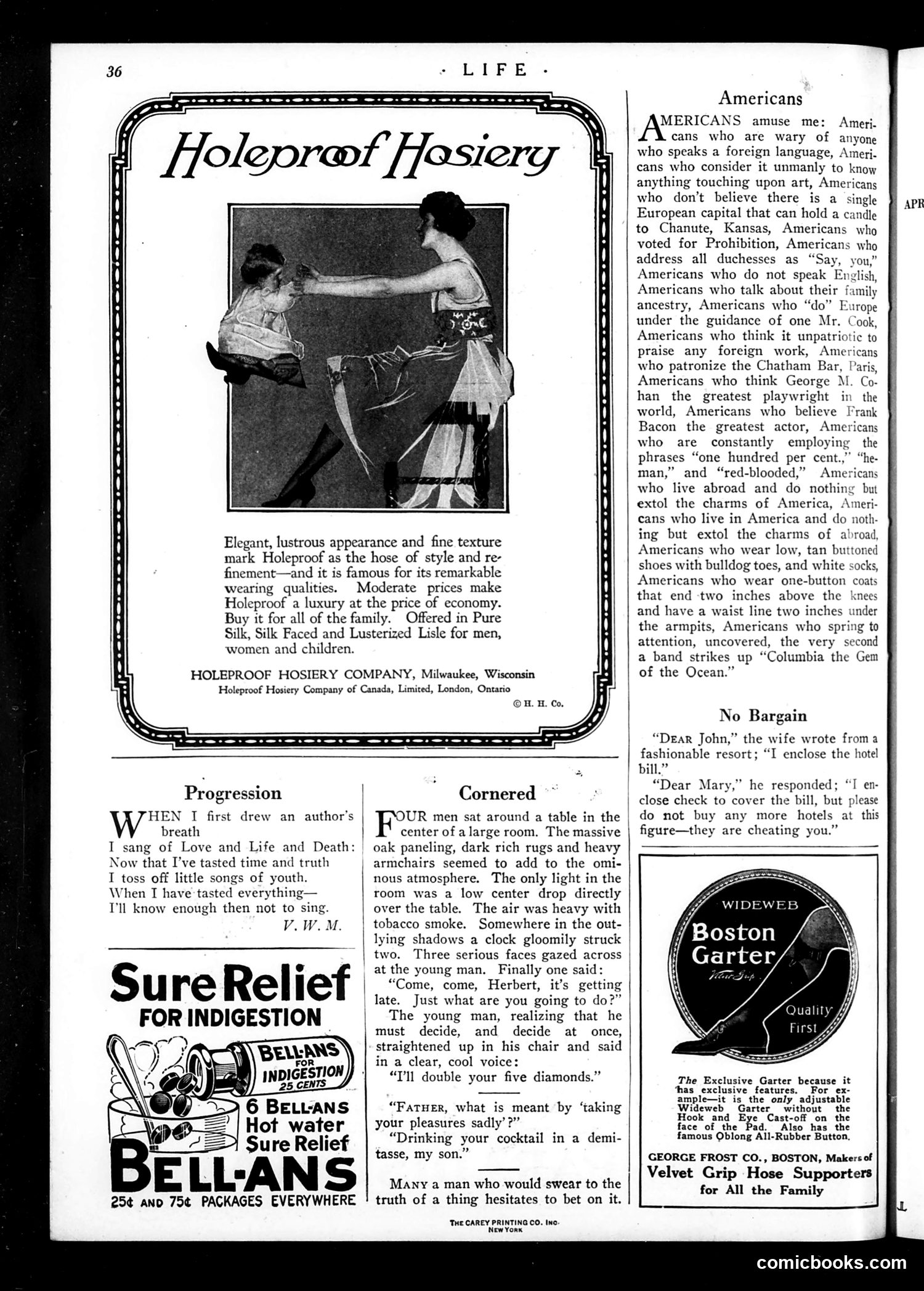
This page from *Life* magazine contains mostly **advertising and humorous short pieces** rather than political cartoons. The main content includes: **"Americans"** — a satirical list mocking American cultural attitudes, particularly anti-intellectualism and xenophobia. It satirizes Americans who distrust foreign languages and art, prefer American entertainment figures (George M. Cohan, Frank Bacon) to European talent, and display contradictory behavior about patriotism and foreign travel. **"Cornered"** — a short story vignette about a young man pressured at a table, likely depicting a marriage proposal or major life decision, ending with his dramatic commitment ("I'll double your five diamonds"). **"Progression"** and **"No Bargain"** are brief humorous poems/quips about life experience and marital finances. The page is primarily filled with **period advertisements** for Holeproof hosiery, Bell-ans indigestion remedy, Boston Garter, and other products. The satirical content reflects *Life*'s role as a humor magazine targeting educated, urbane readers amused by American provincial attitudes.