
Life, 1922-04-06 · page 17 of 38
Life — April 6, 1922 — page 17: what you’re looking at
What you’re looking at
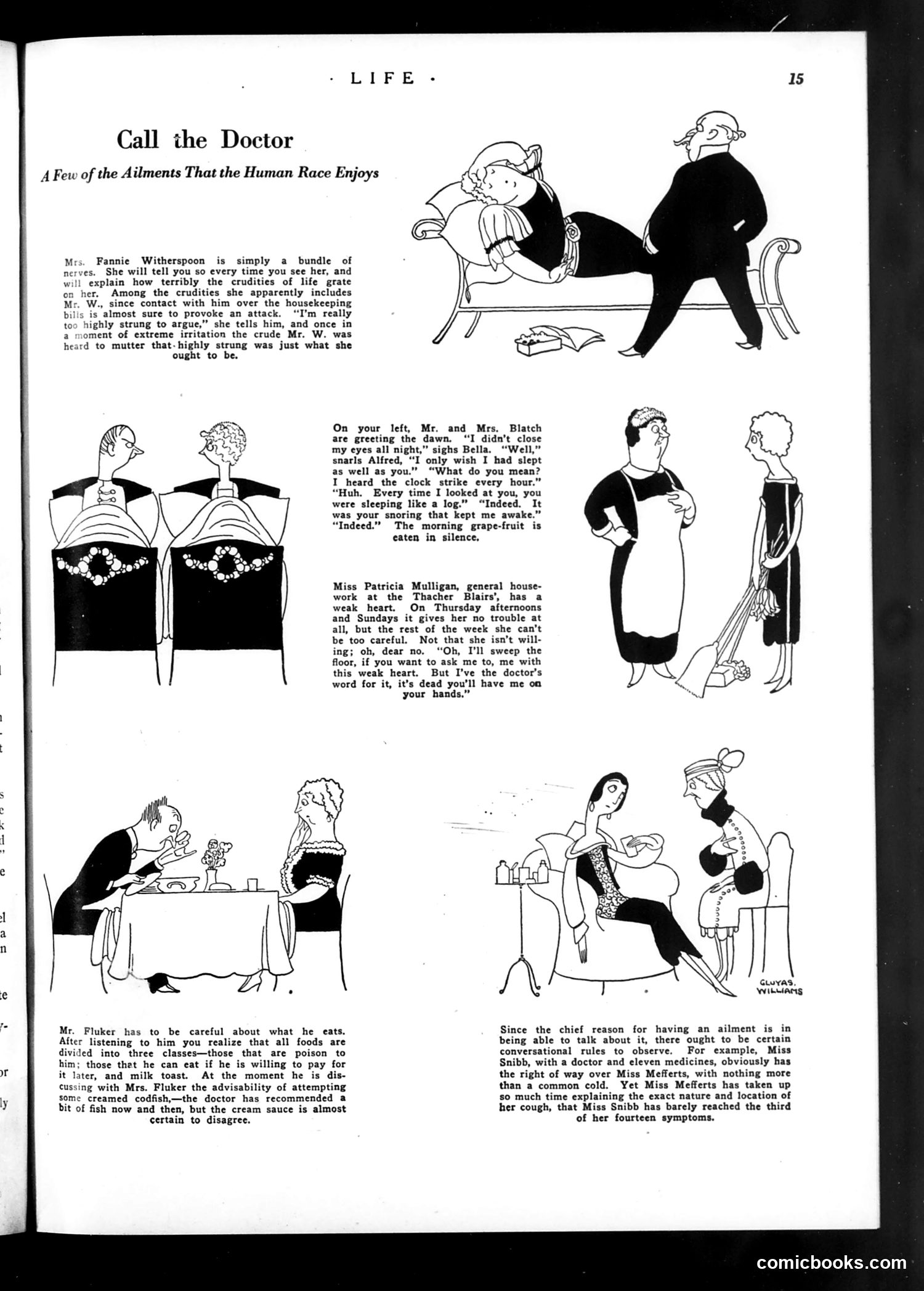
This page satirizes hypochondriacs and those who use minor ailments as social currency or excuses. Each illustrated vignette presents a recognizable type: **Mrs. Witherspoon** is "highly strung"—a nervous woman who blames life's "crudities" (including her husband) for her ailments, using fragility to avoid argument. **Mr. and Mrs. Blatch** bicker through a sleepless night, each blaming the other's snoring/wakefulness, their resentment simmering silently over breakfast. **Miss Mulligan**, despite a "weak heart," uses her ailment strategically—offering to work while invoking her doctor's warnings to avoid actual labor. **Mr. Fluker** obsesses over which foods will cause digestive suffering. The final commentary critiques "ailment etiquette": those with serious conditions should monopolize conversation over minor sufferers. The satire targets a culture where illness becomes a form of status and social performance rather than genuine medical concern.
📄 Transcribed text from this page (OCR, searchable)
Machine-transcribed from the original scan — historical spelling and the odd misread are preserved.
Call the Doctor of the Ailments That the Human Race Enjoys Fannie Witherspoon is simply a bundle of es. She will tell you so every time you see her, and 1 explain how terribly the crudities of life grate her. Among the crudities she apparently includes W., since contact with him over the housekeeping is almost sure to provoke an attack. “I’m really too highly strung to argue,” she tells him, and once in a moment of extreme irritation the crude Mr. W. was heard to mutter that-highly strung was just what she ought to be. On your left, Mr. and Mrs. Blatch are greeting the dawn. “I didn’t close my eyes all night,” sighs Bella. “Well,” snarls Alfred, “I only wish I had slept as well as you. ‘What do you mean? I heard the clock strike every hour.” “Huh. Every time I looked at you, you were sleeping like a log.” “Indeed. It was your snoring that kept me awake.” “Indeed.” The morning grape-fruit is eaten in silence, Miss Patricia Mulligan, general house- work at the Thacher Blairs’, has a weak heart. On Thursday afternoons and Sundays it gives her no trouble at all, but the rest of the week she can't be too careful. Not that she isn’t will- ing; oh, dear no. “Oh, I'll sweep the floor, if you want to ask me to, me with this weak heart. But I've the doctor's word for it, it’s dead you'll have me on your hands.” Guuyas, Wikia, Mr. Fluker has to be careful about what he eats. Since the chief reason for having an ailment is in After listening to him you realize that all foods are divided into three classes—those that are poison to him; those thet he can eat if he is willing to pay for it later, and milk toast. At the moment he is dis- cussing with Mrs. Fluker the advisability of attempting some creamed codfish,—the doctor has recommended a bit of fish now and then, but the cream sauce is almost certain to disagree. being able to talk about it, there ought to be certain conversational rules to observe. For example, Miss Snibb, with a doctor and eleven medicines, obviously has the right of way over Miss Mefferts, with nothing more than a common cold. Yet Miss Mefferts has taken up so much time explaining the exact nature and location of her cough, that Miss Snibb has barely reached the third of her fourteen symptoms. comicbooks.com