
Life, 1922-04-06 · page 24 of 38
Life — April 6, 1922 — page 24: what you’re looking at
What you’re looking at
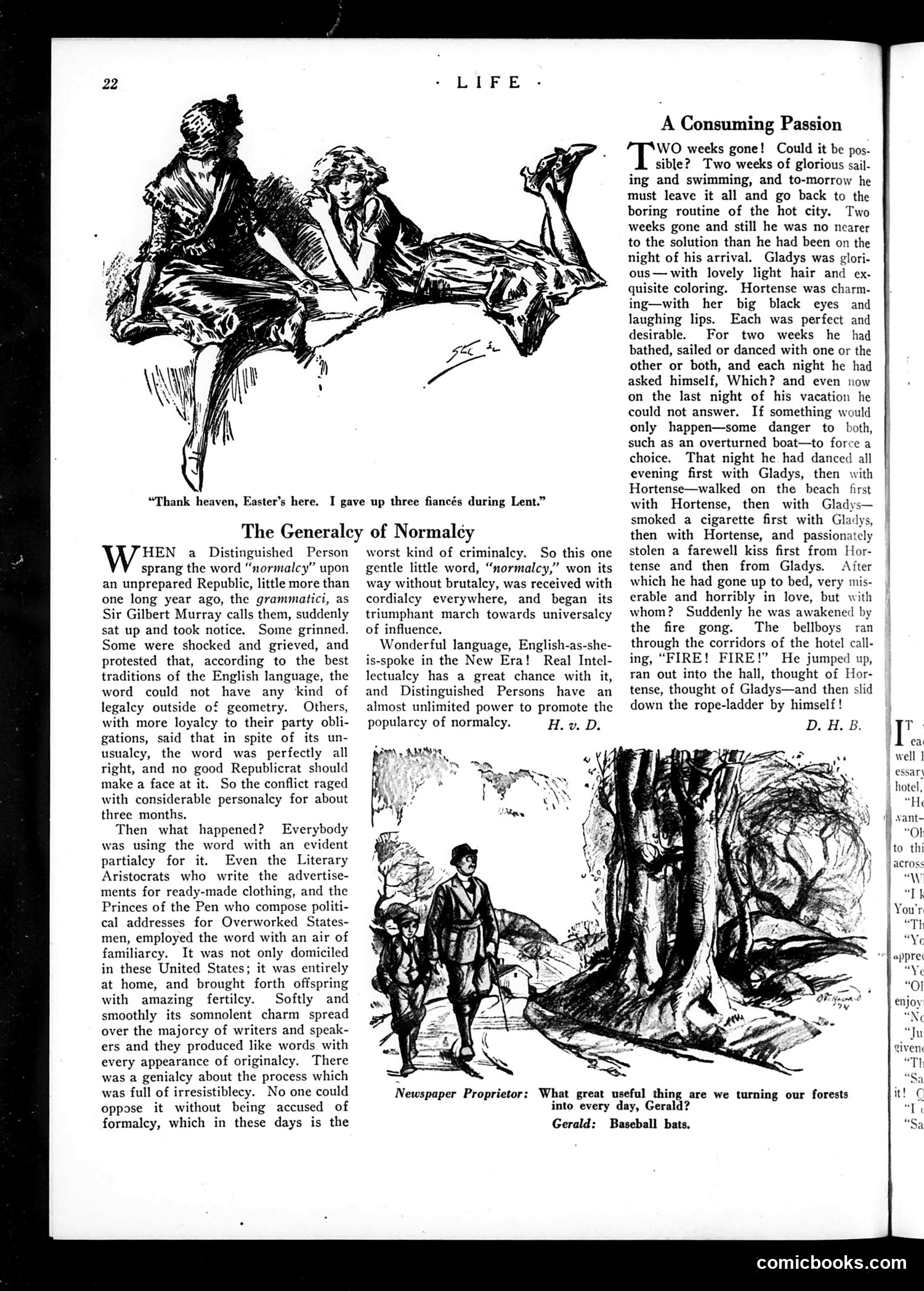
This page contains two satirical pieces typical of Life's early 20th-century humor. **"The Generalcy of Normalcy"** mocks President Warren G. Harding's coinage of "normalcy" (1920-1921). The article satirizes how intellectuals initially resisted this grammatically questionable word, then surrendered as it became ubiquitous. The author humorously invents "-cy" suffix variations ("personalcy," "fertilcy," "criminalcy") to mock both the word's acceptance and how language evolves through popular usage rather than rules. **"A Consuming Passion"** is a comedic short story about a man vacationing with two romantic interests—Gladys and Hortense—unable to choose between them. The joke's punchline: when a hotel fire forces a decision, he saves himself by rope-ladder, abandoning both women. It's dark humor satirizing male indecision and selfishness. **The cartoon below** shows a newspaper proprietor asking what useful forest products exist; the editor replies "Baseball bats"—mocking wasteful industrialization during an era of forest conservation debates. All three pieces employ Life's signature satirical approach: social commentary through exaggeration and unexpected reversals.
📄 Transcribed text from this page (OCR, searchable)
Machine-transcribed from the original scan — historical spelling and the odd misread are preserved.
“Thank heaven, Easter’s here. I gave up three fiancés during Lent.” The Generalcy of Normaléy HEN a Distinguished Person sprang the word “normalcy” upon an unprepared Republic, little more than one long year ago, the grammatici, as Sir Gilbert Murray calls them, suddenly sat up and took notice. Some grinned. Some were shocked and grieved, and protested that, according to the best traditions of the English language, the word could not have any kind of legalcy outside of geometry. Others, with more loyalcy to their party obli- gations, said that in spite of its un- usualcy, the word was perfectly all right, and no good Republicrat should make a face at it. So the conflict raged with considerable personalcy for about three months. Then what happened? Everybody was using the word with an evident partialcy for it. Even the Literary Aristocrats who write the advertise- ments for ready-made clothing, and the Princes of the Pen who compose politi- cal addresses for Overworked States- men, employed the word with an air of familiarcy. It was not only domiciled in these United States; it was entirely at home, and brought forth offspring with amazing fertilcy. Softly and smoothly its somnolent charm spread over the majorcy of writers and speak- ers and they produced like words with every appearance of originalcy. There was a genialcy about the process which was full of irresistiblecy. No one could oppose it without being accused of formalcy, which in these days is the worst kind of criminalcy. So this one gentle little word, “normalcy,” won its way without brutalcy, was received with cordialcy everywhere, and began its triumphant march towards universalcy of influence. Wonderful language, English-as-she- is-spoke in the New Era! Real Intel- lectualcy has a great chance with it, and Distinguished Persons have an almost unlimited power to promote the H. v. D. popularcy of normalcy. A Consuming Passion WO weeks gone! Could it be pos- sible? Two weeks of glorious sail- ing and swimming, and to-morrow he must leave it all and go back to the boring routine of the hot city. Two weeks gone and still he was no nearer to the solution than he had been on the night of his arrival. Gladys was glori- ous— with lovely light hair and ex- quisite coloring. Hortense was charm- ing—with her big black eyes and laughing lips. Each was perfect and desirable. For two weeks he had bathed, sailed or danced with one or the other or both, and each night he had asked himself, Which? and even now on the last night of his vacation he could not answer. If something would only happen—some danger to both, such as an overturned boat—to force a choice. That night he had danced all evening first with Gladys, then with Hortense—walked on the beach first with Hortense, then with Gladys— smoked a cigarette first with Gladys, then with Hortense, and passionately stolen a farewell kiss first from Hor- tense and then from Gladys. After which he had gone up to bed, very mis- erable and horribly in love, but with whom? Suddenly he was awakened by the fire gong. The bellboys ran through the corridors of the hotel call- ing, “FIRE! FIRE!” He jumped up, ran out into the hall, thought of Hor- tense, thought of Gladys—and then slid down the rope-ladder by himself! D. H. B. ven is well | essary “Ob jto thi across Newspaper Proprietor: What great useful thing are we turning our forests into every day, Gerald? Gerald: Baseball bats. comicbooks.com