
Life, 1922-04-06 · page 22 of 38
Life — April 6, 1922 — page 22: what you’re looking at
What you’re looking at
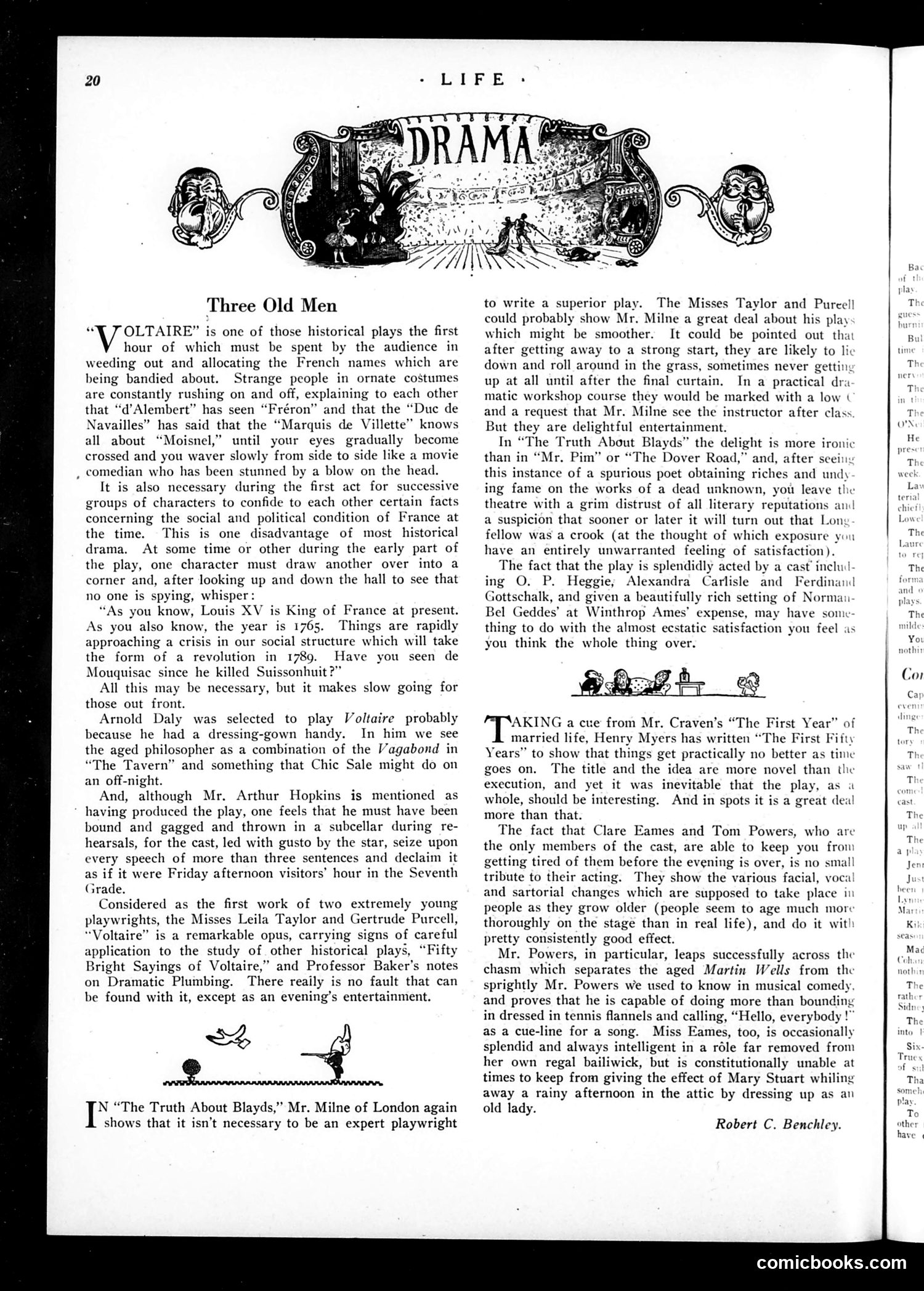
This page reviews three theatrical productions from Life magazine's drama section. The main content critiques: 1. **"Voltaire"** - A historical play by young playwrights Leila Taylor and Gertrude Purcell, starring Arnold Daly as the aged French philosopher. The reviewer mocks the play's slow first act, filled with confusing French character names and tedious exposition about pre-Revolutionary France (set in 1765). The criticism satirizes both the play's construction and the actors' overwrought delivery—comparing their declamatory style to schoolchildren at "Friday afternoon visitors' hour in the Seventh Grade." 2. **"The Truth About Blayds"** - Praised as superior to "Voltaire," this play humorously explores how a spurious poet gains undeserved literary fame, prompting the reviewer's tongue-in-cheek distrust of all literary reputations. The small decorative cartoons show theatrical figures but lack specific identifiable caricatures of named individuals. The satire targets theatrical conventions and amateur playwriting rather than political figures.
📄 Transcribed text from this page (OCR, searchable)
Machine-transcribed from the original scan — historical spelling and the odd misread are preserved.
Three Old Men OLTAIRE” is one of those historical plays the first hour of which must be spent by the audience in weeding out and allocating the French names which are being bandied about. Strange people in ornate costumes are constantly rushing on and off, explaining to each other that “d’Alembert” has seen “Fréron” and that the “Due de Navailles” has said that the “Marquis de Villette’ knows all about “Moisnel,” until your eyes gradually become crossed and you waver slowly from side to side like a movie , comedian who has been stunned by a blow on the head. It is also necessary during the first act for successive groups of characters to confide to each other certain facts concerning the social and political condition of France at the time. This is one disadvantage of most historical drama. At some time or other during the early part of the play, one character must draw another over into a corner and, after looking up and down the hall to see that no one is spying, whisper : “As you know, Louis XV is King of France at present. As you also know, the year is 1765. Things are rapidly approaching a crisis in our social structure which will take the form of a revolution in 1789. Have you seen de Mouquisac since he killed Suissonhuit ?” All this may be necessary, but it makes slow going for those out front. Arnold Daly was selected to play Voltaire probably because he had a dressing-gown handy. In him we see the aged philosopher as a combination of the Vagabond in “The Tavern” and something that Chic Sale might do on an off-night. And, although Mr. Arthur Hopkins is mentioned as having produced the play, one feels that he must have been bound and gagged and thrown in a subcellar during re- hearsals, for the cast, led with gusto by the star, seize upon every speech of more than three sentences and declaim it as if it were Friday afternoon visitors’ hour in the Seventh Grade. Considered as the first work of two extremely young playwrights, the Misses Leila Taylor and Gertrude Purcell, “Voltaire” is a remarkable opus, carrying signs of careful application to the study of other historical plays, “Fifty Bright Sayings of Voltaire,” and Professor Baker’s notes on Dramatic Plumbing. There reaily is no fault that can be found with it, except as an evening’s entertainment. 3% if “The Truth About Blayds,” Mr. Milne of London again shows that it isn’t necessary to be an expert playwright to write a superior play. The Misses Taylor and Purcell could probably show Mr. Milne a great deal about his play which might be smoother. It could be pointed out that after getting away to a strong start, they are likely to lic down and roll around in the grass, sometimes never gettiny up at all until after the final curtain. In a practical dra matic workshop course they would be marked with a low ( and a request that Mr. Milne see the instructor after class But they are delightful entertainment. In “The Truth About Blayds” the delight is more ironic than in “Mr. Pim” or “The Dover Road,” and, after seeiiiy this instance of a spurious poet obtaining riches and und) ing fame on the works of a dead unknown, you leave the theatre with a grim distrust of all literary reputations anil a suspicion that sooner or later it will turn out that Lon fellow was a crook (at the thought of which exposure 5 have an entirely unwarranted feeling of satisfaction). The fact that the play is splendidly acted by a cast’ includ- ing O. P. Heggie,; Alexandra Carlisle and Ferdinai| Gottschalk, and given a beautifully rich setting of Normai Bel Geddes’ at Winthrop Ames’ expens have some- thing to do with the almost ecstatic satisfaction you feel as you think the whole thing over. eee a cue from Mr. Craven’s “The First Year” of married life, Henry Myers has written “The First Fifty Years” to show that things get practically no better as tin goes on. The title and the idea are more novel than the execution, and yet it was inevitable that the pla whole, should be interesting. And in spots it is a great deal more than that. The fact that Clare Eames and Tom Powers, who are the only members of the cast, are able to keep you from getting tired of them before the evening is over, is no small tribute to their acting. They show the various facial, voca and sartorial changes which are supposed to take place in people as they grow older (people seem to age much mor thoroughly on the stage than in real life), and do it wit pretty consistently good effect. Mr. Powers, in particular, leaps successfully across the chasm which separates the aged Martin Wells from the sprightly Mr. Powers we used to know in musical comedy and proves that he is capable of doing more than boundin:; in dressed in tennis flannels and calling, “Hello, everybody ! as a cue-line for a song. Miss Eames, too, is occasionally splendid and always intelligent in a réle far removed from her own regal bailiwick, but is constitutionally unable at times to keep from giving the effect of Mary Stuart whiling away a rainy afternoon in the attic by dressing up as an old lady. asa Robert C. Benchley. The Yo! noth comicbooks.com