
Life, 1922-04-06 · page 25 of 38
Life — April 6, 1922 — page 25: what you’re looking at
What you’re looking at
This satirical story by P.F. Hanley mocks the dynamics of an argumentative married couple through a telephone conversation. A husband calls his wife from his hotel, intending to ask about forgotten papers, but she repeatedly interrupts and misinterprets his purpose—assuming he's calling to express love and apologize. The humor lies in her manipulation: she keeps him repeating scripted apologies and promises ("Say it like this..."), derailing his actual reason for calling. By the story's end, after this exhausting emotional performance, he genuinely forgets why he originally called. The title ironically suggests that the "voice with the smile"—her sweet manipulation—"wins" the interaction, though the victory is hollow: she gets compliance but loses the actual information exchange. The satire targets manipulative relationship tactics and how excessive emotional demands can defeat practical communication between spouses.
📄 Transcribed text from this page (OCR, searchable)
Machine-transcribed from the original scan — historical spelling and the odd misread are preserved.
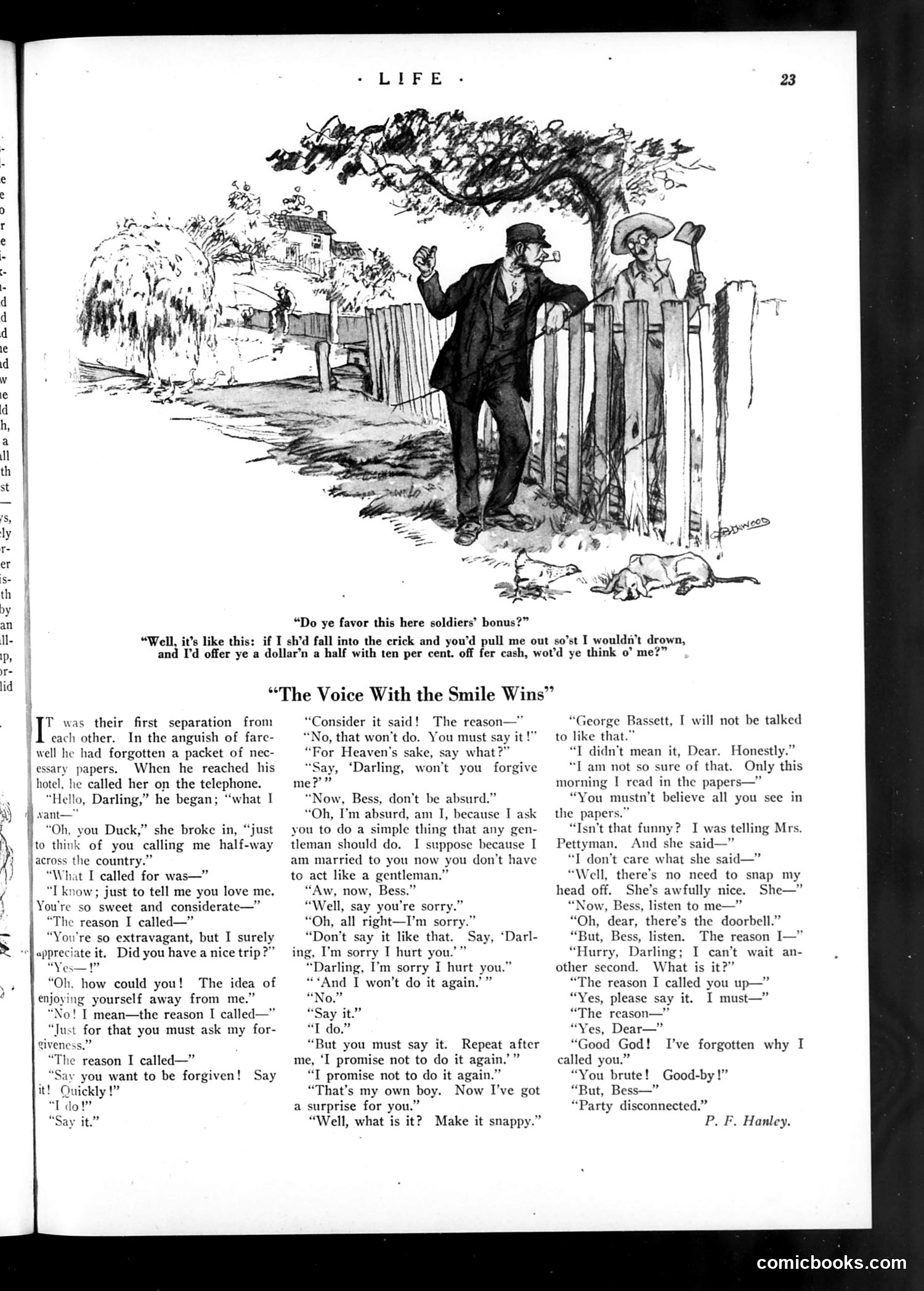
i | “Well, it’s like this: “Do ye favor this here soldiers’ bonus?” if I sh’d fall into the crick and you'd pull me out so’st I wouldn't drown, and I'd offer ye a dollar’n a half with ten per cent. off fer cash, wot'd ye think o’ me?” “The Voice With the Smile Wins” T was their first separation from each other. In the anguish of fare- well he had forgotten a packet of nec- essary papers. When he reached his hotel, he called her on the telephone. “Hello, Darling,” he began; “what I vant—" “Oh, you Duck,” she broke in, “just ‘to think of you calling me half-way jacross the country.” ) “What I called for was—” | “know; just to tell me you love me, You're so sweet and considerate—” “The reason I called—” e so extravagant, but I surely te it. Did you have a nice trip?” “Oh, how could you! The idea of enjoying yourself away from me.” “No! I mean—the reason I called—” i for that you must ask my for- he reason I called—” “Say you want to be forgiven! it! Quickly !” “IT do!” Say “Consider it said!) The reason—* “No, that won't do. You must say it!” “For Heaven's sake, say what?” “Say, ‘Darling, won't you forgive me?” “Now, Bess, don’t be absurd.” “Oh, I’m absurd, am I, because I ask you to do a simple thing that any gen- tleman should do. I suppose because I am married to you nov 1 don’t have to act like a gentleman.” “Aw, now, Bess.” “Well, say you're sorry.” “Oh, all right—I’m sorr: “Don't say it like that. ing, I’m sorry I hurt you.’” “Darling, I'm sorry I hurt you.’ nd I won’t do it again.’” No.” “Say it.” “T do.” “But you must say it. Repeat after me, ‘I promise not to do it again.’” “I promise not to do it again.” “That’s my own boy. Now I’ve got a surprise for you.” Say, ‘Darl- “Well, what is it? Make it snappy.” “George Bassett, I will not be talked to like that.” “I didn’t mean it, Dear. Honestly.” “I am not so sure of that. Only this morning I read in the papers—” “You mustn’t believe all you see in the papers.” “Isn't that funny? I was telling Mrs. Pettyman, And she said—” “I don’t care what she said—” “Well, there’s no need to snap my head off. She’s awfully nice. She—” “Now, Bess, listen to me—” “Oh, dear, there’s the doorbell.” “But, Bess, listen. The reason I—” “Hurry, Darling; I can’t wait an- other second. What is it?” “The reason I called you up—” “Yes, please say it. I must—” “The reason: “Yes, Dear—” “Good God! called you.” “You brute! “But, Bess—” “Party disconnected.” P. F. Hanley. I’ve forgotten why I Good-by !” comicbooks.com