
Life, 1922-04-06 · page 19 of 38
Life — April 6, 1922 — page 19: what you’re looking at
What you’re looking at
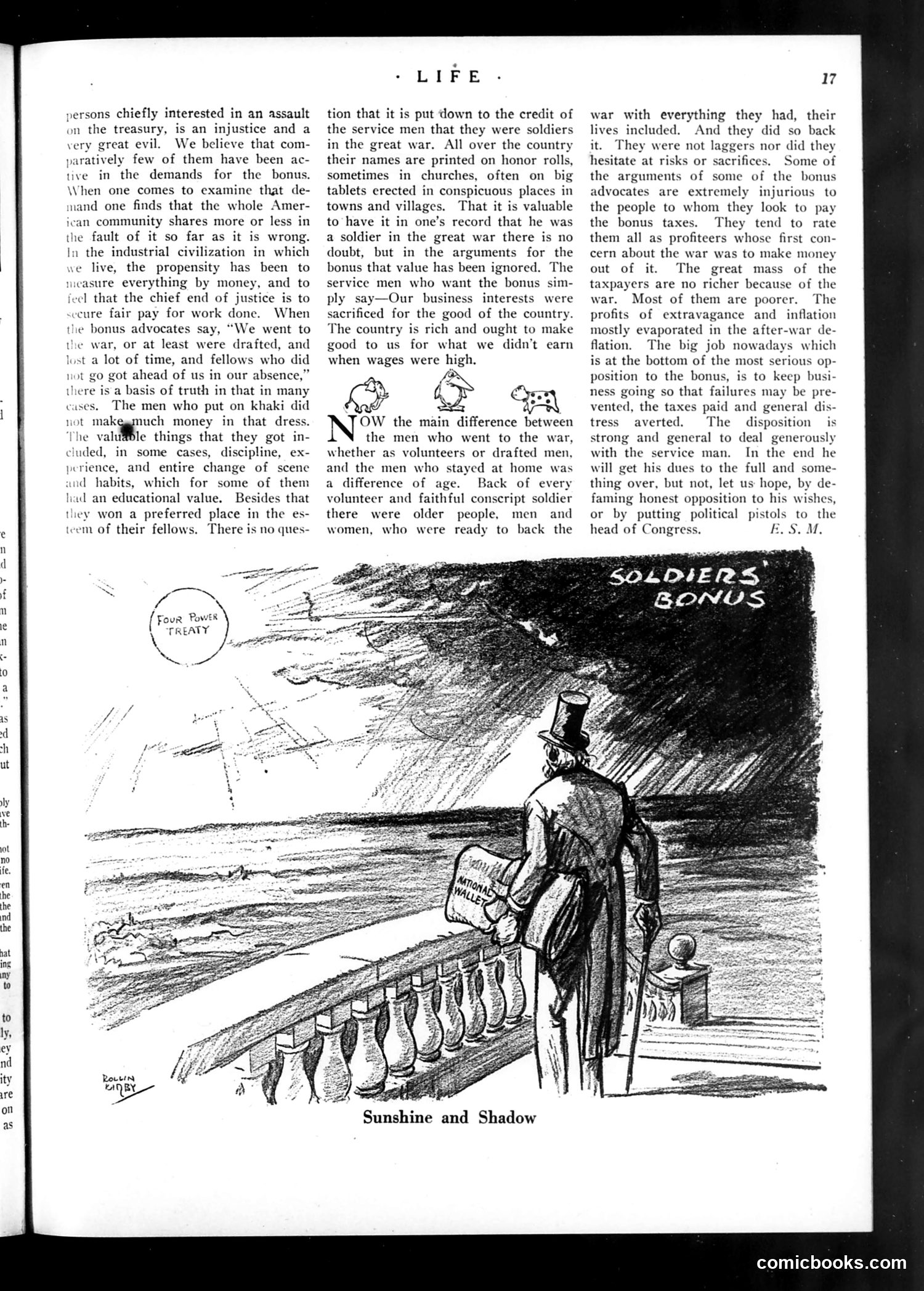
This editorial cartoon addresses the heated 1920s debate over a soldiers' bonus. The figure in the foreground—labeled with what appears to be "Profiteer" or similar—represents those who grew wealthy during WWI while soldiers sacrificed. The "Four Power Treaty" reference (visible in the speech bubble) likely dates this to the early 1920s. The accompanying text argues against the bonus, claiming soldiers already received intangible benefits (honor rolls, social esteem, discipline). The author contends that many civilians and taxpayers also sacrificed—particularly older family members who supported the war effort—and that the nation's economy couldn't afford generous payouts without harming working people. The cartoon's title "Sunshine and Shadow" suggests the contrasting fortunes of those who profited versus those who suffered during the war. The overall message warns against framing the bonus as compensation for business interests that allegedly exploited the war effort.
📄 Transcribed text from this page (OCR, searchable)
Machine-transcribed from the original scan — historical spelling and the odd misread are preserved.
persons chiefly interested in an assault on the treasury, is an injustice and a very great evil. We believe that com- paratively few of them have been ac- tive in the demands for the bonus. \Vhen one comes to examine that de- nand one finds that the whole Amer- ican community shares more or less in the fault of it so far as it is wrong. In the industrial civilization in which we live, the propensity has been to ueasure everything by money, and to feel that the chief end of justice is to cure fair pay for work done. When the bonus advocates say, “We went to the war, or at least were drafted, and lost a lot of time, and fellows who did xt go got ahead of us in our absence,” a basis of truth in that in many The men who put on khaki did not makegmuch money in that dress. le valle things that they got in- cluded, in some cases, discipline, ex- perience, and entire change of scene and habits, which for some of them had an educational value. Besides that tley won a preferred place in the es- teem of their fellows. There is no ques- there is uses. ( Fou Rowse TREATY \ NN - LIFE. tion that it is put down to the credit of the service men that they were soldiers in the great war. All over the country their names are printed on honor rolls, sometimes in churches, often on big tablets erected in conspicuous places in towns and villages. That it is valuable to have it in one’s record that he was a soldier in the great war there is no doubt, but in the arguments for the bonus that value has been ignored. The service men who want the bonus sim- ply say—Our business interests were sacrificed for the good of the country. The country is rich and ought to make good to us for what we didn’t earn when wages were high. OW the main difference between 1 the men who went to the war, whether as volunteers or drafted men, and the men who stayed at home was a difference of age. Back of every volunteer and faithful conscript soldier there were older people, men and women, who were ready to back the Sunshine and Shadow 17 war with everything they had, their lives included. And they did so back it. They were not laggers nor did they hesitate at risks or sacrifices. Some of the arguments of some of the bonus advocates are extremely injurious to the people to whom they look to pay the bonus taxes. They tend to rate them all as profiteers whose first con- cern about the war was to make money out of it. The great mass of the taxpayers are no richer because of the war. Most of them are poorer. The profits of extravagance and inflation mostly evaporated in the after-war de- flation. The big job nowadays which is at the bottom of the most serious op- position to the bonus, is to keep busi- ness going so that failures may be pre- vented, the taxes paid and general dis- tress averted. The disposition is strong and general to deal generously with the service man. In the end he will get his dues to the full and some- thing over, but not, let us hope, by de- faming honest opposition to his wishes, or by putting political pistols to the head of Congres: SOLDIERS. ° BONUS comicbooks.com