
Life, 1922-04-06 · page 18 of 38
Life — April 6, 1922 — page 18: what you’re looking at
What you’re looking at
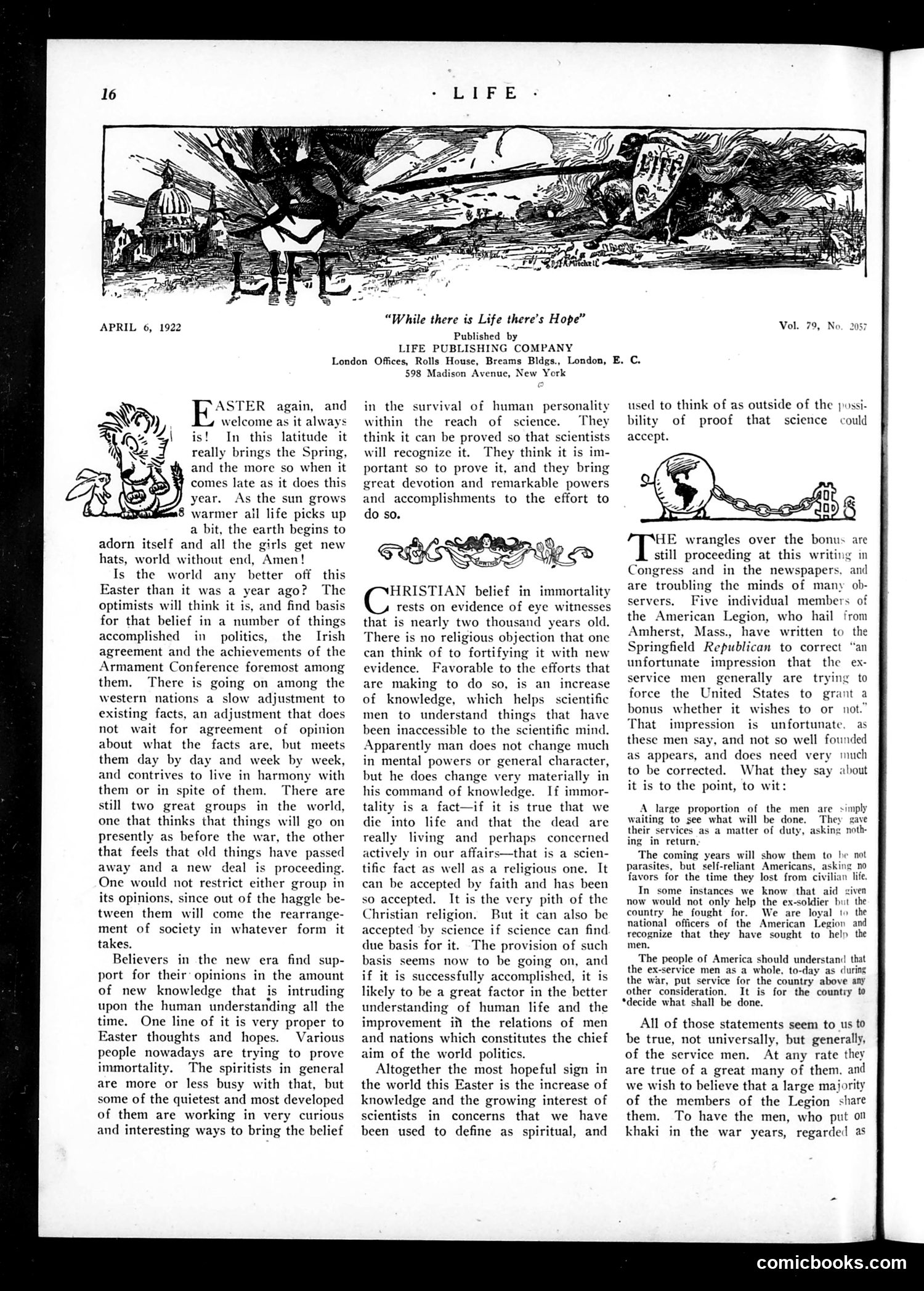
This is an Easter editorial reflecting on post-WWI optimism and spiritual progress. The main illustration shows the word "LIFE" in decorative lettering overlooking a pastoral landscape—symbolizing renewal and hope. The text discusses two competing worldviews among Western nations: those believing pre-war conditions will return, and those accepting permanent social change. The editorial argues the most hopeful sign is scientists increasingly investigating immortality and spiritual matters scientifically, moving beyond traditional faith-only approaches. References include the recent Irish Agreement and Armament Conference (post-war peace efforts). The piece reflects 1920s-era spiritualism's cultural prominence—séances and mediums attempting scientific validation of afterlife claims. The editorial suggests bridging religious and scientific perspectives on immortality offers hope for human understanding and improved international relations. The tone is cautiously optimistic about modernizing Christian belief through empirical investigation.
📄 Transcribed text from this page (OCR, searchable)
Machine-transcribed from the original scan — historical spelling and the odd misread are preserved.
APRIL 6, 1922 “While there is Life there’s Hope” Published by LIFE PUBLISHING COMPANY . 79, No. London Offices, Rolls House, Breams Bldgs., London, E. C. STER again, and welcome as it always In this latitude it really brings the Spring, and the more so when it comes late as it does this year. As the sun grows 8 warmer ail life picks up a bit, the earth begins to adorn itself and all the girls get new hats, world without end, Amen! Is the world any better off this Easter than it was a year ago? The optimists will think it and find basis for that belief in a number of things accomplished in politics, the Irish agreement and the achievements of the Armament Conference foremost among them. There is going on among the western nations a slow adjustment to existing facts, an adjustment that does not wait for agreement of opinion about what the facts are, but meets them day by day and week by week, and contrives to live in harmony with them or in spite of them. There are still two great groups in the world, one that thinks that things will go on presently as before the war, the other that feels that old things have passed away and a new deal is proceeding. One would not restrict either group in its opinions, since out of the haggle be- tween them will come the rearrange- ment of society in whatever form it takes. Believers in the new era find sup- port for their opinions in the amount of new knowledge that is intruding upon the human understanding all the time. One line of it is very proper to Easter thoughts and hopes. Various people nowadays are trying to prove immortality. The spiritists in general are more or less busy with that, but some of the quietest and most developed of them are working in very curious and interesting ways to bring the belief 598 Madison Avenue, New York in the survival of human personality within the reach of science. They think it can be proved so that scientists will recognize it. They think it is im- portant so to prove it, and they bring great devotion and remarkable powers and accomplishments to the effort to do so. HRISTIAN belief in immortality rests on evidence of eye witnesses that is nearly two thousand years old. There is no religious objection that one can think of to fortifying it with new evidence. Favorable to the efforts that are making to do so, is an increase of knowledge, which helps scientific men to understand things that have been inaccessible to the scientific mind. Apparently man does not change much in mental powers or general character, but he does change very materially in his command of knowledge. If immor- tality is a fact—if it is true that we die into life and that the dead are really living and perhaps concerned actively in our affairs—that is a scien- tific fact as well as a religious one. It can be accepted by faith and has been so accepted. It is the very pith of the Christian religion. But it can also be accepted by science if science can find due basis for it. The provision of such basis seems now to be going on, and if it is successfully accomplished, it is likely to be a great factor in the better understanding of human life and the improvement if the relations of men and nations which constitutes the chief aim of the world politics. Altogether the most hopeful sign in the world this Easter is the increase of knowledge and the growing interest of scientists in concerns that we have been used to define as spiritual, and used to think of as outside of the possi- bility of proof that science could accept. 'HE wrangles over the bonus are still proceeding at this writing in Congress and in the newspapers, and are troubling the minds of many ob- servers, Five individual members of the American Legion, who hail from Amherst, Mass., have written to the Springfield Republican to correct “an unfortunate impression that the ex- service men generally are trying to force the United States to grant a bonus whether it wishes to or not.” That impression is unfortunate, as these men say, and not so well founded as appears, and does need very much to be corrected. What they say about it is to the point, to wit: A large proportion of the men are simply waiting to see what will be done. They their services as a matter of duty, asking noth- ing in return, The coming years will show them to he not parasites, but self-reliant Americans, ask favors for the time they lost from civ In some instances we know that aid given now would not only help the ex-soldier country he fought for. We are lo national officers of the American Li recognize that they have sought to help the men. The people of America should understand that the ex-service men as a whole, to-day as curing the war, put service for the country above any other consideration. It is for the country to “decide what shall be done. All of those statements seem to us to be true, not universally, but generally, of the service men. At any rate they are true of a great many of them. and we wish to believe that a large majority of the members of the Legion share them. To have the men, who put of khaki in the war years, regarded as comicbooks.com