
A complete issue · 60 pages · 1920
Life — November 4, 1920
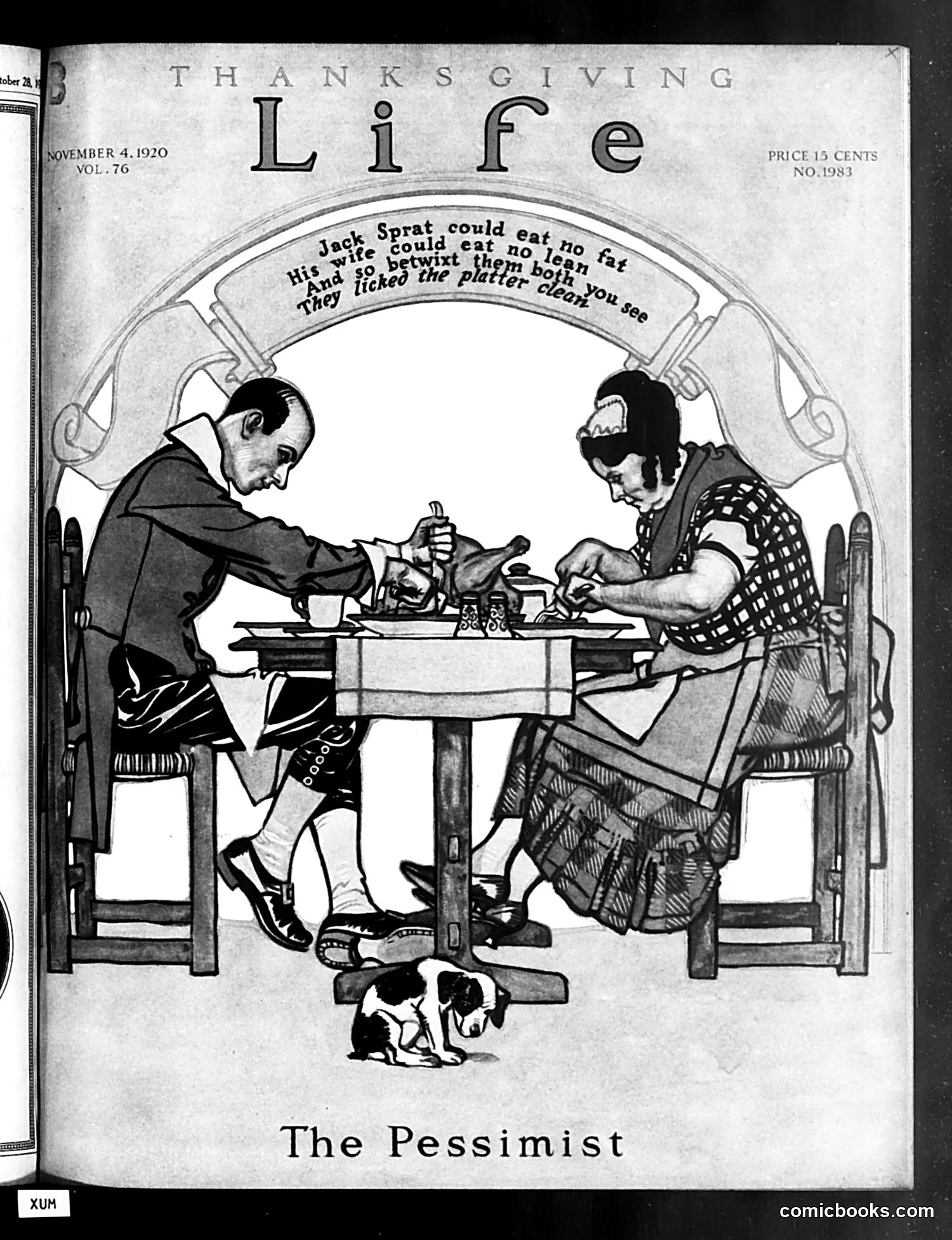
This cartoon depicts a couple dining together on Thanksgiving. The caption reads: "Jack Sprat could eat no lean, far his wife could eat no fat, And so betwixt them you see they licked the platter clean." The joke plays on the nursery rhyme "Jack Sprat" to satirize marital compromise and domestic economy. The reference to "licking the platter clean" likely comments on post-WWI food conservation or household budgeting concerns of the era. The title "The Pessimist" suggests the cartoon critiques a negative outlook—either the husband's dietary limitations or broader wartime/postwar scarcity mentality. The dog beneath the table emphasizes that even pets benefit from this frugal arrangement. The satire mocks restrictive eating habits or financial constraints affecting American households.
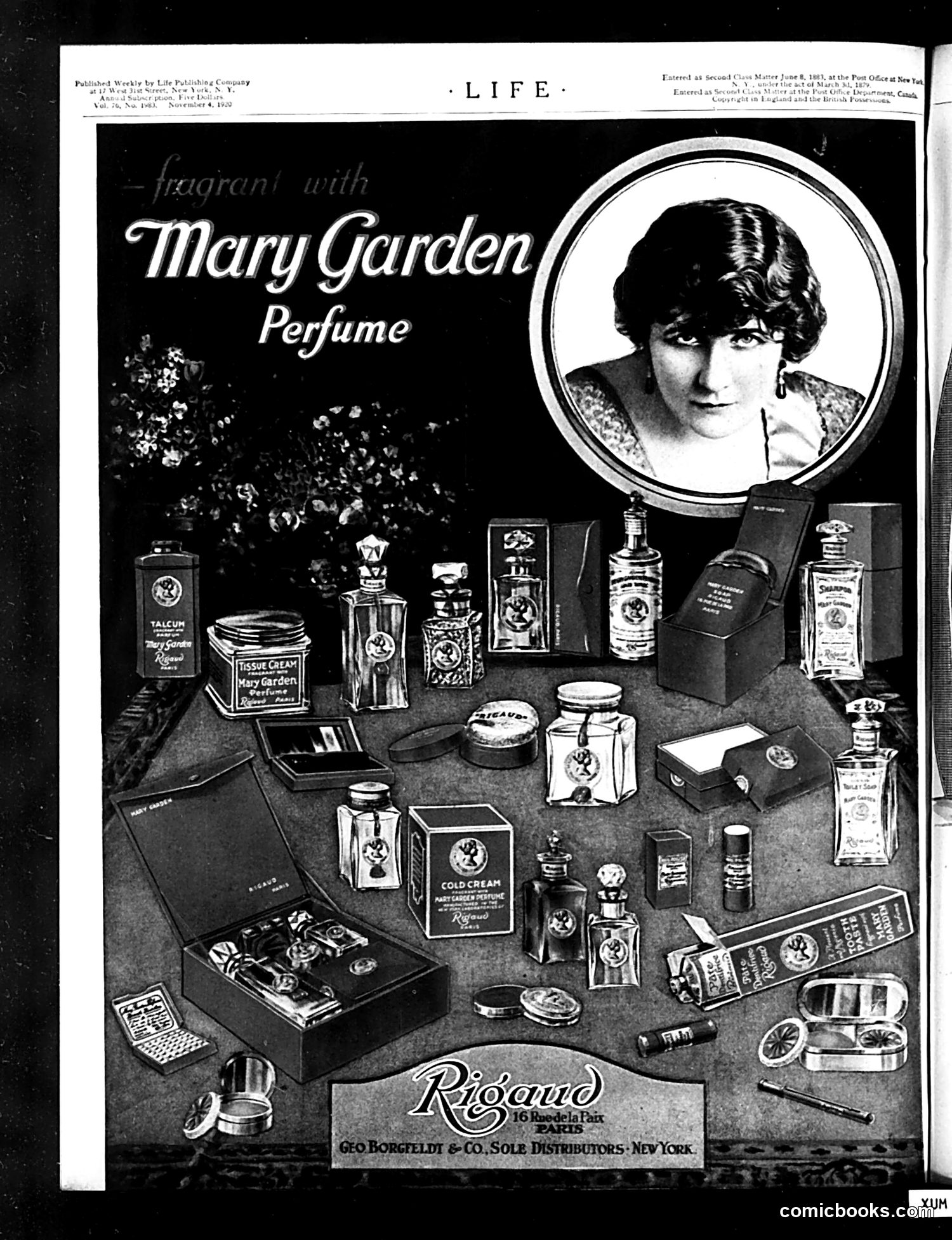
This is not a political cartoon or satirical content—it's a **period advertisement** for Mary Garden Perfume and related cosmetic products by Rigaud, a French beauty brand. The page features a circular portrait photograph of a woman (identified as Mary Garden in the headline) at the top, with an array of perfume bottles, cosmetic jars, cold cream, talcum powder, and other beauty products arranged below. The "satire" here is commercial rather than political: the advertisement uses celebrity endorsement (Mary Garden was a famous opera singer of the era) to market luxury cosmetics. This represents early 20th-century advertising strategy—associating products with glamorous public figures to drive sales among aspirational consumers.
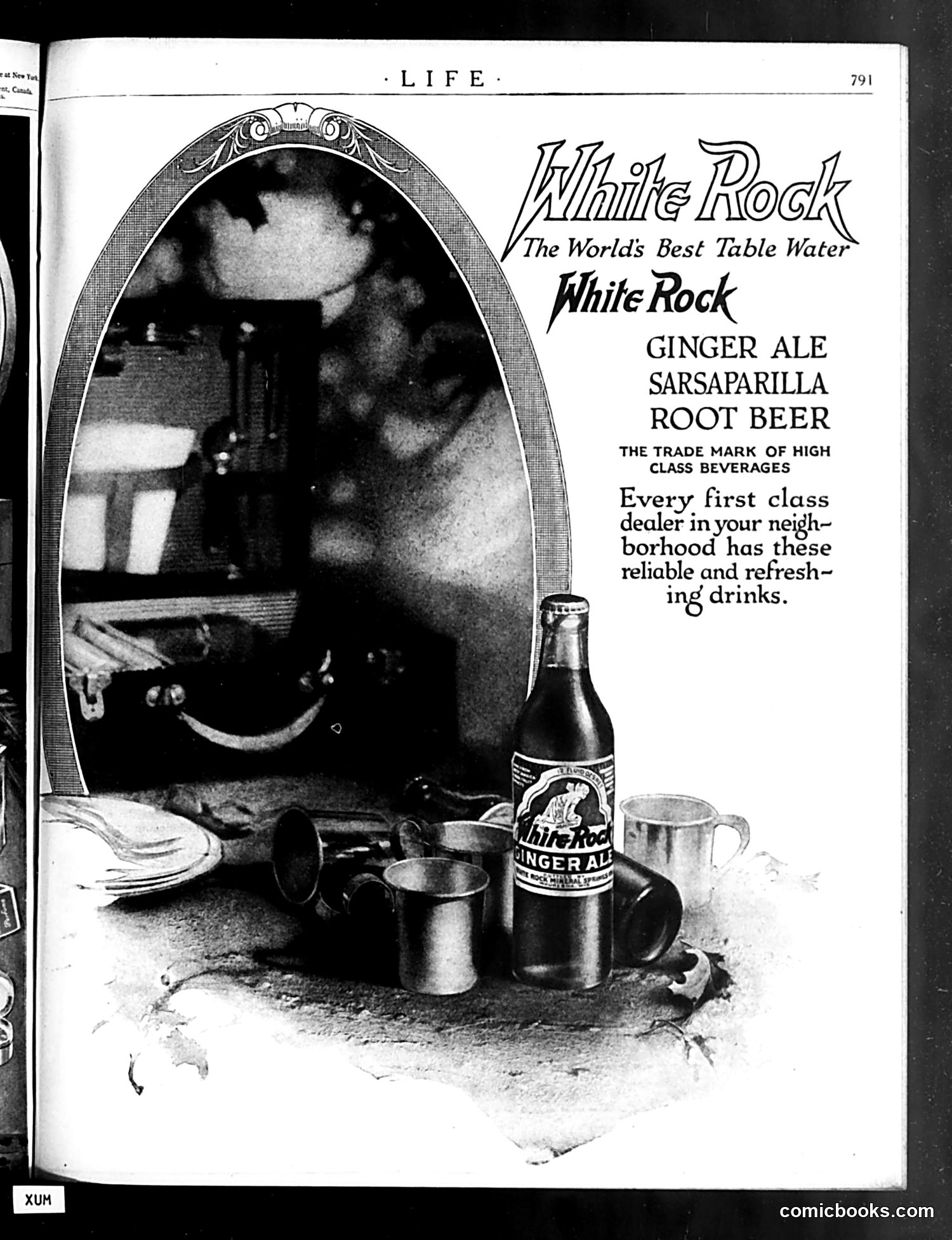
This is **not a cartoon or satire** — it's a straightforward **advertisement** for White Rock beverages, occupying page 791 of Life magazine. The ad promotes White Rock brand products: table water, ginger ale, sarsaparilla, and root beer. The image shows a bottle and glasses arranged with dining items (plates, pitcher) in what appears to be a domestic or hospitality setting. The text emphasizes these as "high class beverages" available through "first class dealers." This represents typical early-20th-century marketing positioning White Rock as a premium, respectable brand for middle-class and upper-class consumers — a common advertising approach during Prohibition or its aftermath, when such non-alcoholic beverages were marketed as sophisticated alternatives.
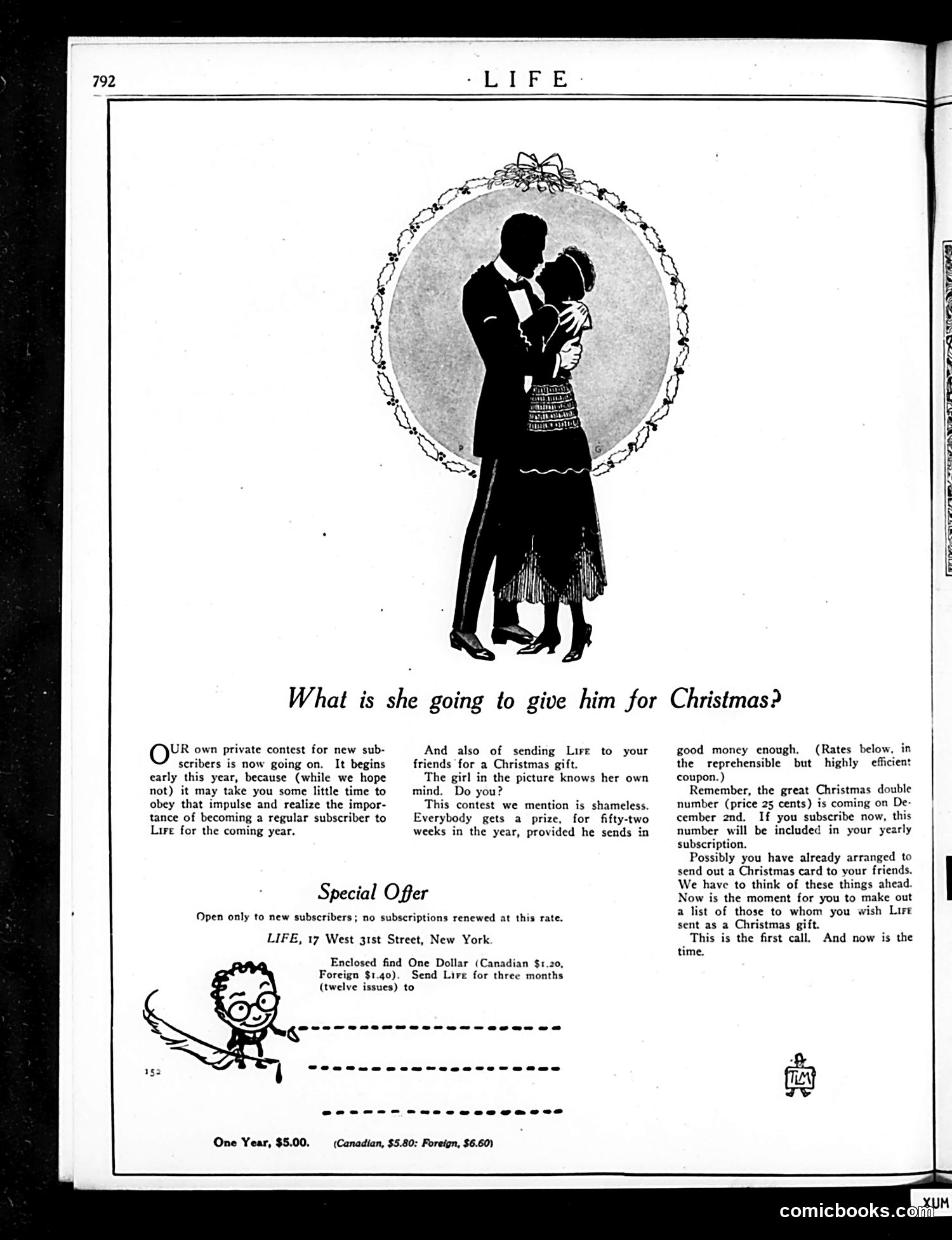
This page is primarily **advertising content** for Life magazine subscriptions, not political satire. The main image shows a silhouetted couple—a man in formal wear holding a woman—posed romantically against a decorative circular background. The headline poses a rhetorical question: "What is she going to give him for Christmas?" The ad promotes a subscription offer: one dollar for three months of Life. It's pitched as an ideal Christmas gift to send friends, capitalizing on the holiday season. The text emphasizes Life's value as entertainment and suggests readers should compile a gift list now. The small cartoon character (appears to be a mascot) is generic—not identifiable as specific political satire. This is straightforward **commercial messaging** rather than political commentary.
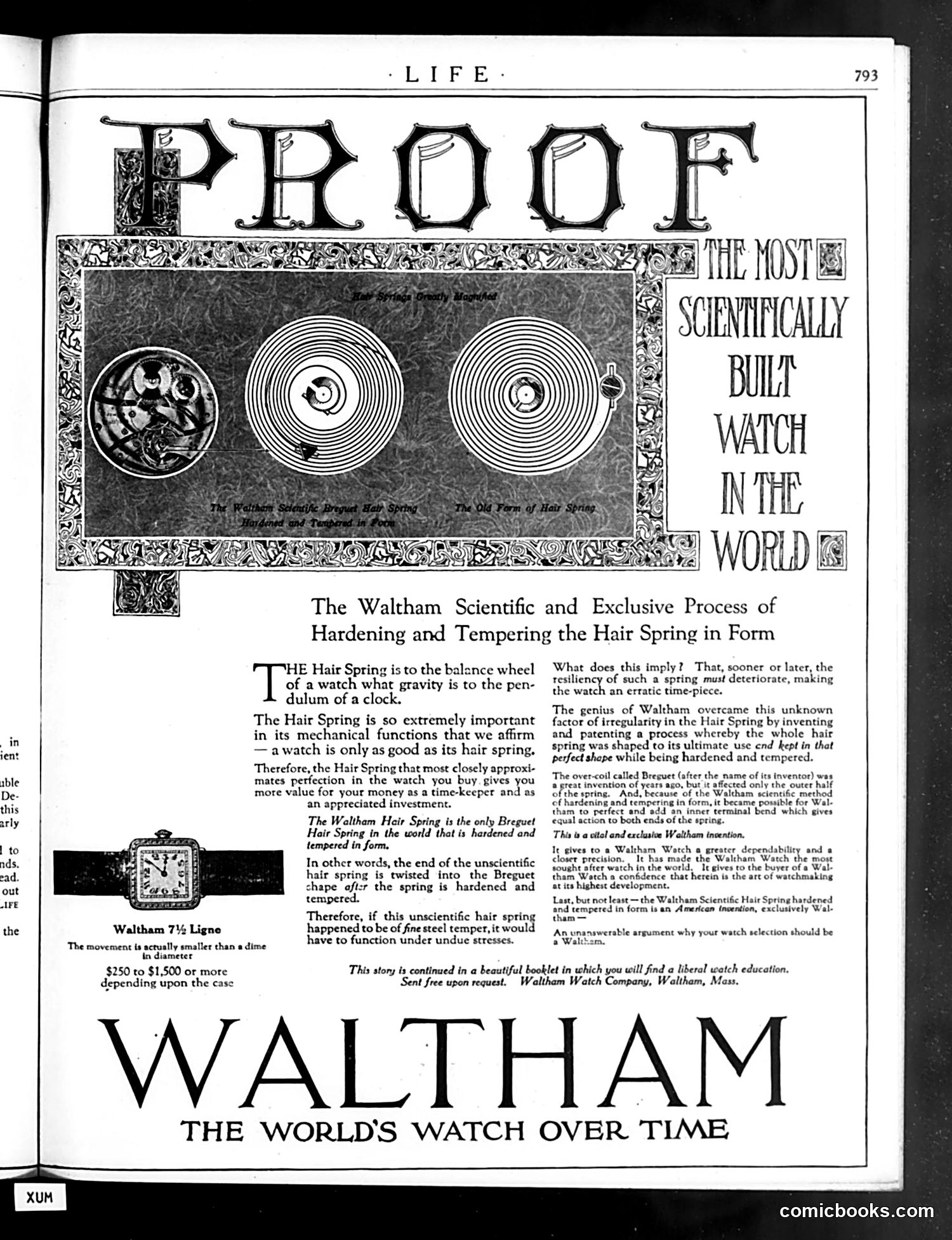
This is **not a political cartoon** but rather a **product advertisement** for Waltham watches, appearing in Life magazine (page 793). The page promotes Waltham's "scientific" approach to watchmaking, specifically their patented process for hardening and tempering the hair spring—a critical component for timekeeping accuracy. The decorative diagrams show the hair spring's coiled structure and mechanical design. The advertisement's claim to superiority centers on solving the problem of hair spring irregularity, which could cause watches to become "erratic time-pieces." Waltham presents this as a technical innovation deserving consumer confidence. The pricing ($250 to $1,500+) positions these as luxury items. The "Proof" headline emphasizes scientific credibility as a sales strategy.
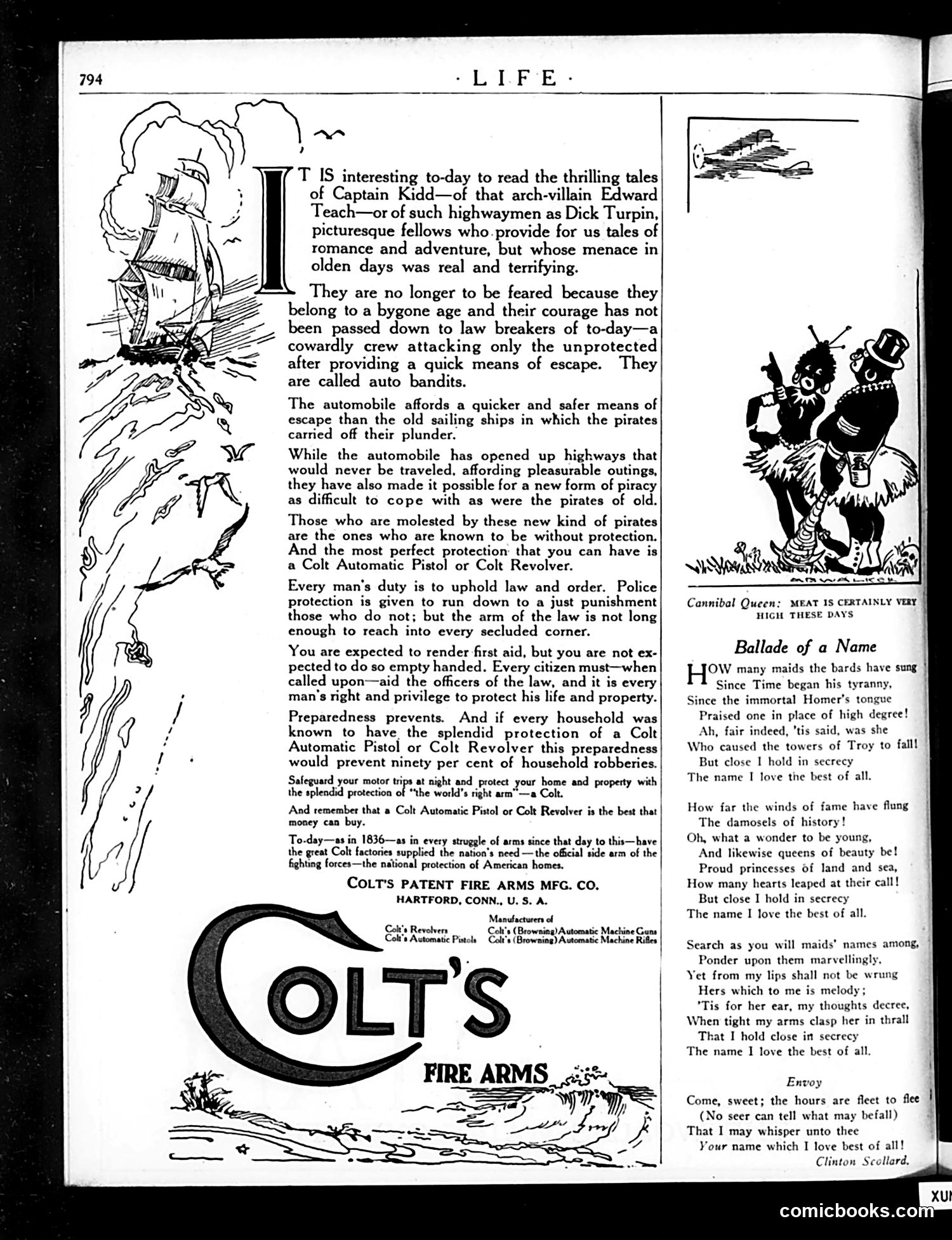
This page combines an editorial article with advertising. **The Article's Message:** The text argues that modern automobiles have replaced sailing ships as targets for criminals. Where pirates once attacked merchant vessels, highway robbers now prey on motorists. The piece advocates that citizens carry Colt firearms for self-defense, positioning the revolver as essential protection—just as it was during the pirate era. **The Cartoon:** The left illustration depicts a pirate ship under attack, establishing the historical comparison. **The Advertisement:** A full Colt Fire Arms ad dominates the lower portion, directly supporting the article's argument by promoting pistols and revolvers as "the world's right arm." **Purpose:** This is essentially advertorial content using nostalgia for historical dangers to market modern weapons to concerned middle-class readers worried about automobile travel safety.
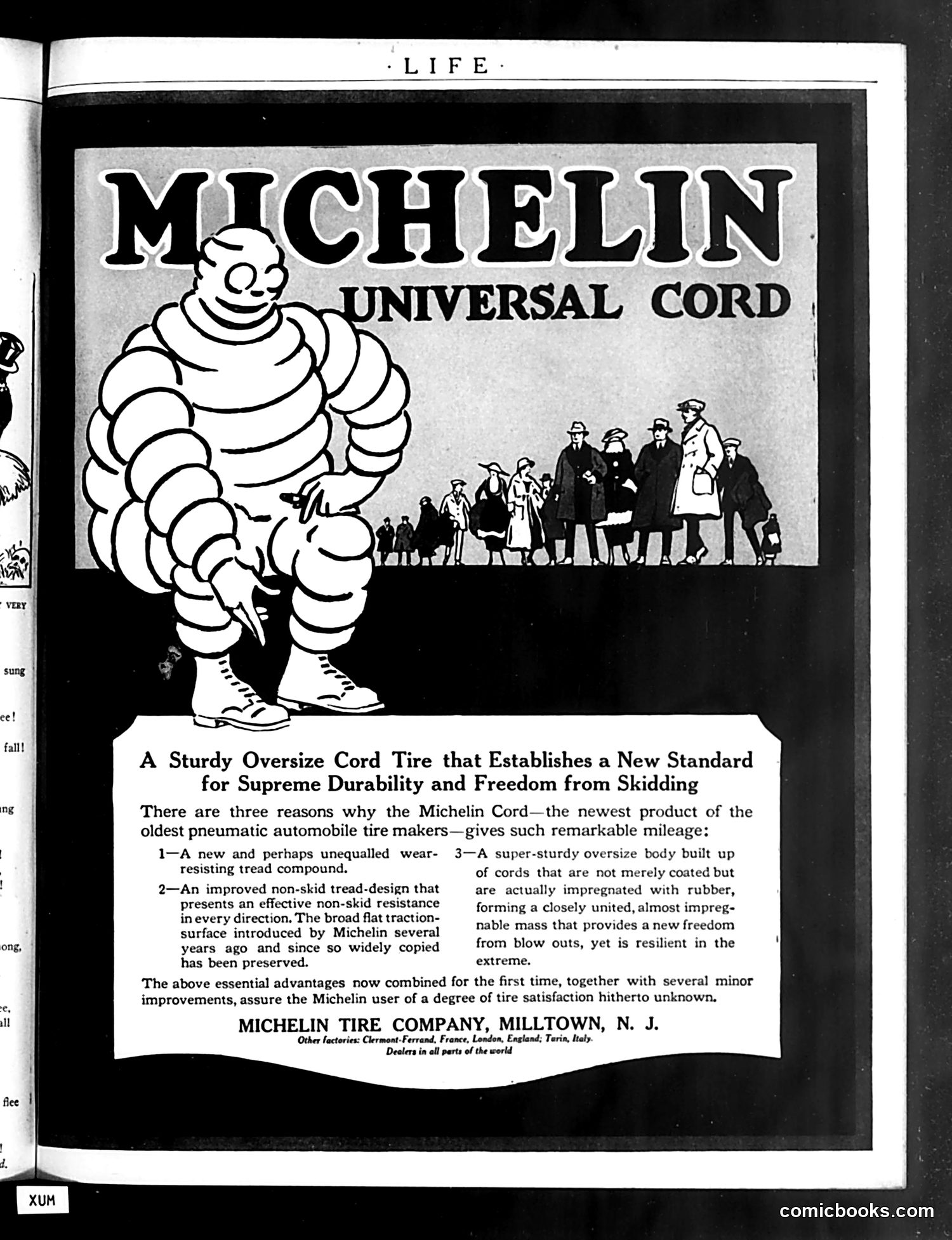
This page is a **product advertisement**, not satire or political commentary. It promotes Michelin's "Universal Cord" tire, featuring the company's famous mascot—Bibendum, the rotund "Michelin Man" made of tire rings—towering over a group of ordinary people. The ad claims three advantages: a wear-resistant tread compound, improved non-skid tread design, and a sturdy oversized cord body impregnated with rubber. The headline promises "Supreme Durability and Freedom from Skidding." The Michelin Man's exaggerated size compared to the tiny humans below serves as visual emphasis of the product's quality and importance. The company's headquarters in Milltown, New Jersey is listed, along with international factory locations.
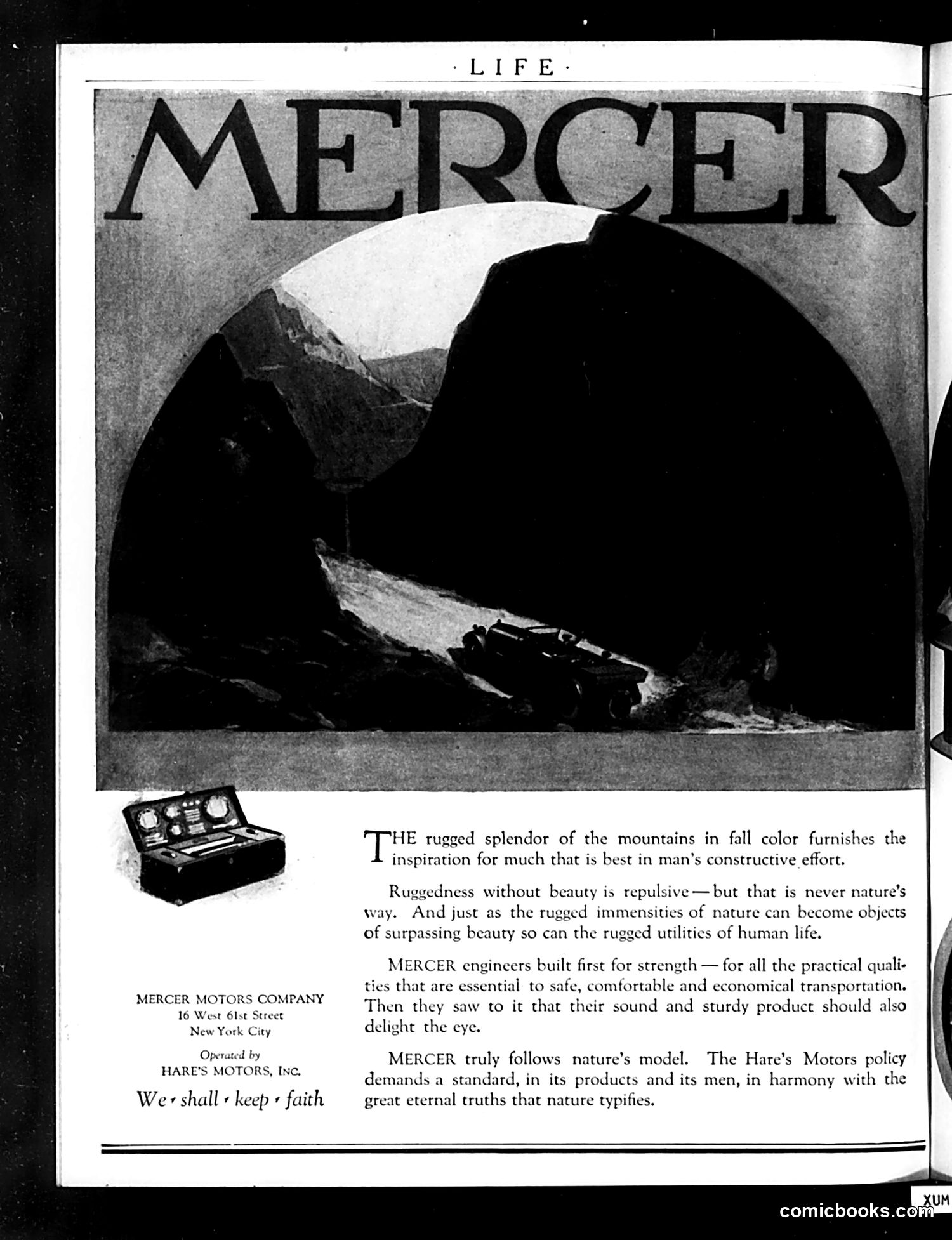
This is a **Mercer Motors advertisement** disguised as editorial content—a common practice in early 20th-century magazines. The image shows a dramatic mountain landscape with a tunnel, evoking nature's "rugged splendor." The ad's central claim is that Mercer automobiles embody this aesthetic philosophy: combining practical strength with beauty. The text explicitly states that Mercer engineers prioritized "strength" and "practical qualities" first, then ensured the product would "delight the eye." This mirrors nature's model—ruggedness paired with beauty. The company's motto, "We shall keep faith" (from Hare's Motors, the operator), frames automobile manufacturing as a moral enterprise aligned with "eternal truths that nature typifies." For modern readers: this represents **aspirational marketing**—selling cars not merely as functional transport but as objects embodying noble principles through nature-inspired design.
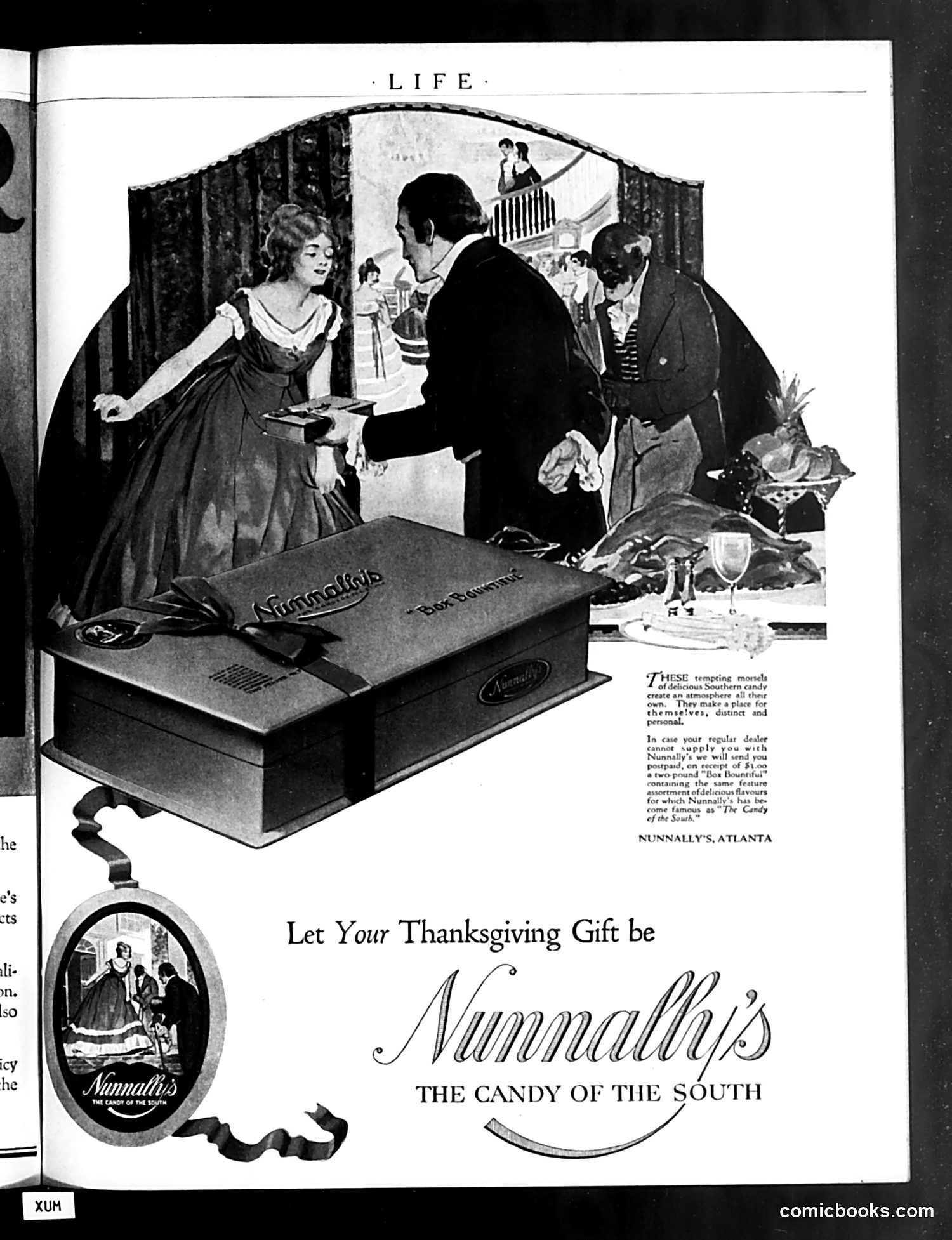
This is primarily a **Nunnally's candy advertisement** rather than a political cartoon. It depicts a Thanksgiving gift-giving scene set in what appears to be an elegant home, with well-dressed figures exchanging a box of Nunnally's candies. The advertisement emphasizes that Nunnally's represents "The Candy of the South" and suggests it as an appropriate Thanksgiving gift. The text mentions that these candies "make a place for themselves, distinct and individual" and references Nunnally's as "The Candy of the South," positioning it as a regional specialty product. The scene itself carries no apparent political satire—it's straightforward promotional material aimed at holiday gift-giving, typical of early-20th-century Life magazine advertising.
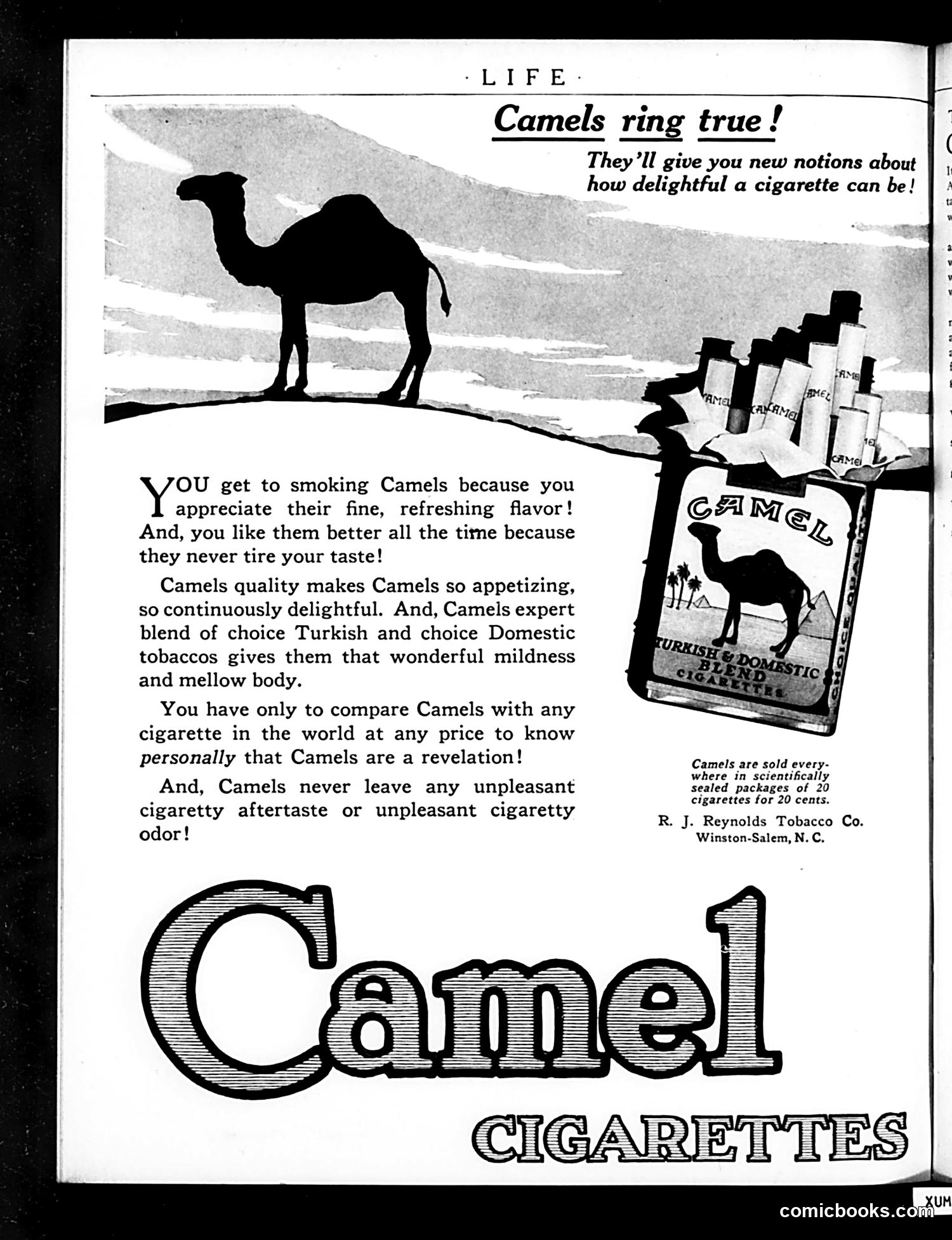
This is a **Camel cigarette advertisement**, not satire or editorial content. The page uses the silhouette of a camel in a desert landscape to market cigarettes, claiming they offer "fine, refreshing flavor" and never tire the smoker's taste. The ad emphasizes Camel's blend of "choice Turkish and choice Domestic tobaccos" for "mildness and mellow body." It promises no "unpleasant cigaretty aftertaste or unpleasant cigaretty odor"—claims that would be illegal to make today. For modern readers, this represents a striking historical artifact: **direct health claims in cigarette advertising were once legal and commonplace**. The exaggerated wellness language and premium positioning contrast sharply with today's strict tobacco marketing restrictions and health warnings.
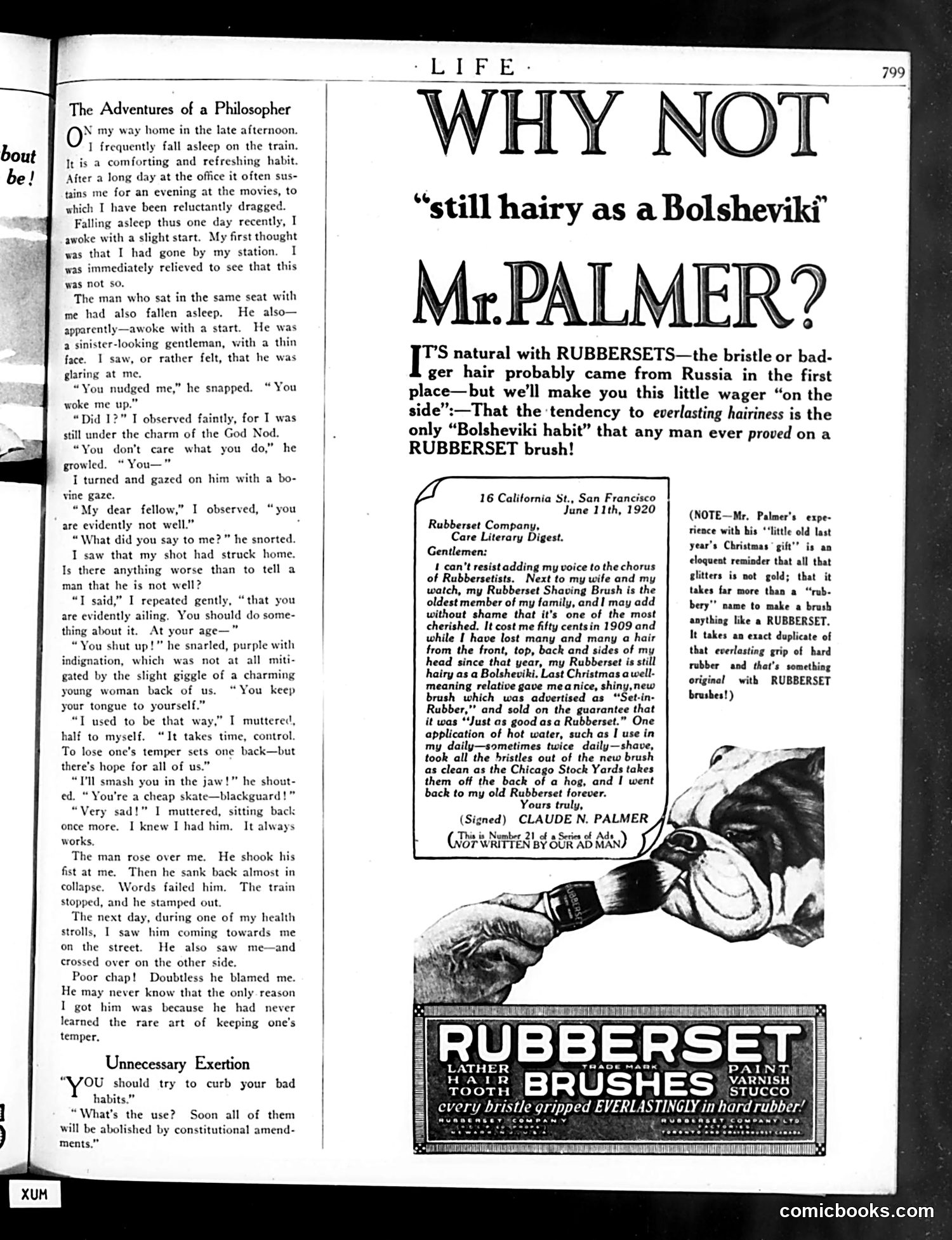
This is primarily a **Rubberset brush advertisement** (1920) masquerading as satirical editorial content. The left column contains "The Adventures of a Philosopher," a short story about a rude man on a train—seemingly unrelated social commentary. The right side features a fake letter from "Claude N. Palmer" claiming his Rubberset brush has outlasted every other brush, even surviving since 1909. The humorous headline promises it won't become "still hairy as a Bolsheviki"—a topical 1920 joke mocking Bolshevik revolutionaries as wild and unkempt. The advertisement cleverly uses contemporary political anxiety (post-Russian Revolution fear) to sell brushes by positioning their product as superior, reliable, and civilized—implicitly opposing chaotic revolutionary imagery.
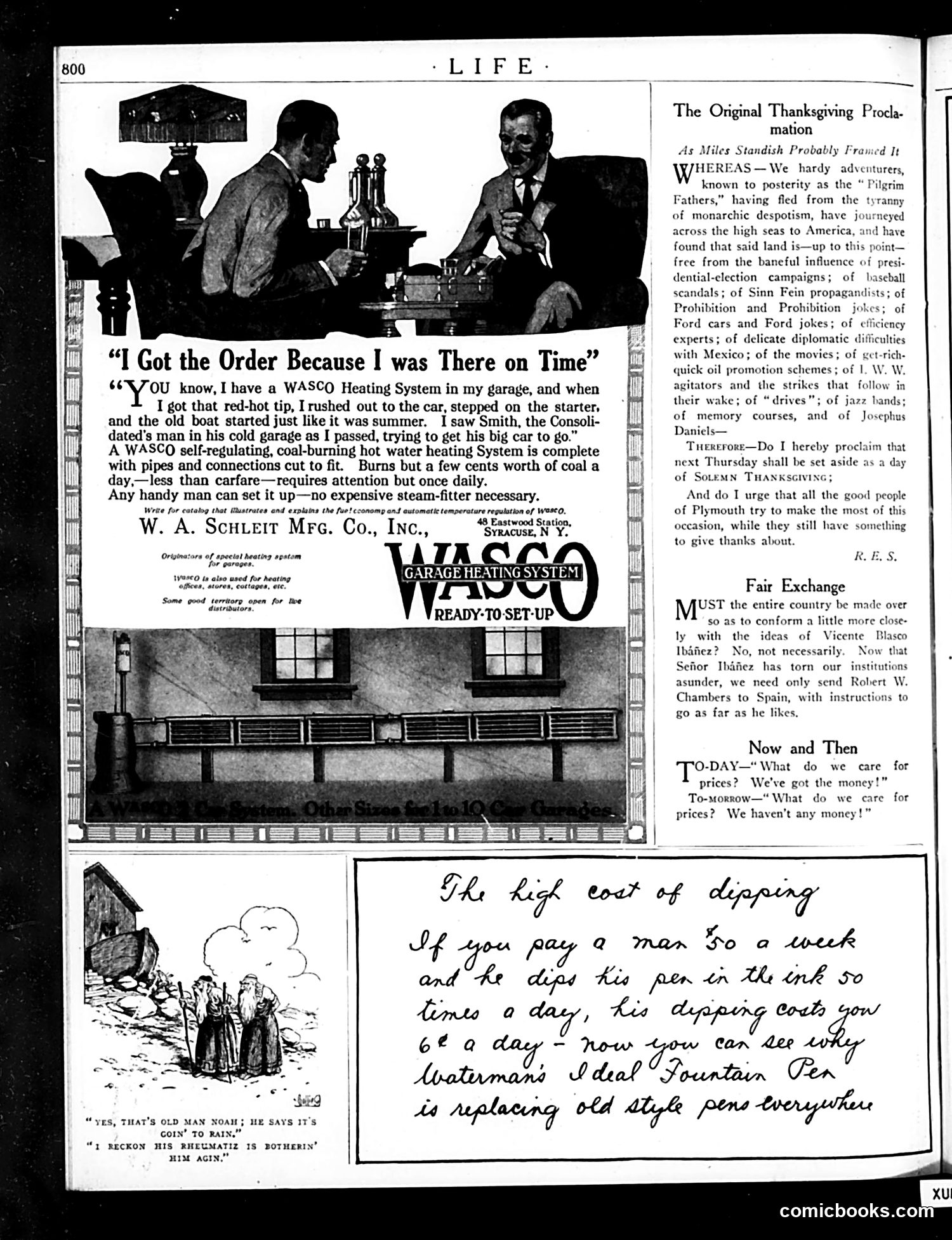
**Main Content:** This page is primarily **advertising**, featuring a large WASCO garage heating system ad with a testimonial about an automatic temperature regulator. **Editorial Content:** The right side includes three brief opinion pieces: "The Original Thanksgiving Proclamation" (a historical reprint apparently satirizing modern American concerns), "Fair Exchange" (a quip about Spanish reformer Vicente Ibáñez), and "Now and Then" (commentary on changing attitudes toward prices and money). **Cartoon:** A small sketch at bottom-left shows figures in period dress discussing an "old man" who "reckon[s] his rheumatic is bothering him again"—likely satirizing folk superstitions about weather prediction. The page's tone is lighthearted social commentary typical of Life's satirical approach during this era.
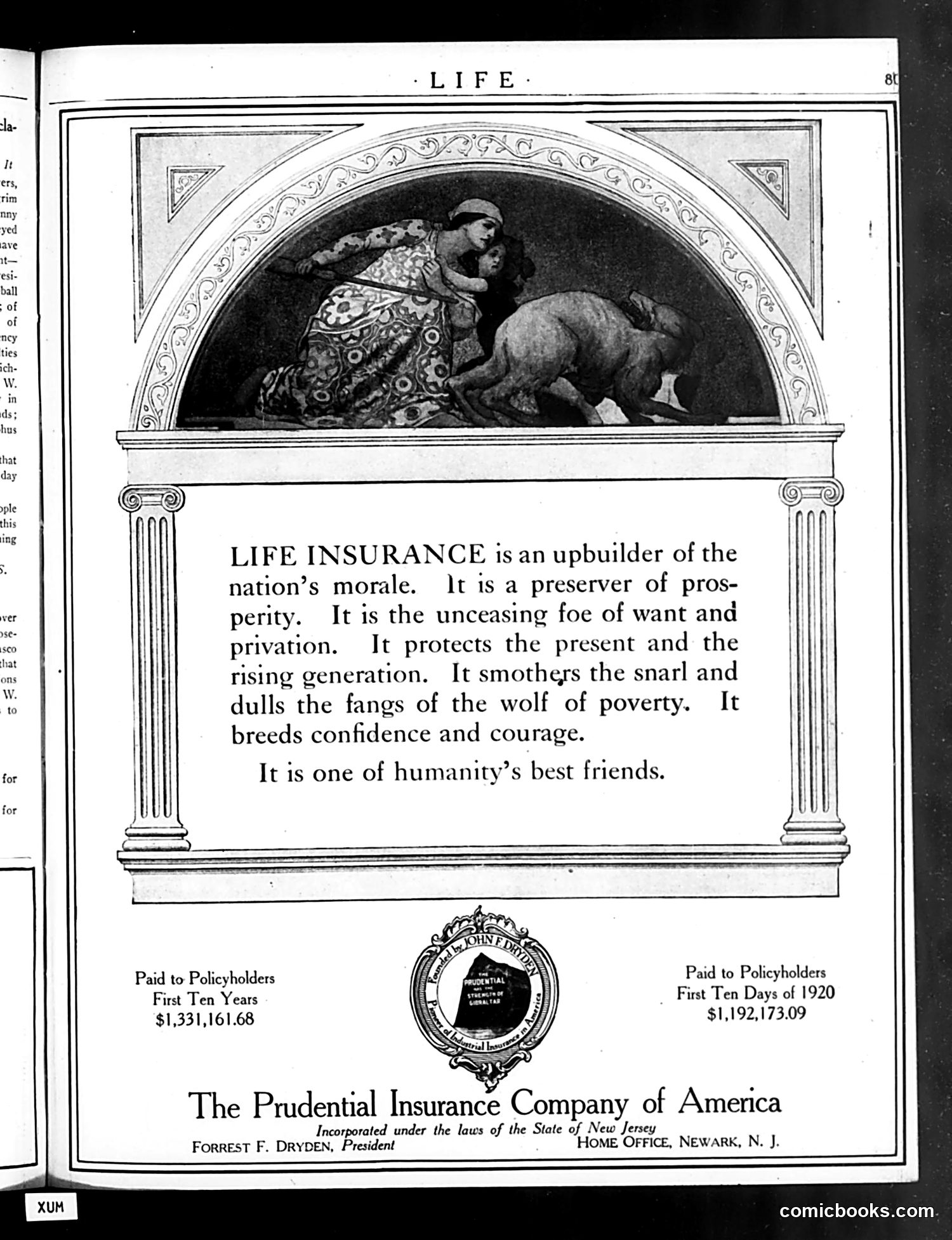
This is a **Prudential Insurance Company advertisement**, not political satire. The page features a classical arch-framed illustration showing two figures (appearing to be a woman and man in period dress) with a horse, rendered in an ornate neoclassical style. The accompanying text presents life insurance as a moral and social good—describing it as "an upbuilder of the nation's morale," a "preserver of prosperity," and protector against "the wolf of poverty." The financial figures shown ($1.3+ million paid to policyholders in the first ten years, and $1.1+ million in the first ten days of 1920) serve as proof of the company's reliability and success. This is straightforward corporate advertising appealing to middle-class anxieties about financial security during the early 20th century.
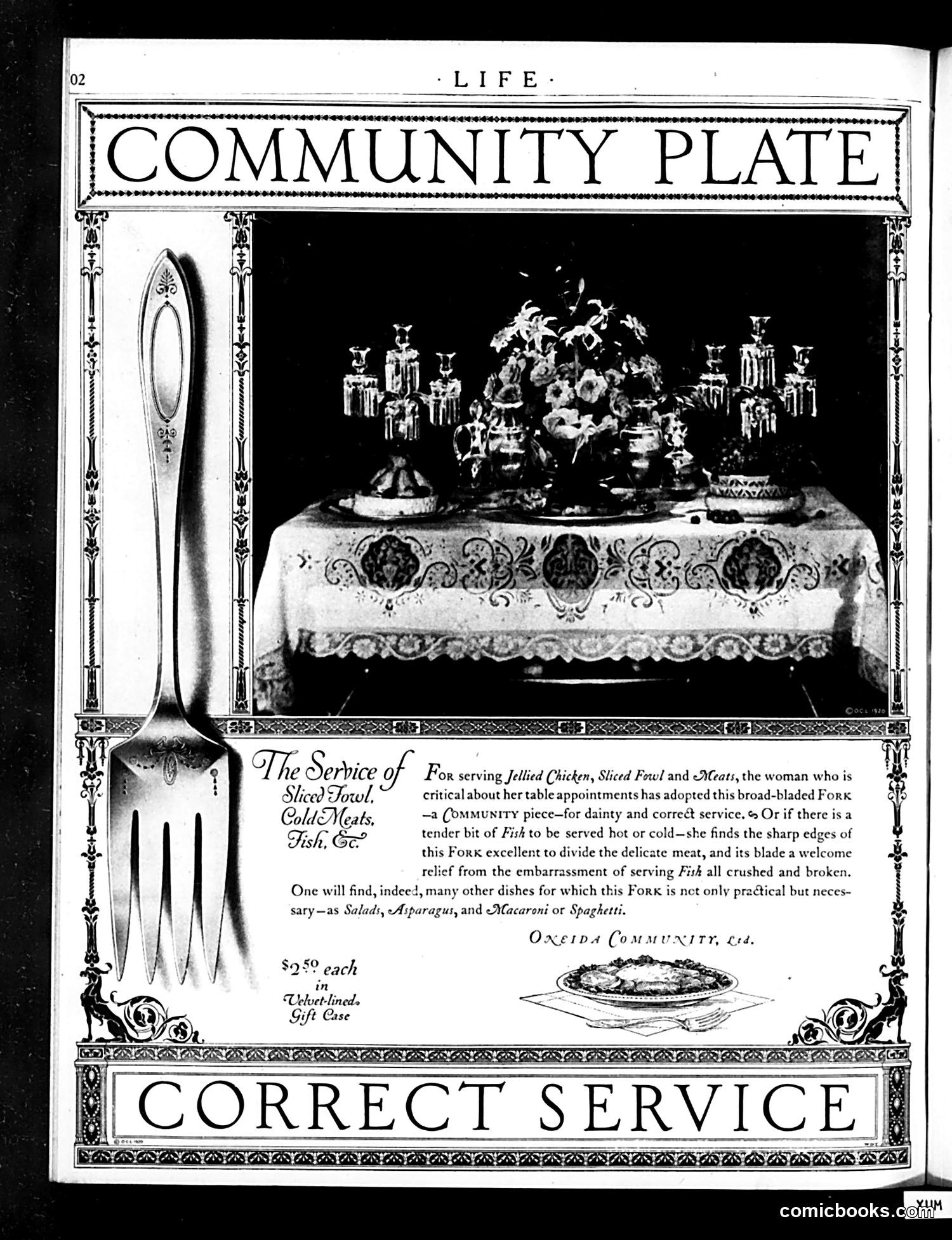
This is a straightforward **advertisement**, not political satire. It promotes Community plate silverware, specifically a fork designed for serving sliced poultry, cold meats, and fish. The ad appeals to socially conscious women concerned with "correct service" and proper table etiquette—anxieties about class status that were common in early-20th-century America. The fork is marketed as solving embarrassing dining problems: preventing crushed or broken food when serving fish, and providing "dainty and correct service." The elaborate table setting in the central image, with floral centerpiece and decorative tablecloth, reinforces aspirational upper-class domesticity. The price ($5.50 in an unlined gift case) targets middle-class consumers seeking to appear refined through proper tableware.
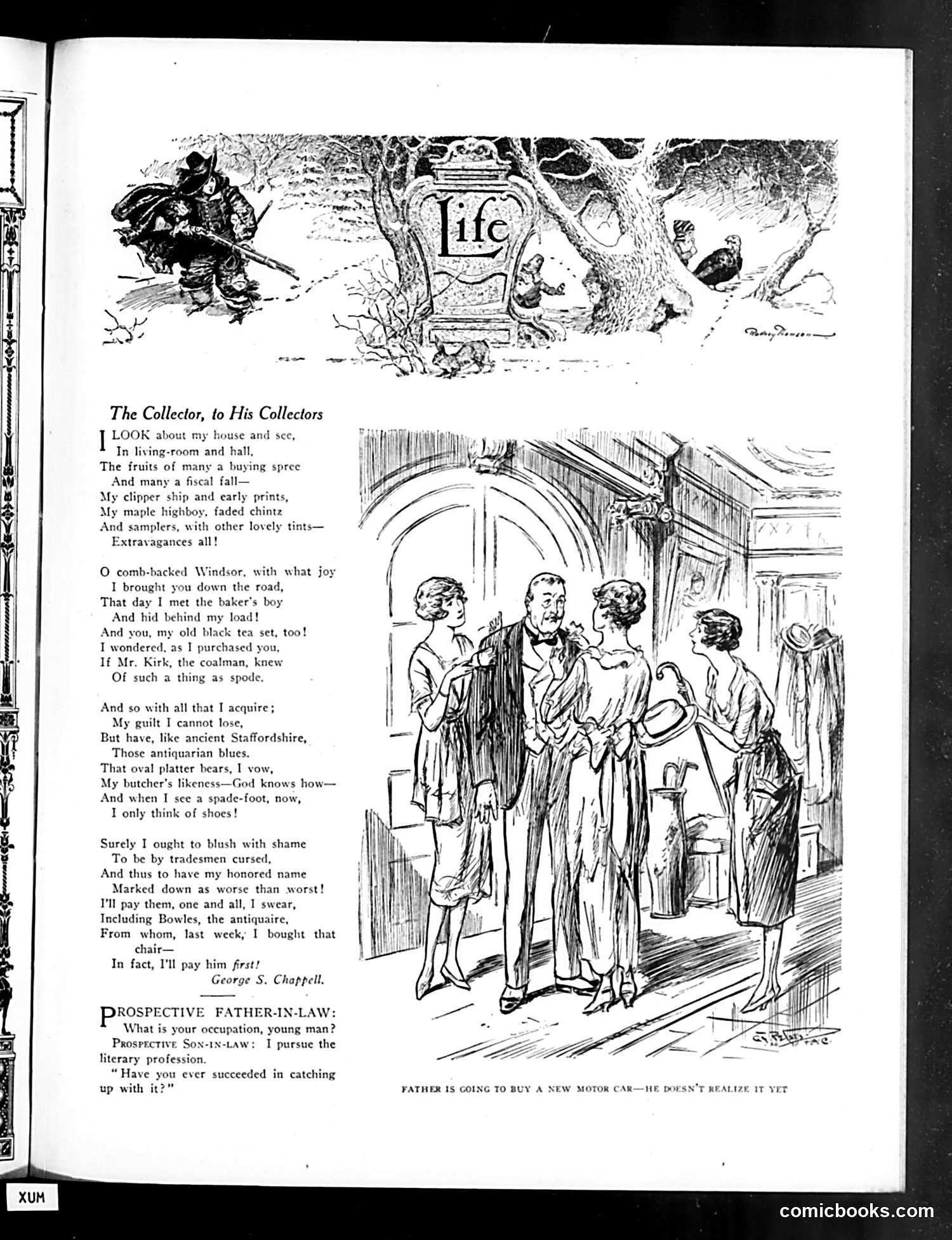
This page contains a poem by George S. Chappell addressed to fellow collectors of antiques and curiosities. The poem humorously catalogs the speaker's accumulated possessions—Windsor chairs, prints, samplers, a comb-backed chair—while confessing anxiety about their authenticity and value. The accompanying illustration shows a domestic scene where a man displays his collected items to visitors. The satire targets wealthy collectors' obsession with acquiring "antique" goods, often uncertain whether purchases are genuine. The poem's confession that he "only think[s] of shoes" now and questions whether items are "worse than warts" mocks the pretentiousness and buyer's remorse common among collectors. Below is an unrelated joke about a prospective father-in-law questioning a young man's occupation.
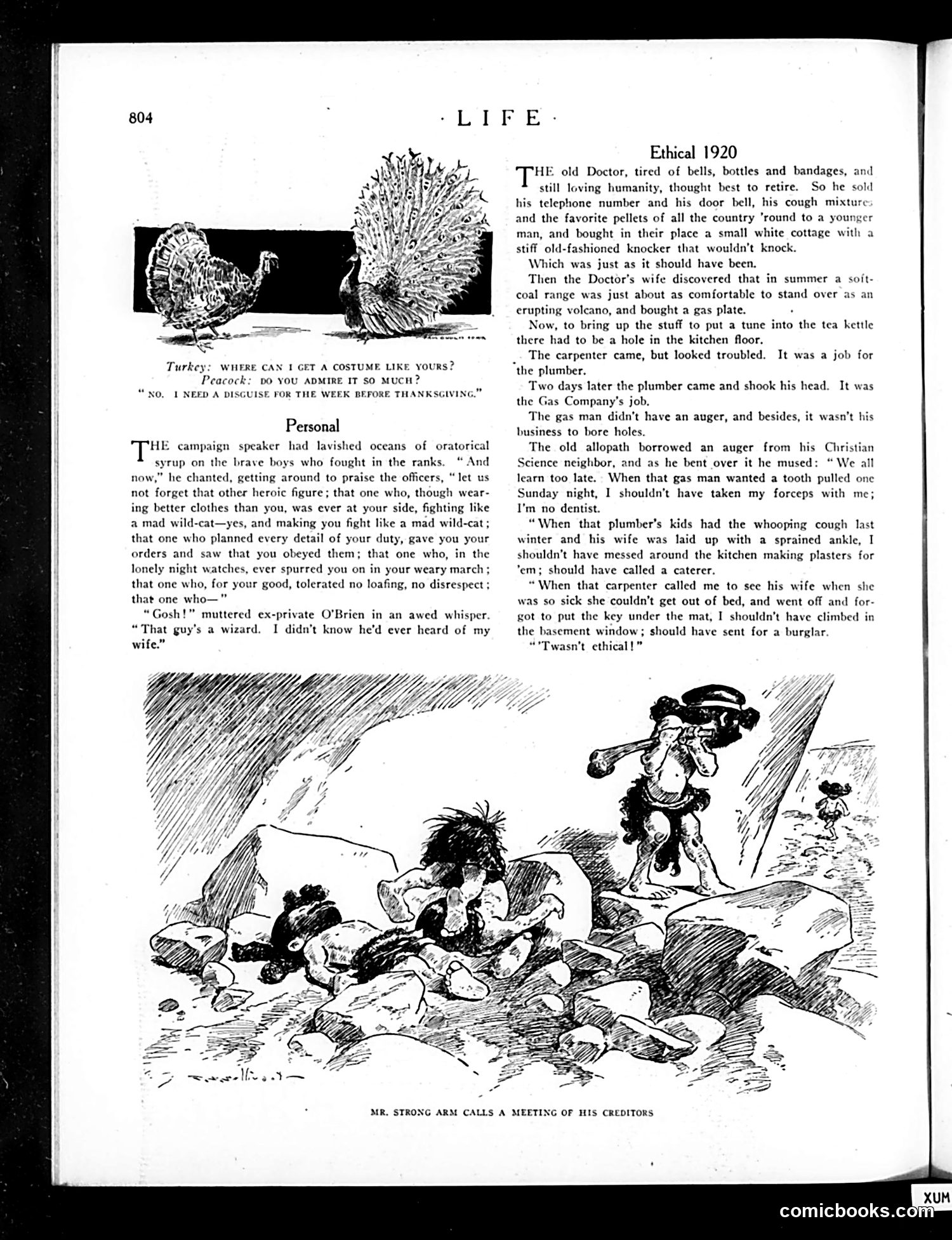
This page contains two distinct pieces: **Top section** ("Personal"): A humorous anecdote about an old doctor retiring and selling his practice. The story satirizes ethical inconsistency—the new owner's allopath (traditional doctor) borrows folk remedies from Christian Science neighbors and calls in carpenters for home repairs rather than proper professionals, contradicting claims of medical ethics. The ex-private's quoted comment mocks the hypocrisy. **Bottom cartoon** ("Mr. Strong Arm Calls a Meeting of His Creditors"): This appears to be political/social satire. "Strong Arm" likely represents a labor figure or powerful businessman literally summoning creditors, depicted as small, distressed figures amid rubble and chaos. The image suggests mockery of how powerful economic actors treat their financial obligations. Both pieces critique 1920s attitudes toward professionalism and business ethics.
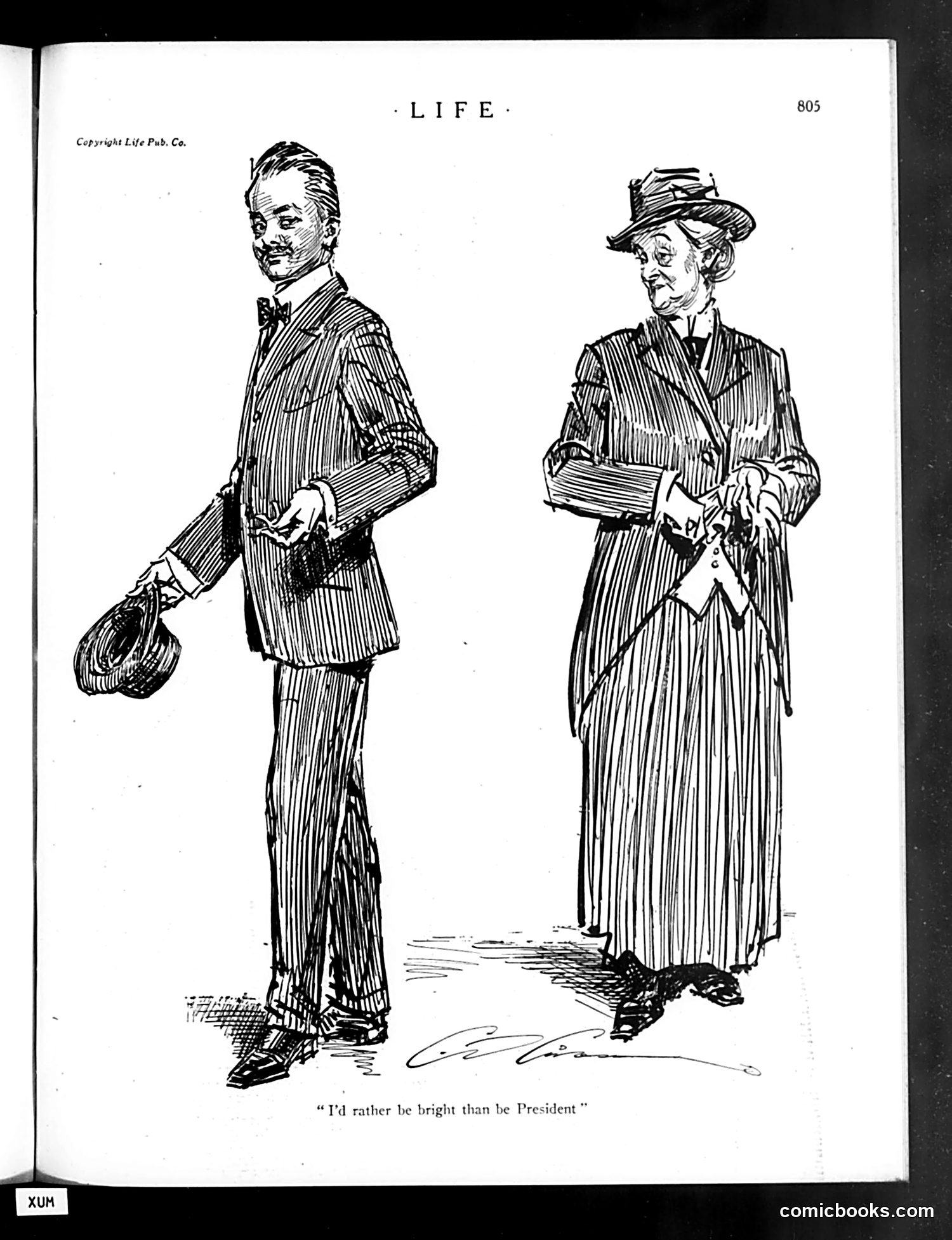
This cartoon from *Life* magazine depicts two figures in formal attire with a caption: "I'd rather be bright than be President." **Left figure:** A well-dressed man in a pinstriped suit holding a hat, appearing sophisticated and intellectual. **Right figure:** An older woman in a long dress and hat, also formally dressed. The satire appears to contrast intellectual aspiration with political ambition—suggesting that being intelligent or accomplished is preferable to holding the presidency. Without knowing the specific publication date or identified subjects, the cartoon likely critiques either a particular president's intellect or comments on the relative value of intellectual pursuits versus political office during the era when *Life* was actively satirizing American politics and society. The refined drawing style and formal dress suggest upper-class or educated characters.
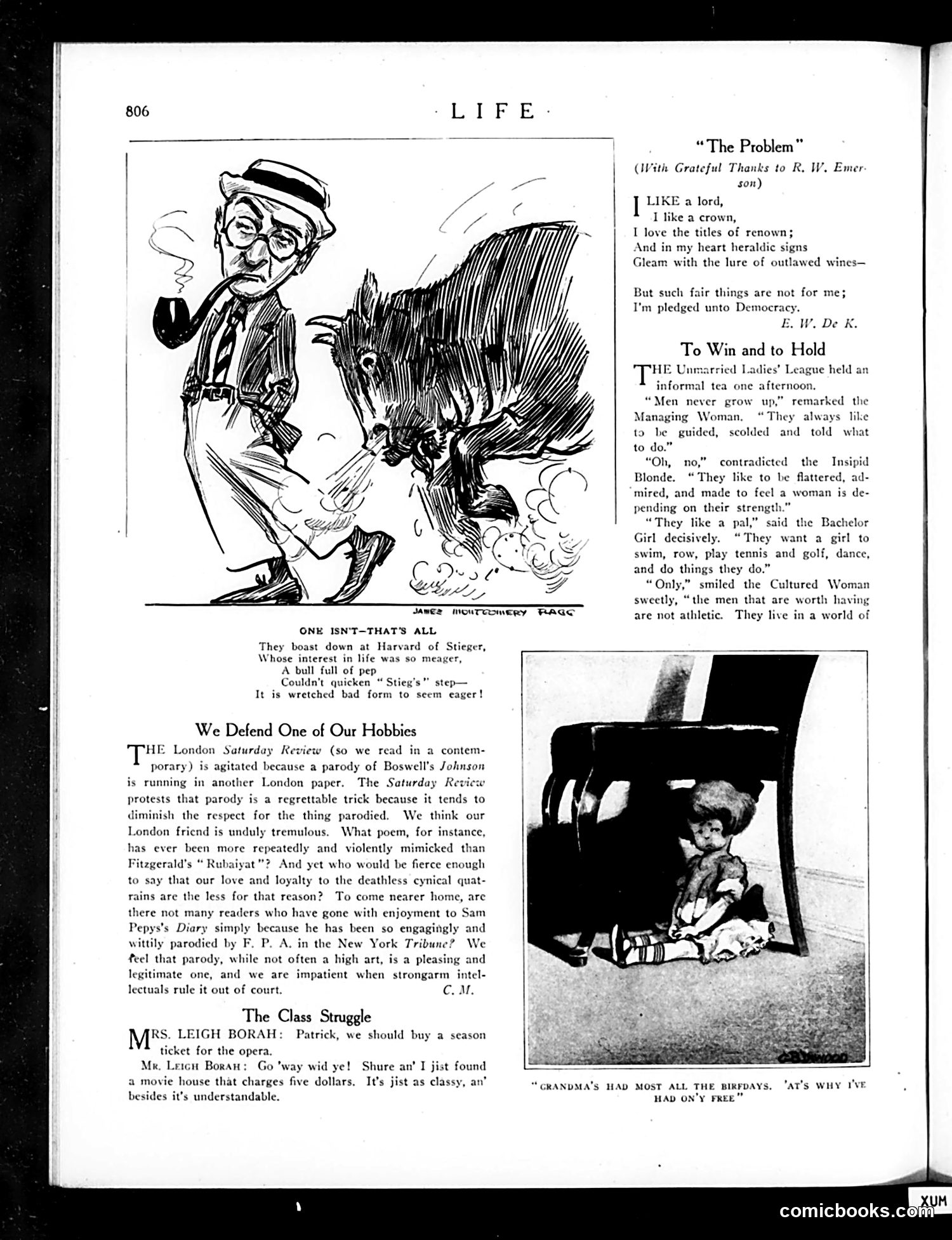
This page from *Life* (a satirical publication) contains several pieces mocking American social attitudes circa early 20th century. The main cartoon shows a caricatured man being dragged by what appears to be a woman or force, captioned "ONE ISN'T—THAT'S ALL." It likely satirizes masculine pretense or social climbing. **"To Win and to Hold"** parodies debate among unmarried women about what men want, with each woman (Managing Woman, Blonde, Bachelor Girl, Cultured Woman) offering contradictory advice. The satire targets both the confusion women face about courtship expectations and male inconsistency. **"We Defend One of Our Hobbies"** defends literary parody against British criticism, citing *Fitzgerald's Rubaiyat* and *F.P.A.'s* parodies of *Sam Pepys's Diary* as legitimately loved despite mockery. **"The Class Struggle"** shows working-class Irish characters (Mr. and Mrs. Leigh Borah) debating entertainment value—he prefers a five-dollar movie to opera because it's "classy" and understandable. The satire mocks working-class attempts at respectability and cultural aspiration. The bottom photograph's caption makes a joke about free childcare.
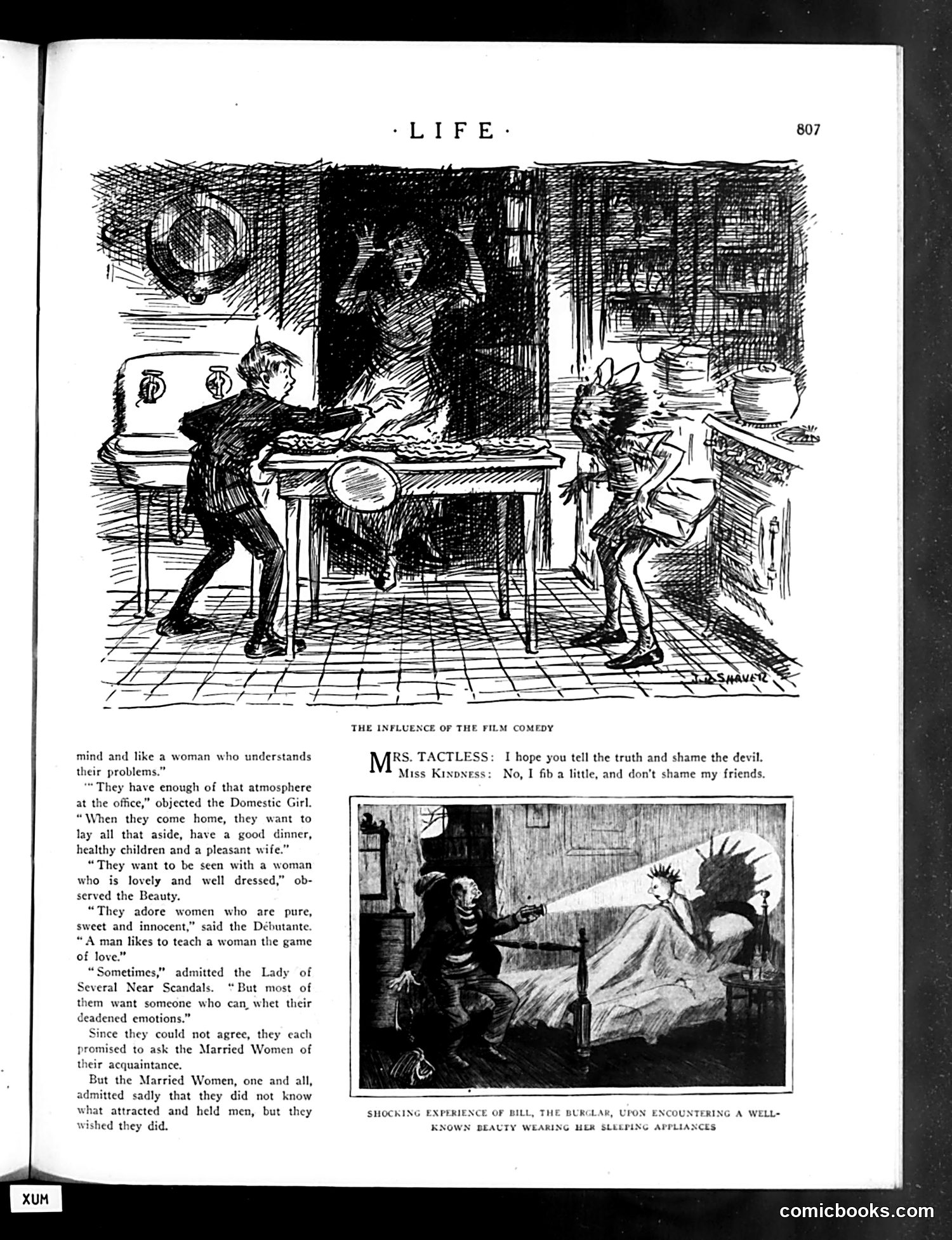
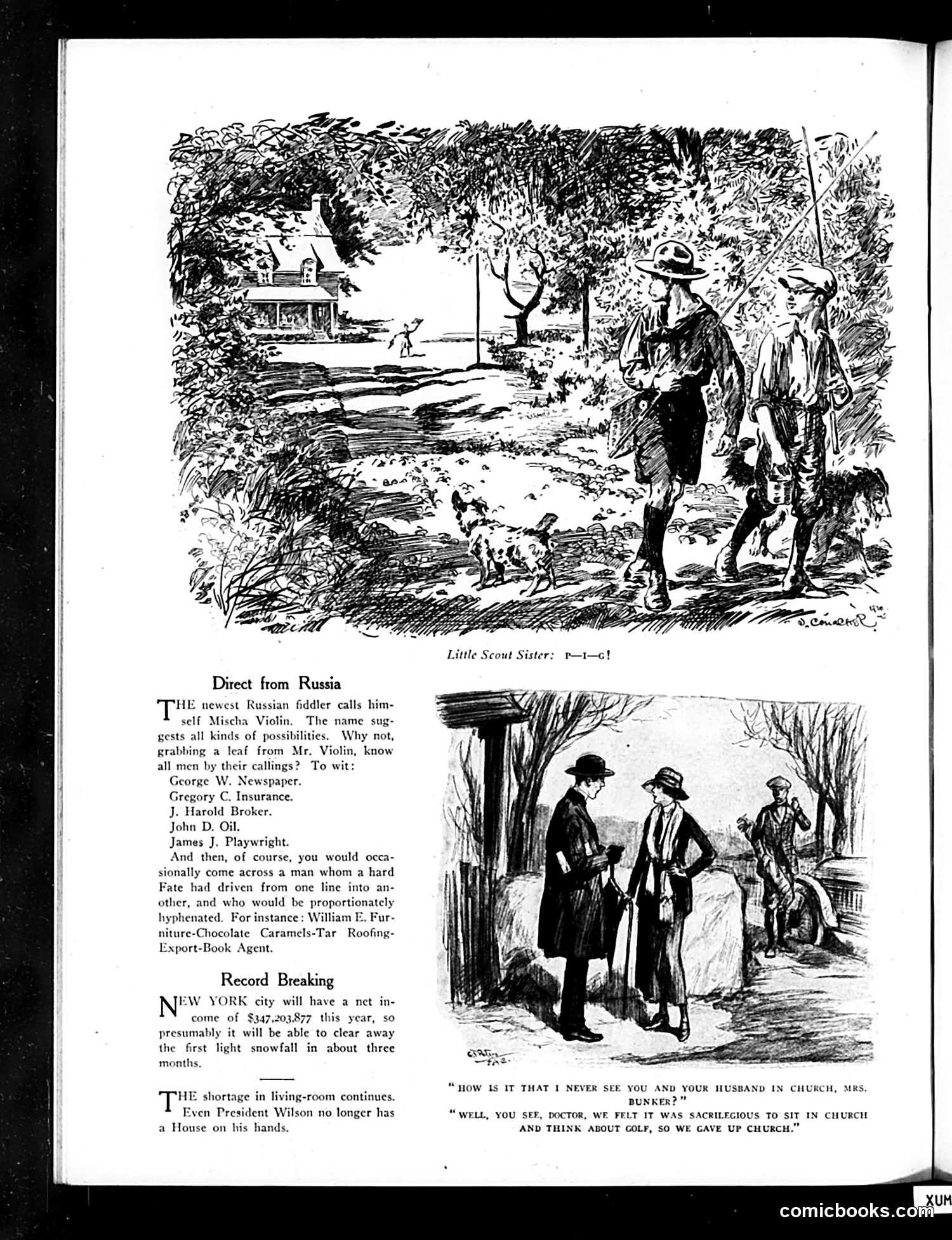
This page contains three satirical pieces: 1. **"Direct from Russia"**: Mocks a Russian violinist named "Mischa Violin" by proposing everyone adopt occupational surnames (George W. Newspaper, John D. Oil, etc.). The humor lies in the absurdity of this naming convention and the exaggerated hyphenated names for people with chaotic careers. 2. **"Record Breaking"**: A brief jab at New York City's inefficiency—despite massive municipal income, the city supposedly takes three months to clear a single snowfall, suggesting incompetent administration. 3. **Church/Golf Cartoon**: Satirizes upper-class hypocrisy. Mrs. Bunker claims she and her husband abandoned church attendance because thinking about golf during services would be "sacrilegious"—a tongue-in-cheek excuse masking that golf has become their actual religion, more important than Christianity. All three pieces target pretension, materialism, and the gap between stated values and actual behavior in American society.
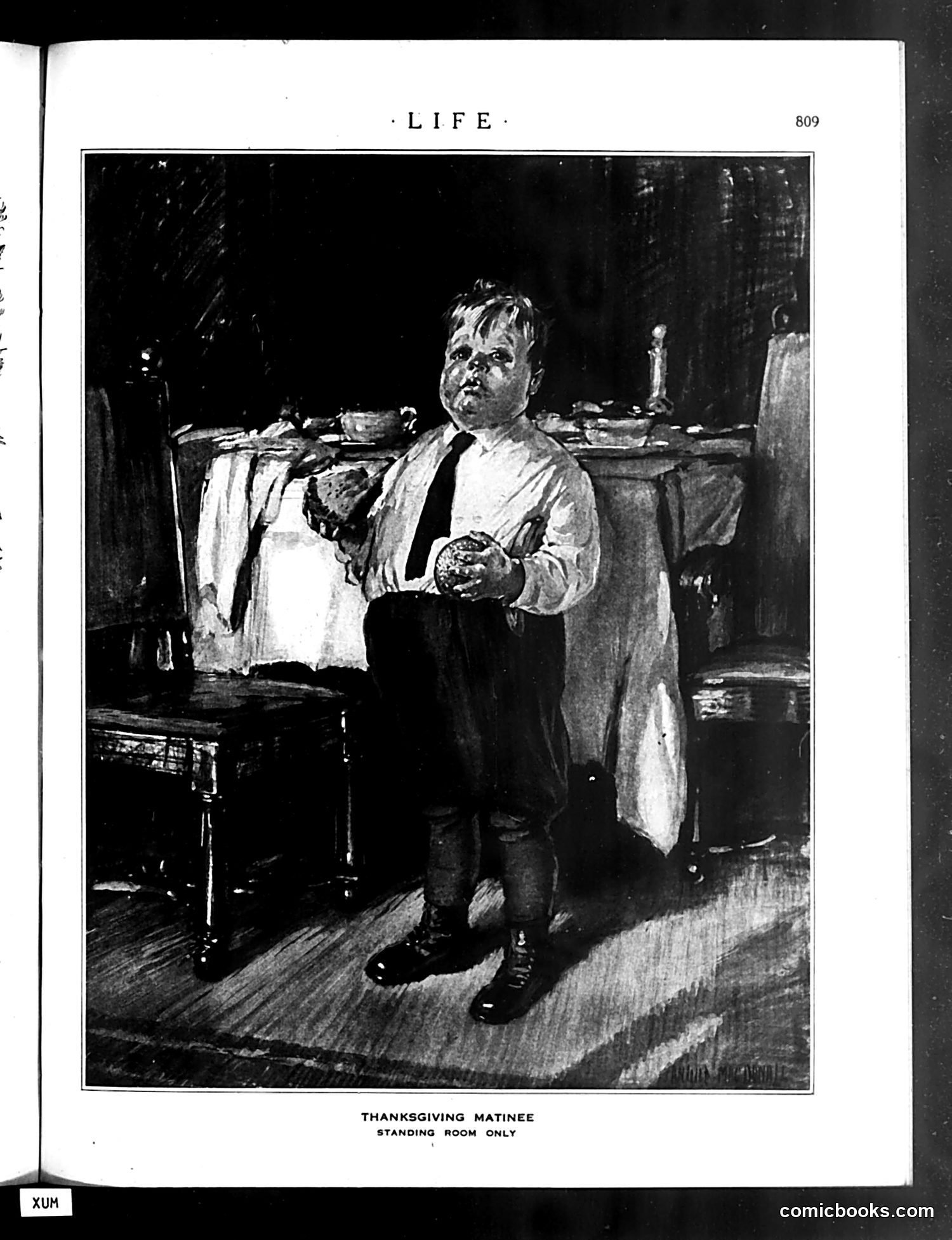
This satirical illustration depicts a rotund, disheveled man in a rumpled jacket standing in what appears to be a cramped room or dressing area, surrounded by clothing and domestic clutter. The caption "Thanksgiving Matinee—Standing Room Only" suggests social commentary about overcrowding, likely referencing either: 1. Overcrowded theaters during holiday performances, or 2. Cramped living conditions in tenement housing (a common satirical target in early 20th-century Life magazine) The man's disheveled appearance and the cluttered, confined space suggest commentary on poverty or working-class conditions. Without additional context, the specific political figure or referenced event remains unclear, though the image likely satirized contemporary social conditions rather than a particular individual. The "Standing Room Only" phrase implies ironic commentary on inadequate space and resources.
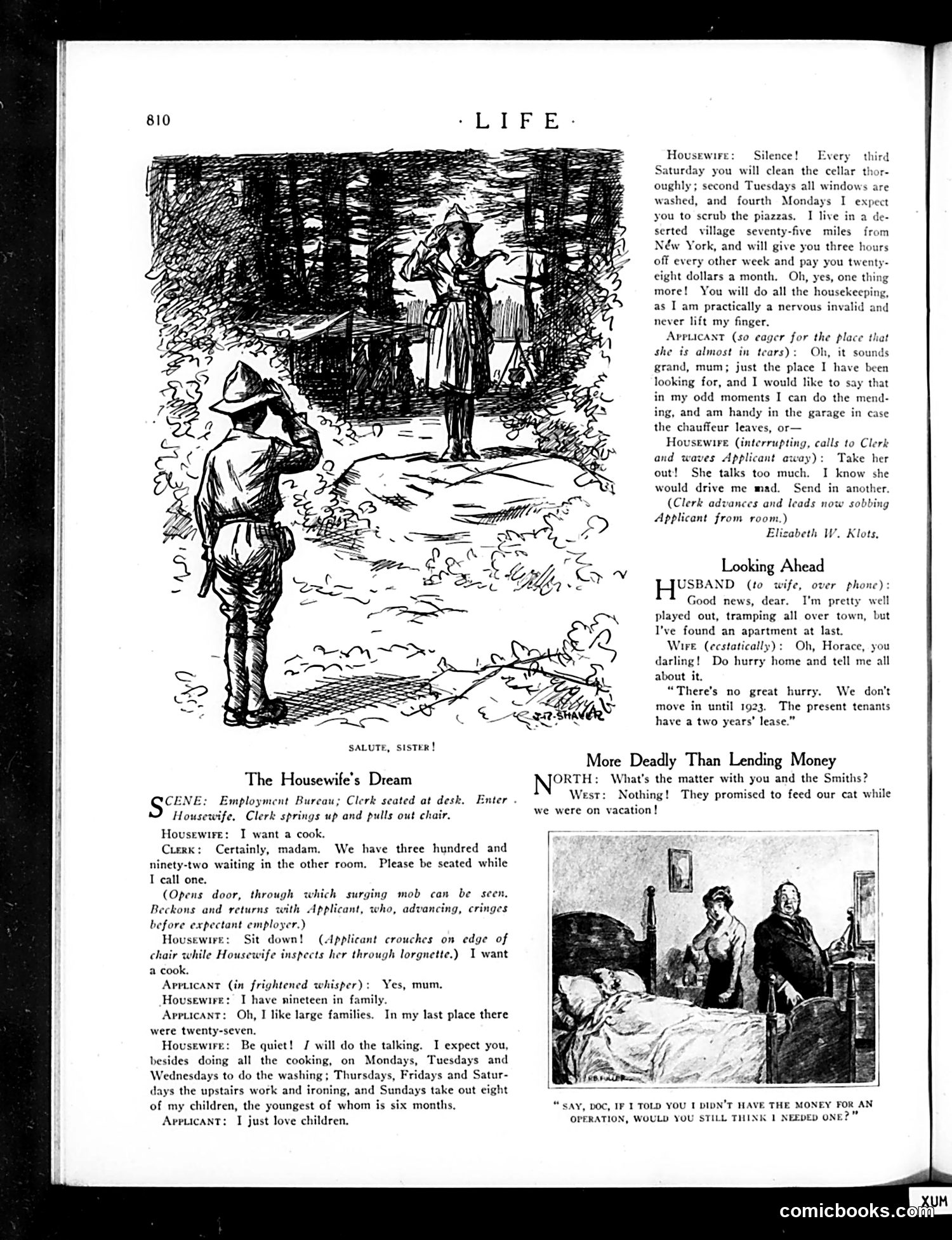
This page satirizes the severe shortage and mistreatment of domestic servants in post-WWI America. **"The Housewife's Dream"** depicts an employment agency scene where a wealthy housewife interviews job applicants with absurdly unreasonable demands: cleaning cellars, washing windows, scrubbing piazzas, doing all housekeeping while she claims to be a "nervous invalid," plus childcare for nineteen children—all for $28/month and minimal time off. When an eager applicant offers extra mending work, the housewife dismisses her as "talking too much" and demands another candidate, illustrating employers' callous exploitation and entitlement. The accompanying sketches mock upper-class obliviousness: a husband's apartment won't be available until 1923 due to existing tenants, and neighbors feud over broken cat-feeding promises during vacation. The satire critiques the vast power imbalance between employers and desperate workers, the impossible workloads expected of servants, and the arrogant assumption that applicants should be grateful for exploitative wages and conditions.
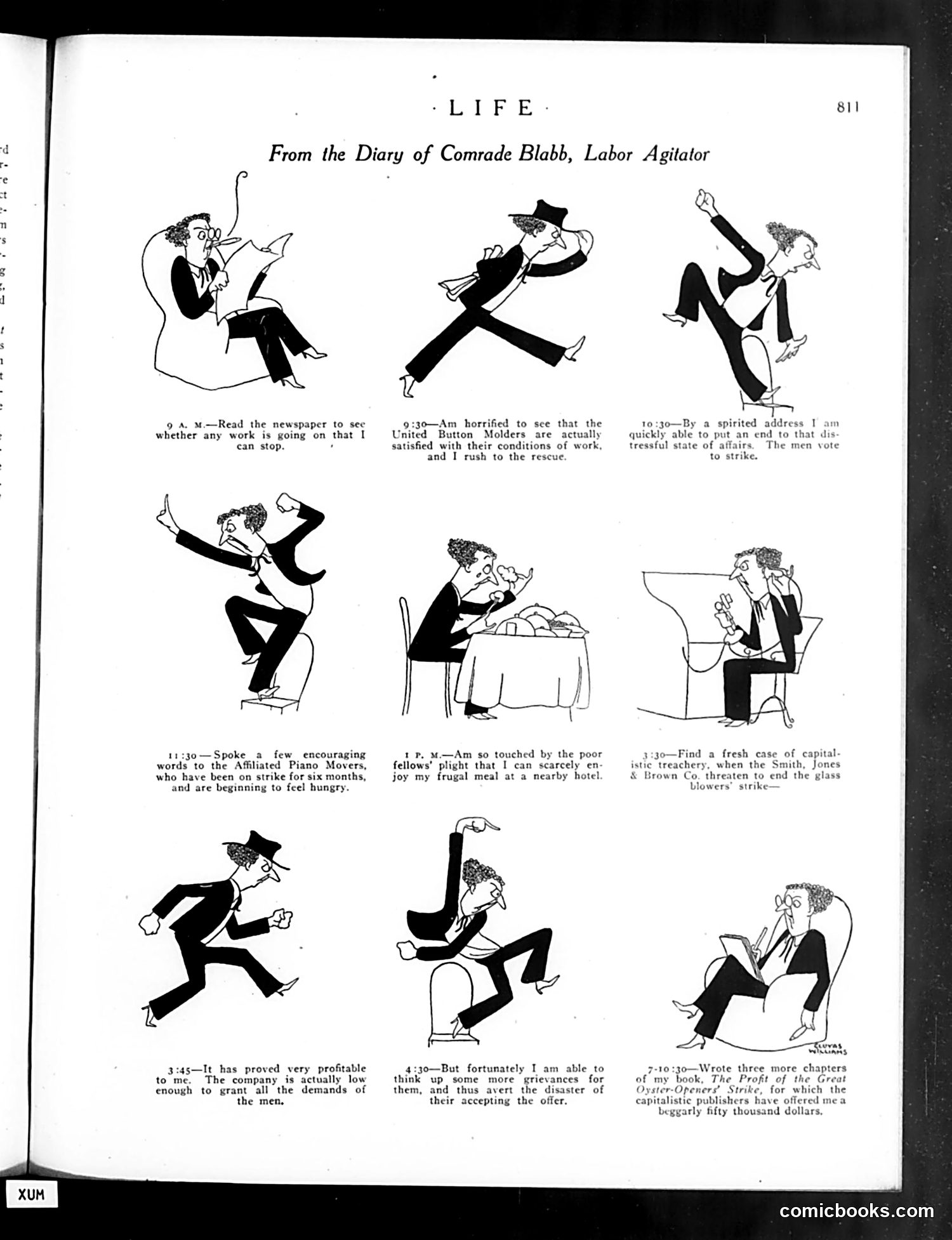
This satirical cartoon mocks professional labor organizers and union agitators of the early 20th century. The character "Comrade Blabb" represents a caricature of a radical labor activist—someone who appears more interested in perpetuating strikes and conflict than actually helping workers. The joke is that Blabb: - Actively seeks work stoppages to incite ("whether any work is going on that I can stop") - Manipulates satisfied workers into striking unnecessarily - Grows comfortable (enjoying hotel meals) while workers starve during six-month strikes - Manufactures false grievances to prevent workers from accepting reasonable company offers - Profits by writing about strikes for capitalist publishers The satire suggests labor agitators are hypocritical opportunists enriching themselves through workers' suffering while claiming to champion their cause. This reflects anti-union sentiment common in conservative publications of the era.
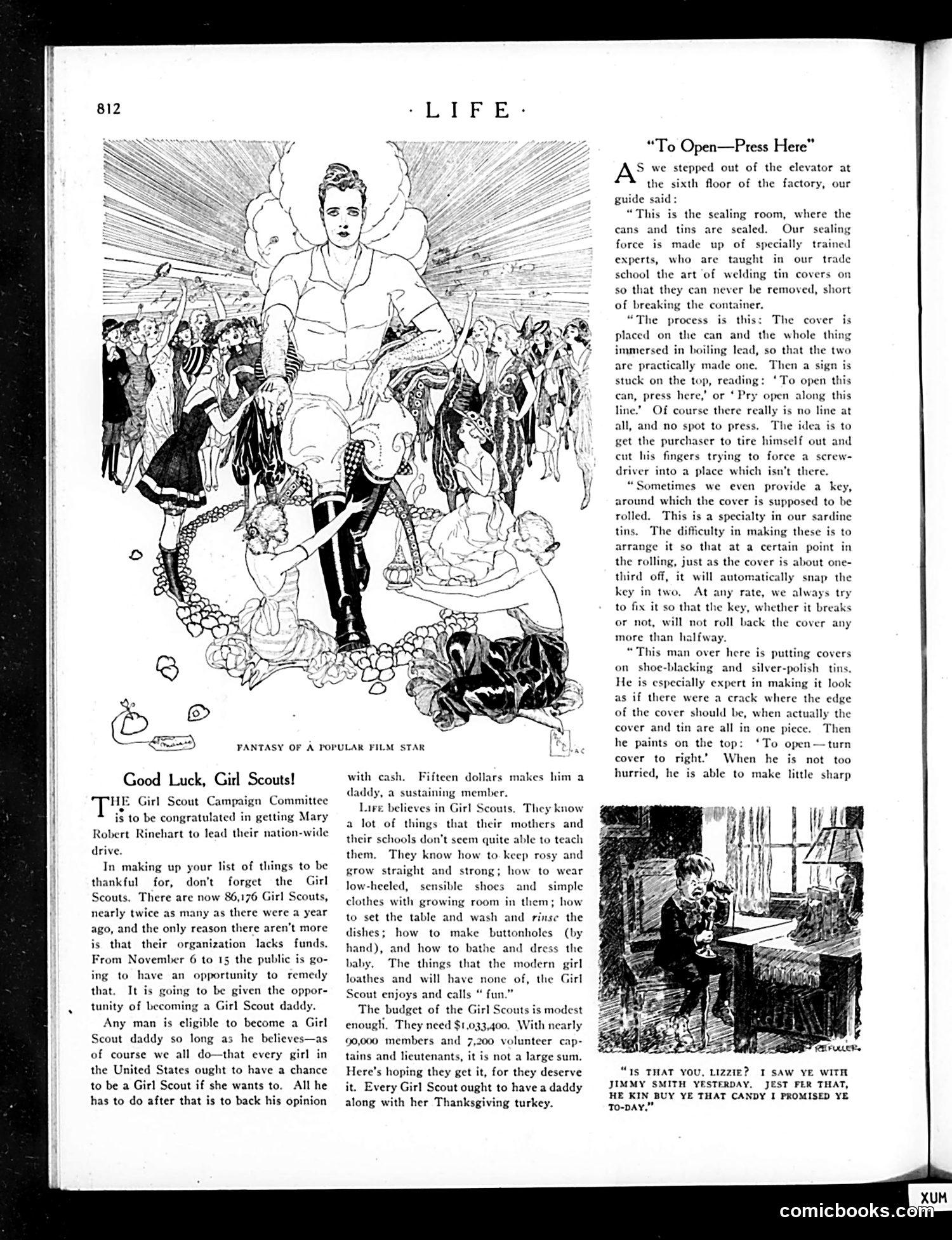
The large illustration satirizes consumerism and deceptive manufacturing practices. A giant, angelic-looking factory worker is surrounded by crowds of consumers, suggesting how companies manipulate the public. The accompanying text describes deliberately frustrating product design—sealed cans with fake "press here" labels, impossible-to-open sardine tins with keys engineered to snap, and misleading instructions. The satire mocks manufacturers who intentionally make products difficult to open, forcing consumers to struggle, cut themselves, or break tools. The joke targets the gap between advertising's promises ("To Open—Press Here") and reality: products designed to *frustrate* rather than serve users. This reflects early 20th-century consumer skepticism about industrial manufacturing and corporate indifference to customer experience. The "popular film star" reference suggests this fantasy reflects widespread public cynicism about big business practices.
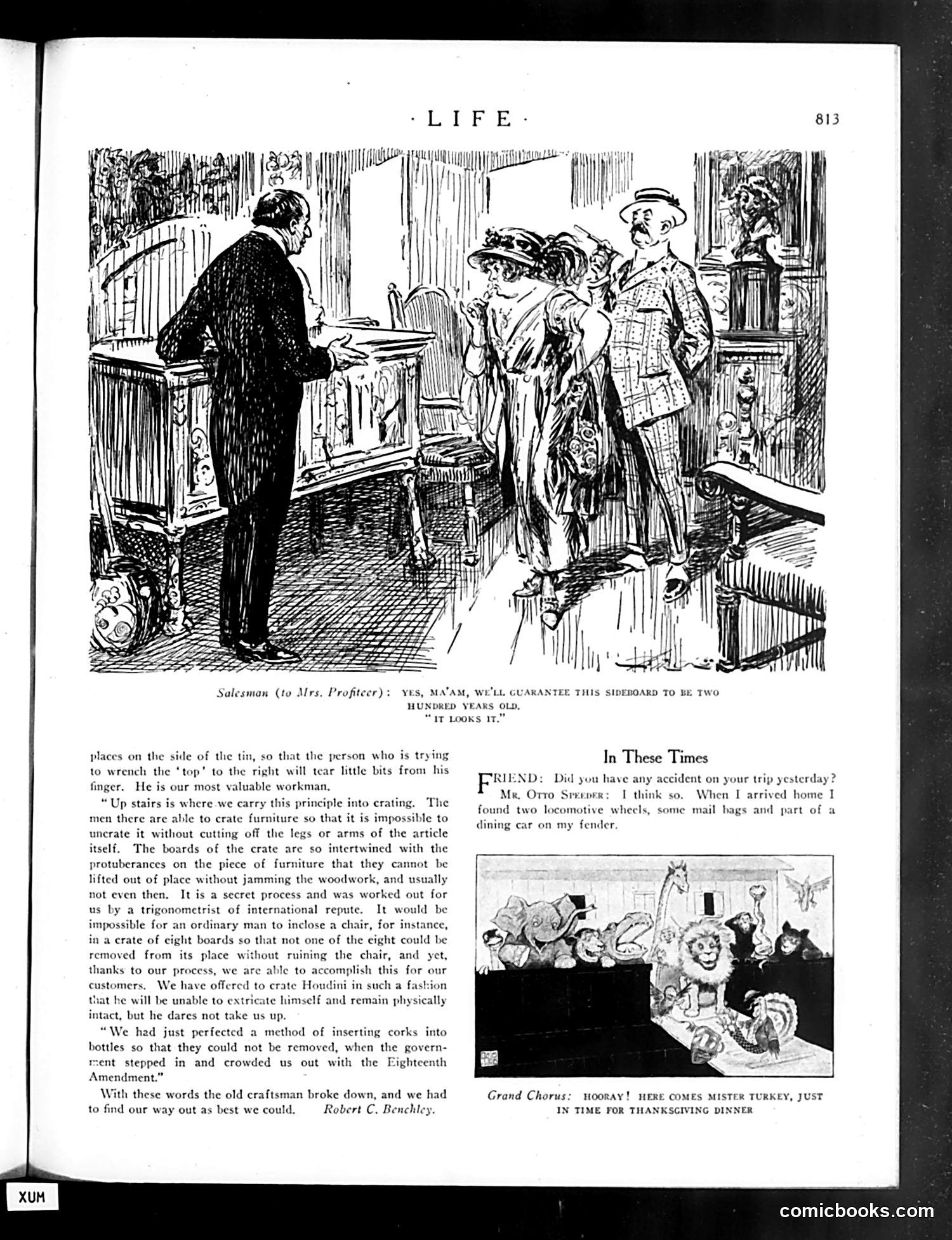
**Top Cartoon:** A furniture salesman pitches an antique sideboard to customers, claiming it's 200 years old when it "looks it"—a joke about selling shabby goods as valuable antiques. **"In These Times" Article & Cartoon:** Humorist Robert C. Benchley satirizes overly complicated industrial packing methods. A craftsman boasts of crating furniture so elaborately that it cannot be unpacked without destroying it—absurd overkill presented as professional excellence. The piece mocks both modern manufacturing pretension and bureaucratic excess. Benchley even jokes about offering to crate escape artist Houdini inescapably. The sideline cartoon shows a man explaining to his friend that a locomotive accident dumped train parts on his car—a darkly comic illustration of the article's theme about destructive "solutions." Both items ridicule impractical over-engineering and sales hype disguised as craftsmanship, typical of Life's satirical approach to American business culture.
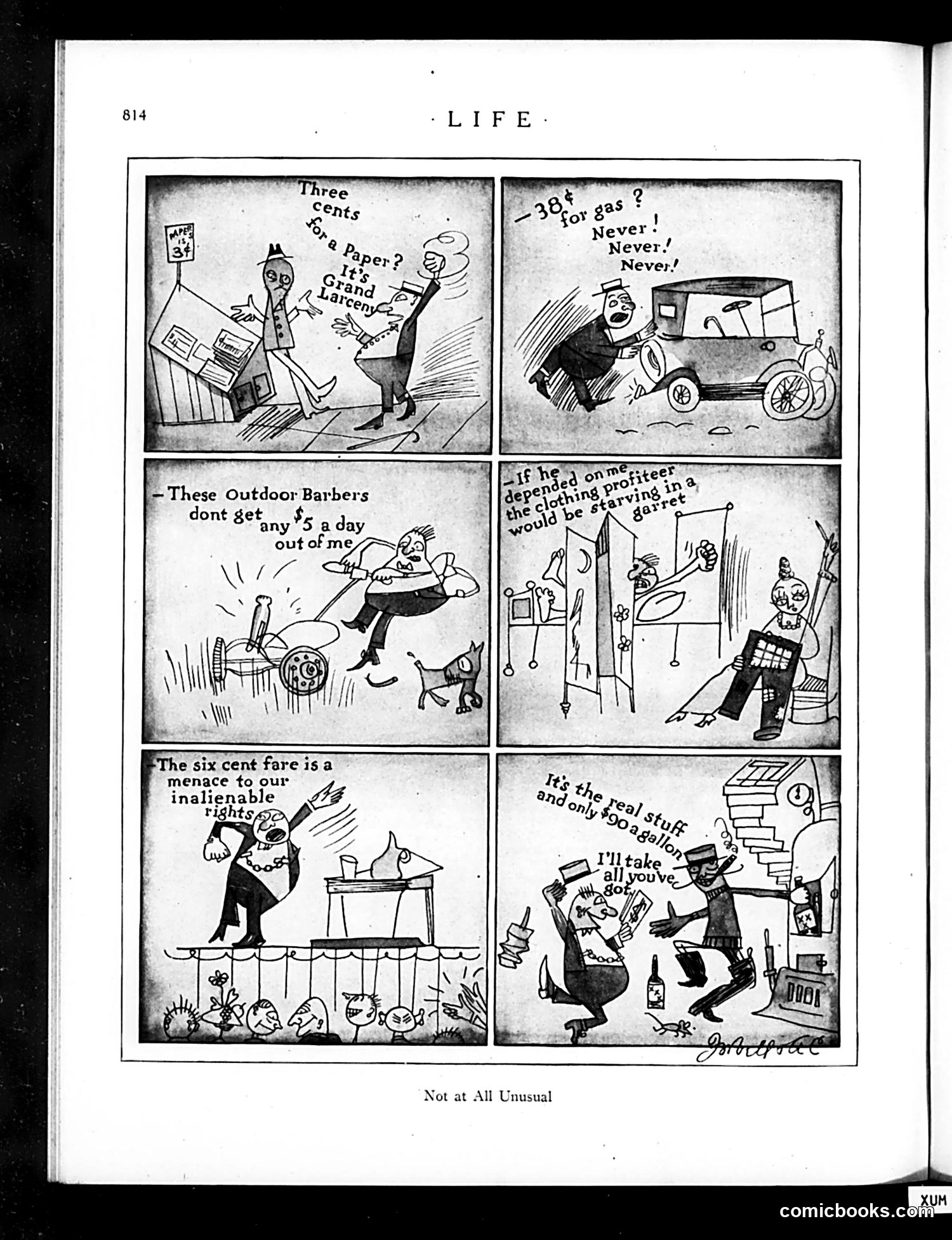
This six-panel satirical strip mocks various Depression-era complaints and price gouging. The panels lampoon: 1. **Newspaper vendors** charging three cents—depicted as highway robbery 2. **Gasoline prices** at 38¢/gallon, treated as outrageous 3. **Outdoor barbers** demanding $5 daily wages, shown as threatening 4. **Clothing profits**, with a man starving in a garret while profiteers prosper 5. **Six-cent transit fares** as attacks on "inalienable rights" 6. **Liquor prices** at $60/gallon—the final panel shows someone willing to buy stolen goods The strip's ironic title suggests these complaints are actually common grievances, not unusual at all. It satirizes both working-class protests against rising costs and the era's pervasive black-market and crime culture driven by Prohibition and economic hardship.
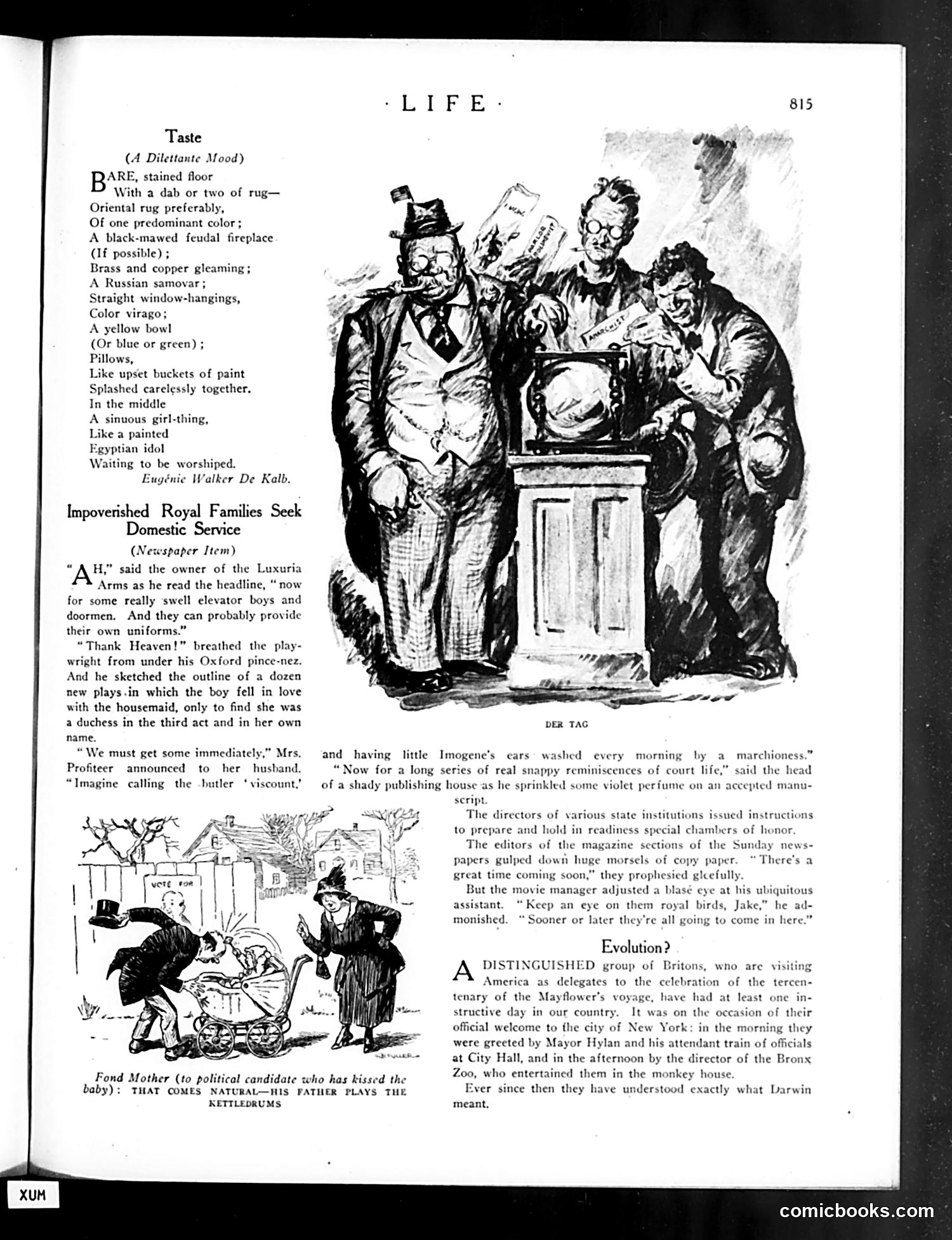
This page contains two satirical pieces mocking early 20th-century American pretension and snobbery. **"Taste"** ridicules aesthetic affectation—the fashionable "dilettante" decoration style featuring Oriental rugs, Russian samovars, and "sinuous girl-things" posed like Egyptian idols. The satire targets wealthy people mimicking bohemian sophistication through trendy interior design. **"Impoverished Royal Families Seek Domestic Service"** lampoons the American elite's fantasy that cash-strapped European nobility might staff their households. The joke: wealthy Americans (the "profiteer") eagerly anticipate hiring actual aristocrats as servants, imagining romantic plots where servants turn out to be duchesses—mocking both American class-consciousness and their gullibility. **"Evolution?"** satirizes American reception of British Mayflower descendants visiting for the 300th anniversary celebration. The punchline: after being formally welcomed by New York's Mayor at City Hall, they're entertained at the Bronx Zoo's monkey house—implying Americans view the British as primitives, thus "proving" Darwin's evolution theory.
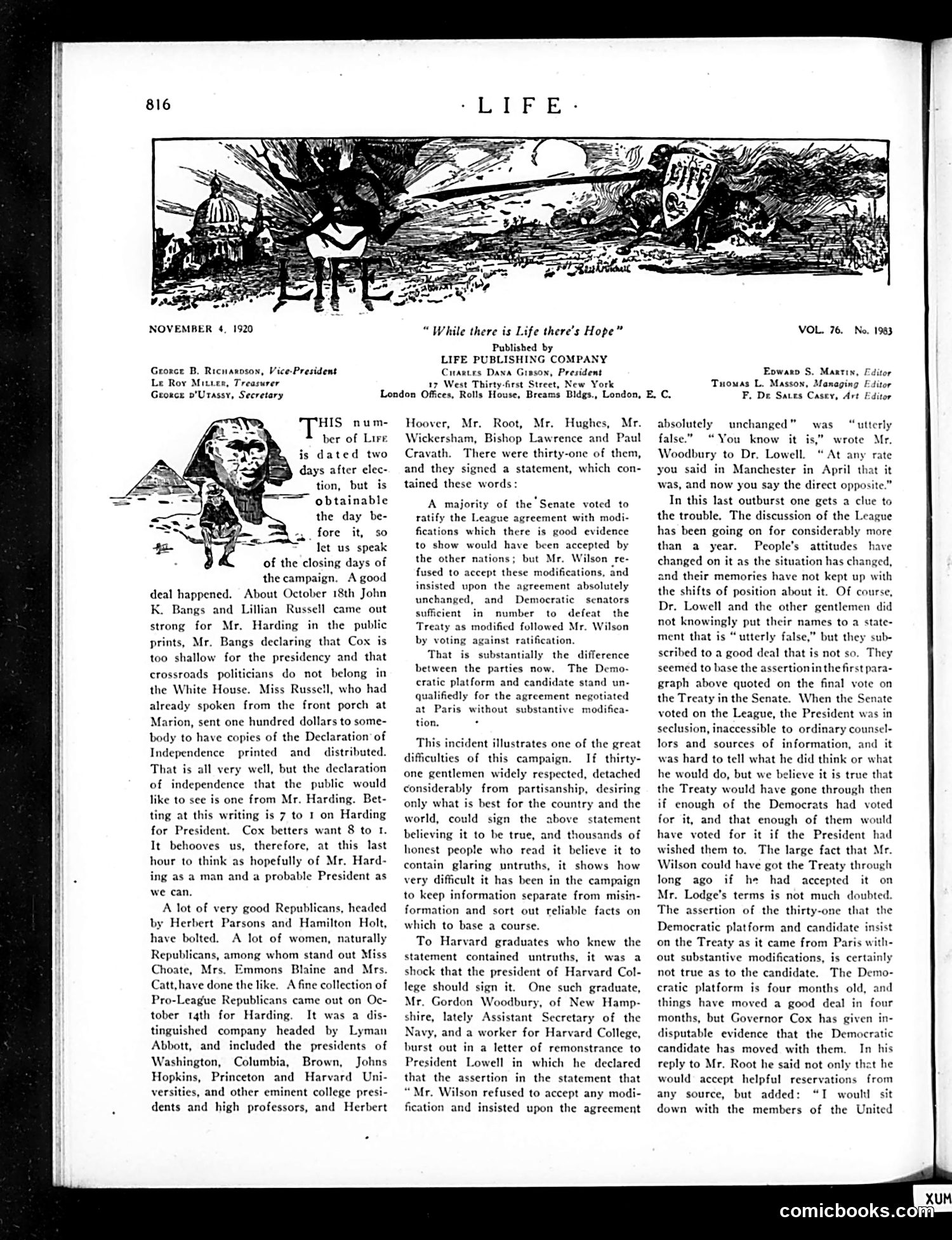
This November 4, 1920 *Life* magazine article addresses the final days of the 1920 U.S. presidential election between Republican Warren Harding and Democrat James Cox. The piece satirizes how high-profile figures were being enlisted to support Harding's campaign. The article critiques a statement signed by 31 prominent figures—including college presidents and civic leaders—claiming President Wilson "refused to accept" League of Nations modifications that other nations would have accepted. The satirical point: these "widely respected, detached" gentlemen signed what some educated readers (like a Harvard graduate quoted) considered factually untrue, exposing how difficult it became to separate reliable information from misinformation during the 1920 campaign. The cartoon appears to depict Lady Liberty or personified America caught between competing political forces, illustrating the campaign's chaos and confusion.
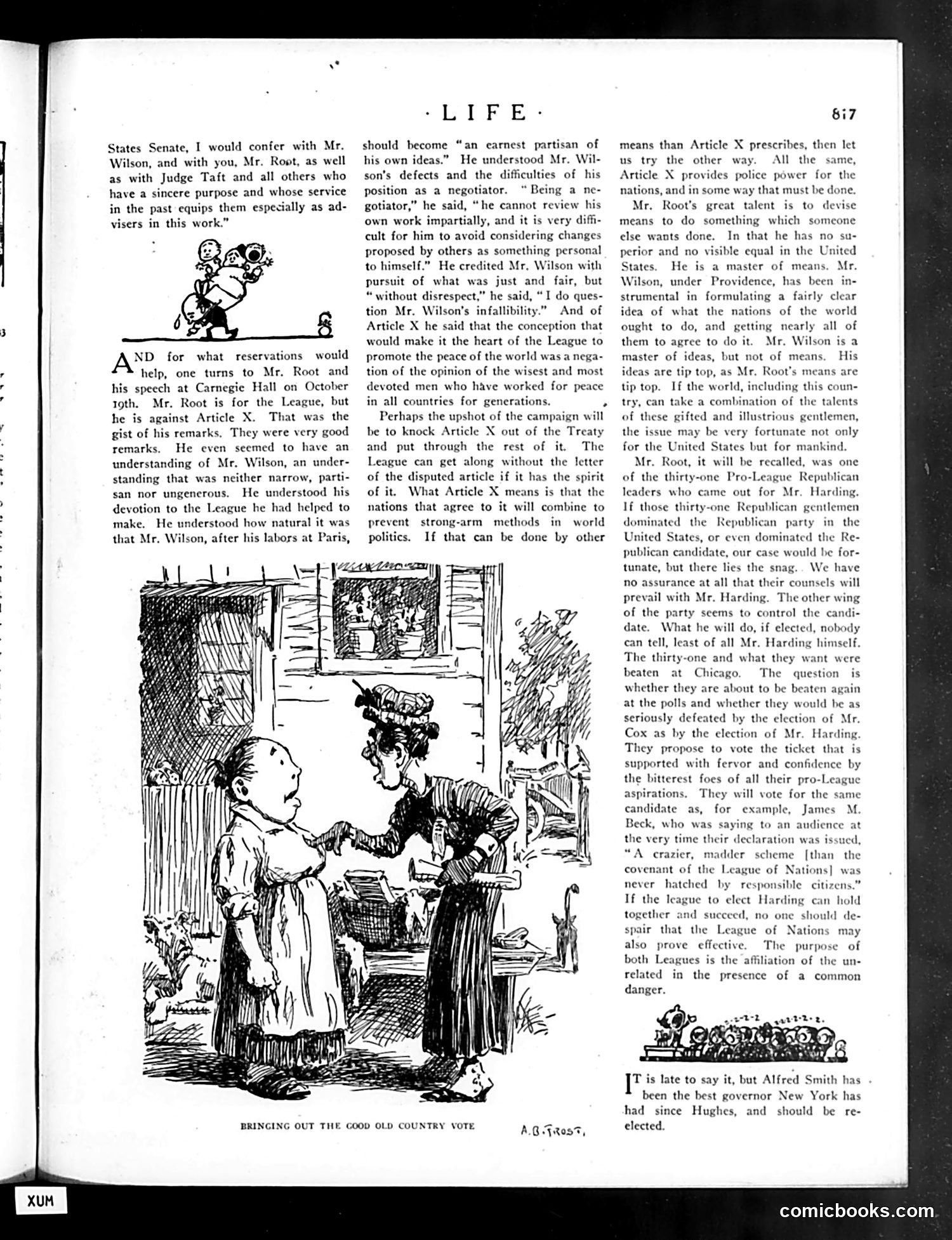
This page discusses post-WWI League of Nations politics. The text debates **Article X** of the League covenant, which would obligate member nations to collectively resist aggression. **Key figures mentioned:** - **President Wilson**: Portrayed as idealistic but inflexible, having formulated the League concept - **Elihu Root**: A respected Republican statesman and lawyer who supports the League but opposes Article X - **James M. Beck**: A Pro-League Republican leader mentioned as example **The satire:** The cartoon "Bringing Out the Good Old Country Vote" (by A.B. Frost) depicts rural voters being mobilized—likely satirizing how political parties were exploiting traditional constituencies during the 1920 presidential election debate over League membership. **The political context:** Republicans were divided between Wilson-sympathetic internationalists (Root's faction) and isolationists opposing Article X. The text expresses concern that isolationist Republicans might dominate the party platform, undermining substantive League support regardless of which candidate wins.
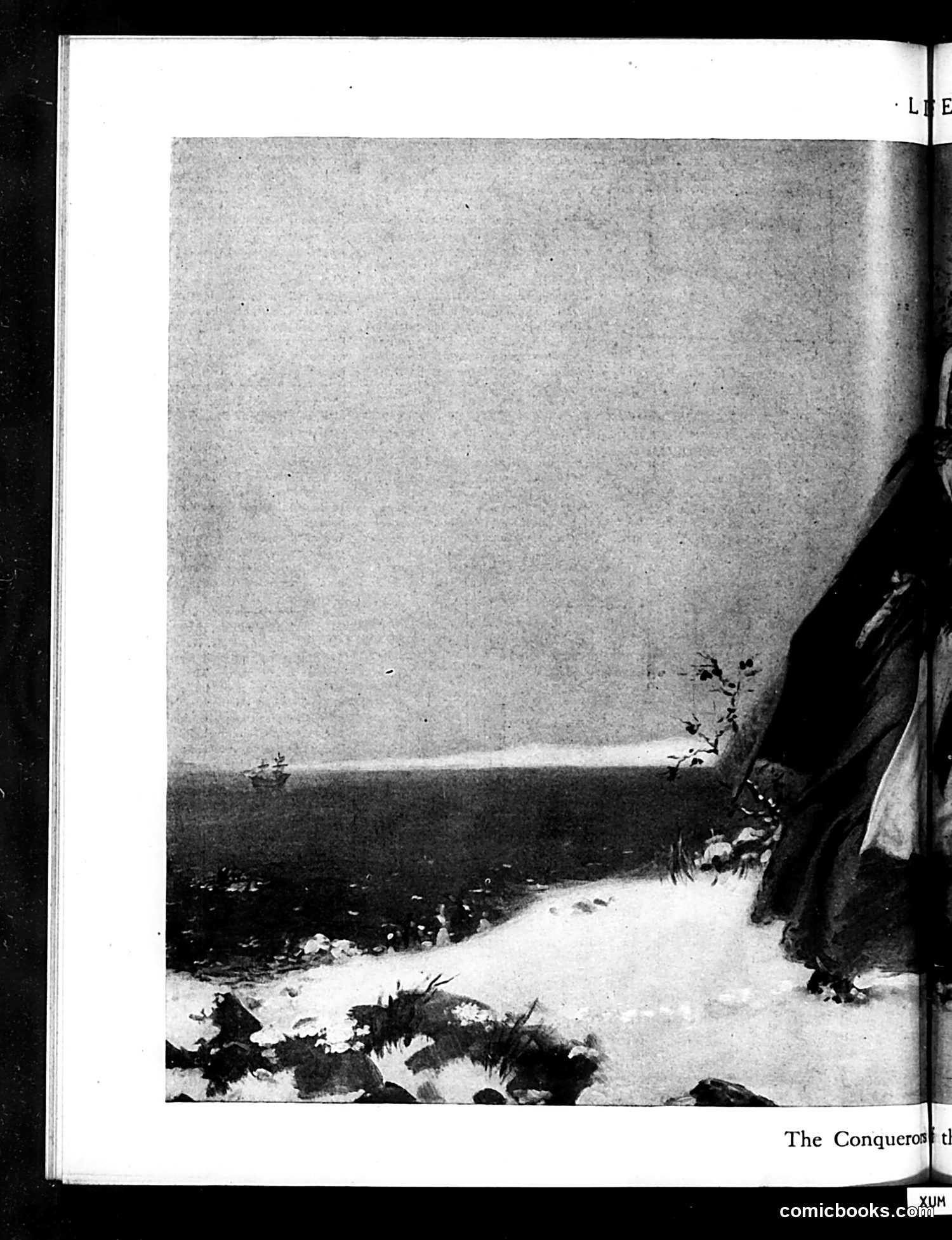
This page appears to be mostly a photograph rather than a traditional cartoon. The image shows a stark landscape with what looks like a fortified wall or barrier overlooking water, with sparse vegetation and rocky terrain in the foreground. A figure in dark clothing appears on the right side. The partial caption reads "The Conqueror" (text is cut off), suggesting this illustrates a historical or literary reference to conquest or colonization. Without the complete caption or surrounding context, it's difficult to determine the specific satirical target. The stark, austere composition might be commenting on imperialism, militarism, or territorial expansion—common Life magazine themes—but the exact meaning requires additional visible text or context that isn't fully legible here.
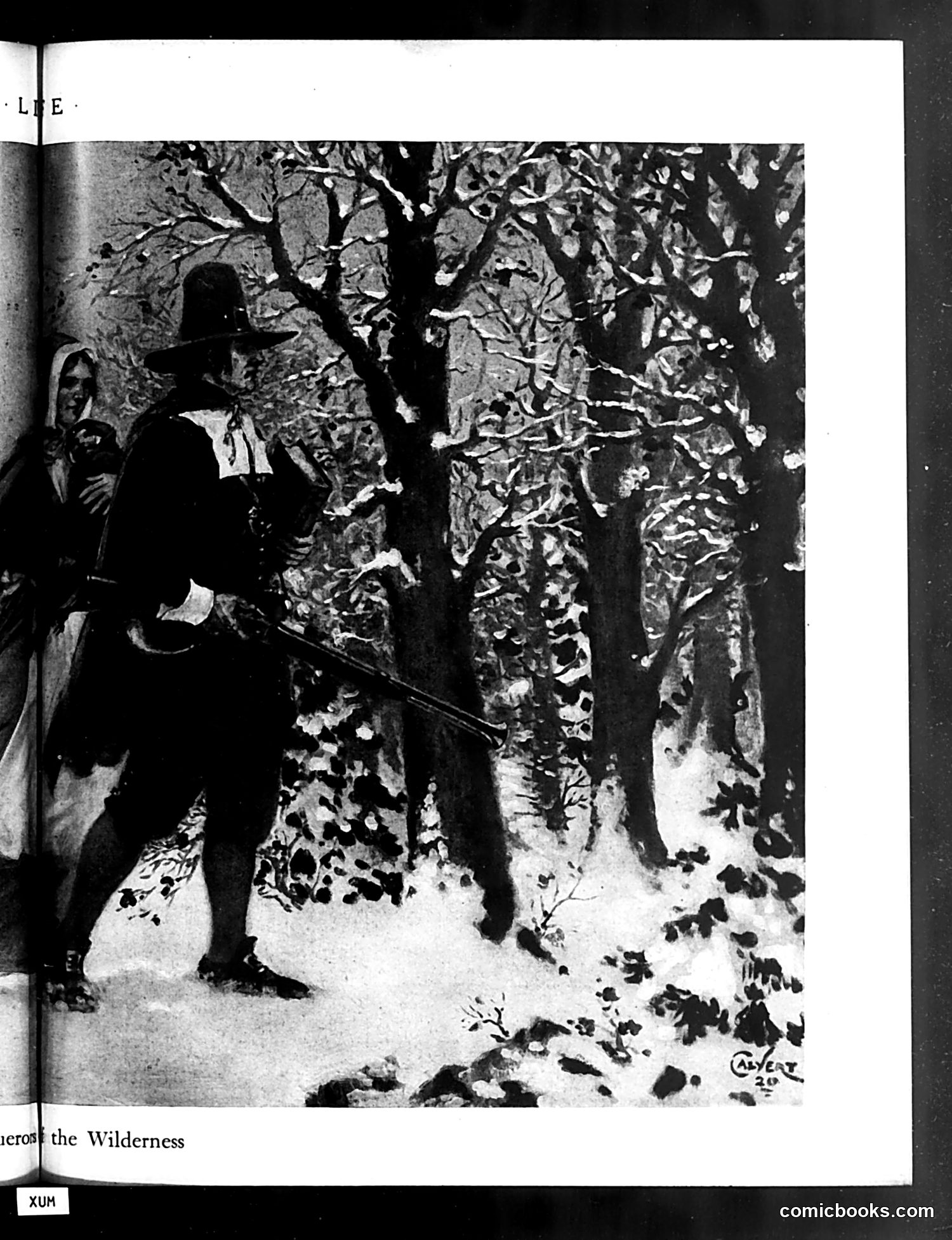
This appears to be an illustration titled "the Wilderness" showing a figure in dark clothing standing in a snowy forest scene with bare trees. The image has a stark, dramatic quality typical of early 20th-century Life magazine illustrations. Without additional context from surrounding text or the magazine's date, I cannot definitively identify the specific political or social satire intended. The wilderness setting and solitary figure could reference various contemporary themes—frontier mythology, isolation, or perhaps social commentary—but the exact meaning remains unclear from this page alone. The signature appears to read "Cesare" or similar. To properly explain the satire to modern readers, I would need the publication date and any accompanying article text that contextualizes this illustration.
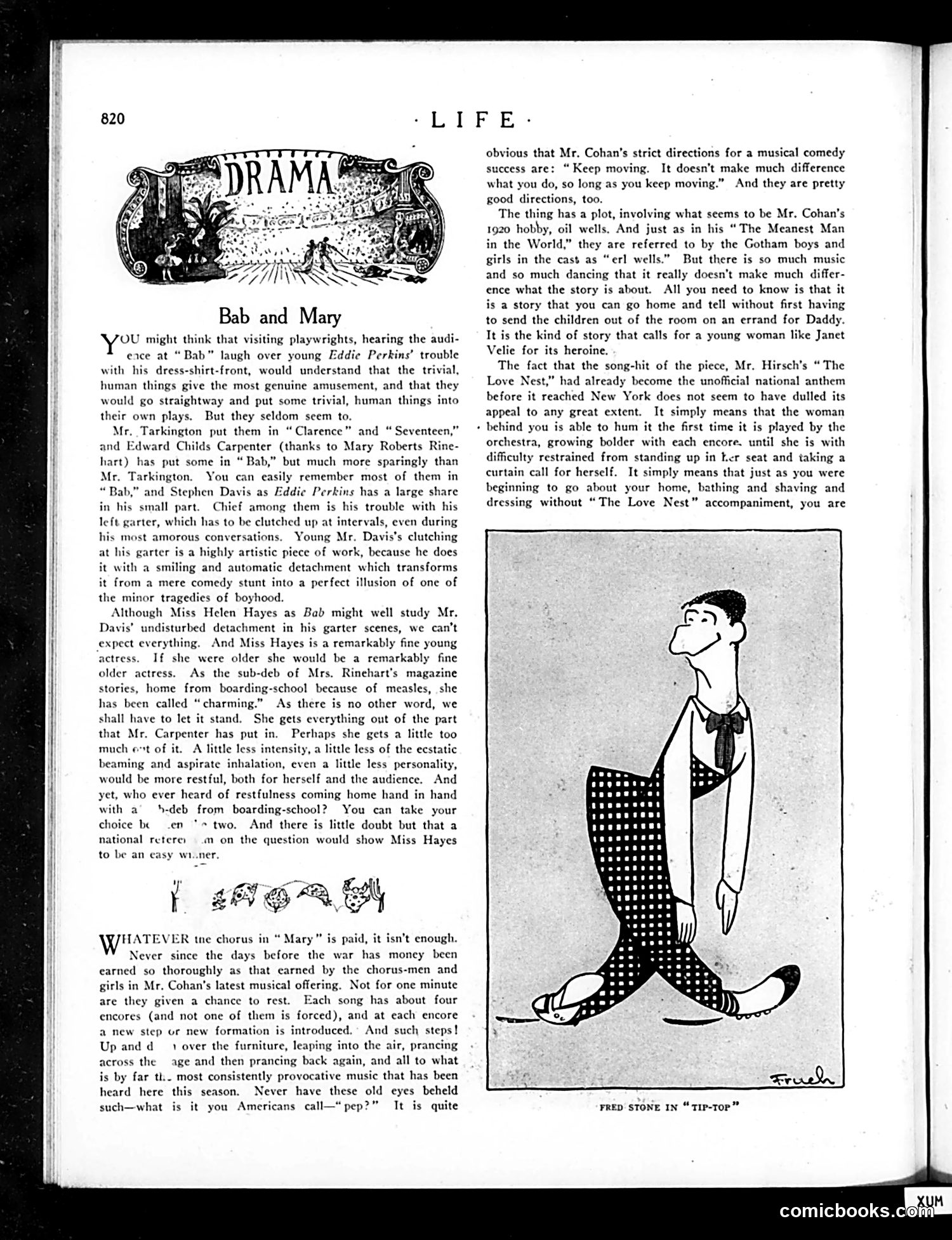
This Life magazine drama review discusses two Broadway productions: "Bab" and "Mary." The page critiques the plays and performances, particularly praising young actor Stephen Davis for his comedic business with a slipping garter—transforming a simple physical gag into genuine comedy through understated acting. The accompanying cartoon (credited to "Frueh") illustrates Fred Stone in "Tip-Top," showing a lanky male performer in an exaggerated pose with polka-dotted pants—likely satirizing the physical comedy and "pep" (energy/showmanship) characteristic of 1920s musical theater. The reviews reflect contemporary theatrical tastes: appreciation for human authenticity over artifice, and recognition that audiences enjoyed vaudeville-style physical humor and elaborate musical numbers with constant choreography and movement—what Mr. Cohan's philosophy reduced to: "keep moving."
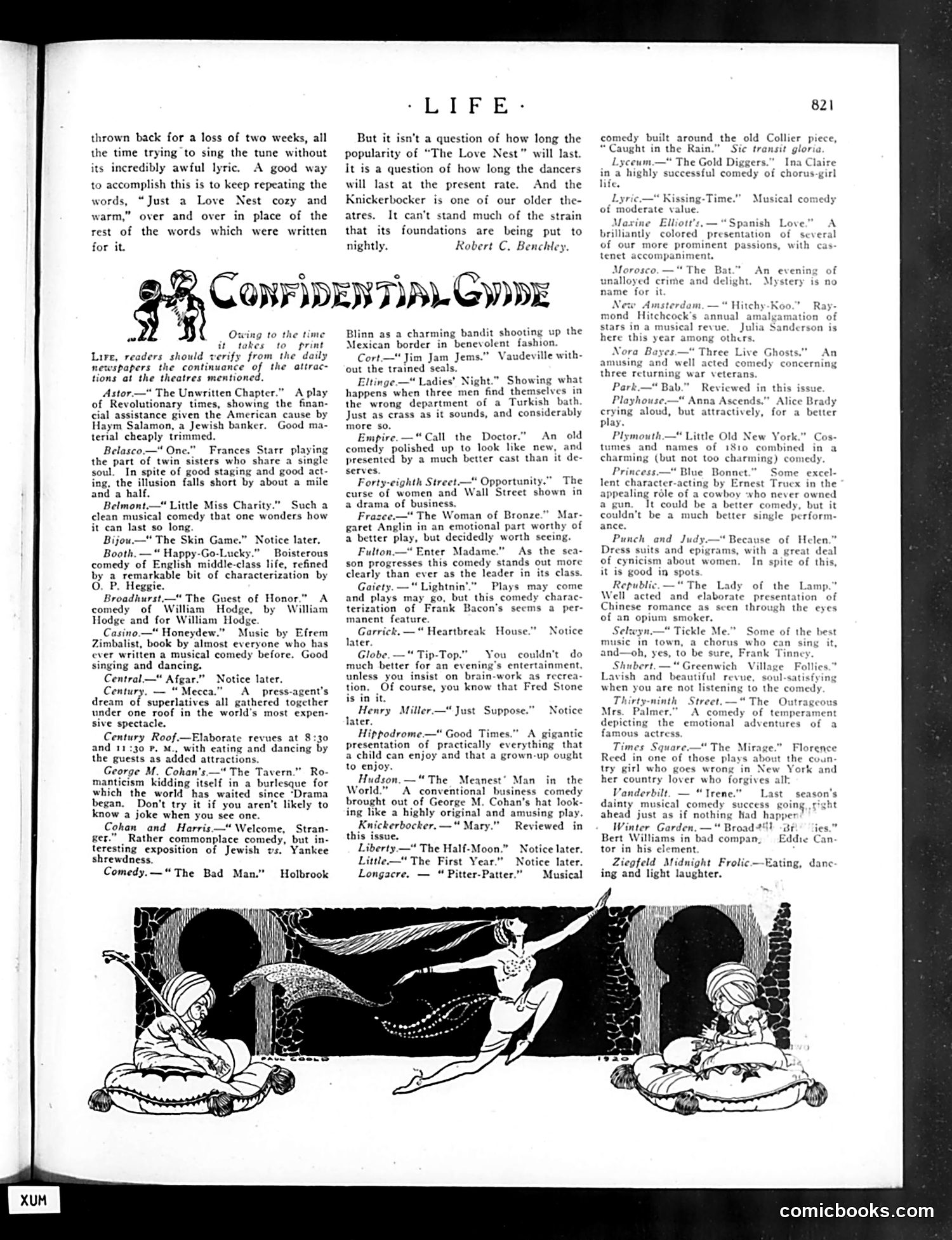
This page is primarily a **theater review guide** for Broadway productions, with a decorative illustration at the bottom. The main content lists current theatrical offerings with brief critical assessments. The opening text discusses "The Love Nest," a popular song whose tune audiences enjoy but whose lyrics are so "incredibly awful" that theatergoers mentally substitute other words. The satire criticizes both the poor songwriting and audiences' willing suspension of disbelief. The author humorously suggests the Knickerbocker theater's foundations may literally collapse from nightly dancing to this mediocre song. The bulk of the page catalogs Broadway theaters (Astor, Belasco, Booth, etc.) with capsule reviews of current productions—mostly comedies, musicals, and dramas. Comments range from dismissive ("clean musical comedy") to backhanded praise. The decorative footer illustration depicts elegant figures in what appears to be 1920s theatrical or cabaret style—likely generic theater imagery rather than specific satire. **Context for modern readers**: This reflects the Jazz Age theater world when Broadway was America's dominant entertainment, and popular songs—however poorly written—could drive massive audiences to performances.
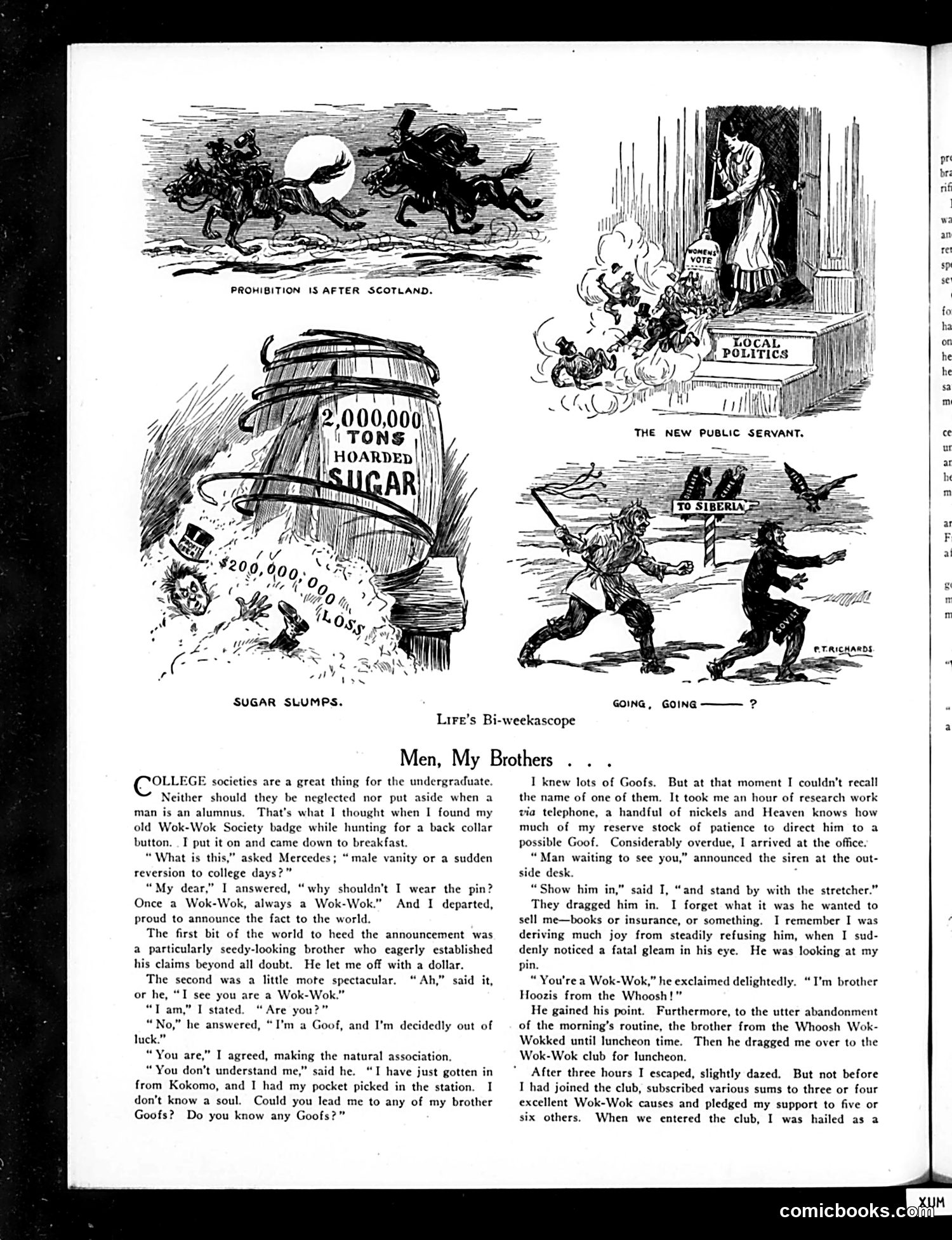
This page contains two distinct elements: **Political Cartoons (top):** "Prohibition is After Scotland" depicts law enforcement chasing suspects across water, satirizing Prohibition enforcement. "Sugar Slumps" shows a barrel labeled with massive financial losses (2,000,000 tons hoarded sugar, $200,000,000 loss), mocking speculation and market collapse in sugar commodities. "The New Public Servant" and "Going, Going—?" appear to reference political/bureaucratic themes, though their specific targets are unclear without additional context. **Humorous Essay (bottom):** "Men, My Brothers" is a comedic first-person narrative about wearing a college fraternity pin ("Wok-Wok"). The joke centers on how displaying the pin triggers relentless social obligation—strangers claiming membership corners the narrator repeatedly, culminating in his exploitation by a manipulative "brother" who pressures him into club membership and donations through fraternal guilt. The satire mocks both fraternal loyalty pressures and social climbing.
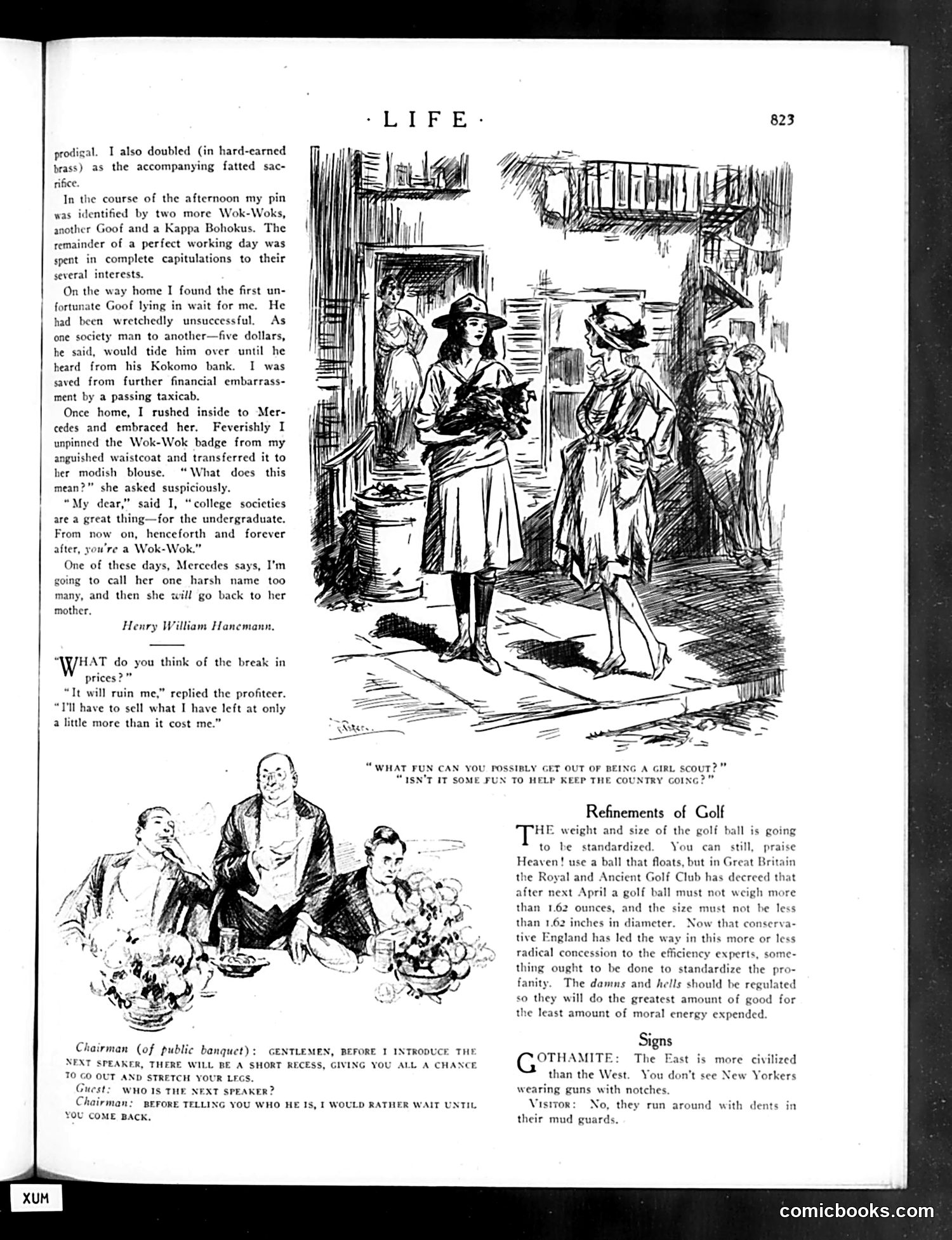
This *Life* magazine page contains several satirical pieces reflecting early 20th-century American culture: **Top story** (by Henry William Hanemann): A humorous account of joining college fraternity societies ("Wok-Woks," "Kappa Bohokus"). The joke mocks how members constantly demand money from each other—the narrator is financially harassed repeatedly and finally escapes via taxicab. He then jokingly "initiates" his wife Mercedes by pinning her with his badge, suggesting these societies are absurd status symbols. **Middle cartoon**: A banquet chairman announces a speaker, then tells guests to leave before introducing him—implying the speaker is so boring or disliked that the chairman prefers the audience absent. This satirizes tedious public speaking. **Bottom sections**: Light satirical observations—a profiteer claims price drops will "ruin" him while maintaining profits; Girl Scouts humorously defend their utility; golf authorities standardize ball specifications while the writer jokes they should similarly regulate profanity on the course; and a comparison between Eastern and Western civilization via gun notches versus car dents.
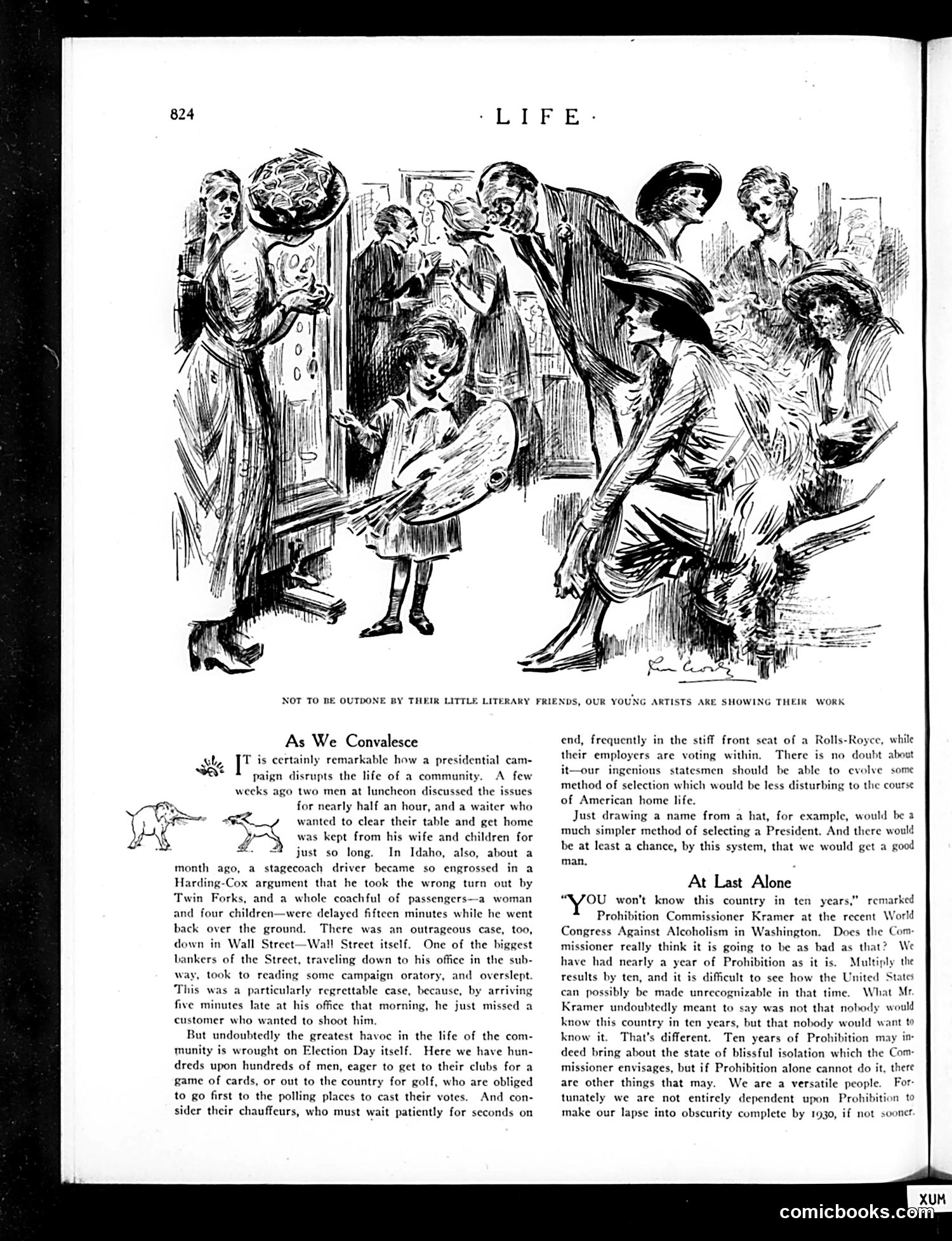
This *Life* magazine page contains two satirical pieces about American politics and social policy, likely from around 1920. **"As We Convalesce"** mocks the disruption caused by a presidential campaign (appears to reference the Harding-Cox election of 1920). The satire escalates absurdly: a waiter delayed, a stagecoach driver taking a wrong turn, a banker sleeping through his subway stop. The joke culminates in suggesting random selection—"drawing a name from a hat"—would be preferable to actual voting, since it might accidentally produce a competent president. This is cynical commentary on both electoral politics and voter apathy among the wealthy. **"At Last Alone"** satirizes Prohibition Commissioner Kramer's claim that America will be unrecognizable in ten years under Prohibition (enacted in 1920). Life's editors sardonically suggest the country will become so isolated and undesirable that *nobody will want to know it*—a sharp critique of Prohibition's social consequences. They imply America has other means of self-destruction beyond alcohol bans. Both pieces ridicule government overreach and elite indifference to civic duty.
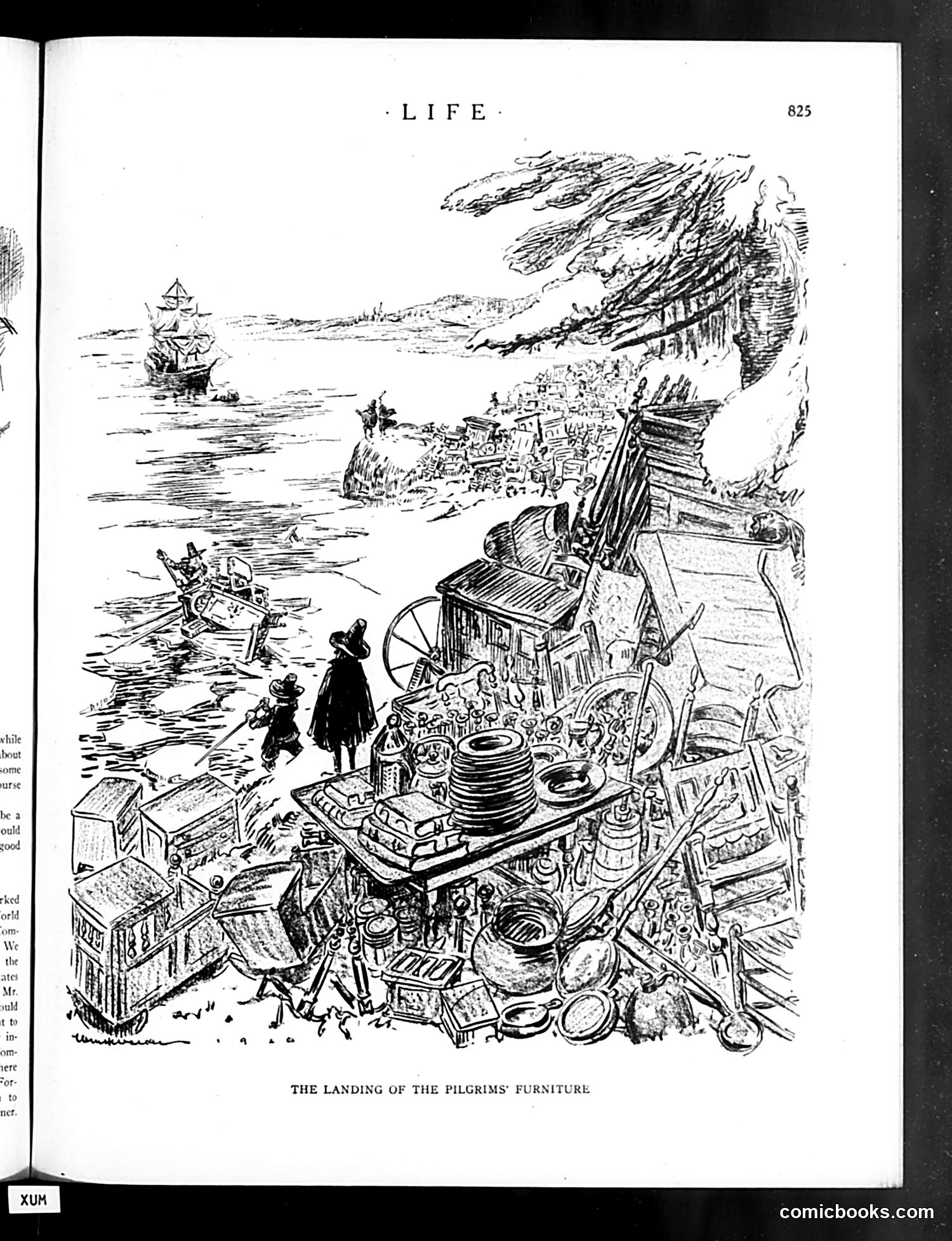
This satirical illustration depicts the arrival of the Pilgrims at Plymouth, but reimagines their landing as a chaotic unloading of household goods and furnishings rather than people. The crowded beach is piled high with barrels, chairs, wheels, crates, and domestic items. Two figures stand observing the scene while a ship approaches in the distance. The satire likely mocks either: 1. The materialism of the Pilgrims or American settlers (emphasizing possessions over spiritual ideals) 2. Contemporary immigration debates or attitudes about newcomers' belongings 3. The romanticization of Pilgrim history versus the practical reality of colonial settlement The exaggerated accumulation of goods suggests commentary on consumerism or the priorities of the founding narrative—treating the "landing" as fundamentally about stuff rather than principle or religious freedom.
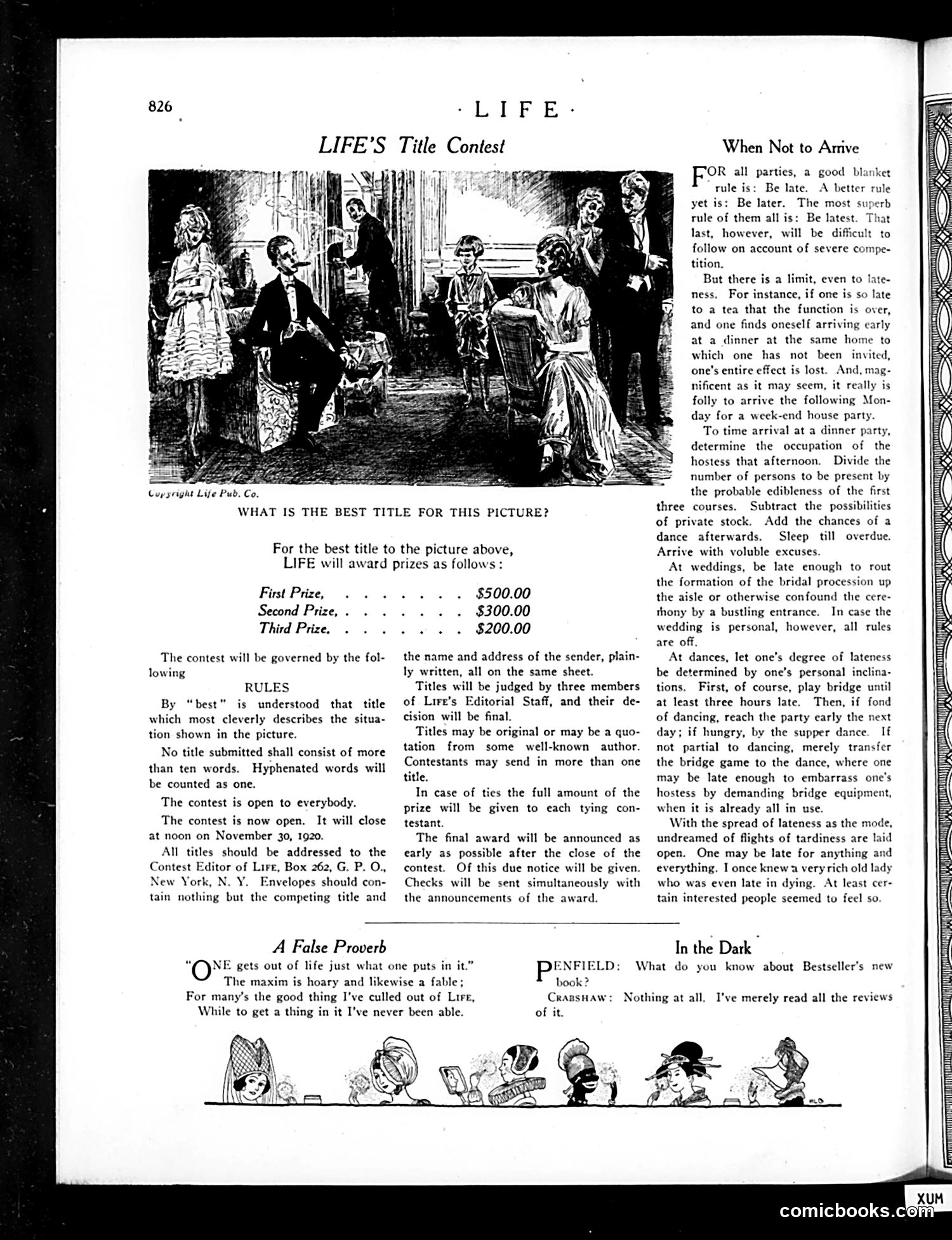
This page contains a **title-writing contest** for a social scene illustration showing well-dressed people in a drawing room. Life magazine offered substantial prize money ($500-$200) for the cleverest caption describing the pictured situation—a common reader-engagement tactic of the era. The page also includes humorous etiquette advice titled "When Not to Arrive," satirizing the upper-class obsession with fashionable lateness. The writer mocks the pretension that arriving late to social events (tea, dinner parties, weddings, dances) demonstrates sophistication, while detailing absurd scenarios—arriving so late to a tea that you show up early for an unrelated dinner, or transferring a bridge game to a dance. At the bottom, "A False Proverb" jokes cynically that while the saying claims "you get out what you put in," the author has extracted "good things" from Life magazine without contributing anything—a self-deprecating jab at readers who enjoy the publication's content without submitting contest entries. The tone throughout is satirical upper-class social commentary.
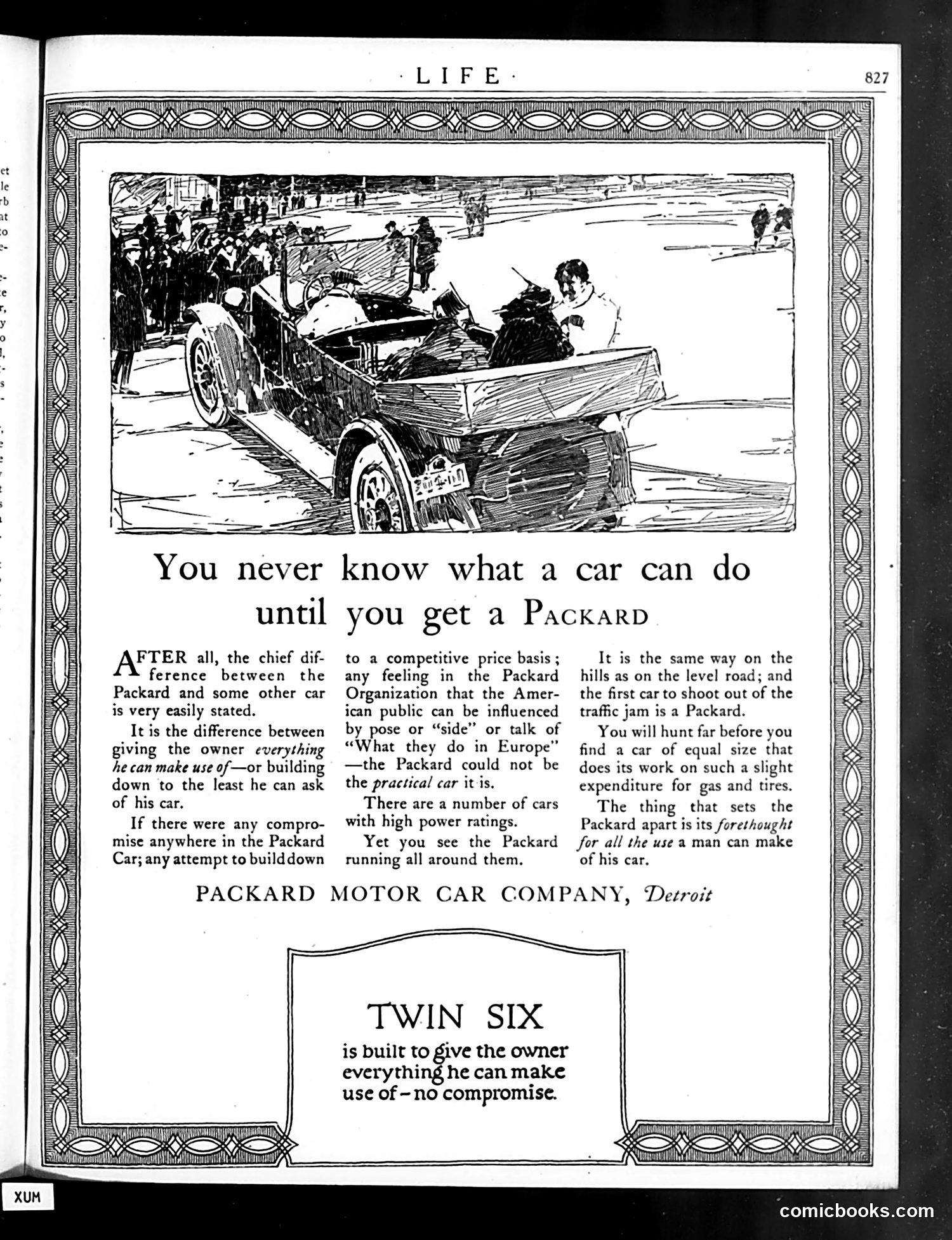
This is a **full-page advertisement** for Packard automobiles, not satire or political commentary. It appears from *Life* magazine's advertising section (page 827). The ad features a sketch of an early automobile with passengers and spectators, illustrating Packard's marketing message: their cars offer superior performance and capability compared to competitors because they're built with "no compromise"—giving owners everything they can use rather than being stripped down to a cheap price point. Key claims made: Packards outperform higher-horsepower competitors, handle hills better, accelerate faster in traffic, and achieve excellent fuel efficiency. The "Twin Six" model is specifically highlighted as providing maximum utility without cost-cutting. This reflects early 20th-century luxury car marketing positioning Packard as the premium, no-compromise choice for affluent buyers—a common advertising strategy emphasizing quality over affordability during that era.
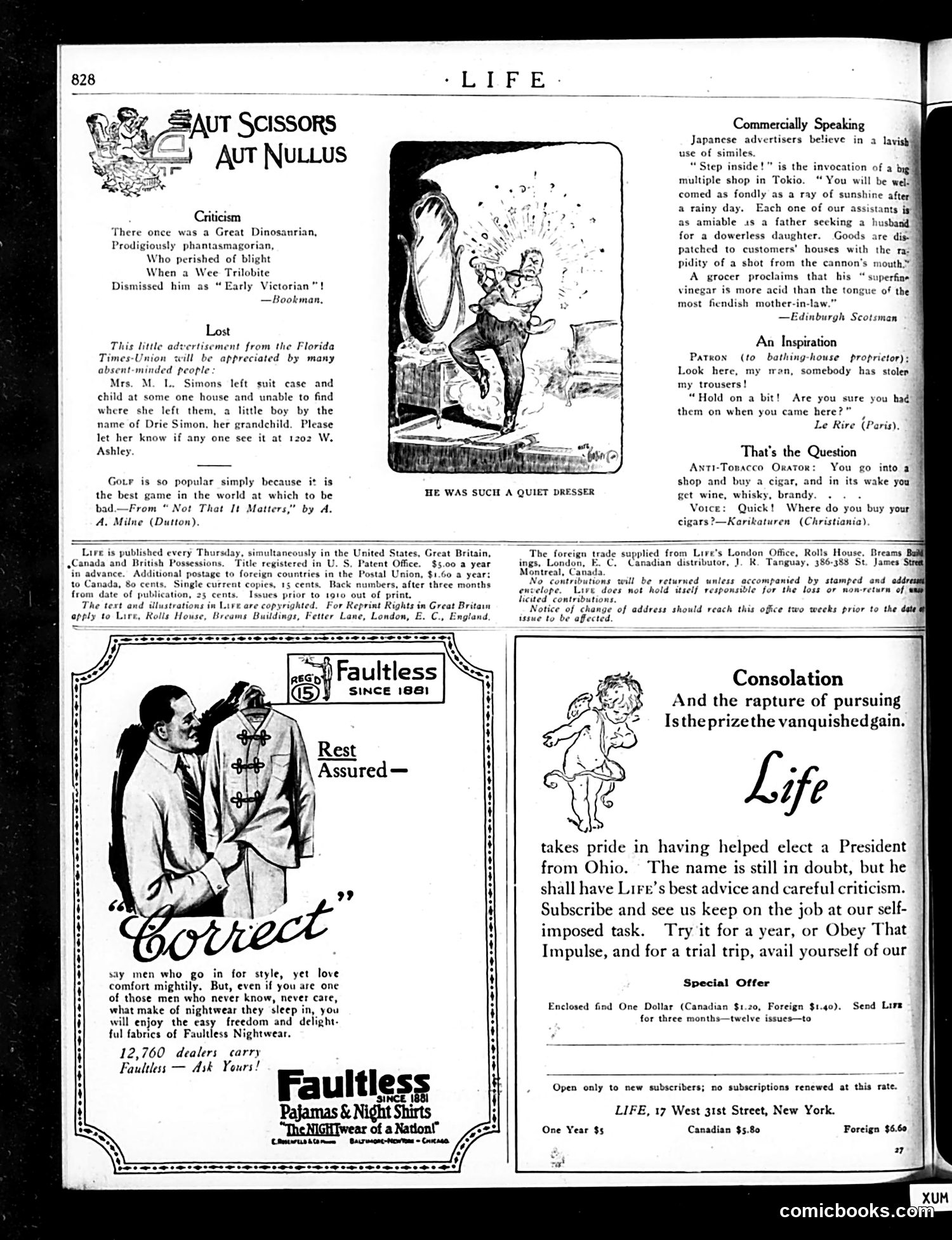
This page from *Life* magazine comprises advertisements, filler content, and satirical commentary typical of early 20th-century American humor magazines. The main cartoon, "He Was Such a Quiet Dresser," depicts a man emerging from a large mirror or doorway—the joke being that an inconspicuous dresser has somehow become notable enough to warrant illustration, subverting expectations. The page includes various brief satirical items: a dinosaur poem mocking Victorian-era criticism; Japanese advertising commentary poking fun at exaggerated similes ("acid than...mother-in-law's tongue"); and jokes about tobacco leading to alcohol consumption. A "Lost" notice humorously reports a woman misplacing both a suitcase and child. The *Faultless* nightwear ad promises style and comfort. The page concludes with *Life*'s self-congratulatory note about supporting a presidential candidate from Ohio (likely referencing recent elections), inviting subscriptions. Overall, this represents *Life*'s formula: advertisements mixed with brief comedic observations about contemporary society, advertising practices, and politics.
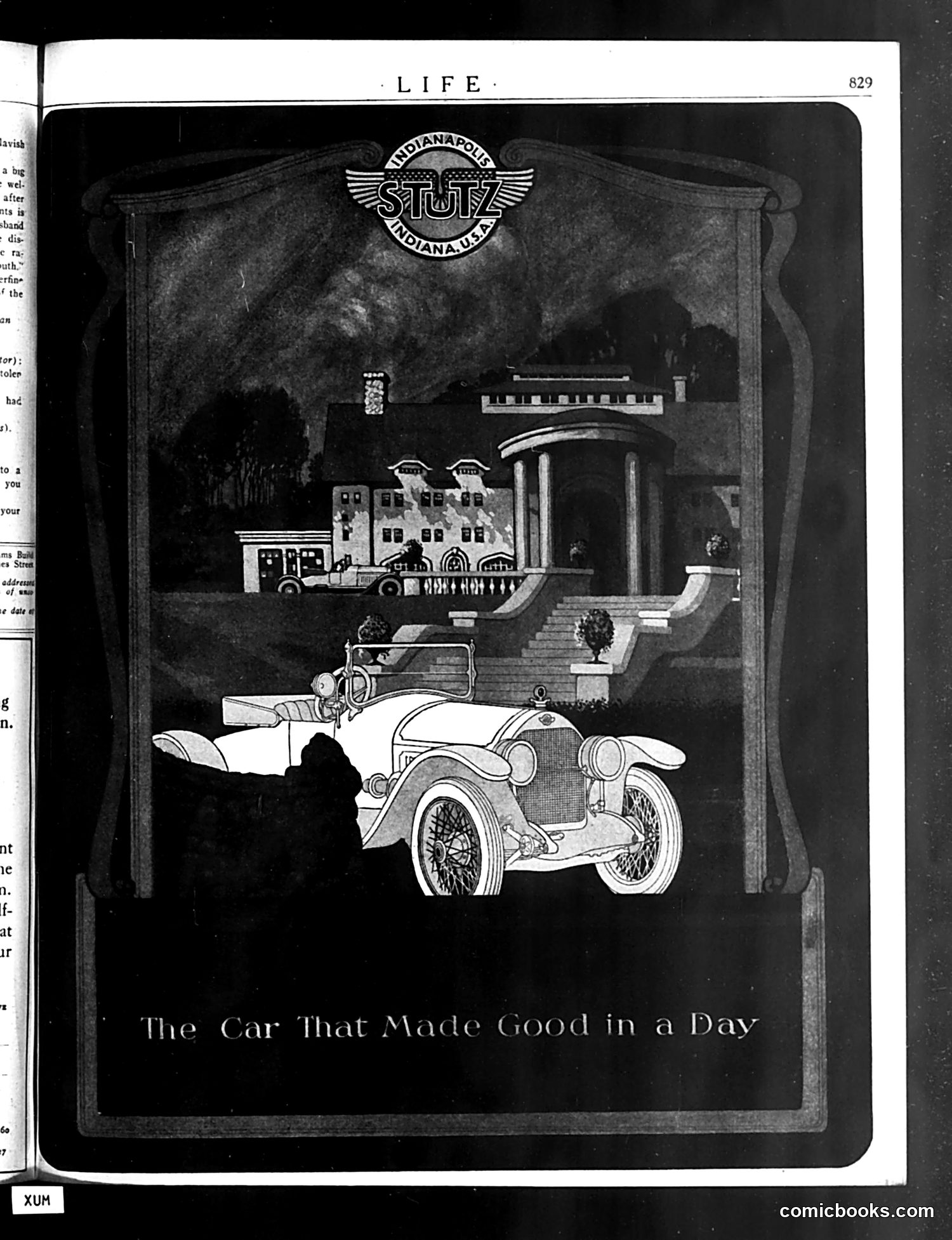
This is a **Stutz automobile advertisement** from Life magazine. The dramatic illustration depicts a luxurious car prominently displayed in the foreground, with an elaborate architectural scene behind it—featuring classical columns, a grand building, and what appears to be industrial or civic infrastructure. The headline "The Car That Made Good in a Day" is promotional copy claiming rapid success or achievement. This references the Stutz brand's actual racing history: Stutz automobiles gained fame through speed records and racing victories, particularly the 1912 Indianapolis 500, which the company leveraged heavily in marketing. The theatrical staging—with the car as the central, brightly-lit focal point against an ornate backdrop—emphasizes the vehicle's prestige and exclusivity. This appeals to wealthy consumers by associating automobile ownership with sophistication and success. This is straightforward commercial advertising rather than satirical commentary.
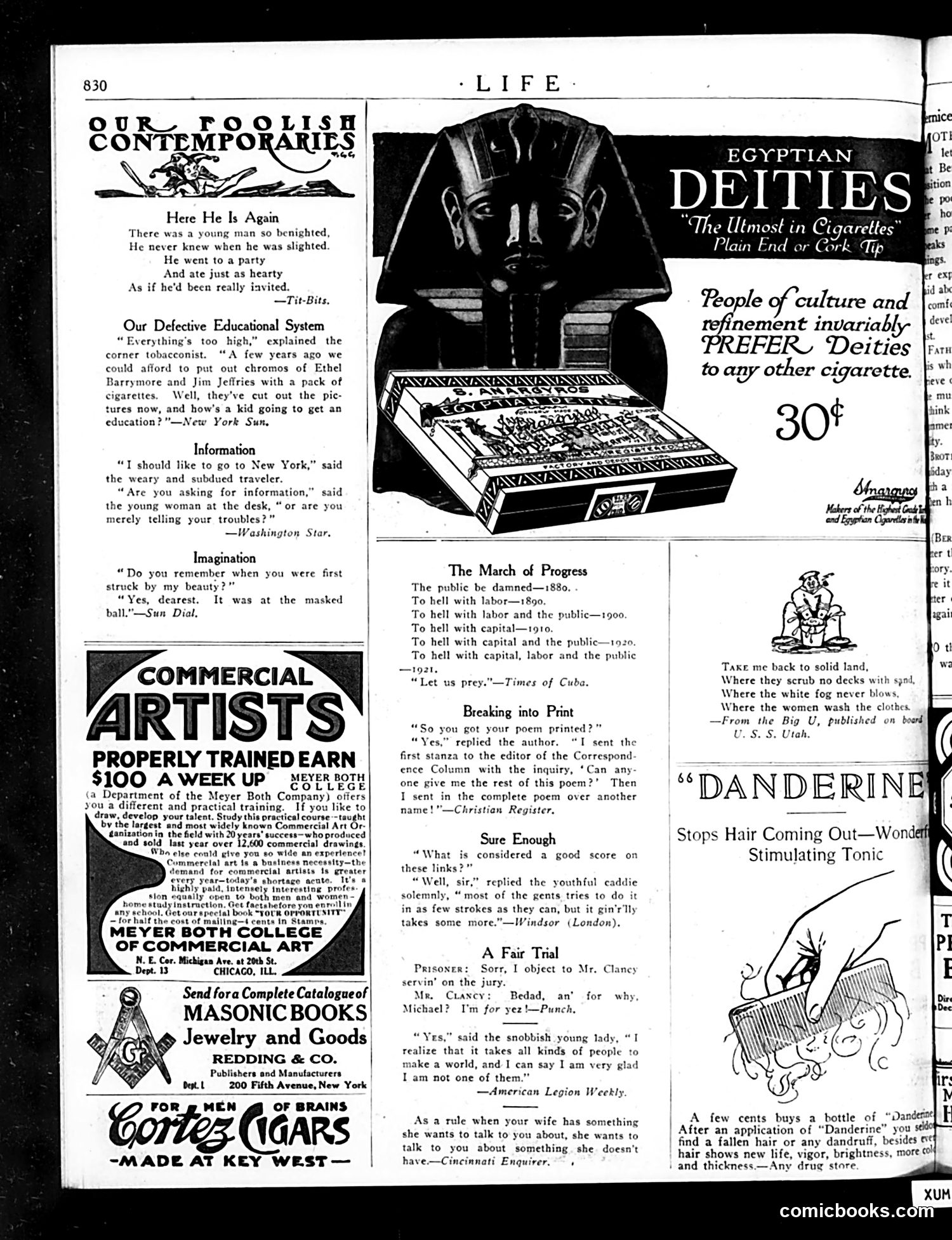
This page from *Life* magazine (circa 1920s) mixes satirical commentary with advertising. The main cartoon, "The March of Progress," is a cynical timeline showing societal decline: **1880-1923**: Each decade's slogan progressively worsens—from "The public be damned" to finally "Let us prey" (pun on "pray"), suggesting capitalism and class conflict have corrupted society. The trajectory mocks the notion of progress itself. Other brief jokes mock pretension (a snobbish woman), failed educational systems (cigarette companies once included chromos/pictures as educational material), and Irish-American stereotypes in the courtroom scene. The advertisements are period-appropriate: cigarettes marketed as refined, hair tonic promising vitality, and art schools promising commercial success. The overall tone reflects 1920s Progressive Era skepticism about whether modern capitalism and materialism actually constituted genuine societal improvement—a sharp social critique wrapped in humor.
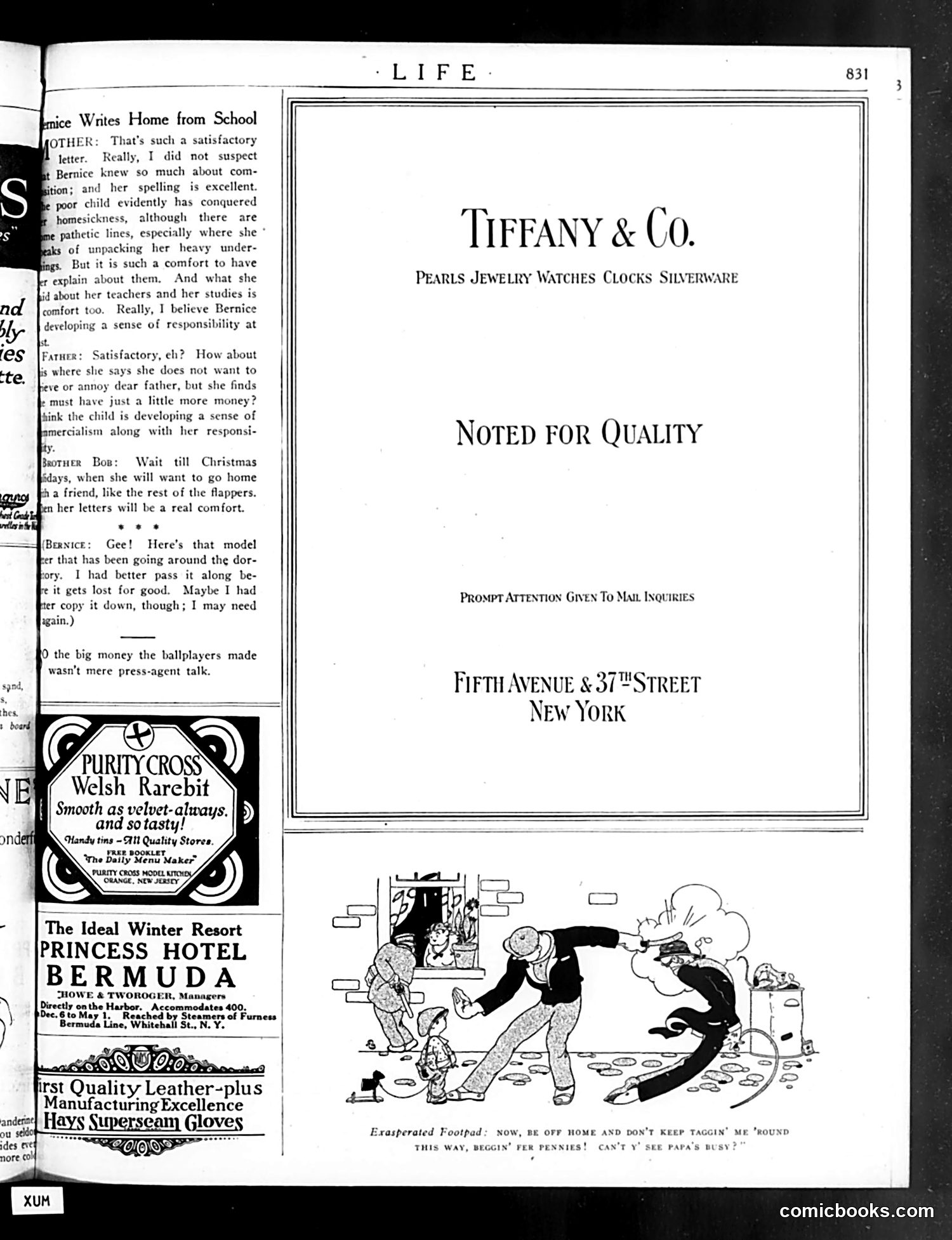
This cartoon depicts a street robbery scene. A disheveled man (the "footpad"—period slang for a street mugger) is robbing a well-dressed gentleman while children mill about. The joke targets economic inequality and the "Jazz Age" tensions of the 1920s. The mugger's complaint—that he can't operate because the man keeps claiming poverty despite appearing wealthy—satirizes how even criminals were affected by the era's economic uncertainty and the gap between appearances and reality. The children in the background add to the commentary: even petty theft has become difficult in this world of conflicting claims about who has money. The caption's vernacular ("beggin' fer pennies," "papa's bus") reinforces class distinctions while mocking the notion that anyone—criminal or child—can reliably extract wealth from the apparently affluent.
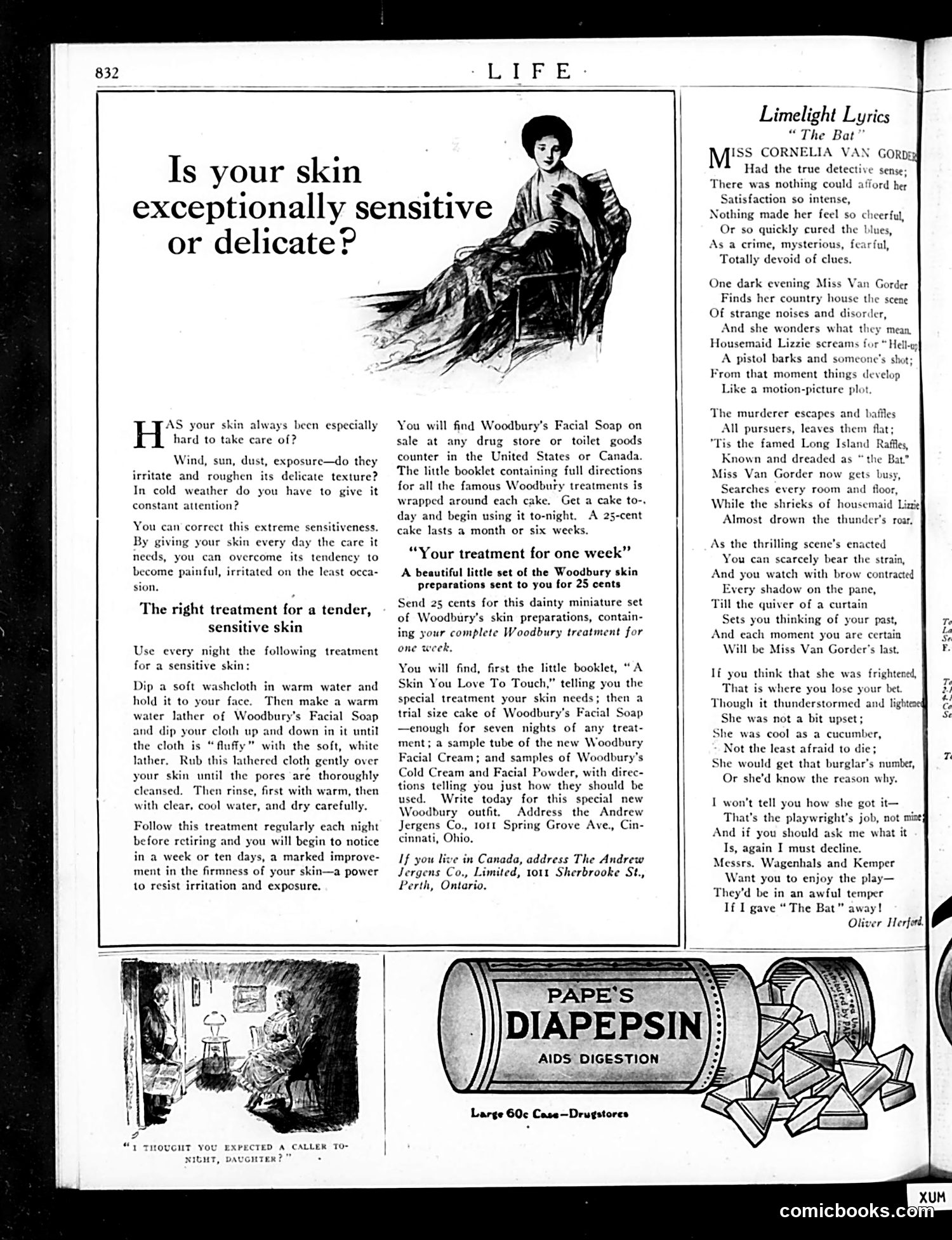
This page consists primarily of **advertising content**, not satire or political commentary. The main advertisement promotes **Woodbury's Facial Soap**, a real skincare product marketed to women with sensitive skin. The ad uses period-typical beauty messaging about skin care routines and offers a 25-cent trial set. On the right side is **"Limelight Lyrics,"** a poem about the plot of "The Bat," apparently a theatrical production or film featuring the character Miss Cornelia Van Gorder—a female detective who coolly investigates mysterious crimes at her country house. The poem celebrates her fearlessness and detective prowess. At the bottom is an advertisement for **Pope's Diapepsin**, a digestive aid product. This is primarily a **commercial magazine page** designed to reach female readers through beauty and entertainment content, with no significant political or satirical message beyond standard period advertising conventions.
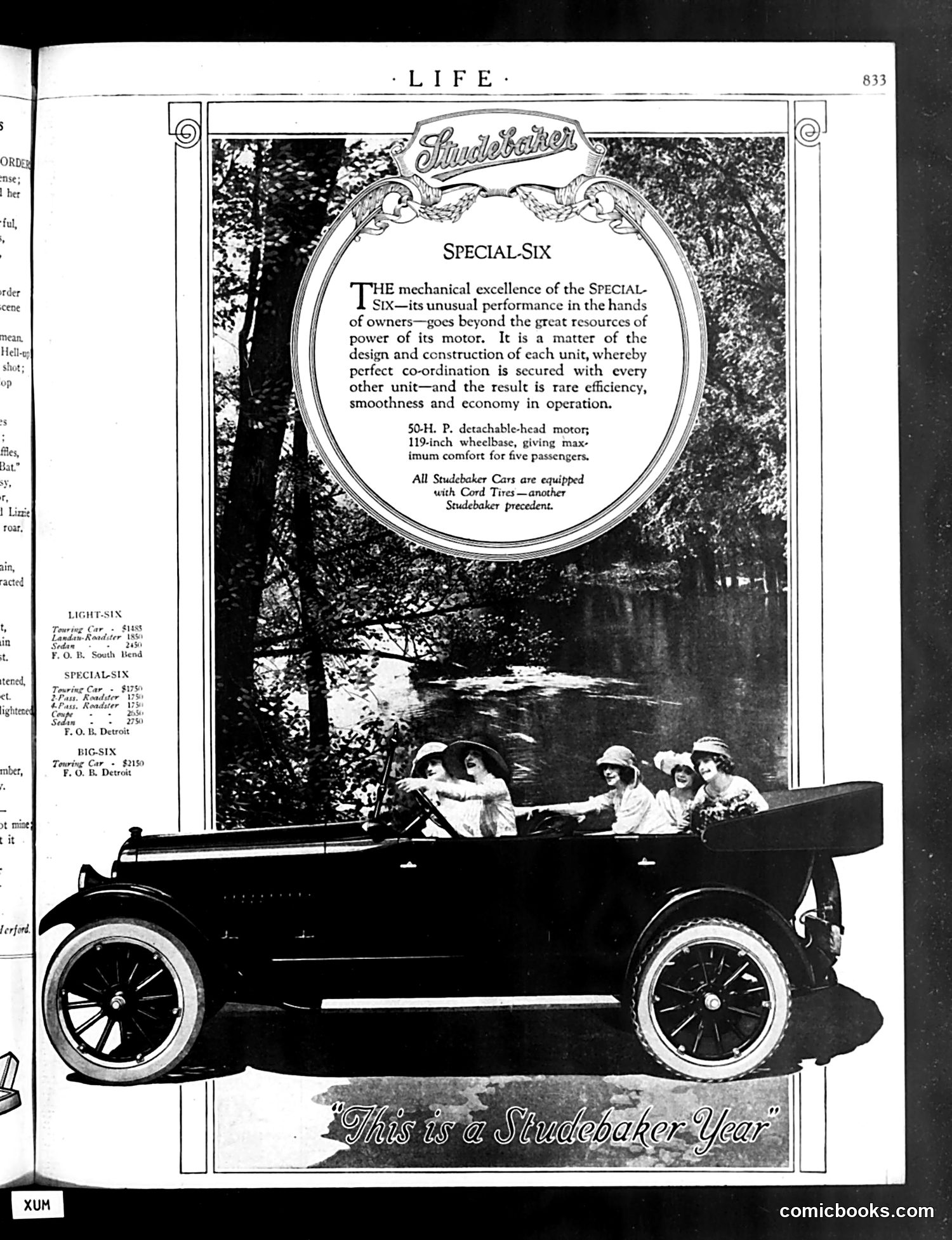
This page is primarily **automobile advertising**, not political satire. It's a Studebaker car advertisement from Life magazine's early 20th-century period. The ad promotes the "Special-Six" model, emphasizing its mechanical superiority: a 50-horsepower detachable-head motor, 119-inch wheelbase, and capacity for five passengers. The copy stresses "rare efficiency, smoothness and economy." The image shows five well-dressed passengers (appearing to be women in period hats) enjoying an open-air drive through a scenic wooded area—a common advertising trope suggesting leisure, comfort, and social status associated with automobile ownership. The tagline "This is a Studebaker Year" uses a marketing catch-phrase typical of the era. There is **no political cartoon or satire** on this page—it's straightforward commercial advertising designed to appeal to affluent buyers during the automobile industry's early expansion.
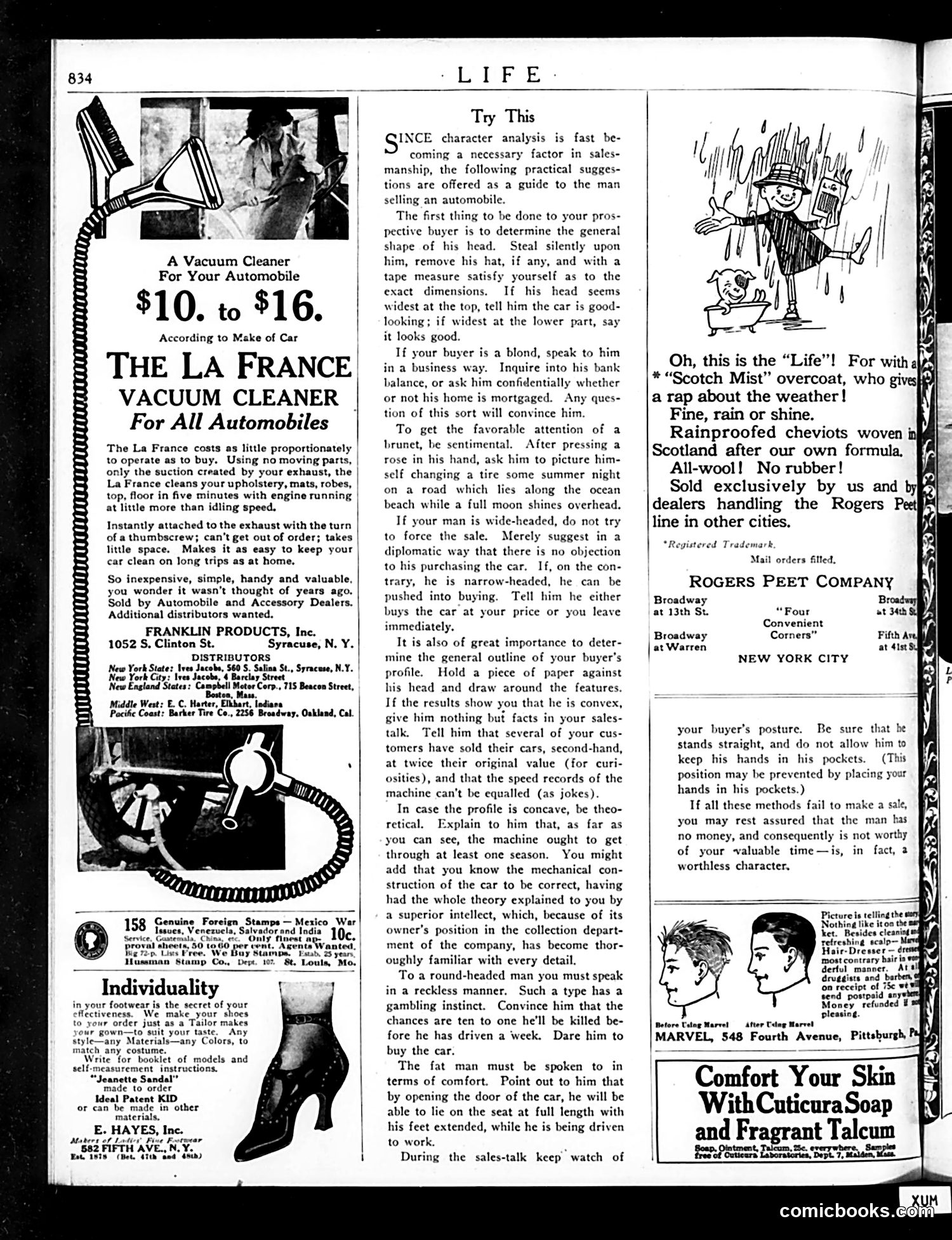
This page satirizes pseudoscientific sales techniques popular in the 1920s. The article mocks "character analysis" in auto salesmanship by suggesting salesmen should: - Examine a buyer's head shape to predict personality - Tailor pitches based on hair color (blonds respond to business logic; brunettes to sentiment) - Adjust sales tactics based on facial profile (convex vs. concave) The satire targets the era's obsession with phrenology and physiognomy—discredited pseudo-sciences claiming personality and intelligence derived from physical features. By presenting absurd advice as serious salesmanship wisdom (measuring heads, drawing profile outlines), the article ridicules both gullible salesmen and the bogus "scientific" thinking they embraced. The page also advertises vacuum cleaners and custom shoes—typical early-20th-century products shown alongside this satirical content about consumer manipulation.
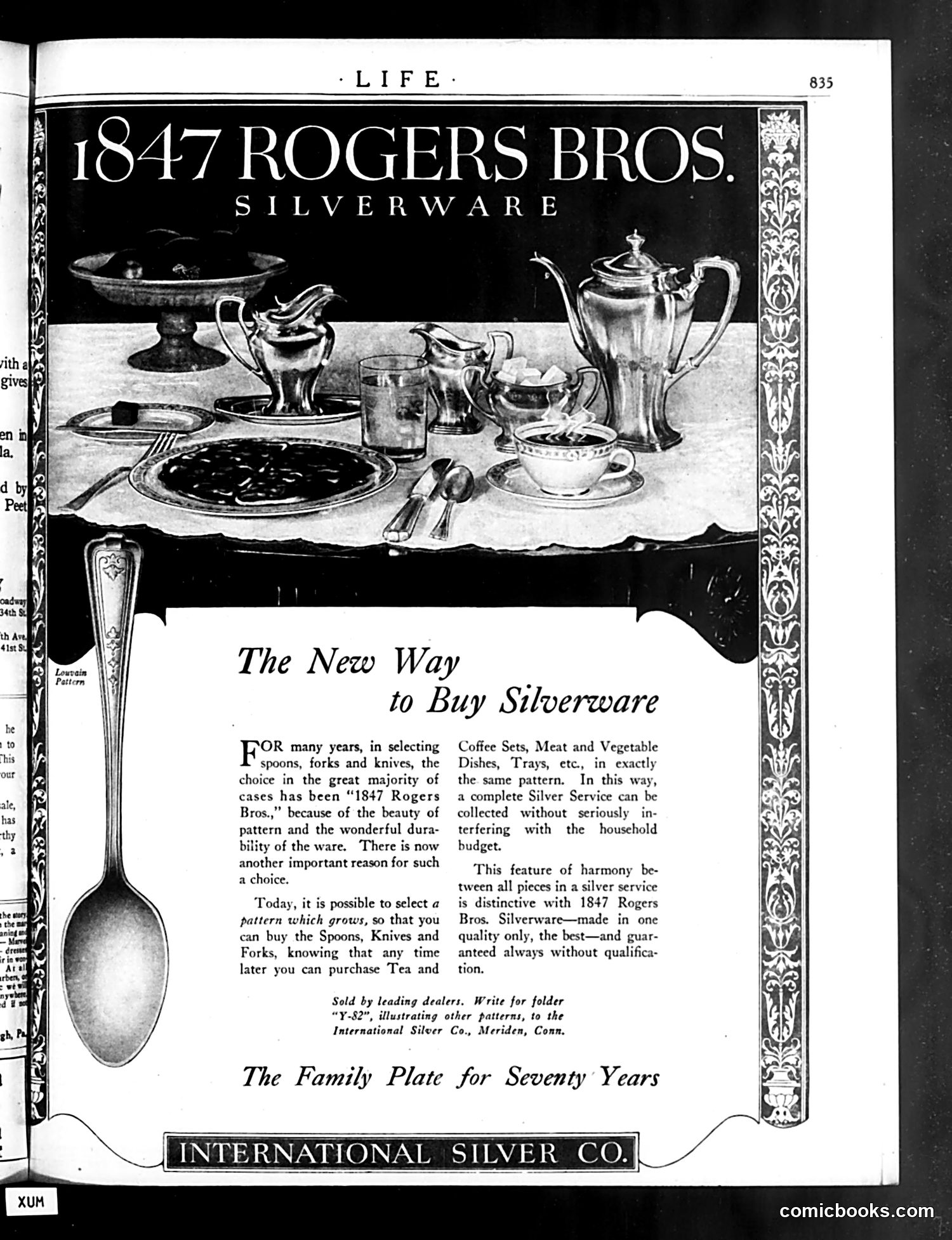
This is **not a cartoon or satirical content**—it's a full-page **advertisement** for 1847 Rogers Bros. silverware, placed in *Life* magazine. The ad promotes a practical innovation: consumers can now buy silverware pieces individually in matching patterns, gradually building a complete service without major expense. The photograph displays an elegant table setting with various pieces—teapot, cups, plates, forks, spoons—to demonstrate the coordinated aesthetic. The tagline "The Family Plate for Seventy Years" emphasizes durability and longevity. The pitch addresses middle-class households: you can acquire quality silver service "without seriously interfering with the household budget" by purchasing pieces over time in one consistent pattern. This reflects early-to-mid 20th-century consumer culture: manufacturers marketing aspirational domesticity and incremental purchasing to working families. The International Silver Company (parent firm) uses *Life*'s audience to reach affluent readers seeking both elegance and practicality.
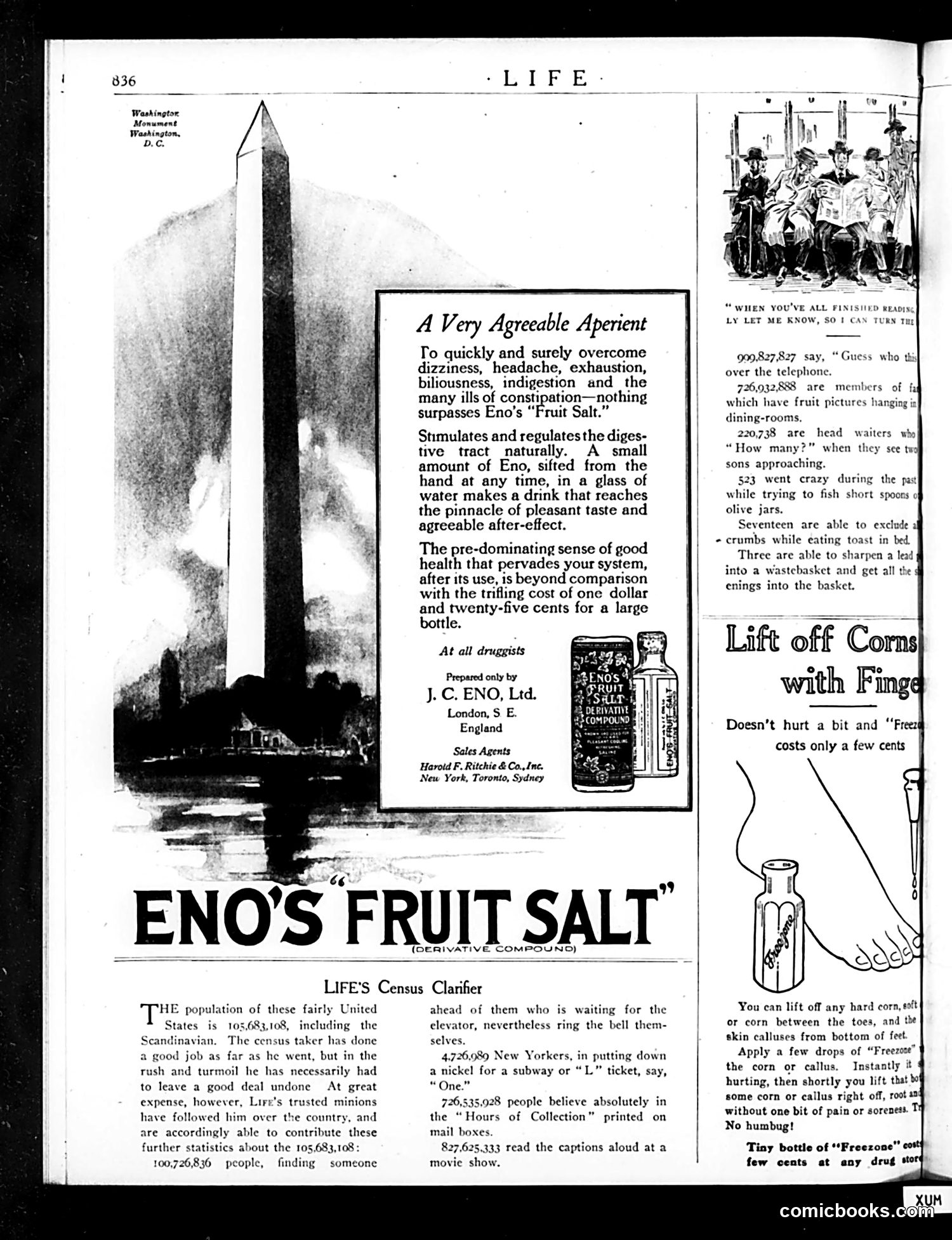
This page is primarily **advertising**, with two product promotions dominating the layout. The main advertisement features the **Washington Monument** and promotes **Eno's Fruit Salt**, a digestive laxative product marketed as a cure for constipation, indigestion, and general digestive complaints. The pitch emphasizes its affordable cost and pleasant taste. Below this, "**LIFE's Census Clarifier**" is a **humorous satirical piece** that parodies official census data with absurdist observations about American behavior. Examples include: 100+ million people ring elevator buttons twice; 827 million read movie captions aloud; 523 people went "crazy" fishing spoons from olive jars. The satire mocks both the census-taking process and predictable human quirks—ringing elevator bells repeatedly despite someone already waiting, or blindly trusting "Hours of Collection" notices on mailboxes. A secondary ad for "**Freezone**" (a corn/callus remover) appears on the right with a medical diagram. The page is mostly **commercial content** rather than editorial satire, though the Census Clarifier section offers light social commentary.
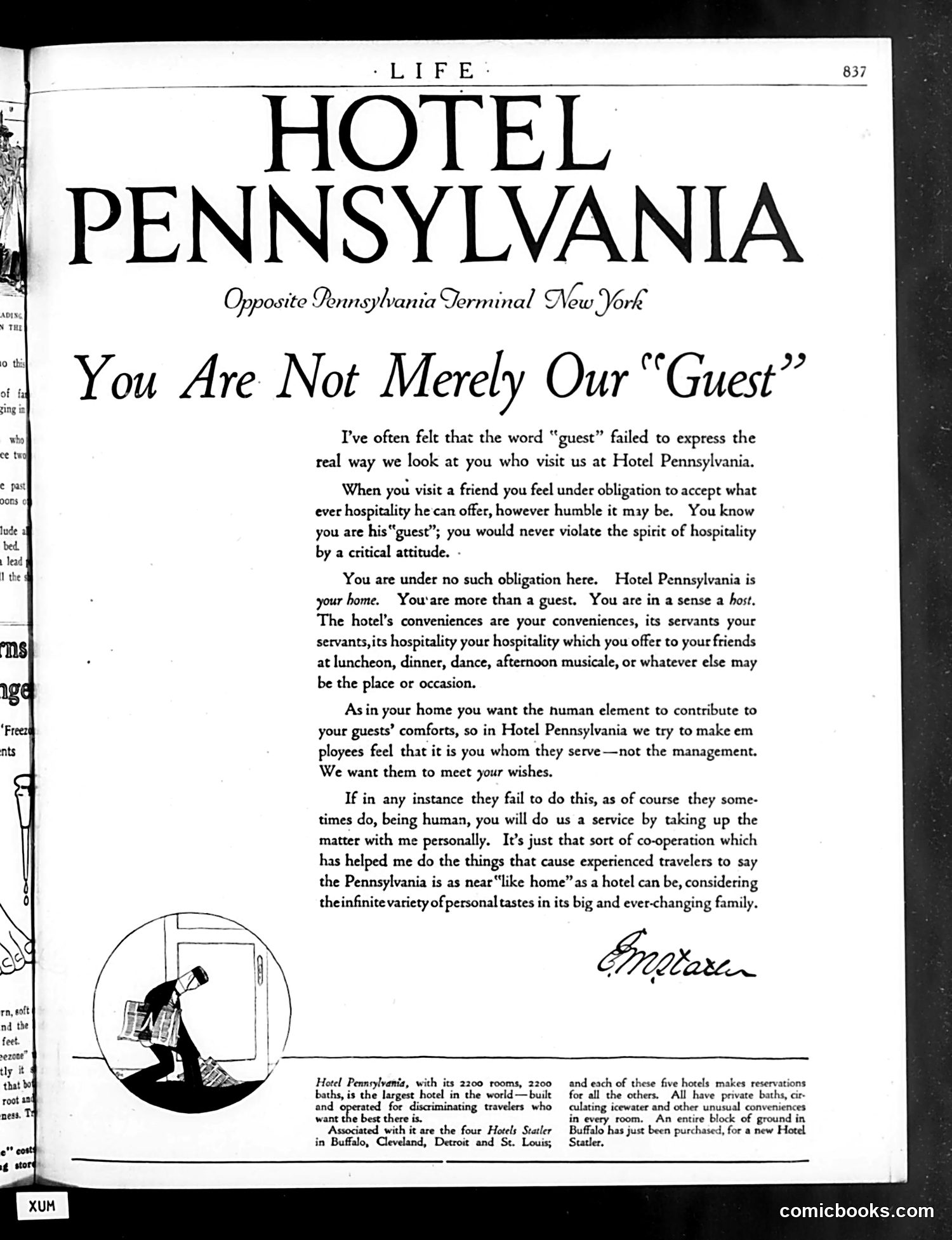
This is **not satire or political commentary**—it's a straightforward hotel advertisement from Life magazine (page 837). The small cartoon showing a bellhop appears purely decorative. The ad promotes the Hotel Pennsylvania (across from Pennsylvania Terminal in New York) through a personal message, likely from the hotel's manager or owner. The pitch reframes the customer relationship: you're not merely a "guest" but essentially a "host" using the hotel as your temporary home. Employees should serve *your* wishes, not just management directives. The appeal targets affluent travelers of the era seeking luxury accommodations with modern conveniences (2,200 rooms and baths—then the world's largest hotel). The mention of associated Statler Hotels in other cities highlights a hotel chain offering coordinated reservations. This represents early 20th-century hospitality marketing emphasizing personalized service and comfort as competitive advantages.
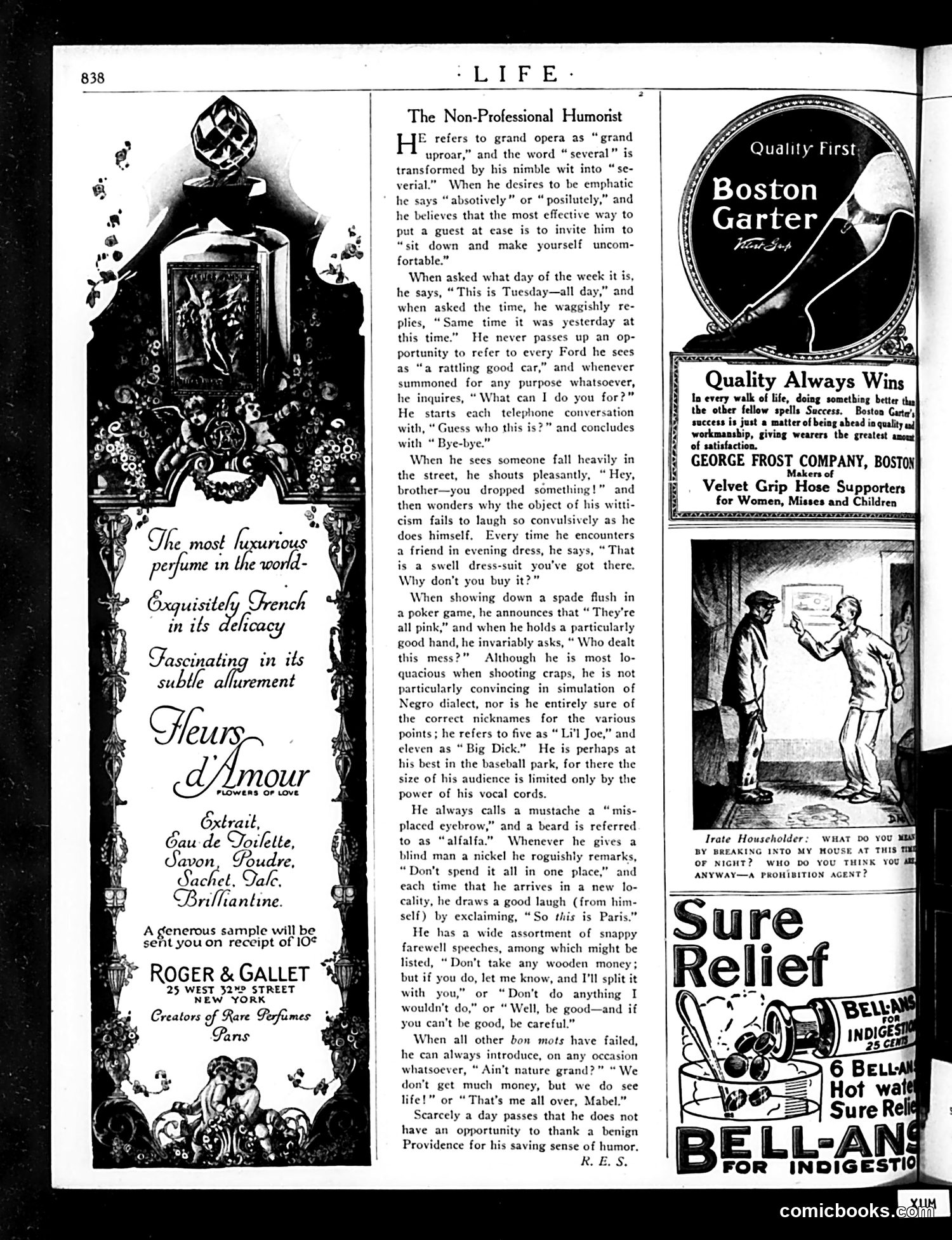
This page contains a satirical essay titled "The Non-Professional Humorist," mocking a specific social type—the amateur comedian who relies on worn-out jokes and forced wordplay. The piece catalogs his predictable behaviors: mangling words ("absotively," "posilutely"), tired puns, and repetitive catchphrases he believes are hilarious. The satire targets someone desperate for laughs who uses clichéd humor in inappropriate moments (mocking a person who's fallen, making stale "Paris" jokes upon arriving anywhere new). He's particularly annoying at baseball games where his loud voice amplifies bad jokes. The essay culminates in mocking his gratitude for possessing "a saving sense of humor" he clearly lacks. The surrounding advertisements are period products (French perfume, Boston garters, Bel-Ans antacid). A cartoon shows an angry homeowner confronting someone, with a joke about Prohibition agents—referencing 1920s alcohol enforcement. The humor depends on readers recognizing themselves or acquaintances in this annoying personality type.
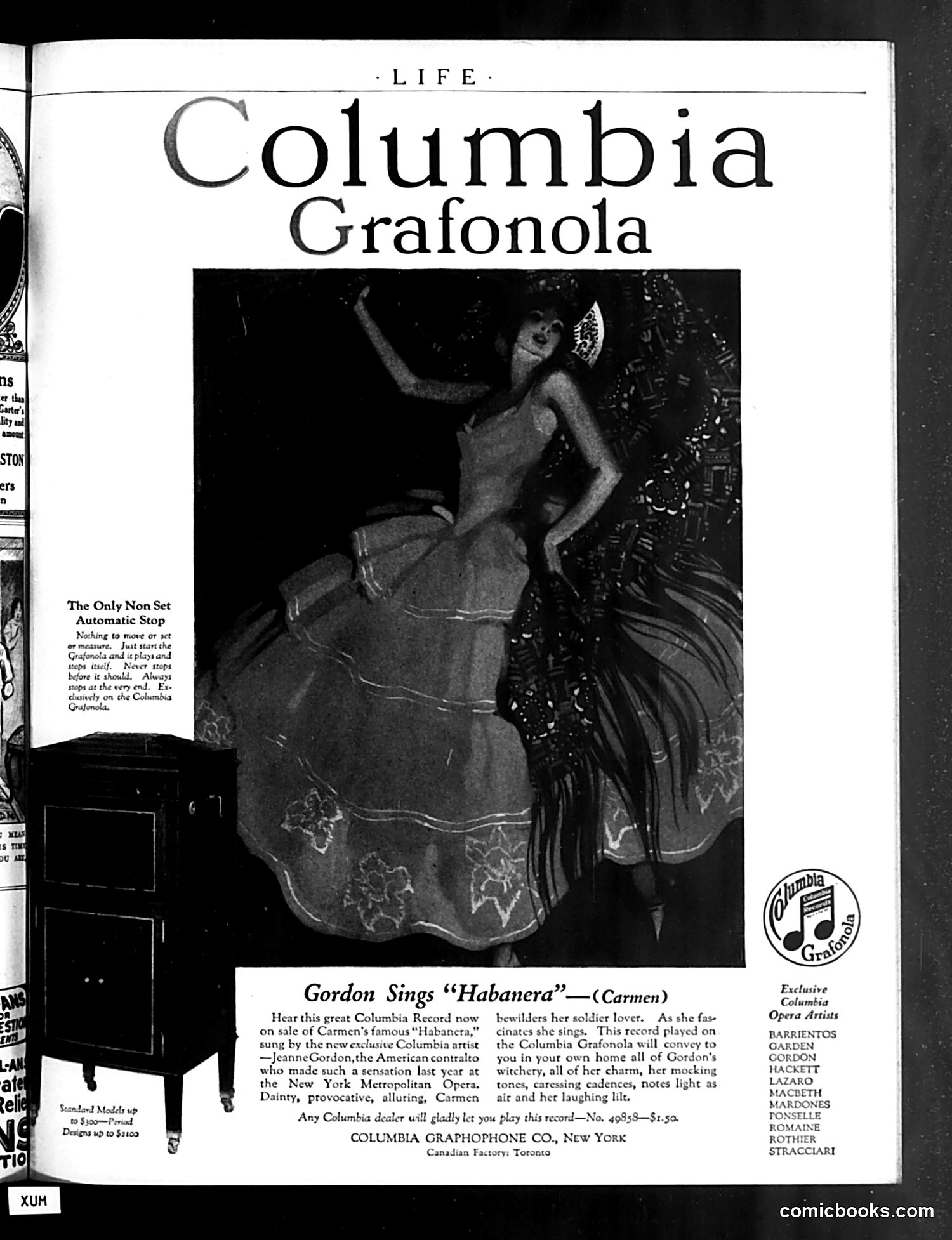
This is a **product advertisement**, not political satire. It promotes Columbia's gramophone player and recording technology. The page features **Jeanne Gordon**, an American opera singer, performing the famous aria "Habanera" from Bizet's *Carmen*. The dramatic photograph shows her in costume as Carmen, the seductive character who "bewilders her soldier lover." The advertisement emphasizes the Grafonola's innovative **"automatic stop" feature**—a technological selling point allowing the machine to play records without manual intervention and stop at the proper end. This was a notable advancement in early phonograph technology. The copy uses Carmen's sensuality as marketing appeal, promising the recording will convey "all of Gordon's witchery" and "charm" to listeners in their homes. It's essentially leveraging operatic glamour and star power to sell consumer electronics, a common early 20th-century advertising strategy.
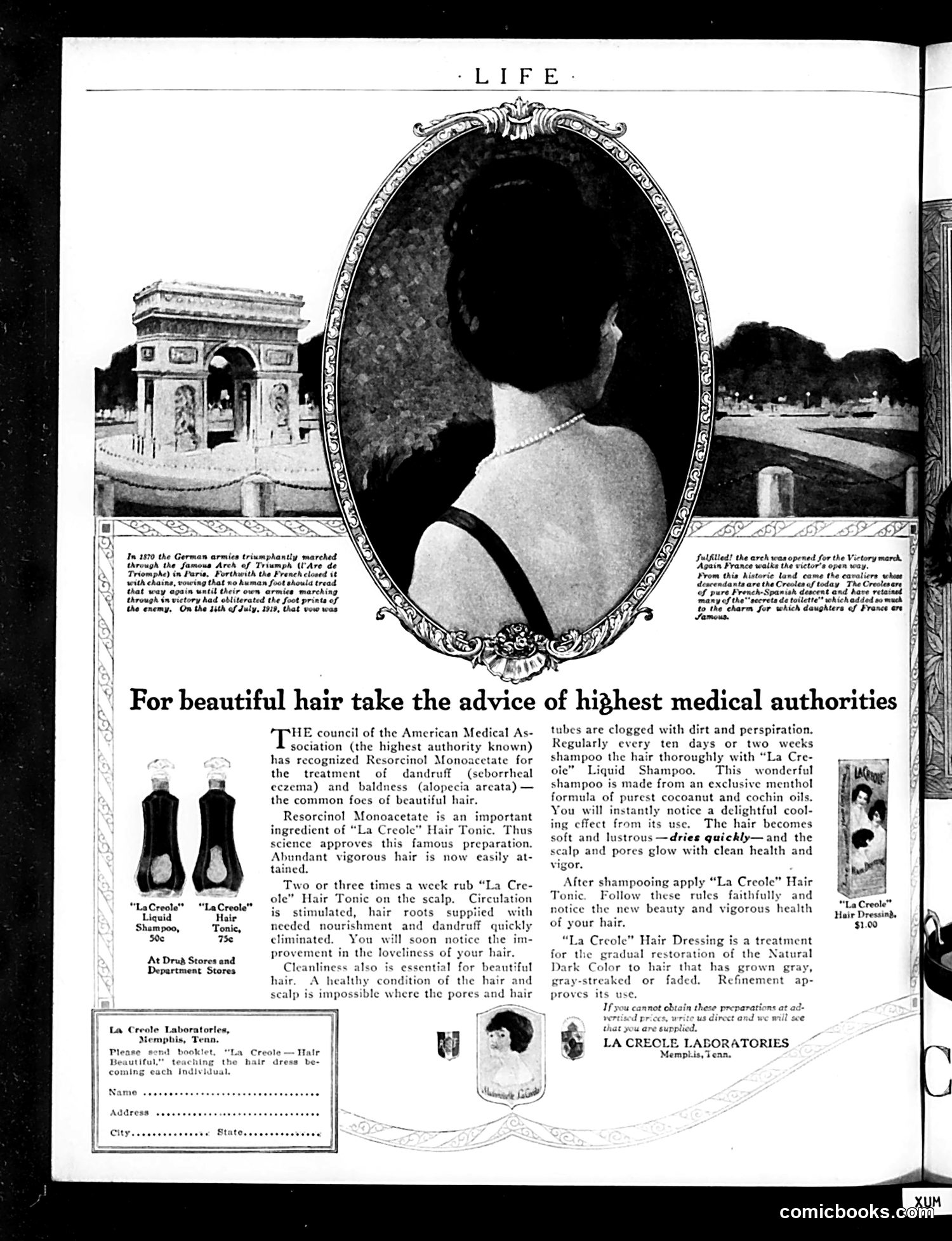
This page is primarily a **hair care advertisement** for "La Creole" products, not a political cartoon. However, the ad's opening text references a historical event for emotional branding: the German army's 1940 march through the Arc de Triomphe in Paris during World War II occupation, followed by the Allied victory parade on July 14, 1919 (likely meant to reference 1944 or post-WWI). The advertisement exploits French national pride and victory symbolism to sell hair products, claiming "La Creole" embodies the beauty secrets of French women. The accompanying portrait shows a woman from behind, styled elegantly. This is marketing strategy: associating a commercial product with patriotic imagery and cultural prestige. For modern readers, it's notable how aggressively vintage advertisements weaponized historical trauma and national identity to sell mundane consumer goods—here, shampoo and hair tonic.
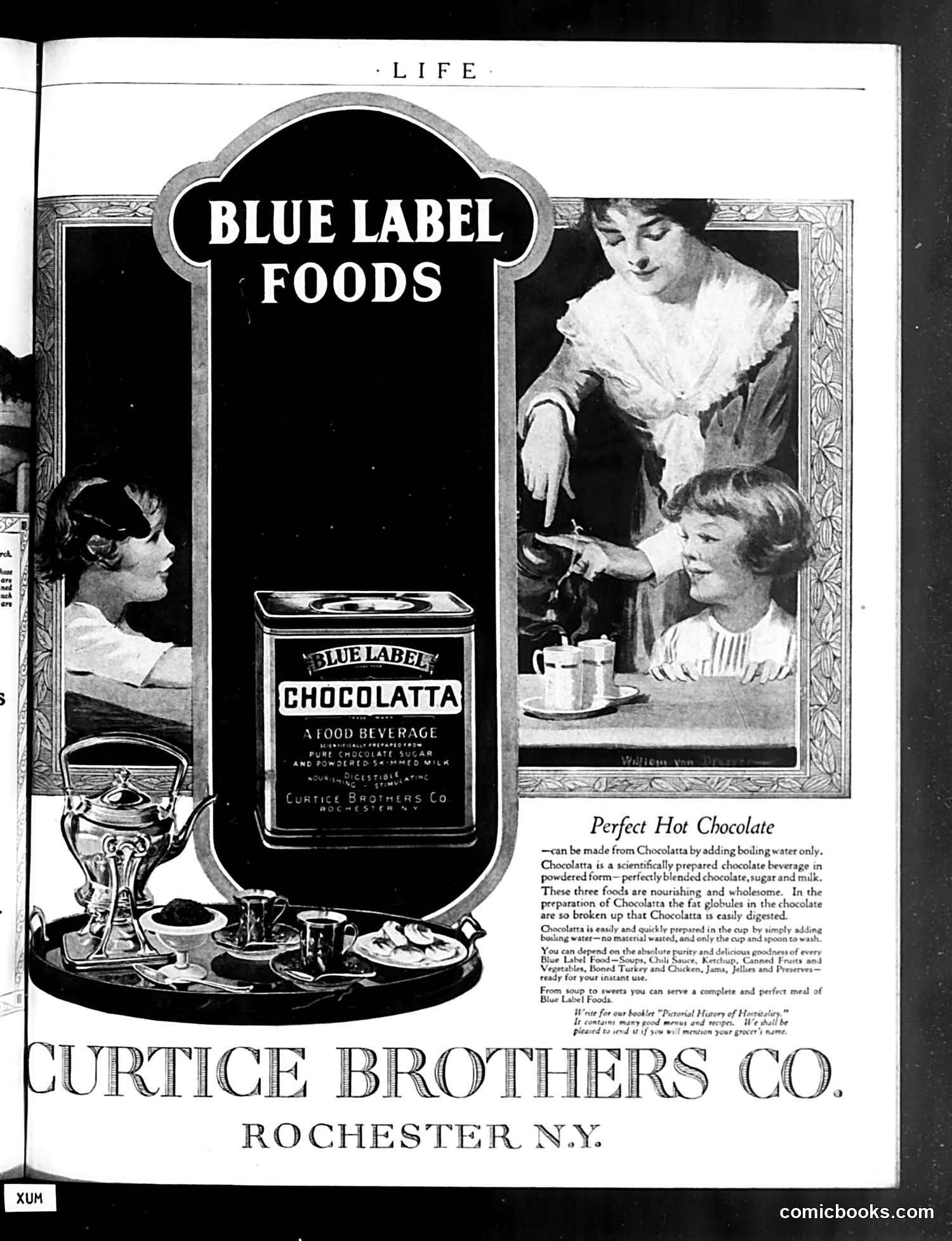
This is **not a political cartoon or satire page**—it's a straightforward **advertisement for Blue Label Foods**, specifically for Curtice Brothers Co.'s "Chocolatta" hot chocolate product from Rochester, NY. The page features a domestic scene showing a mother serving hot chocolate to children, positioned as aspirational imagery emphasizing family wellness and nutrition. The accompanying text promotes Chocolatta as a nutritious, easily-prepared beverage made from powdered chocolate, sugar, and milk. The "Perfect Hot Chocolate" heading and descriptive text focus on product benefits and preparation methods rather than satirical commentary. This appears to be early 20th-century commercial advertising leveraging wholesome family imagery to market a powdered beverage product—a common advertising strategy of the era emphasizing convenience and nutritional value.
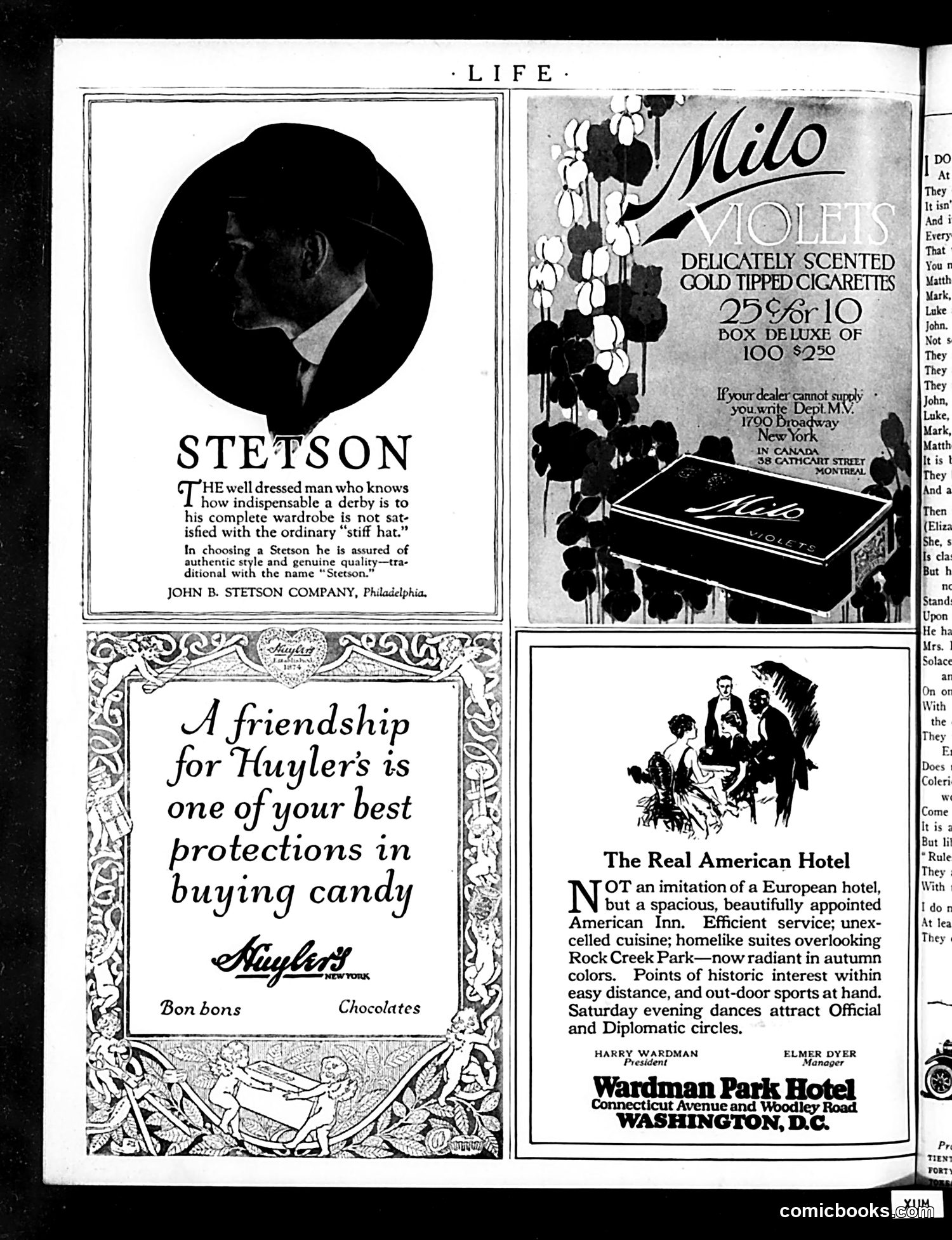
This page is primarily **advertising**, not political satire. It contains four product advertisements from what appears to be an early 20th-century *Life* magazine: 1. **Stetson hats** — appeals to well-dressed men by emphasizing the derby's importance to a "complete wardrobe" 2. **Milo Violets cigarettes** — delicately scented, gold-tipped luxury smokes 3. **Huyler's candy** — positions friendship with the brand as "protection" when buying candy (suggesting quality assurance) 4. **Wardman Park Hotel** (Washington, D.C.) — markets itself as authentically American (not European), emphasizing luxury amenities, historic proximity, and that it attracts "Official and Diplomatic circles" There is no cartoon or satirical content visible. The page reflects period consumer culture: luxury goods marketed to affluent, genteel audiences through appeals to taste, status, and patriotism.
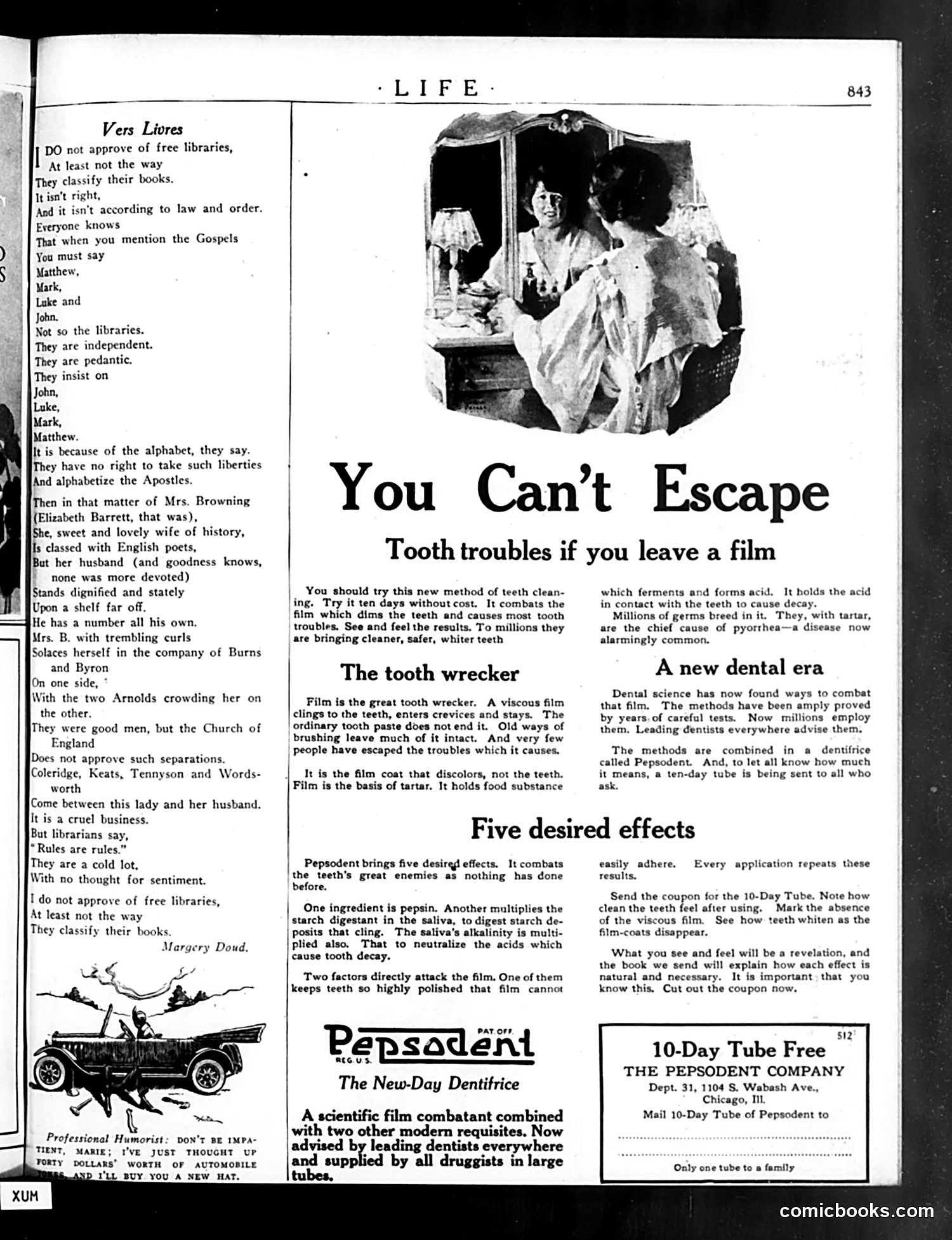
The left column satirizes free public libraries' cataloging practices. The author (Margery Doud) complains that libraries alphabetize books rather than following traditional conventions—specifically, they separate Elizabeth Barrett Browning from her husband Robert Browning by shelving her among poets alphabetically rather than keeping couples together. The satire targets librarians' rigid adherence to the Dewey Decimal System as emotionally cold and illogical, mocking their response "Rules are rules" as pedantic. The complaint extends to alphabetizing the four Gospels rather than using their proper liturgical order (Matthew, Mark, Luke, John). The humor stems from treating library classification as a *moral* and *sentimental* issue—framing it as cruel to separate devoted spouses—when the library system is actually modern, rational, and democratic. The right side is a **Pepsodent toothpaste advertisement** unrelated to the satire, promoting a new dental science method for removing tooth film.
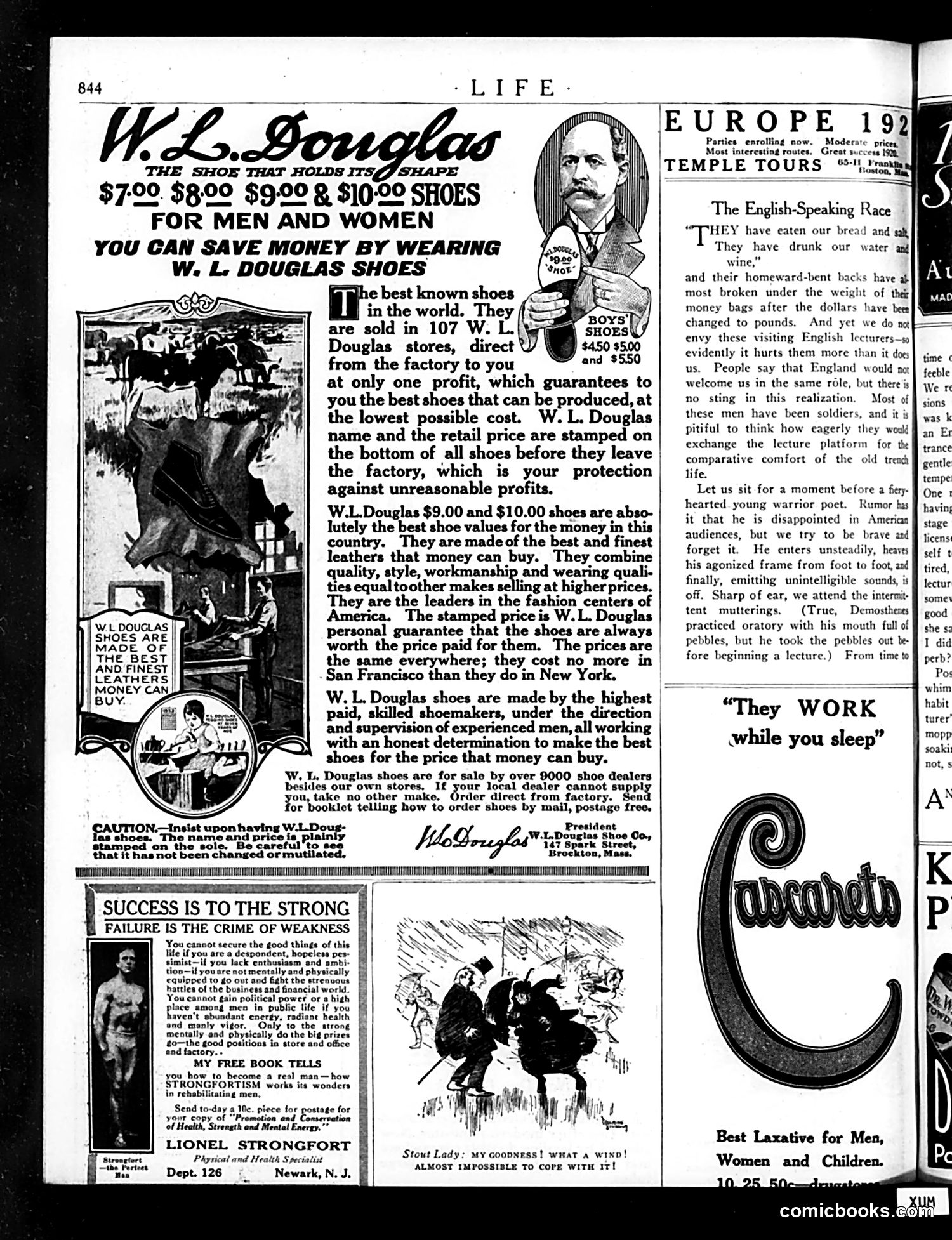
This page is primarily **advertising** rather than editorial content. The dominant feature is a large W.L. Douglas shoe advertisement claiming superior quality at lower prices due to direct factory-to-consumer sales. The small cartoon ("Stout Lady") depicts a woman struggling against wind, captioned "MY GOODNESS! WHAT A WIND! ALMOST IMPOSSIBLE TO COPE WITH IT!" — a mild visual gag about weather, not political satire. The editorial article "The English-Speaking Race" mildly satirizes visiting English lecturers in America, suggesting their tours are financially motivated and their oratory sometimes incoherent. The tone is gently mocking rather than harsh. The remaining content includes advertisements for "Cabareth" (a laxative) and a self-improvement book by Lionel Strongfort promoting physical fitness and success. This is a typical Life magazine page mixing commerce, light humor, and self-help messaging — reflecting 1920s American consumer culture and optimism rather than sharp political commentary.
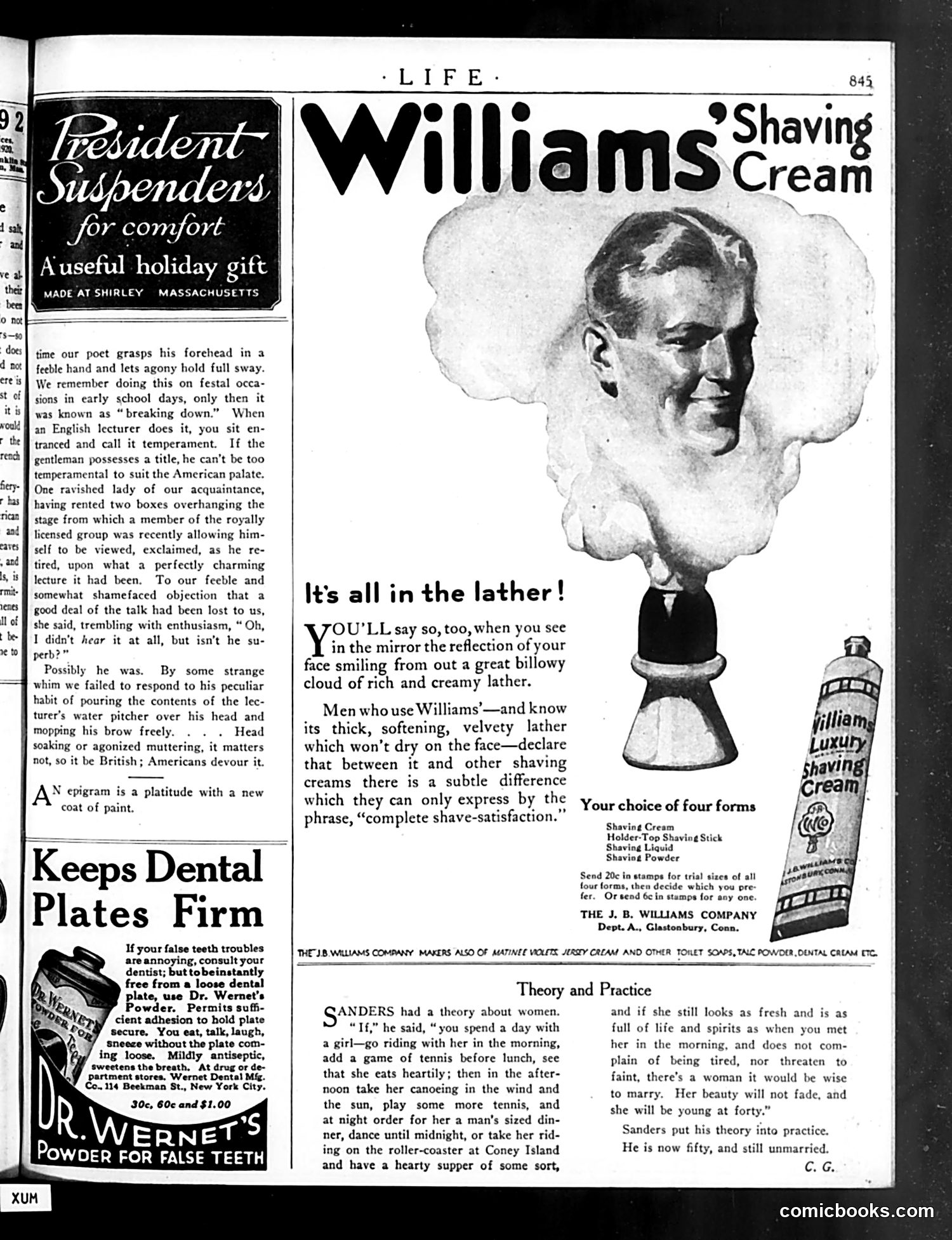
This page contains **advertisements and a brief satirical story**, not political cartoons. The main content is a humorous anecdote titled "Theory and Practice" about a man named Sanders who theorizes that a woman worth marrying is one who can endure an exhausting day of activities—riding, tennis, canoeing, dancing, and heavy eating—without appearing tired or complaining. Sanders puts this theory into practice, but remains unmarried at fifty. The satire targets **turn-of-the-century gender attitudes**: it mocks both Sanders's impossibly demanding standards for women and the underlying assumption that a woman's value depends on her stamina and appearance. The joke's punchline—that his unrealistic expectations left him perpetually single—suggests the author finds his standards absurd. The surrounding content is period advertising (dental powder, shaving cream, suspenders), typical of Life magazine's commercial pages.
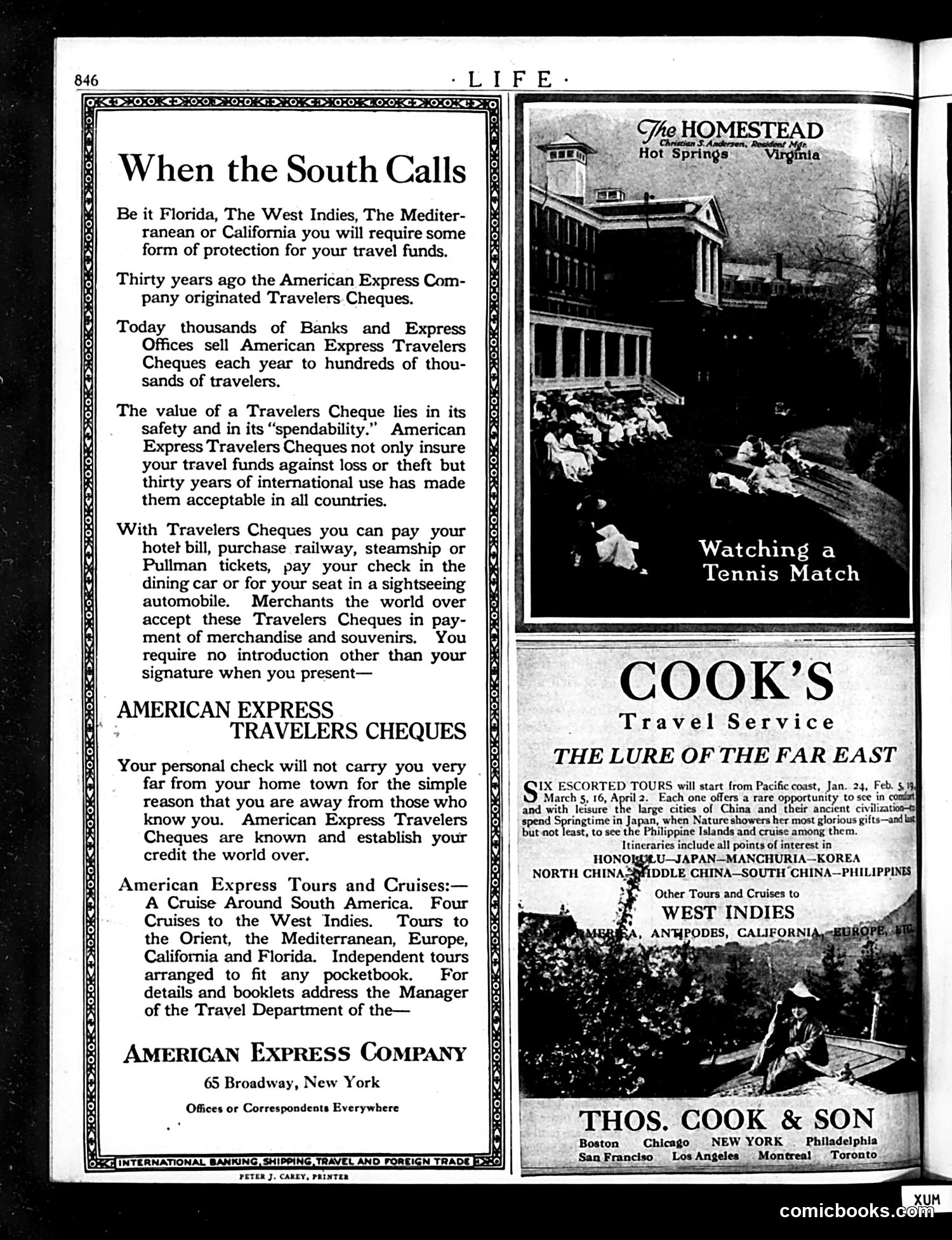
This page is **primarily advertising**, not satirical content. It contains two travel industry advertisements from the 1920s era: **Left side:** American Express promotes its Travelers Cheques product, emphasizing their safety and worldwide acceptance for travelers heading to southern destinations (Florida, Caribbean, Mediterranean, California). The pitch stresses that personal checks lack credibility away from home, while Travelers Cheques establish "credit the world over." **Right side:** Two travel service ads—one for "The Homestead" resort in Hot Springs, Virginia (showing people watching tennis), and below it, Thomas Cook & Son advertising guided tours to Asia ("The Lure of the Far East") and the West Indies. **Historical context:** This reflects the 1920s travel boom among affluent Americans, when international travel required financial instruments for security and merchant acceptance. The ads target wealthy leisure travelers—note the emphasis on comfort, steamships, and exclusive itineraries. There is no cartoon or satire present; the page documents how travel companies marketed to the prosperous class of this era.
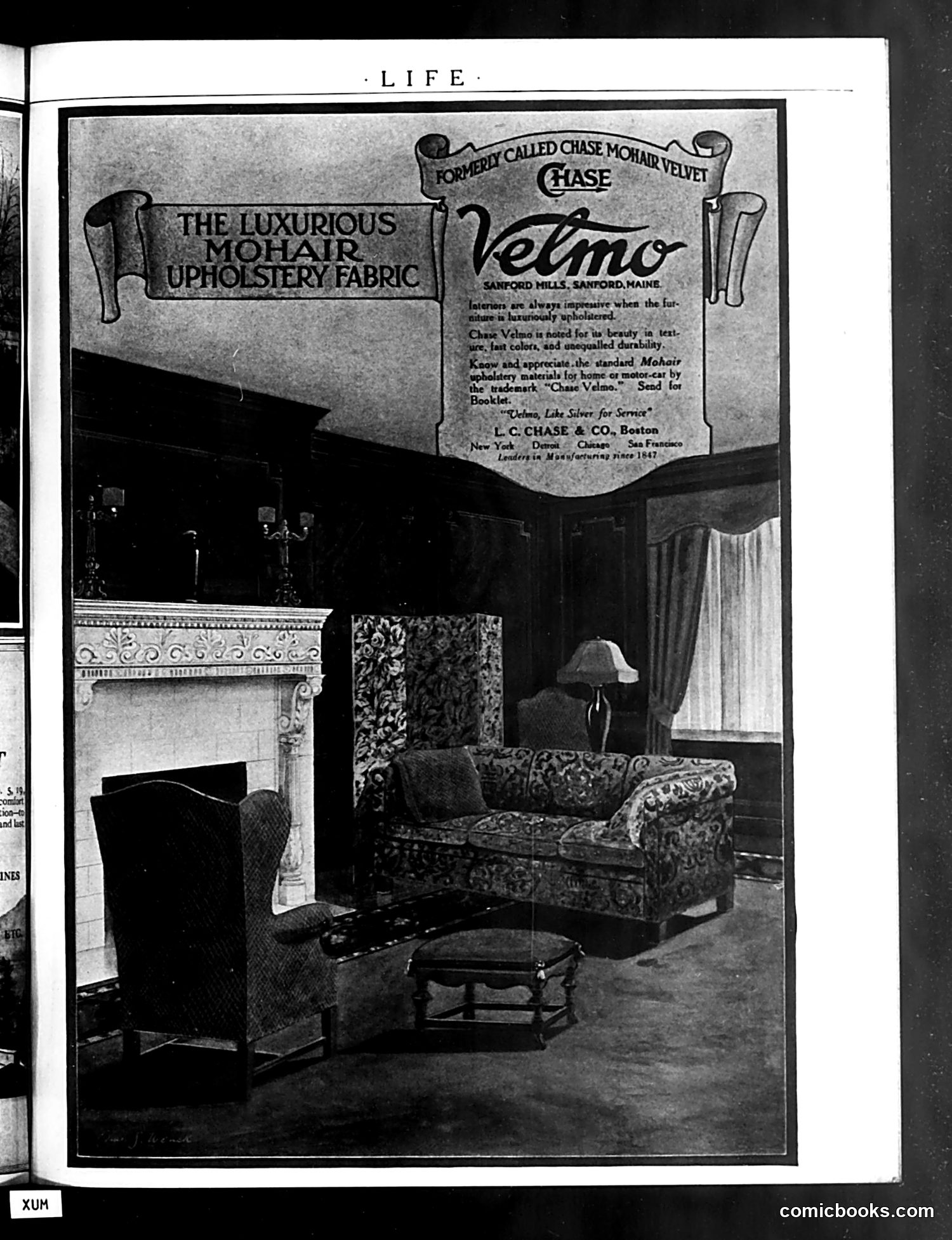
This page is primarily an **advertisement**, not satire or political commentary. It promotes "Velmo," a mohair upholstery fabric formerly called "Chase Mohair Velvet," manufactured by L.C. Chase & Co. of Boston (established 1847), with offices in New York and San Francisco. The ad emphasizes Velmo's luxury qualities: soft texture, rich colors, and durability for home and automobile upholstery. The photograph displays the fabric on period furniture in an elegantly appointed interior with a fireplace, demonstrating its aesthetic appeal. The decorative header labels it "The Luxurious Mohair Upholstery Fabric," positioning Velmo as a premium material for affluent consumers during what appears to be the early 20th century. There is no political or satirical content on this page.
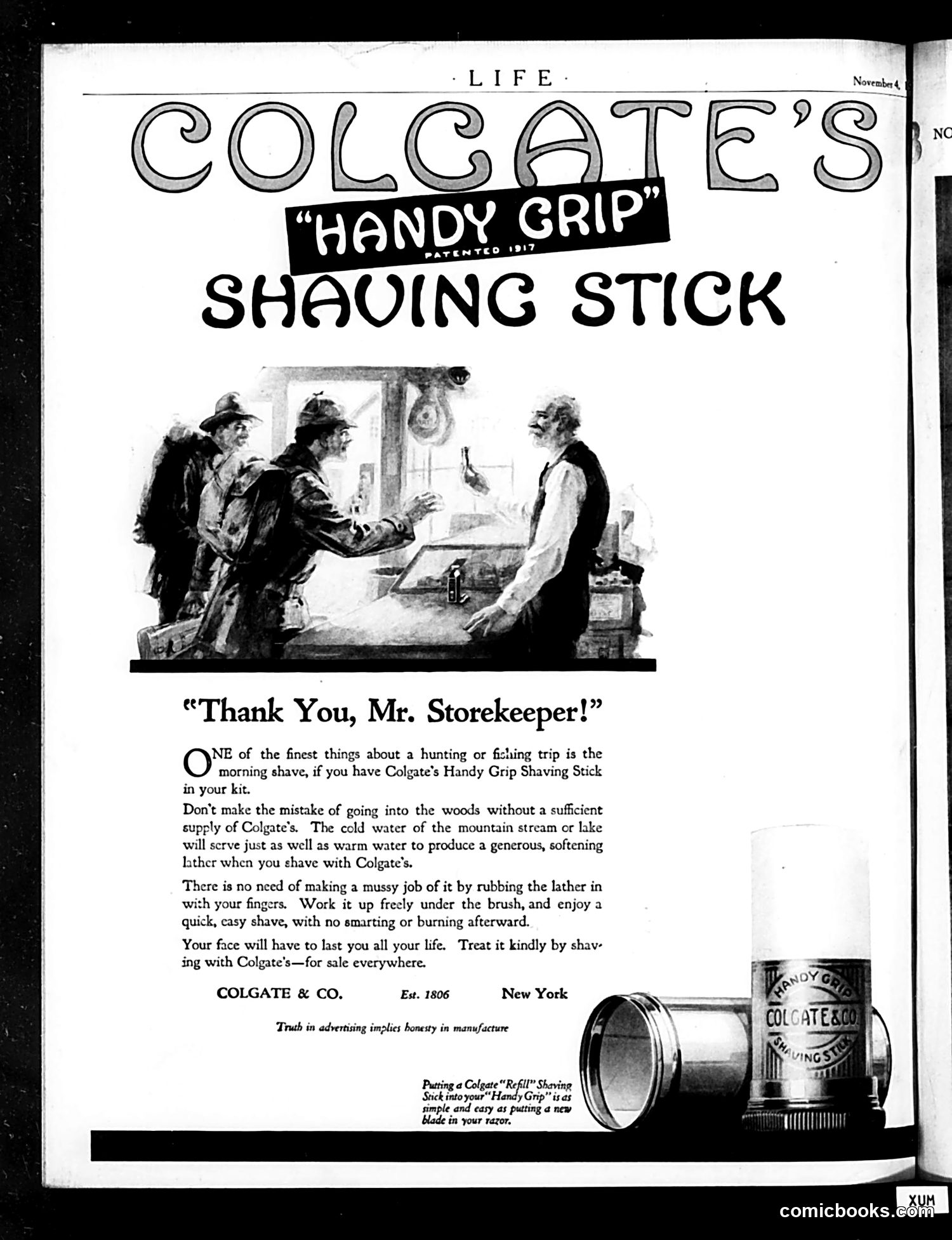
This is a **Colgate shaving product advertisement**, not political satire. The illustration shows a storekeeper selling the "Handy Grip" shaving stick to two outdoorsmen preparing for a hunting or fishing trip. The ad's humor is gentle and practical rather than satirical: it depicts the convenience of having quality shaving supplies while camping in the wilderness. The "Thank You, Mr. Storekeeper!" caption suggests gratitude for being properly equipped before entering the woods. The advertisement emphasizes product benefits—lathering with cold water, ease of use, no irritation—and includes a refill system comparable to modern razor cartridges. The tagline "Truth in advertising implies honesty in manufacture" reflects early 20th-century consumer trust messaging. This represents typical **early 1900s advertising strategy**: associating consumer goods with desirable lifestyles (adventure, outdoor masculinity) to drive sales. No political figures or contemporary events are referenced.